
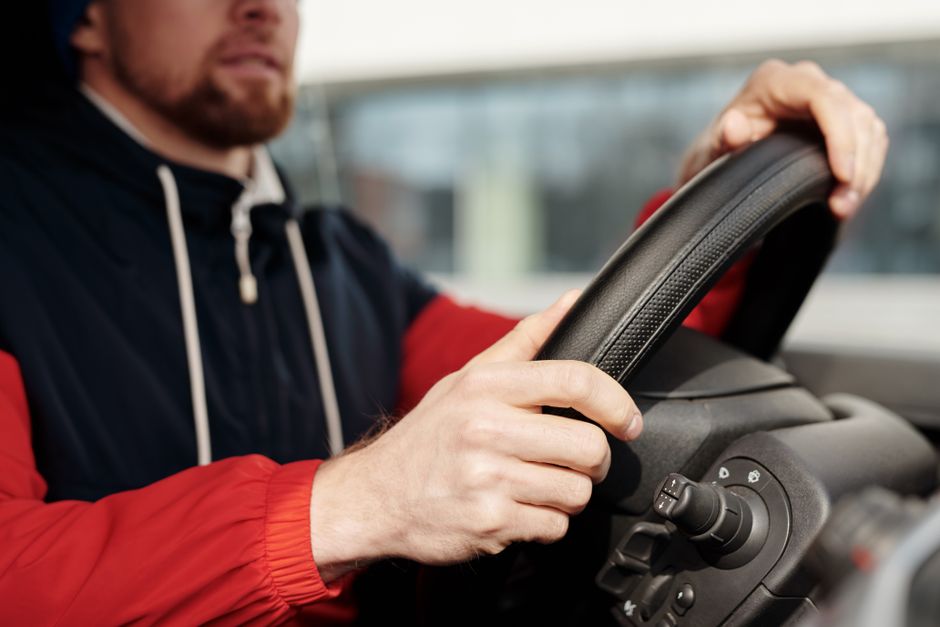
Photo: Norma Mortenson, Pexels
Hold the steering wheel at 9 and 3 o’clock or 8 and 4 o’clock, not the old 10 and 2. That is what the California and Louisiana driver handbooks now teach, and Kentucky’s manual says 3 and 9. The reason is the air bag in the wheel hub: hands high on the wheel, or arms crossed over it, are in the path of the bag when it fires. Before you get to the hands, though, US handbooks want the seat, head restraint, mirrors and seat belt set up first. Here is the routine, in order.
Pre-drive routine: the order to set up your car
- Seat upright, back against the seat. Kentucky’s manual says slouching reduces how well the seat belt and air bags protect you, and tells you not to recline the seat.
- Seat distance. Sit as far back as you can while still working the pedals and wheel fully, with at least 10 inches between your breastbone and the center of the steering wheel (California, Kentucky and Louisiana all use the 10-inch figure). California says to contact your dealer or the vehicle maker if you can’t sit 10 inches back and still control the car.
- Steering wheel height and tilt. Kentucky: the top of the wheel should be no higher than the top of your shoulders and below chin level. Louisiana: if the wheel tilts, angle it toward your chest, not your head.
- Head restraint. It should touch the back of your head and sit no lower than the level of your ears (Kentucky). Its job is to limit whiplash.
- Inside mirror. Frame the whole rear window. Kentucky calls it your primary mirror for looking behind.
- Side mirrors. See the method below.
- Seat belt. Lap belt snug and low across your hips; shoulder belt across your chest, never under your arm or behind your back.
- Clear view. Clean windows and mirrors, nothing hanging from the mirror. Kentucky says decals that block your view are unlawful.
Do this before you start the engine, every time. On a road test the examiner sees it before you move, so it is your first impression. Our road test day checklist covers the rest of the pre-drive checks.
How to set your side mirrors to cut blind spots
Kentucky’s manual gives a method that many instructors use:
- Left mirror: rest your head against the closed driver’s window, then set the mirror so you can barely see the rear edge of your own car.
- Right mirror: lean right until your head is roughly above the center console, then set the mirror so you can barely see the right side of your car.
Sitting normally, you will no longer see your own car in the side mirrors. Kentucky says this adds 12 to 16 degrees of view on each side. It shrinks blind spots but doesn’t remove them, so you still turn your head before every lane change. See lane changes and blind spots.
9 and 3 vs 8 and 4: which hand position is right?
Both are accepted. The handbooks put it like this:
| Handbook | What it says about hand position |
|---|---|
| California (Section 5) | Push-pull steering starts at 9 and 3 or 8 and 4. Hand-over-hand starts at 8 and 4. Keep both hands on the wheel whenever possible. |
| Louisiana | Recommended positions are 9 and 3 or 8 and 4. The 10 and 2 position “is not recommended” in cars with air bags. |
| Kentucky | Hands on the outside of the wheel at 3 and 9, thumbs up along the face of the wheel, fingers rather than palms. Never grip it from the inside. |
| Oklahoma | Still teaches the left hand between 9:00 and 10:30 and the right hand between 2:00 and 4:00, so not every handbook has moved fully to 9 and 3. |
Pick the one that feels steady in your car and stick with it. Both keep your hands and arms out of the air bag’s path.
Why 10 and 2 is out
Louisiana’s guide explains that a driver’s air bag comes out at 150 to 200 mph. With hands at the top of the wheel, the bag can throw your hands into your face or break a wrist or forearm. Kentucky’s manual says the whole deployment takes about 1/20th of a second, so there is no time to move your hands. That is also why handbooks warn against reaching across the hub while steering.
Push-pull vs hand-over-hand steering
Hand-to-hand (push-pull)
This is the method Louisiana calls preferred for normal driving forward, above about 10 to 15 mph.
- Start at 9 and 3 or 8 and 4.
- To turn right, push the wheel up with your left hand while your right hand slides up.
- Your right hand grips and pulls down; your left hand slides back toward its starting point.
- Repeat as needed, then reverse the movement to straighten up.
Your hands never cross over the middle of the wheel, which keeps your arms clear of the air bag.
Hand-over-hand
California and Louisiana both say to use this at low speeds: turning at intersections, parking and (California adds) recovering from a skid. Start at 8 and 4, reach across the wheel with one hand to grasp the far side, let go with the other hand, then reach across the arm still holding the wheel and pull. Practice it slowly in a parking lot before you need it in a tight turn. It matters on the three-point turn and in parking.
One-hand steering: the only two times
- Backing up while turned in your seat: one hand at 12 o’clock (California, Kentucky and Louisiana). See backing up on the road test.
- Briefly using a control such as the wipers or lights. Keep the other hand at its normal position.
Controlling the vehicle smoothly
- Grip: firm but gentle (Kentucky). A death grip makes your steering jerky.
- Accelerate gradually, with the heel of your right foot on the floor and the top of your foot on the pedal (Kentucky).
- Brake early with steady pressure, after checking your mirrors.
- Look where you want to go. Louisiana’s cornering advice: your eyes steer the car, so look as far through the bend as you can.
- In an emergency swerve, steer less than you think. Louisiana says modern cars need only 45 to 90 degrees of steering to get back on the road after drifting off it, and warns that more than 180 degrees often causes a loss of traction. More in vehicle emergencies.
Quick checklist
- Seat upright, 10 inches from the wheel, pedals reachable
- Wheel below chin, tilted toward the chest
- Head restraint at the back of the head, not below ear level
- Inside mirror frames the rear window; side mirrors set wide
- Belt low and snug, shoulder strap across the chest
- Hands at 9 and 3 or 8 and 4, thumbs along the rim
Rules on licensing and testing differ by state. Start with learning to drive in the USA, and see seat belt and child car seat laws and driver assistance features for the rest of the in-car setup.
Sources
- California DMV, “California Driver’s Handbook, Section 5: An Introduction to Driving” (dmv.ca.gov)
- California DMV, “California Driver’s Handbook, Section 8: Safe Driving (Continued)” (dmv.ca.gov)
- Louisiana Office of Motor Vehicles, “Class D & E Driver’s Guide” (DPSMV 2052, R08/25) (public.powerdms.com)
- Kentucky State Police, “Kentucky Driver Manual” (updated July 2026), Section Four: Before You Drive and Section Five: Basic Driving (kentuckystatepolice.ky.gov)
- Service Oklahoma, “Oklahoma Driver Manual” (updated 11/24/25) (oklahoma.gov)