
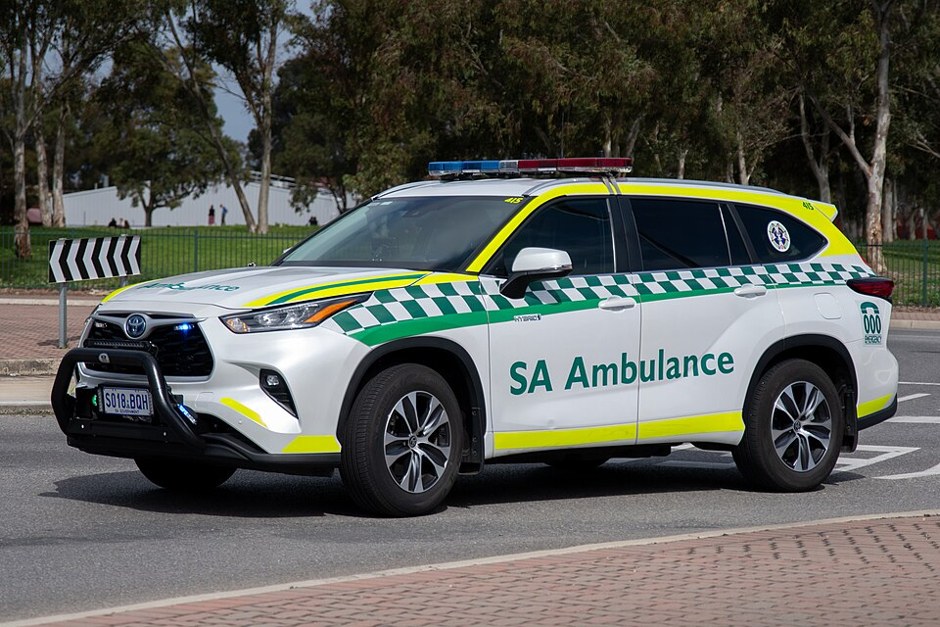
Photo: BraedenGatt, CC BY 4.0, via Wikimedia Commons
Every Australian state requires you to give way to an emergency vehicle using its siren or flashing lights. The rule for passing one that has stopped differs by state: most use 40 km/h, South Australia uses 25 km/h, and Queensland requires a safe speed and distance. This checklist sets out each state’s rule and which vehicles it covers.
Passing a stopped emergency vehicle: speed by state
| State | Passing speed | Vehicles covered |
|---|---|---|
| NSW | 40 km/h on roads of 80 km/h or less; above 80 km/h, slow down safely and move over | Emergency vehicles with flashing blue or red lights, and tow trucks or breakdown assistance vehicles with flashing lights |
| VIC | No more than 40 km/h | Enforcement, emergency or escort vehicles stopped or under 10 km/h, with siren or flashing lights; since 1 July 2025 also tow trucks, roadside assistance and incident response vehicles |
| QLD | A safe distance and speed; move over and slow down if necessary | Emergency vehicles, transport enforcement, breakdown and tow vehicles |
| WA | No more than 40 km/h, whatever lane you are in | Stationary incident response vehicles with flashing lights, including tow trucks and breakdown vehicles |
| SA | No more than 25 km/h | Stopped emergency vehicles with flashing blue or red lights; breakdown vehicles with flashing amber lights (since 19 May 2025) |
| TAS | 40 km/h; on roads over 80 km/h, 40 km/h if safe, otherwise as slowly as is safe | Emergency, enforcement, escort and roadside assistance vehicles with flashing red, blue, magenta or yellow lights |
| ACT | 40 km/h, or a lower speed limit | Stationary or slow-moving police or emergency vehicles with flashing red or blue lights |
| NT | No fixed passing speed in the NT handbook | Check the current rule with NT Police |
Giving way to an emergency vehicle on the move (all states)
- When you hear a siren or see flashing blue or red lights, give way so the vehicle can pass. Move left, slow down, or pull over and stop if needed.
- Victoria’s handbook says this applies even if you have a green light. Emergency vehicles have exemptions and may act unpredictably.
- The NT handbook says it is an offence to obstruct an emergency vehicle sounding its siren or showing flashing lights, and to keep driving until it is safe to pull over.
- Do not move into the path of an approaching emergency vehicle.
New South Wales
- When passing a stopped emergency vehicle with flashing blue or red lights:
- if the speed limit is 80 km/h or less, slow to 40 km/h
- if the limit is over 80 km/h, slow down safely and move over, changing lanes on a multi-lane road if it is safe
- The same rule applies when passing a stopped tow truck or breakdown assistance vehicle with flashing lights.
- Do not speed up again until you have passed all the vehicles and people involved.
Victoria
- Do not exceed 40 km/h when passing enforcement, emergency or escort vehicles that are stationary or moving slowly (under 10 km/h). The rule applies when the vehicle sounds an alarm or shows flashing red, blue, magenta or yellow lights.
- Since 1 July 2025 the rule also covers accident and breakdown tow trucks, roadside assistance vehicles and incident response vehicles. The Road to Solo Driving handbook was written before this change.
- Do not increase your speed until you are a safe distance past.
- You do not need to slow for these vehicles on the opposite side of a divided road separated by a median strip.
- Stop if twin red lights are flashing outside a fire or ambulance station.
Queensland
- Under the move over, slow down rule, pass at a safe distance and speed, moving over and slowing down if necessary.
- On a multi-lane road, leave one clear lane between you and a parked emergency response vehicle with flashing lights, if it is safe and practical to change lanes.
- You do not have to move over where there are roadworks, when following a police or enforcement officer’s direction, or when turning left or right.
- If you cannot move over, keep as far from the vehicle as you can within your lane and slow to a safe speed.
- The rule covers ambulances, police, fire, transport enforcement vehicles and breakdown assistance providers, including tow trucks.
Western Australia
WA calls this Slow Down, Move Over (SLOMO). It applies to stationary incident response vehicles with flashing lights:
- police
- ambulances
- fire and emergency services
- motor breakdown service vehicles
- tow trucks
- Main Roads Incident Response Service vehicles
- Approach at a safe speed and be ready to stop.
- Pass at no more than 40 km/h, leaving as much space as is safe. On a multi-lane road, 40 km/h applies whatever lane you are in.
- If the vehicle is in your lane, move to another lane if it is safe. Drive Safe suggests leaving a one-lane gap.
Indicators and hazard lights do not count. If you are unsure whether a stopped vehicle with flashing lights is an incident response vehicle, treat it as one.
South Australia
- An emergency service speed zone exists near an emergency vehicle that has stopped on the road with flashing blue or red lights. You must not go faster than 25 km/h through it.
- Since 19 May 2025, the 25 km/h limit also applies when you pass a stationary breakdown service vehicle with flashing amber lights.
- South Australia is the only state that uses 25 km/h. If you learnt to drive elsewhere, this is the rule to remember when you drive in SA.
More: SA Driver’s Handbook study guide.
Tasmania
- Slow to 40 km/h when passing a slow-moving or stationary emergency service, enforcement, escort or roadside assistance vehicle. The rule applies when it shows flashing red, blue, magenta or yellow lights or sounds an alarm.
- On roads over 80 km/h, slow to 40 km/h if it is safe. If it is not safe, slow down as safely as possible.
- The rule applies in both directions unless there is a dividing barrier.
- Brake gradually. Heavy vehicles behind you take longer to stop.
- Give way to any worker on foot near the vehicle.
Australian Capital Territory
- Clear a passage for a police or emergency vehicle sounding a warning or flashing its lights. That may mean stopping or moving out of the way.
- Give them every opportunity to overtake safely.
- Road rule 300C applies when a police or emergency vehicle on the road is stationary or moving slowly and shows flashing red or blue lights. Approach at a speed that lets you stop safely, give way to any officer or emergency worker on foot, and pass at no more than 40 km/h, or the speed limit if that is lower.
- After passing, keep your speed down until you are far enough past that speeding up does not put workers at risk.
- The rule does not apply if you are on the other side of a road divided by a median strip.
- Section 300C applies only to police vehicles and emergency vehicles, which the regulation defines as vehicles driven on duty by ambulance, fire and rescue, rural fire service or SES members and other declared emergency workers. Tow trucks and roadside assistance vehicles are not named in section 300C or in these definitions, whatever lights they show. Slow down and pass with care anyway.
- The maximum penalty for breaking section 300C is 20 penalty units.
- When clearing a path for an emergency vehicle, only move when it is safe. If there is nowhere safe to go, stay where you are.
Northern Territory
- The NT Road Users’ Handbook (Fifth Edition) requires you to give way to emergency vehicles. These are police, fire and emergency services, ambulance, and Australian Protective Services vehicles.
- It sets no specific speed for passing a stopped one.
- Slow down when passing any stopped vehicle at the roadside. Check the current rule with NT Police or the Motor Vehicle Registry, as the handbook is from 2020.
Checklist when you see flashing lights
- Check your mirrors before braking. A sudden stop can cause a rear-end crash.
- Know your state’s passing speed: 40 km/h in most states, 25 km/h in SA.
- Move over a lane if the vehicle is in or next to your lane and it is safe.
- Watch for people on foot around the scene.
- Do not speed up until you are clear of the scene.
- Remember that NSW, Victoria, Queensland, WA, SA and Tasmania also cover tow trucks and breakdown vehicles.
Common questions
Do I have to slow down on the other side of a divided road?
In Victoria and the ACT, no, if a median strip separates you from the vehicle. Tasmania’s rule applies in both directions unless there is a dividing barrier. When unsure, slow down safely.
Do the rules apply to tow trucks?
Yes, in Western Australia, Queensland, South Australia (amber lights) and Tasmania (roadside assistance with yellow lights). Yes in NSW too: the handbook applies the 40 km/h and move-over rule to stopped tow trucks and breakdown assistance vehicles with flashing lights. Victoria added tow trucks and roadside assistance vehicles from 1 July 2025. The ACT rule, section 300C of the Road Transport (Road Rules) Regulation 2017, covers police and emergency vehicles showing flashing red or blue lights, and does not name tow trucks or breakdown vehicles. Pass them carefully anyway.
What if slowing to 40 km/h on a freeway is dangerous?
NSW and Tasmania allow for this on roads over 80 km/h. In NSW you slow down safely and move over. In Tasmania you slow to 40 km/h if safe, otherwise as safely as possible.
Can I go through a red light to let an ambulance pass?
In Victoria, give way and stop if necessary, even on a green light. Transport Victoria says you can enter an intersection on a red light only if it is safe and it is the only way to make room for the emergency vehicle. Never force your way into an intersection. Do not assume other states allow the same.
What happens on the driving test if an emergency vehicle comes?
Give way exactly as you would on any drive. Your examiner expects you to follow the road rules, including this one. See giving way in Australia.
Why are the rules different in each state?
Each state sets its passing rule in its own law, which is why the speeds and the vehicles covered differ. See the Australian Road Rules explained.
Sources
- Transport for NSW, “Road User Handbook” (nsw.gov.au)
- Department of Transport and Planning Victoria, “Road to Solo Driving” (transport.vic.gov.au)
- Premier of Victoria, “New road worker safety laws now in effect”, 2 July 2025 (premier.vic.gov.au)
- Queensland Government, “Move over, slow down” ministerial statement (statements.qld.gov.au)
- Department of Transport and Major Infrastructure WA, “Drive Safe: A handbook for Western Australian road users” (transport.wa.gov.au)
- Government of South Australia, “Drive 25” (mylicence.sa.gov.au)
- Premier of South Australia, “Slow down for amber: new speed limit when passing breakdown service vehicles” (premier.sa.gov.au)
- Department of State Growth Tasmania, “Tasmanian Road Rules, Version 2.1” (transport.tas.gov.au)
- Access Canberra, “ACT Road Rules Handbook” (accesscanberra.act.gov.au)
- Northern Territory Government, “NT Road Users’ Handbook” (nt.gov.au)
- ACT Government, “Road Transport (Road Rules) Regulation 2017” (SL2017-43), republication R17 effective 3 November 2025, section 300C and dictionary definitions of emergency vehicle and emergency worker (legislation.act.gov.au)
- Queensland Government, “Parked emergency response vehicles with flashing lights” (qld.gov.au)
- Transport Victoria, “Sharing the road with emergency vehicles in Victoria” (transport.vic.gov.au)