

Photo: atelierbyvineeth / Pexels. Illustrative photograph.
In Ireland a Garda directing traffic overrides the traffic lights, so you need to recognise the five Garda hand signals and know what to do when stopped at a checkpoint. This guide covers both, plus how to let an ambulance, fire engine or Garda car through safely. It follows Section 12 and Section 20 of the Rules of the Road and the current fixed charges.
Key facts
- Garda signals override traffic lights. If a Garda signals you to stop on a green light, you stop.
- Failing to obey a Garda’s signal: €80 fixed charge and 1 penalty point (3 on conviction).
- Failing to stop when a Garda requires you to: €80 and 2 penalty points (5 on conviction).
- You must carry your driving licence or learner permit whenever you drive.
- For emergency vehicles: pull over only where it is safe, never mount the kerb unless you absolutely have to, and never go through a red light to make room unless a Garda directs you.
Garda hand signals in Ireland
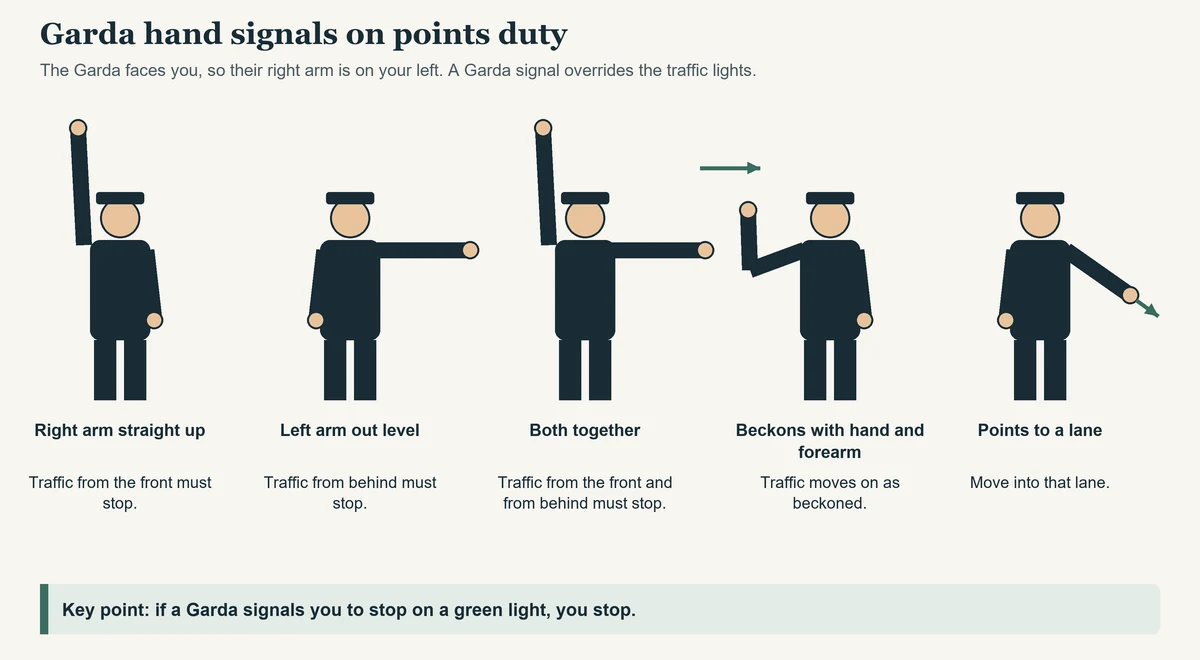
These are the signals set out in the Road Traffic (Traffic and Parking) Regulations 1997 for a Garda on points duty. Drivers and pedestrians must act on them.
| What the Garda does | What it means |
|---|---|
| Right arm raised straight up above the shoulder | Traffic approaching from the front must stop. |
| Left arm held out horizontally from the shoulder | Traffic approaching from behind must stop. |
| Right arm raised straight up and left arm held out horizontally at the same time | Traffic approaching from the front and from behind must stop. |
| Beckons with the hand and forearm | Traffic from the front, the right or the left, or traffic already stopped, moves on as beckoned. |
| Points towards a particular lane | Move into that lane. |
A direction from a Garda controlling traffic also overrides the normal rules in the regulations. Ignoring a Garda’s direction carries an €80 fixed charge.
Signalling to a Garda on points duty
Use your indicator, or the arm signal from the regulations:
- Straight ahead: raise your forearm and hand upwards, palm to the front.
- Turning left (car driver): point your right forearm and hand, fingers extended, to the left.
- Turning right: extend your right arm fully to the right, palm to the front.
The driving test includes hand signals. See Irish driving test pre-test checks and traffic lights, driver signals and hand signals.
What a Garda can ask you to do
If a Garda asks, you must:
- show your driving licence or learner permit, which you must carry whenever you drive
- let the Garda examine the discs displayed on your windscreen
- produce your NCT or roadworthiness certificate, where relevant, at a named Garda station within 10 days
- produce a valid motor insurance certificate to a Garda within 10 days
- produce the vehicle registration certificate at any reasonable time
- stop and let the Garda check the vehicle for defects
- give your name and address, and write your signature
- give a roadside breath or saliva (oral fluid) sample
- do impairment tests if a Garda suspects drug driving, telling them first about any disability or medical condition that could affect how you do them
Checkpoints and breath tests
Gardaí can set up mandatory testing checkpoints and require breath or saliva tests from drivers without suspecting they have been drinking or taking drugs. Refusing a breath sample, or refusing impairment tests when required, is an offence. Revenue officials can also stop and examine vehicles. For the alcohol limits that apply to learners and novices, see drink driving limits in Ireland.
Failing to produce a licence to a Garda carries 1 penalty point (3 on conviction) under the penalty points schedule.
What to do when an emergency vehicle approaches
Gardaí, fire brigades and ambulances on an emergency call can be exempt from some traffic rules, as long as they don’t endanger other road users. Your job is to clear the way safely.
- Stay alert. Keep in-car noise low enough to hear sirens. Expect emergency vehicles from behind or from a side road at junctions.
- Check all mirrors to judge the vehicle’s speed, and look for pedestrians, cyclists and motorcyclists.
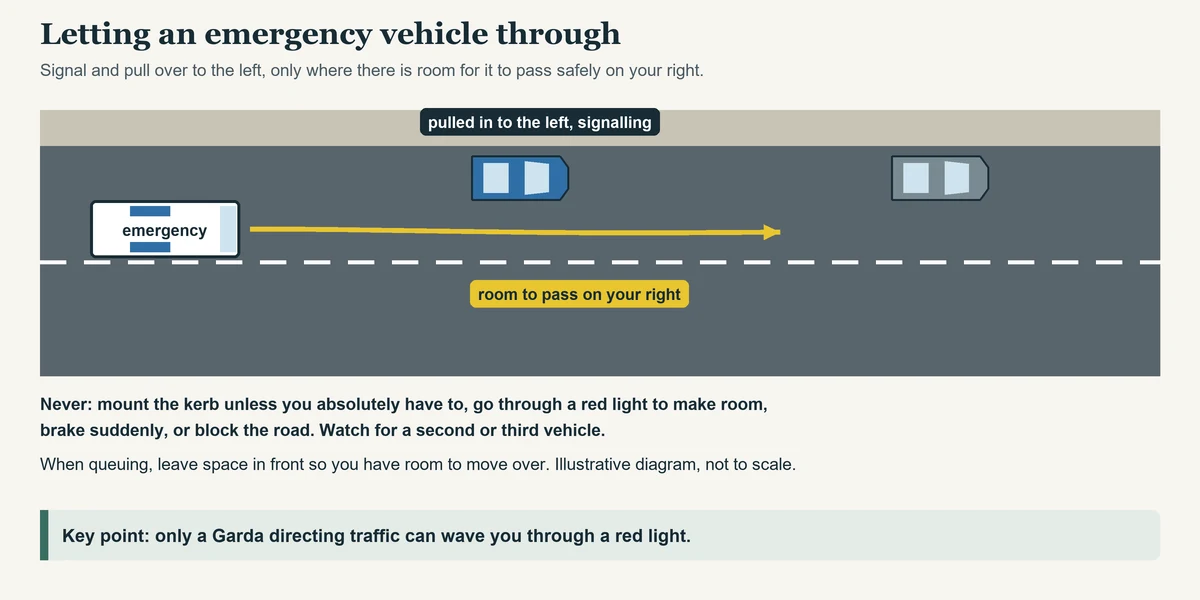
- Signal and pull over to the left, only where there is room for the emergency vehicle to get past safely on your right.
- On a dual carriageway or motorway, move left when it is safe. Garda guidance says emergency vehicles usually overtake in the right-hand lane. Don’t stop in the middle of the road or on the hard shoulder unless you are told to.
- Stay there until it has passed. Watch for a second or third vehicle.
- Signal and rejoin traffic gradually when it is safe.
When queuing, leave space in front so you have room to move over. You can’t pull in if you are boxed in nose to tail.
Never
- mount the kerb unless you absolutely have to, and only if you are certain no pedestrians are near
- go through a red light or speed to make room. Stay behind the line and let the emergency driver find a way round you, unless a Garda directs you
- brake suddenly or block the road
- tailgate an emergency vehicle, race after it through lights, or overtake one showing flashing lights unless directed
If a Garda motorcyclist with blue lights stops at a junction ahead of you to escort other vehicles, stop and stay there until the escorted vehicles have passed or the Garda waves you on.
Common questions
Can I go through a red light to let an ambulance pass?
No. Stay behind the line and let the ambulance find a way round you. Only a Garda directing traffic can wave you through a red light.
A Garda waves me on but the light is red. What do I do?
Follow the Garda. A Garda’s signal overrides the traffic lights.
Do I have to carry my licence in Ireland?
Yes. The Rules of the Road says you must carry your licence or learner permit at all times when driving.
What happens if I don’t stop for a Garda?
Failing to stop when required by a Garda carries an €80 fixed charge and 2 penalty points, or 5 points on conviction, as of November 2026. See penalty points in Ireland.
Can a Garda breath test me at a checkpoint for no reason?
Yes, at a Mandatory Alcohol Testing checkpoint. Refusing is a criminal offence.
What should I do if an emergency vehicle comes up behind me on a narrow road?
Signal, then pull in where it is wide enough for it to pass safely, even if that means going a little further. Don’t stop on a bend or the brow of a hill.
Related: what to do at the scene of a crash. Back to learning to drive in Ireland.
Sources
- Road Safety Authority, “Rules of the Road”, Section 1 Carrying a driving licence, Section 12 Assisting Gardaí, Section 20 Emergency services vehicles (Revision 5, hosted on garda.ie)
- Irish Statute Book, “S.I. No. 182/1997, Road Traffic (Traffic and Parking) Regulations 1997”, articles 6 and 19 and Second Schedule Tables B and C (irishstatutebook.ie)
- Irish Statute Book, “S.I. No. 227/2024, Road Traffic Act 2010 (Part 3) (Fixed Charge Offences) Regulations 2024”, Schedule 5 (irishstatutebook.ie)
- Law Reform Commission, “Road Traffic Act 2002”, First Schedule, revised (revisedacts.lawreform.ie)
- An Garda Síochána, “Roads policing message: emergency vehicles”, Crimecall, 31 March 2025 (garda.ie)
- Law Reform Commission, “Road Traffic Act 2010”, sections 9 to 11, revised (revisedacts.lawreform.ie)