
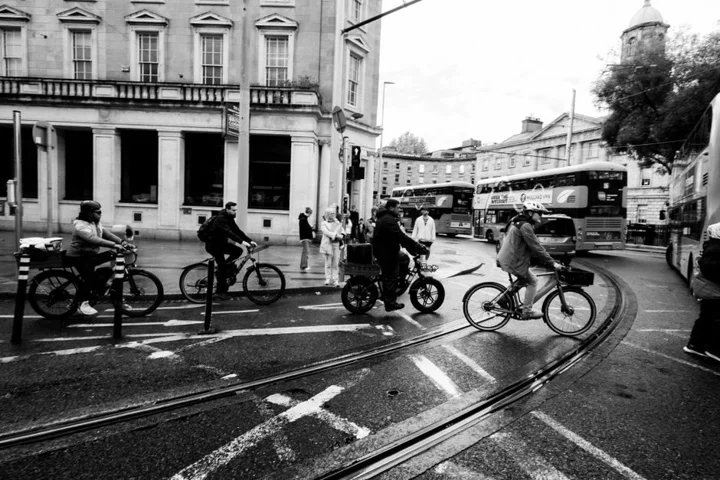
Photo: Jonathan Borba / Pexels. Illustrative photograph.
Ireland has no separate hazard perception clip test. The Irish Driver Theory Test is multiple choice, and hazard awareness and risk perception are among the topics it checks. On the driving test, the tester assesses whether you react promptly and properly to hazards. This guide shows Irish learners how to build the skill on real roads, using the Rules of the Road and the EDT lessons.
Key facts
- No clip-based hazard perception test in the Irish theory test (unlike Great Britain).
- Theory test topics include risk perception and hazard awareness.
- The driving test marks observation, reaction to hazards, clearance to other road users and speed.
- Perception time can be 0.25 to 0.5 seconds or more; reaction time 0.25 to 0.75 seconds, and up to 1.5 seconds.
- A perception and reaction time of 4 seconds at 100 km/h means about 110 metres before you even brake.
Is there a hazard perception test in Ireland?
Not as a separate test. Theorytest.ie lists the car theory test as a set of questions with a time limit and pass mark, drawn from the official question bank (see the Irish Driver Theory Test). The Rules of the Road says the theory test checks knowledge of topics including risk perception and hazard awareness, so expect written questions on spotting and responding to hazards.
The real test of the skill comes on the road. Among the headings on the Irish driving test are:
- taking proper observation
- reacting promptly and properly to hazards
- allowing enough clearance to pedestrians, cyclists and other traffic
- adjusting speed appropriately
- making reasonable progress without undue hesitancy
Late reactions and poor anticipation show up as faults. See Irish driving test marking and common reasons for failing.
What counts as a hazard?
The Rules of the Road defines a hazard as anything that could be a source of danger on the road. It includes:
- What you can see: oncoming traffic as you turn onto a major road, a cyclist ahead, a bus at a stop.
- What you can’t see yet but can expect: a child running out between parked cars, a pedestrian stepping out, animals around a bend.
- You: whether you are stressed or tired.
- Your car: its condition, such as worn tyres or a dirty windscreen.
Why seeing it early matters
Total stopping distance starts with perception time (seeing the hazard and realising you must act) and reaction time (moving your foot to the brake). Both are down to you, and alcohol, drugs, tiredness and lack of concentration all stretch them. The earlier you spot a developing hazard, the less you depend on hard braking. For the full figures, see the two second rule and stopping distances.
Where hazard skills fit in EDT
| EDT lesson | Hazard skill to practise afterwards |
|---|---|
| 6: Anticipation and reaction | Scanning ahead and responding in good time: speed, gear, gap and braking |
| 7: Sharing the road | Predicting pedestrians, cyclists and motorcyclists |
| 10: Speed management | Choosing a speed that lets you stop in the distance you can see |
| 12: Night driving | Spotting hazards with limited vision and glare |
Lesson details: EDT lesson by lesson.
A practice routine for Irish roads
Do these with your accompanying driver between EDT lessons.
- Commentary drive (10 minutes). Say aloud every hazard you see and what you will do: “Parked van on the left, could hide a pedestrian, easing off.” Your supervisor notes anything you missed.
- Far, middle, near. Every few seconds, look well ahead, then mid-distance, then close, then the mirrors.
- Clues, not just objects. Look for what is about to happen: a ball on the footpath, brake lights two cars ahead, a front wheel turning, a bus indicator, smoke from an exhaust.
- Junction drill. At each junction, name what could come from each direction, including cyclists and motorcyclists who are easy to miss.
- Review. After each drive, list the two hazards you spotted latest. Practise those situations next time.
Hazards to look for by road type
| Road | Typical hazards |
|---|---|
| Town centre | Pedestrians stepping out, doors opening, buses pulling out, cyclists and e-scooters, delivery vans |
| Housing estate | Children, parked cars, ramps, cars reversing from driveways |
| Rural local road | Blind bends, walkers on your side, tractors, animals, mud and gravel |
| National road | Overtaking traffic, slow vehicles, junctions on fast roads |
| Roadworks | Lane changes, workers, sudden queues |
See tractors, animals and rural roads and roadworks signs and traffic calming.
Common questions
Do I need to practise hazard perception clips for the Irish theory test?
No. There are no clips. Revise the official question bank, which includes hazard awareness and risk perception questions.
Are UK hazard perception apps useful in Ireland?
They are not official Irish material and are based on GB roads and rules. Theorytest.ie warns that unofficial apps don’t contain the official DTT questions. Real practice on Irish roads is more useful.
How does the tester know if I spotted a hazard?
From what you do: mirror checks, slowing early, positioning, giving room. A late, sharp reaction suggests you saw it late.
What is commentary driving?
Talking through what you see and plan to do as you drive. It makes your scanning visible so your supervisor or instructor can correct it.
Does tiredness count as a hazard?
Yes. The Rules of the Road includes your own physical and mental state. See tiredness, drugs and road rage.
Back to learning to drive in Ireland.
Sources
- Driver Theory Test Service, “FAQs: Frequently Asked Questions” and “Revision material” (theorytest.ie)
- Road Safety Authority, “Rules of the Road”, Sections 1, 3, 8 and glossary (Revision 5, hosted on garda.ie)
- Road Safety Authority, “Essential Driver Training (EDT)” (rsa.ie, search-result summary only)