
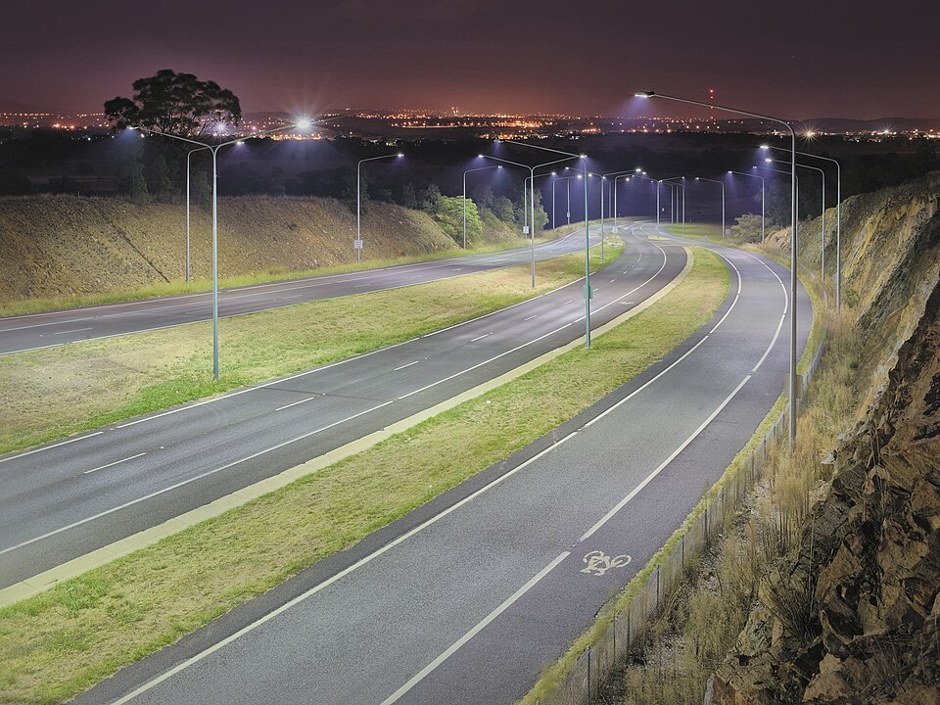
Photo: Thennicke, CC BY-SA 4.0, via Wikimedia Commons
In every Australian state and territory you must dip your high beam when an oncoming vehicle is within 200 metres, and when you are driving 200 metres or less behind another vehicle. This explainer covers that rule, when headlights must be on, hazard lights, and when you are allowed to use your horn. It is written for learners and P platers, and each rule is checked against the state handbooks.
The 200 metre high beam rule
| Situation | Rule |
|---|---|
| Oncoming vehicle within 200 m | Dip to low beam |
| Driving 200 m or less behind another vehicle | Dip to low beam |
| Oncoming driver dips their lights first | Dip straight away (WA). The NT says whichever comes sooner: 200 m or the other driver dipping |
| About to overtake | You may briefly flash high beam just before you start (NSW, QLD, WA, SA, NT) |
This rule appears in the NSW, Victorian, Queensland, WA, SA, Tasmanian, ACT and NT material. You can use high beam on any road where these limits allow it, even with street lights (NSW, NT, ACT).
It is an offence to use your lights in a way that dazzles other road users (SA, TAS, ACT).
Dip early at crests, curves, cyclists and road trains
- Dip before a crest or curve, where an oncoming car may appear suddenly (NT).
- Dip when approaching or overtaking a cyclist or motorcyclist at night (NT).
- Dip when travelling behind a road train or heavy vehicle (NT).
When must your headlights be on?
- Between sunset and sunrise, in every state.
- Any other time you cannot see a person wearing dark clothing 100 metres away (NSW, NT).
- In hazardous weather that reduces visibility, such as rain, dust or fog (VIC, SA). SA says it is an offence to drive with only your parking lights on at these times.
Victoria’s tip: if the street lights are on, your lights should be too. Day running lights or low beam in daylight help others see you (NSW, NT). SA adds that headlights on country roads increase your safety, especially when overtaking.
If you are dazzled by high beam
- Do not look directly at the oncoming headlights.
- Look to the left side of the road and keep to the left of your lane.
- Slow down. If you cannot see, stop or pull over until your eyes recover (NSW, VIC, WA, SA, ACT, NT).
If oncoming drivers keep flashing you while you are on low beam, have your headlights checked. Badly aimed lights can dazzle others (NT). Check the aim when the car is heavily loaded or towing.
Driving at night: speed and your headlights
Drive at a speed that lets you stop within the distance your headlights show to be clear (WA, SA, ACT). Keep the windscreen and lights clean inside and out, and do not wear tinted glasses at night unless an eye specialist advises it (WA).
Fog lights
Fog lights are only legal when fog, heavy rain, smoke or dust reduces visibility, and must be switched off when it clears. Full state-by-state rules: driving in rain, fog, smoke and floods.
When can you use hazard lights?
Only when your vehicle:
- is stopped and could obstruct traffic or pedestrians
- is moving slowly and could obstruct others
- is being towed (TAS)
- is stopped in an emergency stopping lane
- is in hazardous weather, such as fog or smoke
- uses them as part of an anti-theft or alcohol interlock device (NT)
Hazard lights do not make illegal parking legal (TAS).
When are you allowed to use your horn?
Only to warn others. The handbooks list:
- warning other road users of your approach or position
- warning animals to get off the road (NSW, TAS, NT)
- as part of an anti-theft or alcohol interlock device (NSW, TAS, NT)
Not allowed:
- using the horn to greet someone, or because you are annoyed with another driver (NT)
- using it to scare or intimidate cyclists, pedestrians or horse riders (NSW)
- unnecessary or offensive noise. SA also bans musical horns
Near horses, do not sound your horn (NSW, NT, SA). For animals on the road at night, SA and the ACT suggest braking and sounding the horn.
Common questions
How far away must I dip my high beam?
200 metres from an oncoming vehicle, and when you are 200 metres or less behind another vehicle.
Can I use high beam in the city?
Yes, if no vehicle is within 200 metres ahead or coming towards you. Street lights do not stop you using it.
Is flashing your headlights illegal?
You may briefly flash high beam to signal that you are about to overtake. Using lights to dazzle someone is an offence. Victoria says only flash your headlights or use the horn to warn other drivers about a situation that could be dangerous.
Do I need headlights on in the rain during the day?
Yes, when the rain reduces visibility (VIC, SA). NSW and the NT also say turn them on when it starts to rain.
Can I beep my horn to say goodbye?
No. The horn is only for warning others of danger or your position.
Related: the Australian Road Rules explained, kangaroos and wildlife at night and overtaking, merging and changing lanes.
Sources
- Transport for NSW, “Road User Handbook” (nsw.gov.au)
- Department of Transport and Planning Victoria, “Road to Solo Driving” (transport.vic.gov.au)
- Queensland Government, “Other common road rules” (qld.gov.au)
- Department of Transport and Major Infrastructure WA, “Drive Safe: A handbook for Western Australian road users” (transport.wa.gov.au)
- Government of South Australia, “The Driver’s Handbook”, February 2026 (mylicence.sa.gov.au)
- Department of State Growth Tasmania, “Tasmanian Road Rules, Version 2.1” (transport.tas.gov.au)
- Access Canberra, “ACT Road Rules Handbook” (accesscanberra.act.gov.au)
- Northern Territory Government, “NT Road Users’ Handbook” (nt.gov.au)