
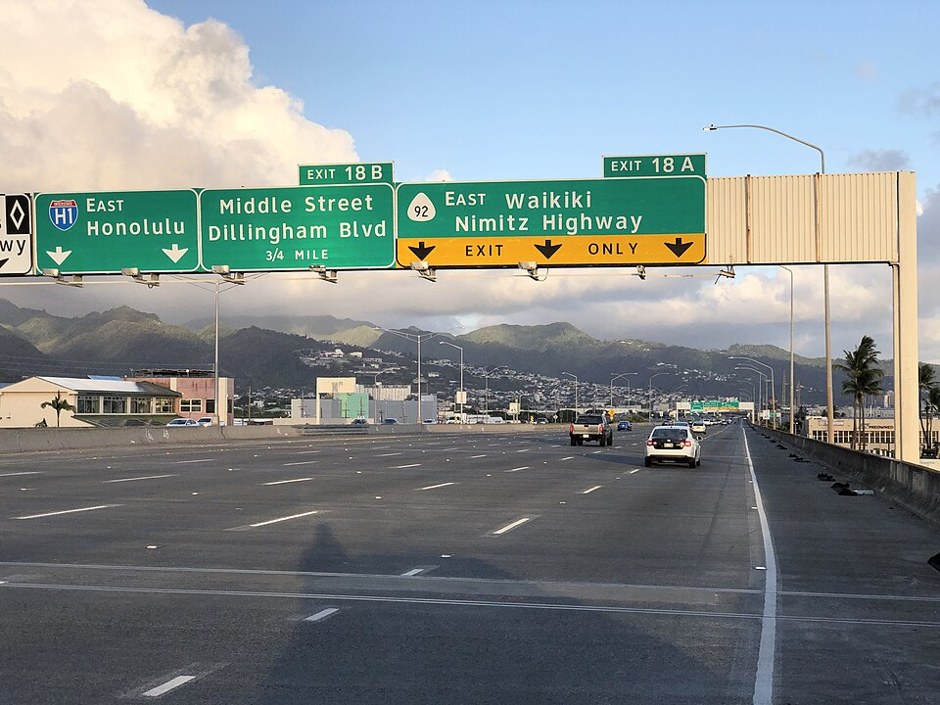
Photo: Famartin, CC BY-SA 4.0, via Wikimedia Commons
In Hawaii you can get an instruction permit at 15½, a provisional license at 16 after holding the permit for 180 days, and a full Class 3 license at 17 after 6 months on the provisional license. This guide is for Hawaii teens, their parents and adults getting a first license. It covers each stage, the tests, the county offices that run them, and what every chapter of the Hawaii Driver’s Manual expects you to know.
Key facts (as of November 2026)
- Handbook: the Hawaii Driver’s Manual, 2023 edition, published by the Hawaii Department of Transportation (HDOT).
- Licenses and tests are handled by the four counties: City and County of Honolulu, Hawaii County, Maui County and Kauai County.
- Instruction permit: minimum age 15½. A written rules of the road test and a vision test come first.
- Provisional license: minimum age 16, permit held 180 days, state-certified driver education, road test.
- Full Class 3 license: at least 17, after 6 months on a provisional license. A provisional license expires on your 19th birthday.
- Supervising driver for a permit holder: licensed and at least 21. Between 11 p.m. and 5 a.m. it must be your parent or guardian.
How to get a driver’s license in Hawaii: the three stages
| Stage | Minimum age | What you need | Main limits |
|---|---|---|---|
| Instruction permit | 15½ | Parental consent if under 18, vision test, written test, documents | Licensed driver 21+ beside you; parent or guardian only between 11 p.m. and 5 a.m.; everyone belted |
| Provisional license (under 18) | 16 | Permit held 180 days with no pending violations, driver ed classroom and behind-the-wheel certificates, road test | One passenger under 18 who is not a household member unless a parent or guardian is with you; no driving 11 p.m. to 5 a.m. without a licensed parent or guardian, except for work or a school-authorized activity |
| Class 3 driver’s license | 17 | Provisional license held 6 months, no pending violations, eye test | No GDL limits |
If you are 18 or older, the graduated licensing stages do not apply: you get a permit, then take the road test for a Class 3 license.
Full detail on each stage:
- Hawaii written driving test and instruction permit
- Hawaii provisional license rules for teens
- Hawaii driver’s ed requirement for under 18s
- Hawaii road test for a Class 3 license
Step by step for a Hawaii teen
- Study the Hawaii Driver’s Manual. The appendix has 177 numbered multiple-choice practice questions, each with a page reference back to the text.
- Take the written test. Online from home (computer with webcam, no phones or tablets) or in person at a county office by appointment.
- Go to your county licensing office. Bring documents, parental consent, pass the eye test and pay the permit fee.
- Start state-certified driver education and practice with a licensed driver 21 or older.
- After 180 days, book the road test. Bring both driver ed certificates, a test vehicle with current registration, safety inspection and insurance, and a licensed driver 21+.
- Drive on your provisional license for 6 months, then convert it to a full license from age 17. Do it before your 19th birthday.
Who runs licensing in Hawaii?
HDOT writes the manual and sets statewide rules. Each county issues permits and licenses and runs the tests. Written tests in person are given 8:00 a.m. to 3:30 p.m. in Honolulu, Kauai and Maui, and 8:00 a.m. to 3:00 p.m. in Hawaii County, according to the manual. Fees and booking systems differ by county, so always check your own county’s page. Honolulu uses AlohaQ for licensing appointments and a separate online system for road tests.
License classes in Hawaii
| Class | Vehicles |
|---|---|
| 1 | Mopeds |
| 2 | Motorcycles and motor scooters |
| 3 | Cars and light trucks with a GVWR of 18,000 pounds or less, and buses designed for 15 or fewer occupants |
| 4 | Single vehicles with a GVWR of 18,001 to 26,000 pounds (minimum age 21) |
| A, B, C | Commercial driver’s licenses (CDL), with a separate HDOT manual |
Documents and REAL ID
For a first REAL ID permit or license you need original or certified documents showing your legal name, date of birth, legal presence, Social Security number and two proofs of your Hawaii principal residence. A birth certificate or valid U.S. passport covers name, birth date and legal presence. Applicants under 18 who lack two address documents may use a parent’s, according to Honolulu. Notarized copies and faxes are not accepted. If you cannot or choose not to give a Social Security number, you can get a limited purpose license, valid for driving only. See REAL ID and your first US driver’s license.
What the Hawaii Driver’s Manual covers, chapter by chapter
I Licensing of drivers
Who is exempt, who cannot be licensed, license classes, the tests, driving by minors and renewal. A Hawaii license is void after its expiration date, the manual says, with no grace period to keep driving. You must carry your license whenever you drive and show it to a police officer on request.
II Vehicle equipment and inspection
Required equipment, banned equipment (red lights showing to the front, blue lights, sirens, loud muffler bypasses) and the annual safety inspection. Replace tires with less than 1/16 inch of tread. Details: Hawaii safety inspection and no-fault insurance.
III Vehicle registration
Register in the county where you operate the vehicle and renew every year. A current safety inspection certificate is needed before registration. Tell the county of an address change in writing within 30 days. Cars need plates front and rear.
IV The driver
Attitude, emotions and health. If you are upset, ill or angry, the manual says let someone else drive.
V Traffic laws
- Signal at least 100 feet before turning, changing lanes or stopping, even with no one around.
- Stop at least 15 feet from the nearest rail when a train signal is on, a gate is down or a train is close.
- Parallel park with your wheels within 12 inches of the curb. Do not park where less than 10 feet of street is left for traffic, or on a public street for more than 24 hours.
- Do not drive on the left half of the road within 100 feet of an intersection, railroad crossing, or a bridge or tunnel where you cannot see oncoming traffic.
- Leaving a car unattended: stop the engine, take the key, set the parking brake, and on a grade turn the wheels toward the curb.
- No more than three people in the front seat.
- For emergency vehicles with siren or lights: slow, move out of the path and stop. For a stopped emergency vehicle with flashing lights, slow down and leave an empty lane if you safely can.
VI Signals, signs and lane markings
Regulatory, warning and guide signs, plus centerlines. You may cross a double solid yellow line only to turn left into or out of an alley, private road or driveway. More: US road signs by shape and color.
VII Crash procedures
Report any crash with injury, death or property damage of $3,000 or more to the police immediately. Stop, help the injured, warn traffic and exchange name, address and registration details.
VIII No-fault insurance
Every owner of a car, bus or truck must be insured to register or drive it. The manual lists the old minimum limits. The Hawaii Insurance Division says the minimums went up to 40/80/20 for policies new or renewed from January 1, 2026, with at least $10,000 of personal injury protection.
IX Alcohol and other drugs
- A test result of .08 or more, or refusing the test, means your license is taken and you get a 30-day temporary permit.
- Drivers under 21 may not drive with .02 or more (zero tolerance explained).
- Refusing a test can cost your license for one, two or four years, depending on prior alcohol enforcement contacts.
- No open alcohol containers in the passenger area on a public road.
X Safe driving techniques
A minimum two-second following gap, lane choice, passing, braking, parking and emergencies. Three Hawaii specifics worth knowing:
- Hills: the manual says turn your wheels to the right whether you park uphill or downhill, set the parking brake and shift to Park.
- Roundabouts: slow down, yield to pedestrians, bicyclists and traffic already circulating, go counterclockwise and signal right to exit (roundabouts in the US).
- Rain: the main weather risk in Hawaii. Partial hydroplaning can start at 35 mph. Never drive through swiftly moving water more than a foot deep.
XI Trucks, buses and motorcycles
Large vehicles have blind spots and need more room to stop. A motorcyclist is entitled to the full width of the lane.
XII Pedestrian safety
Stop for any blind pedestrian with a white cane or guide dog. Never pass a vehicle stopped for a pedestrian. Stop for a school bus with flashing red lights if you are in its lane or an adjacent lane. Oncoming traffic on a divided highway does not have to stop. The manual says the fine can be $1,000.
XIII Bicycle safety
Leave at least 3 feet when passing a bicyclist, stay out of bike lanes when turning right, and look before opening your door.
Phones and driving in Hawaii
HDOT says hand-held use of a mobile electronic device is illegal while driving, including when stopped at a red light or stop sign. Drivers under 18 may not use even a hands-free device. Fines are higher in school zones and construction areas. Check the current amount with HDOT. Compare states: hands-free and texting laws.
Moving to Hawaii or visiting
Visitors with a valid license from another state, U.S. territory or Canadian province can drive without a Hawaii license. New residents from those places usually transfer with a vision test. Japan, Korea and Taiwan have reciprocity agreements. Full rules: driving in Hawaii on an out-of-state or foreign license.
Common questions
How old do you have to be to drive in Hawaii?
15½ for an instruction permit, 16 for a provisional license and 17 for a full Class 3 license.
Is driver’s ed required in Hawaii?
Yes, if you are under 18 and want a provisional license. You need both the classroom and behind-the-wheel certificates.
How many supervised hours do I need in Hawaii?
The manual and Honolulu’s GDL page set no logged-hours total. You must hold the permit 180 days, and Honolulu advises 16 and 17 year olds to practice for six months.
Can I take the Hawaii permit test online?
Yes. The written test has been available online statewide since December 2024. You still visit a county office afterward for the eye test, photo and permit.
Which county do I apply in?
Use the licensing office in your own county. When you take the test online, pick the right county or you may lose your result, Honolulu warns.
Does a Hawaii license have a grace period after it expires?
The manual says no: the license is void after the expiration date. You may renew up to six months early. If you miss the renewal window, you go through the steps for an original license.
Compare Hawaii with other states
- Learning to drive in the USA
- US graduated driver licensing compared
- US permit test by state
- Car insurance for new drivers in the US
Sources
- Hawaii Department of Transportation, “Hawaii Driver’s Manual” (2023 edition) (hidot.hawaii.gov)
- Hawaii Department of Transportation, “What you need to know about Hawaii’s Graduated Licensing Program” (hidot.hawaii.gov)
- Hawaii Department of Transportation, “Driver’s License” (hidot.hawaii.gov)
- Hawaii Department of Transportation, “Written test for driver’s permit now available online statewide” (hidot.hawaii.gov)
- Hawaii Department of Transportation, “April is National Distracted Driving Awareness Month” (hidot.hawaii.gov)
- City and County of Honolulu, Department of Customer Services, “Graduated Driver Licensing Program (GDL)” (honolulu.gov)
- City and County of Honolulu, Department of Customer Services, “Driver’s License Procedures” (honolulu.gov)
- City and County of Honolulu, Department of Customer Services, “Road Test” (honolulu.gov)
- Hawaii Department of Commerce and Consumer Affairs, Insurance Division, “FAQ: Auto Insurance Minimum Limits” (cca.hawaii.gov)