
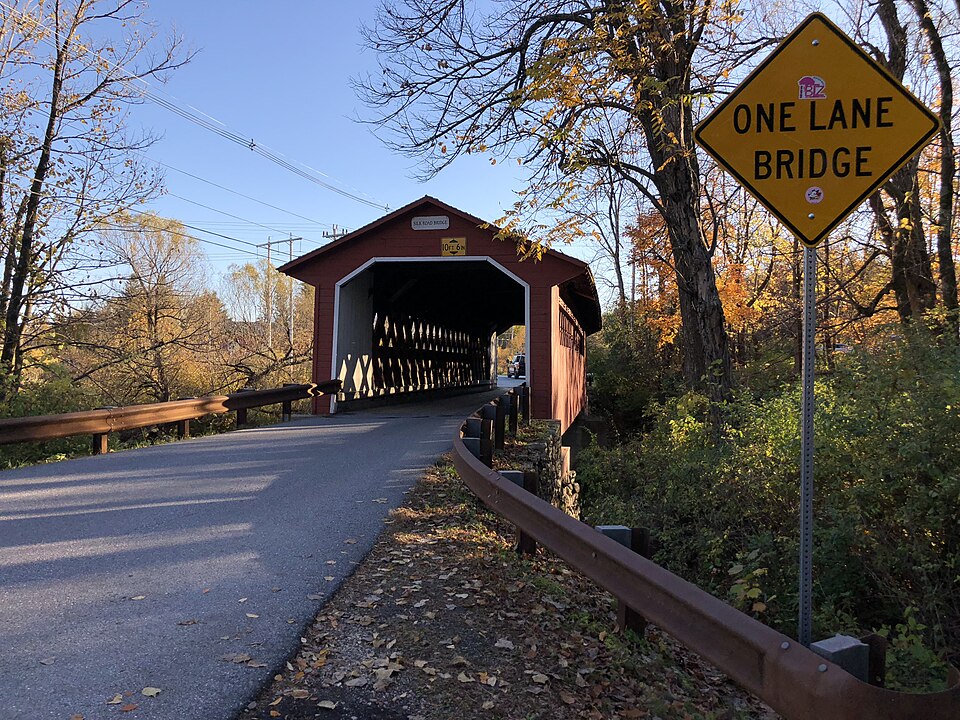
Photo: Famartin, CC BY-SA 4.0, via Wikimedia Commons
Learning to drive in Vermont follows three stages: a learner’s permit from 15, a junior driver’s license at 16 or 17 after holding the permit for a year, and a full license at 18. The permit test is online only, and driver education plus 40 hours of supervised practice are required before a junior license. This guide walks through every chapter of the Vermont Driver’s License Manual and links to a detailed guide for each step.
Key facts (Vermont DMV, as of November 2026)
- Handbook: Vermont Driver’s Manual (VN-007), listed by the DMV as November 18, 2024. Audio, translated and interactive (DriveVermont) versions exist.
- Permit: from age 15. Online test, 20 questions, 16 correct to pass. $63 ($39 test plus $24 permit).
- Junior license: age 16 or 17 after holding the permit at least one year. Road test $23 plus $39 license.
- Under 18: driver education (30 hours classroom, 6 behind the wheel, 6 observation) plus 40 practice hours, 10 at night.
- Full license: at 18, with no recalls, suspensions or revocations in the previous six months.
- All DMV office visits are by appointment.
The Vermont path to a license, step by step
| Stage | Age | Main rules | Detailed guide |
|---|---|---|---|
| Learner’s permit | 15+ | Drive only with a licensed, unimpaired parent or guardian, driver ed instructor, or person 25+ beside you | Vermont permit test |
| Driver ed and 40 hours | While on permit | 30/6/6 course; 40 more hours with 10 at night, certified by a parent | Driver’s ed and 40 hours |
| Road test | 16+ after 1 year on permit | Hill start, side-street turnaround, parallel parking | Vermont road test |
| Junior license | 16 to 17 | Passenger limits for 6 months; no driving for work for 1 year | Junior license rules |
| Driver’s license | 18+ | Clean six months; points system applies | Points system |
Chapter 1: General information
- DMV offices: Bennington, Dummerston, Montpelier (main office), Newport, Saint Albans, Saint Johnsbury, South Burlington, Springfield, Rutland and White River Junction.
- Book at mydmv.vermont.gov or 888.970.0357. General line: 802.828.2000. Hearing impaired: dial 711.
- Road tests can be cancelled for poor road conditions. Offices close on state holidays, including Town Meeting Day and Bennington Battle Day.
Chapter 2: How to lose your license
Under-21 alcohol offenses go to the Teen Alcohol Safety Program. Failing to contact it within 15 days can mean a $300 penalty and a 90-day suspension. Lying on an application carries a fine of up to $1,000, up to two years in prison, or both, plus a 90-day suspension. Every application is checked against the national Problem Driver Pointer System, so a suspension elsewhere blocks a Vermont license. Full detail: Vermont points system and how to lose your license.
Chapter 3: Proof of identity in Vermont
Bring original documents (or copies certified by the issuer) from each category:
- Identity and date of birth: for example, a valid passport, certified birth record, Permanent Resident Card or Certificate of Naturalization.
- Social Security: your card or an SSA ineligibility letter; a W-2, SSA-1099 or pay stub showing your SSN can substitute.
- Vermont residency: two pieces of mail at your street address, or two documents such as a utility bill or lease. Minors use a Vermont Residency Certification plus one parent document and proof of relationship.
- Lawful status: only for Real ID and the Enhanced Driver’s License (EDL), and it must have at least 30 days remaining.
Photocopies and faxes are refused. Height, weight, eye color and gender on the card are self-designated, so no document is needed for them. You can also register as an organ donor when you apply. Vermont also issues a Driver Privilege Card, a license or permit that is not Real ID compliant and needs no proof of legal presence. More on Real ID: Real ID and your first US driver’s license.
Chapter 4: Permits, junior licenses and driver’s licenses
- Permit: 15 or older, parent signature under 18, clean record for the previous two years. You may drive anywhere, anytime in Vermont with a qualified supervisor.
- Tests: a vision screening (20/40 standard, or referral to an eye doctor), the online knowledge test, then the road test.
- Junior license: 16 or 17, one year on the permit, driver ed logged by your instructor, 40 certified hours, parent consent, insured and inspected car.
- Driver’s license: 18 or older. It covers any noncommercial vehicle except a school bus or motorcycle.
- New residents: get a Vermont license within 60 days of moving (30 days for a CDL). With a valid out-of-state license, or one expired 3 years or less, you take an eye exam. Otherwise you take vision, written and road tests. See moving to a new state.
- Motorcycles: at 16 or older with a license, by test. The Vermont Rider Education Program’s Basic Rider Course exempts you from the state written and skills exams.
Chapter 5: Vermont’s Graduated Driver’s License program
Junior drivers carry no passengers for the first three months unless a qualified adult is in the front seat. In months 4 to 6 they may carry immediate family. After that, the only limit is one passenger per safety belt. There is no driving for work for one year, and no passengers for hire. Violations bring 30- or 90-day recalls. Full rules: Vermont junior driver’s license rules. Compare states: US graduated driver licensing compared.
Chapter 6: Vermont license fees, renewals and replacements
| Item | Fee (DMV fee page, July 2026) |
|---|---|
| Knowledge test plus learner’s permit | $63 ($39 + $24) |
| Road test plus 2-year junior license | $62 ($23 + $39) |
| Road test plus 4-year license (18+) | $85 ($23 + $62) |
| Renewal: 2-year / 4-year license | $39 / $62 |
| Replacement license or permit | $24 |
| Enhanced Driver’s License | $36 extra |
| Reinstatement after suspension | $96 |
- A renewal form is mailed about a month before your license or permit expires; renew by mail, online or in person. A license photo is valid for 8 years.
- A Vermont license expired more than 14 days is not valid for driving. After more than 3 years expired, you must test again.
- Report a change of name or address within 30 days. Address changes can be made online; name changes need an office visit.
- You can renew and replace a license online at mydmv.vermont.gov.
Chapter 7: Driving safely in Vermont (the permit test chapter)
This is the chapter the permit test draws on most. Rules that catch learners:
- Speed: 50 mph maximum on Vermont roads and 65 mph on the Interstate, unless posted. Always drive at a speed safe for conditions.
- Signals: at least 100 feet before a turn or lane change. If your signals or brake lights fail, use hand signals and get them fixed at once.
- Turns: for a left turn, move to within one foot of the center line and keep your wheels straight until you turn. For a right turn, stay about three feet from the road edge and don’t swing left first. Turn into the nearest lane, yield to pedestrians and bicyclists, and never change lanes during a turn or turn from a lane marked for straight ahead.
- Following distance: at least four seconds, and more in bad weather, at night, behind a motorcycle and behind farm vehicles.
- Driving slowly: if traffic backs up behind you, the law requires you to pull over when it is safe and let it pass.
- Right of way: yield to anyone already in the intersection. At a four-way stop the first to arrive goes first; if two arrive together, the driver on the left yields to the driver on the right. Turning left, yield to all oncoming vehicles and bicyclists. Coming out of a driveway, alley, parking lot or the top of a T, yield to all traffic on the road.
- Parking: park with the flow of traffic and within 12 inches of the curb or road edge. In the country, get all four wheels off the road, and never stop where you can’t be seen for 150 feet. No parking within 6 feet of a hydrant, 20 feet of a crosswalk at an intersection, 30 feet of a stop sign, traffic light or flashing signal, or 50 feet of the nearest rail of a railroad crossing; within 20 feet of a fire station driveway (75 feet across the street when signed); in a bike lane; on a bridge, sidewalk or crosswalk; or beside a parked car. On a hill, turn your wheels and set the parking brake.
- Roundabouts: yield to traffic in the circle, never change lanes inside, and signal your exit (see how to drive a roundabout).
- Move over: pull right and stop for approaching emergency vehicles. Change lanes away from stopped ones on the Interstate, or slow to 20 mph below the limit. Yield to working highway maintenance vehicles such as snowplows. Treat stopped tow and repair trucks with amber lights the same way. In a roundabout, pull over for an emergency vehicle only after you have exited (see move over laws).
- Traffic lights: a dark signal means stop as if there were stop signs in all directions. Right on a circular red is usually allowed after a full stop unless a sign forbids it; never turn right on a red arrow, or when a lit NO TURN ON RED sign is showing.
- School buses: never pass one stopped with red lights flashing, from any direction, even in a school yard. Flashing yellow lights mean get ready to stop. You need not stop on a divided highway when the bus is on the other side, or where a concrete barrier separates you (see school bus stopping laws).
- Railroad crossings: stop at least 15 feet from the nearest rail when lights flash, gates are down, a flagger signals, a train is in sight or sounding, or there is a STOP sign. Never go around a closed gate, and never pass another vehicle at a crossing. Report a danger at a crossing to the number on the emergency sign, quoting the crossing number.
- Passing: pass on the left with at least four feet of clearance, and don’t pull back in until you can see the whole vehicle or bicyclist in your inside mirror. You may pass on the right on a multilane road, or on a narrower road when the vehicle ahead is turning left and there is room. Never leave the pavement to pass. Don’t pass on hills, on curves, at railroads or intersections, or where a “changed path ahead” sign shows. When someone passes you, slow a little and keep right.
- Pedestrians: never pass a vehicle stopped for a pedestrian, even on a two-lane road. Yield even when a pedestrian crosses carelessly, don’t block crosswalks, and stop for anyone with a white cane or guide dog. Watch school zones, where lower limits apply “when flashing” or “when children are present”. Don’t pick up hitchhikers on the Interstate or its ramps.
- Bicyclists: they may use every road except limited-access highways like the Interstate, may ride two abreast, and may take the lane when it is safer. Leave at least four feet when passing, wait if the road is too narrow, and don’t honk without good cause. Check for bikes before turning and before opening a door.
- Horses, farm vehicles and other road users: a rider or animal-drawn vehicle has the same rights as a driver. Slow down or stop, never honk or rev, leave at least four seconds behind them, and use the full lane to pass. Slow-moving vehicles carry an orange and red triangle; pass them only when it is safe, and yield to wide farm equipment on narrow roads. Watch for skateboards, scooters and electric wheelchairs too.
- Work zones: the rules apply 24 hours a day, fines for speeding are doubled, and flaggers must be obeyed. Merge early and keep four seconds back.
- Headlights: required from half an hour after sunset to half an hour before sunrise, and whenever you can’t see people or vehicles 500 feet ahead. Use low beams in fog, rain, snow, streetlit areas and when meeting or following others. Daytime running lights are not headlights, and parking lights are only for parking.
- Interstates: yield to traffic already on the road when you merge, keep right except to pass, and never stop in a travel lane. In an emergency, use the breakdown lane, raise the hood and stay in the car. If you miss your exit, go on to the next one; never back up or use the emergency crossovers. Don’t use cruise control in rain, fog, snow or ice.
- Low shoulders and floods: if your wheels drop off the pavement, ease off without braking and steer back slowly. Never drive into water over the road or around a road closed barrier, abandon a car that stalls in floodwater, and keep away from downed wires.
- Police stops: pull right, keep your seat belt on, stay in the car, and show license, registration and insurance when asked.
- Winter and wildlife: snow tires on all four wheels, clear all ice and snow, watch for black ice on bridges and ramps. Moose and deer are most likely on roads in the late evening, at night and early morning, and they often travel in pairs. If you are stranded in a blizzard, stay with the car, keep the exhaust pipe clear of snow, and run the engine about 10 minutes an hour with a downwind window open a crack. Keep at least half a tank of fuel in winter.
- Alcohol and drugs: .08 BAC is impaired; under 21 the limit is .02. Refusing a test means at least six months without a license, and Vermont can suspend you through a civil process before any criminal conviction. Only time sobers you up: allow at least an hour per drink (see zero tolerance laws).
- Phones: no portable electronic device use while driving, even when stopped. Fines start at $100 (see hands-free and texting laws).
- Crashes: if anyone is hurt or damage is over $3,000, file a written report with the DMV within 72 hours. Stop and give reasonable help, call 911 for injuries, and show your license to anyone hurt or whose property was damaged. If you hit a parked car and can’t find the owner, leave your name, address and phone number on it. A crash in another state is reported in that state (see what to do after a car crash).
- Seat belts and car seats: everyone must be belted or in an approved child seat. Under 2 rides in a rear-facing harnessed seat, never in front of an active airbag. From 2 to under 5, a rear- or forward-facing harnessed seat. Under 8 and out of a harnessed seat, a booster. Under 13 rides in back if practical, and anyone under 18 not in a child seat or booster wears a belt (see seat belt and car seat laws).
The road test section of Chapter 7 is covered in the Vermont road test guide.
Chapter 8: Vermont point system
10 points within two years means suspension. Example values are speeding 2 to 8, passing a stopped school bus 5, and failing to yield to a pedestrian in a crosswalk 4. Teens are recalled at 6 points or after a single 3-point speeding ticket. See the Vermont points system.
Chapter 9: Owning a car in Vermont
- New residents register vehicles within 60 days. Carry proof of registration in the car.
- Vehicles are inspected once a year, and within 15 days of registration unless they already carry a valid Vermont sticker. Tires need at least 2/32 inch of tread.
- Minimum liability insurance: $25,000 for one person’s injury or death, $50,000 for two or more people, and $10,000 for property damage. No insurance when stopped means a fine and 2 points (see car insurance for new drivers).
- Purchase and Use Tax is 6% of the price or fair market value, whichever is greater.
- When selling, give a bill of sale, sign over the title and remove your plates.
- Insured but can’t show the card when stopped? You have 15 days to prove you were covered. Drive uninsured and then crash, drive impaired, or commit certain other offenses, and your license is taken until you get insurance; you must then prove cover for 3 years.
- Equipment the law cares about: nothing hanging from the rearview mirror or sun visors, a working horn and rearview mirror, a rear plate lit so it can be read from 50 feet, clear windows and working defrosters, and no tampering with the catalytic converter. Leaving a running car unattended in public is illegal.
- Tell the DMV within 30 days if you change your name, your address or your vehicle’s color.
- The manual’s fuel-saving tips: 55 to 60 mph instead of 65 on the Interstate, smooth starts and stops, short warm-ups, correct tire pressure, less weight and air conditioning, windows closed above 50 mph, and combined trips or carpools.
Chapter 10: Commercial driver’s license (CDL)
A CDL is needed for vehicles rated over 26,000 pounds, vehicles carrying 16 or more people including the driver, or placarded hazardous materials. The classes are A, B and C, plus a CDL instructional permit. Separate CDL manuals are available at DMV offices.
Chapter 11: Drivers with disabilities
If you have a condition that may cause loss of consciousness, such as epilepsy or insulin-treated diabetes, or have lost a limb or use a wheelchair, call the Driver Improvement Section (802.828.2000) before booking. You will get a medical evaluation form for your doctor. Disabled parking placards are free. With a disabled plate or placard you may park for up to 10 days, without a fee, in spaces where others have a time limit, and gas stations showing the disability access symbol must pump your fuel for you at the self-service price. Ask for help with reading or building access when you book, and the DMV will accommodate you.
Chapter 12: For parents and guardians
The DMV asks parents to give more than the required 40 practice hours and to set family rules on belts, speed, phones, night driving after 9 p.m. and teen passengers. Parents can also suspend a teen’s provisional license by writing to the Commissioner. See driver’s ed and the 40-hour certification.
Common questions
How old do you have to be to drive in Vermont?
15 for a learner’s permit (with supervision), 16 for a junior license after a year on the permit, and 18 for a full license.
Is the Vermont permit test online?
Yes, only online at mydmv.vermont.gov. You need 16 of 20 correct.
Is driver’s ed required in Vermont?
Yes, for license applicants under 18.
Is there a curfew for teen drivers in Vermont?
The DMV’s published GDL rules contain no curfew. They limit passengers and work driving instead.
I am 18 or older. Do I still need a permit first?
New drivers start with a learner’s permit at any age. Supervisors must still be 25 or older (or a parent, guardian or instructor), and you bring one to the road test.
Can I practice in another state on a Vermont permit?
Ask that state first. The DMV says you must check whether a Vermont permit is legal there (see driving with a learner’s permit in another state).
For how Vermont fits into the US system, see learning to drive in the USA.
Sources
- Vermont Department of Motor Vehicles, “Vermont Driver’s Manual” (VN-007), Chapters 1 to 12 (dmv.vermont.gov)
- Vermont Department of Motor Vehicles, “Driver’s License Manual” (dmv.vermont.gov)
- Vermont Department of Motor Vehicles, “Learner’s Permit” (dmv.vermont.gov)
- Vermont Department of Motor Vehicles, “Junior Driver’s License” (dmv.vermont.gov)
- Vermont Department of Motor Vehicles, “Graduated License Laws” (dmv.vermont.gov)
- Vermont Department of Motor Vehicles, “Driver’s License Fees” (dmv.vermont.gov)
- Vermont Department of Motor Vehicles, “License Suspensions & Related Programs” (dmv.vermont.gov)
- Vermont Department of Motor Vehicles, “Driver Education” (dmv.vermont.gov)