
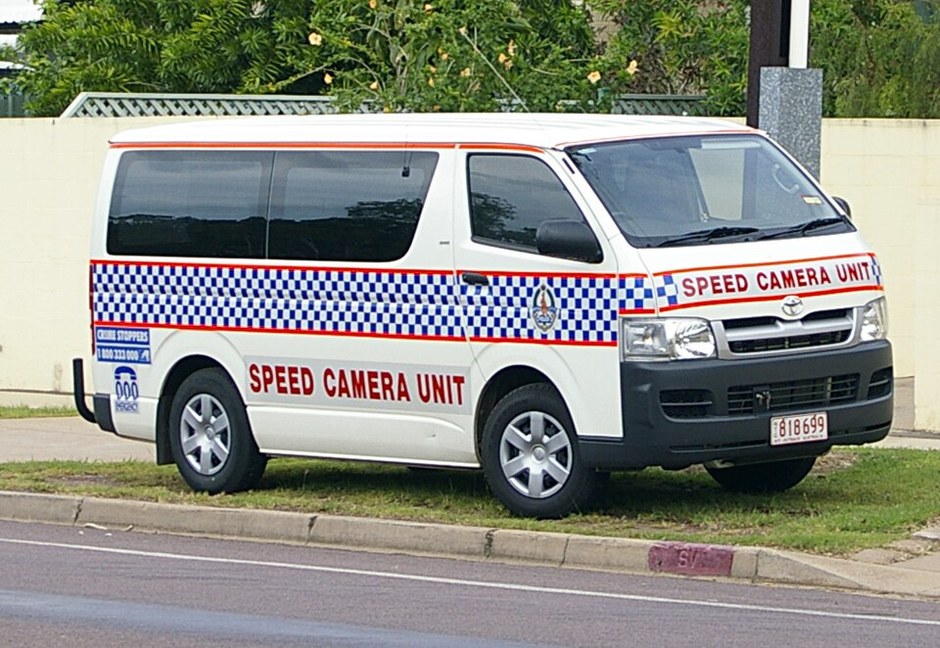
Photo: Bidgee, CC BY 3.0, via Wikimedia Commons
Northern Territory speed limits default to 60 km/h in built-up areas and 110 km/h outside them, and some sections of four highways are signed at 130 km/h. Learners are capped at 80 km/h and P platers at 100 km/h, whatever the sign says. This guide covers every NT limit a learner needs, from school zones and school buses to cameras and unsigned outback roads. It is part of the guide to learning to drive in the Northern Territory.
NT speed limits at a glance
| Where or who | Limit |
|---|---|
| Built-up area, no sign | 60 km/h, unless the town has gazetted a lower default (many use 50 km/h or less) |
| Outside built-up areas, no sign | 110 km/h |
| Signed sections of the Stuart, Barkly, Victoria and Arnhem highways | 130 km/h |
| School zone, on school days during signed times | 40 km/h |
| Local traffic area | 40 km/h |
| Shared zone | Often 10 km/h. Give way to all pedestrians. |
| Roadworks | As signed, and enforceable |
| Learner drivers | 80 km/h maximum |
| Provisional drivers | 100 km/h maximum |
| Buses over 5 tonnes GVM and other heavy vehicles over 12 tonnes GVM | 100 km/h maximum |
Learner and P plate speed limits
Your licence limit applies on every road, even a 110 or 130 km/h highway. Where the posted limit is lower than your licence limit, the posted limit applies.
- Learners: 80 km/h. The NT Government speed limits page says this applies “unless accompanied by a licensed driving instructor”. The handbook and licence page give no exception, so check with the MVR before relying on it. Going over the learner limit on your driving test is a fail item. More: NT learner licence rules.
- P platers: 100 km/h. More: NT P plate rules.
On a 110 or 130 km/h road you will be slower than most traffic. Keep left, use overtaking lanes as intended (stay in the left lane unless overtaking), and let faster vehicles pass.
Which NT roads are 130 km/h?
The NT Government lists sections of the Stuart, Barkly, Victoria and Arnhem highways as having a 130 km/h maximum “as indicated”. The 130 km/h limit applies only where it is signposted. The NT Government does not publish a list of the exact stretches on its speed limits page, and limits on sections can change, so always follow the signs. Learners and P platers cannot drive at 130 km/h.
What counts as a built-up area?
A built-up area has buildings next to the road no more than 100 metres apart, or street lights less than 100 metres apart for at least 500 metres (or the whole road if it is shorter). If the town uses a lower default such as 50 km/h, you will see a sign on each road into it.
Roads with no speed signs
Many unsealed and remote roads have no speed signs. The default limit for that area or road type still applies, but you should drive to the conditions. On dirt and gravel, vehicles take longer to stop and are more likely to skid or roll over, and dust can hide ruts and potholes. See outback and remote driving.
Regulatory and advisory signs
- Regulatory signs: white with the number in a red circle. This is the legal maximum.
- Advisory signs: yellow, often before curves, bends and crests. They show a recommended maximum for an average car in good conditions.
Driving needlessly slower than the limit and conditions allow is also an offence under the handbook.
School zones and school buses
- School zones are 40 km/h between the school zone and end school zone signs, on gazetted school days and only at the times on the sign.
- Take extra care passing stationary buses from 7am to 9.30am and 2.30pm to 5pm.
- When a bus shows flashing orange lights, it is picking up or dropping off school children. The handbook recommends 40 km/h or less. If the bus shows a speed limit sign between the lights, that limit is enforceable while the lights flash. The lights keep flashing for about 30 seconds after the doors close.
- On the NT driving test, exceeding 40 km/h past a bus with flashing lights is a fail item.
How school zones differ across Australia: school zones in every state.
Speed and red-light cameras in the NT
Fixed speed cameras, combined safety cameras (speed and red light) and mobile speed camera vans operate across the NT. Penalties for speeding include fines, demerit points and suspension, and they increase the further over the limit you are. On Ls or Ps, 5 demerit points in 12 months suspends your licence.
Why a few km/h matters
The handbook gives a worked example. Two cars, one at 60 km/h and one at 65 km/h, brake at the same point for a truck 38 metres ahead. The 60 km/h car hits it at 5 km/h. The 65 km/h car hits it at 32 km/h.
Common questions
Is there an open speed limit in the NT?
No. The handbook says all NT roads have a speed limit. Unsigned rural roads and highways default to 110 km/h, and the highest posted limit is 130 km/h on signed sections.
Can P platers drive 110 km/h in the NT?
No. Provisional drivers are limited to 100 km/h.
How fast can learners drive in the NT?
80 km/h, or the posted limit if it is lower.
Are school zone times the same everywhere in the NT?
The times are shown on each school zone sign. Always read the sign.
How fast do road trains travel?
Up to 100 km/h, and they can be up to 53.5 metres long. See sharing the road with trucks and road trains.
Sources
- Northern Territory Government, “Speed limits” (nt.gov.au)
- Northern Territory Government, “Road Users’ Handbook”, Fifth Edition, August 2020 (nt.gov.au)
- Northern Territory Government, “Get your driver licence” (nt.gov.au)
- Northern Territory Government, “Demerit points” (nt.gov.au)
- Motor Vehicle Registry, “A guide to the Driving Test”, 2nd Edition, April 2026 (nt.gov.au)