
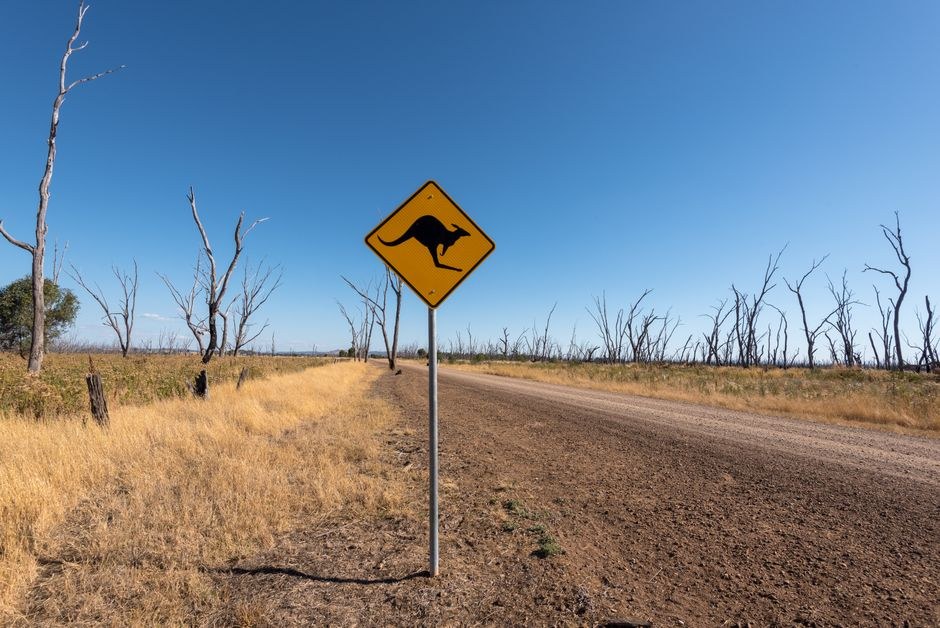
Photo: Richard Pan, Pexels
Outback driving in Australia means long distances, road trains, gravel and dirt roads, and water over the road. This guide is for learners and new P platers planning a country or remote trip. It pulls together the official advice from the Northern Territory, Western Australian, ACT, NSW, Victorian, Tasmanian and South Australian handbooks.
Key facts
- Road trains in the Northern Territory can be up to 53.5 metres long and travel at up to 100 km/h (NT Road Users’ Handbook).
- In the NT, vehicles over 7.5 metres long, including a car towing a caravan or trailer, must leave at least 200 metres to the long vehicle ahead so others can overtake.
- Gravel and dirt take longer to stop on. NSW advises a crash avoidance space of 4 seconds or more on unsealed roads.
- Where there is no speed sign, the default limit for the area or road type still applies. In Tasmania it is 80 km/h on an unsealed road outside a built-up area.
- Plan enough fuel and water to reach the next town (WA Drive Safe).
- If in doubt about water over the road, do not cross.
Before you go: fuel, water and planning
- Fuel and water: plan your journey so you have enough of both to get to the next town (WA).
- Tell someone: if you are leaving the major roads, get advice on local conditions, make sure the vehicle suits the terrain, carry enough equipment, water and other provisions, and tell someone where you are going and when you will be back (NT).
- Road closures: outback roads can close after rain. In South Australia, check the Department for Infrastructure and Transport outback roads map before you travel.
- Rest: the NT handbook says to avoid driving more than 10 hours a day and to stop at least every two hours. Rest areas are every 80 to 120 km along major NT roads. Unless signposted, they are not camping areas and you cannot stay longer than 24 hours. Truck parking bays are for heavy vehicles. More on driver fatigue on Australian roads.
Road trains: following, being overtaken and passing
The NT relies heavily on triple road trains, which can weigh more than 115 tonnes. The NT handbook gives this advice.
| Situation | What to do |
|---|---|
| Behind a road train | Stay well back. Keep out of the blind spots beside the cabin and do not sit directly behind the trailer. If you cannot see its mirrors, the driver cannot see you. |
| Road train slowing or turning | Do not cut in front of it. It needs more room to stop and may use the whole road to turn at roundabouts and lights. |
| Being overtaken | Keep your speed and do not move off the road. Slow down only once it moves out to pass. When it has passed, you can flash your headlights to show it is safe to move back in. |
| You are overtaking | Be sure you can see enough clear road. Indicate, move out and pass quickly but sensibly. Do not move back until you can see both of its headlights in your mirror, and do not slow down. |
| Oncoming on a single-lane sealed road | Slow down, move gradually off the road and drive slowly on the edge. |
| Oncoming on an unsealed road | Slow down and move as far left as is safe. |
| At night | Dip your headlights when following a road train. |
Road trains appear in other states too. Victoria’s handbook says to keep back at least 200 metres when following another long vehicle in a road train area. For buses, trucks and turning heavy vehicles generally, see sharing the road with trucks, buses and road trains.
How to drive on unsealed roads
Every handbook says the same thing first: slow down. On gravel your vehicle takes longer to stop and is harder to control, and it can skid, slide or roll over (NSW, NT).
- Slow down even more for oncoming vehicles. Stones thrown up by tyres can shatter a windscreen (ACT, NT).
- Brake and accelerate gently. The ACT handbook warns that ABS can actually increase your braking distance on gravel.
- Corners: do not let the car drift wide. Loose gravel builds up on the outside of corners and can cost you grip and steering (ACT).
- Corrugations: slow down. Regular ridges can make the wheels bounce and lose traction (NT).
- Dust: it hides ruts, potholes, dips, corners and other vehicles. Turn your headlights on. If the dust is thick, slow down or pull off and wait for it to settle (NT, VIC).
- Wet gravel becomes very slippery, and mud on the windows reduces your view (VIC).
- River crossings may be deeply rutted. Approach with caution (ACT).
South Australia’s Driver’s Handbook says gravel gives roughly half the grip of bitumen, so stopping distances roughly double.
Two-wheel drive or four-wheel drive?
The NT handbook says two-wheel drives can be driven on most gravel roads, while a four-wheel drive is recommended for dirt roads. In the wet season, some gravel roads need a four-wheel drive, especially at creek crossings and floodways. Four-wheel drives have a higher centre of gravity, so learn how to use the vehicle’s features, such as engaging four-wheel drive and locking the front hubs, before you set off.
Running off the edge of the road: avoiding a rollover
Rollovers are a major cause of road deaths in the NT. They often happen when a car drifts off the sealed edge and the driver overcorrects. If a wheel drops off the bitumen:
- Do not pull the wheel back sharply.
- Keep the wheels straight and let the car slow down gradually. The NT handbook says to do this without braking; Victoria’s says brake gently if needed.
- Steer smoothly back onto the road when it is safe.
Never swerve to avoid an animal at speed. It is a common cause of single-vehicle rollovers. See kangaroos and wildlife on Australian roads.
Floodways and water over the road
NSW’s advice is simple: it is safer to turn around than to drive into floodwater. Never cross where there are “road closed” signs or other traffic controls.
WA Drive Safe says inexperienced drivers should use another route if there is one. If there is no alternative, check before you cross:
- Walk the crossing first, if it is safe, to check the depth.
- Still water: no higher than the bottom of the vehicle for a normal two-wheel drive, or an average adult’s knee for a higher four-wheel drive.
- Flowing water deeper than the bottom of the chassis: do not cross.
The NT handbook adds:
- Fast-flowing water can make your car float.
- If you cannot see the road surface, there may be obstructions or washouts.
- Watch for crocodiles in northern waterways.
- If you cannot see the line markings, use roadside markers and guide posts to stay on track.
- Afterwards, check your brakes. Dry them by driving a short distance while pressing gently on the brake.
More on wet weather, smoke and floods: driving in rain, fog, smoke and floods.
Bogged in mud or sand
The NT handbook suggests these steps:
- Engage four-wheel drive, locking the hubs if needed.
- Try reversing out.
- Let some air out of the tyres and try again. Pump them back up once you are out.
- Put sticks, bushes or other material under the tyres.
- Wait for another vehicle to pull you out with a snatch strap or load-rated rope. Do not use the tow ball as an anchor point.
If you are still stuck, stay with your vehicle until help arrives.
Country driving habits (WA)
- Watch for wildlife and livestock, especially at sunrise and after sunset.
- Expect tractors towing farm machinery, particularly at seeding and harvest time.
- Do not stop on or near bridges, floodways or narrow sections of road.
- Park at the front end of a roadside parking bay so others can get in and out.
- Do not pull out when you can see another vehicle coming. Wait until it has passed.
For WA-specific country advice, see country driving in WA.
Breaking down in the country
Victoria’s handbook says help may take longer to arrive on a country road. Do not change a tyre yourself; wait for roadside assistance and follow their instructions. In the NT, if you are bogged or stranded, stay with the vehicle. Park well clear of the road, and use your hazard lights if you are in a dangerous position.
Common questions
How long is a road train?
In the Northern Territory, up to 53.5 metres. The NT handbook also says road trains can be “over 50 metres long”, so allow plenty of clear road to overtake one.
What speed can I drive on a gravel road with no signs?
The default limit for that area or road type applies, but you should drive to the conditions. Tasmania’s default on an unsealed road outside a built-up area is 80 km/h. Learner and P plate speed caps still apply. See the Australian Road Rules explained.
Should I flash my lights at a road train?
The NT handbook says you can flash your headlights once a road train has passed you, to tell the driver it is safe to move back in.
How deep is too deep for my car?
WA’s guide: still water no higher than the bottom of a normal two-wheel drive. If the water is flowing and deeper than the bottom of the chassis, do not cross. If you are unsure, do not cross.
Can I camp in a highway rest area?
In the NT, only where signposted. Otherwise you cannot stay longer than 24 hours.
Do I need a four-wheel drive for the outback?
Not for most gravel roads, according to the NT handbook. A four-wheel drive is recommended for dirt roads, and some gravel roads need one in the wet season.
Sources
- Northern Territory Government, “NT Road Users’ Handbook” (nt.gov.au)
- Department of Transport and Major Infrastructure WA, “Drive Safe: A handbook for Western Australian road users” (transport.wa.gov.au)
- Access Canberra, “ACT Road Rules Handbook” (accesscanberra.act.gov.au)
- Transport for NSW, “Road User Handbook” (nsw.gov.au)
- Department of Transport and Planning Victoria, “Road to Solo Driving” (transport.vic.gov.au)
- Department of State Growth Tasmania, “Tasmanian Road Rules, Version 2.1” (transport.tas.gov.au)
- Government of South Australia, “Country driving” and “The Driver’s Handbook: Hazardous driving situations” (mylicence.sa.gov.au)
- Department for Infrastructure and Transport SA, “Outback road warnings, temporary closures and restrictions” (dit.sa.gov.au)