
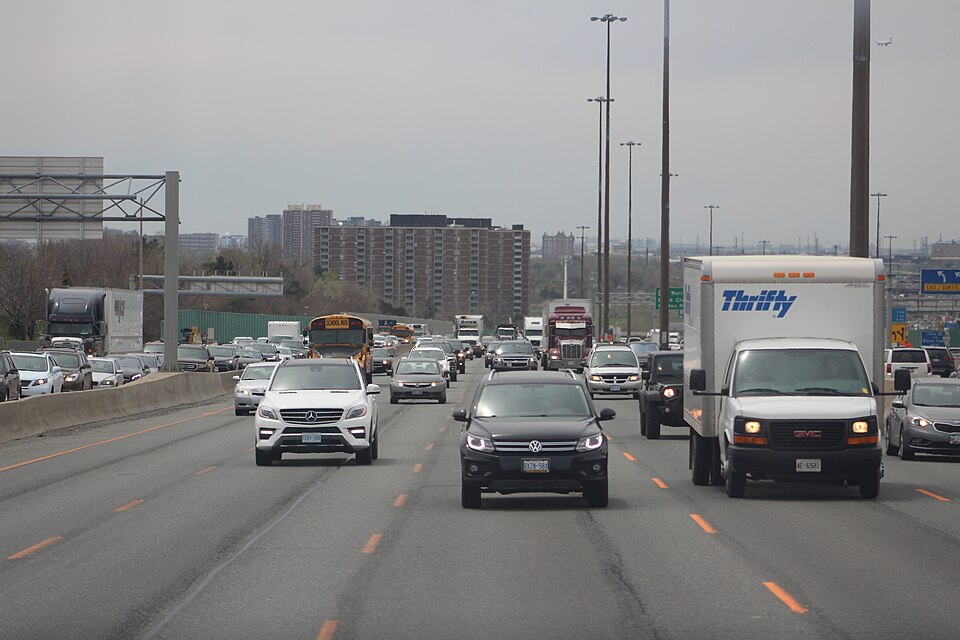
Photo: Jason Zhang, CC BY-SA 3.0, via Wikimedia Commons
The Ontario G road test is the G2 exit test and your last step to a full licence. It takes about 30 minutes, includes expressway driving, and you must sign a Declaration of Highway Driving Experience first. At full-time DriveTest centres it currently leaves out parallel parking, roadside stops, the three-point turn and residential driving. Here is what remains, how the declaration works and how to prepare.
Key facts
- Eligible after 12 months as a G2.
- About 30 minutes, with a highway component (DriveTest).
- You need highway experience on roads with limits of at least 80 km/h, declared on a signed form.
- Reduced content at full-time DriveTest centres and temporary road test locations “until further notice”; part-time Travel Points still give the standard test.
- DriveTest lists the G road test fee as $91.25; check the current amount.
What was dropped from the G road test (and what wasn’t)
| Not currently tested at full-time centres | Still tested |
|---|---|
| Parallel parking | Major roads and expressways: merging on and off, speed, space, signalling |
| Roadside stops | Turns and curves |
| Three-point turn | Lane changes |
| Residential neighbourhoods | Intersections |
| Business areas |
Ontario says the dropped elements are already covered in the G2 road test. This was still in place as of November 2026, but it is temporary. If you book at a Travel Point, expect the full test, including the manoeuvres in the G2 road test guide.
The Declaration of Highway Driving Experience
Before the test you complete and sign the declaration. On it you state:
- how many times in the three months before the test you drove on a freeway or a highway with a speed limit of at least 80 km/h
- the average length of those trips: under 5 km, 5 to 15 km, or over 15 km
DriveTest says you must have driven at least five times on these roads in the last three months. Freeways named in the handbook: the 400, 401, 402, 403, 404, 405, 406, 407, 409, 410, 416, 417, 420 and 427, the Queen Elizabeth Way, Don Valley Parkway, Gardiner Expressway, E.C. Row Expressway and Conestoga Parkway.
If your experience is not enough, the examiner must declare the test out-of-order and cancel it. You lose 50% of the prepaid fee and pay it again to rebook.
Example practice plan
Over the 12 weeks before your test, drive the nearest freeway every other week, choosing trips over 15 km each way. Include entering and leaving at different interchanges, and drive at least once in heavier traffic. That clears the minimum with margin and covers the skills the examiner will watch.
What the examiner checks on the expressway
Entering
- On the ramp, check mirrors and blind spot for a gap as soon as you can see freeway traffic.
- Signal as soon as freeway traffic can see you.
- Match freeway speed in the acceleration lane and merge smoothly into the centre of the nearest lane. Do not merge alongside another vehicle or into its blind spot.
- Cancel the signal once merged.
Driving along
- Mirrors every 5 to 10 seconds; look 12 to 15 seconds ahead.
- Steady speed: not over the limit, not unreasonably slow.
- Two to three seconds behind the vehicle ahead, space on both sides, out of other vehicles’ blind spots.
Exiting
- Signal before the exit lane; enter it at its start.
- Do not slow down until you are fully in the exit lane.
- Don’t cross solid lines between exit lanes. Cancel the signal on the ramp.
More on merging and lane choice: Ontario freeway driving for G2 drivers.
Curves, business areas and intersections
- Curves: slow to a safe speed before the curve and be at it by 30 metres in. Look through the curve to stay centred. No gear changes in the curve with a manual.
- Business sections: drive in the safest through lane (usually the curb lane), watch entrances and crossings, check mirrors every 5 to 10 seconds.
- Intersections: look left, ahead and right before entering; both hands on the wheel; do not change lanes in the intersection. Details in driving through Ontario intersections.
G road test checklist
- Signed highway driving declaration, with real experience behind it.
- A vehicle in good working order, plated and insured, with no electronic aids in use during the test (no cruise control, lane monitoring or back camera).
- Money for any fees due; glasses or contacts if needed.
- Arrive 30 minutes early. No passengers or pets.
If you fail, or your G2 is running out
- Wait at least 10 days before the next attempt.
- If your G2 is about to expire, Ontario.ca says you can take the G2 road test (the G1 exit test) again and get five more years as a G2.
- Rebooking rules: booking, rescheduling and failing a DriveTest road test.
Full route: learning to drive in Ontario.
Common questions
Is parallel parking on the Ontario G test?
Not at full-time DriveTest centres while the reduced test is in place. Part-time Travel Points still give the standard test, which includes it.
How much highway driving do I need for the G test?
DriveTest says at least five trips on roads with limits of 80 km/h or more, or 400-series highways, in the last three months. Longer trips show more experience on the form.
Can I take the G test before 12 months on a G2?
No. The G2 level lasts at least 12 months. Drivers credited with foreign experience follow the rules in New to Ontario.
Can I use cruise control on the highway part?
No. Electronic driving aids, including cruise control, may not be used on road tests.
Do I still need zero alcohol after passing?
Yes, if you are 21 or under. That zero BAC rule applies to all young drivers, whatever their licence class.
Sources
- Government of Ontario, “Get a G driver’s licence: new drivers” (ontario.ca)
- Government of Ontario, “The Official MTO Driver’s Handbook: The Level Two road test” (ontario.ca)
- Government of Ontario, “The Official MTO Driver’s Handbook: Getting your driver’s licence” (ontario.ca)
- DriveTest, “Road Tests” and “Fees” (drivetest.ca)