
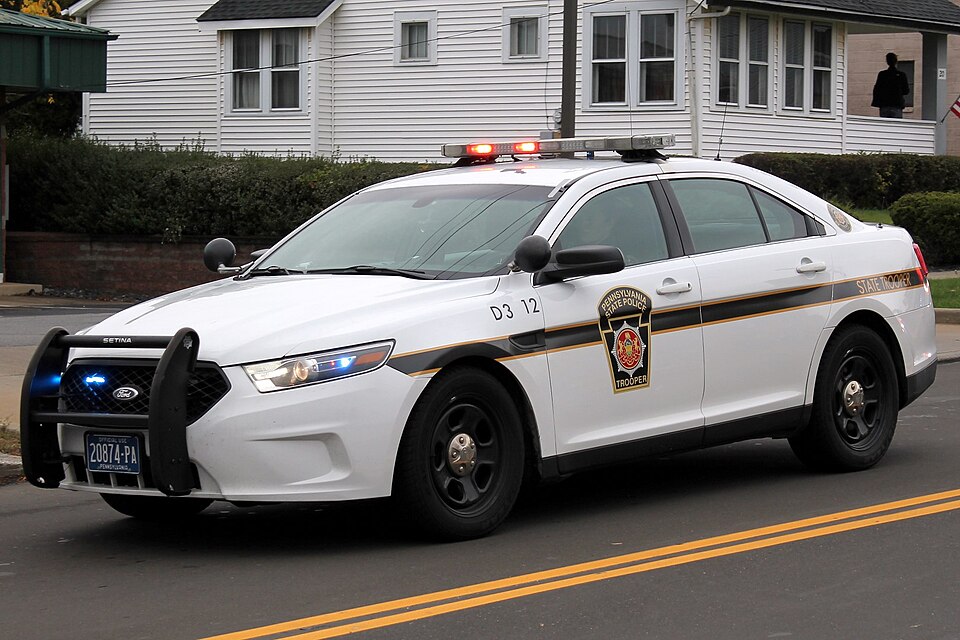
Photo: Raymond Wambsgans, CC BY-SA 2.0, via Wikimedia Commons
Pennsylvania’s move over law (first passed in 2006 as the Steer Clear law) requires you to move into a lane that is not next to an emergency response area or a marked disabled vehicle. If you cannot move over safely, you must slow down. Since April 27, 2021, breaking it brings 2 points and fines of $500, $1,000 and $2,000 for first, second and third offenses. This explainer covers that law plus the other Pennsylvania “stop, slow or stay back” rules learners are tested on: road-closed signs, school buses, emergency vehicles, work zones and snow plows.
Key facts (as of November 2026)
- Move over: 2 points; $500 first offense, $1,000 second, $2,000 third or later, plus a 90-day suspension for a third or later offense.
- Driving around a road-closed sign for hazardous conditions: 2 points and up to $250, or up to $500 plus response costs if emergency responders are called out.
- Not stopping for a school bus with red lights flashing and stop arm out: 5 points and a 60-day suspension.
- Speeding 11 mph or more over in an active work zone: 15-day suspension on top of points.
What the Pennsylvania move over law requires
When you approach an emergency response area or a disabled vehicle, move into a lane that is not adjacent to it. If traffic or conditions stop you moving over, slow down. PUB 95 (4-21) says to reduce speed to at least 20 mph below the posted limit.
- Emergency response area: where police, sheriffs, coroners or medical examiners, firefighters and fire police, fire marshals, rescue and EMS personnel, towing and recovery crews, hazmat teams, or highway construction and maintenance workers are working. Responders mark these with road flares, caution signs or other traffic control devices.
- Disabled vehicle: covered when it shows at least two of: hazard warning lamps, caution signs or other traffic control devices, road flares.
- Trash and recycling trucks: a similar law (Title 75, Section 4572.2) requires you to move over or slow down when approaching a stationary trash or recycling truck.
Road workers and emergency responders can report drivers who fail to move over, and police can issue citations from those reports even if no officer saw it.
Move over penalties in PA
| Situation | Penalty (Act 105 of 2020, effective April 27, 2021) |
|---|---|
| First offense | $500 fine and 2 points |
| Second offense | $1,000 fine and 2 points |
| Third or later offense | $2,000 fine, 2 points and a 90-day suspension |
| Seriously injuring or killing another person | 90-day suspension and a fine of up to $1,000 |
| Seriously injuring an emergency responder or a person in or near a disabled vehicle | Six-month suspension and a fine of up to $5,000 |
| Killing an emergency responder or a person in or near a disabled vehicle | One-year suspension and a fine of up to $10,000 |
Fines for several traffic violations are also doubled in an emergency response area when first responders are present.
Is “Steer Clear” the same as move over?
Yes. PennDOT’s online manual still calls the move over rule the Steer Clear law, which took effect September 8, 2006. Its fine figures ($250, $500, $1,000) are from that original law. The 2021 update replaced them with the higher figures above, so use PennDOT’s current move over page if you see the older numbers in study material.
Road closed for flooding or hazards: do not drive around it
Since September 6, 2012, it has been illegal in Pennsylvania to drive around or through signs or devices closing a road because of hazardous conditions, such as a flooded roadway.
- 2 points and a fine of up to $250.
- If emergency responders are called out because of you: a fine of up to $500, and you are liable for the cost of the emergency response.
School buses: the 10-foot rule
- Amber (yellow) lights flashing: the bus is preparing to stop.
- Red lights flashing and stop arm out: stop at least 10 feet away, whether you are behind the bus, coming toward it on the same road, or approaching an intersection where it is stopped.
- Stay stopped until the red lights stop flashing, the stop arm is withdrawn and the children are safe.
- The only exception: you are on the opposite side of a divided highway separated by a barrier, guide rail or median such as grass, trees or a stream. Slow down and continue with caution.
- Penalty: 60-day license suspension, 5 points and a fine.
How this compares nationally: school bus stopping laws in the US.
Emergency vehicles with sirens or lights
When an emergency vehicle approaches from any direction with a siren or flashing red, or red and blue, lights:
- Pull over to the curb or side of the road and stop, as near and parallel to the curb as you can. On a one-way street, pull toward the nearest side.
- Stay clear of intersections.
- Check that no other emergency vehicle is coming.
- Move off again only after it passes, and keep at least 500 feet behind it.
More detail: pulling over for ambulances, fire engines and police.
Work zones in Pennsylvania
- Turn on your headlights (not just daytime running lights) in posted work zones. PUB 95 (4-21) says this applies to all posted work zones, and police add a $25 fine if you are stopped for a violation in a work zone without them.
- Fines are doubled for certain violations in active work zones, including speeding.
- Speeding 11 mph or more over in an active work zone brings a 15-day suspension plus the usual points. Driving too fast for conditions in an active work zone in connection with a crash also brings a 15-day suspension.
- Do not cross a solid white line in a work zone, do not use cruise control, double your following distance and obey flaggers, whose directions override signals and signs.
- Flaggers can report unsafe drivers to police.
Snow plows
Plow drivers see little in their mirrors and often turn around. Follow at a safe distance, which also protects your car from salt and anti-skid material. Wing plows can stick out several feet on either side, so do not try to pass a plow on the left or the right. Winter driving tips: driving in snow, fog and rain.
Scenario: a tow truck on the highway shoulder
You are in the right lane of a two-lane highway. A tow truck is loading a car on the shoulder with flares out. Check mirrors and blind spot, signal and move into the left lane. If the left lane is full, stay in your lane and slow to at least 20 mph below the limit until you are past. Holding your speed and lane here risks a $500 fine and 2 points on a first offense, which for a junior driver also counts toward the 6-point suspension. See the Pennsylvania point system.
Common questions
What is the fine for not moving over in Pennsylvania?
$500 for a first offense, $1,000 for a second and $2,000 for a third or later, plus 2 points each time.
Does the PA move over law apply to a car with its hazard lights on?
Only if it shows at least two of: hazard lamps, caution signs or other traffic control devices, road flares. Moving over or slowing for any stopped car is still sensible.
What if I cannot move over safely?
Slow down. PUB 95 (4-21) says to reduce speed to at least 20 mph below the posted limit.
Do I stop for a school bus on the other side of a divided highway in PA?
No, if a barrier, guide rail or median separates you. On any undivided road you stop in both directions.
How far behind a fire truck must I stay?
At least 500 feet once you move off after it passes.
Is Pennsylvania’s move over law the same in other states?
No. Scope and penalties differ by state. See move over laws in the US.
Back to the main guide: how to get a driver’s license in Pennsylvania.
Sources
- PennDOT, “Move Over, Slow Down: Pennsylvania’s Move Over Law” (pa.gov)
- PennDOT, “Online Driver’s Manual: Special Circumstances and Emergencies” (pa.gov)
- PennDOT, “Online Driver’s Manual: Chapter 5, Laws and Related Issues” (pa.gov)
- PennDOT, “Point System” fact sheet, March 2024 (pa.gov)
- PennDOT, “Pennsylvania Driver’s Manual, PUB 95 (4-21)” (pa.gov)