
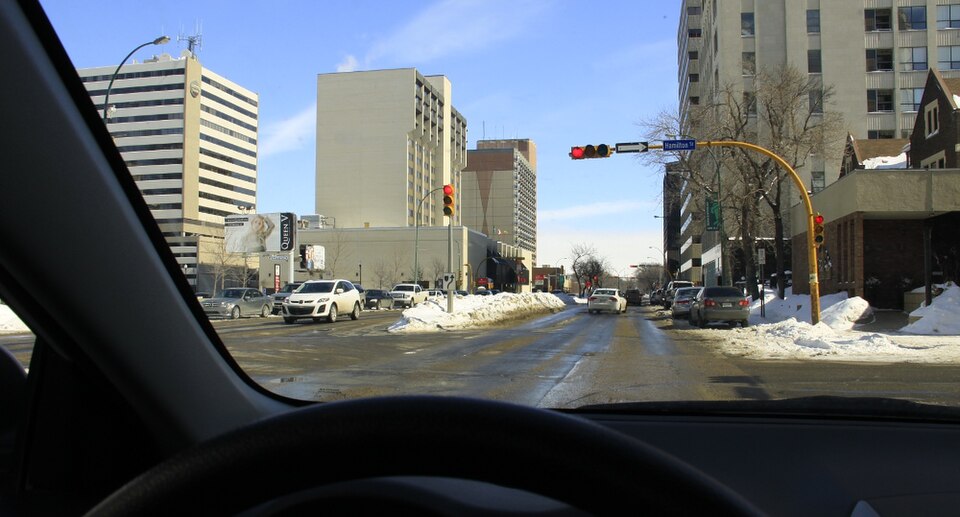
Photo: waferboard, CC BY 2.0, via Wikimedia Commons
The SGI Class 5 road test checks whether you can drive safely in real Saskatchewan traffic. Examiners score signs, hazards, backing and parking, two-point turns, lane driving, shoulder checks, intersections and turns. You need nine months on your Class 7, proof of driver education and a road-safe vehicle. This guide lists what is scored, what gets a test rescheduled, the instant fails, and how to do a two-point turn the SGI way.
Before you can book
- At least nine months held on your Class 7 learner licence (time suspended or not renewed does not count).
- Mandatory driver education finished, with a training record on your SGI file or a Driver Education Certificate in hand. See SGI mandatory driver education.
- Book online through MySGI or through a motor licence issuer. Add your cellphone number to get text reminders 24 hours and one hour before, and to check in by text.
- Road test slots in smaller centres are reserved for local residents.
- Test fee paid. Check the current fee with SGI.
What does the SGI examiner score?
- obeying road signs along the route
- anticipating potential hazards
- backing up, parallel parking and two-point turns
- proper lane driving
- shoulder checking
- starting and stopping
- traffic signs and signals
- controlled and uncontrolled intersections
- turning
- safe driving practices such as speed selection and steering
Depending on the office, the examiner scores on paper or with a tablet app. The test is in English. Know these terms: right turn, left turn, lane change, traffic lights, intersection, stop, shoulder check, two-point turn, parallel park.
Instant fails on the Saskatchewan road test
| You fail if you | How to avoid it |
|---|---|
| Exceed the speed limit | Know the limit on every road. Unposted roads are 80 km/h, but urban limits apply inside town boundaries. |
| Are 50% or more responsible for a collision | Keep at least three seconds of following distance and two open gates. |
| Fail to stop where required | Stop at the stop line, or the crosswalk, or within 3 m of the intersection in town. |
| Fail to yield to vehicles or pedestrians | Scan crosswalks before every turn, including right turns on red. |
| Disobey traffic lights | On amber, stop before the crosswalk unless you cannot stop safely. |
| Need the examiner’s help | Practise the manoeuvres until they are automatic. |
| Make a combination of minor mistakes | Small habits add up: late shoulder checks, rolling stops, missed signals. |
Gates and shoulder checks: what the examiner watches for
SGI teaches that four “gates” surround your car: front, rear and each side. A gate is closed by a vehicle, curb, guardrail or even deep snow. A safe driver always keeps at least two gates open. On test day this shows up as:
- checking your inside and left mirrors often, so you always know if your rear gate is open
- shoulder checking the blind spot of the gate you are moving into before every lane change, pull-out and turn
- dropping back to five or six seconds behind the car ahead if someone is tailgating you
How to do a two-point turn in Saskatchewan
A two-point turn turns you around by backing into a driveway or approach on your right. First check sight distance: at least 20 seconds clear each way in a 60 km/h area, 40 seconds in a 100 km/h area.
- Well before the turnaround spot, signal right, shoulder check, move to the right lane and slow down.
- Cancel the signal, drive past the approach or intersection, and stop as far right as possible.
- Signal right or switch on your four-way flashers. Check for traffic.
- Back up slowly. When your rear bumper is even with the approach, turn the wheel sharply right. Watch that the front of the car does not swing into traffic.
- Straighten the wheels as you back in, then stop.
- Signal left, check traffic and turn left into the left driving lane.
U-turns
A U-turn turns you around at an intersection. It is banned at traffic lights unless a sign permits it. Before you try one, check for prohibiting signs, room to turn in one swing and the same sight distance as a two-point turn. If you have any doubt, go around the block.
- Signal and approach as you would for a left turn.
- Move very slowly and turn the wheel to full lock as soon as you can, hand over hand.
- Once on full lock, speed up slightly and keep checking both ways.
- Start unwinding before the car is straight, and finish in the left-most driving lane.
Backing up the SGI way
Backing collisions are among the most frequent type, so practise until backing is routine.
- Check behind the car first. Children, pets and bicycles aren’t always visible from inside.
- Start with the car and front wheels straight.
- Shift onto your right hip, brace with your left foot, put your right arm along the seat and palm the top of the wheel with your left hand.
- Look out the rear window, well back along your path, and back slowly.
- In the first foot or so, check forward. If the front swings left, steer left to straighten; if it swings right, steer right.
- Expect the front to swing wide as you turn. This front end swing causes many backing collisions.
For sharper turns while backing use hand over hand, hand-to-hand or palming, where your palm presses the rim and stays in one place on it. Sensors, 360-degree cameras and blind spot monitors are aids only.
Parallel and angle parking
Parallel parking, one method SGI suggests. Signal as you approach and check you have at least 2 m more than your car’s length.
- Stop parallel to the front vehicle, about 0.5 m out, with your back bumpers lined up. Shift to reverse and check it is clear.
- Back slowly, turning the wheel toward the curb until you are at about 45 degrees. Watch your front end swing into traffic.
- Keep backing slowly and straighten your wheels.
- When your front bumper clears the front vehicle, turn your wheels away from the curb.
- If needed, pull forward slowly and straighten up.
Angle parking: stalls at about 60 degrees are meant to be driven into and backed out of. Signal, slow down and approach about one vehicle width from the parked cars. When your front end is even with the rear of the stall, steer sharply into it, checking both sides, then straighten and pull fully in. Backing out, shoulder check both sides and the rear, and if a truck blocks your view, move back cautiously.
Set up the car first
- Check that doors are closed, loose objects secured, seat, head restraints and mirrors adjusted, seatbelts fastened, and warning lights working and going out when the engine starts. If an engine or oil light comes on later, find the cause as soon as you safely can.
- Find the wipers, washers, horn, lights, heater, signals and hazard lights without looking. Car controls for learner drivers covers seat, mirror and hand positions.
- Left foot brace: push your left foot against the fire wall to steady yourself in curves, braking and emergencies, which leaves your right foot free. Always brake with your right foot.
- Crawling in an automatic: rest your foot on the brake and let the engine’s idle move the car. In a manual, control very low speeds with the clutch.
- Manual cars: learn the gear pattern without looking, shift in order, never force a gear, never coast in neutral, don’t ride the clutch, and park in first gear rather than neutral. Some SGI-certified instructors teach manual.
Vehicle check: reasons your test gets rescheduled
The examiner inspects your car first. These must work, or you will be rescheduled:
- horn, signal lights, brake lights, speedometer
- headlights, wipers and defrost, as required
- seatbelts and airbags
- one valid licence plate attached at the rear
- windshield with no obstructing cracks, stickers or tint; no aftermarket tint on the windshield or front side windows
- working driver and front passenger doors, and proper seats
- a clean passenger compartment without strong scent or odour
- the right class of vehicle for the licence
Not sure about a cracked windshield? Have an examiner at your local office look at it before test day.
The test is also rescheduled if you are late, have no proof of driver education, hold the wrong licence, have not paid, have not held a Class 7 for nine months, or do not meet vision or medical standards.
On the day
- Park and turn off your car.
- Stay in the car and text “Here” if you signed up for texts.
- Keep your phone on with the ringer on: the examiner calls you, asks a few questions, then comes out.
- Have your photo ID ready.
- Your supervising driver waits in the waiting room, not the parking lot. No pets or passengers are allowed in the car.
After the test
You get a full report explaining every error, on paper or by email with links to the handbook sections to work on. If you fail a Class 5 test you must wait two weeks before trying again, and pay the fee again. The examiner may recommend more training or a longer learning period. If you pass, results are valid for 12 months, but you must upgrade to Class 5 at a motor licence issuer before driving alone. Then Novice 1 rules apply.
Common questions
How long do I wait to retake the SGI road test?
Two weeks after a failed Class 5 road test.
Can I use a car with a back-up camera?
The handbook says back-up cameras are helpful but no substitute for proper technique: they do not capture everything. Turn your head to look out the rear window, check all directions and use your mirrors along with the camera. Don’t rely mainly on the screen: sun glare, snow or dirt on the lens can block its view, so keep the lens clean and keep looking out the rear window.
Does SGI provide a car for the test?
No. You must supply a vehicle in the right class that passes the examiner’s check.
Can my parent ride along during the test?
No. Only examination staff can be in the car.
Can I take the test in another language?
SGI road tests are conducted in English, using simple, clear directions.
What should I practise most?
The scored list above, especially shoulder checks, full stops and the two-point turn. Keep a Practice Log to cover a range of conditions.
Related: learning to drive in Saskatchewan, IPDE and eye lead time, roundabouts and interchanges.
Sources
- SGI, “Saskatchewan Driver’s Handbook: A guide to safe driving 2026-27” (sgi.sk.ca)
- SGI, “Your test” (sgi.sk.ca)
- SGI, “Parking” (sgi.sk.ca)