
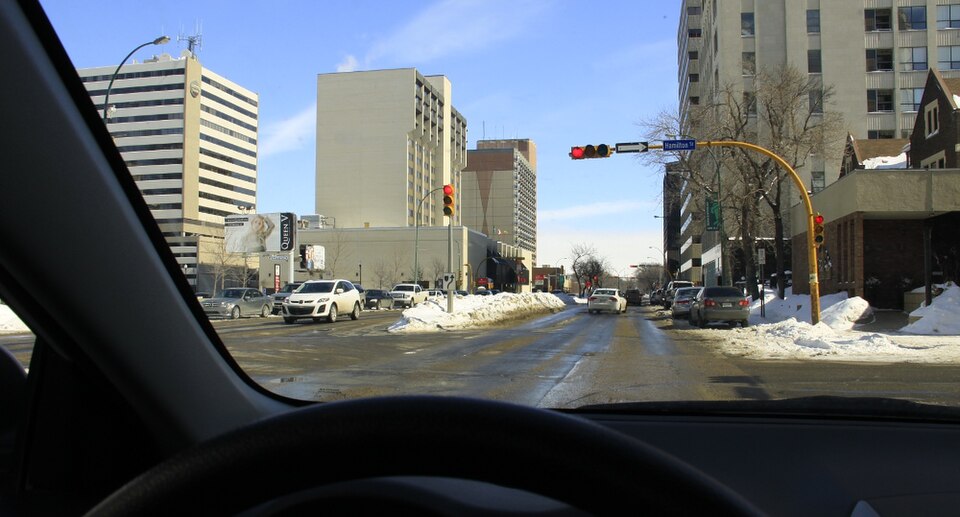
Photo: waferboard, CC BY 2.0, via Wikimedia Commons
IPDE is the four-step hazard method in SGI’s Saskatchewan Driver’s Handbook: Identify, Predict, Decide, Execute. It works with a 12-second eye lead, meaning you reference the road about 12 seconds ahead, and a minimum three-second following distance. This guide explains each step, the search pattern SGI teaches, and drills to practise with your supervising driver.
Key facts
- IPDE: Identify, Predict, Decide, Execute.
- Eye lead: reference down about 12 seconds ahead, in the city and on the highway.
- Look up: as far as you can see; on a straight highway that can be up to 90 seconds.
- Following distance: at least 3 seconds in ideal conditions; more in poor conditions or behind trucks and motorcycles.
- Gates: never drive with fewer than two of your four gates open.
Real and potential hazards
A hazard is anything that forces you to change speed or steering to avoid a collision.
- Real hazard: something you must react to, such as a red light, a car stopping in your lane, or a curve that needs you to slow down.
- Potential hazard: something that might happen, such as a car signalling a lane change, a car on the shoulder that could pull out, or a pedestrian who might step out.
The four IPDE steps
| Step | What you do | Example |
|---|---|---|
| Identify | Spot real and potential hazards early and filter out what doesn’t matter | Ignore a restaurant’s neon sign; notice the child near the curb |
| Predict | Work out what the hazard may do, and keep updating | The car ahead may turn right; the child may run across |
| Decide | Plan your action in detail | Brake gently, change lanes, or keep watching |
| Execute | Carry out the decision smoothly | Ease off, cover the brake, stop smoothly |
Before you act: SGI’s four checks
- Is your chosen gate still open?
- What is the road surface like for braking?
- What are the shoulder and ditch like?
- Keep watching the other vehicle and decide whether to act.
IPDE gets faster with practice until much of it is instinctive. Fatigue, illness, alcohol, drugs and distraction all slow it down. When tired or unwell, SGI advises reducing speed, avoiding heavy traffic, or not driving.
Using time to judge distance
Count seconds out loud: “thousand one, thousand two, thousand three.” To measure your following distance, start counting when the car ahead passes a fixed object (a sign, shadow or pavement patch) and stop when your front bumper reaches it. Under three seconds? Drop back. If a large truck or van blocks your view, drop back further until you can see around it. Other drivers may cut into your gap sometimes; don’t give it up because of that.
| Speed | 3-second gap | 12-second eye lead |
|---|---|---|
| 100 km/h | 84 m | 336 m |
| 80 km/h | 66 m | 264 m |
| 60 km/h | 51 m | 204 m |
| 50 km/h | 42 m | 168 m |
| 40 km/h | 33 m | 132 m |
Looking far enough ahead lets you see a problem 12 to 60 seconds away, often before the driver in front sees it, so you respond to the problem, not just their brake lights.
SGI’s search pattern
On highways and rural roads
- Look up to the horizon.
- Reference down to about 12 seconds ahead. At 100 km/h, that is where the spaces in the broken lines seem to disappear.
- Sweep left and right about 12 seconds ahead for entering vehicles, animals, people and approaches.
- Fill in the gap between you and the 12-second point: vehicles, ice, potholes, the shoulder.
- Check your gates with your mirrors.
- Check instruments only on a straight, clear stretch. Even checking speed takes about one and a half seconds.
Keep returning to look up and reference down between the other steps.
In the city
Look up several lights or blocks ahead. Reference down 12 seconds, looking around or through cars ahead for brake and signal lights. Sweep wider and more often than on the highway. If you can’t keep your rear and side gates open, drop back to five or six seconds. Check your gauges at traffic lights and stop signs, and your speed only in light traffic or on straight, clear roads. In dense traffic, plan your route in advance, keep searching and keep your following distance, even if the drivers around you are one second apart.
At night
Still reference about 12 seconds ahead, which is often beyond your headlights. Look straight ahead in line with your seat, not at oncoming headlights or the road edge. With less than 12 seconds of view you are over-driving your headlights, so slow down. If you can see the rear lights of the vehicle ahead, no large object is between you. Brake as soon as you detect something on the road, while you work out what it is.
On curves
Look across and around as far as you can see. In a right curve, look at the shoulder line to where it disappears. In a left curve, look along the centre line. Coming out, look along your lane to the horizon.
In an emergency or skid
Look where you want to go and steer there. You steer where you look.
Spotting a collision course at intersections
Approaching an intersection with another vehicle heading for it, hold your speed and course and turn your head to note its position. A few seconds later, check again. If it is in the same position relative to you, you are on a collision course: slow down and be ready to yield or stop. Turn your head; don’t rely on peripheral vision.
Practice drills with your supervisor
- Guess and count: pick a sign ahead, guess how many seconds away it is, then count. Practise at 50, 80 and 100 km/h.
- Commentary drive: say aloud every hazard you identify and what you predict it will do.
- Steer where you look: on a quiet straight highway, look at the centre line 12 seconds ahead and notice the car drift toward it. Then look straight ahead to correct.
Common questions
What does IPDE stand for?
Identify, Predict, Decide, Execute.
What is eye lead time?
How far ahead you look, measured in seconds. SGI teaches referencing about 12 seconds ahead while looking up as far as you can see.
Is IPDE tested on the SGI road test?
The road test scores “anticipation of potential hazards” and shoulder checking, which is what IPDE and gate checks train. See the SGI road test guide.
Is three seconds always enough?
No. It is the minimum in ideal conditions. Increase it in poor weather, when tired, and behind large trucks or motorcycles.
Related: learning to drive in Saskatchewan, SGI written test, rural and gravel road driving.
Sources
- SGI, “Saskatchewan Driver’s Handbook: A guide to safe driving 2026-27” (sgi.sk.ca)