
Photo: Masterhatch, CC BY-SA 4.0, via Wikimedia Commons
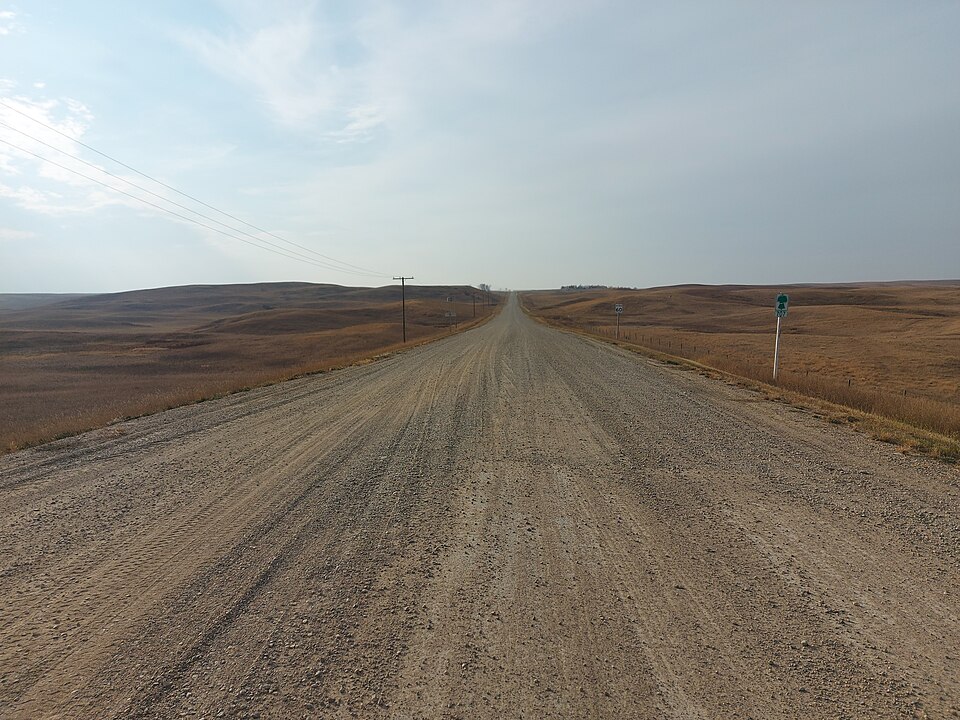
Saskatchewan’s grid, municipal and resource roads are gravel or dirt, with no shoulders, sharper curves and T-intersections that end with little warning. SGI’s handbook says to drive slowly, keep your headlights on, stay right of centre on hills and blind curves, and slow to 60 km/h when passing stopped highway equipment with lights flashing. This guide covers gravel technique, farm machinery, snowmobiles and ATVs, and wildlife.
Key facts
- No posted limit on a grid road: 80 km/h is the maximum, and only in ideal conditions.
- Farm equipment travels at 10 to 40 km/h and is on highways and grid roads from early spring to late fall.
- 60 km/h maximum passing stopped emergency vehicles, tow trucks, snow plows or highway equipment with lights flashing.
- When stopping on a rural road, stay at least 30 m from any vehicle stopped on the opposite side.
- Wildlife collisions peak at dawn and dusk, in May and June, and in late fall and early winter.
Why grid roads are different
- Shorter sight distances, no shoulders and sharper curves.
- Many T-intersections where the road ends, often with little notice.
- Railway crossings, crossroads and farm entrances are harder to see than on highways.
- More slow farm vehicles, livestock and wildlife.
- These roads are not built to get you out of trouble if you are going too fast. Treat the speed limit as a maximum.
Read the delineators
Triangular reflectors on stop or yield posts at rural intersections show the road you are about to meet: three for highways, grid roads and community access roads; two for main farm access and improved all-weather roads; one for other minor rural roads.
How to drive on gravel in Saskatchewan
- Slow down as you leave the highway. Gravel and dirt give far less grip than pavement.
- Keep your eyes up for as much warning as possible.
- Stay right of centre on hills and blind curves. The main track is often in the centre, but oncoming traffic you can’t see may be using it.
- In deep gravel, grip the wheel firmly and expect the car to wander. Don’t over-steer to fight it; that can cause loss of control.
- Stay well back from dust clouds. Dust makes meeting and passing very dangerous.
- Keep your headlights on so others see you sooner.
- Meeting a large truck or farm equipment: slow down and pull as far right as you can. You may need to stop.
Watch for two extremes: deep loose gravel that makes curves hard to steer, and so little gravel that you are on dirt, which is very slippery when wet.
Farm equipment on Saskatchewan roads
Combines, tractors and large cultivators move at 10 to 40 km/h, so you close on them quickly. Be ready to slow or change lanes, and only pass when it is safe. If needed, stop on an approach or pull to the right edge of the road to let the machinery pass.
Snow plows and highway equipment
- Slow to 60 km/h when passing snow plows or highway equipment stopped with blue and amber lights flashing.
- Ministry of Highways equipment with lights flashing: 60 km/h maximum whether it is moving or not.
- A moving snow plow can be passed when safe. Stay back from the snow cloud it throws up; most plow crashes are rear-end collisions.
- Fines triple for speeding past highway workers in a work zone.
The same 60 km/h rule covers stopped emergency vehicles and tow trucks. See slow down, move over.
Snowmobiles, ATVs and golf carts
Snowmobiles are small, low and often out in storms when visibility is poor. Children may be driving snowmobiles and ATVs. Expect them to cross suddenly. Some municipal bylaws allow snowmobiles, ATVs and golf carts on streets.
If you ride one yourself: Class 1 to 5 holders may operate a snowmobile or ATV, and snowmobile operators born after 1 January 1989 also need an approved safety course. A Class 7 learner may do so only when accompanied by a Class 1 to 5 holder, or supervised within 5 m and in view by one on another machine. Class 7 or higher may drive a golf cart on a public road only where the municipality has passed an SGI-approved bylaw.
Wildlife and livestock
- Slow down in areas with yellow wildlife warning signs.
- Scan shoulder to shoulder. At night, watch for glowing eyes and use high beams when you can.
- If an animal crosses, expect others to follow. You can sound your horn to scare wildlife off the road.
- If an animal appears suddenly, brake firmly and stay in control. Don’t swerve into oncoming traffic or the ditch.
- Herded animals or horseback riders: slow down, wait to be waved through, and don’t use the horn.
If a collision can’t be avoided
Aim for where the animal came from, not where it is going. Try for a glancing blow, and let up on the brake just before impact so the front of the car rises slightly. Afterwards, pull onto the shoulder with hazards on, don’t approach the animal, and call police or the RCMP if anyone is hurt or damage is significant. Report a dead or injured animal to the Conservation Officer Service. More in moose, deer and caribou.
Winter on Saskatchewan roads
You could be driving in winter conditions for at least five months of the year. Most collisions happen from November to March, and the main cause is failing to adjust to changing conditions. Check the Highway Hotline (hotline.gov.sk.ca/map) before you leave, and stay home if it says travel is not recommended.
- Slippery curves: slow down early and start toward the inside of your lane. Steer gradually across the lane so that near the mid-point of a right curve you are near the right side with your wheels straight, then steer gradually back toward the left as you exit. Reverse this for left curves.
- Stopping: shift to neutral or declutch first, brake early and gently, and look for the best traction. Sand, grit or snow grips better than ice, and a small move within your lane can find it.
- Long trips: dress warmly, listen to forecasts, keep the tank above half and consider stopping over in a town if you could get stranded.
- Stranded: stay with the vehicle and keep calm. Lower your downwind windows slightly, open the heater vent for fresh air, keep the exhaust clear, and run the engine for heat without running out of gas or draining the battery.
The full kit list and techniques are in winter driving in Canada for new drivers.
Skids, hard braking and emergency steering
Good search patterns prevent most emergencies, but gravel and ice leave little margin. SGI suggests practising these techniques with a trained instructor. Soft shoulders, ditches, blow-outs and brake failure are in car emergencies in Canada.
| Situation | What SGI teaches |
|---|---|
| Normal braking | Begin early with light pressure and ease up as you stop. Always brake with your right foot, and brake in a straight line. |
| Hard braking with ABS | Press firmly and hold until stopped. Do not pump. A pulsing pedal and clunking noises are normal. Allow a longer stopping distance on gravel, slush and snow than with conventional brakes. |
| Hard braking without ABS | Threshold brake if you are calm. A four-wheel lock gives the shortest stop on every surface except glare ice, but the car will not steer while the wheels are locked. |
| Steering around an object | Steer, counter-steer, then straighten, and get the car straight before any second move. If you must choose, steer: it takes less distance than stopping. |
| Braking and steering together | Without ABS, brake first, come off the brake, then steer. With ABS, brake hard and steer where you want to go. |
| Skid from braking | Shift to neutral or declutch where your owner’s manual allows it, take your foot off the brake, look where you want to go and steer there. |
| Skid from too much acceleration | Shift to neutral or declutch, come off the accelerator, look and steer where you want to go. Do not touch the brake. |
| Skid from steering too sharply | Shift to neutral or declutch and turn the wheel back toward centre until the front wheels grip, then steer where you want to go. |
| Vehicle starting to spin | Shift to neutral if you have time and lock all four wheels. The car keeps going in a straight line and usually stays on the road. |
| Engine stalls and power assistance goes | Push much harder on the brake and steering wheel, try shifting to neutral and restarting, then return to drive. |
Avoid skids by adjusting speed first, looking well ahead and keeping every move smooth. Never use cruise control on wet or slippery roads or on gravel.
Common questions
What is the speed limit on a Saskatchewan grid road?
The posted limit, or 80 km/h when none is posted. Both are maximums for ideal conditions.
Do I have to slow down for a plow that is moving?
The handbook’s snow plow section sets 60 km/h for plows stopped with blue and amber lights flashing, and says drivers passing a moving plow are not limited to 60 km/h. Its speed section also sets 60 km/h for Ministry of Highways equipment with lights flashing, moving or not, so slow down if you are unsure. Either way, pass only when it is safe.
Should I drive in the centre of a gravel road?
The main track is often in the centre, but keep right of centre on hills and blind curves.
Can a learner drive on grid roads?
Yes, with a supervising driver. SGI’s advice is to practise in a variety of conditions, and the road test scores uncontrolled intersections.
What about winter on gravel?
See winter driving in Canada for new drivers.
Related: learning to drive in Saskatchewan, IPDE and eye lead time.
Sources
- SGI, “Saskatchewan Driver’s Handbook: A guide to safe driving 2026-27” (sgi.sk.ca)