
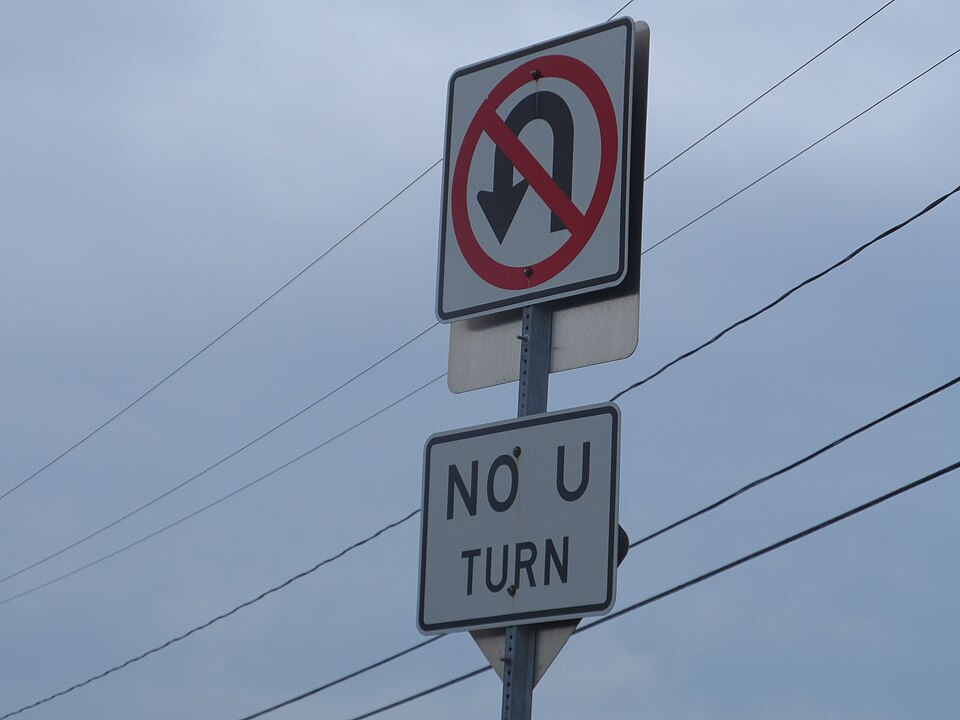
Photo: MarkBuckawicki, CC0, via Wikimedia Commons
Are U-turns legal in the US? Usually yes, where no sign bans them and you can see and be seen by other traffic, but each state sets its own limits. This guide is for learner and new drivers. It explains the places where U-turns are commonly banned (business districts, curves, hilltops, railroad crossings, one-way streets) and shows how California, Pennsylvania, Texas and Florida word their rules, as of November 2026.
Key facts
- No state allows a U-turn where a NO U-TURN sign is posted.
- Most limits are about visibility: you must be able to see oncoming traffic, and it must be able to see you, from a set distance.
- California: 200 feet of clear view in each direction, and no U-turns in business districts except at intersections or divider openings.
- Pennsylvania: traffic from all directions should be at least 500 feet away, and no U-turns on curves or near a hill crest.
- Texas: no turning around near a curve or hill crest unless approaching drivers can see you within 500 feet.
- Florida: legal only if it is safe, doesn’t interfere with other traffic and isn’t banned by a sign.
Where U-turns are banned in most states
The wording varies, but these places come up again and again in state handbooks and traffic codes:
- Where a NO U-TURN sign is posted. This applies at intersections too, even on a green light.
- On curves and near the top of a hill. Drivers coming the other way can’t see you in time.
- At or on a railroad crossing. See railroad crossings.
- On one-way streets. You would end up facing the wrong way.
- Across a median, curb or painted barrier. On a divided highway, turn only at an opening provided for it.
- Where you can’t see far enough in both directions.
If you miss a turn, the California handbook’s advice works everywhere: keep driving until you can safely and legally turn around. On a freeway, that means taking the next exit. See freeway driving for new drivers.
California U-turn rules
The California Driver’s Handbook gives the most detailed list of any state checked. To make a U-turn, signal and use the left turn lane or far-left lane.
| You may make a U-turn | Never make a U-turn |
|---|---|
| Across a double yellow line | Where a NO U-TURN sign is posted |
| In a residential district, if no vehicles are approaching within 200 feet | At or on a railroad crossing |
| At an intersection on a green light or green arrow, unless a sign bans it | On a divided highway by crossing a divider, curb, strip of land or two sets of double yellow lines |
| On a divided highway, through an opening in the center divider | When you can’t see clearly for 200 feet in each direction |
| On a one-way street | |
| In front of a fire station, or using a fire station driveway to turn around | |
| In business districts, except at an intersection or a divider opening |
A business district is the part of a city or town where most offices and businesses are. A center left turn lane can also be used to prepare for a U-turn in California. See center two-way left-turn lanes.
Pennsylvania, Texas and Florida compared
| State | What the rule says | Distance in the rule |
|---|---|---|
| Pennsylvania | Allowed only if it doesn’t endanger other traffic. Not allowed on curves or when approaching or near the crest of a hill, or where a NO U-TURN sign is posted. | Drivers from all directions at least 500 feet away and able to see you clearly |
| Texas | You may not turn to go the opposite way when approaching a curve or hill crest if drivers coming from either direction can’t see you within 500 feet (Transportation Code 545.102). | 500 feet, near curves and crests |
| Florida | Turning to go the opposite way is allowed only if it can be done safely, without interfering with other traffic, and isn’t banned by posted signs (Florida Statutes 316.1515). A violation is a moving violation. | None stated |
Cities can add their own bans with signs, so the sign at the spot always wins. For other states, check the turning section of your state handbook. State guides are linked from learning to drive in the USA.
How to make a safe U-turn, step by step
- Pick a legal spot. No sign against it, straight road, clear view both ways, not a business block mid-street (in California), not near a hill or curve.
- Signal left early and move into the left turn lane or the lane closest to the center.
- Stop or slow and check oncoming traffic, cross traffic, pedestrians and cyclists. Check your mirrors for anyone coming up behind.
- Turn the wheel fully and go around in one smooth movement, at walking pace.
- Finish in the correct lane going the other way, usually the lane nearest the center or the right lane if the road is narrow, then build up speed.
If the road is too narrow to turn in one go, a U-turn isn’t the right move. Use a three-point turn instead, or drive on to a place where you can turn around. See three-point turns and turnabouts.
Scenario: can you U-turn here?
- A quiet residential street in California, no cars within 200 feet, no sign. Yes.
- A shopping street downtown, mid-block, in California. No. Business districts allow U-turns only at an intersection or divider opening.
- A green light at a big intersection with no sign. In California, yes. Watch for right-turning drivers coming from the cross street, who may also think they have the gap. If a sign bans it, no.
- Just before the top of a hill on a country road in Pennsylvania or Texas. No. Oncoming drivers can’t see you in time.
- Across the double yellow lines to turn around. In California the handbook allows a U-turn across a single set of double yellow lines, but never across two sets spaced two or more feet apart (a barrier). Check your own state.
U-turns on the road test
Examiners may ask you to turn around, but many states test a three-point turn or another turnabout instead of a U-turn. Either way, they score the same things: signaling, full observation before and during the turn, smooth control, and not choosing an illegal or unsafe place. An illegal U-turn in front of an examiner is the kind of dangerous or illegal maneuver that can end a test. See US road test by state and common reasons people fail the driving test.
Common questions
Is a U-turn at a traffic light legal?
Often yes. California allows it on a green light or green arrow unless a NO U-TURN sign is posted. Other states may treat signal-controlled intersections differently or post signs, so look for a sign before you go.
Can you make a U-turn on a double yellow line?
In California, yes, across a single set of double yellow lines. Not across two sets of double yellow lines two or more feet apart, which count as a barrier. Rules differ elsewhere.
Are U-turns illegal in a business district?
In California, yes, except at an intersection or through an opening in a divided highway. Some other states have similar rules or use signs. Check your state handbook.
How far must you be able to see before a U-turn?
California says 200 feet in each direction. Pennsylvania says oncoming drivers should be at least 500 feet away and able to see you. Texas uses 500 feet near curves and hilltops.
Can I U-turn in a center turn lane?
California allows the center left turn lane to be used to prepare for a U-turn. You still need a legal, clear place to finish the turn.
What is the penalty for an illegal U-turn?
It is usually a moving violation, which may add points to your record. Florida’s law classes it as a moving violation. For how points work, see points systems and license suspensions.
Sources
- California DMV, “California Driver’s Handbook: Navigating the Roads” (dmv.ca.gov)
- Pennsylvania Department of Transportation, “Pennsylvania Driver’s Manual: Turning, Merging, and Passing” (pa.gov)
- Texas Legislature, “Transportation Code Chapter 545, Section 545.102” (tcss.legis.texas.gov)
- Florida Legislature, “Florida Statutes s. 316.1515, Limitations on turning around” (leg.state.fl.us)