
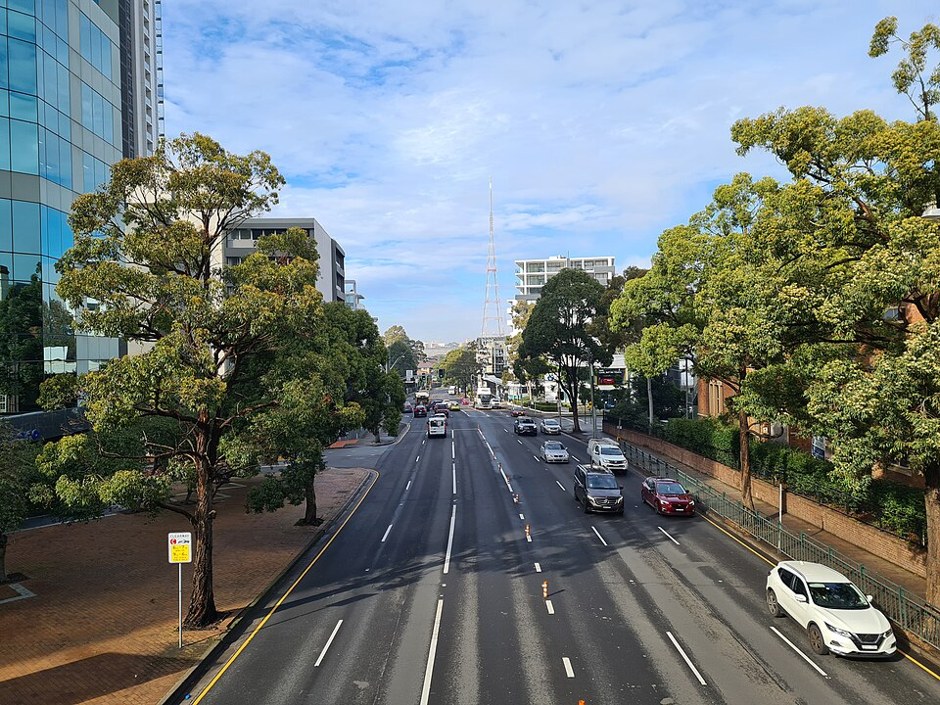
Photo: Andrew Harvey, CC BY 4.0, via Wikimedia Commons
Road markings in Australia follow the national Australian Road Rules, but the state handbooks word some line rules differently. This explainer shows what each dividing line, lane line, edge line and painted marking means, and when you may cross it. It is for learners studying for a knowledge test and anyone unsure about a line.
Key facts
- Broken line: you may cross it to overtake or change lanes when it is safe.
- Continuous line on your side: you must not cross it to overtake.
- Passing a bicycle rider: NSW, Victoria, Tasmania, the ACT and the NT let you cross continuous centre lines to give the required passing distance, if you have a clear view and it is safe.
- Painted islands: with single lines around them, you may drive on them for up to 50 metres to enter or leave a road or reach a turning lane. With double lines, never.
- Keep clear: you must not stop on the marked area.
- Yellow edge lines: continuous means no stopping. Broken means a clearway.
Dividing lines: what each one lets you do
Dividing lines separate traffic travelling in opposite directions. Keep to the left of them. Any line may be crossed to avoid an obstruction if you have a clear view of oncoming traffic and it is safe (NSW).
| Line | Overtake? | U-turn? | Turn in or out of a road or driveway? |
|---|---|---|---|
| Single broken | Yes, if clear | Yes, unless signed | Yes |
| Single continuous | No | No | Yes |
| Double, broken line closer to you | Yes, if clear | Yes, unless signed | Yes |
| Double, continuous line closer to you | No | No | NSW: yes. Tasmania: yes, into or out of a road, driveway or car park. Check other states |
| Double continuous | No | No | Varies by state (see below) |
| Double broken (Tasmania) | No | No | Yes |
Some NSW roads have wide centrelines up to 1.5 m apart to help prevent head-on crashes. They follow the same rules as other dividing lines.
Double continuous lines: the states word it differently
- NSW: you can cross double continuous lines to enter or leave the road by the shortest route.
- Victoria: do not cross double continuous lines to overtake a motor vehicle, to turn, or to enter or leave the road.
- Tasmania: only cross them to avoid a hazard or pass a bicycle rider. Not to turn into a road or driveway.
- NT: unless a sign says otherwise, you can cross any dividing line to turn right at an intersection, to angle park on the other side, or to enter or leave a property by the shortest route.
Learn the version in your own state’s handbook, because that is what your knowledge test is based on.
Crossing a continuous line to pass a cyclist
You must leave at least 1 metre when passing a bicycle rider where the limit is 60 km/h or less, and 1.5 metres above that. To do it, the NSW, Victorian, Tasmanian, ACT and NT handbooks let you cross continuous centre lines if you have a clear view of oncoming traffic and it is safe. The ACT and NT also let you straddle lane lines and drive on painted islands. If it is not safe, wait behind the rider. Each state’s rule: minimum passing distance for cyclists in each Australian state.
WA’s Drive Safe handbook does not describe this exception. Check with the WA Department of Transport before relying on it.
Lane lines on multi-lane roads
- Broken lane lines: you may change lanes after signalling, giving way to any vehicle already in that lane. Drive completely within your lane (VIC).
- Continuous lane lines: do not cross them to change lanes, unless avoiding an obstruction, a sign allows it, or you are entering a special purpose lane you may use (VIC, WA).
- Turn lines and painted arrows: follow the arrows. If more than one direction is shown, you may take any of them. You must still indicate. Where turn lines are marked, stay in your lane through the turn (NSW).
- S-lanes (NSW): the other lanes curve in an S shape around a right-turn lane. Do not cross the continuous line to enter the S-lane.
Edge lines and audible lines
- Edge lines keep traffic off soft road edges and out of breakdown lanes.
- The NT handbook says you can drive on, across or outside an edge line for up to 100 metres only to:
- stop
- overtake a vehicle turning right (or, in a one-way street, turning left)
- turn into or out of the road by the shortest route
- turn at an intersection
- drive a slow-moving vehicle
- Rumble strips and audible lines make a noise and vibrate if you drift onto them. Slow down and ease back onto the road (NSW).
Painted islands, traffic islands and median strips
- Painted island with single lines (broken or continuous): you may drive on it for up to 50 metres to enter or leave the road, to enter a turning lane that starts right after it, or to angle park on the other side (NSW, NT).
- Painted island with double lines: do not drive or stop on it.
- Also do not drive on a painted island that separates two lines of traffic going the same way, or separates the road from a slip lane (NSW).
- Entering a turning lane from a painted island, give way to vehicles already in the lane or entering it from another lane.
- Raised traffic islands: do not drive on them unless they are designed for it.
- Median strips: do not stop or park on them unless a sign allows it.
Yellow lines
| Marking | Meaning |
|---|---|
| Continuous yellow edge or kerb line | No stopping, except in an emergency |
| Broken yellow edge or kerb line | Clearway: no stopping during the times on the sign |
| Yellow box or cross-hatching at a level crossing | Do not stop on it (VIC, WA) |
Other markings you will see
- Keep clear: keeps exits clear at places such as hospitals, fire stations and car parks, and stops queues blocking intersections. You must not stop on it. Tasmania adds that oncoming traffic must not stop in the zone either.
- Dragon’s teeth (NSW): pairs of white triangles on each side of the lane. They mark a school zone and its 40 km/h limit. See school zones in every Australian state.
- Zig-zag lines: warn of a pedestrian crossing ahead, often one hidden by a curve, crest or dip (NSW, NT).
- Bicycle lane markings: a bicycle symbol with the word “Lane” starts the lane, and “Lane end” finishes it.
- Special purpose lanes: bus, transit, truck, bicycle and tram lanes are marked by signs and road markings. You may drive in a bus or transit lane for up to 100 metres, or a bicycle or tram lane for up to 50 metres, only when necessary to enter or leave the road, or to get around an obstruction or turning vehicle (VIC). For NSW lane types, see NSW transit lanes, bus lanes, T-ways and tram lanes.
Lines and parking
Dividing lines also affect where you can park. In Victoria and Tasmania, leave at least 3 metres between your car and a continuous dividing line or dividing strip. NSW and the NT apply the 3 metre rule to double dividing lines. Full list: parking rules in Australia.
Common questions
Can you cross a solid white line in Australia?
Not to overtake another motor vehicle. A single continuous dividing line can be crossed to enter or leave the road. In most states, continuous lines can also be crossed to pass a cyclist safely or avoid an obstruction.
Can I cross double white lines to turn into my driveway?
It depends on the state. NSW says yes, by the shortest route. Victoria and Tasmania say no. Check your own state’s handbook.
Can I drive on a painted island to get into a turning lane?
Yes, for up to 50 metres, if the island has single lines around it and the turning lane starts right after it. Never if it has double lines. Give way to vehicles already in the turning lane.
Can I overtake using a broken line on my side of a double line?
Yes, if the road ahead is clear and you can complete the pass safely and within the speed limit. For the full rules, see overtaking, merging and changing lanes in Australia.
What does a broken yellow line mean?
A clearway. You must not stop there during the times shown on the clearway sign.
Can I wait on a Keep Clear marking in a queue?
No. Do not stop on it. Wait behind it until there is room to clear it completely.
Related: the Australian Road Rules explained.
Sources
- Transport for NSW, “Road User Handbook” (nsw.gov.au)
- Department of Transport and Planning Victoria, “Road to Solo Driving” (transport.vic.gov.au)
- Department of Transport and Major Infrastructure WA, “Drive Safe: A handbook for Western Australian road users” (transport.wa.gov.au)
- Department of State Growth Tasmania, “Tasmanian Road Rules, Version 2.1” (transport.tas.gov.au)
- Access Canberra, “ACT Road Rules Handbook” (accesscanberra.act.gov.au)
- Northern Territory Government, “NT Road Users’ Handbook” (nt.gov.au)