
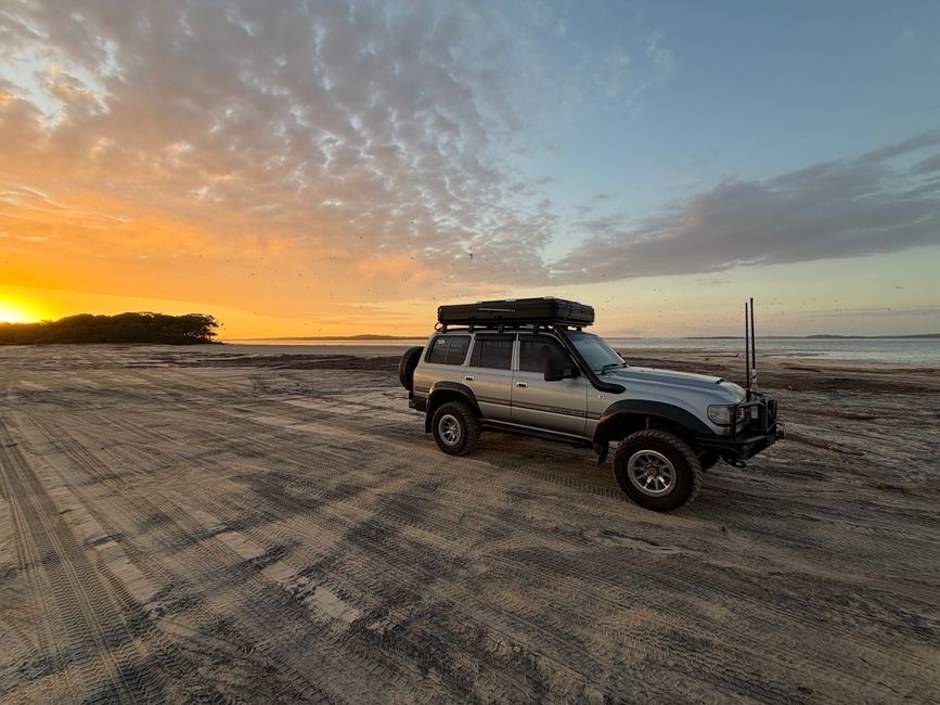
Photo: Hunty Hunt, Pexels
Driving on the beach in Australia is not off the rule book. Queensland Parks and Wildlife Service (QPWS) says all Queensland road rules apply even on beaches, and WA’s parks department says WA’s road and traffic laws apply, with licensed drivers and roadworthy vehicles. Many popular beaches also need a vehicle access permit before you drive on the sand. This guide is for learners, new P platers and their supervisors planning a first beach or four-wheel-drive trip. It covers permits, licence rules, tides, tyre pressures and getting unbogged.
Key facts
- Queensland: “All Queensland road rules apply, even on beaches” (QPWS). Police patrol anywhere.
- WA: road and traffic laws apply in parks. Drivers must be licensed and vehicles roadworthy (Department of Biodiversity, Conservation and Attractions).
- In Queensland, you need a vehicle access permit before driving on Bribie Island, K’gari (Fraser Island), Mulgumpin (Moreton Island), Cooloola and Minjerribah (North Stradbroke Island) recreation areas. Driving in without one can mean a $518 fine, a figure that rises each 1 July.
- Travel at low tide, or within 2 hours either side, and drive on the firmer sand between the waterline and the high tide mark.
- Lower tyre pressures only within the manufacturer’s specifications, and reinflate before you return to normal roads.
- Councils can ban beach driving outright. Always check the local rules for the beach you plan to use.
Do road rules and licence conditions apply on the beach?
| Jurisdiction | What the official guidance says |
|---|---|
| Queensland | QPWS: all Queensland road rules apply, even on beaches, and police patrol anytime, anywhere. Park vehicles must be fully road registered. Recreational use of conditionally registered vehicles is not permitted in recreation areas. |
| WA | DBCA: WA’s road and traffic laws apply. All vehicles and drivers must be licensed and vehicles roadworthy. Designated off-road vehicle areas are the only places you can drive without a driver’s licence or road registration. |
| Other states | The road rules apply on roads and “road-related areas”, which Tasmania’s handbook defines to include any area open to the public for driving. Check with the state transport department, the park authority and the local council before driving on a beach. |
What this means on L or P plates
Do not assume your L or P conditions are relaxed on beaches or park tracks. If you think an exemption applies, check with your licensing agency first. Plan the trip as if all your normal conditions apply:
- Learners: a qualified supervisor beside you, L plates displayed, zero alcohol and your learner speed cap. See Queensland learner rules and WA learner rules.
- P platers: P plates, zero alcohol, your speed cap, and any passenger, night or vehicle limits. Some powerful four-wheel drives may be banned for P platers in your state. See P plate rules compared and Queensland P1 and P2 rules.
- Seatbelts: everyone belted. QPWS rangers name rollovers, speeding and unbelted occupants among the dangers they see on beaches. See seatbelts and child car seats.
Confirm with TMR or your state’s transport department before taking a learner onto sand.
Queensland vehicle access permits
- Buy the permit before you enter. For Bribie Island, K’gari and Cooloola, book through the Queensland National Parks Booking Service or call 13 QGOV (13 74 68). Mulgumpin and Minjerribah have their own camping and permit websites.
- Buy it in your own name as the driver of the registered vehicle. Permits are not transferable. A permit attached to a second-hand four-wheel drive you just bought does not cover you.
- Hiring a vehicle? Get a permit in your name with the hire vehicle’s registration number for the dates you will be there.
- Carry proof. At Bribie, K’gari and Cooloola, number plate cameras check permits, so you don’t need to display one, but you must be able to show a copy (a digital copy on your phone is fine) if an officer asks. At Minjerribah and Mulgumpin, the permit must be displayed on the vehicle.
- Changes and refunds: make them more than 2 calendar days before the permit start date for an automatic refund.
A combined K’gari and Cooloola permit is available with a 20 per cent discount. Check current fees on the QPWS booking service.
Other places
Elsewhere in Queensland, QPWS says to contact local councils or QPWS offices to find out about restrictions and permits before driving on beaches. In WA, DBCA says to seek permits where needed, stay on designated roads and tracks, and check park alerts. Councils set their own beach rules, and some ban vehicles on beaches entirely.
Before you go: preparation checklist
- Experience: QPWS suggests novices first drive with an experienced four-wheel driver. For a learner, that means a supervisor who has driven on sand before.
- Vehicle: mechanically sound, registered, and a genuine four-wheel drive. QPWS says to make sure your vehicle is in 4WD on sand.
- Know your car. The NT handbook warns that four-wheel drives handle differently from standard cars, with a higher centre of gravity and more effect from wind. Learn how to engage 4WD and use features such as locking front hubs before the trip.
- Kit: tyre pressure gauge, air pump, shovel, traction aids, first-aid kit, enough water, food, fuel and spares.
- Load: pack light and stow heavy gear low. Top-heavy vehicles tip over more easily.
- Plan: check tide times, park alerts and fire bans, and carry paper maps in case GPS fails.
- Tell someone where you are going and when you expect to return. In remote beach areas, travel with at least one other vehicle.
- Communications: for remote trips QPWS recommends a satellite phone or UHF radio and a personal locator beacon.
How to drive on sand
Tides
- Drive at low tide, or within 2 hours either side of it.
- Stay on the harder sand between the waterline and the high tide mark.
- Watch for washouts. QPWS rangers single them out as a beach hazard that changes with the conditions.
Tyre pressures
- Lowering tyre pressure helps traction on soft sand. Stay within the manufacturer’s specifications.
- With lower pressures, avoid sharp turns, sudden braking, high speeds and rough surfaces. QPWS warns tyres have come off rims and serious crashes have happened.
- Reinflate as soon as you reach harder sand, and before you drive on normal roads.
On the beach
- Use only designated beach access tracks. Keep off sand dunes and vegetation.
- Give way to walkers, cyclists and horse riders.
- Drive slowly near people and animals. They may not hear you over the surf and wind.
- Park well away from traffic areas and at an angle to the water, so other drivers can see you have stopped.
- Keep away from nesting seabirds.
- Don’t drive tired.
Turtle season in Queensland
On beaches where marine turtles nest, from November to April, QPWS asks drivers to drive slowly, avoid nests, keep to the wet sand below the high tide mark, and avoid beach driving at night and bright lights between 6pm and 6am. Fines may apply for disturbing turtles or nests.
If you get bogged
- Carry the gear and know how to use it. QPWS says to carry a shovel or traction aids in case you get bogged, and to learn how to use them before you need them.
- Try traction aids first. QPWS suggests that, if it is safe, you free the vehicle with traction aids rather than tow ropes or snatch straps.
- Check your tyre pressures. Lower pressures help traction on soft sand, within the manufacturer’s range.
- Snatch straps and tow ropes should only be used by trained operators with safety-rated equipment.
- Don’t count on a ranger tow. QPWS rangers can’t help with towing or snatch strap recoveries because of the safety risks, though they may suggest local towing services.
- In an emergency, call 000. This is why you plan around the tide and travel with another vehicle in remote areas.
If you break down somewhere remote, QPWS advises staying with your vehicle. More: outback and remote driving in Australia.
Inland tracks and four-wheel driving
- Stay on designated roads and tracks. In WA parks, DBCA says never drive where there is no existing access, and vehicles aren’t allowed on walking or cycling tracks.
- Closed means closed. Never drive past locked gates or closure signs.
- If it’s flooded, forget it. Don’t drive through floodwater or fast-flowing creeks, and stay out of parks during and after heavy rain. See driving in rain, fog, smoke and floods.
- Unsealed roads. The NT handbook recommends engaging 4WD on unsealed roads, slowing for corrugations and curves, and notes some gravel roads need 4WD in the wet season, especially at creek crossings and floodways.
- Clean your vehicle in WA’s south-west, to avoid spreading Phytophthora dieback in mud and soil.
WA-specific advice: country driving in WA. Wildlife: kangaroos and wildlife on Australian roads.
Common questions
Can a learner drive on the beach in Queensland?
No official page checked bans it, but QPWS says all Queensland road rules apply on beaches, so your learner conditions still apply: a supervisor, L plates, zero alcohol and your speed cap. Check with TMR before you go.
Do I need a permit to drive on K’gari (Fraser Island)?
Yes. A vehicle access permit is required before you drive in the K’gari recreation area. Buy it in your name, for the vehicle you are driving, before you arrive.
Can I drive on any beach in WA?
No. Councils and park authorities decide where vehicles can go, and some councils ban beach driving. DBCA says you must stay on designated roads and tracks and get permits where needed.
Can I drive on the beach without a licence if it isn’t a road?
Not in WA: DBCA says road and traffic laws apply and drivers must be licensed. Designated off-road vehicle areas are the only exception. In Queensland, all road rules apply on beaches.
What tyre pressure should I use on sand?
Follow your vehicle manufacturer’s specifications for sand. QPWS does not give a single figure. Carry a gauge and pump, and reinflate before returning to the road.
Is a two-wheel-drive car OK on sand?
QPWS advice is written for four-wheel drives: it says to make sure your vehicle is in 4WD on sand, and that sand driving can be difficult and dangerous. Check with QPWS or the council before taking any other vehicle onto a beach.
National overview: the Australian Road Rules explained. Towing a camper to the coast: towing a trailer or caravan on L or P plates.
Sources
- Department of the Environment, Tourism, Science and Innovation (Queensland Parks and Wildlife Service), “Vehicle access permits” (parks.qld.gov.au)
- Department of the Environment, Tourism, Science and Innovation, “Four-wheel drive with care” and “Driving on sand” (parks.qld.gov.au)
- Department of the Environment, Tourism, Science and Innovation, “Four-wheel driving” (parks.qld.gov.au)
- Department of Biodiversity, Conservation and Attractions WA, “Four-wheel driving” (exploreparks.dbca.wa.gov.au)
- Department of Transport and Major Infrastructure WA, “Drive Safe: A handbook for Western Australian road users”, 3.7 Crossing Water on Roadways (transport.wa.gov.au)
- Northern Territory Government, “Road Users’ Handbook”, Four-wheel drive vehicles and unsealed roads (nt.gov.au)
- Department of State Growth Tasmania, “Tasmanian Road Rules” handbook, What is a road or road-related area? (transport.tas.gov.au)