
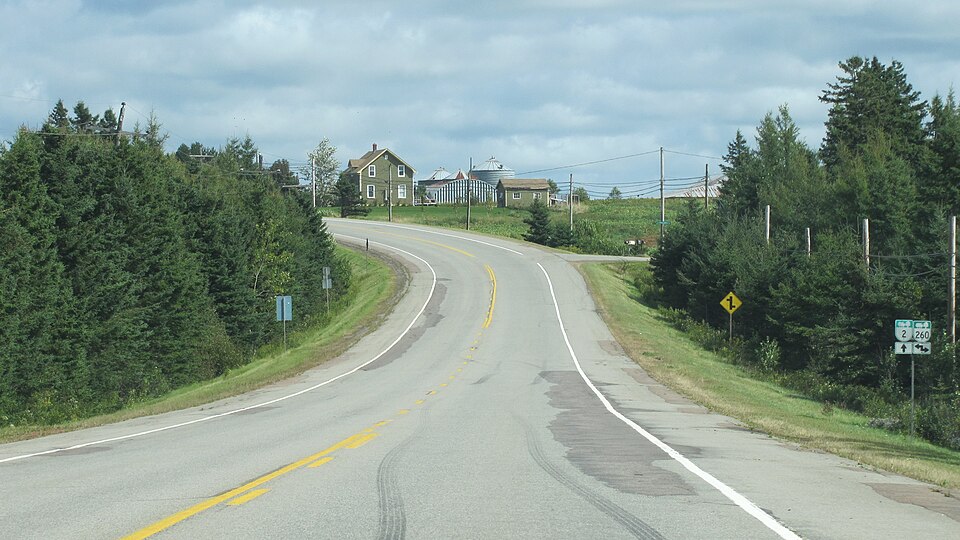
Photo: Robert Linsdell, CC BY 2.0, via Wikimedia Commons
Chapter 3 of Prince Edward Island’s Driver’s Handbook covers signs, pavement markings and work zones, and it feeds directly into the sign questions on the PEI knowledge test. This study guide goes through it in order: traffic lights, school signal lights, railway crossings, crosswalks, pavement markings, sign shapes, and construction signs with the work zone speed rules from Chapter 4. It is for anyone preparing for the Class 7 instruction permit test in PEI.
Key facts
- A green light is only permission to proceed with care. You must still yield to vehicles in the intersection and pedestrians in the crosswalk.
- Entering an intersection on amber is a Highway Traffic Act violation unless you cannot stop safely.
- Right turn on red: allowed after a complete stop, unless a sign prohibits it.
- Stop lines, crosswalk lines and intersection arrows are always white.
- Construction zone speed limits apply even when no one is working. The basic limit in a construction zone is 60 km/h.
- School zones: 60 km/h unless a lower limit is posted, 8 a.m. to 4 p.m., Monday to Friday, September to June. Speeding fines there are doubled.
Is the February 2022 PEI handbook still current?
The most recent English handbook PDF is the February 2022 edition. The Government of PEI’s publication page says the handbook is being updated. Study the 2022 edition, but check the publication page before your test in case a new edition has been released, and confirm any rule that looks out of date with Access PEI.
Traffic lights in PEI
| Signal | What the PEI handbook says |
|---|---|
| Green | Qualified permission to proceed carefully in the direction allowed. Yield to vehicles lawfully in the intersection and pedestrians in the crosswalk. When turning, yield to pedestrians in your half of the road or close enough to be in danger. Do not enter unless you can clear the intersection before the lights change. |
| Green arrow with a red light | Go only in the direction of the arrow, and still yield to traffic already in the intersection and pedestrians in an adjacent crosswalk. |
| Amber | Lets traffic already in the intersection clear it. Entering on amber is a violation unless you cannot stop safely. |
| Red | Stop at the stop line; if there is none, at the crosswalk; if none, before the intersection. |
| Right turn on red | Allowed after a complete stop unless a sign prohibits it, yielding to pedestrians and traffic. Do not hold up traffic behind you once the way is clear. |
| Flashing red | Complete stop, then go only when safe. It may be overhead, a standard signal, or a beacon above a stop sign. After stopping, the Highway Traffic Act requires you to yield to traffic in the intersection and pedestrians in an adjacent crosswalk. |
| Flashing amber | Caution. Slow down and be prepared to stop. You may enter the intersection only with caution, yielding to all traffic in it and to pedestrians in an adjacent crosswalk. |
Watch lights a block ahead. A light that has been green for a while may change before you get there, so never speed up toward an intersection.
School signal lights
Where traffic is heavy, PEI has signal lights at and between intersections to help children cross. They operate when children are going to or from school, and there may be advance warning signs before them. Treat them like any traffic signal.
On the regulatory sign pages, PEI also shows school bus signs: amber lights mean slow down and be prepared to stop; flashing red lights mean all traffic must stop. A “school bus stop ahead” sign warns of a stop you may not see in time.
Railway crossings (for driving off the Island)
The handbook points out that PEI has no railways, but you still need these rules when driving elsewhere in Canada.
- Signal device warning of a train, or a flag person signalling: stop not less than 5 metres from the nearest rail.
- Stop sign at the crossing: stop no closer than 5 metres and no further than 15 metres from the nearest rail.
- Flashing lights and bell: stop at the stop line, or at least 5 metres from the rail. Wait until the lights and bell stop and the train has passed.
- More than one track: a sign under the crossbuck shows how many. Make sure all tracks are clear.
- Advance warning signs may carry an advisory speed tab and show the angle of the tracks. An X or STOP line may be painted on the approach.
More detail in railway crossings in Canada.
Crosswalks
| Type | What you must do |
|---|---|
| Crosswalk at an intersection without signals | Stop when a pedestrian enters the crosswalk on or close to your side of the road |
| School crosswalk with a crossing guard | Stop when the guard signals, and stay stopped until the crosswalk is clear and the guard has left it |
| Special crosswalk (overhead signs, flashing amber beacons) | Stop before the crosswalk when the beacons are flashing |
| Crosswalk with traffic signals | Obey the signals |
Pavement markings
Yellow lines
- Separate traffic going in opposite directions. Keep the yellow line on your left, except when passing.
- Also mark the left shoulder on ramps and multi-lane highways.
- Solid yellow: passing is not safe. Broken yellow: passing permitted if there is no opposing traffic.
White lines
- Separate lanes going the same way, and mark the right shoulder.
- Solid white: do not change lanes. Broken white: you may change lanes with care.
- Wider, shorter white lines with short gaps near intersections warn that vehicles will be merging, changing lanes, speeding up and braking.
Other markings
- Diagonal markings or crosshatches: before islands, merges, lane shifts or medians. Not a traffic lane. Keep to the correct side.
- Stop lines: stop so the front of your vehicle does not go past the line. A stop sign itself does not show where to stop.
- Crosswalk lines: with no stop line, stop before any part of your vehicle enters the crosswalk.
- Intersection arrows: show which lane you need for each movement.
Stop lines, crosswalk lines and intersection arrows are always white.
Sign shapes and their meanings
PEI’s handbook notes that all Canadian provinces and territories use uniform traffic signs, mostly the same as those in the United States. Each shape has its own meaning, so you can identify a sign even if darkness, rain or snow hides the words.
| Shape | Meaning |
|---|---|
| Octagon (white letters on red) | Stop. Make a complete stop at the stop line, before the crosswalk, or before the intersection, then yield |
| Triangle (red on white) | Yield. Slow down, yield to traffic and pedestrians, stop if necessary |
| Vertical rectangle (white, black or coloured letters) | Regulatory: speed limits, parking, turning and passing |
| Diamond | Warning |
| Pentagon | School zone |
| Slow-moving vehicle sign | A slow-moving vehicle is ahead |
Colour also helps: red marks prohibited movements and green marks permitted ones. Speed limit signs are always vertical rectangles.
Signs worth extra study
Regulatory
- One way; keep right of the traffic island; WRONG WAY (white on red) on ramps entered the wrong way
- No left turn, no U-turn, no turns, no right on red, do not enter
- No stopping, no parking in either direction, passing permitted
- Maximum speed limit ahead, truck route, school zone
- Dangerous goods route and dangerous goods prohibited
- Snowmobile route and snowmobile restricted
- Cycling prohibited, pedestrians prohibited, reserved bicycle lane, littering prohibited
Warning
- Playground: reduce speed and be ready for an emergency stop, as children may run onto the road
- Hidden intersection, merge, narrow bridge, low clearance, underpass
- Divided highway ahead and divided highway ends, right lane ends, road narrows
- Bridge opening ahead, bridge freezes, snowmobile entrance, fire truck entrance, school bus entrance
- Curve with an advisory speed: the posted speed is the safe speed for the turn
Lane control lights
Overhead change lane destination lights include a steady green arrow (use this lane), a flashing green arrow, a steady amber arrow, and a flashing or steady red X. The handbook also shows a transit priority signal.
Work zones and construction signs
Construction signs warn that you can expect delays from construction or repair work. The handbook’s rules:
- Obey the flagperson. A traffic control person ahead sign warns you one is coming up.
- Speed limits in construction zones apply at all times, even when no workers or equipment are working. Bumps, detours, fresh oil and loose gravel may still be there.
- The basic limit in a construction zone is 60 km/h unless a sign says otherwise (Chapter 4).
Construction signs in the handbook include: construction ahead, road work ahead, survey crew ahead, detour ahead, lane ends and lane ends ahead, bump or rough road, uneven lanes, low shoulder and high shoulder ahead (a drop in level caused by construction), tar construction ahead, and traffic control person ahead.
Driving through a PEI work zone
- Before you set off, check the province’s current road construction information for your route, and allow extra time. Follow detour signs and the flagperson over your usual route or a navigation app.
- Slow down at the first orange sign, not when you see workers.
- Watch for a flagperson and the sign they show.
- Merge early when you see lane ends signs, and leave more room ahead for sudden stops.
- Watch your wheels at low or high shoulder signs: dropping a tire off an edge can pull the car.
- Keep the reduced speed until the zone is clearly over.
For moving over for stopped workers and emergency vehicles, see slow down, move over.
Common questions
Can I go through an amber light in PEI?
Only if you cannot stop safely. The handbook says entering an intersection on amber is otherwise a Highway Traffic Act violation.
Where do I stop at a red light with no stop line?
At the nearest crosswalk. If there is no crosswalk either, stop before entering the intersection.
What is the speed limit in a PEI school zone?
60 km/h unless a lower limit is posted, between 8 a.m. and 4 p.m., Monday to Friday, September to June, in a signed school zone. Speeding fines there are doubled.
Does the construction speed limit apply on weekends when no one is working?
Yes. PEI says construction zone speed limits must be obeyed at all times, even when workers and equipment are not working.
Do I need to study railway signs if PEI has no trains?
Yes. They are in Chapter 3 and you will need them as soon as you drive off the Island.
What colour are stop lines?
Always white, as are crosswalk lines and intersection arrows.
Related: learning to drive in PEI (full guide), PEI knowledge test and vision test, PEI rules of the road, PEI Stage 1 and Stage 2 rules, Canadian road signs compared.
Sources
- Government of Prince Edward Island, “Driver’s Handbook”, February 2022, Chapter 3: Signs, Pavement Markings and Work Zones, and Chapter 4: Speed Limits (princeedwardisland.ca)
- Government of Prince Edward Island, “Driver’s Handbook” publication page (princeedwardisland.ca)
- Government of Prince Edward Island, “Highway Traffic Act”, section 167, consolidated to May 29, 2026 (princeedwardisland.ca)

