Category: United States

  • How to Get a South Carolina Driver’s License as an Adult

    How to Get a South Carolina Driver’s License as an Adult

    Photo: JamieS93, CC BY 3.0, via Wikimedia Commons

    If you are 18 or older in South Carolina, the South Carolina Department of Motor Vehicles (SCDMV) says you must hold a beginner’s permit for a minimum of 30 days before the road test, instead of the 180 days teens wait. The conditional and special restricted licenses, with their curfews and passenger limits, are teen stages, so an adult moves straight from the permit to a regular Class D license. This guide sets out that timeline, the supervision rules, what the road test asks you to do and the retest waits.

    Key facts

    • Permit hold at 18 or older: at least 30 days (SCDMV; 180 days for ages 15 to 17).
    • Permit tests: a vision screening and a knowledge test on traffic laws, road signs and safe driving.
    • Fees (as of November 2026): $2 per knowledge test and $2.50 for the beginner’s permit (SCDMV fee schedule).
    • Permit supervision (6 a.m. to midnight): a licensed driver at least 21 with at least one year of driving experience.
    • Road test retest waits: 2 business days after a first fail, 7 calendar days after a second, 30 calendar days after that.

    Your South Carolina timeline as an adult

    When What happens
    Day 1 Vision screening and knowledge test at an SCDMV branch (not started after 4 p.m.), or at an approved One Stop Driver Training and Testing Program. Pay for the permit.
    Days 1 to 30 Practice with a qualified supervisor. Book your road test for a date after day 30.
    Day 30 or later Road test. Pass, and you get a regular Class D license.
    If you fail Retest after 2 business days (first fail), 7 calendar days (second) or 30 calendar days (third and later).

    The 2026 Driver’s Manual states it directly: at 18 or older you hold the beginner’s permit at least 30 days and may apply for your license on the 31st day.

    Getting the beginner’s permit at 18 or older

    1. Study the SCDMV Driver’s Manual. Its “Test Your Knowledge” section has sample questions, and our South Carolina permit practice test adds more.
    2. Bring your documents. Use the US documents checklist and decide about a REAL ID.
    3. Take the vision screening. It is free at branches, or bring a Certificate of Vision Examination from a licensed eye care professional dated within the past 36 months.
    4. Pass the knowledge test. Format and tips: the South Carolina beginner’s permit test guide.
    5. Pay the fees: $2 per knowledge test and $2.50 for the permit.

    Practicing on a South Carolina permit

    From 6 a.m. to midnight, a licensed driver at least 21 years old with at least one year of driving experience must be with you. Driving after midnight on a permit is only allowed with a supervisor who qualifies under SC Code 56-1-100. The Consent for Minor form that names those supervisors is a teen document, so if you plan to practice after midnight as an adult, ask SCDMV who may supervise you.

    Adults are not required to log hours, but 30 days is a short window for a complete beginner. Aim to cover parking, backing, hills, turnarounds and busy roads before test day. A plan you can follow: the supervised practice plan.

    Do adults need driver’s ed in South Carolina?

    SCDMV ties driver education (8 hours classroom and 6 hours driving) to the teen conditional and special restricted licenses. The 2026 Driver’s Manual lists driver education, the 40-hour log and school attendance only for applicants who are 15 or 16, so an adult does not need them. Teen rules: South Carolina driver education and the 40-hour requirement.

    What is on the South Carolina road test?

    What to bring

    • Your beginner’s permit
    • A licensed driver to accompany you
    • Proof of liability insurance from a company licensed in South Carolina
    • A car with a valid plate, registration card and insurance card (in a rental, the contract must list you as insured)
    • Glasses or contacts if you need them

    The vehicle check

    Headlights, brakes, wipers, safety belts, turn signals, mirrors, speedometer, defroster and horn must all work. The examiner can refuse to test an unsafe car.

    Skills you may be asked to perform

    • parallel parking
    • backing 100 feet in a straight line
    • parking on a hill
    • a two-point turnaround and a three-point turn
    • lane changes and turns in traffic

    Book through its “Schedule a Road Test” page. Full walkthrough: the South Carolina road test explained.

    After you pass: rules for new adult drivers

    • Phones: the Hands-Free and Distracted Driving Act took effect September 1, 2025. You may not hold or support a phone while driving. A first offense is a $100 fine; a later offense within three years is $200 and 2 points.
    • Points: 12 points suspends a license. See the South Carolina points system.
    • Under 21: a blood alcohol content of 0.02 or more means a suspension of at least three months.

    Common questions

    How long do I have to hold a permit in South Carolina if I’m over 18?

    At least 30 days, according to SCDMV. The 180-day rule is for ages 15 to 17.

    Do the conditional license curfew rules apply to me?

    No. The conditional and special restricted licenses, and their time and passenger limits, are teen stages.

    Can I take the road test at a driving school?

    SCDMV approves One Stop Driver Training and Testing Programs as third-party testers. Ask your school whether it can give the skills test.

    Can I use a rental car for the test?

    Yes, if the rental contract lists you as insured. See road test car rules.

    I’m moving to South Carolina with a license. Do I need a permit?

    The transfer route for existing license holders is different from the first-time route. See moving to South Carolina.

    What does it cost?

    $2 per knowledge test and $2.50 for the permit (as of November 2026). Check the SCDMV fee schedule for the license fee before you go. Comparison: license costs by state.

    Back to learning to drive in South Carolina. Other states: learning to drive as an adult in the US.

    Sources

    • South Carolina Department of Motor Vehicles, “Beginner’s Permit” (dmv.sc.gov)
    • South Carolina Department of Motor Vehicles, “Regular License Testing” (dmv.sc.gov)
    • South Carolina Department of Motor Vehicles, “Driver’s License Manual” and “Revision History” (dmv.sc.gov)
    • South Carolina Department of Motor Vehicles, “Fees” (dmv.sc.gov)
    • South Carolina Department of Motor Vehicles, “Teenage Drivers” (dmv.sc.gov)
    • South Carolina Department of Motor Vehicles, “Points System” (dmv.sc.gov)
    • South Carolina Department of Public Safety, hands-free law information (scdps.sc.gov)
  • How to Get a Wisconsin Driver’s License as an Adult (18+)

    How to Get a Wisconsin Driver’s License as an Adult (18+)

    Photo: Dougtone, CC BY-SA 2.0, via Wikimedia Commons

    In Wisconsin, a first-time driver aged 18 or older needs no driver education, no sponsor and no 50-hour log. You pass the highway signs, knowledge and vision tests, hold the instruction permit for at least seven days, and then take the road test. You still start on a probationary license, though, so the first years carry tougher point rules. This guide covers the adult route, permit supervision, the road test and the fees, from Wisconsin DMV pages and the 2026 Motorists’ Handbook.

    Key facts

    • Permit hold at 18 or older: at least 7 days before the road test.
    • Not needed at 18 or older: driver education, an adult sponsor, the 50-hour log.
    • Permit tests: highway signs (15 questions, 12 to pass), knowledge (50 questions, 40 to pass) and vision. Walk-in and free at the DMV.
    • First license: probationary, so demerit points double from your second conviction.
    • Fees (as of November 2026): permit $35, probationary license $28, skills (road) test $15 per appointment.

    Teen route vs adult route in Wisconsin

    Under 18 18 or older
    Driver education with behind-the-wheel Required Not required
    Adult sponsor on the MV3001 application Required Not required
    Supervised practice log 50 hours, 10 in darkness Not required
    Minimum permit time before the road test 6 months, violation free 7 days
    Knowledge test online at home Ages 15 to 17 ($10 per attempt) No; test free at a service center
    Passenger and midnight limits on the license First 9 months None
    Probationary license and doubled points Yes Yes

    Step 1: get your Wisconsin instruction permit

    • Complete the Wisconsin Driver License Application (MV3001).
    • Bring original, unexpired proof of name and date of birth, U.S. citizenship or legal status, identity, Wisconsin residency (two documents, such as a utility bill or financial statement) and your Social Security number. Photocopies are not accepted.
    • Pass the vision screening: 20/40 in one eye and a 70-degree field of vision from the center of each eye.
    • Pass the highway signs test and the knowledge test (about 45 minutes). Both are walk-in with no appointment.
    • Pay the $35 permit fee. The permit lasts 18 months and can be renewed once for another 18 months ($35).

    Test prep: Wisconsin DMV knowledge and highway signs tests and the Wisconsin permit practice test.

    Step 2: practice on the permit

    The handbook’s supervision rules: your supervisor sits in the front passenger seat, holds a valid regular license (not probationary or occupational) and has at least two years of licensed driving experience. They must be one of:

    • a qualified instructor aged 19 or older
    • your parent, guardian or spouse aged 19 or older
    • any other licensed person aged 21 or older

    In darkness, the handbook says the supervisor must be a qualified instructor or a licensed person aged 25 or older. The minimum 7-day hold is only a legal floor. If you have never driven, plan on weeks of practice across residential streets, business areas, rural highways and freeways. A practical plan: the supervised practice plan. Supervisor details: Wisconsin driving log and supervisor rules.

    Step 3: book and pass the Wisconsin road test

    Book online. Most centers let you schedule 8 to 11 weeks ahead, and slots fill quickly, so book as soon as you get your permit and practice in the meantime. New slots appear daily, and you can test at any location with openings. You supply the car, and the examiner checks the horn, lights and signals, plates, doors, mirrors and registration before you drive.

    The test covers:

    • turning, with mirror, blind spot and signal checks
    • intersections with and without a stop
    • business and residential driving (25 mph in residential areas unless posted)
    • lane changes
    • a Y-turn
    • a roadside stop and start
    • parking and backing (no faster than a slow walk, looking through the rear window)

    The $15 fee is charged for every appointment, including fails and appointments not canceled 24 hours ahead. If you fail, the wait before your next test is 1 to 14 days, depending on your result. Step-by-step Y-turn and full guide: the Wisconsin road test and Y-turn guide.

    Step 4: the probationary license

    Every first-time Wisconsin driver gets a probationary license, which costs $28 and expires two years from your next birthday. As an adult you have no passenger or midnight limits, but demerit points double from your second conviction. You can renew to a regular license from 90 days before the probationary license expires; the regular license lasts 8 years and costs $42.50 (as of November 2026). See Wisconsin probationary license rules and the Wisconsin points system.

    Under 21, Wisconsin’s alcohol limit for drivers is 0.00%.

    Common questions

    Do I need driver’s ed to get a license in Wisconsin at 18?

    No. Driver education, the sponsor and the 50-hour log are requirements for applicants under 18.

    How long do I have to wait between the permit and the road test as an adult?

    At least 7 days. In practice, the booking queue is usually the longer wait.

    Can I take the knowledge test online at home?

    No. The online test is only for ages 17 and under. Adults test free at a DMV service center.

    Can a 20-year-old friend supervise me?

    Not unless they are your spouse or a qualified instructor. Other supervisors must be at least 21, with two years of licensed experience, and 25 or older in darkness.

    I’m moving to Wisconsin with a foreign license. Do I start here?

    Possibly. The handbook says new residents transferring an out-of-state license must apply within 60 days of moving. For a license from another country, ask the DMV what you need to test, and see foreign license reciprocity by state.

    What will it cost in total?

    $35 permit, $15 road test and $28 probationary license: $78 if you pass first time (as of November 2026). Each extra road test appointment adds $15.

    Back to learning to drive in Wisconsin. Other states: learning to drive as an adult in the US.

    Sources

    • Wisconsin Department of Transportation, “Wisconsin Motorists’ Handbook” BDS126, 2026 (wisconsindot.gov)
    • Wisconsin Department of Transportation, “DMV fees” (wisconsindot.gov)
    • Wisconsin Department of Transportation, “Class D knowledge test” (wisconsindot.gov)
    • Wisconsin Department of Transportation, “Road test general information” (wisconsindot.gov)
    • Wisconsin Department of Transportation, “Probationary license” (wisconsindot.gov)
    • Wisconsin Department of Transportation, “GDL differences” (wisconsindot.gov)
  • How to Get a Missouri Driver’s License as an Adult (18+)

    How to Get a Missouri Driver’s License as an Adult (18+)

    Photo: Dougtone, CC BY-SA 2.0, via Wikimedia Commons

    Missouri’s graduated driver license (GDL) rules are written for teens, so an adult getting a first license skips the 182-day permit hold, the 40-hour log and the intermediate license. What every first-time driver still does is pass the Missouri State Highway Patrol (MSHP) tests: vision, road sign recognition, written and driving. This guide explains the adult route, what to confirm with the MSHP, and how to prepare for the MSHP driving test.

    Key facts

    • Two agencies: the MSHP gives the tests at its driver examination stations; the Department of Revenue (DOR) issues the permit and license at license offices.
    • GDL stages (182-day permit, 40 hours, intermediate license) are for first-time drivers under 18.
    • Tests: vision, road sign recognition and a written test on the Missouri Driver Guide, then a driving test. Results more than a year old must be retaken.
    • Written test: 25 questions, 20 correct to pass, according to the Driver Guide.
    • Supervisor on a permit (16 or older): a licensed driver at least 21 years old with a valid license, in the front seat.

    How the Missouri adult route compares with the teen route

    Step Teen (15 to 17) Adult (18 or older)
    Vision, sign and written tests Yes Yes
    Instruction permit hold At least 182 days No GDL minimum; the DOR lists an instruction permit for applicants 18 and older
    40 hours supervised (10 at night) Yes No
    Driving test with the MSHP Yes Yes
    Intermediate license with curfew and passenger limits Yes, until 18 No
    Under-21 alcohol limit (.02) Yes Yes, until 21

    Step by step: a first Missouri license at 18 or older

    1. Study the Missouri Driver Guide. The DOR publishes it free, and the written questions come from it. Try the Missouri permit practice test too.
    2. Visit an MSHP driver examination station and pass the vision, road sign recognition and written tests. Details: Missouri written driver test and instruction permit.
    3. Take your results to a DOR license office with proof of identity and Social Security number (check the DOR’s list for anything else, such as residency proof for a REAL ID), and get your instruction permit if you need time to practice. See the US documents checklist.
    4. Practice with a licensed driver aged 21 or older in the front seat.
    5. Pass the MSHP driving test in a registered, insured, safe car.
    6. Take your passing results to a license office and pay for your license.

    Keep an eye on the one-year limit: if your test results are more than a year old when you apply, you have to retake the vision, sign and written tests.

    What adults should confirm in Missouri

    • Whether an adult must hold a permit first. The DOR fee chart lists an instruction permit with a minimum age of 18. Ask whether an adult must hold one, and for how long, before the driving test. Ask the MSHP station before you book.
    • Fees. The Driver Guide (revised August 2026) lists $10.00 for an instruction permit and $16.50 (3 years) or $33.00 (6 years) for a Class F license. Check the DOR for any processing fees.
    • Retest waits. The Driver Guide allows one driving test per day. After three fails you need extra behind-the-wheel training and DOR approval before testing again. No waiting period is set for the written test, so ask the MSHP station.

    The MSHP driving test: what to expect

    The examiner checks the car first (lights, signals, brake lights, horn and seat belts should all work), then rides with you and gives directions. Their job is to assess, not teach, so expect few comments. The Driver Guide lists the tasks: smooth starts and stops, parallel parking in a 25 by 7 foot space within two minutes, backing in a straight line, at least two left and two right turns, parking on a hill, intersections and obeying signs. Losing more than 30 points is a fail. Full detail is in the driver examination chapter of the Driver Guide.

    Skill What to show the examiner
    Observation Obvious head checks before pulling out, changing lanes and backing
    Stops A full stop behind the line, never rolling
    Speed At or below the limit, slower when conditions call for it
    Signals Early every time, cancelled after the turn
    Lane position Turn into the correct lane and stay in it
    Right of way Yield to pedestrians and at four-way stops

    More: the Missouri State Highway Patrol driving test guide, the road test day checklist and common reasons people fail.

    After you pass: rules for new adult drivers in Missouri

    • Phones: Missouri’s hands-free law applies to drivers of every age. See the Missouri hands-free law.
    • Points: 4 points in 12 months brings an advisory letter; 8 points in 18 months brings a suspension. See Missouri driver points.
    • Under 21: a blood alcohol content of .02 or more can lead to suspension or revocation.

    Common questions

    Do adults have to hold a Missouri permit for 182 days?

    No. The 182-day hold is part of the GDL rules for first-time drivers under 18.

    Do I need driver’s ed in Missouri as an adult?

    Ask the MSHP station if you are unsure. Lessons are optional, but a good idea if you have never driven.

    Do I need the 40-hour log at 18?

    No. The 40 hours (10 at night) are a requirement for the intermediate license, which is a teen stage.

    Who can supervise me on a Missouri permit?

    From 16, any licensed driver aged at least 21 with a valid license, sitting in the front seat.

    Where do I take the tests?

    At an MSHP driver examination station. Check hours and booking for your nearest station before you go.

    I have a license from another country. Do I need all the tests?

    Possibly. See foreign license reciprocity by state and check with the DOR.

    Back to learning to drive in Missouri. Other states: learning to drive as an adult in the US.

    Sources

    • Missouri Department of Revenue, “Missouri Graduated Driver License Law” (dor.mo.gov)
    • Missouri Department of Revenue, “FAQs: Graduated Driver License Law” (dor.mo.gov)
    • Missouri Department of Revenue, “Missouri Driver Guide”, revised August 2026 (dor.mo.gov)
    • Missouri Department of Revenue, “Permit/Driver License/Nondriver ID Fees” (dor.mo.gov)
    • Missouri Department of Revenue, “FAQ: Tickets and Points” (dor.mo.gov)
    • Missouri State Highway Patrol, “Driver Examination: Frequently Asked Questions” (mshp.dps.mo.gov)
  • How to Get an Indiana Driver’s License as an Adult (18+)

    How to Get an Indiana Driver’s License as an Adult (18+)

    Photo: Dougtone, CC BY-SA 2.0, via Wikimedia Commons

    For adults in Indiana, the route is permit, practice, skills exam. Driver education is optional for adults, but the July 2026 Indiana Driver’s Manual from the Bureau of Motor Vehicles (BMV) still asks adults for a 50-hour practice log and lists a 180-day permit hold as a general license requirement. This guide covers what applies at 18, at 19 to 20 and at 21 or older, and how to prepare for the skills exam.

    Key facts

    • Learner’s permit: vision screening, knowledge exam and documents proving identity, lawful status, Social Security number and Indiana residency. Valid for 2 years.
    • Supervisor at 18 or older: a licensed driver aged 25 or older, or your licensed spouse aged 21 or older.
    • 50-hour log: required at 18 or older too, with 10 hours at night, on State Form 54706, according to the July 2026 Driver’s Manual. You sign it yourself.
    • Permit hold: the manual lists holding your Indiana learner’s permit for at least 180 days among the license requirements.
    • Driver education: not required for adults.
    • Skills exam: book on myBMV or by calling 888-692-6841.
    • Under 21: your first license is probationary, with a 180-day curfew and passenger limit and a ban on phone use.

    What applies to you: 18, 19 to 20, or 21 and older

    Rule 18 19 to 20 21 or older
    Driver education Not required Not required Not required
    50-hour log (10 at night) Required Required Required
    Permit held first 180 days 180 days 180 days
    Permit supervisor Licensed driver 25+ or licensed spouse 21+ Same Same
    License type Probationary until 21 Probationary until 21 Standard license
    First 180 days on the license No driving 10 p.m. to 5 a.m.; no passengers without a qualifying adult in front Same No probationary limits
    Phone use while driving Banned except 911 until 21 Banned except 911 until 21 Hands-free only

    Two rules adults often get wrong

    1. Do adults need the 50-hour log?

    Yes. The July 2026 Driver’s Manual says that if you are at least 18 and applying for a license, you must complete at least 50 hours of supervised practice, 10 of them at night, with a licensed driver aged 25 or older or your licensed spouse aged 21 or older. You hand in State Form 54706 when you apply. If your permit is daytime-only (restriction G), you still need the 50 hours, just not the night hours. The “no log, no holding period” wording you may see quoted online comes from the manual’s section on applicants with disabilities who complete driver rehabilitation training with a BMV-recognized specialist; it does not cover other adults. Log details: Indiana driver education and the 50-hour log.

    2. Is there a minimum permit holding period for adults?

    The manual lists a valid Indiana learner’s permit held for at least 180 days among the license requirements, and says new residents who were never licensed in another state must hold an Indiana permit for 180 days. Plan on 180 days. If a branch tells you a shorter wait applies to you, get that confirmed before you book a skills exam, so your appointment is not wasted.

    Step by step: your first Indiana license as an adult

    1. Gather documents proving identity, lawful status, Social Security number and Indiana residency. See the US permit documents checklist.
    2. Pass the vision screening and the knowledge exam at a BMV branch. Study with the Indiana BMV permit test guide and the Indiana permit practice test.
    3. Practice with a qualified supervisor: a licensed driver 25 or older, or your licensed spouse 21 or older.
    4. Book the skills exam through myBMV or on 888-692-6841, once your 180 days and 50 logged hours are done.
    5. Pass the skills exam and get your license. Under 21, it is probationary.

    What is on the Indiana driving skills exam?

    What the BMV sets out:

    • Always tested: backing out of a parking space, with mirror and blind-spot checks.
    • Not tested: parallel parking, which the BMV says is no longer part of the exam.
    • Automatic fails: backing over a curb or driving into a parked vehicle.
    • Car: legally equipped, insured and safe, with current registration. Driver assistance technology must be turned off (backup cameras are exempt).
    • Bring: your permit, your completed 50-hour log, and, at 18 or older, a licensed driver to come with you.

    If you fail, the BMV wait before a retest is 7 days. Full guide: the Indiana road skills test explained.

    Driving on a probationary license at 18 to 20

    Every Indiana license issued before 21 is probationary. In the first 180 days you may not drive between 10 p.m. and 5 a.m., or carry passengers unless a licensed instructor, a licensed driver 25 or older, or your spouse 21 or older sits in the front seat. Night exceptions cover work, school-sanctioned activities and religious events. The later weekday curfews end at 18, so they do not affect you. Until 21 you may not use any telecommunications device while driving, except to call 911. At 21, renew to an unrestricted license. Full rules: Indiana probationary license rules and Indiana phone laws for new drivers.

    Common questions

    Do I need driver’s ed to get a license in Indiana at 18?

    No. Driver education lets teens license earlier; it is not required for adults.

    Who can I practice with?

    At 18 or older, any licensed driver aged 25 or older, or your licensed spouse aged 21 or older.

    How long is an Indiana learner’s permit valid?

    Two years from the date it is issued.

    Can I book the skills exam online?

    Yes, through your myBMV account, or by phone on 888-692-6841.

    What does it cost?

    Check the BMV fee page before you go. Comparison: license costs by state.

    I get points in my first year. Does age matter?

    The point thresholds are the same for all ages, but drivers under 21 can be required to complete a driver safety program after two incidents. See the Indiana BMV points system.

    Back to learning to drive in Indiana. Other states: learning to drive as an adult in the US.

    Sources

    • State of Indiana, “If my child completes an online driver education class and then completes the 50 hours of driving…” (faqs.in.gov)
    • State of Indiana, “How long is a learner’s permit good for?” (faqs.in.gov)
    • State of Indiana, “Can I schedule a driving skills exam online? By phone?” (faqs.in.gov)
    • Indiana Bureau of Motor Vehicles, “Learner’s Permit” (in.gov)
    • Indiana Bureau of Motor Vehicles, “Driver’s License” (in.gov)
    • Indiana Bureau of Motor Vehicles, “Indiana Driver’s Manual” (in.gov)
    • Indiana Bureau of Motor Vehicles, “Probationary Driver’s License” (in.gov)
  • How to Get a Tennessee Driver’s License as an Adult (18+)

    How to Get a Tennessee Driver’s License as an Adult (18+)

    Photo: Doug Kerr, CC BY-SA 2.0, via Wikimedia Commons

    Tennessee keeps the route simple for adults. If you are 18 or older, the Tennessee Department of Safety and Homeland Security says you must pass the knowledge test, but you do not have to get a learner permit or wait any set time before the road test. There is no driver education requirement and no 50-hour certificate for adults. This guide covers the steps, when a permit is still worth having, and how the road test and retests work at a Driver Services Center.

    Key facts

    • Tests: vision screening, Class D knowledge test and road skills test.
    • Learner permit at 18+: not required, and no waiting period (Department help center).
    • Driver education: not required in Tennessee at any age.
    • 50-hour certificate and school attendance form: teen requirements only.
    • Vision standard: 20/40. If either eye tests worse, you need a vision statement from an optometrist or ophthalmologist.
    • Retest: never the same day. The wait depends on how many errors you made.

    How do you get a Tennessee license as an adult? Five steps

    1. Apply online first. Fill in the Regular Driver License application in the Department’s e-Services and upload documents for pre-approval, which can take up to 5 business days. You still bring the originals or certified copies to the center.
    2. Gather your documents: proof of identity, Social Security number, U.S. citizenship or lawful status, and Tennessee residence. Use the US documents checklist to prepare, and decide whether you want a REAL ID.
    3. Pass the vision screening and knowledge test at a Driver Services Center. Appointments are available for knowledge tests at some centers. Prep: Tennessee knowledge test guide and Tennessee permit practice test.
    4. Practice legally. See the next section.
    5. Pass the road skills test and get your Class D license. No Intermediate stages apply to adults.

    Should an adult still get a Tennessee learner permit?

    You are not required to, but think about how you will practice. You can only drive on public roads with a license or a permit. If you have never driven, a learner permit gives you a legal way to build skills with a licensed driver beside you before you test.

    If you hold a learner permit when you go for your road test, the Department says you must be accompanied to the center by a licensed driver aged 21 or older. Without one, you will not be allowed to take the test.

    Your situation Practical route
    Never driven Pass the knowledge test, take the permit, practice with a licensed adult or a driving school, then test
    Already drive well (for example, licensed abroad) Pass the knowledge test, then book the road test. See moving to Tennessee first, in case you can transfer
    Learning with a driving school Some approved driver training programs can give the road test too. Ask the school

    Booking the Tennessee road test

    • Schedule through the Department’s online ticketing system (choose the regular driver license road test). If you are from out of state, you cannot book online; use the help request form instead.
    • Arrive 15 minutes before your appointment. If you are late it may be cancelled and you will be treated as a walk-in.
    • Cancel or reschedule in the same system under My Appointments.
    • An expired permit blocks online booking, so renew it first.

    The road test checks normal driving and maneuvers set out in the Tennessee driver license manual. Prepare with the Tennessee road skills test explained, the road test day checklist and road test car rules.

    What happens if you fail the Tennessee road test?

    The examiner tells you your errors, how to correct them and what to practice. You cannot retest on the same day. The Department sets a mandatory practice time before your next attempt, based on your total score (number of errors), and applies the same guideline to every later retest. Ask the examiner when you can return.

    After you pass: rules for new adult drivers

    • Phones: Tennessee’s hands-free law covers every driver. See Tennessee hands-free law and driver points.
    • Points: moving violations add points. Adults face a proposed suspension at 12 points within 12 months.
    • Traffic school: an approved 4-hour course completed within 90 days of a speeding conviction can remove up to 5 points for that offense.
    • Alcohol: under 21, zero-tolerance rules apply. See zero tolerance laws for drivers under 21.

    Common questions

    Do I need driver’s ed to get a license in Tennessee at 18?

    No. Tennessee does not require driver education at any age. Lessons are optional but help if you have never driven.

    Can I skip the permit in Tennessee if I’m over 18?

    Yes. The Department says applicants over 18 must take the knowledge test but do not have to get a permit or wait a set time. You still need a legal way to practice.

    Do I need the 50-hour certificate as an adult?

    No. The certificate and the school attendance form are for applicants under 18.

    Can I take the knowledge test online at home?

    The online test is offered to teens aged 15 to 17 with a parent or guardian as proctor. Adults test at a Driver Services Center.

    How much does it cost?

    Tennessee sets a fee for each license class. Check the current figure on the Department’s Driver License Fees page before you go. Comparison: license costs by state.

    I failed the vision screening. What now?

    Get a vision statement from an optometrist or ophthalmologist and bring it to the center.

    Back to learning to drive in Tennessee. Other states: learning to drive as an adult in the US.

    Sources

    • Tennessee Department of Safety and Homeland Security, “Adult First-Time Drivers” (tn.gov)
    • Tennessee Department of Safety and Homeland Security, “How do I obtain a Learners Permit” (safetysupport.tn.gov)
    • Tennessee Department of Safety and Homeland Security, “How do I make, view, or cancel an appointment at a Driver Service Center?” (safetysupport.tn.gov)
    • Tennessee Department of Safety and Homeland Security, “Failed Road Test” (safetysupport.tn.gov)
    • Tennessee Department of Safety and Homeland Security, “What if I cannot pass the vision screening?” (safetysupport.tn.gov)
    • Tennessee Department of Safety and Homeland Security, “Temporary restricted license-paper copy” (safetysupport.tn.gov)
    • Tennessee Comptroller of the Treasury, Office of Research and Education Accountability, “Driver Education in Tennessee” (comptroller.tn.gov)
  • How to Get a Maryland Driver’s License as an Adult (18+)

    How to Get a Maryland Driver’s License as an Adult (18+)

    Photo: Famartin, CC BY-SA 4.0, via Wikimedia Commons

    In Maryland, adults getting a first license go through almost the same process as teens. Every first-time driver, whatever their age, needs a learner’s permit, the full 36-hour driver education course, logged practice and a provisional license. What changes with age is how long you hold the permit and how many practice hours you log. At 25 or older the minimum is 45 days and 14 hours. This guide works through each age band, using the Maryland Transportation Article.

    Key facts

    • Permit first: the Motor Vehicle Administration (MVA) issues a learner’s instructional permit before any original license (§16-105(a)).
    • Driver education at every age: at least 30 hours of classroom and 6 hours of behind-the-wheel instruction (§16-105(d)).
    • Minimum permit time: 9 months under 19; 3 months at 18 with a high school diploma or equivalent, or at 19 to 24; 45 days at 25 or older with no moving violations.
    • Practice hours: 60 (10 at night) under 25; 14 (3 at night) at 25 or older.
    • Provisional license: held for at least 18 months before a full license, at any age (§16-111).

    How long must an adult hold a Maryland learner’s permit?

    Your age and situation Earliest skills test Practice hours Driver ed
    18 without a high school diploma or equivalent 9 months after the later of your permit date or your most recent moving violation 60, including 10 at night 30 + 6 hours
    18 with a diploma or equivalent, or 19 to 24 The later of 3 months after the permit date or 9 months after your most recent moving violation 60, including 10 at night 30 + 6 hours
    25 or older, no moving violations 45 days after the permit date 14, including 3 at night 30 + 6 hours
    25 or older, with a moving violation 9 months after the most recent violation 14, including 3 at night 30 + 6 hours

    “Moving violation” includes a probation before judgment for one. The law counts night hours from 30 minutes before sunset to 30 minutes after sunrise, and every supervisor signs your skills log.

    Worked examples

    Jordan, 20

    Gets a permit on March 1 with no tickets. Earliest skills test: June 1 (3 months), once the 36-hour course and 60 logged hours (10 at night) are done. Sixty hours in 13 weeks is a little under 5 hours a week, so start the course early.

    Priya, 31

    Gets a permit on March 1 with no tickets. Earliest skills test: April 15 (45 days), after the full 30 + 6 hour course and 14 hours of practice (3 at night). The course is the long part, not the hold.

    Sam, 27

    Gets a speeding conviction on the permit on May 10. The 45-day rule no longer applies: the earliest test is February 10 the following year, 9 months after the conviction.

    Who can supervise an adult learner in Maryland?

    • At least 21 years old.
    • Licensed for at least 3 years, in Maryland or another state, for the class of vehicle you are driving.
    • Seated beside you, and the only other person allowed in the front seat.

    At 18 or older on a permit, you may not use a handheld phone while driving. Logging tips: the Maryland Rookie Driver practice skills log.

    Step by step: first Maryland license as an adult

    1. Book a knowledge test at a full-service MVA office and bring identity, Social Security and residency documents. See the Maryland knowledge test and learner’s permit and the Maryland permit practice test.
    2. Pass the vision screening and knowledge test and get your permit. A first-time permit is valid for 2 years.
    3. Take an MVA-approved driver education course: 30 hours classroom and 6 hours behind the wheel. See Maryland driver education requirements.
    4. Log your practice hours for your age band and get each supervisor to sign.
    5. Pass the driving skills test once your minimum permit time is up. See the Maryland driving skills test explained.
    6. Drive on a provisional license for 18 months without a moving violation conviction, then move to a full license.

    What is on the Maryland driving skills test?

    The MVA describes two parts: a closed-course section that you must pass first, then an on-road drive. Before the test, you and the person who brought you sign the MVA’s certification of insurance form. The detail of the maneuvers, what to bring and the retest rules (which differ between MVA pages) are in the skills test guide. The December 2025 Driver’s Manual lists pull-in parking, back-in parking and a three-point turn on the closed course, and says parallel parking is no longer required. Check the current maneuver list with the MVA before test day.

    The provisional license for adults

    Passing the skills test gets you a provisional license, not a full one, even at 30. You must hold it for at least 18 months after the later of the issue date, your most recent moving violation conviction or provisional-restriction violation, or the date any suspension ends (§16-111(d)).

    Provisional rule Applies to you at 18 or older?
    Night limits and passenger limits No, these are under-18 rules
    No handheld phone use Yes, until the full license is issued
    No alcohol in your blood Yes, while you are under 21
    A conviction restarts the 18-month clock Yes

    Full detail: Maryland provisional license rules and Maryland points for new drivers.

    Common questions

    Do adults need driver’s ed in Maryland?

    Yes. The 30-hour classroom and 6-hour behind-the-wheel course applies to first-time drivers of every age.

    I’m 18. Does finishing high school change anything?

    Yes. At 18 with a diploma or equivalent, the minimum permit time drops from 9 months to 3 months. The 60 practice hours stay the same.

    Is it worth waiting until 25?

    Only if you were going to wait anyway. At 25 the hold drops to 45 days and the log to 14 hours, but the 36-hour course and the 18-month provisional period still apply.

    I have a license from another country. Do I start over?

    Not necessarily. The MVA can issue a provisional license to someone licensed in another state or country, or by the armed forces, for less than 18 months, with the provisional period shortened by how long you have been licensed. See moving to Maryland.

    Can I drive alone on a permit as an adult?

    No. Every permit driver, at any age, needs a qualified supervisor seated beside them.

    What does it cost?

    The MVA fee page lists $65 for a first learner’s permit if you have never been licensed, covering conversion to your license later (as of November 2026). Driving schools set their own course prices. Confirm the current fee with the MVA before your appointment.

    Back to learning to drive in Maryland. Other states: learning to drive as an adult in the US.

    Sources

    • Maryland General Assembly, “Transportation Article §16-105” (mgaleg.maryland.gov)
    • Maryland General Assembly, “Transportation Article §16-111” (mgaleg.maryland.gov)
    • Maryland General Assembly, “Transportation Article §16-113” (mgaleg.maryland.gov)
    • Maryland General Assembly, “Transportation Article §21-1124.2” (mgaleg.maryland.gov)
    • Maryland MVA, “License & ID Fees” (mva.maryland.gov)
    • Maryland MVA, “Behind-the-Wheel Tests” (mva.maryland.gov)
  • How to Get a Massachusetts Driver’s License as an Adult

    How to Get a Massachusetts Driver’s License as an Adult

    Photo: Kenneth C. Zirkel, CC BY-SA 4.0, via Wikimedia Commons

    At 18 or older in Massachusetts, you skip driver’s education, the 40-hour practice log and the Junior Operator License. You still pass the learner’s permit exam, practice with a qualified supervisor and pass a Class D road test with a sponsor in the back seat. This checklist is for adults getting a first Massachusetts license, and for anyone helping them, using the Registry of Motor Vehicles (RMV) pages and the Massachusetts Driver’s Manual (revised April 2026).

    Key facts

    • Driver’s ed: not needed if you are over 18, according to the RMV.
    • Permit hold and practice hours: the RMV lists the 6-month permit period and 40 supervised hours as requirements for applicants between 16 and a half and 18. Ask the RMV whether any minimum period applies to adults.
    • Permit exam: 25 questions, 18 correct to pass, 25 minutes.
    • Road test: you must bring a sponsor who is 21 or older, has at least 1 year of driving experience and holds a valid U.S. license.
    • Fees (as of November 2026): $30 permit exam, $35 road test, $50 license.

    Teen route vs adult route in Massachusetts

    Requirement 16 and a half to 17 18 or older
    Parent or guardian consent on the application Yes No
    Driver’s education (30 hours classroom, 12 behind the wheel, 6 observing) Yes No
    6 consecutive months on the permit with a clean record Yes Not listed for adults
    40 supervised hours (30 with a skills program) and 2-hour parent class Yes Not listed for adults
    Permit curfew, midnight to 5 a.m. Yes, unless with a parent or guardian No
    License type after the road test Junior Operator License until 18 Class D license

    If you are close to 18, ask the RMV which rules apply on your test date. The teen rules are in Massachusetts junior operator license rules.

    Checklist 1: getting your Massachusetts learner’s permit

    • You are a Massachusetts resident and do not hold a license or permit from another state.
    • You meet the Class D medical standards.
    • You started the application online and booked a Service Center appointment (or a AAA branch if you are a member).
    • You decided between a REAL ID and a Standard license. The RMV notes that people 18 and older need a REAL ID (or another TSA-accepted ID) to board domestic flights. See REAL ID and your first license.
    • You have your identity documents and the $30 exam fee.
    • You pass the vision screening and have your photo taken.
    • You pass the 25-question exam at the Service Center or online. It covers rules of the road, drugs and alcohol, the Junior Operator Law, and sharing the road with visually impaired people, bicyclists and pedestrians.

    The RMV lists the exam in 37 languages, including English and American Sign Language (ASL only at a Service Center). Study guide: Massachusetts RMV learner’s permit test. Practice questions: Massachusetts permit practice test.

    The permit is valid for 2 years, or the length of your stay in the U.S.

    Checklist 2: practicing on your permit

    • Your supervisor is licensed, at least 21, has at least 1 year of driving experience and sits beside you.
    • You carry your learner’s permit every time you drive.
    • You don’t drive in another state if that state’s law would not allow it.
    • You practice everything the road test covers (below), including a hill start and a three-point turn.

    No hours log is required for adults, but the RMV’s supervised driving log is a handy way to track progress. A practice plan that suits adults too: the supervised practice plan.

    Checklist 3: booking and passing the Massachusetts road test

    Booking

    • Book online through myRMV with your name, date of birth and permit number.
    • Tests are released 60 days ahead, and new slots are added through each business day.
    • You can pay the road test and license fees when you book or after the test, but no license is issued until both are paid.
    • Cancel or reschedule more than 72 hours ahead, or the $35 fee is not refunded.

    Your sponsor

    • At least 21, with at least 1 year of driving experience.
    • Holds a valid license from a U.S. state or territory (a foreign license does not qualify). Brings the physical card.
    • Sits in the back seat behind you during the test.
    • A certified driving school instructor can be your sponsor.

    No sponsor means no test, even if you hold a valid foreign license.

    The car

    • Registered and inspected, with a parking brake the examiner can reach.
    • No donut spare tire. A rental needs a letter from the company allowing the road test.

    What the examiner asks you to do

    The manual lists what you will do: hand signals, start and stop, parallel park, back up about 50 feet, left and right turns, a hill start and stop, a turnaround between curbs (three-point turn), and entering and leaving intersections while obeying signs and signals. Full detail, including the car rules that get tests rejected: Massachusetts road test and sponsor rules.

    If you fail

    Wait at least 14 days, pay the $35 fee again, and rebook. The manual allows no more than 6 Class D road tests in 12 months.

    When you pass

    If your fees are paid and you have proved lawful presence (if it applies to you), your permit serves as your temporary license until the card arrives by mail. If you did not prepay, apply at a Service Center within 60 calendar days of passing, or you must pass a new road test at your own expense.

    Rules that still apply to new adult drivers

    • Phones: Massachusetts is hands-free for all drivers. At 18 or older you may use one earplug for a cell phone; headphones are otherwise illegal. See Massachusetts phone laws for new drivers.
    • Suspensions for 18 and older: three speeding violations within one year mean a 30-day suspension and a $100 reinstatement fee (manual chart).
    • Insurance surcharges: at-fault crashes and violations raise your premium. See Massachusetts SDIP surcharges.

    Common questions

    Do I need driver’s ed at 18 in Massachusetts?

    No. The RMV says applicants over 18 don’t need a driver’s education program for a Class D license.

    How long do I have to hold my permit before the road test as an adult?

    The RMV lists the 6-month period for applicants between 16 and a half and 18. Book when you are ready, and confirm with the RMV if you are unsure.

    Can I take the road test without a sponsor if I drove for years abroad?

    No. A sponsor is required for every Class D road test. If you already hold a license from another state or country, check whether you need the full test route at all in moving to Massachusetts.

    Can I take the permit test online?

    Yes. After your Service Center visit you can choose to take the exam online instead of at the Service Center.

    I don’t have lawful status. Can I still get a license?

    See Massachusetts Work and Family Mobility Act licenses.

    What does it cost in total?

    $30 exam, $35 road test and $50 license, so $115 if you pass both first time (as of November 2026). Each failed or missed road test adds $35. Lessons are extra.

    Back to learning to drive in Massachusetts. Other states: learning to drive as an adult in the US.

    Sources

    • Massachusetts Registry of Motor Vehicles, “Junior Operator License (JOL) requirements” (mass.gov)
    • Massachusetts Registry of Motor Vehicles, “Schedule your road test” (mass.gov)
    • Massachusetts Registry of Motor Vehicles, “Apply for a passenger (Class D) learner’s permit” (mass.gov)
    • Massachusetts Registry of Motor Vehicles, “Massachusetts Driver’s Manual (Class D), revised April 2026” (mass.gov)
    • Massachusetts Registry of Motor Vehicles, “Class D and M Road Test Information Sheet” (mass.gov)
  • How to Get a Florida Driver’s License as an Adult (18+)

    How to Get a Florida Driver’s License as an Adult (18+)

    Photo: Michael Rivera, CC BY-SA 4.0, via Wikimedia Commons

    In Florida, an adult getting a first driver license does not have to sit out the 12-month learner’s license period or log 50 hours. Those rules are for under 18s. What you do need, if you are 18 or older and have never been licensed anywhere, is the Traffic Law and Substance Abuse Education (TLSAE) course, followed by the vision, hearing, knowledge and driving skills exams. This guide sets out that route, what the law says about practicing beforehand, and what the driving test checks.

    Key facts

    • TLSAE: required for applicants 18 or older, unless you have been licensed in another jurisdiction or completed a Department of Education driver education course under s. 1003.48 (Florida Statutes s. 322.095(1)).
    • No 12-month learner period at 18+: the 12-month hold and the 50-hour certification in s. 322.05 apply to applicants aged 16 and 17.
    • Knowledge exam: 50 questions, 40 correct to pass (80%), according to FLHSMV. Applicants 18 and over take it in person.
    • Fees (as of November 2026): $48 original Class E license (s. 322.21), $10 per knowledge retake and $20 per driving skills retake (s. 322.12). Tax collector offices add a service fee.

    Who needs the TLSAE course in Florida?

    Your situation TLSAE needed?
    18 or older, never licensed anywhere Yes
    18 or older, completed a Department of Education driver education course (s. 1003.48) No
    Any age, licensed in another state or country No. See moving to Florida
    Under 18 No. Teens take a different driver education course (DETS) instead

    What the TLSAE course involves

    • Length: at least 4 hours of content, with no more than 30 minutes of that for breaks (s. 322.095(9)).
    • Format: classroom or online. The law allows courses delivered through communications technology.
    • Content: alcohol and drug effects on drivers, Florida traffic law, risky behavior such as speeding, phone use, and motorcyclist, bicyclist and pedestrian safety.
    • Cost: the provider’s fee plus a $3 state assessment (s. 322.095(4)). Providers must list every fee when you register.
    • Proof: the provider must report your completion electronically to FLHSMV within 5 days. Paper certificates are not accepted for licensing (s. 322.095(10) and (12)).

    Use a provider on FLHSMV’s approved TLSAE list; other courses do not count. More detail: the Florida TLSAE course.

    Step by step: a first Florida license at 18 or older

    1. Complete the TLSAE course (unless you are exempt) and check it has been reported.
    2. Gather documents for identity, Social Security number and residential address. Start with the Florida documents checklist.
    3. Book at a driver license office or county tax collector office. Booking is county by county. See Florida fees and test booking.
    4. Pass the vision and hearing exam and the Class E knowledge exam in person. Study guide: the Florida Class E knowledge test, then try the Florida permit practice test.
    5. Pass the driving skills test in an insured, registered car that passes inspection.
    6. Pay for your Class E license ($48 under s. 322.21, plus any office service charge).

    Do adults need a learner’s license or supervised hours in Florida?

    Florida law does not set a learner period or practice hours for adults. FLHSMV says applicants must hold a learner’s license for 12 months or be 18. The 50-hour certification in s. 322.05(3) applies only to applicants aged 16 to 17.

    Practice is a separate question. Driving on public roads without a license is an offense, so you need a legal way to practice before the test. A learner’s license is the usual route. If you hold one, the law (s. 322.1615) says:

    • a licensed driver aged 21 or older must sit in the seat closest to your right
    • daylight driving only for the first 3 months, then until 10 p.m.
    • breaking either rule is a moving violation

    One point to check before you apply: s. 322.1615(1)(c) lists an approved driver education course (the 1900300 standard) as a learner’s license condition, and the statute does not limit this by age. FLHSMV describes that course (DETS) as one for under 18s. If you plan to get a learner’s license at 18 or older, ask your service center which course they will accept. More on learner rules: Florida learner’s license rules.

    What is on the Florida driving skills test?

    FLHSMV sets out what the examiner scores:

    Maneuver What the examiner expects
    Three-point turn Turn around in a 20 to 40 foot space
    Straight-in parking Centered, with nothing sticking out into the traffic lane
    Quick stop A quick, safe stop when told
    Backing 50 feet, slowly, looking to the rear
    Signal and turn Proper lane, signal for the last 100 feet
    Following distance At least four seconds
    Parking on a grade Uphill and downhill, with and without a curb
    Also scored Stop signs and signals, approaching a crossing, passing, yielding, lane use, posture

    Parallel parking is not on the FLHSMV list. The test will not go ahead if the car has faulty brakes, lights, signals, horn, mirror or tires, no driver-side wiper, cracked glass that blocks your view or an expired tag. Full list and practice drills: every maneuver the Florida examiner checks.

    You can also test with an approved third party administrator, who may charge its own fee. Online knowledge testing through a third party is for under 18s only. See third party testing in Florida.

    Common questions

    I’m 25 and have never driven. What is the minimum I need?

    The TLSAE course, then the vision, hearing, knowledge and driving skills exams. There is no minimum learner period or practice log at your age.

    Can I take the Florida knowledge test online as an adult?

    No. FLHSMV says applicants 18 and over take the knowledge exam in person.

    Is the TLSAE the same as traffic school?

    No. Traffic school (basic driver improvement) is for drivers with a ticket. TLSAE is a licensing course for new adult drivers.

    Can I take the knowledge test in Spanish?

    No. Since February 6, 2026, FLHSMV gives the knowledge and driving skills exams in English only and does not allow interpreters or translation services. Some older FLHSMV pages still list other languages; those lists are out of date. See permit tests in other languages.

    What happens if I fail?

    Pay $10 for each knowledge retake or $20 for each driving retake. Ask your office when you can rebook.

    Do curfew rules apply to me at 18?

    No. Florida’s driving curfews in s. 322.16 apply to licensed drivers aged 16 and 17.

    Back to learning to drive in Florida. Other states: learning to drive as an adult in the US.

    Sources

    • Florida Department of Highway Safety and Motor Vehicles, announcement of English-only driver license knowledge and skills exams from February 6, 2026 (flhsmv.gov)
    • Florida Legislature, “Florida Statutes s. 322.095, Traffic law and substance abuse education program for driver license applicants” (leg.state.fl.us)
    • Florida Legislature, “Florida Statutes s. 322.03, Drivers must be licensed” (leg.state.fl.us)
    • Florida Legislature, “Florida Statutes s. 322.05, Persons not to be licensed” (leg.state.fl.us)
    • Florida Legislature, “Florida Statutes s. 322.1615, Learner’s driver license” (leg.state.fl.us)
    • Florida Legislature, “Florida Statutes s. 322.12 and s. 322.21” (leg.state.fl.us)
    • Florida Legislature, “Florida Statutes s. 322.16, License restrictions” (leg.state.fl.us)
    • Florida Department of Highway Safety and Motor Vehicles, “Class E Knowledge Exam & Driving Skills Test” (flhsmv.gov)
    • Florida Department of Highway Safety and Motor Vehicles, “Frequently Asked Questions” (flhsmv.gov)
  • How to Get a Colorado Driver’s License as an Adult (18+)

    How to Get a Colorado Driver’s License as an Adult (18+)

    Photo: Retaildesigner, public domain, via Wikimedia Commons

    If you are 18 or older and have never held a license, Colorado lets you move fast: pass the written test, get an instruction permit, and you can take the driving test any time after that. There is no minimum permit holding period and no driving log at 18 or older. The one big change to plan around is January 1, 2027, when 18 to 20 year olds start needing a course before the permit. This guide covers both age groups (18 to 20, and 21 and over) and what the driving test involves.

    Key facts

    • Permit hold at 18 or older: none. You can test any time after getting your permit (Colorado DMV).
    • Driving log at 18 or older: not required.
    • Course: none needed today. From January 1, 2027, 18 to 20 year olds applying for a permit need a 30-hour driver education course or a 4-hour in-person driver awareness program. At 21 or older, no course.
    • Written test: required at every age. Take it @Home online, in an office, or at an approved driving school.
    • Driving test: given by approved third-party testers, mostly driving schools. State driver license offices do not conduct it.
    • Fees (as of November 2026): $20 REAL ID-compliant permit, $11.50 per written retest, $15.40 per driving retest, $6.50 per @Home test attempt.

    Do you need driver’s ed as an adult in Colorado?

    It depends on your age and when you apply for the permit. The rule comes from House Bill 24-1021.

    Your age when you apply for the permit Until December 31, 2026 From January 1, 2027
    18 to 20 No course required 30-hour driver education course, or the 4-hour driver awareness program taken in person
    21 or older No course required No course required

    If you already hold your permit before January 1, 2027, the DMV says the new requirements do not apply to you. So if you are 18 to 20 and want to avoid the course, getting your permit in 2026 is the simplest way. The two course options are compared in Colorado 30-hour driver ed vs the 4-hour course.

    Step by step: your first Colorado license at 18 or older

    1. Pre-register on myDMV before your first visit.
    2. Pass the written test (Driving Knowledge Test). Online @Home tests take 60 minutes, need a desktop or laptop with a webcam, and cost $6.50 per attempt. You can take the test twice a day, on as many days as you need. Details: Colorado DMV written permit test guide.
    3. Book a driver license office appointment for the permit. Bring proof of identity, your test pass confirmation, any course completion (if your age needs one from 2027) and glasses or contacts. At the office you take a vision test, give fingerprints, have a photo taken and pay the fee. The card arrives by mail within 30 days; a temporary paper permit covers you until then.
    4. Practice with a supervisor. The supervisor must be 21 or older, sit in the front passenger seat and hold a valid Colorado license (or a military ID plus a valid out-of-state license).
    5. Book the driving test with an approved tester. Find one on the DMV’s Driver Education School Locations map. Testers set their own prices, so compare a few.
    6. Pass the test and upgrade. You can upgrade online if you have no name change and are not claiming the 30-mile exemption. Your receipt plus your old permit act as a temporary license until the card arrives.

    Is there a waiting period between the Colorado permit and the driving test?

    No, not at 18 or older. The 12-month hold and the 50-hour log (10 at night) apply only if you are under 18. In practice, the wait is the time you need to get good enough to pass, plus the tester’s booking queue. Adults who have never driven usually need many hours of practice before they are ready, even though the law sets no minimum. A structured plan is in the supervised practice plan, which works just as well for adult learners.

    What is on the Colorado driving test?

    Your tester picks the route. The handbook sets out what you are scored on:

    • left and right turns
    • stopping at and driving through intersections
    • lane changes in traffic
    • merging into and leaving traffic
    • general driving behavior

    The examiner grades lane selection, lane position, signals (on 100 feet before a turn in urban areas, 200 feet on four-lane highways), speed control, full stops behind the line, smooth acceleration and searching (mirrors, shoulder checks, left-right-left at intersections). The handbook’s scoring list does not name parallel parking, a three-point turn or backing, so ask your tester what their route includes. Backup cameras and blind spot alerts are allowed but do not replace physical checks.

    Only you and the examiner may be in the car. The car needs current insurance and registration, and the examiner checks brake lights, turn signals, seat belts, the windshield, tires, and that the doors and windows open from inside. Full walkthrough: the Colorado driving test explained.

    If you fail

    You can retake the test once per day, starting the day after you fail, according to the DMV. The handbook says to wait until the next business day. Each retake carries the $15.40 state fee on top of the tester’s charge.

    18 to 20 versus 21 and older: what still differs

    Rule 18 to 20 21 or older
    Course before the permit (from January 1, 2027) 30-hour course or 4-hour in-person program None
    Teen passenger and curfew limits Do not apply (they are for under 18s) Do not apply
    License expiry A license issued under 21 expires 20 days after your 21st birthday; renew on or after that birthday Standard adult license
    Alcohol License may be revoked at a BAC over 0.02% DUI per se above 0.08%; DWAI from 0.05%
    Points that require suspension 9 in 12 months, 12 in 24 months, or 14 at any point between 18 and 21 12 in 12 months or 18 in 24 months

    More on points: Colorado driver points and suspension rules. Phones: Colorado phone laws for new drivers.

    Fees for an adult first-time license in Colorado

    Item State fee (as of November 2026)
    Instruction permit (REAL ID compliant) $20.00
    Driver license (the DMV fee page lists it as “Driver License, renewal”) $34.00
    Standard (non-REAL ID) permit / license $23.00 / $36
    Written test retest $11.50 each
    Driving test retest $15.40 each
    @Home online written test $6.50 per attempt

    Driving schools charge separately for lessons, courses and the driving test. Check the DMV fees page before you go. National comparison: driver’s license costs by state.

    Common questions

    Can I skip the permit and go straight to the driving test at 18?

    No. You still pass the written test and get the permit first. What you skip is the waiting period: at 18 or older you can test any time after the permit is issued.

    I’m 19. Should I get my permit before 2027?

    If you want to avoid the course, yes. From January 1, 2027, 18 to 20 year olds need the 30-hour course or the 4-hour in-person program before the permit. A permit issued before that date is not affected.

    Can I take the driving test at a Colorado DMV office?

    No. State driver license offices do not conduct driving tests. Use an approved third-party tester. The handbook notes that some county offices may offer tests, so check your county’s website.

    Can I use my own car?

    Often, yes, if it is insured, registered and passes the examiner’s safety check. Some schools provide a car. See road test car rules.

    I have a license from another country. Do I start from scratch?

    See moving to Colorado and foreign license reciprocity by state. If you are applying under Colorado’s SB 251 program, see Colorado SB 251 driver’s licenses.

    How quickly can an adult get a Colorado license?

    Legally, as soon as you have a permit and pass the driving test. The real limits are your own readiness and how soon a tester can see you.

    Back to learning to drive in Colorado. Other states: learning to drive as an adult in the US.

    Sources

    • Colorado Division of Motor Vehicles, “Colorado Driver Handbook” DR 2337, January 2025 edition (dmv.colorado.gov)
    • Colorado Division of Motor Vehicles, “Get Your Colorado Permit and Driver License (Under 21)” (dmv.colorado.gov)
    • Colorado Division of Motor Vehicles, “Adult Permit” (dmv.colorado.gov)
    • Colorado Division of Motor Vehicles, “HB24-1021: Motor Vehicle Minor Driver Education” (dmv.colorado.gov)
    • Colorado Division of Motor Vehicles, “@Home Driving Knowledge Tests” (dmv.colorado.gov)
    • Colorado Division of Motor Vehicles, “State DMV Fees” (dmv.colorado.gov)
    • Colorado Division of Motor Vehicles, “Driver Education School Locations” (dmv.colorado.gov)
    • Colorado Department of Revenue, “Point Suspensions” (cdor.colorado.gov)
  • When to Use High Beams: US Night Driving and Headlight Rules

    When to Use High Beams: US Night Driving and Headlight Rules

    Photo: Luke Miller, Pexels

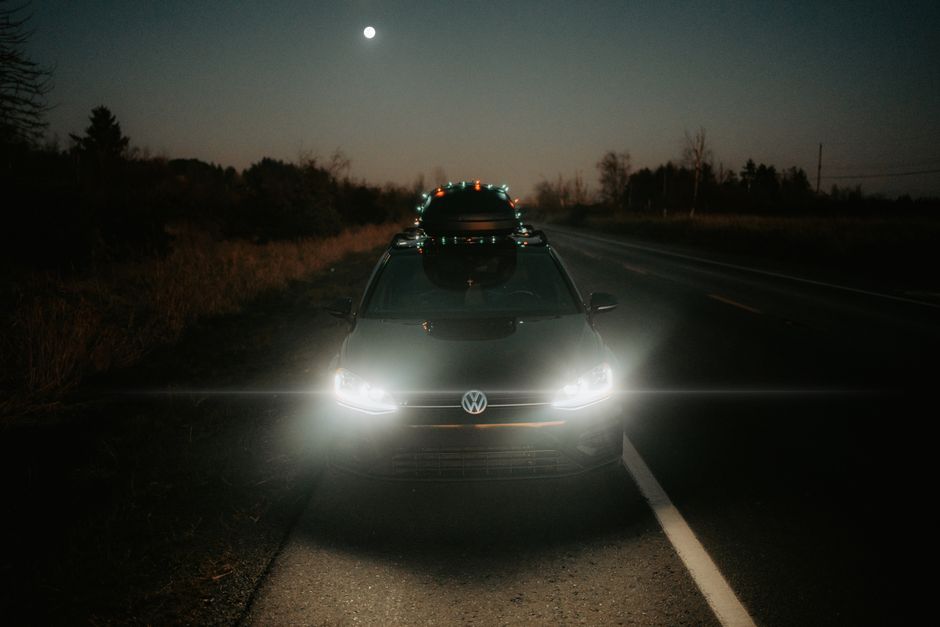
    Use high beams on dark open roads when no one is near, and switch to low beams when another vehicle approaches. Most US states require it within 500 feet of an oncoming vehicle, and within 200 to 350 feet of a vehicle you are following, depending on the state. This guide is for new drivers and permit test takers. It covers when headlights must be on, the dimming distances by state, the “wipers on, lights on” laws and how to handle glare.

    Key facts

    • Oncoming traffic: dim within 500 feet in the state handbooks covered here.
    • Following a vehicle: dim within 300 feet in California, Pennsylvania, Alaska and Kentucky; 200 feet in New York and Alabama; 350 feet in Oregon.
    • When lights must be on: typically from sunset (or 30 minutes after) to sunrise (or 30 minutes before), and whenever you can’t see a set distance ahead, often 1,000 feet.
    • Wipers on, lights on: California and Pennsylvania require headlights whenever you use your wipers because of the weather.
    • Don’t overdrive your headlights. Pennsylvania says low beams light only about 250 feet ahead, so on a dark road you should not drive faster than 45 mph.

    When to use high beams

    • Use them: on open country roads and dark city streets when no vehicle is close (California).
    • Switch to low beams: when a vehicle comes toward you or you close in on one ahead, within your state’s distance.
    • On lighted roads, use low beams (Idaho).
    • In rain, snow, fog or smoke, use low beams. Pennsylvania says high beams actually reduce visibility in bad weather, and California says they reflect back and cause glare in fog.
    • Where they are illegal, don’t use them (California).

    High beam dimming distances by state

    State Oncoming vehicle Vehicle ahead (same direction)
    California 500 feet 300 feet
    Pennsylvania 500 feet 300 feet
    Alaska 500 feet 300 feet
    Kentucky 500 feet 300 feet
    New York 500 feet 200 feet (even in another lane)
    Alabama 500 feet 200 feet
    Oregon 500 feet 350 feet
    Idaho Dim when approaching (no distance given in the manual) Dim when following, and on lighted roads (no distance given)

    For other states, check your handbook. If you aren’t sure, dim as soon as you see another vehicle’s lights, as Pennsylvania advises for oncoming traffic.

    When must headlights be on?

    State Time of day Low visibility rule Other
    California 30 minutes after sunset to 30 minutes before sunrise When too dark to see 1,000 feet ahead Low beams on when wipers are needed for fog, rain or snow; on mountain roads and in tunnels; where signs say so
    Pennsylvania Sunset to sunrise When you can’t see people or vehicles 1,000 feet ahead Wipers in use because of weather; all posted work zones; daytime running lights alone aren’t enough
    Alaska Half an hour after sunset to half an hour before sunrise Daytime visibility of 1,000 feet or less (fog, rain, snow, smoke or dust) Don’t drive on parking lights only
    Alabama Half an hour after sunset to half an hour before sunrise When you can’t see clearly for at least 500 feet If in doubt, turn on low beams
    Idaho Sunset to sunrise Visibility reduced to 500 feet or less Low beams are best in fog, smoke, dust or rain

    Driving on parking lights alone is illegal in California and warned against in Alaska and Alabama.

    Wipers on, lights on

    • California: if you need your wipers because of fog, rain or snow, you must turn on low beams.
    • Pennsylvania: since January 28, 2007, headlights must be on whenever wipers are in continuous or intermittent use because of weather. Tail lights must be lit too, so daytime running lights don’t count. The fine is $25, but with fees the penalty approaches $100.

    Don’t overdrive your headlights

    Overdriving means going so fast you can’t stop within the distance your lights show.

    • Pennsylvania: low beams shine only about 250 feet ahead, and stopping from 55 mph on dry pavement takes more than 250 feet. On a dark road, don’t drive faster than 45 mph on low beams.
    • Idaho: you can see about 350 feet with high beams and about 100 feet with low beams. Drive slowly enough to stop within the distance you can see.
    • California: make sure you can stop within the distance lit by your headlights.

    How to deal with headlight glare

    Oncoming high beams

    1. Don’t look directly at the lights.
    2. Look toward the right edge of your lane and watch the other car from the corner of your eye (California). Idaho says to shift your eyes to the lower right side of your lane.
    3. If a driver forgets to dim, Pennsylvania says you may flash your high beams quickly a few times.
    4. Don’t retaliate by keeping your own high beams on. California and Pennsylvania both say it only makes it harder for both of you to see.

    Glare from behind

    Switch the inside mirror to its night setting (Pennsylvania).

    Sun glare at dawn and dusk

    California suggests keeping the windshield clean inside and out, wearing polarized sunglasses, keeping your visor clear and leaving extra space. Idaho warns never to wear sunglasses when light levels are low, and calls twilight and dawn the most dangerous times of day.

    Night driving tips for new drivers

    • Look harder for people. Pennsylvania says pedestrians are the hardest things to see at night, and California says motorcycles, pedestrians and cyclists are much harder to see.
    • Leave more following distance and more time for passing (Idaho). Pennsylvania calls passing at night the most dangerous kind, because you can’t judge distance well from headlights alone.
    • Let your eyes adjust: after leaving a brightly lit place, drive slowly until they do (California).
    • One light coming toward you? Keep well right: it could be a motorcycle, a bicycle or a car with a broken headlight (California).
    • Clean your headlights. Pennsylvania says dirty headlights may give only half the light they should.
    • Watch for animals on rural roads. See deer and animal collisions.
    • Don’t drive tired. See drowsy driving.
    • Wrong-way check: California says that if road reflectors shine red in your headlights, you are going the wrong way.

    Night driving and teen license rules

    • Practice hours: most states require some supervised night hours. California, for example, requires 50 hours with 10 at night. See supervised driving hours by state.
    • Curfews: most provisional licenses ban late-night driving at first. California bans driving between 11 p.m. and 5 a.m. in the first 12 months, with exceptions. Compare states in US graduated driver licensing compared.
    • Road test: California scores failing to use headlights when darkness or weather requires them.

    Permit test practice: headlights

    These are unofficial practice questions, written for this guide.

    1. In most states, you must dim your high beams for an oncoming vehicle within: A) 100 feet B) 200 feet C) 500 feet D) 1,000 feet. Answer: C. 500 feet in every handbook checked (handbook: using your headlights).
    2. In California, you must dim your high beams when following a vehicle within: A) 100 feet B) 300 feet C) 500 feet D) 1,000 feet. Answer: B. 300 feet (California handbook: using your headlights).
    3. An oncoming driver doesn’t dim their high beams. You should: A) Keep your high beams on B) Look toward the right edge of your lane C) Stare at their lights to judge distance D) Stop in your lane. Answer: B. Don’t look into the lights or retaliate (handbook: darkness).
    4. Which lights should you use in fog? A) High beams B) Low beams C) Parking lights only D) Hazard lights only. Answer: B. High beams reflect back and cause glare (handbook: fog).
    5. In Pennsylvania and California, turning on your wipers for rain means you must also: A) Turn on hazard lights B) Turn on your headlights C) Slow to 30 mph D) Use high beams. Answer: B. Wipers on, lights on (handbook: headlight laws).
    6. “Overdriving your headlights” means: A) Using high beams in town B) Driving too fast to stop within the distance your lights show C) Leaving lights on after parking D) Driving without headlights. Answer: B. Pennsylvania suggests no more than 45 mph on low beams on a dark road (handbook: night driving).

    More practice: US permit practice tests.

    Common questions

    When should you use high beams?

    On dark roads with no vehicle close ahead or coming toward you. Switch to low beams within 500 feet of oncoming traffic and within your state’s following distance (200 to 350 feet).

    How far ahead do low beams light the road?

    About 250 feet, according to Pennsylvania; Idaho’s manual says you can see about 100 feet with low beams and 350 feet with high beams.

    Is it illegal to drive with only daytime running lights at night?

    Yes, in effect. Headlights must be on at night, and Pennsylvania says daytime running lights aren’t enough because tail lights must be lit too.

    Can I flash my high beams at a driver who doesn’t dim?

    Pennsylvania’s manual says you may flash them quickly a few times. Then look toward the right edge of the road rather than keeping your brights on.

    Do I need headlights when it’s raining in the daytime?

    In California and Pennsylvania, yes, whenever your wipers are on because of the weather. Many other states have similar rules.

    Why is night driving more dangerous?

    Pennsylvania lists limited vision, glare, and more tired or impaired drivers on the road. Distances, colors and side vision are all harder to judge.

    Back to learning to drive in the USA. Related: driving in snow, fog and rain and rural roads and passing.

    Sources

    • California DMV, “California Driver’s Handbook: Section 5, An Introduction to Driving; Section 8, Safe Driving; Section 2, Getting an Instruction Permit and Driver’s License” (dmv.ca.gov)
    • California DMV, “Driving Performance Evaluation (DPE) Scoring Criteria” (dmv.ca.gov)
    • Pennsylvania Department of Transportation, “Pennsylvania Driver’s Manual” PUB 95, Chapter 3: Learning to Drive (pa.gov)
    • Alaska Division of Motor Vehicles, “Alaska Driver Manual” (Rev. 10/2025), Use of Lighting Equipment (dmv.alaska.gov)
    • Alabama Law Enforcement Agency, “Alabama Driver Manual” (November 2024) (alea.gov)
    • Idaho Transportation Department, “Idaho Driver’s Manual” (July 2026), Night Driving (itd.idaho.gov)
    • California DMV, “California Driver’s Handbook: Safe Driving” (dmv.ca.gov)
    • Kentucky State Police, “Kentucky Driver Manual” (updated July 2026) (kentuckystatepolice.ky.gov)
    • Kentucky State Police, “Driver Testing” (kentuckystatepolice.ky.gov)
    • New York State DMV, “New York State Driver’s Manual” (dmv.ny.gov)
    • Oregon DMV, “Oregon Driver Manual: Safe and Responsible Driving, Hazardous Conditions” (oregon.gov)