
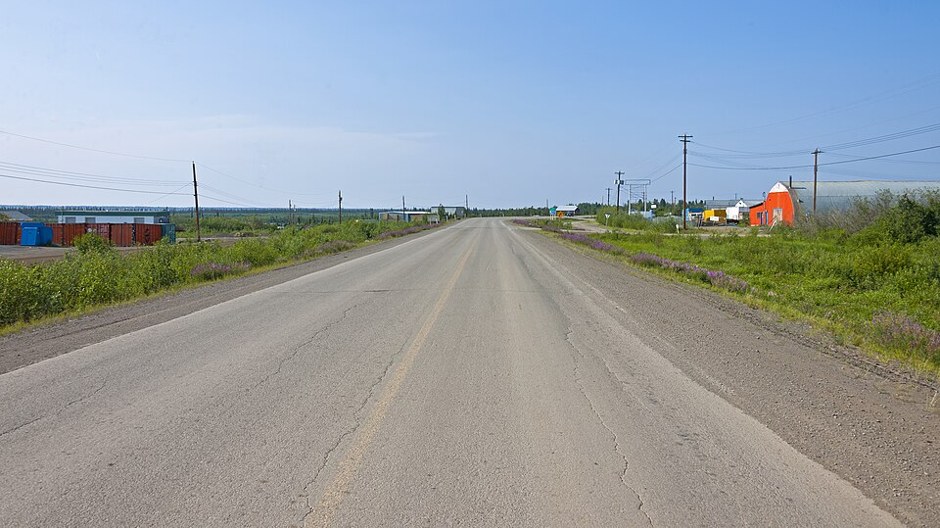
Photo: Daniel Case, CC BY-SA 3.0, via Wikimedia Commons
NWT winter and ice roads are temporary routes built over frozen lakes, rivers and overland trails. They are typically open from December through April and have their own posted speed and weight limits. Driving too fast can set up waves under the ice. This guide is for new NWT drivers and their supervisors, and covers ice roads, gravel highways, bison, log-haul trucks and the survival kit the territory recommends.
Key facts
- About 1,400 km of winter and ice roads are built each year, linking nine remote communities.
- Typical season: December through April. Opening and closing dates depend on weather and ice.
- Obey posted speed and load limits; they protect the ice.
- Never drive on a closed winter road.
- Check DriveNWT (the territory’s highway conditions map) before every trip.
- Headlights on at all times is the law in the NWT.
Ice road rules every NWT driver should know
Why ice road speed limits matter
The Department of Infrastructure says moving too fast can create waves under the ice that cause cracks or even failures. The risk is highest near shorelines, where ice is weaker. Posted limits also spread weight evenly. Heavy vehicles should keep extra space between each other.
Load limits
Different sections have different posted weight limits. Check them, especially if you are towing or carrying a heavy load.
Cracks and changing ice
Ice cracks naturally under vehicle weight and with temperature swings. Crews repair cracks and monitor thickness, but spring and sudden warm spells can change ice quality quickly. Expect rougher surfaces later in the season.
Visibility on open lakes
High winds and drifting snow can wipe out visibility on lake crossings and exposed areas, and make it easy to lose the route. Slow down when visibility drops.
Closures happen with little notice
Roads close for weather or ice strength, sometimes suddenly. Near the end of the season, some winter roads and ice crossings shut with little or no notice. Driving on a closed road is never allowed.
Trip planning checklist for NWT winter roads
- Check DriveNWT for road status, closures, ice crossings and weight restrictions.
- Tell someone your route and arrival time. Check in when you arrive.
- Leave early and plan for delays of hours or even days (weather, breakdowns, overflow).
- Fill up and carry extra fuel. Fuel and food are limited along the route.
- Carry a LADD 1 radio, or travel with someone who has one. Cell coverage is limited or missing on parts of NWT highways.
- Pack a lunch and a survival kit (below).
- Expect longer emergency response times.
What goes in an NWT winter survival kit?
The Department of Infrastructure recommends:
- Two-way radio or satellite phone
- Ice scraper, snow brush, shovel and axe
- Sand, cat litter or another traction aid
- Tow rope and booster cables
- Flares, warning lights or reflective triangles
- Gas line antifreeze
- Flashlight or headlamp with spare batteries
- First aid kit and fire extinguisher
- Tool kit and duct tape
- Spare tire (inflated) and a jerry can of fuel
- Extra clothing and footwear, insulated gloves and hats
- A winter-rated sleeping bag (rated to minus 20 degrees Celsius or colder)
- Non-perishable food and water
- Candles, a small tin can, a lighter and matches
Sharing winter roads with big trucks
Winter resupply puts many large commercial vehicles on the road. Give them room and time on hills and bridges. Watch for narrow sections, yield to oncoming traffic, and expect clouds of snow dust from passing vehicles.
For log-haul trucks, the NWT manual says:
- Keep at least four seconds behind them.
- Pull as far right as you can when one approaches, especially on gravel.
- Never pass one that is turning: the overhang at the back can be up to 9 metres, and a turning truck can block every lane.
Off-highway vehicles: the NWT manual warns that off-highway vehicles, such as ATVs and snowmobiles, may be running close to the highway and may cross it. When you see one, slow down, give it space and be ready to stop.
Driving NWT gravel highways
- Slow down when passing or meeting vehicles to cut dust and flying stones.
- Close the windows and use the vent fan to keep dust out.
- Carry a good spare tire, or two.
- Know where fuel and repair shops are along your route and when they are open.
- On wet or gravel roads you can spray other windshields with water, mud or gravel. Slow down and keep washer fluid topped up.
Bison on NWT highways
Most bison collisions happen on Highways 3 and 5; bison also use Highway 7. The highest risk on Highway 3 is from about kilometre 21 near Fort Providence to kilometre 70. August through November, from dusk to dawn, is the most dangerous time, because there is less daylight and no snow yet to show the animals against the road.
- Drive Highways 3, 5 and 7 in daylight if you can.
- Use high beams whenever possible.
- Flash your hazard lights to warn drivers behind you when you see wildlife.
- Do not swerve. Stop and wait if needed. Where there is one bison, there are often more.
- If you hit one, do not approach it. Move to the shoulder, use your hazards, and get a Wildlife Officer called.
More on wildlife across Canada: moose, deer and caribou.
Snowplows, black ice and cold-weather habits
- Stay well back from snowplows. They have flashing amber lights and pull over regularly to let traffic pass.
- Keep at least half a tank of fuel so fuel lines don’t freeze.
- Check tire pressure often; it drops in the cold.
- Bridges, overpasses, shaded areas and intersections ice up first. Shiny black asphalt may be black ice.
- No cruise control on poor roads.
- If stranded, stay with the vehicle, run the engine only enough to keep warm, and crack a window to prevent carbon monoxide build-up.
- Use your low beams within 150 m of a vehicle ahead and within 300 m of an oncoming one. Headlights are required whenever you can’t see clearly for 150 m.
General winter skills: winter driving in Canada for new drivers. Passing plows and roadside crews: slow down, move over.
Common questions
What is the speed limit on NWT ice roads?
It varies by road and crossing and is posted. Follow the signs; they are set to protect the ice structure.
Can a learner drive on an NWT ice road?
The GDL rules do not ban it, but every learner rule still applies: supervisor beside you, no other passengers and no driving 11 p.m. to 6 a.m. Long winter road trips often run into the curfew, so plan accordingly.
When do NWT winter roads open?
Typically December through April, but each road depends on weather and ice. Check DriveNWT for current status.
Do I need a radio on NWT winter roads?
The Department of Infrastructure recommends a LADD 1 radio, or travelling with someone who has one, because cell coverage is limited.
When are bison collisions most likely?
August through November, from dusk until dawn, especially on Highway 3 between Fort Providence and Yellowknife.
Do I have to keep my headlights on in daylight?
Yes. The Department of Infrastructure says keeping headlights on at all times is the law in the NWT.
Back to the full guide: Learning to drive in the Northwest Territories.
Sources
- Government of the Northwest Territories, Department of Infrastructure, “Winter Driving” (inf.gov.nt.ca)
- Government of the Northwest Territories, Department of Infrastructure, “NWT Winter Road Safety” fact sheet (inf.gov.nt.ca)
- Government of the Northwest Territories, Department of Infrastructure, “Driving Safety” (inf.gov.nt.ca)
- Government of the Northwest Territories, Department of Infrastructure, “Bison Safety” (inf.gov.nt.ca)
- Government of the Northwest Territories, Department of Infrastructure, “Highway Conditions Map: DriveNWT” (inf.gov.nt.ca)
- Government of the Northwest Territories, Department of Infrastructure, “Driver’s Manual: A guide to safely operate cars and light trucks”, Chapters 6 and 8 (idmv.inf.gov.nt.ca)