
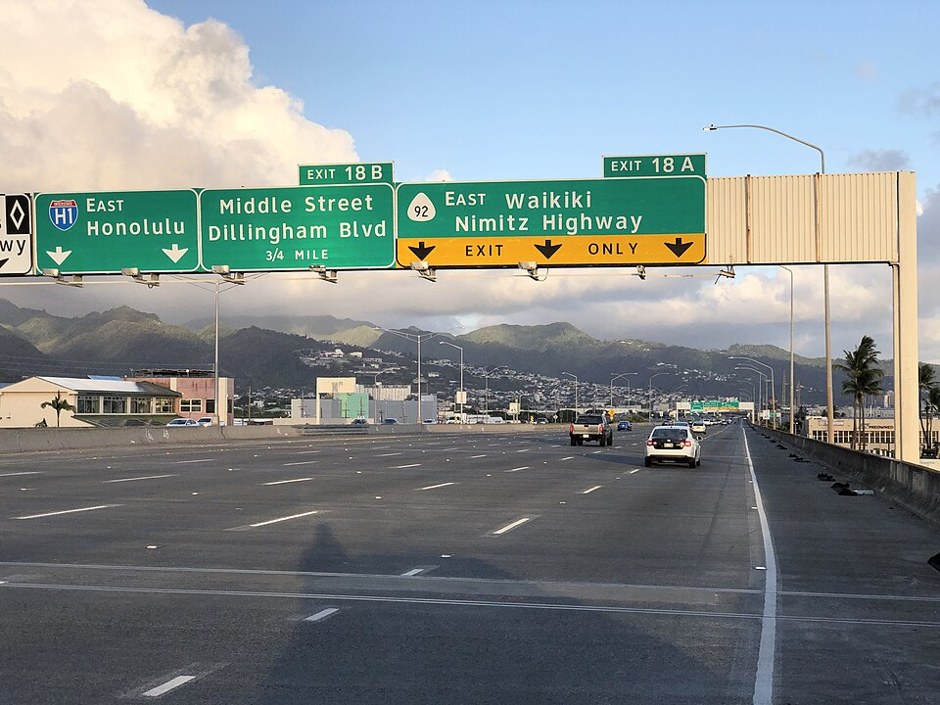
Photo: Famartin, CC BY-SA 4.0, via Wikimedia Commons
Honolulu’s online permit test page describes the Hawaii written test as 30 multiple-choice questions on rules of the road and traffic control devices, with a one-hour limit online. This page gives you a 30-question mock in that format, then 10 bonus questions on the Hawaii rules that trip people up. All questions are original and unofficial, written from the 2023 Hawaii Driver’s Manual, not taken from the county tests.
Hawaii written test at a glance
| Item | Detail (as of November 2026) |
|---|---|
| Questions | 30 on Honolulu’s pages; HDOT’s statewide online page says 25. Prepare for 30. |
| Pass mark | Ask your county office. A Maui County page says more than 6 errors is a fail, which is 24 of 30. |
| Time limit online | One hour |
| Fail? | Wait seven days after a knowledge-based fail. Each attempt costs the full fee ($12 online in Honolulu). |
| Minimum age | 15 and a half |
How to book, county fees and what to bring: the Hawaii written test and instruction permit guide.
Mock exam: 30 questions
Set a one-hour timer and no notes, as on the online test.
1. A triangular sign pointing down tells you to:
- A. Yield to traffic and pedestrians, stopping if needed
- B. Watch for falling rocks
- C. Stop every time
- D. Merge without looking
Answer: A. YIELD means give way; you only have to stop if traffic or pedestrians require it. Manual topic: Chapter VI, signals, signs and lane markings.
2. Which color is used for regulatory signs such as speed limits?
- A. Yellow with black letters
- B. Brown with white letters
- C. White with black letters
- D. Green with white letters
Answer: C. Regulatory signs (laws you must obey) are mostly black on white. Yellow warns; green guides. See US road signs by shape and color.
3. A yellow diamond sign with a picture of a person walking means:
- A. Watch for pedestrians crossing
- B. Pedestrians may not cross
- C. Hiking trail ahead
- D. Sidewalk closed
Answer: A. Diamond warning signs alert you to conditions ahead, here a pedestrian crossing. Manual topic: Chapter VI.
4. An orange triangle with a red border on the back of a slow vehicle means:
- A. A vehicle carrying explosives
- B. A tow truck
- C. The vehicle is designed to go 25 mph or less
- D. A school vehicle
Answer: C. The manual says this emblem marks vehicles built for 25 mph or less. Slow down and approach with care.
5. When may you cross a double solid yellow center line in Hawaii?
- A. Never, even to turn
- B. To pass a slow car
- C. Whenever no traffic is coming
- D. Only to turn left into or out of an alley, private road or driveway
Answer: D. The Hawaii manual allows crossing a double solid yellow line only to turn left into or out of an alley, private road or driveway. See US pavement markings.
6. A steady red light with a green arrow pointing right means:
- A. You may turn right in the arrow’s direction, yielding to pedestrians still crossing
- B. The light is broken
- C. You must wait for the red to change
- D. Only buses may turn
Answer: A. A green arrow allows the movement shown even while the main light is red. See traffic signals in the US.
7. How far before turning, changing lanes or stopping must you signal in Hawaii?
- A. At least 300 feet
- B. At least 50 feet
- C. At least 100 feet
- D. At least 200 feet
Answer: C. At least 100 feet, even when no one seems to be around. Manual topic: Chapter V, traffic laws.
8. A train signal is flashing at a crossing. How close to the nearest rail may you stop?
- A. No closer than 10 feet
- B. No closer than 15 feet
- C. No closer than 5 feet
- D. No closer than 50 feet
Answer: B. Stop at least 15 feet from the nearest rail when a signal is on, a gate is down or a train is close. See railroad crossings.
9. When parallel parking, your curbside wheels may be no more than how far from the curb?
- A. 6 inches
- B. 12 inches
- C. 18 inches
- D. 24 inches
Answer: B. Parking more than 12 inches from the curb is prohibited. See how to parallel park.
10. How many people may ride in the front seat of a car in Hawaii?
- A. No more than three
- B. Only the driver
- C. Any number with belts
- D. No more than two
Answer: A. The manual warns that more than three persons in the front seat may be a violation, because it blocks your view and control. Manual topic: Chapter V.
11. Which of these is a place where you may NOT pass another vehicle?
- A. On a four-lane highway in the left lane
- B. On a straight road with a broken yellow line and clear view
- C. Within 100 feet of an intersection or railroad crossing
- D. When the car ahead signals right
Answer: C. The manual bans passing within 100 feet of an intersection, railroad crossing or posted narrow bridge, viaduct or tunnel. See passing on two-lane roads.
12. The end of a “no passing zone” sign means:
- A. You must pass now
- B. The speed limit rises
- C. The road becomes one way
- D. You can see farther ahead, not that passing is automatically safe
Answer: D. The manual points out the end of the zone only means improved visibility. Check before you pass.
13. Two cars arrive at an uncontrolled intersection at about the same time. Who must yield?
- A. The driver on the right yields
- B. The car going straight always yields
- C. The driver on the left yields to the driver on the right
- D. The faster car goes first
Answer: C. With no signs or signals, yield to the vehicle on your right. See right of way at uncontrolled intersections.
14. At a roundabout in Hawaii you should:
- A. Yield to traffic already circulating, travel counterclockwise and signal right to exit
- B. Stop inside the circle
- C. Travel clockwise
- D. Signal left when leaving
Answer: A. Slow down, yield to pedestrians, bicyclists and circulating traffic, go counterclockwise and signal right to exit. See how to drive a roundabout.
15. An emergency vehicle is stopped on the shoulder with lights flashing. The manual says to:
- A. Keep your speed
- B. Stop next to it
- C. Use your horn
- D. Slow down and leave an empty lane next to it if you safely can
Answer: D. Slow down and move over a lane when it is safe. See move over laws.
16. A school bus is stopped with alternating red lights flashing. Which drivers must stop?
- A. No one, if the bus is on the shoulder
- B. Drivers in the bus’s lane and all lanes next to it
- C. Only oncoming drivers
- D. Only drivers directly behind the bus
Answer: B. The manual says traffic in the bus’s lane and all adjacent lanes stops, and stays stopped until the bus moves or the lights go off. On a divided highway, oncoming traffic does not have to stop. See school bus stopping laws.
17. A pedestrian with a white cane or guide dog is about to cross. You must:
- A. Drive around them slowly
- B. Continue if you have a green light
- C. Honk so they know you are there
- D. Stop and let them cross
Answer: D. Always stop for a blind pedestrian. Manual topic: Chapter XII, pedestrian safety.
18. A car ahead in the next lane has stopped at a crosswalk. You should:
- A. Honk to warn the pedestrian
- B. Change lanes and continue
- C. Pass it carefully
- D. Stop too; never pass a vehicle stopped for a pedestrian
Answer: D. The stopped car may hide a person crossing. See pedestrians and crosswalks.
19. What is the minimum following interval the Hawaii manual says you should never go below?
- A. 1 second
- B. 2 seconds
- C. 4 seconds
- D. 6 seconds
Answer: B. At least two seconds behind the car ahead in good conditions, more in rain or at night. See following distance.
20. When making a right turn at an intersection with a bike lane, you should:
- A. Check for bicyclists and not drive in the bike lane
- B. Use the bike lane as a turn lane
- C. Turn from the left lane
- D. Speed up to beat cyclists
Answer: A. The manual says not to drive in a bike lane when turning right. Look over your shoulder for riders.
21. When passing a bicyclist, leave at least:
- A. 1 foot
- B. 2 feet
- C. 3 feet
- D. 6 feet
Answer: C. At least 3 feet. See sharing the road.
22. A motorcyclist is riding in your lane. The motorcyclist is entitled to:
- A. The shoulder only
- B. The full width of the lane
- C. Share the lane with you
- D. Half the lane
Answer: B. Never squeeze alongside a motorcycle in its lane. Manual topic: Chapter XI.
23. In heavy rain, at what speed does the Hawaii manual say partial hydroplaning can start?
- A. 25 mph
- B. 35 mph
- C. 50 mph
- D. 65 mph
Answer: B. Partial hydroplaning can start around 35 mph. Slow down in heavy rain. See driving in snow, fog and rain.
24. Water is flowing fast across the road ahead. The manual says:
- A. It is safe if you can see the road
- B. Never drive through swiftly moving water more than a foot deep
- C. Drive through quickly to avoid stalling
- D. Follow a larger vehicle through
Answer: B. Moving water can float a car. Turn around.
25. You must report a crash to police immediately if it causes injury, death, or property damage of:
- A. $500 or more
- B. $1,000 or more
- C. $3,000 or more
- D. $5,000 or more
Answer: C. The Hawaii threshold is $3,000. Stop, help the injured, warn traffic and exchange details. See what to do after a crash.
26. A driver aged 21 or older tests at a BAC of .08 or refuses a test in Hawaii. What happens straight away?
- A. A warning
- B. A $50 fine
- C. The license is taken and a 30-day temporary permit is issued
- D. Nothing until a court date
Answer: C. The manual says your license is taken and you get a 30-day temporary permit. A refusal can cost the license for one, two or four years depending on your record. See implied consent and DUI.
27. Drivers under 21 in Hawaii may not drive with a BAC of:
- A. .02 or more
- B. .05 or more
- C. .08 or more
- D. .10 or more
Answer: A. Zero tolerance applies at .02. See zero tolerance laws.
28. Where may an open container of alcohol be kept in a car on a public road?
- A. In the glove box
- B. In a cup holder if the driver is not drinking
- C. Anywhere, if the passenger is over 21
- D. Not in the passenger area
Answer: D. The manual bans open containers in the passenger area.
29. Is it legal for an adult Hawaii driver to hold a phone while stopped at a red light?
- A. Yes, the car is not moving
- B. No. Hand-held use is banned while driving, including when stopped at a light or stop sign
- C. Only on Oahu
- D. Yes, for calls only
Answer: B. HDOT says hand-held use is illegal, even when stopped. See hands-free and texting laws.
30. Tires must be replaced when tread depth is less than:
- A. 1/32 inch
- B. 1/16 inch
- C. 1/8 inch
- D. 1/4 inch
Answer: B. Replace tires with less than 1/16 inch of tread. They also have to pass the annual safety inspection. See Hawaii safety inspection.
Score your mock exam
| Correct out of 30 | Result |
|---|---|
| 27 to 30 | Ready for the real test |
| 24 to 26 | A pass on Maui’s 6-error rule. Review your misses. |
| Under 24 | A fail on that rule. Study the chapters named in your misses. |
Bonus: Hawaii permit and teen rules (questions 31 to 40)
31. What is the youngest age for a Hawaii instruction permit?
- A. 15
- B. 15 and a half
- C. 16
- D. 17
Answer: B. 15 years and 6 months. See the Hawaii learner driver guide.
32. The licensed driver supervising a Hawaii permit holder must be at least:
- A. 18
- B. 19
- C. 21
- D. 25
Answer: C. At least 21 and licensed for that type of vehicle, in the right front seat.
33. Between 11 p.m. and 5 a.m., who must supervise a Hawaii permit holder?
- A. No one; permit holders cannot drive then at all
- B. A parent or guardian
- C. A driving instructor only
- D. Any licensed driver 21 or older
Answer: B. At night the supervisor must be your parent or guardian. Other times, any licensed driver 21 or older.
34. How long must a Hawaii permit holder under 18 hold the permit before the road test?
- A. 90 days
- B. 120 days
- C. 180 days
- D. 1 year
Answer: C. At least 180 days. See the Hawaii road test guide.
35. May a 16-year-old with a Hawaii permit use a hands-free phone while driving?
- A. Only for GPS
- B. Yes, with a parent in the car
- C. Yes, hands-free is legal for all
- D. No. Drivers under 18 may not use hands-free devices either
Answer: D. HDOT says no one under 18 may use a hands-free mobile electronic device while driving.
36. On a Hawaii provisional license, how many passengers under 18 who are not household members may you carry without a licensed parent or guardian?
- A. 0
- B. 1
- C. 2
- D. 3
Answer: B. No more than one. Household members do not count. See Hawaii provisional license rules.
37. A provisional driver may drive from 11 p.m. to 5 a.m. without a parent in which case?
- A. Driving to or from work, carrying a signed employer statement
- B. Driving friends home from a party
- C. Never
- D. Driving to the beach
Answer: A. Work and school-authorized activities are the two exceptions. Carry the signed statement.
38. What must a Hawaii provisional license applicant under 18 complete besides the road test?
- A. State-certified driver education (classroom and behind-the-wheel)
- B. Nothing else
- C. 100 logged hours
- D. A first aid course
Answer: A. You need both certificates. See the Hawaii driver’s ed requirement.
39. What is the penalty for a first violation of a Hawaii provisional license rule?
- A. A $25 fine only
- B. A 3-month suspension
- C. A 1-year revocation
- D. A written warning
Answer: B. A first violation brings a 3-month suspension; a second, a 6-month revocation.
40. When does a Hawaii provisional license expire?
- A. On your 21st birthday
- B. On your 19th birthday
- C. It never expires
- D. On your 18th birthday
Answer: B. Convert to a full license from 17, after 6 months, and before your 19th birthday.
Common questions
Are these the real Hawaii test questions?
No. They are original, unofficial practice. The Hawaii Driver’s Manual appendix has 177 numbered practice questions with page references, which is the best official extra practice.
How many questions can I miss on the Hawaii permit test?
Ask your county office for the pass mark. Maui County says more than 6 errors fails. Aim for at least 27 of 30 here.
Can I take the Hawaii permit test online?
Yes, statewide since December 2024, on a desktop or laptop with a webcam. Phones and tablets are not allowed. You still visit your county office afterward.
What languages are available?
Online, English and Spanish, and questions can be read aloud. Honolulu also offers an oral test at Kapalama. See oral and audio permit tests.
I’m visiting from the mainland. Do I need this test?
Not to drive on a valid US license as a visitor. See driving in Hawaii on an out-of-state license.
Practice tests for other states?
See US permit practice tests by state.
Sources
- Hawaii Department of Transportation, “Hawaii Driver’s Manual” (2023) (hidot.hawaii.gov)
- City and County of Honolulu Customer Services, “Online Permit Test” (honolulu.gov)
- City and County of Honolulu Customer Services, “Graduated Driver Licensing Program (GDL)” (honolulu.gov)
- Hawaii Department of Transportation, “Graduated Driver Licensing” brochure (hidot.hawaii.gov)
- Hawaii Department of Transportation, distracted driving news releases, 2021 and 2024 (hidot.hawaii.gov)