
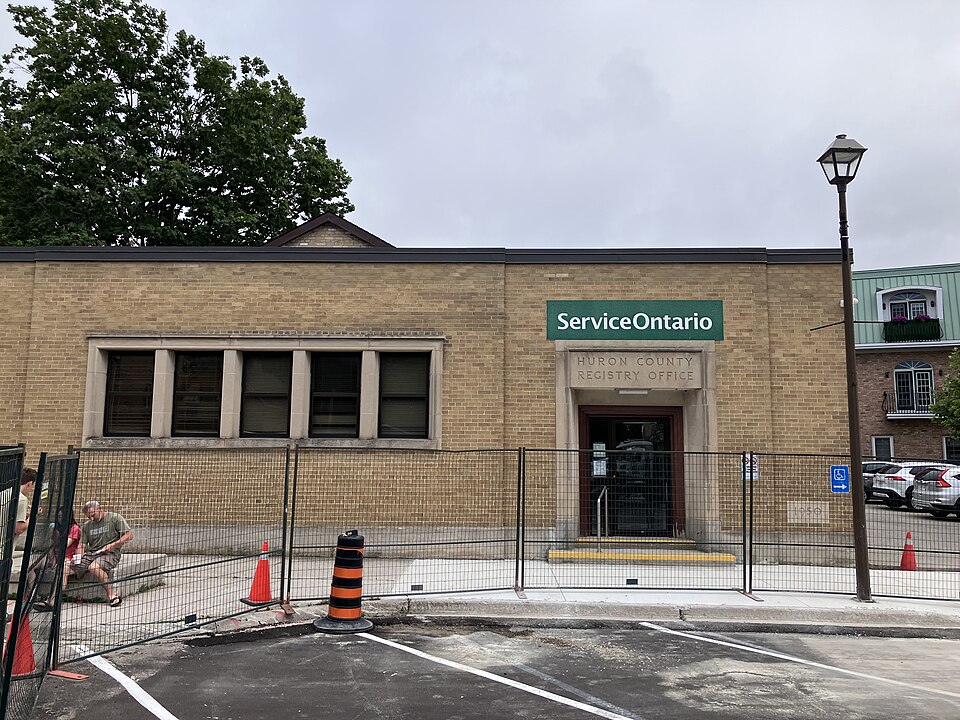
Photo: Gogerr, CC BY-SA 4.0, via Wikimedia Commons
The Ontario G1 knowledge test is a multiple-choice test on traffic signs and the rules of the road, taken at a DriveTest centre with no appointment. DriveTest says you need a total score of at least 80% to pass, and the test is not timed. This guide covers what to bring, what the questions cover, how to study, and what happens if you fail.
Key facts
- Minimum age: 16. You also take a vision test.
- Walk in at any DriveTest centre. The ServiceOntario Bay and College office in Toronto is by appointment.
- Multiple choice, in two or three sections (for example signs, and rules of the road).
- Pass mark: 80% total, according to DriveTest.
- Not timed: you can take until the office closes. DriveTest says most people take 20 to 30 minutes.
- Fee: included in the $159.75 G1 package listed by DriveTest; a retest is $16.00. Check current fees on DriveTest.
What to bring to the G1 test
- Original ID showing your legal name and full date of birth: for example a passport, Canadian Citizenship Card with photo, Permanent Resident Card, or study or work permit. The handbook checklist says to bring two pieces of identification, so bring a second document if you have one.
- Payment: cash, debit or credit card.
- Glasses or contact lenses if you need them to drive. The vision test is done at the same visit.
Expired documents and photocopies are not accepted.
How many questions are on the G1 test, and what is the pass mark?
DriveTest describes the test as two or three sections, such as one on signs and one on rules of the road, with a pass mark of at least 80% overall. Check the question count with DriveTest.
All questions follow the handbook’s sample format: a question with four possible answers. DriveTest offers the test on paper at all locations and on computer at some, in many languages.
What the G1 test asks about
The handbook’s “Could you pass?” list says the written test may cover:
| Topic | Where to study |
|---|---|
| Traffic signs and lights | Ontario signs and pavement markings |
| Rules of the road, passing, sharing the road | Handbook chapter 2; sharing Ontario roads |
| Intersections and right-of-way | driving through Ontario intersections |
| Getting on and off a freeway | Ontario freeway driving |
| Streetcars and school buses | school bus stopping rules |
| Emergency vehicles | slow down, move over |
| Demerit points and suspensions | Ontario demerit points |
| Seatbelts, headlights, speed limits, collision reporting | Handbook chapters 2 and 4 |
A study plan that works
- Signs first. Learn shapes and colours before individual signs. It is the most rule-bound section and the easiest to score highly on.
- Read chapters 1, 2 and 4 of the handbook (licensing, safe driving, keeping your licence). Note every number: distances, demerit points, BAC limits.
- Do the handbook’s “Test yourself” page. It has eight sample questions with an answer key.
- Test yourself on numbers using the practice questions below.
- Revisit what you got wrong the day before.
Practice questions based on the Ontario handbook
- How much driving experience must a G1 driver’s accompanying driver have? Answer: at least four years, with a full G (or higher) licence.
- With no stop line, where do you stop at a red light? Answer: at the crosswalk, marked or not; if no crosswalk, at the edge of the sidewalk; if no sidewalk, at the edge of the intersection.
- How many demerit points lead to a 60-day suspension for a G1 or G2 driver? Answer: 9 or more.
- What does a flashing red light mean? Answer: come to a complete stop and go only when it is safe.
- Traffic lights are blank in a power cut. What do you do? Answer: treat the intersection as an all-way stop.
- What do yellow pavement lines separate? Answer: traffic travelling in opposite directions. White lines separate traffic going the same way.
- What blood-alcohol level must a G1 driver have? Answer: zero.
- How close may you follow a fire vehicle responding to an alarm? Answer: it is illegal to follow within 150 metres.
If you fail the G1 knowledge test
- You can try again. DriveTest lists a $16.00 knowledge test retest fee; check the current amount.
- DriveTest says that if you retry within one year, you only redo the sections you did not pass.
- Ask which sections let you down and go back to those handbook chapters.
After you pass
You leave with a G1 licence and can start practising under the Ontario G1 rules. Your first road test is the G2 road test, 12 months later (8 with a BDE course). See the full route in learning to drive in Ontario.
Common questions
Is the G1 test hard?
It tests recall of the handbook, so it is hard only if you skip the reading. The 80% pass mark leaves little room for guessing.
Can I take the G1 test online?
No. The ontario.ca licensing page sends you to a DriveTest centre or the ServiceOntario Bay and College location.
Can I take the G1 test in another language?
Yes. DriveTest offers G1 knowledge tests in many languages, with more on computer than on paper. Check the list on DriveTest before you go. If you bring an interpreter, you can book an appointment for a verbal test given by DriveTest staff; arrange it at a centre in advance rather than expecting a friend to translate on the day.
Can I have the questions read aloud?
Yes, on the computer test. Each kiosk has an audio function that lets you hear, skip or repeat questions. Tell the staff before you go into the test room.
Is the G1 test timed?
No. DriveTest says you can take as long as you need until the office closes.
Do I need to book?
No, DriveTest centres take walk-ins for knowledge tests. Arrive well before closing so you have time for the vision test and the knowledge test.
Can I drive home after passing?
Only with a qualified accompanying driver in the front seat, because G1 rules apply the moment you are licensed.
Sources
- Government of Ontario, “Get a G driver’s licence: new drivers” (ontario.ca)
- Government of Ontario, “The Official MTO Driver’s Handbook: Getting your driver’s licence” (ontario.ca)
- Government of Ontario, “The Official MTO Driver’s Handbook: Test yourself, sample knowledge test questions” (ontario.ca)
- Government of Ontario, “The Official MTO Driver’s Handbook: Keeping your driver’s licence”, “Traffic lights”, “Pavement markings” and “Dealing with particular situations” (ontario.ca)
- DriveTest, “Knowledge Tests”, “Translators & Languages” and “Fees” (drivetest.ca)