
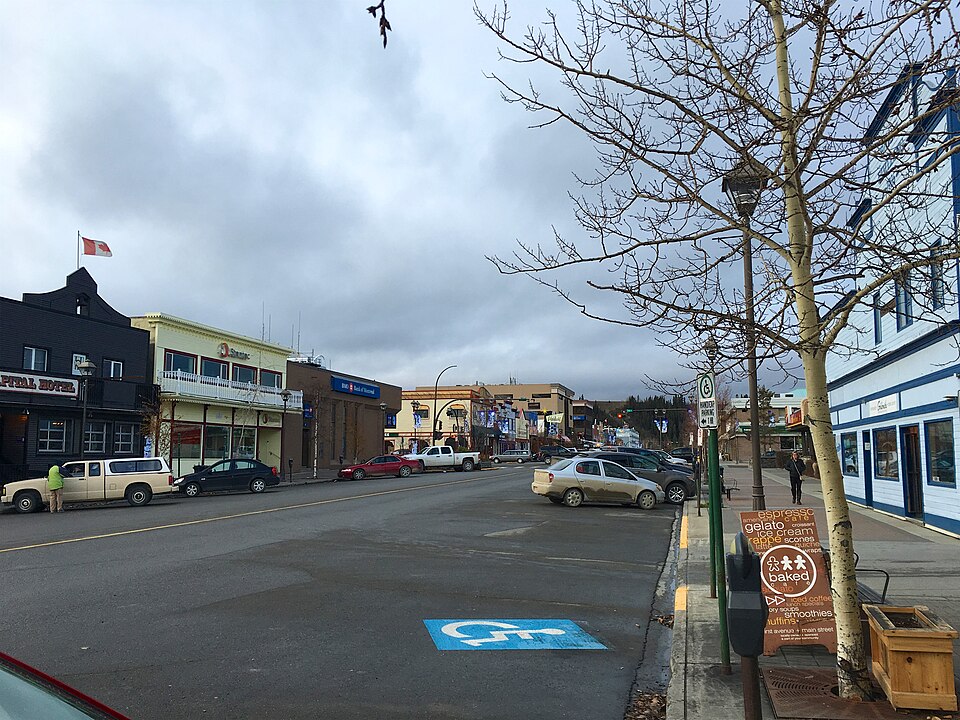
Photo: James Badger, CC BY 2.0, via Wikimedia Commons
The Yukon Driver’s Basic Handbook (cars and light trucks) is the book the Yukon learner’s knowledge and sign tests are based on. This guide is a checklist for working through it: what the signs chapter covers, the Yukon school zone, playground and school bus rules, the right-of-way basics, and the Yukon numbers worth memorizing, including the speeding fines and demerit points in force since 1 July 2025. It is for anyone 15 or older preparing for the Yukon learner’s test, and for parents helping them.
Key facts
- Current edition: the 2023 Yukon Driver’s Basic Handbook, cars and light trucks, free from yukon.ca. Yukon says it prepares you for the sign and knowledge tests.
- It was prepared from British Columbia’s Learn to Drive Smart material, but Yukon rules differ in places. Study the Yukon book, not the BC one.
- School zones: 30 km/h, in effect Monday to Friday from 8 a.m. to 4:30 p.m. when children are in class. If unsure, assume it is in effect.
- Stop for a stopped school bus with its upper red lights flashing.
- Ignoring a regulatory sign is an offence under the Yukon Motor Vehicles Act.
- Graduated licence (learner and novice) drivers are suspended at 7 demerit points; other drivers at 15.
Which handbook do you need for the Yukon learner’s test?
Use the Yukon Driver’s Basic Handbook: Cars and light trucks. The yukon.ca listing shows the 2023 web edition, updated 5 February 2023. It runs to about 157 pages in 10 chapters. There is a separate commercial vehicle handbook and a motorcycle guide (Learn to Ride Smart); you do not need them for a Class 5 learner’s licence.
The companion workbook, Tuning Up for Drivers, is for the road test stage. You can skim it now to see where the handbook rules lead, but the knowledge test comes from the handbook. For test format, fees and what to bring, see Yukon written knowledge test and learner licence rules.
Why not just use BC’s Learn to Drive Smart?
Yukon’s book borrows BC material, but the details that turn into test questions are territorial. One example: BC’s handbook shows school zone limits in effect from 8 a.m. to 5 p.m. on school days, while Yukon’s school zones run from 8 a.m. to 4:30 p.m. Penalties, demerit points and graduated licence rules are also different. Study the Yukon edition.
Study checklist: work through the handbook in this order
Tick each item off as you finish it. The order puts the most heavily tested material first.
- Signs, signals and road markings (Chapter 3). The whole of the sign test, plus many knowledge questions. Detail below.
- Rules of the road. Right-of-way, intersections, four-way stops, yield signs, turns, passing, speed, school buses, emergency vehicles, parking.
- Your licence. Learner and novice conditions: co-driver, passenger limits, curfew, zero alcohol and drugs, no electronic devices, no towing. The handbook says Chapters 9 and 10 (licensing, GDL and penalties) are not tested, but you must follow them from your first drive, so learn them anyway.
- Sharing the road. Pedestrians, cyclists, motorcycles, large vehicles, school zones and playgrounds.
- Personal strategies and impairment. Alcohol, drugs, fatigue and distraction. See Yukon impaired driving and demerit points.
- Hazards and emergencies. Winter roads, gravel, wildlife, skids, breakdowns. Yukon conditions are covered in driving the Alaska Highway and Yukon winter roads.
- The rest of the book. Vehicle checks and equipment, then a final read of anything you skipped.
The ten chapters are: 1 You in the driver’s seat; 2 You and your vehicle; 3 Signs, signals and road markings; 4 Rules of the road; 5 See-think-do; 6 Sharing the road; 7 Impairment and high risk behaviour; 8 Preventing and handling emergencies; 9 Graduated Driver Licensing; 10 Licensing requirements. Chapter 7 also explains how to register with the Yukon Organ Donation Program. For extra practice on Chapters 5 and 6, which come from BC material, try see-think-do and sharing the road, but take your rules and numbers from the Yukon book.
Chapter 3: signs, signals and road markings
Yukon’s signs chapter covers these groups. Make sure you can name every sign in each.
| Section | What to know |
|---|---|
| Regulatory signs | Signs that state the law, such as the fastest you may drive in good conditions. Disregarding them is an offence under the Yukon Motor Vehicles Act. |
| Warning signs | Hazards ahead: curves, hills, intersections, animals, road conditions. |
| Construction signs | You must follow their instructions. Yukon says there is no stopping or passing in a construction zone unless traffic controls direct otherwise. |
| School and playground signs | Tabs under the sign set the speed and hours. See the next section. |
| Railway signs | Crossbucks and advance warnings. See railway crossings in Canada. |
| Lane control signals | Overhead signals that open or close lanes. If the signals over all lanes are flashing yellow, slow down and proceed with caution. |
| Traffic lights | Steady, flashing and arrow signals have different meanings. Learn each one. |
| Road markings | White lines, yellow lines and reserved-lane markings. |
Learn the shapes first
Canadian provinces and territories use uniform traffic signs (as Prince Edward Island’s handbook notes), built on the same basic shapes: the octagon for stop, the downward triangle for yield, the diamond for warnings and the pentagon for school zones. Learning the shapes lets you answer some sign questions before you read the words. For a cross-Canada view, see Canadian road signs compared.
Yukon school zones, playgrounds and school buses
- School zones: slow to 30 km/h. Yukon says school zones are in effect when children are in class, Monday to Friday, 8 a.m. to 4:30 p.m. If you are unsure, assume the zone is in effect.
- Read the tab: the handbook’s examples also show a school zone limit of 50 km/h that applies from 8 a.m. to 4:30 p.m. on school days when children are on the roadway or shoulder. Obey whatever the sign and tab show.
- Playground zones: 30 km/h. The handbook’s examples include playground limits that apply around the clock, so check the sign every time.
- School buses: amber lights mean get ready to stop. On a street or undivided highway, stop in either direction for a bus with its upper red lights flashing, and wait until it moves on or the driver turns the lights off and pulls in the stop sign. For other provinces’ rules, see school bus stopping rules across Canada.
Right-of-way basics from the Yukon handbook
- Four-way stop: the first vehicle to arrive and come to a full stop goes first. If two arrive together, the vehicle on the right goes first.
- Yield sign: let traffic on the through road have the right-of-way. You may enter without stopping if no pedestrians, cyclists or vehicles are on the through road.
- Unmarked T-intersection: treat it like any other uncontrolled intersection.
Uncontrolled intersection: yield to a vehicle that got there first. If you arrive together, the vehicle on the left yields to the vehicle on the right.
Yukon speeding fines and demerit points
Yukon raised these fines on 1 July 2025. The figures below are from the Government of Yukon’s speeding penalties page as of November 2026.
| Offence | Fine | Demerit points |
|---|---|---|
| Up to 15 km/h over the posted limit | $100 | 2 |
| 16 to 30 km/h over | $200 | 3 |
| 31 to 50 km/h over | $300 | 4 |
| More than 50 km/h over | $500 | 6 |
| Speeding in a school or playground zone | $150 (up to 15 km/h over) to $550 | 3 to 6 |
| Unreasonable speed for conditions | $400 | 4 |
As a learner or novice, you are suspended at 7 points. One ticket for more than 50 km/h over (6 points) leaves you one point from a suspension.
More handbook rules to learn
| Topic | The rule |
|---|---|
| Speed | 50 km/h unless a sign says otherwise |
| Following distance | At least 3 seconds; increase to 4 in bad weather |
| Looking ahead | Scan at least 12 seconds: one to two blocks in town, half a kilometre on the highway |
| Parking | Within 50 cm of the curb. Not within 1.5 m of a driveway; 5 m of a hydrant, crosswalk, intersection, stop sign or traffic light; or 15 m of a railway crossing |
| Hill parking | Wheels left uphill with a curb. Wheels right uphill without a curb, and downhill with or without one |
| U-turns | Illegal near a hill crest where traffic cannot see you within 150 m, on a municipal roadway between intersections, and where a by-law bans them |
| Emergency vehicles | With lights and siren, pull over to the right and stop, clear of intersections. Stay at least 150 m behind a fire truck. Slow down for stopped emergency vehicles with flashing lights and change lanes if you can |
| Railway crossings | Trains always have the right-of-way. Where you must stop, stay 5 to 15 m from the nearest rail. Stuck on the tracks? Get everyone out and at least 30 m away |
| Changing lanes and merging | Vehicles already in the lane have the right-of-way. Always signal. On a ramp, use the acceleration lane to reach traffic speed within the limit. It is illegal to speed up while someone is passing you |
| Cyclists | Leave at least 1 m when passing |
| Roundabouts | Yield to pedestrians and traffic already inside, go counter-clockwise, signal right before you exit |
| Headlights | Required at night and when visibility is under 150 m. Dim high beams within 300 m of oncoming traffic and 150 m when following |
| Winter signs | Winter tires or chains must be used where the regulatory sign is displayed |
| Tires | At least 1.6 mm of tread. Never over 80 km/h on a space-saver spare |
| Child seats | Rear-facing until at least 10 kg and walking; forward-facing with a tether over 10 kg; booster over 22 kg until 145 cm tall or 45 kg |
| Attitude | When friends push you to take a risk, identify the problem, think through the consequences, find an alternative and follow through. Do not return another driver’s aggression: give them room, avoid eye contact and call 911 if needed, having a passenger make the call if you can |
| Crashes | Stay at the scene, help, and exchange details. Report to police if anyone is hurt or damage is over $1,000 |
Yukon numbers to memorize
- 15: minimum age for a learner’s licence.
- 30 km/h: school zones and playground zones.
- 8 a.m. to 4:30 p.m.: school zone hours on school days.
- Midnight to 5 a.m.: learners may not drive; novices need a co-driver.
- 6 months and 50 hours: the minimum learner period and the logged practice before the road test.
- 18 months: the minimum novice stage.
- Zero: alcohol and drugs for learners, novices and their co-driver.
- 80 per cent: the knowledge test pass mark.
- 7 and 15: demerit points that trigger suspension for graduated licence drivers and for other drivers.
The graduated licence figures are explained in learning to drive in Yukon and Yukon novice drivers. Yukon is rewriting its Motor Vehicles Act, so check the current stage lengths with Motor Vehicles before you plan dates.
A two-week study plan
- Days 1 to 3: Chapter 3. Make flash cards of every sign: picture on one side, meaning and action on the other.
- Days 4 to 7: rules of the road. After each section, write two questions you think the test could ask.
- Day 8: licence rules and the numbers list above.
- Days 9 to 11: sharing the road, impairment, hazards and emergencies.
- Days 12 to 13: re-test yourself on the sign cards and your own questions. Re-read anything you miss.
- Day 14: a final skim of Chapter 3, then book the test.
Common questions
How many questions are on the Yukon knowledge test, and what is the pass mark?
It is multiple choice, with a pass mark of 80 per cent. Ask Motor Vehicles how many questions to expect.
Is there a printed copy of the Yukon handbook?
The handbook is free online at yukon.ca. Ask at a Motor Vehicles office whether printed copies are available.
Can I study from BC’s handbook instead?
No. Yukon adapted BC material, but school zone hours, penalties and graduated licence rules differ. The Yukon test is based on the Yukon book.
What does a flashing yellow lane control signal mean?
If the signals over all lanes flash yellow, slow down and proceed with caution.
Can I pass in a Yukon construction zone?
No. There is no stopping or passing in a construction zone unless traffic controls tell you otherwise.
Does the school zone limit apply in July?
School zones apply when children are in class. Outside school days the posted daytime limit applies, but playground zones can apply every day, so read each sign.
Related: learning to drive in Yukon (full guide), Yukon knowledge test and learner rules, Yukon road test, Yukon impaired driving and demerits.
Sources
- Government of Yukon, “Yukon Driver’s Basic Handbook: Cars and light trucks”, 2023 web edition (yukon.ca)
- Government of Yukon, “Yukon driver’s basic handbook” listing page (yukon.ca)
- Government of Yukon, “Learn about school bus and school zone safety” (yukon.ca)
- Government of Yukon, “Learn about construction zone safety” (yukon.ca)
- Government of Yukon, “Learn about the penalties for speeding” (yukon.ca)
- Government of Yukon, “Increased fines for dangerous driving offences” fact sheet, in effect 1 July 2025 (yukon.ca)
- Government of Yukon, “Find out how your licence could become suspended” (yukon.ca)
- Government of Yukon, “Get a driver’s licence” (yukon.ca)
- ICBC, “Learn to Drive Smart”, chapter 3 school and playground zone signs (icbc.com)
- Government of Prince Edward Island, “Driver’s Handbook”, February 2022, Chapter 3 (uniform traffic signs across Canada) (princeedwardisland.ca)