
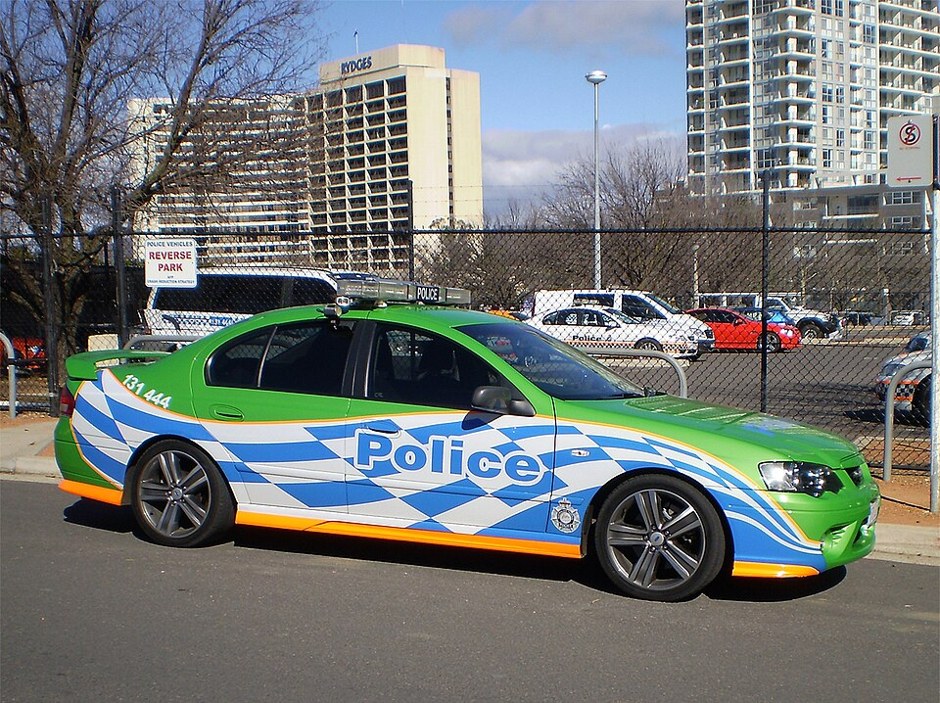
Photo: Angelo Tsirekas, CC BY-SA 3.0, via Wikimedia Commons
This is the full list of rules for ACT learner and provisional (P1 and P2) drivers: plates, alcohol, phones, speed, towing, the late-night passenger limit and demerit points. The ACT is stricter than many people expect on phones (a total ban, hands-free included) but has no special speed cap for L or P platers.
ACT L and P rules at a glance
| Rule | Learner | P1 (red, first 12 months) | P2 (green, last 2 years) |
|---|---|---|---|
| Plates front and rear | L | Red P | Green P |
| Supervisor | Full Australian licence holder in the front passenger seat | Not needed | Not needed |
| Alcohol and drugs | Zero | Zero | Zero |
| Mobile phone | Total ban, including hands-free and speaker | Total ban | Total ban |
| Speed | Up to the posted limit | Up to the posted limit | Up to the posted limit |
| Trailer over 750 kg GVM | Not allowed | Not allowed | Allowed (within licence class) |
| Passengers | No limit | Max one peer aged 16 to 22, 11pm to 5am | No limit |
| Demerit limit | 4 points = 3-month suspension | 4 points = 3-month suspension | 4 points = 3-month suspension |
If you get your Ps at 25 or older, you skip P1 and drive on green P2 plates for all 3 years, with no late-night passenger limit.
Learner licence rules
- Display L plates at the front and back. They must be clearly visible, so not behind wiper arms, rear louvres or tinted glass, and must not cover number plates.
- Only drive with a person holding a valid full Australian licence in the front passenger seat. They must have zero alcohol and no drugs.
- Zero blood or breath alcohol, and no drugs.
- No trailer with a Gross Vehicle Mass over 750 kg.
- Do not exceed posted speed limits.
- No passenger restrictions.
P1 and P2 rules
- Display the correct colour P plates at the front and rear, the right way up. It is an offence to show the wrong letter or colour plates.
- Zero alcohol and no drugs.
- Fewer than 4 demerit points in a 3-year period.
- P1 only: no trailer over 750 kg, and the late-night peer passenger limit.
Do ACT P platers have a curfew?
No full curfew, but P1 drivers have a late-night peer passenger restriction: between 11pm and 5am you may carry only one peer-aged passenger. A peer-aged passenger is someone aged 16 to 22 who is not a family member.
Exemptions
- Employment (paid or voluntary)
- Education
- Police trainees in recruit training or assessment, or driving a police vehicle
There is no exemption for designated driving. Driving your mates home from a party at midnight is exactly what the rule targets.
Penalty: 3 demerit points and a $514 infringement notice, or a court fine of up to 20 penalty units.
Scenarios
- 11.30pm, two friends aged 18 and 19: not allowed on P1.
- 11.30pm, one friend aged 18 plus your sister aged 20: allowed. Family members do not count.
- 10pm, three friends aged 17: allowed. The limit only applies from 11pm to 5am.
- Midnight, two friends aged 24: allowed. They are outside the 16 to 22 age range.
ACT phone rules for L and P platers
Learner and provisional drivers have a full mobile device ban. While driving, or stopped but not parked (for example at traffic lights), you must not text, use social media, take or make calls by Bluetooth, hands-free or speaker, or touch the device at all, even to skip a song.
Two narrow exceptions:
- Music and podcasts: allowed if the device is not held and needs no interaction, including by voice. The ban covers wearables such as headphones too, so you cannot touch them.
- GPS: allowed if the device is in a mount fixed to the car and needs no interaction, including by voice. Set the route before you drive.
| Offence | Penalty |
|---|---|
| Messaging, social media, apps or internet | 4 demerit points and $632 |
| Other phone use, such as a call | 3 demerit points and $514 |
With a 4-point limit, one messaging offence suspends an L or P licence. Note the ACT Road Rules Handbook’s phone section describes the rules for full licence holders (mounted phones, calls allowed). Those do not apply to you on Ls or Ps.
Speed limits for ACT learners and P platers
ACT learner and provisional drivers may drive up to the posted speed limit in the ACT. Default limits are 50 km/h in built-up areas and 100 km/h in rural areas. Interstate, local rules apply: many states cap L and P platers at lower speeds, so check before you cross the border. See driving interstate on L or P plates.
Demerit points on Ls and Ps
| Licence | Points in 3 years | Suspension |
|---|---|---|
| Learner (issued or renewed after 1 January 2020) | 4 or more | 3 months |
| Provisional (P1 or P2) | 4 or more | 3 months |
| Full | 12 to 15 | 3 months |
- Points reset to zero when you move from Ls to Ps, but carry over from Ps to a full licence.
- Suspension time does not count towards your 3-year provisional period.
- L and P drivers cannot choose a good behaviour period instead of a suspension. Only full licence holders can.
- Examples: speeding by 15 km/h or less is 1 point; failing to give way or disobeying a traffic signal is 3 points.
For which states use double demerits, see double demerit points in Australia.
Common questions
Can I use Apple CarPlay or Android Auto on my Ps in the ACT?
Not for calls or messages: hands-free and Bluetooth are banned for L and P drivers. Audio and mounted GPS are allowed only if you do not interact with them at all while driving.
What is the speed limit for P platers in the ACT?
The posted limit. The ACT has no special L or P speed cap.
Can learners carry passengers in the ACT?
Yes. There are no passenger restrictions for learners, but the supervisor must sit in the front passenger seat.
Can P1 drivers tow a trailer?
Yes, up to 750 kg GVM. The limit lifts on P2. See towing a trailer or caravan on L or P plates.
Do I need to display P plates on P2?
Yes. Green P plates front and rear for the last 2 years of the provisional period.
Does the ACT have a zero alcohol limit for P2 drivers?
Yes. Zero applies to all learner and provisional drivers. See zero alcohol for learners and P platers.
Back to the main guide: learning to drive in the ACT. Compare states: P plate rules in every Australian state.
Sources
- Access Canberra, “Licence classes and conditions” (accesscanberra.act.gov.au)
- Access Canberra, “Get your learner driver licence” (accesscanberra.act.gov.au)
- Access Canberra, “Demerit points and suspensions” (accesscanberra.act.gov.au)
- Access Canberra, “ACT Road Rules Handbook” (accesscanberra.act.gov.au)
- City Services, “Learner and provisional driver safety” (cityservices.act.gov.au)
- City Services, “Safe plates frequently asked questions” (cityservices.act.gov.au)