
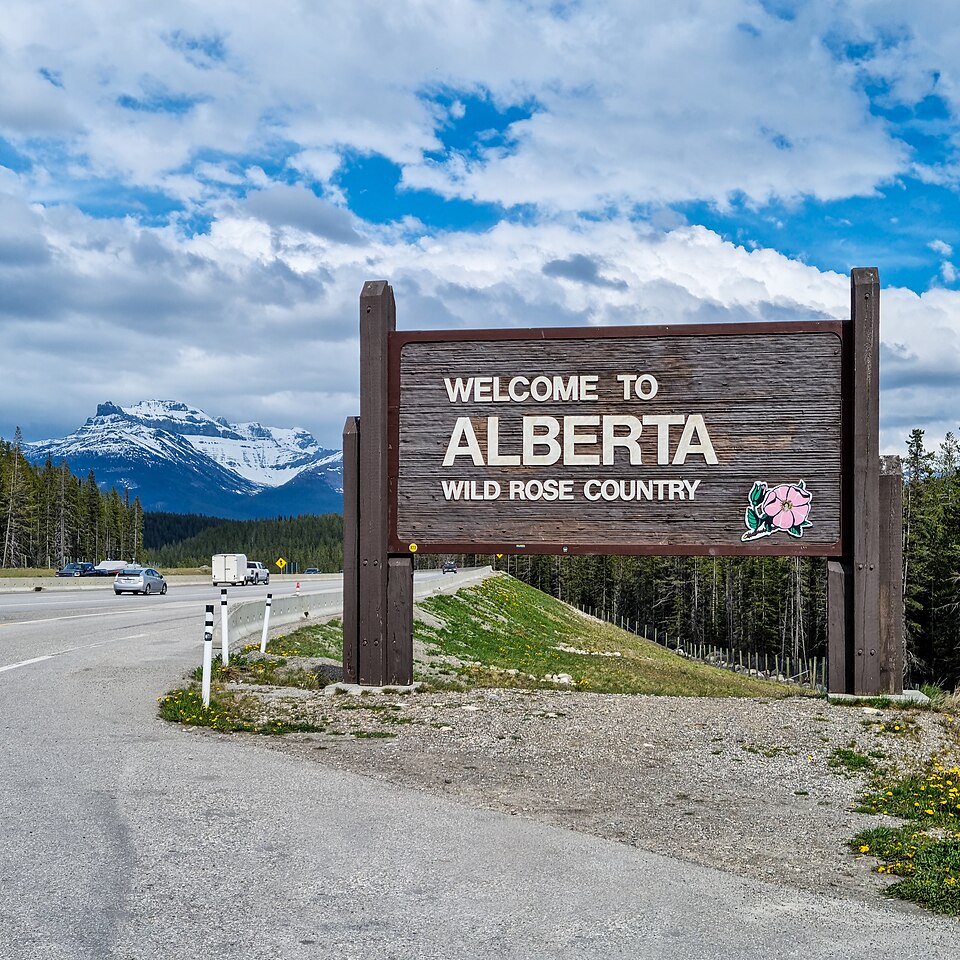
Photo: Dietmar Rabich, CC BY-SA 4.0, via Wikimedia Commons
The Alberta Driver’s Guide (full title: Driver’s Guide to Operation, Safety and Licensing: Cars and Light Trucks) is the official book for the Class 7 knowledge test. It is free from alberta.ca, also comes in French, and covers licensing, signs, rules of the road and safe driving. This study plan breaks it into six sessions, using the topic list in Alberta’s own Class 5 driver education curriculum (June 2026), so you know what to learn and what the test asks.
Where to get the Alberta Driver’s Guide
- Download the PDF from the Government of Alberta’s “Driver guides” page on alberta.ca.
- A French edition, Guide du conducteur : conduite, sécurité et délivrance de permis : automobiles et camions légers, is produced by the Francophone Secretariat.
- Community groups have translated the guide into other languages. These versions are not Government of Alberta publications, so check anything important against the English or French guide.
Check the edition. The edition currently linked from alberta.ca is dated Spring 2023 on its back cover. Alberta updates the guide, so use the copy currently linked from alberta.ca and check its date, especially for road tests, GDL and fines.
The guide has ten chapters: licensing information, traffic control, the basics of driving, intersections and turns, highways and freeways, emergency situations and challenging conditions, responsible driving, sharing the road, driving within the law, and towing a trailer. The guide itself says it interprets the Traffic Safety Act and has no legal authority; the Act and its regulations decide.
Other Alberta guides you might need
- Rider’s Guide (motorcycles, mopeds, power-assisted bicycles): a supplement for the Class 6 test.
- Commercial Driver’s Guide (trucks, buses, emergency responders, taxis): a supplement for Classes 1 to 4.
For a car licence you need only the cars and light trucks guide.
Six-session study plan for the Alberta learner test
| Session | Topic | What to master |
|---|---|---|
| 1 | Licensing | The 3 GDL stages, Class 7 and GDL restrictions, demerits and losing your licence |
| 2 | Signals and signs | Lights, arrows, pedestrian and lane control signals; regulatory, warning, construction, guide, school and playground signs |
| 3 | Pavement markings and lanes | White and yellow lines, secondary highways, acceleration and deceleration lanes, weave zones, lane use on multi-lane highways |
| 4 | Intersections | Right and left turns, right of way, one-way and two-way roads, traffic circles, uncontrolled intersections |
| 5 | Sharing the road | Emergency and slow-moving vehicles, large vehicles, trains and LRT, school buses, funeral processions, motorcycles, ATVs, cyclists, pedestrians, children, pets and wildlife |
| 6 | The driver and collision avoidance | Distraction, impairment, fatigue, stopping distance, scanning and blind spots, following distance, skids, hydroplaning, night and fog driving |
Session notes: the facts most worth memorizing
1. Licensing
- Class 7 at 14; road test after 12 months and at 16; full Class 5 at 18 after 24 months on GDL.
- Learner curfew: 12 a.m. to 5 a.m. Zero alcohol. 8-point demerit limit (full licence: 15).
- Read: Class 7 learner rules, GDL probationary rules.
2. Signals and signs
- Flashing red = stop sign. Flashing yellow = yield.
- Sign shapes and colours: red octagon stop, triangle yield, fluorescent yellow-green pentagon for school zones, yellow diamond warning, orange diamond construction, green guide signs, blue service signs. A green circle permits the action shown; a red circle and slash forbids it.
- Default limits unless posted: 50 km/h in an urban area, 80 km/h on a rural road and on a provincial highway inside a city, 100 km/h on a provincial highway outside an urban area. Municipal bylaws can differ, so read the signs.
- Lane reversal signals: a red X means leave or stay out of that lane; a downward green arrow means you may use it.
- Pedestrian signals: a walking symbol or WALK lets pedestrians start crossing; a hand or DON’T WALK means those already in the crosswalk finish and clear it, and some signals show a countdown. Expect people still crossing when you turn.
- Blue service signs mark hospitals, fuel, phones (including TTY pay phones for callers who are deaf or speech impaired) and disabled parking, which needs a placard from a registry agent.
- Pedestrian and school crossing signs with flashing yellow lights: slow to 30 km/h or less and yield or stop for pedestrians.
- Construction zone limits apply at all times, even when nobody is working. Fines double when workers are present. Obey the flag person.
- A slow-moving vehicle sign is on vehicles that travel under 40 km/h, such as tractors.
- Right on red is allowed after a full stop unless a sign prohibits it.
- A school sign with a speed tab is a zone; without one it is an area.
3. Lanes
- Slow-moving vehicles carry an orange triangle with a red border. Keep back and pass only when safe.
- When passing, wait until you can see the whole front of the vehicle in your rear-view mirror before pulling back in.
- Inside an urban area you may pass safely across a single solid yellow line. Elsewhere, single or double solid yellow lines mean no passing.
- Do not drive or pass in the emergency stopping lane (the shoulder of a primary highway). It is for emergencies and breakdowns.
- Weave zones are where a highway entrance and exit share one lane. Control your speed and time your lane change so drivers entering and leaving can both get through.
- A large white X painted on a rural highway warns of a railway crossing ahead. A no stopping zone keeps the road clear where large vehicles need room to turn.
- Bicycle lanes: do not drive in them except to turn or reach a parking spot, usually where the line is dashed. Painted islands are not for travel, except to enter or leave a driveway or alley.
4. Intersections
- Uncontrolled: yield to the vehicle on your right.
- Traffic circle: yield to traffic in the circle on your left; never change lanes inside.
- Read: Alberta intersections and traffic circles.
5. Sharing the road
- School and playground zones: 30 km/h. School days 8:00 to 9:30, 11:30 to 1:30, 3:00 to 4:30; playground 8:30 a.m. to 1 hour after sunset, daily.
- School bus red lights: stop from both directions unless the road has a median.
- Siren approaching: pull to the right and stop. Do not follow within 150 m.
- Stopped vehicle with flashing lights: move to the far lane, or slow to 60 km/h or the posted limit, whichever is lower.
- Read: school zones and school buses, slow down, move over.
6. Collision avoidance
- Following distance: at least 2 seconds in ideal conditions; at least 3 times normal on slick roads.
- Skid: take your foot off the brake and steer where you want to go.
- 17 to 19 hours awake is like a 0.05 percent BAC.
- Read: demerits and impaired driving, winter driving in Canada.
Responsible driving habits and laws (chapter 7)
- Scan: look 12 to 15 seconds ahead in the city (about one to one and a half blocks) and 20 to 25 seconds ahead in rural areas. Check your mirrors every 8 to 12 seconds.
- Hazards: fixed hazards stay put (curves, hills, hidden driveways, intersections, merging roads); variable hazards change through the day (children and pedestrians, left-turning cars, icy patches, stale green lights, emergency vehicles). Expect the unexpected, keep an escape route, and if you must swerve, stay on your side of the yellow line if you can.
- Space cushion: keep space ahead, behind and to each side. Stopped in traffic, leave enough room to pull out into another lane without reversing. If someone tailgates, slow a little to encourage them to pass.
- Following time: at least 2 seconds in normal conditions, more when conditions are poor. The guide suggests at least 4 seconds for large vehicles such as motorhomes.
- Fuel and idling: if you will be parked for more than 10 seconds, turn the engine off. About one minute of idling is enough on a cold day, and a block heater on a timer about two hours before you leave helps cold starts.
- Fuelling: engine off, no smoking or phone, stay by the nozzle, never prop it open, and put spare fuel containers on the ground to fill them.
- Other laws: never tow a person on skis, a toboggan or a bicycle; no one may ride in a towed trailer or on the outside of a vehicle, including an open pickup box; a load sticking out 1.5 m or more behind needs a red flag by day and a red light at night; do not disturb residents between 10 p.m. and 7 a.m.; do not drive in two lanes at once; anyone under 14 may not drive a tractor or other self-propelled farm equipment on a highway; if the view in your inside mirror is blocked you need an outside mirror on each side; and driving without due care and attention, or reasonable consideration for others, is careless driving.
How to use the guide well
- Do one session per sitting. Read the guide section, then close it and list the numbers from memory.
- Make a sign sheet: shape, colour and meaning for each sign group.
- Go back to sessions 1, 4 and 5 the day before the test. They hold most of the numbers.
- Keep the guide after the test. The road test checks the same rules in practice: see the Alberta Class 5 road test guide.
Common questions
Is the Alberta Driver’s Guide free?
Yes, as a PDF from alberta.ca. Alberta also lists retailers that sell translated copies.
Are the test questions taken from the guide?
The test checks your understanding of Alberta traffic laws, which is what the guide covers. Alberta tells learners to study the guide before the test.
Is there an Alberta Driver’s Guide in other languages?
French, from the Government of Alberta. Other translations come from community groups and are not official. The test itself is offered in 25 languages: see the Alberta Class 7 knowledge test.
Do I need the Rider’s Guide for a car licence?
No. It is a supplement for the Class 6 motorcycle test.
What do driving schools use?
Licensed schools follow Alberta’s Class 5 Curriculum, and course materials may include the Driver’s Guide.
Back to learning to drive in Alberta.
Sources
- Government of Alberta, “Driver guides” (alberta.ca)
- Government of Alberta, “Class 5 Curriculum” (alberta.ca)
- Government of Alberta, “Class 5 driver training” (alberta.ca)
- Government of Alberta, “Driver’s knowledge test” (alberta.ca)
- Government of Alberta, “Class 7 learner’s licence” (alberta.ca)
- Government of Alberta, “Intersection rules” (alberta.ca)
- Government of Alberta, “School and playground zones” (alberta.ca)
- Government of Alberta, “Reacting to emergency vehicles” (alberta.ca)
- Government of Alberta, “Roadside worker safety” (alberta.ca)
- Government of Alberta, “Slow moving vehicles” (alberta.ca)
- Government of Alberta, “Share the road” (alberta.ca)
- Government of Alberta, “Driver error” (alberta.ca)
- Government of Alberta, “Safer winter highways” (alberta.ca)
- Government of Alberta, “Preventing impaired driving” (alberta.ca)
- Alberta King’s Printer, “Use of Highway and Rules of the Road Regulation, AR 304/2002” (kings-printer.alberta.ca)
- Government of Alberta, “Driver’s Guide: Cars and light trucks” Open Government listing (open.alberta.ca)