Category: Alberta

  • Sharing Alberta Roads: Cyclists, Motorcycles, LRT and OHVs

    Sharing Alberta Roads: Cyclists, Motorcycles, LRT and OHVs

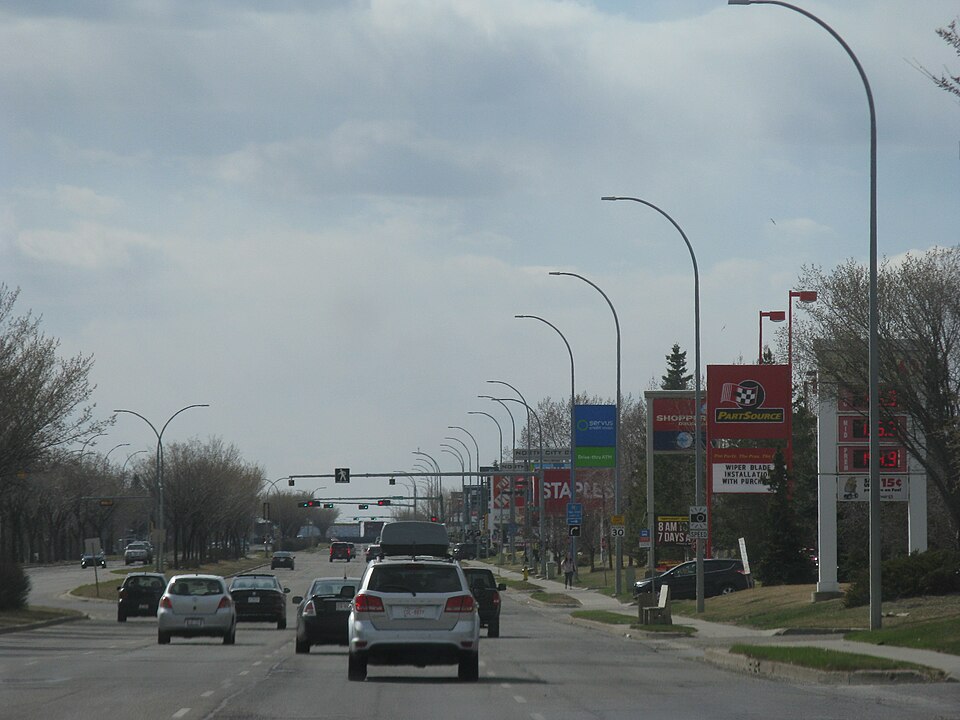
    Photo: Rowanlovescars, CC BY-SA 4.0, via Wikimedia Commons

    Sharing Alberta roads safely means four things for a new driver: pass cyclists at a safe distance and expect them on the right edge or shoulder; treat every motorcycle as closer than it looks before you turn left; obey every signal, gate and bell at Calgary and Edmonton LRT crossings and never stop on the tracks; and expect off-highway vehicles to cross highways in rural areas. This guide sets out what Alberta’s rules actually say about each one.

    Key facts

    • Alberta’s Use of Highway and Rules of the Road Regulation says you must pass another vehicle “at a safe distance” on the left. A bicycle is a vehicle under that rule. Alberta’s Driver’s Guide says to change lanes to pass a cyclist, as you would for any other vehicle.
    • Cyclists must ride as near as practicable to the right edge, use a paved shoulder where there is one, and ride single file.
    • Alberta’s government warns that motorcycles tend to look farther away than they are when you turn left across traffic.
    • Edmonton’s Valley Line LRT has no crossing arms, gates or bells at intersections. Calgary’s CTrain street crossings use flashing lights, gate arms and bells.
    • Off-highway vehicles (OHVs) may not use a highway, road or ditch without written provincial permission or a municipal bylaw. When they cross a road, the rider must stop and yield to you.

    How much room do you give a cyclist in Alberta?

    Alberta has no fixed metre figure in its rules of the road regulation. Section 21 says a driver overtaking another vehicle must pass to the left “at a safe distance” and must not move back to the right until safely clear. The Government of Alberta’s “Share the road” advice is simply to give other road users, from cyclists to tractor trailers, the space they need. Alberta’s Driver’s Guide (Spring 2023) puts it plainly: when passing a cyclist, change lanes as you would for any other vehicle.

    The guide’s other cyclist points: a person walking a bike is a pedestrian; cyclists under 18 must wear an approved helmet; cyclists may move out from the curb to avoid grates, potholes, gravel or wet surfaces; check for cyclists before opening your door or pulling away from the curb; do not follow closely, because bikes have no brake lights; and take extra care around children on bikes.

    In practice that means:

    • slow down and wait behind the cyclist until you can pass with plenty of room;
    • move partly or fully into the next lane if the lane is narrow, but only when oncoming traffic allows and the markings permit it;
    • do not cut back in until you can see the cyclist well behind you;
    • never squeeze past on a bend, near the crest of a hill or approaching an intersection.

    Where cyclists ride, and why they move out

    Knowing the cyclist’s rules helps you predict them. Under the regulation (sections 77 and 78), a cyclist:

    • must ride as near as practicable to the right curb or edge, unless making a left turn;
    • on a one-way street in a city or town, may ride near either curb;
    • on a highway with a paved shoulder, must ride on the right shoulder; with no paved shoulder, as far right as practicable;
    • must ride single file, not beside another cyclist in the same lane, except when passing.

    So a cyclist moving toward the centre of the lane is often setting up a left turn. Hold back and let them make it.

    Bike lanes in Calgary and Edmonton

    Bike lanes, cycle tracks and their markings are set by each city. Follow the signs and pavement markings, and before crossing a bike lane to turn right or reach a driveway, check your mirror and shoulder check for cyclists coming up on your right. The Government of Alberta’s “Share the road” page reminds drivers that cyclists and motorcyclists are harder to see, so check mirrors and blind spots before you change lanes, stop or turn.

    Pedestrians

    • At a flashing yellow pedestrian-activated light, slow to 30 km/h and yield to people waiting to cross.
    • In an urban area, a pedestrian may signal by holding an arm out pointing to the far curb. You must stop safely before the crosswalk and let them cross.
    • Yield to anyone who has entered a marked or unmarked crosswalk. Stop about two to three car lengths back so drivers in other lanes can see the pedestrian.
    • Never pass a vehicle when you are approaching a crosswalk. It may be stopping for someone you cannot see.
    • In residential streets, glance under parked cars for feet, toys and bike wheels. At night, drive so you can stop within the distance your headlights light.

    Motorcycles: the left-turn trap

    The Government of Alberta’s “Driver error” page names turning left across traffic as a common error. Drivers misjudge the time and space they need, and small vehicles such as motorcycles tend to appear farther away than they actually are. A driver turning left across an oncoming vehicle must not turn until it is safe.

    Before any left turn:

    1. Look specifically for single headlights in the oncoming traffic, not just cars.
    2. If you are unsure how fast a motorcycle is coming, wait for the next gap.
    3. If drivers behind you are impatient, ignore them. The Driver error page tells following drivers not to honk at or crowd someone waiting to turn left.

    Other points for driving near motorcycles in Alberta:

    • Motorcyclists, like other cyclists, must ride single file in a lane except when passing, so two motorcycles side by side in one lane should be uncommon.
    • When you pass any vehicle, wait until you can see its whole front in your rear-view mirror before pulling back in (Share the road page).
    • Do not tailgate. Always assume the vehicle in front may brake suddenly, and leave room to stop.
    • Alberta warns riders that they are even harder to spot at night, so look twice at intersections after dark.

    Trucks, log haulers and oversize loads

    • If you cannot see both of a truck’s side mirrors, you are too close. If you can see the driver in a mirror, the driver can see you.
    • Never move into the space in front of a large vehicle approaching a light; it needs that space to stop. Stopped behind one on a hill, leave extra room in case it rolls back.
    • Do not sit on the right of a large vehicle turning right, and stop well back when one is turning onto your road. It may need part of your lane.
    • Never pass a log hauler turning off the highway. Logs can stick out up to 9 m behind and sweep across the lanes.
    • Oversize loads often travel slowly with pilot vehicles and pull over to let traffic by. Pass only with plenty of room and a clear view of oncoming traffic.

    Railway crossings and funeral processions

    • You must stop when a train is visible or sounding a signal within 500 m of the crossing.
    • At a railway stop sign, stop between 5 m and 15 m from the nearest rail. At flashing lights and bells, the first vehicle stops at least 5 m back. Never go around a gate that is down, rising or lowering.
    • Do not change gear on the tracks in a manual car. If you stall on a crossing, get everyone out and away, moving toward the approaching train so you are clear of flying debris.
    • Buses and trucks carrying passengers or dangerous goods may have to stop at every railway crossing. Be ready to stop behind one.
    • A train can need a kilometre or more to stop; an LRT train up to 100 m.
    • Do not cut through a funeral procession. Its vehicles, with headlights on, may continue through stop signs and red lights while closely following each other.

    LRT crossings: CTrain and Edmonton LRT

    Calgary and Edmonton both run light rail on city streets, and the two systems do not look the same at crossings.

    Where What you see What to do
    Calgary CTrain street crossings Flashing lights, gate arms and bells (City of Calgary) Stop when the lights flash or the gates are coming down. Do not go around or under a gate
    Edmonton Capital and Metro Lines Gates, warning bells and lights at crossings (City of Edmonton) Obey every gate and bell, and wait behind the gate until it rises
    Edmonton Valley Line No crossing arms, gates or bells. Trains run in or beside the street and follow traffic signals Obey the traffic signals, look both ways before entering the track area and take extra care when turning

    The City of Edmonton’s rules for drivers near LRT tracks:

    • Obey traffic control signs and signals, and always yield to pedestrians.
    • Look both ways before moving into the track area. Trains can come from either direction on any track.
    • Never stop your vehicle on an LRT track. If the traffic ahead is queued, wait before the tracks until there is room for your whole car on the other side.
    • Use extra caution when turning at intersections where LRT runs.
    • The LRT moves quickly and quietly. Do not rely on hearing it.

    For railway crossings generally, Alberta’s regulation (section 42) says that when a train is approaching you must stop no closer than 5 metres from the nearest rail, and you must not drive through, around or under a crossing gate while it is closed, opening or closing.

    Off-highway vehicles near Alberta highways

    Off-highway vehicles include quads (ATVs), side by sides, dirt bikes and snowmobiles. In farm country and near trail areas you will see them close to, and crossing, the road.

    Can OHVs ride in the ditch?

    Not without permission. According to the Government of Alberta, an OHV may not be operated on any highway, road or ditch unless the Minister of Transportation has given written permission (such as a Ministerial Order or a permit) or a municipal bylaw allows it. The only provincial Ministerial Order lets four-wheeled ATVs use three-digit-numbered highways in daylight during farming operations or an emergency. Municipal bylaws vary, so some towns and counties allow OHVs on certain roads.

    What the rider must do to cross

    • stop the OHV before crossing;
    • make sure all passengers are off the OHV and anything attached to it;
    • yield the right of way to all other vehicles and people on the road;
    • cross by the most direct, shortest and safest route.

    What you should do as a driver

    • When you see an OHV near the road, slow down and expect it to cross, even though the rider must yield.
    • On three-digit highways in farm areas in daylight, expect slow ATVs on the road itself.
    • Give them the space you would give a cyclist when passing.

    Snowplows, farm equipment and wildlife on rural highways are covered in driving in Alberta’s Rockies and rural highways. For stopped emergency and tow vehicles, see slow down, move over.

    Common questions

    Is there a one-metre passing law for cyclists in Alberta?

    The Use of Highway and Rules of the Road Regulation sets no metre figure. It requires you to pass at a safe distance. Check the current Alberta Driver’s Guide and your city’s bylaws for any further guidance.

    Can I drive on LRT tracks in Calgary or Edmonton?

    Only to cross them where the road crosses the tracks, following the signals. Never stop on the tracks.

    Will sharing the road come up on the Class 7 knowledge test?

    The Alberta Driver’s Guide is the official study book for Alberta drivers and covers the rules of the road, so expect sharing-the-road topics. See Alberta Class 7 knowledge test and the Alberta Driver’s Guide study plan.

    Back to learning to drive in Alberta. Related: Alberta intersections, traffic circles and right of way, Alberta parking, backing and lane driving.

    Sources

    • Government of Alberta, “Driver’s Guide to Operation, Safety and Licensing: Cars and Light Trucks”, Spring 2023 edition (alberta.ca)
    • Alberta King’s Printer, “Use of Highway and Rules of the Road Regulation, Alta Reg 304/2002”, consolidated to 8 August 2025, sections 21, 42, 77 and 78 (kings-printer.alberta.ca)
    • Government of Alberta, “Share the road” (alberta.ca)
    • Government of Alberta, “Driver error” (alberta.ca)
    • Government of Alberta, “Off-highway vehicle helmet law” (alberta.ca)
    • Government of Alberta, “Driver guides” (alberta.ca)
    • City of Edmonton, “Rail Safety” (edmonton.ca)
    • City of Calgary, “Signals, tracks and power” (calgary.ca)
  • Alberta parallel parking, backing and lane rules for new drivers

    Alberta parallel parking, backing and lane rules for new drivers

    Photo: Milan Suvajac, CC BY-SA 4.0, via Wikimedia Commons

    Alberta law says a parallel-parked car must sit with its right wheels no more than 50 cm (500 mm) from the curb, you must park at least 5 metres from a fire hydrant, crosswalk or stop sign, and on any slope you must turn your front wheels toward the curb or edge and set the parking brake. This guide covers parallel, angle and hill parking, backing, lane rules, passing and merging under Alberta’s Use of Highway and Rules of the Road Regulation, and what the Class 5 road test examiner marks you on.

    Key facts

    • Parallel parking: sides parallel to the curb, wheels within 500 mm of it.
    • Angle parking with no painted lines: 30 to 60 degrees to the curb, one front wheel within 500 mm.
    • No stopping or parking within 5 m of a hydrant, the near side of a marked crosswalk, or a stop or yield sign you are approaching; within 1.5 m of a driveway; or on a crosswalk, sidewalk or bridge.
    • In a town or city you may not back into or through an intersection or crosswalk.
    • No passing uphill, on a curve, or within 30 m of a level railway crossing on a two-lane road.
    • The Class 5 road test is a fail at more than 75 points, and poor observation is the main way points add up.

    Before you move: Alberta’s pre-drive routine

    1. Walk round the car: look for children and objects in your path, tire inflation and leaks underneath. Beside a road, walk facing oncoming traffic.
    2. Lock the doors.
    3. Adjust the seat so you are at least 25 cm (10 in) from the steering wheel, can see over it, and can push the pedals fully (and the clutch to the floor in a manual).
    4. Adjust the head restraint: its centre level with the tops of your ears, ideally less than 10 cm from your head.
    5. Set the mirrors: rear window framed in the inside mirror, and just a sliver of your own car in each side mirror.
    6. Fasten your seat belt: lap belt low and snug over the hips, shoulder belt across the chest. The law requires it, airbags or not.

    Hands at about 9 and 3 o’clock (10 and 2 if the wheel design needs it), and use hand-over-hand steering for corners. Press the accelerator gradually, then hold it steady at the speed you want: smooth acceleration is safer and uses less fuel. Before pulling out, check your path, mirrors and blind spot, and signal left from the right side of the road.

    Stopping distance and braking

    Total stopping distance is perception distance plus reaction distance plus braking distance. Perception takes about three-quarters of a second and reaction about another three-quarters, before the brakes do anything, and new drivers often take longer. Brake early and smoothly. To stop fast without ABS, use threshold braking: firm pressure just short of locking the wheels, easing off slightly if they lock.

    Manual transmissions

    Start the engine in neutral with the clutch pressed. Find the friction point and release the clutch slowly. Take your foot off the clutch after each change (no “riding the clutch”), and do not coast to a stop with it pressed.

    Parallel parking in Alberta: the rule and the method

    What the law requires

    • The sides of the vehicle must be parallel to the curb or edge of the roadway.
    • The right wheels must be no more than 500 mm (50 cm) from the right curb or edge.
    • On a one-way street where parking is allowed on both sides, the wheels closest to the curb must be within 500 mm, and the car must face the direction of travel.

    A step-by-step method

    1. Check mirrors, signal right and stop beside the car in front of the space, about one metre out, with your rear bumpers roughly level.
    2. Shoulder check, then reverse slowly while watching all around.
    3. When your rear wheel lines up with the other car’s rear bumper, turn the wheel fully right.
    4. When your car is at about 45 degrees and your front bumper clears the other car’s rear, straighten the wheel and keep backing.
    5. When the front of your car is clear, turn fully left to swing the front in.
    6. Straighten up, centre the car in the space and check you are within 50 cm of the curb.
    7. Leaving: signal left, mirror and shoulder check, and pull out only when there is a safe gap.

    Signalling when you pull out is a legal duty in Alberta: from a space on the right side of the road, signal left before you move into traffic.

    Angle and reverse-angle parking

    • Painted lines: park between and parallel to two of the lines, with one front wheel no more than 500 mm from the curb.
    • No painted lines but a sign permits angle parking: park at 30 to 60 degrees to the curb, with one front wheel within 500 mm.
    • Angle parking is only allowed where a sign says it is permitted or required.

    Backing out of an angle space is one of the riskiest moves for a new driver. Back out very slowly, check both ways over your shoulder and keep checking until you are fully out.

    Hill parking: which way to turn your wheels

    Alberta’s rule is short: on any grade or slope, turn the front wheels toward the nearest curb or edge of the roadway so the car cannot roll, and set the parking brake.

    Situation Turn the front wheels Why
    Downhill, with a curb Right, toward the curb If it rolls, the front tire stops against the curb
    Uphill, with a curb Left, away from the curb, and let the car roll back gently until the rear of the front tire rests on the curb The curb blocks the tire from rolling backward
    Uphill or downhill, no curb Right, toward the edge of the road If it rolls, it rolls off the road, not into traffic

    The table matches the diagrams in Alberta’s Driver’s Guide (Spring 2023, chapter 3) for parking on the right side of the road. Parked on the left side, turn the wheels the opposite way.

    Hill parking, uphill or downhill, is on the Class 5 road test. Always set the parking brake, and shift to Park (or a low gear in a manual car).

    Perpendicular parking

    Approach slowly, about 2 m out from the rear of the vehicle to the right of the space. When your front bumper is level with that vehicle’s left side, look through the space, turn fully right and drive in slowly, checking your left front corner and right side. Centre the car completely in the stall. Entering a stall on the left is easier, but only do it in a parking lot. Perpendicular parking is on the road test too.

    Getting in and out beside traffic

    Before opening your door, check mirrors and shoulder check for traffic and cyclists. Open it no wider than you need, get out quickly and walk round the rear facing traffic. To get in, approach from the front of the car.

    Where you cannot stop or park in Alberta

    Unless a sign, a peace officer or traffic conditions direct otherwise, you must not stop or park:

    • on a sidewalk, boulevard or crosswalk
    • inside an intersection (except next to the curb in a “T” intersection)
    • within 5 m of the corner property line at an intersection, unless a meter or sign allows it
    • within 5 m of a stop sign or yield sign on your approach
    • within 5 m of a fire hydrant (or the point on the curb nearest it)
    • within 5 m of the near side of a marked crosswalk
    • within 1.5 m of a garage, private road or driveway access
    • beside a parked car (double parking), or beside a street excavation where it would block traffic
    • on a bridge, in a subway, or on the approaches to either
    • at the scene of a fire, collision or emergency if you would obstruct traffic or responders
    • on a divided highway, to the left of the yellow line, except in an emergency

    Outside towns and cities, park off the roadway if you can. On a provincial highway, you may only stop on the road, shoulder or parking lane if the vehicle cannot move, there is an emergency, or the law allows it. If you must stop on the road, leave room for traffic to pass and make sure your car can be seen from 60 m in both directions.

    Backing up safely, and where it is illegal

    Reverse at a crawl. For a straight line, put your left hand at the top of the wheel, turn onto your right hip and look over your right shoulder, glancing forward now and then. Correct with no more than a quarter turn, steering the way you want the rear to go. Backing out of a driveway, reverse into the nearest lane only, never into a second lane.

    • You may only back up if it can be done safely without interfering with other traffic.
    • In an urban area, you must not back into or through an intersection or crosswalk.
    • Before backing: walk around the car if you cannot see behind it, check both mirrors, then turn your head and look over your right shoulder through the rear window.
    • Back slowly, keep looking where you are going, and stop if a pedestrian or car appears.

    Back-up cameras help, but the examiner wants to see you turn and look. A missed shoulder check is a point deduction.

    U-turns in Alberta

    A U-turn must be safe and must not interfere with other traffic. It is illegal:

    • on a curve, or near the crest of a hill, if drivers approaching within 150 m cannot see you
    • in an urban area between intersections, at an alley intersection, or at an intersection that is an entrance to a public or private facility
    • where a sign prohibits it
    • at an intersection with traffic lights, unless a sign or signal specifically allows it

    Lane driving: lines, signals and following distance

    What the lines mean

    Marking What you may do
    Double solid line Never cross it from one lane to another
    Single solid line, in a town or city Do not cross, except to pass
    Single solid line, outside towns and cities Do not cross
    Solid line beside a broken line Cross only from the broken-line side, only to pass, then return
    Broken line on a two-lane, two-way road Cross to pass a vehicle, then return as soon as safely past
    Broken lines between same-direction lanes Change lanes when safe

    Unless a sign prohibits it, you may cross a single solid line (or, outside towns, a double solid line) to turn left into or out of a driveway or onto a road.

    Changing lanes

    1. Check your mirrors.
    2. Signal early enough to warn other drivers. Alberta law requires a signal before moving from one lane to another, or from a curb or parking lane into traffic.
    3. Shoulder check the blind spot on the side you are moving to.
    4. Move over smoothly, keeping your speed.
    5. Cancel the signal.

    Following distance and slower traffic

    • Alberta law says you must not follow more closely than is reasonable and prudent, given the speed, traffic and road conditions. Leave more room in snow, rain and at night.
    • If you are driving slower than normal traffic, use the right lane or keep as close as practicable to the right edge, except when passing or getting ready to turn left.

    Lane position, blind spots, curves and hills

    • Drive in the centre of your lane. Choose your lane early and avoid last-minute changes.
    • Mirrors never show everything beside and just behind you. Shoulder check through the rear side windows before every lane change.
    • Slow down before a curve, not in it, look well round it and hold a steady speed. Never pass on a curve on a two-lane highway.
    • Near the crest of a hill, move to the right of your lane and never pass. Going down a steep hill, slow down, and in a manual change to a lower gear to save your brakes.
    • When a passing lane is ending, drivers in the right lane merge left and drivers in the left lane let them in.
    • Missed your exit? Carry on to the next one. Never stop or reverse on a highway or its shoulder.

    Passing in Alberta

    • Pass on the left at a safe distance, and return to the right only when you are safely clear.
    • Only pull left of the centre line if the view ahead is clear and there is enough space to finish without interfering with oncoming traffic.
    • No passing when going uphill, on a curve, or within 30 m of a level railway crossing, unless there are two or more lanes in your direction.
    • Passing on the right is allowed only when the vehicle ahead is turning left (or has signalled to), on a one-way road wide enough for two lines of traffic, or on a multi-lane road with a lane free on the right.
    • When someone is passing you: move right to give them room and do not speed up until they are past.

    Merging and exits, and stopped vehicles with flashing lights

    • On an entrance ramp, signal, check mirrors and shoulder check, and use the ramp to match the speed of traffic before you merge into a safe gap.
    • When you pass a stopped vehicle with its flashing lamps on (such as police, an ambulance or a tow truck), you must not drive in its lane or the lane next to it if there is another lane further away you can move into safely. Drivers in that further lane must let you in.
    • To exit, signal early, move into the exit lane before the ramp and slow down on the ramp, not on the highway.

    Alberta’s rule for passing emergency vehicles and tow trucks, and the speed limit beside them, is covered in slow down, move over.

    What the Alberta Class 5 examiner looks for

    Alberta’s examiners add points for errors. More than 75 points on a Class 5 test is a fail. The Government of Alberta gives these examples:

    Type of error How it shows up in parking and lane driving
    Missing a driving skill No mirror or shoulder check before parking, backing, pulling out or changing lanes
    Breaking a rule of the road Parking within 5 m of a hydrant, crossing a solid line, an illegal U-turn
    Doing a manoeuvre poorly Signalling too early or too late, being too hesitant or too aggressive when merging

    An automatic fail is given for endangering a pedestrian or another driver, driving unsafely or breaking traffic laws. Full scoring details: Alberta Class 5 road test.

    Practice plan for a Class 7 learner

    1. Empty parking lot: angle parking and backing in a straight line, 20 times each.
    2. Quiet residential street: parallel parking between two cars, then pulling out with a signal and shoulder check.
    3. A street with a slope: hill parking up and down, with and without a curb.
    4. Four-lane city roads: lane changes with the full mirror, signal, shoulder check routine.
    5. Highway with your supervisor: merging, passing and exiting.

    Remember the Class 7 rules while you practise, including the midnight to 5 a.m. ban and a supervisor aged 18 or older with a full licence. See Alberta Class 7 learner rules.

    Common questions

    How close to the curb do you have to park in Alberta?

    Within 500 mm (50 cm). The car must also be parallel to the curb.

    How far from a fire hydrant can you park in Alberta?

    At least 5 m. If the hydrant is set back from the curb, measure from the point on the curb nearest it.

    Is parallel parking on the Alberta road test?

    Alberta’s Driver’s Guide lists perpendicular, uphill or downhill, and parallel parking among the road test skills (drivers over 65 do not have to parallel park). Confirm the details with your registry when you book.

    Can you pass on the right in Alberta?

    Only when the vehicle ahead is turning left, on a wide one-way road, or on a road with two or more lanes in your direction.

    Can I cross a solid line to turn into a driveway?

    Yes, a single solid line, and outside towns a double solid line, unless a sign prohibits it.

    Can I make a U-turn at a traffic light in Alberta?

    Not unless a sign or signal specifically allows it.

    Related: learning to drive in Alberta, Alberta Driver’s Guide study plan, Alberta intersections and traffic circles, Alberta school and playground zones.

    Sources

    • Government of Alberta, “Driver’s Guide to Operation, Safety and Licensing: Cars and Light Trucks”, Spring 2023 edition (alberta.ca)
    • Alberta King’s Printer, “Use of Highway and Rules of the Road Regulation”, Alberta Regulation 304/2002, consolidated to August 2025 (kings-printer.alberta.ca)
    • Government of Alberta, “Driver’s road test” (alberta.ca)
    • Government of Alberta, “Driver’s Guide to Operation, Safety and Licensing: Cars and Light Trucks” (open.alberta.ca)
  • Alberta driving lessons: get the full price and refund policy

    Alberta driving lessons: get the full price and refund policy

    Photo: Marek Slusarczyk, CC BY 2.5, via Wikimedia Commons

    Before you pay an Alberta driving school, ask for its policy in writing. If you request it, the school must give you its rates (including all charges), its hours of training and its refund policy. This guide is for Alberta Class 7 learners and their parents comparing driving lessons. It covers what licensed Class 5 driver training must include, what to ask before you sign, and how to compare packages on total cost rather than the headline price.

    Key facts

    • Driving schools and instructors in Alberta must be licensed under the Driver Training and Driver Examination Regulation.
    • Licensed Class 5 training for a Class 7 or Class 5-GDL holder includes at least 15 hours in the classroom and at least 10 hours in the vehicle.
    • To get the Notice of Driver Education Course Completion, you must pass knowledge and practical assessments, with a score of at least 7.5 out of 10 by the end of in-vehicle training.
    • Completing the course may qualify you for lower insurance rates. Eligible drivers who complete a licensed program can take up to 6 months off the 24-month probationary stage.

    What licensed Class 5 driver training includes in Alberta

    Part Minimum Notes
    Classroom 15 hours Often evenings or weekends. You must attend every class to write the knowledge assessment
    In-vehicle (Class 7 or Class 5-GDL holders) 10 hours Behind the wheel with a licensed instructor
    In-vehicle (Class 5 non-GDL holders) 6 hours For drivers who already hold a full licence
    Assessments Knowledge and practical A minimum overall score of 7.5 out of 10 by the end of in-vehicle training

    A package that lists fewer hours than this is not the full licensed course, so ask what it actually is.

    Questions to ask before you pay

    1. “Can I have your written policy on rates, all charges, training hours and refunds?” The school must provide it on request.
    2. “Are the school and this instructor licensed?” Check the school against the Government of Alberta’s list of licensed driver training schools. Instructors must show identification on request.
    3. “How many hours behind the wheel are included, and how long is each lesson?” Compare the driving time, not the number of “lessons”.
    4. “What costs extra?” For example: pick-up, a car for the road test, extra lessons or rebooking.
    5. “What happens if I cancel or miss a lesson?” A refund policy does not mean every unused booking is refundable. Read the conditions.
    6. “How will you show my progress?” Instructors are expected to give clear feedback on strengths and areas to improve, and to help judge when you are ready for the road test.
    7. “Will I get the Notice of Driver Education Course Completion, and when?” It is the document that shows you finished the licensed course.

    Comparing two driving packages: a worked example

    Question Package A Package B
    Headline price Lower Higher
    Full licensed course (15 h class, 10 h in car)? In-car lessons only Yes
    Car for the road test included? No, extra charge Yes
    Cancellation terms No refund after booking Refund of unused hours on notice
    Course completion notice? No Yes

    Package A looks cheaper, but it is not the full licensed course and gives no completion notice. Without a licensed program, you cannot use it to reduce your probationary stage. Add up the cost of what you actually need from each package before you choose.

    What good instruction looks like

    The Government of Alberta says instructors must:

    • be courteous and professional at all times
    • keep the conversation focused on driver education
    • give clear, accurate instruction and specific feedback
    • show proof of identification on request

    If explanations stay vague after a lesson or two, ask more questions or book a single trial lesson before paying for more. Keep your written policy, receipts and lesson records.

    If something goes wrong

    • Raise it with the school first, using its written policy.
    • Questions about licensing go to the Government of Alberta’s Examinations and Licensing office: 780-644-4325, Monday to Friday, 8:15 a.m. to 4:30 p.m. Toll-free in Alberta, dial 310-0000 first.
    • Traffic safety concerns can be reported through the government’s online complaints form.

    Common questions

    Is driving school mandatory in Alberta?

    No. You can learn with a supervisor who meets the Class 7 rules. Licensed training is optional, but it brings the benefits above.

    Does driver training shorten the Alberta probationary licence?

    It can, for eligible drivers: up to 6 months off the 24-month Class 5-GDL stage, if you complete a program from a school licensed by the Alberta government. See Alberta Class 5-GDL rules.

    Will it lower my insurance?

    Alberta says it may. Get quotes from insurers with and without the completion notice. See car insurance for new drivers in Canada.

    How much do driving lessons cost in Alberta?

    Schools set their own prices. Ask each one for its written rates and compare the total for the same services.

    Can a school refuse to give me its refund policy?

    No. If you ask, the school must give you a written policy covering rates, all charges, hours and refunds.

    Related: learning to drive in Alberta, Alberta Class 7 learner rules, Alberta Class 5 road test, cost of a licence in Canada.

    Sources

    • Government of Alberta, “Class 5 driver training” (alberta.ca)
    • Government of Alberta, “Class 5 driver’s licence” (alberta.ca)
    • Government of Alberta, “Class 7 learner’s licence” (alberta.ca)
  • Mountain Driving in Alberta: Rockies, Rural Highways and Wildlife

    Mountain Driving in Alberta: Rockies, Rural Highways and Wildlife

    Photo: Ethan Sahagun, CC BY 4.0, via Wikimedia Commons

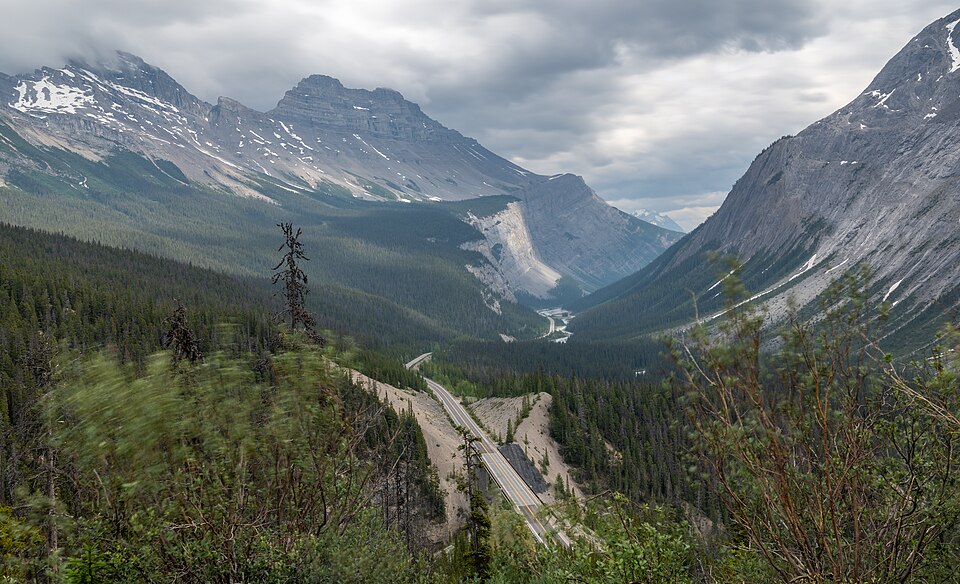
    Driving in Alberta’s Rockies and on rural highways means long grades, fast-changing weather, slow farm traffic and a high chance of meeting wildlife. Animal-vehicle collisions made up about 60 percent of reported collisions on Alberta’s rural highways between 2015 and 2020. This guide is for Alberta learners and new drivers heading to Banff, Jasper or out of town, using Government of Alberta and Parks Canada advice.

    Key facts

    • Banff National Park limits: 90 km/h maximum on major routes, 60 km/h maximum on secondary roads, unless posted otherwise.
    • Snow tires or chains are required by law on the Icefields Parkway (Hwy 93N) and the Banff-Windermere Highway (Hwy 93S) in Banff National Park from 1 November to 31 March, or whenever the roads are snow or ice covered.
    • Cell coverage is not reliable throughout Banff National Park.
    • Check road conditions with 511 Alberta (dial 511 in Alberta, or 1-855-391-9743).
    • Learners still cannot drive between 12 a.m. and 5 a.m., so plan long trips with that in mind.

    Before you go: a mountain trip checklist

    • Check 511 Alberta for closures and conditions. For trips into BC, check DriveBC.
    • Fill the tank and carry extra windshield washer fluid.
    • Plan to finish driving in daylight. In winter the sun sets early.
    • Pack a kit (the Driver’s Guide also suggests booster cables, a tow rope, a jack and inflated spare, reflective triangles, spare headlight bulbs, sand or salt, and tire chains): phone and charger, water and food, warm clothes, blanket, first aid kit, ice scraper and brush, shovel, flashlight and batteries, candle in a deep can with matches, whistle, road maps. Parks Canada also suggests a satellite messenger, as cell service is patchy.
    • In winter, fit tires with the snowflake or M+S symbol, and check the dates when snow tires or chains are mandatory on your route.

    Hills and mountain grades

    • Gear down for long climbs and for steep downhill grades. This saves your brakes and reduces the chance of sliding.
    • Avoid abrupt downshifting, which can cause a skid, especially when turning.
    • Approaching a hill on a slippery road, accelerate slightly before it, then hold a steady speed going up.
    • Avoid braking in curves on slick roads. Slow down before the curve and drive through at a steady speed.
    • Large trucks and RVs slow on hills. Be patient and pass only where it is safe and legal.

    Mountain weather and black ice

    • It can snow in summer at higher elevations.
    • Watch for black ice, especially on bridges and near water. Bridge decks are often slicker than the rest of the highway.
    • Never use cruise control in winter conditions. Parks Canada also advises against cruise control in Banff National Park.
    • Posted limits are for ideal conditions. You are legally required to drive to conditions and can be ticketed if you do not.
    • On slick roads, leave at least 3 times your normal following distance.

    More on snow and whiteouts in winter driving in Canada for new drivers.

    Wildlife on Alberta highways

    • Be most careful at dusk and dawn, when many animals are active and visibility is poor.
    • Where there is one animal, expect others nearby.
    • Fencing does not keep all wildlife off the road. Animals may be on or near any park road.
    • If you see an animal by the road, slow down and warn drivers behind with your hazard lights.
    • In Banff National Park, Parks Canada’s advice is to slow down, stay in your vehicle and move on. If you stop, pull onto the shoulder only where safe, use hazard lights, stay in the vehicle and keep it brief. If a wildlife jam forms, move on.

    Alberta has built wildlife fencing, overpasses and underpasses on Highways 1, 1A, 3 and others, and fencing and crossings have cut wildlife-vehicle collisions in Banff National Park by more than 80 percent. Collisions still happen, so speed matters. To report an animal carcass on a highway, call 511 Alberta. How to react if an animal steps out is covered in moose, deer and caribou: avoiding wildlife collisions.

    Rural highways: farm equipment, snowplows and stopped vehicles

    Slow-moving vehicles

    Watch for the orange triangle with a red border, especially at planting and harvest. Stay out of the driver’s blind spots and far enough back to be seen. Be patient: the driver will pull over when safe, and if they do not, they are likely not going far. Pass only when it is safe and the driver knows you intend to pass.

    Snowplows

    You must not pass a snowplow if the view along its side is blocked, if passing would interfere with its work, or if it cannot be done safely. Operators let traffic pass every 5 to 8 km or when safe. The fine is $324 and 3 demerits.

    Stopped vehicles with flashing lights

    In the lane next to any stopped roadside vehicle with flashing lights (police, ambulance, fire, tow, maintenance), move to the far lane, or if you cannot, slow to 60 km/h or the posted limit, whichever is lower. The fine is $243 and 3 demerits, and speeding fines double. See slow down, move over.

    When something goes wrong

    Emergency braking and skids

    • With ABS: steady, firm pressure; do not pump or release; look and steer where you want to go. Vibration in the pedal is normal.
    • Without ABS: threshold brake just short of locking. If the wheels lock, ease off slightly, then press firmly again.
    • Any skid: stay off the brake and accelerator, look and steer where you want the front to go, and use small steering corrections. Power skid: ease off the gas. Braking skid: release the brake until the wheels roll. Cornering skid: off the gas, no brakes.
    • Off the pavement: grip the wheel, ease off the gas, avoid hard braking, check traffic, then steer back gradually at a controlled speed.

    Breakdowns

    • Get to a safe spot, never on a bridge or in a tunnel. Hazard lights on, hood up, and place reflective triangles behind the vehicle about 10 to 20 m apart. Wait away from the vehicle where it is dangerous.
    • Flat tire: do not brake hard. Ease off the gas, hold the wheel firmly, then brake gently once slower and pull off.
    • Brake warning light: check the parking brake is off, then pull over when safe. If brakes fail, press harder, use the parking brake carefully and shift down.
    • Headlights fail: hazard lights on, switch the headlights off and on, then slow down and pull off if they stay out.

    Night, fog and smoke

    • Headlights on at night and whenever you cannot see clearly 150 m ahead. Daytime running lights are not enough.
    • Low beams within 150 m of a vehicle you are following and within 300 m of oncoming traffic. Look toward the right edge of your lane to avoid glare.
    • Use low beams in fog, smoke and rain. If you cannot see well enough to continue, pull well off the road, hazard lights on, and wait.
    • On wet roads, if you hydroplane, do not brake. Ease off the gas and steer where you want to go.

    Collisions and police stops

    • At a crash, stop safely away from it, protect the scene with hazard lights and triangles, help if you can and call for help if needed. If involved, exchange names, contact and insurance details, record witnesses and conditions, do not discuss fault, and tell your insurer.
    • Report to police if anyone is injured or killed or if damage is $5,000 or more. That threshold is set by regulation and can rise with repair costs each year; the $2,000 figure in the Spring 2023 Driver’s Guide is out of date. Report damage to public property, such as a traffic sign, straight away. If you hit an unattended vehicle, find the owner or leave your name, address, licence and plate numbers and phone number securely on it.
    • A siren from any direction: move as close as you can to the right edge (either curb on a one-way street) and stop until it passes. Treat flashing green lights (volunteer firefighters) the same way. Stay at least 150 m behind emergency vehicles.
    • Pulled over by police: stop at the right edge, put the car in Park (or neutral) with the parking brake on, stay inside, have your licence, registration and insurance ready, and do not move until told.

    Staying on the road

    Alberta lists speed, road conditions, weather, hard braking, fast acceleration and tire condition as the main reasons drivers run off the road. On rural and gravel roads, reduce speed and increase following distance whenever conditions are not ideal, and scan ahead for icy patches, wildlife and debris. Keep tires in good condition.

    Common questions

    Can a learner drive to Banff?

    Yes, with a qualified supervisor and outside the 12 a.m. to 5 a.m. curfew. See Alberta Class 7 learner rules.

    What is the speed limit in Banff National Park?

    90 km/h maximum on major routes and 60 km/h on secondary roads, unless posted otherwise.

    Do I need winter tires to drive the Icefields Parkway?

    Snow tires or chains are required in Banff National Park on Highway 93N and 93S from 1 November to 31 March, or whenever the road is snow or ice covered.

    Should I stop to photograph wildlife?

    Parks Canada’s advice is to slow down, stay in your vehicle and move on.

    Can I pass a snowplow in Alberta?

    Only when the view is clear, it will not interfere with the plow, and it is safe.

    Back to learning to drive in Alberta.

    Sources

    • Government of Alberta, “Driver’s Guide to Operation, Safety and Licensing: Cars and Light Trucks”, Spring 2023 edition (alberta.ca)
    • Government of Alberta, “Animal-Vehicle Collision Safety Program” (alberta.ca)
    • Government of Alberta, “Safer winter highways” (alberta.ca)
    • Government of Alberta, “Slow moving vehicles” (alberta.ca)
    • Government of Alberta, “Driving safely around snowplows” (alberta.ca)
    • Government of Alberta, “Roadside worker safety” (alberta.ca)
    • Government of Alberta, “Collision reports” (alberta.ca)
    • Alberta King’s Printer, “Operator Licensing and Vehicle Control Regulation, AR 320/2002”, current as of 1 October 2026, section 147 (kings-printer.alberta.ca)
    • Government of Alberta, “Driver error” (alberta.ca)
    • Government of Alberta, “Share the road” (alberta.ca)
    • Government of Alberta, “Class 7 learner’s licence” (alberta.ca)
    • Parks Canada, “Driving: Banff National Park” (parks.canada.ca)
    • Parks Canada, “Obey speed limits: Banff National Park” (parks.canada.ca)
  • Alberta Driver’s Guide: Six-Session Study Plan for Learners

    Alberta Driver’s Guide: Six-Session Study Plan for Learners

    Photo: Dietmar Rabich, CC BY-SA 4.0, via Wikimedia Commons

    The Alberta Driver’s Guide (full title: Driver’s Guide to Operation, Safety and Licensing: Cars and Light Trucks) is the official book for the Class 7 knowledge test. It is free from alberta.ca, also comes in French, and covers licensing, signs, rules of the road and safe driving. This study plan breaks it into six sessions, using the topic list in Alberta’s own Class 5 driver education curriculum (June 2026), so you know what to learn and what the test asks.

    Where to get the Alberta Driver’s Guide

    • Download the PDF from the Government of Alberta’s “Driver guides” page on alberta.ca.
    • A French edition, Guide du conducteur : conduite, sécurité et délivrance de permis : automobiles et camions légers, is produced by the Francophone Secretariat.
    • Community groups have translated the guide into other languages. These versions are not Government of Alberta publications, so check anything important against the English or French guide.

    Check the edition. The edition currently linked from alberta.ca is dated Spring 2023 on its back cover. Alberta updates the guide, so use the copy currently linked from alberta.ca and check its date, especially for road tests, GDL and fines.

    The guide has ten chapters: licensing information, traffic control, the basics of driving, intersections and turns, highways and freeways, emergency situations and challenging conditions, responsible driving, sharing the road, driving within the law, and towing a trailer. The guide itself says it interprets the Traffic Safety Act and has no legal authority; the Act and its regulations decide.

    Other Alberta guides you might need

    • Rider’s Guide (motorcycles, mopeds, power-assisted bicycles): a supplement for the Class 6 test.
    • Commercial Driver’s Guide (trucks, buses, emergency responders, taxis): a supplement for Classes 1 to 4.

    For a car licence you need only the cars and light trucks guide.

    Six-session study plan for the Alberta learner test

    Session Topic What to master
    1 Licensing The 3 GDL stages, Class 7 and GDL restrictions, demerits and losing your licence
    2 Signals and signs Lights, arrows, pedestrian and lane control signals; regulatory, warning, construction, guide, school and playground signs
    3 Pavement markings and lanes White and yellow lines, secondary highways, acceleration and deceleration lanes, weave zones, lane use on multi-lane highways
    4 Intersections Right and left turns, right of way, one-way and two-way roads, traffic circles, uncontrolled intersections
    5 Sharing the road Emergency and slow-moving vehicles, large vehicles, trains and LRT, school buses, funeral processions, motorcycles, ATVs, cyclists, pedestrians, children, pets and wildlife
    6 The driver and collision avoidance Distraction, impairment, fatigue, stopping distance, scanning and blind spots, following distance, skids, hydroplaning, night and fog driving

    Session notes: the facts most worth memorizing

    1. Licensing

    • Class 7 at 14; road test after 12 months and at 16; full Class 5 at 18 after 24 months on GDL.
    • Learner curfew: 12 a.m. to 5 a.m. Zero alcohol. 8-point demerit limit (full licence: 15).
    • Read: Class 7 learner rules, GDL probationary rules.

    2. Signals and signs

    • Flashing red = stop sign. Flashing yellow = yield.
    • Sign shapes and colours: red octagon stop, triangle yield, fluorescent yellow-green pentagon for school zones, yellow diamond warning, orange diamond construction, green guide signs, blue service signs. A green circle permits the action shown; a red circle and slash forbids it.
    • Default limits unless posted: 50 km/h in an urban area, 80 km/h on a rural road and on a provincial highway inside a city, 100 km/h on a provincial highway outside an urban area. Municipal bylaws can differ, so read the signs.
    • Lane reversal signals: a red X means leave or stay out of that lane; a downward green arrow means you may use it.
    • Pedestrian signals: a walking symbol or WALK lets pedestrians start crossing; a hand or DON’T WALK means those already in the crosswalk finish and clear it, and some signals show a countdown. Expect people still crossing when you turn.
    • Blue service signs mark hospitals, fuel, phones (including TTY pay phones for callers who are deaf or speech impaired) and disabled parking, which needs a placard from a registry agent.
    • Pedestrian and school crossing signs with flashing yellow lights: slow to 30 km/h or less and yield or stop for pedestrians.
    • Construction zone limits apply at all times, even when nobody is working. Fines double when workers are present. Obey the flag person.
    • A slow-moving vehicle sign is on vehicles that travel under 40 km/h, such as tractors.
    • Right on red is allowed after a full stop unless a sign prohibits it.
    • A school sign with a speed tab is a zone; without one it is an area.

    3. Lanes

    • Slow-moving vehicles carry an orange triangle with a red border. Keep back and pass only when safe.
    • When passing, wait until you can see the whole front of the vehicle in your rear-view mirror before pulling back in.
    • Inside an urban area you may pass safely across a single solid yellow line. Elsewhere, single or double solid yellow lines mean no passing.
    • Do not drive or pass in the emergency stopping lane (the shoulder of a primary highway). It is for emergencies and breakdowns.
    • Weave zones are where a highway entrance and exit share one lane. Control your speed and time your lane change so drivers entering and leaving can both get through.
    • A large white X painted on a rural highway warns of a railway crossing ahead. A no stopping zone keeps the road clear where large vehicles need room to turn.
    • Bicycle lanes: do not drive in them except to turn or reach a parking spot, usually where the line is dashed. Painted islands are not for travel, except to enter or leave a driveway or alley.

    4. Intersections

    5. Sharing the road

    • School and playground zones: 30 km/h. School days 8:00 to 9:30, 11:30 to 1:30, 3:00 to 4:30; playground 8:30 a.m. to 1 hour after sunset, daily.
    • School bus red lights: stop from both directions unless the road has a median.
    • Siren approaching: pull to the right and stop. Do not follow within 150 m.
    • Stopped vehicle with flashing lights: move to the far lane, or slow to 60 km/h or the posted limit, whichever is lower.
    • Read: school zones and school buses, slow down, move over.

    6. Collision avoidance

    • Following distance: at least 2 seconds in ideal conditions; at least 3 times normal on slick roads.
    • Skid: take your foot off the brake and steer where you want to go.
    • 17 to 19 hours awake is like a 0.05 percent BAC.
    • Read: demerits and impaired driving, winter driving in Canada.

    Responsible driving habits and laws (chapter 7)

    • Scan: look 12 to 15 seconds ahead in the city (about one to one and a half blocks) and 20 to 25 seconds ahead in rural areas. Check your mirrors every 8 to 12 seconds.
    • Hazards: fixed hazards stay put (curves, hills, hidden driveways, intersections, merging roads); variable hazards change through the day (children and pedestrians, left-turning cars, icy patches, stale green lights, emergency vehicles). Expect the unexpected, keep an escape route, and if you must swerve, stay on your side of the yellow line if you can.
    • Space cushion: keep space ahead, behind and to each side. Stopped in traffic, leave enough room to pull out into another lane without reversing. If someone tailgates, slow a little to encourage them to pass.
    • Following time: at least 2 seconds in normal conditions, more when conditions are poor. The guide suggests at least 4 seconds for large vehicles such as motorhomes.
    • Fuel and idling: if you will be parked for more than 10 seconds, turn the engine off. About one minute of idling is enough on a cold day, and a block heater on a timer about two hours before you leave helps cold starts.
    • Fuelling: engine off, no smoking or phone, stay by the nozzle, never prop it open, and put spare fuel containers on the ground to fill them.
    • Other laws: never tow a person on skis, a toboggan or a bicycle; no one may ride in a towed trailer or on the outside of a vehicle, including an open pickup box; a load sticking out 1.5 m or more behind needs a red flag by day and a red light at night; do not disturb residents between 10 p.m. and 7 a.m.; do not drive in two lanes at once; anyone under 14 may not drive a tractor or other self-propelled farm equipment on a highway; if the view in your inside mirror is blocked you need an outside mirror on each side; and driving without due care and attention, or reasonable consideration for others, is careless driving.

    How to use the guide well

    1. Do one session per sitting. Read the guide section, then close it and list the numbers from memory.
    2. Make a sign sheet: shape, colour and meaning for each sign group.
    3. Go back to sessions 1, 4 and 5 the day before the test. They hold most of the numbers.
    4. Keep the guide after the test. The road test checks the same rules in practice: see the Alberta Class 5 road test guide.

    Common questions

    Is the Alberta Driver’s Guide free?

    Yes, as a PDF from alberta.ca. Alberta also lists retailers that sell translated copies.

    Are the test questions taken from the guide?

    The test checks your understanding of Alberta traffic laws, which is what the guide covers. Alberta tells learners to study the guide before the test.

    Is there an Alberta Driver’s Guide in other languages?

    French, from the Government of Alberta. Other translations come from community groups and are not official. The test itself is offered in 25 languages: see the Alberta Class 7 knowledge test.

    Do I need the Rider’s Guide for a car licence?

    No. It is a supplement for the Class 6 motorcycle test.

    What do driving schools use?

    Licensed schools follow Alberta’s Class 5 Curriculum, and course materials may include the Driver’s Guide.

    Back to learning to drive in Alberta.

    Sources

    • Government of Alberta, “Driver guides” (alberta.ca)
    • Government of Alberta, “Class 5 Curriculum” (alberta.ca)
    • Government of Alberta, “Class 5 driver training” (alberta.ca)
    • Government of Alberta, “Driver’s knowledge test” (alberta.ca)
    • Government of Alberta, “Class 7 learner’s licence” (alberta.ca)
    • Government of Alberta, “Intersection rules” (alberta.ca)
    • Government of Alberta, “School and playground zones” (alberta.ca)
    • Government of Alberta, “Reacting to emergency vehicles” (alberta.ca)
    • Government of Alberta, “Roadside worker safety” (alberta.ca)
    • Government of Alberta, “Slow moving vehicles” (alberta.ca)
    • Government of Alberta, “Share the road” (alberta.ca)
    • Government of Alberta, “Driver error” (alberta.ca)
    • Government of Alberta, “Safer winter highways” (alberta.ca)
    • Government of Alberta, “Preventing impaired driving” (alberta.ca)
    • Alberta King’s Printer, “Use of Highway and Rules of the Road Regulation, AR 304/2002” (kings-printer.alberta.ca)
    • Government of Alberta, “Driver’s Guide: Cars and light trucks” Open Government listing (open.alberta.ca)
  • Alberta Demerit Points, IRS and Impaired Driving for New Drivers

    Alberta Demerit Points, IRS and Impaired Driving for New Drivers

    Photo: Acefitt, CC BY-SA 4.0, via Wikimedia Commons

    Alberta suspends a learner or GDL licence at 8 demerit points within 2 years, and a full licence at 15. Impaired driving is handled first at the roadside through Immediate Roadside Sanctions (IRS), and for Class 7 and Class 5-GDL drivers any alcohol or drug at all brings a 30-day suspension. This page sets out the points, the sanctions and how to get points removed.

    How Alberta demerit points work

    • Points go on your record on your conviction date: the day you pay the ticket, are found guilty in court, or are convicted for not appearing. Not the day you were stopped.
    • The points come off 2 years after the conviction date. The conviction itself, and any suspension, stays on your driving record and abstract for 10 years.
    • You cannot appeal a demerit suspension, but you can ask for the points to be reviewed if you think they were assigned in error. Removing a conviction needs an appeal through the Court of Justice of Alberta.

    Demerit thresholds: GDL vs full licence

    Class 7 and Class 5-GDL Full Class 5
    Cautionary notice 4 to 7 points 8 to 14 points
    First suspension 8+ points in 2 years: 1 month 15+ points in 2 years: 1 month
    Second suspension within 1 year 3 months 3 months
    Third or later within 2 years 6 months 6 months
    Points on reinstatement 3 (stay 2 years) 7 (stay 2 years)

    A suspension or any demerits in your last 12 months also delay your exit from GDL. See Alberta Class 5 GDL probationary rules.

    Demerit points for common tickets in Alberta

    Offence Demerits Fine
    Speeding 1 to 15 km/h over 2 $105 to $164
    Speeding 16 to 30 km/h over 3 $190 to $324
    Speeding 31 to 50 km/h over 4 $343 to $744
    Speeding 51+ km/h over 6 Mandatory court appearance
    Distracted driving 3 $390
    Not yielding to a pedestrian in a crosswalk 4 $810
    Not moving over or slowing for stopped roadside vehicles with flashing lights 3 $243 plus any speed fine
    Unsafe passing of a snowplow 3 $324
    Careless driving 6 Check current fine
    Following too closely 4 Check current fine
    Failing to stop for a school bus 6 Check current fine
    Failing to remain at the scene of a collision 7 Court
    Running a stop sign or red light 3 Check current fine
    More passengers than seat belts (learner or GDL) 2 $211

    Speeding fines include the 20 percent victims of crime surcharge and double when construction workers, emergency responders or stopped roadside vehicles with flashing lights are present. Fines are as listed by the Government of Alberta in November 2026.

    Worked example: a GDL driver gets a distracted driving ticket (3) and a 20 km/h speeding ticket (3) in the same year. That is 6 points and a cautionary notice. One more 2-point speeding ticket within 2 years means a 1-month suspension.

    Getting points removed: merit credit

    An approved Defensive Driving Course or Professional Driver Improvement Course from a licensed driver training school can remove up to 3 points, once every 2 years. For GDL drivers, you must finish it before reaching 8 points. Submit the Notice of Driver Education Course Completion to a registry agent (a fee may apply). The form is valid for 2 years.

    Serving a suspension

    • Hand your licence in at any registry agent on or before the date the suspension starts. Holding it while suspended is an offence.
    • Driving while suspended or disqualified means fines or jail, a further suspension, and a 30-day seizure of the vehicle whoever owns it, with the owner paying towing and storage.
    • Alberta can also suspend a licence for a poor driving record, an unpaid court judgment or medical reasons.
    • To challenge an IRS penalty or vehicle seizure, apply to SafeRoads Alberta within the time on your notice; matters are decided within 30 days. Other licensing decisions, such as interlock exemptions or driver conduct, go through the Registrar Reconsideration Process.

    Immediate Roadside Sanctions for new drivers

    IRS penalties are administrative and start immediately when police issue a Notice of Administrative Penalty. Criminal Code charges can be laid as well.

    IRS ZERO: Novice (Class 7 and Class 5-GDL)

    Zero tolerance for any alcohol or drugs:

    • immediate 30-day licence suspension, no driving at all
    • 7-day vehicle seizure
    • $200 fine plus 20 percent victim fine surcharge

    IRS 24-hour suspension

    For any driver suspected of impairment by alcohol, drugs, or a physical or medical condition.

    IRS WARN (BAC 0.05 to 0.079, or failed sobriety tests)

    Occurrence Suspension Vehicle seizure Fine (+20%)
    First 3 days 3 days $300
    Second 15 days 7 days $600, plus Crossroads course
    Third 30 days 7 days $1,200, plus IMPACT program

    IRS FAIL (BAC 0.08+, failing or refusing tests)

    Occurrence Suspension Vehicle seizure Fine (+20%)
    First 90 days, then 12 months (interlock option) 30 days $1,000, plus Planning Ahead course
    Second 90 days, then 36 months (interlock option) 30 days $2,000, plus IMPACT program
    Third 90 days, then lifetime (interlock option) 30 days $2,000

    Checkstops and testing

    Police can demand a breath sample from any driver they have lawfully stopped, even without suspecting alcohol. They can also use roadside oral fluid tests for drugs, field sobriety tests and Drug Recognition Experts. Refusing a test can lead to Criminal Code charges and a licence suspension.

    Impairment is more than alcohol

    Alberta treats driving impaired by alcohol, cannabis, other drugs, fatigue, or prescription or over-the-counter medication as impaired driving. Being awake for 17 to 19 hours is equivalent to a BAC of 0.05 percent. For federal Criminal Code penalties see impaired driving in Canada for new drivers.

    Common questions

    How many demerits can a new driver have in Alberta?

    A Class 7 or GDL licence is suspended at 8 points within 2 years.

    Can a GDL driver have one drink in Alberta?

    No. Any alcohol or drugs triggers IRS ZERO: Novice penalties.

    Can a GDL driver get a restricted licence during a demerit suspension?

    Alberta offers the Restricted Driver’s Licence Program to fully licensed drivers serving a demerit suspension. If you hold a GDL, ask a registry agent whether any option applies to you.

    When do points come off?

    Two years after the conviction date.

    Back to learning to drive in Alberta. See also Alberta Class 7 learner rules.

    Sources

    • Government of Alberta, “Driver’s Guide to Operation, Safety and Licensing: Cars and Light Trucks”, Spring 2023 edition (alberta.ca)
    • Government of Alberta, “Demerit driving suspension” (alberta.ca)
    • Government of Alberta, “Demerit points” (alberta.ca)
    • Government of Alberta, “Impaired driving penalties” (alberta.ca)
    • Government of Alberta, “Checkstop program” (alberta.ca)
    • Government of Alberta, “Preventing impaired driving” (alberta.ca)
    • Government of Alberta, “Speeding fines in Alberta” (alberta.ca)
    • Government of Alberta, “Roadside worker safety” (alberta.ca)
    • Government of Alberta, “Driving safely around snowplows” (alberta.ca)
    • Government of Alberta, “Distracted driving” (alberta.ca)
    • Government of Alberta, “Pedestrian safety” (alberta.ca)
    • Government of Alberta, “Driver error” (alberta.ca)
    • Government of Alberta, “Occupant restraint laws” (alberta.ca)
  • Playground Zone Alberta: School Zones, Times and School Buses

    Playground Zone Alberta: School Zones, Times and School Buses

    Photo: TagaSanPedroAko, CC BY-SA 4.0, via Wikimedia Commons

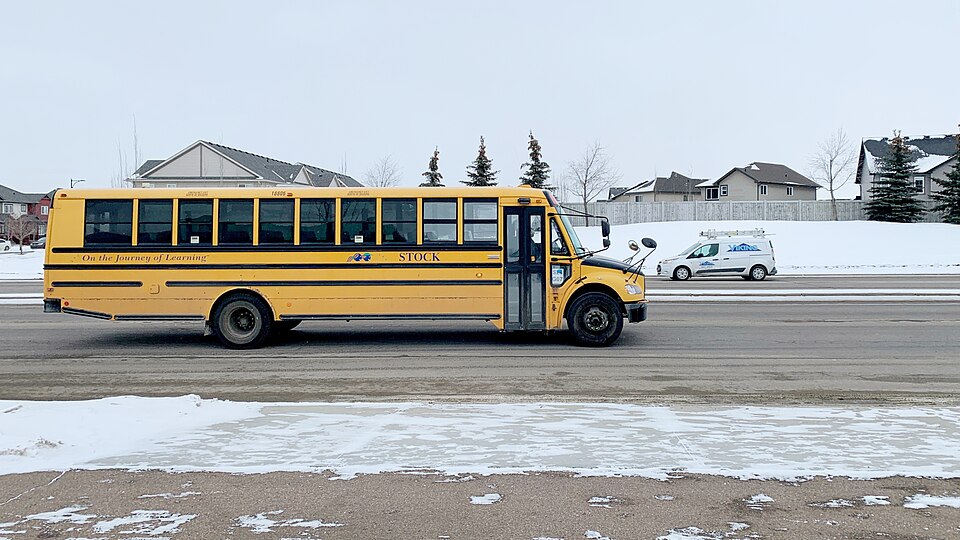
    Alberta school zones and playground zones are both 30 km/h unless otherwise posted. School zones apply on school days from 8:00 to 9:30 a.m., 11:30 a.m. to 1:30 p.m. and 3:00 to 4:30 p.m.; playground zones apply every day from 8:30 a.m. to one hour after sunset. When a school bus shows flashing red lights, traffic in both directions must stop unless the road is divided by a median. These rules appear on the Class 7 knowledge test and are checked on the Class 5 road test.

    Alberta school zone and playground zone times

    School zone Playground zone
    Sign School sign with a maximum speed sign Playground sign with a maximum speed sign
    Speed limit 30 km/h unless otherwise posted (urban and rural) 30 km/h unless otherwise posted (urban and rural)
    When it applies School days only: 8:00 to 9:30 a.m., 11:30 a.m. to 1:30 p.m., 3:00 to 4:30 p.m. Every day, 8:30 a.m. to 1 hour after sunset
    Passing No passing vehicles going the same way while in effect No passing vehicles going the same way while in effect
    Ends at A sign showing a higher speed or the end of the zone A sign showing a higher speed or the end of the zone

    Local times can differ. Municipalities can set different hours by bylaw. When they do, the times are posted beneath the sign. Always read the tab under the sign.

    Where a school zone or playground zone sign has rapidly flashing yellow lights, the zone speed applies while the lights flash.

    School zone vs school area, playground zone vs playground area

    • Zone: the school or playground sign has a speed sign attached. The reduced limit is the law during the set times.
    • Area: the sign has no speed sign. There is no special limit, but children may be crossing, so drive with extra care.

    Worked examples

    • Saturday, 2 p.m., playground zone: 30 km/h applies. Playground zones run 7 days a week.
    • Saturday, 2 p.m., school zone (no playground): the school zone speed does not apply because school is not held, unless local signs say otherwise.
    • Winter evening, playground zone: the zone ends 1 hour after sunset, so on a short December day it can end in the late afternoon. In summer, the same zone runs well into the evening.
    • School day, 10:00 a.m., school zone: outside the set times, so the normal limit applies, unless a municipal bylaw sets different hours on the sign.

    Speeding in a school or playground zone

    Speeding fines in Alberta rise with how far over the limit you are, and demerits are 2 points for 1 to 15 km/h over, 3 for 16 to 30, 4 for 31 to 50 and 6 for 51 or more (a mandatory court appearance). For a learner or GDL driver, 8 points means a suspension. See Alberta demerits and Immediate Roadside Sanctions.

    School bus rules in Alberta

    Flashing amber lights

    The bus is slowing to stop. Slow down. If you do pass, pass cautiously. This applies to traffic behind the bus on a divided highway, and to traffic from either direction on an undivided road.

    Flashing red lights and stop arm

    • Undivided road: traffic in both directions must stop before reaching the bus.
    • Road divided by a median: only traffic behind the bus must stop. Oncoming traffic on the other roadway does not.
    • Stop about 20 m (four to five car lengths) back from the bus, so drivers behind you can see the lights and the children.
    • Stay stopped until the red lights stop flashing or the bus driver signals you to go.

    Some municipalities have bylaws that do not require buses to use their flashing lights in town. There, you do not have to stop, but you must still watch for children getting on and off. Treat any stopped school bus with caution.

    Alberta’s Driver’s Guide lists 6 demerit points for failing to stop for a school bus. Check the current fine with the Government of Alberta. Compare the rules across provinces in school bus stopping rules across Canada.

    What the road test examiner watches for

    Knowing school and playground zone times and speed limits is one of the listed road test skills. Examiners expect you to:

    • spot the sign and read any time tab beneath it
    • slow to 30 km/h before the zone starts, not inside it
    • not pass while the zone is in effect
    • resume speed only at the end-of-zone or higher-speed sign

    More on the test in the Alberta Class 5 road test guide.

    Common questions

    Are Alberta playground zones in effect on weekends?

    Yes. They apply every day from 8:30 a.m. to one hour after sunset, unless local signs say otherwise.

    Are school zones in effect in summer?

    School zone limits apply only on days school is held.

    Are Alberta school zones always 30 km/h?

    The default is 30 km/h in urban and rural areas, but a different speed can be posted.

    Do I stop for a school bus on the other side of a divided highway?

    No, if the road is divided by a median. On an undivided road, you stop from either direction.

    Can I pass a car in a playground zone?

    No, not while the zone is in effect.

    Back to learning to drive in Alberta. See also Alberta Class 7 knowledge test.

    Sources

    • Government of Alberta, “Driver’s Guide to Operation, Safety and Licensing: Cars and Light Trucks”, Spring 2023 edition (alberta.ca)
    • Government of Alberta, “School and playground zones” (alberta.ca)
    • Alberta King’s Printer, “Use of Highway and Rules of the Road Regulation, AR 304/2002” (kings-printer.alberta.ca)
    • Alberta Transportation, “Information Bulletin: School Bus Safety Rules” (transportation.alberta.ca)
    • Government of Alberta, “Roadside worker safety” (alberta.ca)
    • Government of Alberta, “Speeding fines in Alberta” (alberta.ca)
    • Alberta Transportation, “Information about the Class 5 Road Test for New Drivers” (transportation.alberta.ca)
  • Alberta Traffic Circle Rules, Intersections and Right of Way

    Alberta Traffic Circle Rules, Intersections and Right of Way

    Photo: Milan Suvajac, CC BY-SA 4.0, via Wikimedia Commons

    In Alberta, right of way at intersections comes from signs, signals, crosswalks and the position of vehicles. At an uncontrolled intersection the vehicle on the left yields to the vehicle on the right, and in a traffic circle you yield to vehicles already in the circle on your left. This guide sets out each rule from Alberta’s Use of Highway and Rules of the Road Regulation and alberta.ca, for the Class 7 knowledge test and the Class 5 road test.

    Key rules

    • Uncontrolled intersection: if 2 vehicles arrive at about the same time, the driver on the left yields to the driver on the right.
    • Traffic circle or roundabout: yield to vehicles in the circle travelling to your left. Never change lanes inside.
    • Stop signs: stop at the stop line, or before the crosswalk, or no more than 3 metres back from the intersecting road.
    • Leaving an alley, driveway or parking lot: stop as if there were a stop sign, and stop again before the sidewalk.
    • Pedestrians in a crosswalk, marked or unmarked, have the right of way.

    Who has the right of way at an uncontrolled intersection in Alberta?

    When 2 vehicles approach or enter an intersection from different roads at about the same time, the driver on the left must yield to the vehicle on the right.

    Scenario: you and another car reach a residential crossroads with no signs at the same moment. The other car is on your right. You yield.

    Stop signs and yield signs

    Where to stop

    1. At the marked stop line, if there is one.
    2. If there is no stop line but there is a marked crosswalk, stop before the crosswalk.
    3. If neither is marked, stop no more than 3 metres back from the intersecting road.

    After stopping, go only when you can enter safely, yielding to all vehicles and pedestrians on the road you are entering. Rolling through a stop sign is an automatic fail on the Alberta road test.

    Yield signs

    You do not have to stop, but you must yield to all vehicles and pedestrians on the road you are entering.

    Three-way and four-way stops (“courtesy corners”): everyone stops. The vehicle that arrived first goes first; if two arrive together, the vehicle on the right goes first. Go only when it is safe.

    Two-way stops: traffic on the through road has the right of way. Wait for a safe gap.

    Keep intersections clear: do not enter unless you can clear the intersection and the crosswalk on the far side. Directions from a peace officer override signs and signals.

    Traffic lights in Alberta

    Signal What you do
    Solid red Stop completely. You may turn right after stopping unless a sign says otherwise, yielding to vehicles and pedestrians facing green.
    Solid green Go. If turning left, yield to oncoming traffic going straight and to pedestrians in the crosswalk.
    Solid yellow Stop before the crosswalk or intersection unless you cannot stop safely (AR 304/2002, s. 53). If you are already in the intersection, clear it with care.
    Green arrow You have the right of way to turn in that direction.
    Flashing red Treat as a stop sign.
    Flashing yellow Treat as a yield sign.

    Left turns

    You must not turn left across an approaching vehicle unless the turn can be completed safely. Alberta warns that drivers often misjudge the gap, and motorcycles look farther away than they are. If you are behind someone waiting to turn left, do not honk or crowd them.

    How to drive a traffic circle or roundabout in Alberta

    Traffic moves counter-clockwise. Unless a sign or signal says otherwise, a driver in the circle yields to any vehicle in the circle travelling to their left. Alberta’s 7 steps:

    1. Note your exit.
    2. Choose the correct lane before entering.
    3. Slow down on approach and watch for pedestrians crossing.
    4. Yield to all traffic in the circular lane and wait for a gap.
    5. Keep to the posted speed through the circle.
    6. Never change lanes inside the roundabout.
    7. Signal right as you approach your exit.

    Traffic circle or roundabout: what is the difference?

    A roundabout has a smaller centre island and a tighter curve to keep speeds low. Traffic circles have a larger island. Alberta roundabouts also have a truck apron around the island that long trucks drive their rear wheels over, so give large vehicles room.

    Lanes and signals in a two-lane circle

    • First exit: approach in the right lane, signal right as you approach and keep it on until you exit, stay in the right lane and exit from it.
    • Any later exit: approach in the left lane and signal left to show you are not taking the first exit. Stay in the left lane and exit from it.
    • Turn on your right signal once you pass the exit before yours.
    • Inside the circle, drivers on the right yield to drivers on the left. Check the right lane before you exit across it.
    • Can’t exit safely? Stay in your lane and go round again.

    Turning: lanes and positions

    • Be in the proper turning lane at least 15 m before the intersection. Mirror, shoulder check and signal before you move over.
    • Right turns: stay within about 1 m of the curb or road edge before, during and after the turn, shoulder check for cyclists and yield to pedestrians. Do not swing wide into two lanes.
    • Left turns: two-way onto two-way, turn from the lane just right of the yellow line into the lane just right of the yellow line. Two-way onto one-way, finish in the nearest lane on the left side. One-way onto two-way, turn from the leftmost lane into the lane just right of the yellow line.
    • Waiting in the intersection to turn left, keep your wheels pointed straight so a rear-end crash cannot push you into oncoming traffic. Before turning left off a two-lane highway, shoulder check left in case someone is passing you.
    • Dual turn lanes: turn from a marked lane into the matching lane, and never swing wide or change lanes during the turn.
    • You may turn left on a red light only from a one-way street onto a one-way street, after a full stop and when safe.
    • Two-way left turn lane: you may cross its solid yellow line to enter it. Enter close to where you will turn and watch for oncoming drivers using it.

    Driveways, alleys and parking lots

    When entering a street from an alley, driveway, parking lot or service road, stop as if there were an invisible stop sign, and yield before going on. If there is a sidewalk, stop before crossing it and yield to pedestrians on it.

    Pedestrians and crosswalks

    An unmarked crosswalk exists at every intersection unless a sign says otherwise: picture a line from corner to corner. You must yield to a pedestrian in any crosswalk, and you must not pass a vehicle that has stopped at a crosswalk to let someone cross. Failing to yield to a pedestrian in a crosswalk carries an $810 fine and 4 demerit points.

    Emergency vehicles at intersections

    An emergency vehicle with its siren on has the right of way. Pull through the intersection, then over to the right and stop. If you cannot clear the intersection safely, move as far from its centre as you can. Do not follow within 150 m of an emergency vehicle with its siren or lights on. See slow down, move over in Canada.

    Common questions

    Can you turn right on a red light in Alberta?

    Yes, after a complete stop, unless a sign prohibits it. Yield to vehicles and pedestrians facing the green.

    Who goes first at a traffic circle in Alberta?

    Vehicles already in the circle. Inside the circle, yield to vehicles on your left.

    Can I change lanes in a roundabout?

    No. Choose your lane before you enter.

    Do I signal in a traffic circle?

    Yes. Signal right once you pass the exit before yours. In a two-lane circle, also signal left as you approach in the left lane if you are not taking the first exit.

    Who yields at a T intersection with no signs?

    The same rule applies: the driver on the left yields to the vehicle on the right when both arrive at about the same time.

    Related: learning to drive in Alberta, Alberta Class 5 road test, Alberta Class 7 knowledge test, school and playground zones.

    Sources

    • Government of Alberta, “Driver’s Guide to Operation, Safety and Licensing: Cars and Light Trucks”, Spring 2023 edition (alberta.ca)
    • Alberta King’s Printer, “Use of Highway and Rules of the Road Regulation, AR 304/2002”, section 53, office consolidation current as of 8 August 2025 (kings-printer.alberta.ca)
    • Government of Alberta, “Intersection rules” (alberta.ca)
    • Government of Alberta, “Roundabouts” (alberta.ca)
    • Government of Alberta, “Pedestrian safety” (alberta.ca)
    • Government of Alberta, “Driver error” (alberta.ca)
    • Government of Alberta, “Reacting to emergency vehicles” (alberta.ca)
    • Government of Alberta, “Driver’s road test” (alberta.ca)
  • Class 5 GDL Alberta: Probation Rules and Your Full Licence

    Class 5 GDL Alberta: Probation Rules and Your Full Licence

    Photo: Marek Slusarczyk, CC BY 2.5, via Wikimedia Commons

    An Alberta Class 5-GDL is a probationary licence: you can drive alone, but with zero alcohol and drugs, no more passengers than seat belts, and a suspension at 8 demerit points. Since 1 April 2023 you leave the GDL program without an advanced road test. You need to be 18, finish 24 months of probation and stay suspension and demerit free for the last 12 months. Here is how each rule works and how to shorten probation by 6 months.

    Class 5-GDL rules in Alberta

    • No more passengers than seat belts.
    • Zero alcohol and zero drugs whenever you drive.
    • Licence suspended at 8 demerit points (fully licensed drivers: 15).
    • No upgrades to Class 1, 2, 3 or 4.
    • You cannot be the accompanying driver for a learner.

    Unlike the Class 7, the GDL has no midnight curfew and no supervisor.

    How do you get a full Class 5 in Alberta?

    Requirement Detail
    Age At least 18
    Time on GDL 24 months of probationary driving
    Clean record No suspensions, demerit convictions or other listed violations, including any alcohol or drug penalty, in the last 12 months
    Residency and ID Proof you live in Alberta, valid ID, legal status in Canada
    Road test None. The advanced road test ended on 1 April 2023

    Check with a registry agent how and when the change to a full Class 5 is made on your licence.

    Cutting 6 months off probation with driver training

    You may reduce the 24-month period by up to 6 months by completing a Class 5 or Class 6 driver training program from a driving school licensed by the Alberta government. A qualifying course for Class 7 and GDL drivers includes:

    • at least 15 hours of classroom instruction
    • at least 10 hours of in-vehicle instruction
    • passing knowledge and practical assessments, with a minimum overall in-vehicle score of 7.5 out of 10

    The school issues a Notice of Driver Education Course Completion form, which may also get you an insurance discount. The reduction applies once the course has added the U condition code to your driving record and you meet the other exit rules.

    When you leave the GDL program you move to a full Class 5, your demerit limit rises to 15, the zero alcohol and drug condition is removed, you can upgrade to a commercial class, and you can supervise a learner.

    Worked example: when can you get your full licence?

    Without training: Class 7 at 14 years 0 months, road test passed at 16, GDL until 18. Full Class 5 at 18 if your last 12 months are clean.

    With training: GDL at 17 with a licensed course completed. Probation can drop to 18 months, but you still need to be 18, so you qualify at 18 years 6 months.

    With a ticket: GDL at 16 years 0 months, a speeding conviction at 17 years 6 months. You are eligible on age and time at 18, but the conviction falls within the last 12 months, so you wait until that 12-month window is clean.

    GDL demerit ladder

    Points within 2 years Result
    4 to 7 Cautionary notice by mail
    8 or more 1-month suspension
    Second suspension within 1 year 3 months, possible review with the Registrar
    Third or later within 2 years 6 months, possible review

    After a suspension you are reinstated with 3 demerits that stay for 2 years. An approved defensive driving course completed before you reach 8 points can remove up to 3 points, once every 2 years.

    Points are recorded on your conviction date (when you pay the ticket or are found guilty), not the date of the ticket. More detail, including roadside sanctions, is in Alberta demerits and Immediate Roadside Sanctions.

    Zero tolerance: what happens if you drink and drive on a GDL

    Under IRS ZERO: Novice, any alcohol or drugs means a 30-day licence suspension, a 7-day vehicle seizure and a $200 fine plus a 20 percent surcharge. A suspension also resets your 12-month clean record. See impaired driving in Canada for new drivers.

    Moving to Alberta on a newer licence

    If you exchange a licence from elsewhere and have held a Class 5 for less than 2 years, you may be placed in the GDL program. You can still reduce probation by up to 6 months with licensed training.

    Common questions

    Do I need to retake a road test to get my full Alberta licence?

    No. The advanced road test was removed on 1 April 2023.

    Is there a curfew on a Class 5-GDL?

    No. The 12 a.m. to 5 a.m. ban applies only to Class 7 learners.

    How many passengers can a GDL driver carry?

    As many as there are seat belts.

    Can I supervise my younger sibling on a GDL?

    No. A supervisor needs a full Class 5.

    Can I do the defensive driving course to stay under 8 points?

    Yes, if you finish it before you reach 8 points. It removes up to 3 points, once every 2 years.

    Where does the GDL fit in the overall process?

    It is stage 2 of 3. See learning to drive in Alberta and how Alberta compares in Canadian graduated licensing compared.

    Sources

    • Government of Alberta, “Driver’s Guide to Operation, Safety and Licensing: Cars and Light Trucks”, Spring 2023 edition (alberta.ca)
    • Government of Alberta, “Class 5 driver’s licence” (alberta.ca)
    • Government of Alberta, “Steps to getting your licence” (alberta.ca)
    • Government of Alberta, “Class 5 driver training” (alberta.ca)
    • Government of Alberta, “Demerit driving suspension” (alberta.ca)
    • Government of Alberta, “Impaired driving penalties” (alberta.ca)
    • Government of Alberta, “Exchange a licence from outside Alberta” (alberta.ca)
    • Alberta King’s Printer, “Operator Licensing and Vehicle Control Regulation, AR 320/2002”, current as of 1 October 2026, section 33 (kings-printer.alberta.ca)
  • Alberta Road Test: How the Class 5 Test Is Scored and Booked

    Alberta Road Test: How the Class 5 Test Is Scored and Booked

    Photo: Marek Slusarczyk, CC BY 2.5, via Wikimedia Commons

    The Alberta Class 5 road test is the test that moves you from a Class 7 learner’s licence to a probationary Class 5-GDL. You book it through a registry agent or the Alberta Road Test Scheduler, the examiner assigns points for errors, and you fail with more than 75 points or with any dangerous or illegal action. This guide covers eligibility, booking, fees, the vehicle check and what examiners mark.

    Can you take the Class 5 road test yet?

    • You are at least 16 (written parental or guardian consent if under 18).
    • You have held a Class 7 for at least 12 months.
    • All outstanding fines owed to the Government of Alberta are paid.
    • You live in Alberta and meet the residency and ID requirements.

    How to book an Alberta road test

    1. Find a registry agent that offers Class 5 road tests, or use the Alberta Road Test Scheduler online.
    2. Have your Motor Vehicle Identification (MVID) number ready. It is the 9-digit number near the barcode on your Alberta licence.
    3. Ask for the registry’s road test information sheet. It lists eligibility, vehicle requirements, documents, fees and the cancellation and no-show policy.

    How much does the Alberta road test cost?

    Class 5 and Class 6 road tests are delivered by driver examiners contracted or employed by registry agents, and each registry agent sets its own fee and must publish it online. Compare a few registries before booking. Maximum charges for tests are set in the Government of Alberta’s Registry Agent Product Catalogue. Check the current figure with your registry; you also pay for the GDL licence card after you pass.

    How the Alberta road test is scored

    The examiner adds points for errors. More than 75 points on a Class 5 test is a fail. Points come from three kinds of mistake:

    Type of error Examples given by Alberta
    Missing a driving skill Not checking mirrors or blind spots
    Breaking a rule of the road Not observing a road sign, making an incorrect turn
    Doing a manoeuvre poorly Signalling too soon or too late, being too aggressive or too hesitant

    Automatic fail (“F”): endangering a pedestrian or another driver, driving unsafely, or breaking traffic laws, for example speeding or not stopping at a stop sign.

    What is on the Alberta Class 5 road test?

    Alberta’s Driver’s Guide (Spring 2023) says the test takes about 45 minutes, including the examiner’s instructions and a summary of your results. You must show you can drive safely without supervision while dealing with other road users. The test includes:

    • identifying and operating your vehicle’s controls
    • handling the vehicle: steering, braking and speed control
    • choosing the right lane for turns
    • obeying speed zones, including school and playground zones
    • working out right of way at intersections and when changing lanes
    • intersections with and without signs or signals
    • moving with other traffic without obstructing it
    • parking: perpendicular, uphill or downhill, and parallel (drivers over 65 do not have to parallel park)

    No passengers or pets may ride along. Confirm the details on your registry’s road test information sheet.

    Automatic fails listed in the Driver’s Guide

    • speeding, or driving too fast for conditions
    • not stopping completely at a stop sign, or before turning right on a red light
    • not yielding at an intersection or during a lane change
    • obstructing traffic by driving too slowly or stopping when you do not need to
    • climbing the curb while parking, or not parking legally within three attempts
    • not slowing or looking properly at uncontrolled intersections, where you must be ready to yield to drivers on your right

    The vehicle check before you drive

    Your vehicle must be legal and in good working condition. The Driver’s Guide lists what it must have:

    • valid licence plate and insurance
    • brake lights and signal lights, horn, speedometer
    • brakes and parking brake
    • clear windshield and working wipers
    • tires in good condition
    • driver and passenger doors, seats and seat belts
    • exhaust and muffler, mirrors
    • enough fuel for the test

    You may be asked to help check lights, horn, brakes and steering, and to describe and demonstrate two controls, such as the hazard lights and wipers. A failed vehicle check can stop the test before it starts.

    What to bring

    • Your Class 7 learner’s licence (plus photo ID if you only have a temporary non-photo licence).
    • Clothing suitable for the weather.
    • A road-legal, insured vehicle that passes the checks above.
    • Payment.

    Skills to practise, in order of risk

    1. Observation: mirror checks and shoulder checks before every lane change, turn and pull-out. This is the most-cited point category.
    2. Full stops: behind the stop line or crosswalk, or within 3 metres of the intersecting road if neither is marked.
    3. Zone speeds: 30 km/h in school zones on school days at set times and in playground zones from 8:30 a.m. to one hour after sunset. See school and playground zones.
    4. Right of way: uncontrolled intersections and traffic circles. See Alberta intersections and traffic circles.
    5. Left turns: wait until the turn can be completed safely.
    6. Parking: parallel and hill parking with full observation.

    After the test

    Pass: pass a vision test at the registry, then buy your Class 5-GDL card. You get a 30-day temporary licence; the card should arrive within 21 business days. Your GDL rules are in Alberta Class 5 GDL probationary rules.

    Fail: the examiner explains where you lost points. Keep the checklist form for your next test, and ask your registry when you can book again.

    Common questions

    How many points can you get on the Alberta road test?

    Up to 75. More than 75 points is a fail on a Class 5 test.

    Can I use my own car?

    Yes, if it meets all legal and safety requirements. Driving schools may also provide a vehicle.

    Does driver training help me pass?

    Alberta encourages it. A licensed course includes at least 10 hours in the vehicle, and the instructor helps you judge when you are ready for the test.

    How do I complain about my road test?

    Alberta has an online Traffic Safety Services complaints form, or you can contact Examinations and Licensing.

    Is there a second road test later?

    No. The advanced road test was removed on 1 April 2023. See learning to drive in Alberta.

    Sources

    • Government of Alberta, “Driver’s Guide to Operation, Safety and Licensing: Cars and Light Trucks”, Spring 2023 edition (alberta.ca)
    • Government of Alberta, “Driver’s road test” (alberta.ca)
    • Government of Alberta, “Class 5 driver’s licence” (alberta.ca)
    • Government of Alberta, “Steps to getting your licence” (alberta.ca)
    • Government of Alberta, “Class 5 driver training” (alberta.ca)
    • Government of Alberta, “School and playground zones” (alberta.ca)
    • Alberta Transportation, “Information about the Class 5 Road Test for New Drivers” (transportation.alberta.ca)
    • Alberta King’s Printer, “Use of Highway and Rules of the Road Regulation, AR 304/2002” (kings-printer.alberta.ca)