
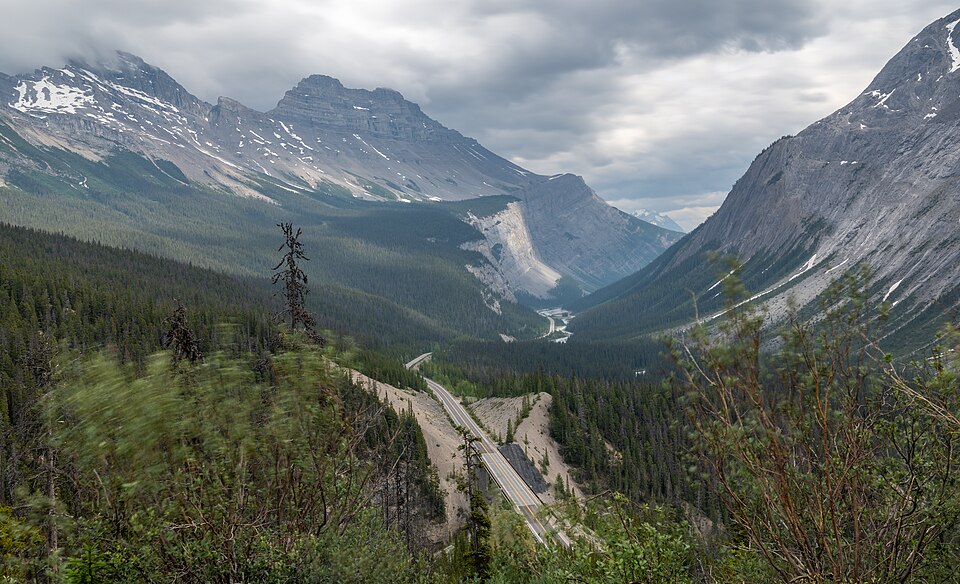
Photo: Ethan Sahagun, CC BY 4.0, via Wikimedia Commons
Driving in Alberta’s Rockies and on rural highways means long grades, fast-changing weather, slow farm traffic and a high chance of meeting wildlife. Animal-vehicle collisions made up about 60 percent of reported collisions on Alberta’s rural highways between 2015 and 2020. This guide is for Alberta learners and new drivers heading to Banff, Jasper or out of town, using Government of Alberta and Parks Canada advice.
Key facts
- Banff National Park limits: 90 km/h maximum on major routes, 60 km/h maximum on secondary roads, unless posted otherwise.
- Snow tires or chains are required by law on the Icefields Parkway (Hwy 93N) and the Banff-Windermere Highway (Hwy 93S) in Banff National Park from 1 November to 31 March, or whenever the roads are snow or ice covered.
- Cell coverage is not reliable throughout Banff National Park.
- Check road conditions with 511 Alberta (dial 511 in Alberta, or 1-855-391-9743).
- Learners still cannot drive between 12 a.m. and 5 a.m., so plan long trips with that in mind.
Before you go: a mountain trip checklist
- Check 511 Alberta for closures and conditions. For trips into BC, check DriveBC.
- Fill the tank and carry extra windshield washer fluid.
- Plan to finish driving in daylight. In winter the sun sets early.
- Pack a kit (the Driver’s Guide also suggests booster cables, a tow rope, a jack and inflated spare, reflective triangles, spare headlight bulbs, sand or salt, and tire chains): phone and charger, water and food, warm clothes, blanket, first aid kit, ice scraper and brush, shovel, flashlight and batteries, candle in a deep can with matches, whistle, road maps. Parks Canada also suggests a satellite messenger, as cell service is patchy.
- In winter, fit tires with the snowflake or M+S symbol, and check the dates when snow tires or chains are mandatory on your route.
Hills and mountain grades
- Gear down for long climbs and for steep downhill grades. This saves your brakes and reduces the chance of sliding.
- Avoid abrupt downshifting, which can cause a skid, especially when turning.
- Approaching a hill on a slippery road, accelerate slightly before it, then hold a steady speed going up.
- Avoid braking in curves on slick roads. Slow down before the curve and drive through at a steady speed.
- Large trucks and RVs slow on hills. Be patient and pass only where it is safe and legal.
Mountain weather and black ice
- It can snow in summer at higher elevations.
- Watch for black ice, especially on bridges and near water. Bridge decks are often slicker than the rest of the highway.
- Never use cruise control in winter conditions. Parks Canada also advises against cruise control in Banff National Park.
- Posted limits are for ideal conditions. You are legally required to drive to conditions and can be ticketed if you do not.
- On slick roads, leave at least 3 times your normal following distance.
More on snow and whiteouts in winter driving in Canada for new drivers.
Wildlife on Alberta highways
- Be most careful at dusk and dawn, when many animals are active and visibility is poor.
- Where there is one animal, expect others nearby.
- Fencing does not keep all wildlife off the road. Animals may be on or near any park road.
- If you see an animal by the road, slow down and warn drivers behind with your hazard lights.
- In Banff National Park, Parks Canada’s advice is to slow down, stay in your vehicle and move on. If you stop, pull onto the shoulder only where safe, use hazard lights, stay in the vehicle and keep it brief. If a wildlife jam forms, move on.
Alberta has built wildlife fencing, overpasses and underpasses on Highways 1, 1A, 3 and others, and fencing and crossings have cut wildlife-vehicle collisions in Banff National Park by more than 80 percent. Collisions still happen, so speed matters. To report an animal carcass on a highway, call 511 Alberta. How to react if an animal steps out is covered in moose, deer and caribou: avoiding wildlife collisions.
Rural highways: farm equipment, snowplows and stopped vehicles
Slow-moving vehicles
Watch for the orange triangle with a red border, especially at planting and harvest. Stay out of the driver’s blind spots and far enough back to be seen. Be patient: the driver will pull over when safe, and if they do not, they are likely not going far. Pass only when it is safe and the driver knows you intend to pass.
Snowplows
You must not pass a snowplow if the view along its side is blocked, if passing would interfere with its work, or if it cannot be done safely. Operators let traffic pass every 5 to 8 km or when safe. The fine is $324 and 3 demerits.
Stopped vehicles with flashing lights
In the lane next to any stopped roadside vehicle with flashing lights (police, ambulance, fire, tow, maintenance), move to the far lane, or if you cannot, slow to 60 km/h or the posted limit, whichever is lower. The fine is $243 and 3 demerits, and speeding fines double. See slow down, move over.
When something goes wrong
Emergency braking and skids
- With ABS: steady, firm pressure; do not pump or release; look and steer where you want to go. Vibration in the pedal is normal.
- Without ABS: threshold brake just short of locking. If the wheels lock, ease off slightly, then press firmly again.
- Any skid: stay off the brake and accelerator, look and steer where you want the front to go, and use small steering corrections. Power skid: ease off the gas. Braking skid: release the brake until the wheels roll. Cornering skid: off the gas, no brakes.
- Off the pavement: grip the wheel, ease off the gas, avoid hard braking, check traffic, then steer back gradually at a controlled speed.
Breakdowns
- Get to a safe spot, never on a bridge or in a tunnel. Hazard lights on, hood up, and place reflective triangles behind the vehicle about 10 to 20 m apart. Wait away from the vehicle where it is dangerous.
- Flat tire: do not brake hard. Ease off the gas, hold the wheel firmly, then brake gently once slower and pull off.
- Brake warning light: check the parking brake is off, then pull over when safe. If brakes fail, press harder, use the parking brake carefully and shift down.
- Headlights fail: hazard lights on, switch the headlights off and on, then slow down and pull off if they stay out.
Night, fog and smoke
- Headlights on at night and whenever you cannot see clearly 150 m ahead. Daytime running lights are not enough.
- Low beams within 150 m of a vehicle you are following and within 300 m of oncoming traffic. Look toward the right edge of your lane to avoid glare.
- Use low beams in fog, smoke and rain. If you cannot see well enough to continue, pull well off the road, hazard lights on, and wait.
- On wet roads, if you hydroplane, do not brake. Ease off the gas and steer where you want to go.
Collisions and police stops
- At a crash, stop safely away from it, protect the scene with hazard lights and triangles, help if you can and call for help if needed. If involved, exchange names, contact and insurance details, record witnesses and conditions, do not discuss fault, and tell your insurer.
- Report to police if anyone is injured or killed or if damage is $5,000 or more. That threshold is set by regulation and can rise with repair costs each year; the $2,000 figure in the Spring 2023 Driver’s Guide is out of date. Report damage to public property, such as a traffic sign, straight away. If you hit an unattended vehicle, find the owner or leave your name, address, licence and plate numbers and phone number securely on it.
- A siren from any direction: move as close as you can to the right edge (either curb on a one-way street) and stop until it passes. Treat flashing green lights (volunteer firefighters) the same way. Stay at least 150 m behind emergency vehicles.
- Pulled over by police: stop at the right edge, put the car in Park (or neutral) with the parking brake on, stay inside, have your licence, registration and insurance ready, and do not move until told.
Staying on the road
Alberta lists speed, road conditions, weather, hard braking, fast acceleration and tire condition as the main reasons drivers run off the road. On rural and gravel roads, reduce speed and increase following distance whenever conditions are not ideal, and scan ahead for icy patches, wildlife and debris. Keep tires in good condition.
Common questions
Can a learner drive to Banff?
Yes, with a qualified supervisor and outside the 12 a.m. to 5 a.m. curfew. See Alberta Class 7 learner rules.
What is the speed limit in Banff National Park?
90 km/h maximum on major routes and 60 km/h on secondary roads, unless posted otherwise.
Do I need winter tires to drive the Icefields Parkway?
Snow tires or chains are required in Banff National Park on Highway 93N and 93S from 1 November to 31 March, or whenever the road is snow or ice covered.
Should I stop to photograph wildlife?
Parks Canada’s advice is to slow down, stay in your vehicle and move on.
Can I pass a snowplow in Alberta?
Only when the view is clear, it will not interfere with the plow, and it is safe.
Back to learning to drive in Alberta.
Sources
- Government of Alberta, “Driver’s Guide to Operation, Safety and Licensing: Cars and Light Trucks”, Spring 2023 edition (alberta.ca)
- Government of Alberta, “Animal-Vehicle Collision Safety Program” (alberta.ca)
- Government of Alberta, “Safer winter highways” (alberta.ca)
- Government of Alberta, “Slow moving vehicles” (alberta.ca)
- Government of Alberta, “Driving safely around snowplows” (alberta.ca)
- Government of Alberta, “Roadside worker safety” (alberta.ca)
- Government of Alberta, “Collision reports” (alberta.ca)
- Alberta King’s Printer, “Operator Licensing and Vehicle Control Regulation, AR 320/2002”, current as of 1 October 2026, section 147 (kings-printer.alberta.ca)
- Government of Alberta, “Driver error” (alberta.ca)
- Government of Alberta, “Share the road” (alberta.ca)
- Government of Alberta, “Class 7 learner’s licence” (alberta.ca)
- Parks Canada, “Driving: Banff National Park” (parks.canada.ca)
- Parks Canada, “Obey speed limits: Banff National Park” (parks.canada.ca)