
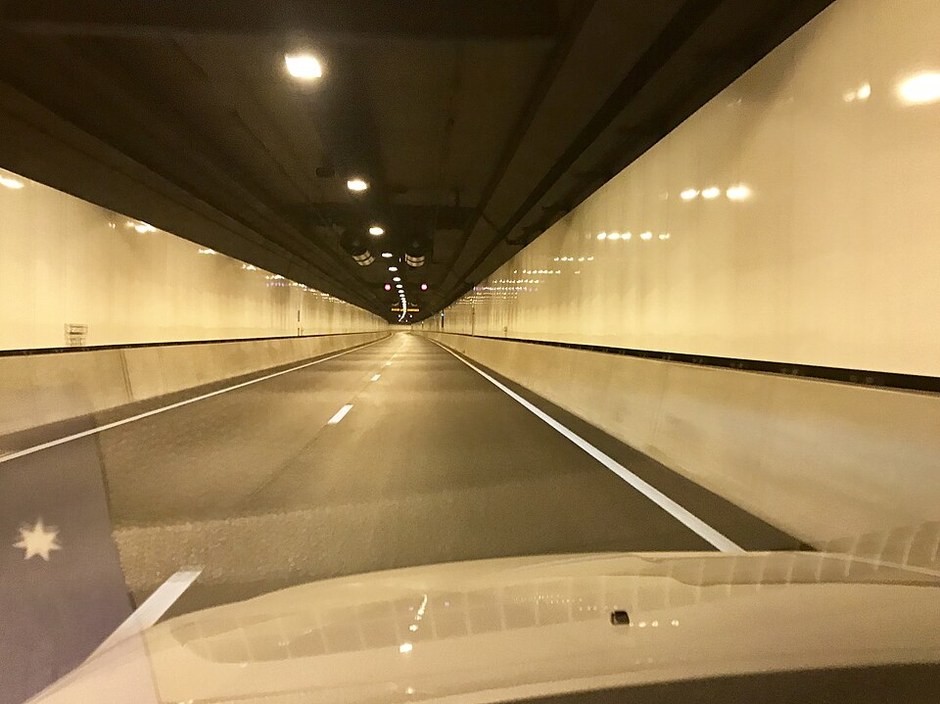
Photo: Kgbo, CC BY-SA 4.0, via Wikimedia Commons
Brisbane’s motorway tunnels, including CLEM7, AirportlinkM7 and Legacy Way, are open to learner and P plate drivers, but a breakdown or crash underground needs a different response from one on an open road. This guide covers the Queensland rules that apply in tunnels, what TMR says to do if you break down or there is a fire, and how to handle motorways as a new driver.
Key facts
- Stopping: you must not stop in a tunnel or underpass unless the road is as wide as on the approaches, or you are in a signed parking or stopping area.
- Breakdown: drive out if you can. If not, stop in a breakdown bay or at the side of the lane, turn on hazard lights and wait for the incident response team.
- Emergency phones: connect you to the tunnel control room.
- Your car catches fire: pull over to the left, stop, turn off the engine and get everyone out, watching for traffic. Do not open the bonnet of an engine fire. Call 000 from an emergency phone or your mobile.
- Traffic help line: 13 19 40 for incidents and breakdowns on major Queensland roads, 24/7. Call 000 in an emergency.
Before you enter a tunnel
- Check your fuel or charge before you go. Breaking down underground blocks a lane.
- Know your exit. Lane changes inside are harder, so pick your lane on the approach.
- Read the overhead signs at the entry. Overhead lane control signals can close lanes; ignoring them carries demerit points.
- Take off sunglasses (unless they are prescription lenses) and turn your headlights on so other drivers can see you.
- Turn your radio on. Tunnels rebroadcast safety and traffic messages over the radio as well as the public address system.
Reading overhead lane control signals
- Red cross over your lane: do not drive in that lane or past the sign.
- Flashing red cross: the lane is closing or closed ahead. Check mirrors, signal and move out as soon as it is safe, rather than swerving into a vehicle beside you.
- Speed sign or white, green or yellow arrow over the lane: you may use the lane, at the speed shown.
A car ahead carrying on under a red cross does not make the lane open. Keep reading the signs, because they can change during an incident.
Driving through the tunnel
- Keep to the speed limit shown on the signs, which can change for incidents.
- Keep a safe following distance. Queensland law requires enough distance to stop safely; the Q-Safe test checks for at least 2 seconds.
- Stay in your lane. Do not cross continuous lane lines. See road markings and lane lines.
- No stopping except in an emergency, in a signed bay or when the tunnel controller directs you. Never reverse in a tunnel.
- Avoid changing lanes and overtaking. If you must pass a broken-down vehicle, check it is clear and signal first.
Motorcyclists cannot ride on the road shoulder (edge filter) in a tunnel, but an open-licence rider may still lane filter between slow or stopped vehicles at 30 km/h or less, so check your mirrors before moving within your lane in queued traffic. See motorcyclists and lane filtering.
If you break down or crash in a Brisbane tunnel
- If the car can move, drive out of the tunnel.
- If not, pull into a breakdown bay or as far to the side of the lane as you can.
- Turn on your hazard lights.
- Stay in the car, or wait safely in front of it, unless there is a fire or you are told to evacuate.
- Use the nearest emergency phone to reach the tunnel control room. Watch for traffic when you get out.
- Wait for the incident response unit.
Learner? Your supervisor should take the lead, but practise the steps together so you both know them. After any crash, follow what to do after a crash in Australia.
If you are stuck in tunnel traffic
- Follow overhead signs and radio traffic updates.
- Keep windows closed and set the air conditioning to recirculate.
- Use an emergency phone if you need urgent help.
If there is a fire
- Do not enter a tunnel if you see smoke ahead or have been warned of a fire inside.
- If you are in the tunnel and see smoke or fire ahead, pull over, turn off the engine and wait for instructions by radio, public address or the incident response team.
- If your own car catches fire, pull over to the left, stop, turn off the engine and get out, watching for passing traffic. Do not open the bonnet of an engine fire, as the extra air feeds it. Do not stay in a burning car waiting for an announcement.
- If you cannot put the fire out, leave the keys in the ignition and call 000 from an emergency phone or mobile. Follow any instructions you are given.
- If you are told to evacuate, leave your keys in the ignition in the off position and follow the running man symbols and flashing lights to the nearest safe exit, on foot.
Queensland motorways on L and P plates
- Learners may drive on motorways with their supervisor; Queensland sets no separate learner speed limit, so the posted limit applies.
- Merge by matching the speed of traffic and finding a gap; give way to traffic already in the lane you are joining.
- Obey any “keep left unless overtaking” signs.
- If you break down on a motorway, use your hazard lights, get as far left as possible (onto the shoulder or an exit) and call 13 19 40, or 000 if anyone is in danger.
- When passing a stopped emergency or breakdown vehicle with flashing lights on a multi-lane road, leave a clear lane between you and it if it is safe and practical. If you cannot change lanes, keep as far away as you can within your lane and slow to a safe speed. See emergency vehicles and slow down rules.
More: learners on motorways and freeways and overtaking, merging and changing lanes.
Common questions
Can learners drive through Brisbane tunnels?
Queensland’s rules do not ban learners from tunnels. Build up to it on motorways first with your supervisor.
Can I stop in a tunnel if I miss my exit?
No. Keep going and take the next exit.
Should I get out of my car if it breaks down in a tunnel?
Stay in the car or wait safely in front of it, unless there is a fire or you are told to evacuate. Watch for traffic if you go to an emergency phone.
What number do I call for a breakdown on a Queensland motorway?
13 19 40 for minor incidents and breakdowns on major roads, or 000 in an emergency.
Are tunnels part of the Q-Safe test?
The test route is chosen by the examiner. Practise tunnel and motorway driving anyway so you are ready to drive them alone on Ps.
Related: Your keys to driving in Queensland study guide, Queensland learner rules and learning to drive in Queensland.
Sources
- Department of Transport and Main Roads, “Tunnel safety” (tmr.qld.gov.au)
- Queensland Government, “Breakdown safety on motorways and freeways” (qld.gov.au)
- Department of Transport and Main Roads, “QLDTraffic: Contact us” (qldtraffic.qld.gov.au)
- Queensland Government, “Transport Operations (Road Use Management: Road Rules) Regulation 2009”, current as at 31 August 2026 (legislation.qld.gov.au)
- Queensland Government, “Transport Operations (Road Use Management: Driver Licensing) Regulation 2021”, schedule 5 (legislation.qld.gov.au)
- Department of Transport and Main Roads, “Your keys to driving in Queensland”, No. 19, November 2022, complete PDF, Safe road use: Driving safely in tunnels (p. 146) and Safe following distance (p. 147) (publications.qld.gov.au)
- Queensland Government, “Traffic lights, U-turns and overhead lane controls” (qld.gov.au)
- Queensland Government, “Parked emergency response vehicles with flashing lights” (qld.gov.au)