
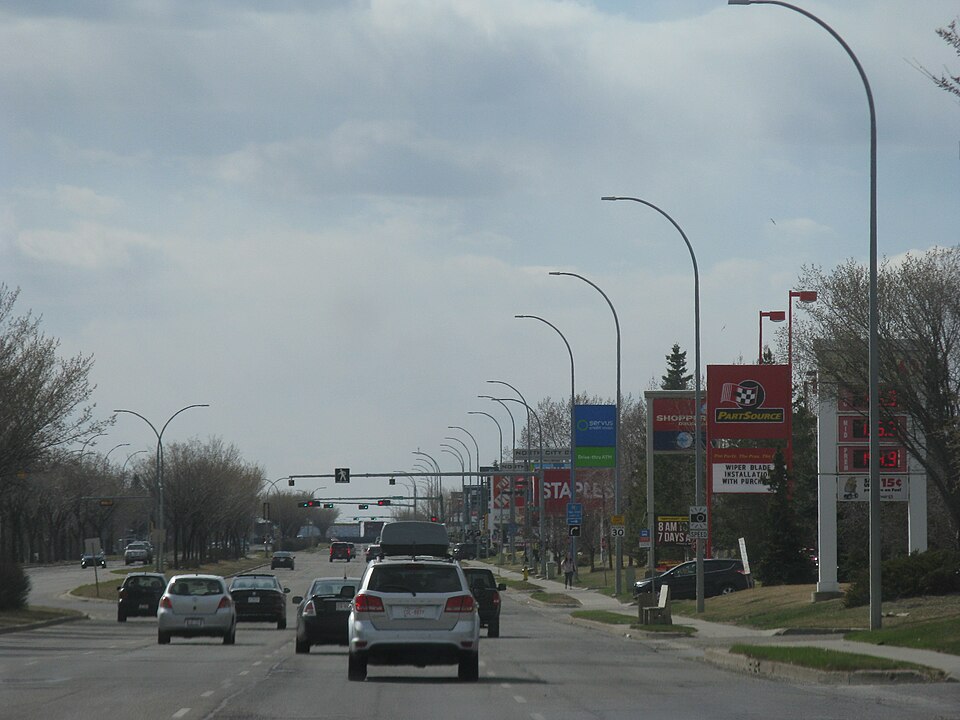
Photo: Rowanlovescars, CC BY-SA 4.0, via Wikimedia Commons
Sharing Alberta roads safely means four things for a new driver: pass cyclists at a safe distance and expect them on the right edge or shoulder; treat every motorcycle as closer than it looks before you turn left; obey every signal, gate and bell at Calgary and Edmonton LRT crossings and never stop on the tracks; and expect off-highway vehicles to cross highways in rural areas. This guide sets out what Alberta’s rules actually say about each one.
Key facts
- Alberta’s Use of Highway and Rules of the Road Regulation says you must pass another vehicle “at a safe distance” on the left. A bicycle is a vehicle under that rule. Alberta’s Driver’s Guide says to change lanes to pass a cyclist, as you would for any other vehicle.
- Cyclists must ride as near as practicable to the right edge, use a paved shoulder where there is one, and ride single file.
- Alberta’s government warns that motorcycles tend to look farther away than they are when you turn left across traffic.
- Edmonton’s Valley Line LRT has no crossing arms, gates or bells at intersections. Calgary’s CTrain street crossings use flashing lights, gate arms and bells.
- Off-highway vehicles (OHVs) may not use a highway, road or ditch without written provincial permission or a municipal bylaw. When they cross a road, the rider must stop and yield to you.
How much room do you give a cyclist in Alberta?
Alberta has no fixed metre figure in its rules of the road regulation. Section 21 says a driver overtaking another vehicle must pass to the left “at a safe distance” and must not move back to the right until safely clear. The Government of Alberta’s “Share the road” advice is simply to give other road users, from cyclists to tractor trailers, the space they need. Alberta’s Driver’s Guide (Spring 2023) puts it plainly: when passing a cyclist, change lanes as you would for any other vehicle.
The guide’s other cyclist points: a person walking a bike is a pedestrian; cyclists under 18 must wear an approved helmet; cyclists may move out from the curb to avoid grates, potholes, gravel or wet surfaces; check for cyclists before opening your door or pulling away from the curb; do not follow closely, because bikes have no brake lights; and take extra care around children on bikes.
In practice that means:
- slow down and wait behind the cyclist until you can pass with plenty of room;
- move partly or fully into the next lane if the lane is narrow, but only when oncoming traffic allows and the markings permit it;
- do not cut back in until you can see the cyclist well behind you;
- never squeeze past on a bend, near the crest of a hill or approaching an intersection.
Where cyclists ride, and why they move out
Knowing the cyclist’s rules helps you predict them. Under the regulation (sections 77 and 78), a cyclist:
- must ride as near as practicable to the right curb or edge, unless making a left turn;
- on a one-way street in a city or town, may ride near either curb;
- on a highway with a paved shoulder, must ride on the right shoulder; with no paved shoulder, as far right as practicable;
- must ride single file, not beside another cyclist in the same lane, except when passing.
So a cyclist moving toward the centre of the lane is often setting up a left turn. Hold back and let them make it.
Bike lanes in Calgary and Edmonton
Bike lanes, cycle tracks and their markings are set by each city. Follow the signs and pavement markings, and before crossing a bike lane to turn right or reach a driveway, check your mirror and shoulder check for cyclists coming up on your right. The Government of Alberta’s “Share the road” page reminds drivers that cyclists and motorcyclists are harder to see, so check mirrors and blind spots before you change lanes, stop or turn.
Pedestrians
- At a flashing yellow pedestrian-activated light, slow to 30 km/h and yield to people waiting to cross.
- In an urban area, a pedestrian may signal by holding an arm out pointing to the far curb. You must stop safely before the crosswalk and let them cross.
- Yield to anyone who has entered a marked or unmarked crosswalk. Stop about two to three car lengths back so drivers in other lanes can see the pedestrian.
- Never pass a vehicle when you are approaching a crosswalk. It may be stopping for someone you cannot see.
- In residential streets, glance under parked cars for feet, toys and bike wheels. At night, drive so you can stop within the distance your headlights light.
Motorcycles: the left-turn trap
The Government of Alberta’s “Driver error” page names turning left across traffic as a common error. Drivers misjudge the time and space they need, and small vehicles such as motorcycles tend to appear farther away than they actually are. A driver turning left across an oncoming vehicle must not turn until it is safe.
Before any left turn:
- Look specifically for single headlights in the oncoming traffic, not just cars.
- If you are unsure how fast a motorcycle is coming, wait for the next gap.
- If drivers behind you are impatient, ignore them. The Driver error page tells following drivers not to honk at or crowd someone waiting to turn left.
Other points for driving near motorcycles in Alberta:
- Motorcyclists, like other cyclists, must ride single file in a lane except when passing, so two motorcycles side by side in one lane should be uncommon.
- When you pass any vehicle, wait until you can see its whole front in your rear-view mirror before pulling back in (Share the road page).
- Do not tailgate. Always assume the vehicle in front may brake suddenly, and leave room to stop.
- Alberta warns riders that they are even harder to spot at night, so look twice at intersections after dark.
Trucks, log haulers and oversize loads
- If you cannot see both of a truck’s side mirrors, you are too close. If you can see the driver in a mirror, the driver can see you.
- Never move into the space in front of a large vehicle approaching a light; it needs that space to stop. Stopped behind one on a hill, leave extra room in case it rolls back.
- Do not sit on the right of a large vehicle turning right, and stop well back when one is turning onto your road. It may need part of your lane.
- Never pass a log hauler turning off the highway. Logs can stick out up to 9 m behind and sweep across the lanes.
- Oversize loads often travel slowly with pilot vehicles and pull over to let traffic by. Pass only with plenty of room and a clear view of oncoming traffic.
Railway crossings and funeral processions
- You must stop when a train is visible or sounding a signal within 500 m of the crossing.
- At a railway stop sign, stop between 5 m and 15 m from the nearest rail. At flashing lights and bells, the first vehicle stops at least 5 m back. Never go around a gate that is down, rising or lowering.
- Do not change gear on the tracks in a manual car. If you stall on a crossing, get everyone out and away, moving toward the approaching train so you are clear of flying debris.
- Buses and trucks carrying passengers or dangerous goods may have to stop at every railway crossing. Be ready to stop behind one.
- A train can need a kilometre or more to stop; an LRT train up to 100 m.
- Do not cut through a funeral procession. Its vehicles, with headlights on, may continue through stop signs and red lights while closely following each other.
LRT crossings: CTrain and Edmonton LRT
Calgary and Edmonton both run light rail on city streets, and the two systems do not look the same at crossings.
| Where | What you see | What to do |
|---|---|---|
| Calgary CTrain street crossings | Flashing lights, gate arms and bells (City of Calgary) | Stop when the lights flash or the gates are coming down. Do not go around or under a gate |
| Edmonton Capital and Metro Lines | Gates, warning bells and lights at crossings (City of Edmonton) | Obey every gate and bell, and wait behind the gate until it rises |
| Edmonton Valley Line | No crossing arms, gates or bells. Trains run in or beside the street and follow traffic signals | Obey the traffic signals, look both ways before entering the track area and take extra care when turning |
The City of Edmonton’s rules for drivers near LRT tracks:
- Obey traffic control signs and signals, and always yield to pedestrians.
- Look both ways before moving into the track area. Trains can come from either direction on any track.
- Never stop your vehicle on an LRT track. If the traffic ahead is queued, wait before the tracks until there is room for your whole car on the other side.
- Use extra caution when turning at intersections where LRT runs.
- The LRT moves quickly and quietly. Do not rely on hearing it.
For railway crossings generally, Alberta’s regulation (section 42) says that when a train is approaching you must stop no closer than 5 metres from the nearest rail, and you must not drive through, around or under a crossing gate while it is closed, opening or closing.
Off-highway vehicles near Alberta highways
Off-highway vehicles include quads (ATVs), side by sides, dirt bikes and snowmobiles. In farm country and near trail areas you will see them close to, and crossing, the road.
Can OHVs ride in the ditch?
Not without permission. According to the Government of Alberta, an OHV may not be operated on any highway, road or ditch unless the Minister of Transportation has given written permission (such as a Ministerial Order or a permit) or a municipal bylaw allows it. The only provincial Ministerial Order lets four-wheeled ATVs use three-digit-numbered highways in daylight during farming operations or an emergency. Municipal bylaws vary, so some towns and counties allow OHVs on certain roads.
What the rider must do to cross
- stop the OHV before crossing;
- make sure all passengers are off the OHV and anything attached to it;
- yield the right of way to all other vehicles and people on the road;
- cross by the most direct, shortest and safest route.
What you should do as a driver
- When you see an OHV near the road, slow down and expect it to cross, even though the rider must yield.
- On three-digit highways in farm areas in daylight, expect slow ATVs on the road itself.
- Give them the space you would give a cyclist when passing.
Snowplows, farm equipment and wildlife on rural highways are covered in driving in Alberta’s Rockies and rural highways. For stopped emergency and tow vehicles, see slow down, move over.
Common questions
Is there a one-metre passing law for cyclists in Alberta?
The Use of Highway and Rules of the Road Regulation sets no metre figure. It requires you to pass at a safe distance. Check the current Alberta Driver’s Guide and your city’s bylaws for any further guidance.
Can I drive on LRT tracks in Calgary or Edmonton?
Only to cross them where the road crosses the tracks, following the signals. Never stop on the tracks.
Will sharing the road come up on the Class 7 knowledge test?
The Alberta Driver’s Guide is the official study book for Alberta drivers and covers the rules of the road, so expect sharing-the-road topics. See Alberta Class 7 knowledge test and the Alberta Driver’s Guide study plan.
Back to learning to drive in Alberta. Related: Alberta intersections, traffic circles and right of way, Alberta parking, backing and lane driving.
Sources
- Government of Alberta, “Driver’s Guide to Operation, Safety and Licensing: Cars and Light Trucks”, Spring 2023 edition (alberta.ca)
- Alberta King’s Printer, “Use of Highway and Rules of the Road Regulation, Alta Reg 304/2002”, consolidated to 8 August 2025, sections 21, 42, 77 and 78 (kings-printer.alberta.ca)
- Government of Alberta, “Share the road” (alberta.ca)
- Government of Alberta, “Driver error” (alberta.ca)
- Government of Alberta, “Off-highway vehicle helmet law” (alberta.ca)
- Government of Alberta, “Driver guides” (alberta.ca)
- City of Edmonton, “Rail Safety” (edmonton.ca)
- City of Calgary, “Signals, tracks and power” (calgary.ca)