
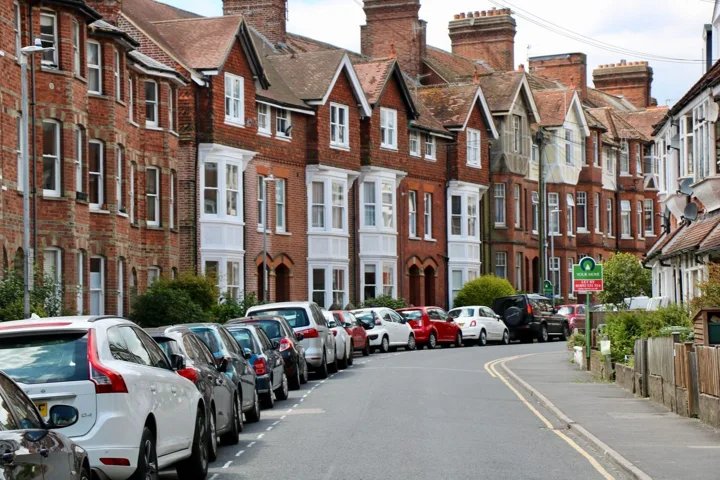
Photo: Ethan Wilkinson / Pexels. Illustrative photograph.
In Great Britain you MUST NOT park on zig-zag lines at a crossing, on a clearway, on double white lines, in a cycle lane while it operates, in a reserved bay you are not entitled to use, or on the pavement in London or Scotland. The Highway Code also says not to park within 10 metres of a junction, on a bend, near a school entrance or at a bus stop. This guide is for learners and new drivers in England, Scotland and Wales. It sorts Highway Code Rules 238 to 247 into what is illegal and what is advice, with the Scotland-only rules set out separately.
MUST NOT and DO NOT: why the difference matters
The Highway Code uses “MUST” or “MUST NOT” for legal requirements: breaking them is an offence and can mean a fine or penalty points. Advice worded as “should” or “do not” is not an offence in itself, but it can be used as evidence in court, and parking somewhere dangerous can still break Rule 242. Both lists below matter for your driving test and your licence.
Where you MUST NOT stop or park (Rules 238, 240 to 242)
- Yellow lines during the times shown on nearby time plates, or zone entry signs in a Controlled Parking Zone. Double yellow lines mean no waiting at any time, even without upright signs (Rule 238).
- School entrance markings when upright signs show a prohibition of stopping. That includes stopping to drop off or pick up (Rule 238).
- A motorway carriageway, emergency area or hard shoulder, except in an emergency (Rule 240).
- A pedestrian crossing, including the area marked by the zig-zag lines (Rules 191 and 240).
- A clearway (Rule 240).
- Taxi bays shown by upright signs and markings (Rule 240).
- An urban clearway during its hours, except to pick up or set down passengers (Rule 240).
- A road marked with double white lines, even if the line on your side is broken, except to pick up or set down passengers or load and unload goods (Rule 240).
- A tram or cycle lane during its period of operation, and any cycle track (Rule 240).
- Red lines on red routes, unless signs say otherwise (Rule 240).
- Reserved spaces for Blue Badge holders, residents or motorcycles, unless you are entitled to use them (Rule 241).
- Anywhere dangerous or where your vehicle or trailer causes unnecessary obstruction (Rule 242).
Rule 240 notes that any vehicle may enter a bus lane to stop, load or unload where this is not prohibited. For the meaning of each line and sign, see yellow lines, red routes and loading bays.
The penalty for parking on zig-zags
Parking on the zig-zags is a contravention of the pedestrian crossing regulations. GOV.UK lists endorsement code PC30 (contravention of pedestrian crossing regulations with a stationary vehicle), which carries 3 penalty points. Leaving a vehicle in a dangerous position (MS10) also carries 3 points. For a new driver, two such offences reach the 6-point limit. See the New Drivers Act.
Where you should not stop or park (Rule 243)
Rule 243 says DO NOT stop or park:

| Place | Why it causes problems |
|---|---|
| Near a school entrance | Children are hidden behind parked cars |
| Anywhere you would block access for emergency services | Fire engines and ambulances need the width |
| At or near a bus or tram stop or taxi rank | Buses cannot pull in, so passengers step into the road |
| On the approach to a level crossing or tramway crossing | Blocks the view and the escape route |
| Opposite or within 10 metres (32 feet) of a junction, unless in an authorised space | Hides emerging traffic and pedestrians, and forces turning vehicles onto the wrong side |
| Near the brow of a hill or a hump bridge | Drivers coming over the top cannot see you |
| Opposite a traffic island, or opposite another parked vehicle if that would cause an obstruction | Narrows the road so traffic cannot pass |
| Where you would force other traffic into a tram lane | Puts drivers in the path of trams |
| Where the kerb has been lowered for wheelchair and powered mobility users | Blocks the only step-free crossing point |
| In front of an entrance to a property | Blocks driveways |
| On a bend | Other drivers come round the bend into your car |
| Where you would obstruct cyclists’ use of cycle facilities | Pushes cyclists into traffic |
The only exception is when you are forced to stop by stationary traffic.
Pavement parking: London, Scotland and the rest of Great Britain
| Where | The rule (Rule 244) |
|---|---|
| London | You MUST NOT park partially or wholly on the pavement. Exceptions are allowed in limited circumstances |
| Scotland | You MUST NOT park partially or wholly on the pavement. Exceptions are allowed in limited circumstances |
| Rest of England, and Wales | You should not park partially or wholly on the pavement unless signs permit it |
Rule 244 explains why: pavement parking can obstruct and seriously inconvenience pedestrians, wheelchair users, people with visual impairments and people with prams or pushchairs.
The Scotland rules in detail
- Pavement parking is banned under the Transport (Scotland) Act 2019. Transport Scotland says councils could start enforcing it from 11 December 2023, with a £100 penalty, reduced to £50 if paid within 14 days (as of November 2026).
- Double parking: Rule 243 says in Scotland you MUST NOT double park.
- Dropped kerbs: in Scotland you MUST NOT park anywhere the kerb has been lowered to help pedestrians or cyclists. The Highway Code was updated on 10 April 2025 to make the Scottish dropped kerb and pavement rules clear.
- Exemptions: councils can exempt particular stretches of pavement. Transport Scotland gives safe access for emergency vehicles as one example of why. Follow the local signs.
Choosing where to pull in
A gap at the kerb is not automatically a good place to stop. Before you commit, check the whole space against the lists above: would the car hide a junction, block a crossing, a dropped kerb or a driveway, or squeeze pedestrians off the pavement? Then check your mirrors and blind spot as you slow down, because a cyclist can come up on your left while you move in. If the place turns out to be unsuitable, drive on to the next safe, legal spot. A little extra distance is better than a rushed stop. An instructor or examiner asking you to pull over does not override a parking restriction, so choose a legal place.
Before you leave the car: Rule 239 checklist
Rule 239 says use off-street car parks or marked bays wherever possible. If you have to stop at the roadside:

- do not park facing against the traffic flow
- stop as close to the side as you can
- do not stop too close to a vehicle showing a Blue Badge; the occupant may need extra room
- you MUST switch off the engine, headlights and fog lights
- you MUST apply the handbrake before leaving the vehicle
- you MUST make sure you do not hit anyone when you open your door. Look all around and use your mirrors
- where you can, open the door with the hand on the opposite side (left hand for a right-hand door) so you turn and look over your shoulder for cyclists and motorcyclists
- let passengers, especially children, get out on the kerb side
- ask passengers to wait and check before they open their doors too; the same duty not to hit anyone applies to them
- put valuables out of sight and lock your vehicle
Rule 239 also covers remote parking apps: you MUST make sure it is safe first and MUST stay in control throughout. At an electric vehicle charge point, park close to it and keep cables from becoming a trip hazard. More in parking at night and EV charging cables.
Controlled Parking Zones, goods vehicles and loading (Rules 245 to 247)
- Controlled Parking Zones (Rule 245): the zone entry signs show when restrictions apply across the zone. Outside those times parking may be allowed in some places; otherwise park in the signed and marked bays.
- Goods vehicles over 7.5 tonnes (Rule 246): MUST NOT park on a verge, pavement or land between carriageways without police permission, except when essential for loading, and then they MUST NOT be left unattended. This will not apply to your car, but explains why lorries should not be on the verge.
- Loading (Rule 247): do not load or unload where there are yellow kerb markings and upright signs show restrictions. On red routes, marked and signed bays show where and when loading is allowed.
Common questions
How close to a junction can I park?
Rule 243 says do not park opposite or within 10 metres (32 feet) of a junction, unless in an authorised parking space.
Is pavement parking illegal in England?
In London, yes. Elsewhere in England and in Wales, Rule 244 says you should not do it unless signs permit. Causing an unnecessary obstruction is still an offence under Rule 242.
When did the Scottish pavement parking ban start?
Councils in Scotland could enforce it from 11 December 2023. Penalties are £100, or £50 if paid within 14 days.
Can I stop on double yellow lines to drop someone off?
Rule 238 says double yellow lines mean no waiting at any time. Check nearby signs and kerb markings for loading restrictions, and never stop on zig-zags or on school entrance markings where signs prohibit stopping.
Can I park facing the wrong way at night?
Rule 239 says do not park facing against the traffic flow. Rule 248 adds that at night you MUST NOT park on a road facing against the direction of traffic unless in a recognised parking space.
Can I park across my own driveway?
Rule 243 lists “in front of an entrance to a property” as a place not to park.
Related: driving test manoeuvres and road markings. Back to the main guide: Learning to Drive in Great Britain.
Sources
- Department for Transport, “The Highway Code: Waiting and parking (238 to 252)” (gov.uk)
- Department for Transport, “The Highway Code: Using the road (159 to 203)” (gov.uk)
- Department for Transport, “The Highway Code: Introduction” (gov.uk)
- Department for Transport, “The Highway Code: Updates” (gov.uk)
- GOV.UK, “Penalty points (endorsements): Endorsement codes and penalty points” (gov.uk)
- Transport Scotland, “Pavement parking ban” (transport.gov.scot)