

Photo: Mike Bird / Pexels. Illustrative photograph.
A red X above a motorway lane in Great Britain means that lane is closed and you must not drive in it. Ignoring one can bring a fixed penalty of up to £100 and three points, and cameras can detect it. This guide covers red X signals, variable speed limits, the hard shoulder used as a lane, and what to do if you have to stop on a motorway with no hard shoulder.
Key facts
- Red X (with flashing red lights): lane closed. You MUST NOT drive in it (Highway Code Rule 258).
- Penalty: fixed penalty of up to £100 and three points, or court in some cases (National Highways).
- Cameras: since a law change in June 2019, cameras can automatically detect drivers ignoring a red X so police can act.
- Speed limit in a red circle: mandatory (Rule 261). Without a red circle, it is advisory.
- Emergency areas: blue signs with an orange SOS phone symbol, often orange surfacing. For emergencies only (Rule 270).
What does a red X on the motorway mean?
A red X with red lights flashing in pairs means “do not proceed in the lane directly below”. It is used when there are people, stopped vehicles or other hazards in the lane, and to keep it clear for emergency services.

- Follow the earlier signs, such as an arrow, to move into an open lane in good time.
- Do not drive in the closed lane, even after you pass the obvious hazard. There may be more danger further on.
- If the lane next to you is about to close, leave gaps so others can merge.
- The lane is open again only when a sign shows a speed limit, the national speed limit sign or “END”. A blank sign does not cancel a red X.
If red lights and closures are shown for every lane, the road is closed. You MUST NOT go past the sign in any lane or use the hard shoulder to get round it unless a police or traffic officer tells you to.
Variable speed limits
| What you see | Meaning |
|---|---|
| Speed in a red circle, over a lane or at the side | Mandatory limit. Enforcement cameras may be in use. |
| Speed with no red circle | Maximum speed advised for the conditions |
| Amber lights flashing with a message (fog, queue) | Warning of a hazard ahead |
| National speed limit sign or “END” | End of the temporary restriction |
A message may appear with no obvious cause. There may be an incident ahead you cannot see yet, so obey it. More signals: motorway signs and signals.
Types of smart motorway
| Type | Hard shoulder |
|---|---|
| Controlled motorway | Permanent hard shoulder, with variable speed limits |
| Dynamic hard shoulder | Opened as a lane at busy times. It is open only when the sign above it shows a speed limit (60 mph or lower). |
| All lane running | No hard shoulder. The old hard shoulder is a permanent lane, with emergency areas at intervals. |
When can you drive on the hard shoulder? (Rule 269)
- Only in an emergency, when police or traffic officers direct you, or when a sign shows a speed limit above it.
- A red X or a blank sign above the hard shoulder means do not use it except in an emergency.
- Misusing it can lead to a warning letter, or a fine and points.
Emergency areas: what they are and how to use them
Emergency areas sit beside motorways with no hard shoulder, or where the hard shoulder is used as a lane. They are set back from the carriageway and have an emergency telephone linked to a National Highways control centre.
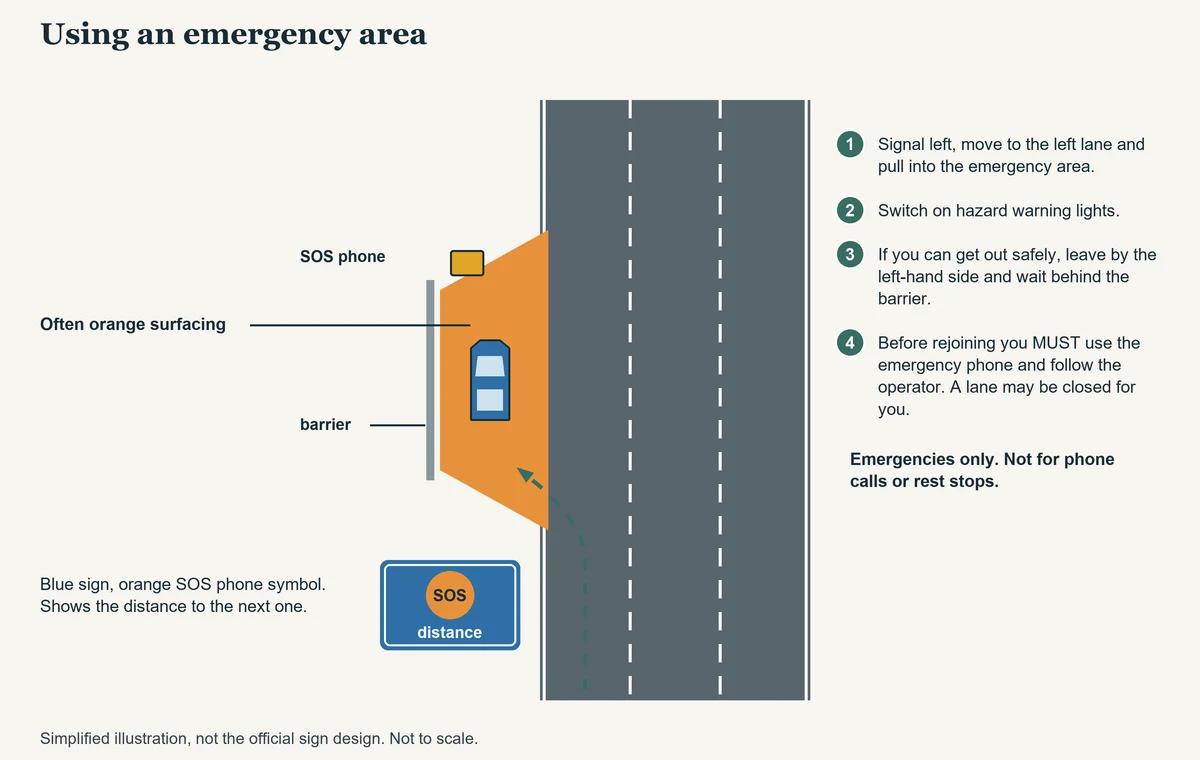
- How to spot one: blue sign with an orange SOS telephone symbol, giving the distance to the next one, and often orange surfacing.
- Use: emergencies only (Rule 270). Not for phone calls, rest stops or checking a route.
- Leaving: you MUST use the emergency telephone and follow the operator’s advice. A lane may be closed for you to rejoin safely (Rule 278).
Breaking down on a motorway with no hard shoulder
- Leave at the next exit or service area if you can.
- If not, signal left, move into the left lane and pull into an emergency area, or onto a hard shoulder if there is one.
- Switch on hazard warning lights (and sidelights in the dark or poor visibility).
- If you can get out safely, leave by the left-hand side, keep passengers with you and wait behind the barrier if there is one.
- If you stop in a live lane and cannot get out safely, stay in the car with seat belts on and hazards on, and call 999 (or press the SOS button if fitted).
- Do not put out a warning triangle on the motorway.
- Once you are out and behind the barrier, do not go back to the car, even if it is raining or cold. Do not try repairs.
- If a disability means you cannot follow these steps, stay in the car with your seat belt on and hazards on, and call 999 or press SOS (Rule 279).
Rejoining the motorway (Rule 278)
- From an emergency area: you MUST use the emergency telephone first and follow the operator’s advice, even if the engine has restarted. The operator may close a lane so you can pull out safely. A restart also does not prove the fault is fixed.
- From a hard shoulder: build up speed on the hard shoulder, signal, and wait for a safe gap. Watch for stopped vehicles and debris ahead of you. Your indicator does not give you priority.
When you call, have ready the motorway, direction of travel, the number on the nearest marker post or driver location sign, whether you are in a lane, an emergency area or on the hard shoulder, and who is with you. Read it from a safe place, not by walking along the road.
Full checklists, including how to tell services where you are: what to do if your car breaks down.
Common questions
How many points for driving under a red X?
Three points and a fixed penalty of up to £100. Some cases go to court, where higher penalties are possible.
Can a camera catch me in a red X lane?
Yes. Since June 2019, cameras can automatically detect vehicles that ignore a red X, and the police then take enforcement action.
Are smart motorway speed limits enforced?
Yes, when the limit is shown in a red circle. Limits without a red circle are advice.
Can I stop in an emergency area to take a phone call?
No. Emergency areas are for emergencies only, and Rule 271 says do not stop on a motorway to make or take calls.
Can learners drive on smart motorways?
Learners in Great Britain can drive on motorways only with an approved driving instructor in a dual-controlled car. See learners and motorways.
Related: your first motorway drive, Highway Code light signals and road works and contraflows. Back to the main guide: Learning to Drive in Great Britain.
Sources
- Department for Transport, “The Highway Code: Motorways (253 to 274)” (gov.uk)
- Department for Transport, “The Highway Code: Breakdowns and incidents (275 to 287)” (gov.uk)
- Department for Transport, “Know your traffic signs” (gov.uk), section: Motorway signs, signals and road markings
- National Highways, “Red X” (nationalhighways.co.uk)
- National Highways, “The hard shoulder” (nationalhighways.co.uk)
- National Highways, “Ambulance crews urge drivers to respect the Red X” (gov.uk)