
Motorway signs have to be read at 70 mph, so they are designed to be simple: blue backgrounds, few destinations, junction numbers and clear lane arrows. The overhead signals matter just as much, because a red X or a speed limit in a red circle is a legal order. You will not drive on a motorway in the practical test, but motorway signs come up in the theory test and you are allowed to have motorway lessons as a learner.
Last reviewed: September 2026. Checked against the Highway Code and GOV.UK.
Learners and motorways
Highway Code rule 253 says provisional car licence holders MUST NOT drive on a motorway unless they are accompanied by a DVSA approved driving instructor and are driving a car with dual controls that displays L plates (or D plates in Wales). GOV.UK confirms the practical test itself does not include motorway driving.
Blue signs and junction numbers
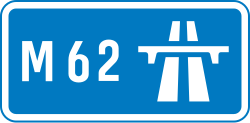

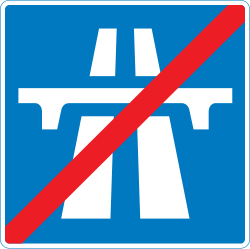

The Department for Transport’s Know Your Traffic Signs explains that most motorway signs have a blue background with white lettering, numbers and borders. Tourist signs are the exception and have brown backgrounds.
- The start of motorway regulations sign shows the motorway symbol: a stylised road narrowing towards the horizon with a bridge across it. From this point, motorway rules and the national speed limit apply unless another limit is signed.
- The end of motorway regulations sign shows the same symbol with a red diagonal bar. It may be given in advance with a distance, such as 1 mile.
- Junction numbers appear on a small black background, usually in a corner of the sign. Know Your Traffic Signs advises checking the junction number of your exit before you set off, because your destination may not appear on the signs. Numbers may not run in order, and new junctions may have a letter, such as 23A.
Approaching your exit
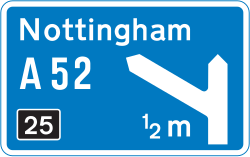

Direction signs are usually placed 1 mile and half a mile before a junction, and again at the exit point. Where junctions are close together, these distances may be reduced, normally to two-thirds of a mile and one-third of a mile.
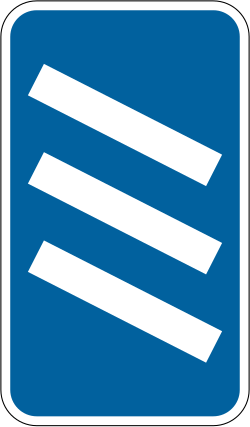

- Countdown markers show the distance to the start of the exit. Each bar represents 100 yards, so three bars means 300 yards.
- Lane signs with downward-pointing arrows mean “get in lane”. At a lane drop, one lane leads straight off the motorway. Only get into it if you want to leave (rule 266).
- A route confirmatory sign after most junctions shows the motorway number and the distances to main destinations ahead.
To leave, move into the left-hand lane well before your exit, signal left in good time and reduce your speed on the slip road (rule 273). If you miss your exit, carry on to the next one. You MUST NOT reverse, cross the central reservation or drive against the traffic flow (rule 263).
Services and distance chevrons
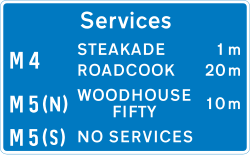


Know Your Traffic Signs says that on most motorways, service areas are provided at intervals of not more than 30 miles.
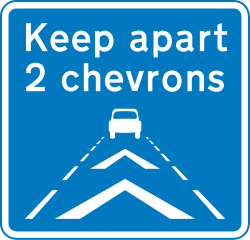
Some motorways have white chevrons painted in the centre of the lanes. They are spaced 40 metres apart, and keeping two chevrons between you and the vehicle in front gives a safe distance at 70 mph.
Overhead signals and variable signs




.svg)
.svg)
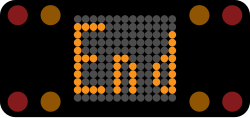

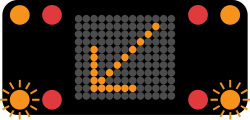
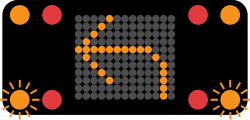
Signals can apply to one lane when mounted over it, or to the whole carriageway when placed at the side of the road or on the central reservation (rule 256 and Know Your Traffic Signs). The key messages are:
- Red X with flashing red lights: the lane is closed. You MUST NOT drive in a closed lane, and you MUST follow the signs in advance to move safely to an open lane (rule 258).
- Red lights and all lanes closed: the road is closed. You MUST NOT go beyond the sign in any lane, or use the hard shoulder, unless a police or traffic officer tells you to.
- Speed limit in a red circle: this is mandatory, and you MUST NOT exceed it (rule 261). Know Your Traffic Signs explains that a speed not shown in a red circle is advisory, the maximum speed advised for the conditions.
- Flashing amber lights: a hazard ahead. Reduce speed, be ready for the hazard, and only speed up when you pass a signal that is not flashing, or one showing the national speed limit or END, and it is safe (rule 257).
- Diagonal arrow: move to the adjacent lane. Leave motorway at next exit, fog and ice warnings may also be shown.
- END or a national speed limit sign: the temporary restriction is over.
Hard shoulders and emergency areas
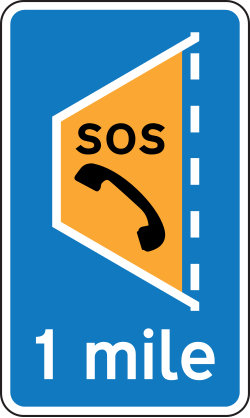

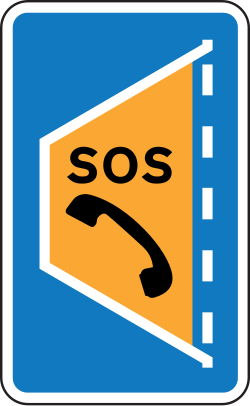

You MUST NOT use a hard shoulder except in an emergency, or when directed by the police, traffic officers or a traffic sign (rule 269). On some motorways, the hard shoulder is used as an extra lane at busy times:
- You can only use it as a lane when a speed limit is shown above it.
- A red X or a blank sign above the hard shoulder means you MUST NOT use it except in an emergency.
Emergency areas are provided on motorways with no hard shoulder, or where the hard shoulder is used as a lane. They are marked by blue signs with an orange SOS telephone symbol and may have orange surfacing. They MUST only be used in an emergency (rule 270).
Motorway signs learners often confuse
- Speed in a red circle vs no red circle: red circle means a legal limit; no red circle means advised speed.
- Red X vs blank signal over the hard shoulder: both mean do not use it as a lane. Only a speed limit above it means it is open.
- Diagonal arrow vs red X: the arrow warns you to move over because the lane is closing ahead; the red X means the lane is closed and you must not be in it.
Practice questions
These practice questions are written by Get Driving Test Ready to help you revise. They are not official DVSA questions.
Q1. What background colour do most motorway direction signs have?
A) Blue
B) White
C) Brown
D) Green
Answer: A. Most motorway signs have a blue background with white lettering. Brown is used for tourist destinations. (Know Your Traffic Signs (GOV.UK))
Practise this on the road: With your instructor, notice blue motorway signs on approach roads and compare them with green primary route signs.
Q2. A red X is lit above the lane you are driving in. What MUST you do?
A) Slow to 50 mph and stay in the lane
B) Stop on the hard shoulder
C) Switch on your hazard lights and carry on
D) Move safely to an open lane and not drive in the closed lane
Answer: D. A red X identifies a closed lane. You MUST follow the signs to move safely to an open lane and MUST NOT drive in a closed lane. (Highway Code rule 258)
Practise this on the road: On a motorway lesson with your instructor, read every overhead gantry aloud and say which lanes are open.
Image: Wikimedia Commons, OGL v1.0
Q3. An overhead signal shows 60 inside a red circle. What does it mean?
A) Mandatory maximum speed of 60 mph
B) The motorway ends in 60 metres
C) Minimum speed of 60 mph
D) Advised speed of 60 mph
Answer: A. A speed limit displayed within a red circle is mandatory and you MUST NOT exceed it. (Highway Code rule 261)
Practise this on the road: On motorway lessons, check each gantry for a red-ringed limit and adjust your speed smoothly.
Q4. What distance does each bar on a motorway countdown marker represent?
A) 100 metres
B) 50 yards
C) Half a mile
D) 100 yards
Answer: D. Each bar on a motorway countdown marker represents 100 yards to the exit. (Highway Code: traffic signs)
Practise this on the road: Before a motorway exit, count down the three, two and one bar markers and plan your lane.
Image: Wikimedia Commons, OGL v1.0
Q5. On a motorway where the hard shoulder can be opened as an extra lane, which signal above the hard shoulder means you may drive in it?
A) A speed limit
B) A blank signal
C) Flashing amber lights
D) A red X
Answer: A. You can only use the hard shoulder as an extra lane when a speed limit is shown above it. A red X or blank sign means you MUST NOT use it except in an emergency. (Highway Code rule 269)
Practise this on the road: On a smart motorway lesson, check the gantry above the hard shoulder before ever moving into it.
Q6. Which of these may a learner car driver do on a motorway?
A) Drive with a DVSA approved driving instructor in a dual-controlled car showing L plates
B) Drive with any full licence holder over 21
C) Drive alone after passing the theory test
D) Nothing, learners may never use motorways
Answer: A. Provisional car licence holders MUST NOT drive on a motorway unless accompanied by an approved driving instructor in a car with dual controls displaying L plates (D plates in Wales). (Highway Code rule 253)
Practise this on the road: Ask your instructor about booking a motorway lesson in a dual-controlled car before you pass.
Q7. You miss your exit on a motorway. What should you do?
A) Reverse along the hard shoulder
B) Cross the central reservation
C) Carry on to the next exit
D) Stop and wait for help
Answer: C. You MUST NOT reverse or cross the central reservation. If you miss your exit, carry on to the next one. (Highway Code rule 263)
Practise this on the road: On motorway lessons, read exit signs early so you are in the left lane in good time.
Q8. How are emergency areas on motorways marked?
A) Blue signs with an orange SOS telephone symbol
B) Brown signs with a picnic symbol
C) Red signs with a white cross
D) Green signs with a white PImage: Wikimedia Commons, OGL v1.0
Answer: A. Emergency areas are marked by blue signs with an orange SOS telephone symbol and may have orange surfacing. They MUST only be used in an emergency. (Highway Code rule 270)
Practise this on the road: On motorways without a hard shoulder, notice the blue SOS emergency area signs and how far apart they are.
Next steps
Return to the road signs hub, then revise the full rules in our motorway rules topic. The traffic lights and signals guide covers lane control signals used on other roads, and the incidents, accidents and emergencies topic explains what to do if you break down.