Author: Get Driving Test Ready

  • Minnesota Points System: Ticket Counts and Teen License Rules

    Minnesota Points System: Ticket Counts and Teen License Rules

    Photo: Thomas Parker, Pexels

    Minnesota has no driver points system. Driver and Vehicle Services (DVS) counts traffic convictions instead: after a warning letter, 4 convictions in 12 months or 5 in 24 months brings a 30-day suspension, and the suspensions get longer from there. For teens, the bigger risk is the provisional license rule: a crash-related moving violation, or more than one other moving violation, keeps you off a full license for 12 months or until you turn 18. This guide sets out the habitual violator ladder, the provisional rules, the under-21 alcohol rule and the speeding tickets that never reach your record.

    Key facts (Minnesota, as of November 2026)

    • No points: suspensions are based on the number of traffic convictions under Minnesota Rules 7409.2200 (“habitual violators”).
    • Warning letter: 2 misdemeanors, or 3 or more traffic offenses, within 24 months.
    • Provisional license holders: one crash-related moving violation, more than one other moving violation, or any alcohol offense delays the full license.
    • Under 21 and alcohol: driving after drinking any alcohol means a 30-day suspension, or 180 days for a repeat (Minn. Stat. 169A.33).
    • Over 100 mph: license revoked for six months (Minn. Stat. 169.14).

    Does Minnesota use a points system?

    No. Minnesota law lets the commissioner suspend a license for an “habitual violator of the traffic laws” (Minn. Stat. 171.18), and the DVS rules turn that into a count of convictions. Every conviction for a traffic law under chapters 169 or 171 counts, apart from those the law keeps off the driving record. DVS counts by the date of each driving incident, not the court date.

    Minnesota habitual violator suspensions

    Traffic convictions Suspension
    2 misdemeanors, or 3 or more traffic offenses, in 24 months Warning letter or preliminary hearing
    4 in 12 months, or 5 in 24 months (after a warning letter) 30 days
    5 in 12 months, or 6 in 24 months 90 days
    7 in 24 months 180 days
    8 or more in 24 months 1 year

    The warning letter lists the violations on your record and explains what further tickets will do. Under Minn. Stat. 171.18, DVS must give 14 days’ written notice before a suspension takes effect (unless the delay would threaten public safety), you can ask in writing for a hearing, and a suspension under that section cannot last more than one year.

    Separate permit and license violation rule

    Two or more convictions for driving without the right license or permit, or for breaking instruction permit rules (Minn. Stat. 171.02 and 171.05, among others), bring a 30-day suspension on their own.

    Which speeding tickets stay off a Minnesota record?

    Minn. Stat. 171.12 tells DVS not to record some lower-speed convictions:

    • In a 55 mph zone: a ticket for 10 mph over or less is not kept on your record.
    • In a 60 mph zone: a ticket for 5 mph over or less is not kept on your record.

    This does not apply to commercial vehicles or to anyone holding a commercial license or commercial learner’s permit. The fine still applies. Speeding in town, in school zones or on 65 and 70 mph roads is recorded as normal.

    At the other extreme, driving faster than 100 mph means a six-month revocation, or longer if an impaired driving penalty also applies.

    Extra rules for teen drivers

    On the instruction permit

    To get a provisional license, the six months before you apply must be free of alcohol and implied consent offenses, crash-related moving violations and any other moving violation. A “moving violation” is any traffic violation except parking, vehicle equipment violations and warnings.

    On the provisional license

    Under Minn. Stat. 171.055, any of these during the provisional period delays your full license:

    • a conviction for impaired driving, underage drinking and driving, or an implied consent violation
    • a conviction for a crash-related moving violation
    • more than one conviction for a moving violation that is not crash related

    The delay: no full license until 12 months in a row have passed since the conviction, or until you turn 18, whichever comes first. One ordinary speeding ticket does not trigger this. A second one does.

    Scenario

    Jordan, 16, has had a provisional license for 7 months. In month 3 there is a ticket for rolling a stop sign. In month 7 there is a speeding ticket in a 30 mph zone. That is a second non-crash moving violation, so Jordan cannot move to a full license until 12 months after the second conviction, or the 18th birthday if that is sooner. Two tickets are far below the habitual violator ladder, but they still cost months.

    Phone use

    Provisional license holders may not use a phone at all while the vehicle is moving, hands-free included, except to get emergency help. It is a petty misdemeanor. See Minnesota hands-free law for new drivers. Passenger and night limits are in Minnesota provisional license rules.

    Alcohol rules for drivers under 21

    It is a crime for a person under 21 to drive while drinking, or after drinking when there is physical evidence of it in their body (Minn. Stat. 169A.33). There is no “safe” small amount.

    Underage drinking and driving finding License result
    First 30-day suspension
    Previous violation on record 180-day suspension

    It is also a misdemeanor. If the facts amount to impaired driving (DWI), the tougher impaired driving penalties apply instead. More: zero tolerance laws for drivers under 21.

    Can a course remove points or tickets in Minnesota?

    There are no points to remove. Because suspensions depend on convictions, a course only helps if the court accepts it as part of an outcome that avoids a conviction. Ask the court how the case will be reported to DVS before you agree to anything. Minnesota’s driver education and supplemental parent class are licensing steps, not ways to clear a record.

    What to do after a ticket: getting a traffic ticket as a new driver.

    Common questions

    How many tickets can you get before your license is suspended in Minnesota?

    After a warning letter, 4 convictions in 12 months or 5 in 24 months means a 30-day suspension.

    Does one speeding ticket stop me getting a full license?

    Not on its own, unless it was crash related. More than one non-crash moving violation during the provisional period does.

    Is a seat belt ticket a moving violation?

    Minnesota defines a moving violation as any traffic violation except parking, vehicle equipment and warnings. Check with DVS how a particular ticket is classed on your record.

    Can I ask for a hearing?

    Yes. Under Minn. Stat. 171.18 you can request a hearing in writing, and DVS must offer one within 20 days of the request.

    How long can a habitual violator suspension last?

    Up to one year for 8 or more convictions in 24 months.

    How do other states compare?

    See points systems and license suspensions in the US.

    Main guide: learning to drive in Minnesota.

    Sources

    • Minnesota Office of the Revisor of Statutes, Minnesota Rules chapter 7409, “Driving Privileges; Loss, Reinstatement” (revisor.mn.gov)
    • Minnesota Office of the Revisor of Statutes, Minn. Stat. 171.18, “Suspension” (revisor.mn.gov)
    • Minnesota Office of the Revisor of Statutes, Minn. Stat. 171.055, “Provisional license” (revisor.mn.gov)
    • Minnesota Office of the Revisor of Statutes, Minn. Stat. 171.12, “Driving record; filing; private data” (revisor.mn.gov)
    • Minnesota Office of the Revisor of Statutes, Minn. Stat. 169A.33, “Underage drinking and driving” (revisor.mn.gov)
    • Minnesota Office of the Revisor of Statutes, Minn. Stat. 169.14, “Speed limits, zones; radar” (revisor.mn.gov)
    • Minnesota Office of the Revisor of Statutes, Minn. Stat. 171.04, “Persons not eligible for drivers’ licenses” (revisor.mn.gov)
  • Washington Points System: How DOL Suspends Teen and Adult Drivers

    Washington Points System: How DOL Suspends Teen and Adult Drivers

    Photo: Alex Smith, CC0, via Wikimedia Commons

    Washington State does not give tickets point values. Instead, the Department of Licensing (DOL) counts how many times you commit a moving violation: 3 occasions in one year, or 4 in two years, means a 60-day suspension and a year of probation for any driver. Intermediate license holders under 18 face a stricter count: a second offense brings a 6-month suspension and a third keeps you off the road until you turn 18. This guide explains both systems, the warning letters, and how the safe driving course and court deferrals work.

    Key facts (Washington, as of November 2026)

    • No points: RCW 46.20.2892 counts “occasions” of moving violations. Several tickets from one traffic stop count as one occasion.
    • Warning notice: 2 occasions in one year, or 3 in two years.
    • Suspension: 3 occasions in one year, or 4 in two years, means 60 days suspended plus one year of probation.
    • Intermediate license (under 18): first offense, a warning letter to your parent; second, 6 months suspended or until 18; third, suspended until 18 (RCW 46.20.267).
    • Since April 1, 2026: finishing the required safe driving course early can end a 60-day suspension early, once every five years.

    What counts as a moving violation in Washington?

    WAC 308-104-160 lists the offenses DOL counts. Parking, equipment and paperwork violations (insurance, registration, licensing) do not count. The list includes, among many others:

    • Speeding, speeding in a school zone and speed too fast for conditions
    • Failure to stop at a signal, stop sign or for a school bus
    • Failure to yield, improper lane change, following too closely and improper passing
    • Negligent driving in the second degree and failure to maintain control
    • Using a personal electronic device while driving, and dangerously distracted driving
    • Violating instruction permit or license restrictions
    • Reckless driving, DUI, racing and hit and run (criminal traffic offenses)
    • A driver under 21 driving after consuming alcohol or cannabis

    Phone use is the one most likely to catch a new driver. See Washington E-DUI distracted driving law explained.

    When does Washington suspend a license for too many tickets?

    Moving violation occasions What DOL does
    2 in one year, or 3 in two years Sends a notice that one more will mean a 60-day suspension
    3 or more in one year, or 4 or more in two years Suspends the license for 60 days, then one year of probation
    Any moving violation during probation Adds a further 30-day suspension

    Before your license is reinstated you must complete a safe driving course recommended by DOL. DOL may not charge a reissue fee at the end of this suspension.

    Ending the suspension early with the safe driving course

    The version of RCW 46.20.2892 in force from April 1, 2026 lets you take the safe driving course any time after DOL sends notice of a pending suspension. When DOL receives proof you finished it, it must end the suspension (or pending suspension) before the 60 days are up, as long as reinstatement requirements and fees are met. Probation then starts that day. Two limits apply:

    • Early termination is allowed only once every five years.
    • It is not available for a suspension caused by a violation during probation.

    A further change takes effect on January 1, 2029: if one of the counted violations was excessive speeding, you will have to drive a vehicle fitted with an intelligent speed assistance device for the first 120 days of probation.

    Extra rules for intermediate license holders under 18

    RCW 46.20.267 applies when an intermediate licensee is convicted of a traffic offense under chapter 46.61 RCW (the rules of the road) or breaks the intermediate license restrictions:

    Offense Result
    First DOL mails your parent or guardian a warning letter
    Second Intermediate license suspended for 6 months, or until you turn 18 if that comes first. Parent notified
    Third Intermediate license suspended until you turn 18. Parent notified

    A single ticket listing more than one offense counts as one offense. The count is much tighter than the adult rule: two tickets in two years would only earn an adult a warning, but they cost a 17-year-old intermediate driver six months.

    How tickets delay the next license stage

    • Getting the intermediate license: you must have no traffic violation conviction in the 6 months before you apply, and no ticket pending at the time of application.
    • Lifting the passenger and night limits early: after 12 months on the intermediate license, the limits drop only if you have had no traffic offense conviction, no restriction violation and no qualifying crash in that time.

    The passenger, night and phone limits themselves are in Washington intermediate license rules for teens. Police can enforce the passenger and night limits only as a secondary action, but the phone ban for intermediate drivers can be enforced on its own.

    Alcohol and drug rules for young drivers

    • Under 21: it is an offense to drive with an alcohol concentration of at least 0.02 (RCW 46.61.503), and it is on DOL’s moving violation list.
    • Juvenile alcohol, drug and firearm offenses: when a court reports certain offenses by a juvenile, DOL revokes all driving privileges: on the first notice, one year or until 17, whichever is longer; on a second or later notice, two years or until 18, whichever is longer (RCW 46.20.265).

    Background: zero tolerance laws for drivers under 21.

    Can a ticket be kept off your Washington record?

    For a traffic infraction, a court hearing can defer findings for up to one year with conditions. If you meet the conditions and commit no other infraction in that time, the court may dismiss the ticket (RCW 46.63.070). You can receive only one deferral for a moving violation in any seven-year period, and commercial license holders are not eligible. A dismissed infraction is not a committed infraction, so it should not count toward the DOL totals. Confirm how your case will be reported with the court.

    What to do in the days after a ticket: getting a traffic ticket as a new driver.

    Common questions

    Does Washington have a points system?

    No. DOL counts moving violation occasions rather than points.

    How many tickets before a suspension in Washington?

    3 in one year or 4 in two years for any driver. For an intermediate license holder under 18, the second offense brings a suspension.

    Do two tickets from one stop count twice?

    Under RCW 46.20.2892, multiple infractions from a single traffic stop are one occasion. Under the intermediate license rule, a single ticket counts as one offense.

    Will my parents find out?

    Yes, if you hold an intermediate license. DOL writes to your parent or guardian after the first offense and with any suspension.

    Does a suspension end when I turn 18?

    The intermediate suspensions run until 18 at the latest. The adult 60-day rule applies to everyone, whatever their age.

    How do other states compare?

    See points systems and license suspensions in the US.

    Main guide: learning to drive in Washington State.

    Sources

    • Washington State Legislature, RCW 46.20.2892, “Traffic infractions for moving violations, suspension, probation, notice” (app.leg.wa.gov)
    • Washington State Legislature, RCW 46.20.267, “Intermediate licensees” (app.leg.wa.gov)
    • Washington State Legislature, RCW 46.20.075, “Intermediate license” (app.leg.wa.gov)
    • Washington State Legislature, RCW 46.20.265, “Juvenile driving privileges, revocation for alcohol or drug violations” (app.leg.wa.gov)
    • Washington State Legislature, RCW 46.61.503, “Driver under twenty-one consuming alcohol or cannabis” (app.leg.wa.gov)
    • Washington State Legislature, RCW 46.63.070, “Response to notice” (app.leg.wa.gov)
    • Washington State Legislature, WAC 308-104-160, “Moving and nonmoving violations defined” (app.leg.wa.gov)
  • Colorado Points System: Teen Suspension Rules and Ticket Points

    Colorado Points System: Teen Suspension Rules and Ticket Points

    Photo: Minime5468, CC BY-SA 4.0, via Wikimedia Commons

    Colorado adds points to your driving record for each traffic conviction, and the number that triggers a suspension depends on your age. Drivers 17 and under are suspended at 6 points in 12 months or 7 points in total before 18. Drivers 18 to 20 are suspended at 9 points in 12 months, 12 in 24 months, or 14 in total, and adults at 12 in 12 months or 18 in 24 months. This guide covers the point values for common tickets, the teen permit and license penalties, and what happens at a point suspension hearing.

    Key facts (Colorado, as of November 2026)

    • Everyone starts at 0 points. Points are added when a conviction reaches the Colorado DMV.
    • The suspension count uses the date of each violation, not the date you were convicted.
    • Once you reach a threshold, the hearing officer must suspend. They decide how long, up to one year.
    • Teen restriction tickets carry their own points: 2 for a curfew, passenger or seat belt violation, 3 for driving on a permit without an approved supervisor.
    • Legal authority: C.R.S. 42-2-127 and 1 CCR 211-3, according to the Department of Revenue Hearings Division.

    Colorado point suspension thresholds by age

    Your age Suspension at
    17 and under 6 or more points in any 12 months, or 7 or more points at any time while under 18
    18 to 20 9 or more in any 12 months, 12 or more in any 24 months, or 14 or more at any time between 18 and 21
    21 and over 12 or more in any 12 months, or 18 or more in any 24 months

    The “at any time” limits are the ones that catch young drivers out. A 17-year-old who spreads tickets out so that no 12-month window reaches 6 points is still suspended once the running total since licensing reaches 7.

    Separate, higher limits apply to chauffeurs (people employed as drivers, such as taxi drivers) who can prove each ticket happened at work. They do not apply to new teen drivers.

    How many points is a ticket in Colorado?

    The full schedule is in C.R.S. 42-2-127(5). These are the values it gives for common tickets.

    Speeding

    Speed over the limit Points
    5 to 9 mph over 1
    10 to 19 mph over 4
    20 to 39 mph over 6
    40 mph or more over 12
    Speed not reasonable and prudent for conditions 3

    One 40 mph-over ticket puts a driver of any age at or past the 12-month limit. For a 17-year-old, a single 10 to 19 mph-over ticket (4 points) leaves only 1 point of room before the 12-month limit.

    Other common convictions

    Conviction Points or result
    Driving while ability impaired (DWAI), first 8 points
    DUI, first Revocation for 9 months
    Reckless driving Up to 8 points
    Passing a stopped school bus 6 points, plus a mandatory court appearance and a fine of up to $300

    For any ticket not listed here, check the point value in C.R.S. 42-2-127(5) or ask the Colorado DMV before you pay it. Paying a ticket counts as a conviction.

    Teen permit and license violations and their points

    CDOT’s graduated licensing guide lists the minimum fines and points for breaking the permit and minor license rules:

    Violation Minimum fine Community service Points
    Permit: driving without an approved supervisor $70 None listed 3
    Mobile device use, any driver (C.R.S. 42-4-239) $75 first, $150 second, $250 third or later within 24 months, each plus a $10 surcharge None listed 2 / 3 / 4
    Unauthorized passenger $50 / $100 / $150 8 to 24 hours 2
    Seat belt or seating violation (everyone belted, one front passenger, no more passengers than rear belts) $65 / $130 / $195 8 to 40 hours 2
    Curfew $50 / $100 / $150 8 to 24 hours 2

    The phone row uses the current statute and C.R.S. 42-2-127(5), not the CDOT guide, which still shows the pre-2025 $50/$100 and 1 point. The full passenger and curfew rules are in Colorado teen license restrictions and penalties. Phone rules for new drivers are in Colorado phone and texting laws for learner and new drivers.

    Worked example: a 16-year-old in the first year

    1. March: a ticket for 12 mph over the limit. 4 points.
    2. August: a curfew ticket. 2 points. Total 6 points inside 12 months.
    3. Result: 6 points within 12 months meets the under-18 threshold. The case goes to a point suspension hearing, and the hearing officer must suspend.

    The same two tickets would leave a 21-year-old at half the adult 12-month limit.

    Alcohol rules for drivers under 21

    • A driver under 21 convicted of DUI or DWAI can have their license revoked on a first conviction if they fail to complete a court-ordered evaluation or program. A second or third conviction means mandatory revocation.
    • Anyone under 21 convicted of buying or possessing alcohol can have their driving privilege revoked, even if no driving was involved.
    • Refusing a chemical test means a one-year revocation and two years with an ignition interlock.

    More on the low under-21 limit: zero tolerance laws for drivers under 21.

    What happens at a Colorado point suspension hearing?

    1. The suspension itself is automatic. If your points meet a threshold, the hearing officer has no discretion about whether to suspend.
    2. The length is decided at the hearing. The officer starts from a base of 6 months, then adjusts for aggravators (repeat offenses, crashes, serious offenses, not disclosing pending tickets) and mitigators (evidence that your driving habits have changed). The maximum is one year.
    3. You may ask for a probationary license. Often called a “red license”, it lets you drive only for set reasons such as work or school. It is discretionary, harder to get a second time, and not valid outside Colorado.
    4. Any moving ticket cancels a probationary license, even if you plan to fight the ticket in court. If that happens, you must carry SR-22 insurance for 3 years after reinstatement.
    5. You must reinstate at the end. When the suspension (or the probationary license) ends, you cannot drive until your license is reinstated.

    Can a course remove points in Colorado?

    The Department of Revenue’s point suspension guidance does not describe any course that removes points from a Colorado record. What it does describe is the hearing, where evidence that you have changed your driving habits counts as a mitigator and can shorten the suspension. If a court offers a driving class as part of a ticket, ask the court in writing whether points will still be reported.

    Colorado’s own driver education is a licensing requirement, not a point-reduction tool. See Colorado 30-hour driver ed vs the 4-hour driver awareness course.

    Common questions

    How many points can you get before losing your license at 17 in Colorado?

    6 points in any 12 months, or 7 points in total before your 18th birthday, means a suspension.

    Do points from my permit count?

    Yes. Permit violations carry points, such as 3 for driving without an approved supervisor, and they count toward the under-18 limits.

    Does the 12-month count run from the ticket date or the court date?

    From the date of each violation.

    What changes when I turn 18?

    You move into the 18 to 20 bracket: 9 points in 12 months, 12 in 24 months, or 14 in total between 18 and 21.

    Can I drive to work during a point suspension?

    Only if the hearing officer grants a probationary license, and only for the reasons written on it.

    How do I check my points?

    Request your driver record through Colorado DMV online services.

    How does Colorado compare with other states?

    See points systems and license suspensions in the US.

    Main guide: learning to drive in Colorado.

    Sources

    • Colorado Department of Revenue, Hearings Division, “Point Suspensions” (revenue.colorado.gov)
    • Colorado Division of Motor Vehicles, “Colorado Driver Handbook” (dmv.colorado.gov)
    • Colorado Department of Transportation, “Graduated Driver Licensing resource guide” (codot.gov)
    • Colorado General Assembly, “Penalties for Speeding Violations” (leg.colorado.gov)
    • Colorado Revised Statutes, sections 42-2-127 and 42-4-239, as amended by Senate Bill 24-065 (leg.colorado.gov)
  • Arizona Points System and Teen License Suspension Rules

    Arizona Points System and Teen License Suspension Rules

    Photo: Christoffer G. Thomsen, CC0, via Wikimedia Commons

    Arizona’s points system adds points to your driving record for each moving violation, from 2 points for most tickets up to 8 for DUI or reckless driving. Collecting 8 or more points in 12 months can mean Traffic Survival School (TSS) or a suspension of up to 12 months. Drivers under 18 face a tougher, separate ladder: TSS after the first conviction, then 3-month and 6-month suspensions. This guide sets out the point values, the teen rules under A.R.S. 28-3321 and 28-3174, and how defensive driving school fits in.

    Key facts (Arizona, as of November 2026)

    • Adult threshold: 8 or more points in any 12-month period can lead to required TSS or a suspension of up to 12 months (ADOT MVD).
    • Under 18: first moving violation conviction means mandatory TSS. Second means a 3-month suspension. Third means a 6-month suspension (A.R.S. 28-3321).
    • Class G restriction breaches (curfew, passengers, phone) in the first 6 months: the restriction period is extended by 30, then 60 days, then a 30-day suspension on the third violation (A.R.S. 28-3174).
    • Defensive driving school: once every 12 months, completing it gets an eligible citation dismissed and kept off your record (A.R.S. 28-3392 and 28-3394).
    • Under 21 and alcohol: any alcohol in your body while driving is an offense in Arizona.

    Arizona point values for common tickets

    Violation Points
    Driving under the influence (DUI) 8
    Extreme DUI 8
    Reckless driving 8
    Aggressive driving 8
    Racing on a highway 8
    Aggravated DUI 8
    Leaving the scene of a crash 6
    Failure to stop for a signal or stop sign, or to yield, causing death 6
    Failure to stop for a signal or stop sign, or to yield, causing serious injury 4
    Speeding 3
    Driving over or parking in a freeway gore area 3
    Wrong-way driving 2
    All other moving violations 2

    Points go on your record each time you are convicted of, or forfeit bail for, a moving violation. If one traffic stop produces several violations, ADOT assesses points based on the highest-value violation only. Source: ADOT MVD Points Assessment table.

    When can police impound your car in Arizona?

    The MVD manual says a vehicle is impounded or immobilized if the driver’s license is suspended or revoked, the driver has never been licensed (and has no out-of-state license), the driver must use an ignition interlock and the car has none, or the driver has no required insurance and is involved in a crash. Driving on a suspended license can mean up to 30 days of impound.

    When does Arizona suspend your license for points?

    Drivers 18 and over

    ADOT says that 8 or more points within any 12-month period means you may be required to attend Traffic Survival School, or have your driving privilege suspended for up to 12 months. Under A.R.S. 28-3306, MVD can also require TSS or suspend a license when violations happen often enough to show disrespect for traffic laws.

    Violations that require TSS whatever your points

    ADOT lists some convictions that require TSS regardless of your point total. These include DUI, wrong-way driving and running red lights or stop signs. A first moving violation by a driver under 18 is also on the list.

    What happens if you skip TSS?

    ADOT says failing to complete a required TSS course leads to suspension of your license. Book it as soon as the order arrives.

    Extra rules for drivers under 18

    A.R.S. 28-3321 applies to a moving violation committed while you are under 18, whether you hold an instruction permit or a Class G license. It counts convictions, not points:

    Conviction What MVD does
    First Orders you to attend and complete Traffic Survival School
    Second Suspends your driving privilege for 3 months
    Third Suspends your driving privilege for 6 months

    So a teen with two speeding tickets, at 3 points each, is well below the adult 8-point line but still loses the license for 3 months.

    Class G restriction violations

    For the first 6 months, Class G holders under 18 may not drive from midnight to 5 a.m. (with exceptions), may not carry more than one passenger under 18 who is not a sibling (unless a qualifying parent or guardian is in the front seat), and may not use a wireless device except in an emergency or for audible turn-by-turn navigation. Under A.R.S. 28-3174, breaking these limits carries its own penalties:

    Violation Civil penalty License effect
    First Up to $75 Restriction period extended by 30 days
    Second Up to $100 Restriction period extended by 60 days
    Third or later Up to $100 30-day suspension
    • Police cannot stop you only for a restriction violation. They need another reason to believe a traffic law was broken.
    • A curfew ticket is dismissed if you provide a notarized letter confirming the trip was allowed. A passenger ticket is dismissed if a notarized letter from a parent or guardian confirms the passengers were your siblings.
    • Restrictions end on your 18th birthday, but any extension or suspension already imposed must still be completed.

    The full Class G rules are in Arizona Class G graduated license rules.

    Courses that keep points off your record

    Defensive driving school

    • Courts must allow attendance for an eligible civil moving violation (A.R.S. 28-3392).
    • You can attend only once every 12 months, counted from violation date to violation date.
    • If you complete it, the court dismisses the citation and MVD does not put it on your driving record (A.R.S. 28-3394). No conviction means no points.
    • Not available if the violation caused death or serious physical injury.
    • Arizona courts say to finish the course at least 7 days before your court date.

    Because the teen ladder in 28-3321 is triggered by a record of judgment or conviction, a dismissed citation should not count as a step on it. An ADOT FAQ also says a first-time teen offender who attends defensive driving school keeps a clean record. Confirm with the court handling the ticket before you rely on it.

    Traffic Survival School

    TSS is the course MVD orders after points or certain convictions. ADOT says completing a required TSS course is what avoids or ends the suspension. It is not a way to dismiss a ticket.

    Scenario: a 16-year-old’s first year

    1. Month 2: a ticket for carrying two friends under 18 with no parent in the front seat. Civil penalty up to $75 and the passenger and curfew limits run 30 days longer.
    2. Month 7: a speeding ticket. The family uses defensive driving school, the citation is dismissed, and nothing goes on the record.
    3. Month 10: a second speeding ticket. Defensive driving school is not available again within 12 months. The conviction is the first under 28-3321, so MVD orders TSS.
    4. Any further moving violation conviction before 18 would mean a 3-month suspension.

    What to do when the ticket arrives: getting a traffic ticket as a new driver.

    Common questions

    How many points before your license is suspended in Arizona?

    8 or more points in 12 months can lead to TSS or a suspension of up to 12 months. Under-18 drivers can be suspended after a second conviction regardless of points.

    How many points is a speeding ticket in Arizona?

    3 points, according to ADOT’s points table.

    Does a permit holder get points?

    Yes. Points apply to moving violation convictions, and the under-18 rules in 28-3321 cover anyone who commits a moving violation while under 18.

    Do suspensions disappear when I turn 18?

    No. A.R.S. 28-3174 says penalties and extensions already imposed must be completed even if you turn 18.

    What about drinking and driving under 21?

    Arizona makes it an offense for anyone under 21 to drive with any alcohol in their body. The license consequences are covered in Arizona DUI and extreme DUI rules for new drivers.

    How do I check my points?

    Request a copy of your driving record from ADOT MVD.

    How do other states compare?

    See points systems and license suspensions in the US.

    Main guide: learning to drive in Arizona.

    Sources

    • Arizona Department of Transportation MVD, “Arizona Driver License Manual and Customer Service Guide” (99-0117, revised September 2026) (azdot.gov)
    • Arizona Department of Transportation MVD, “Points Assessment” (azdot.gov)
    • Arizona Department of Transportation MVD, “Suspension and Traffic Survival School” (azdot.gov)
    • Arizona Department of Transportation MVD, “Penalties” (Teen Drivers) (azdot.gov)
    • Arizona Department of Transportation, “What are the penalties for moving violations while under the age of 18?” (azdot.gov)
    • Arizona State Legislature, “A.R.S. 28-3174” (Class G license) (azleg.gov)
    • Arizona State Legislature, “A.R.S. 28-3306” (suspension and traffic survival school) (azleg.gov)
    • Arizona State Legislature, “A.R.S. 28-3321” (moving violations under 18) (azleg.gov)
    • Arizona State Legislature, “A.R.S. 28-3392” (defensive driving school) and “28-3394 Successful course completion” (azleg.gov)
    • Arizona Judicial Branch, “Frequently Asked Questions for Defensive Driving School” (azcourts.gov)
    • Arizona State Legislature, “A.R.S. 4-244” (under-21 alcohol offense) (azleg.gov)
  • Do College Students Need to Change Their Driver’s License?

    Do College Students Need to Change Their Driver’s License?

    Photo: George Pak, Pexels

    Most US college students who go to school in another state can keep driving on their home-state license, as long as they stay a resident of their home state. Several states write a student exemption into law. The catch is that some everyday choices, like registering to vote or claiming in-state tuition, can make you a resident of the school state, and then you may need to switch. This guide is for students and parents. It explains how residency works, gives real state examples, and covers insurance and the car itself.

    Key facts

    • Driver licensing follows residency, not where you happen to be living for the semester.
    • Many states exempt nonresident students who hold a valid license from their home state. Florida, Arizona, Idaho, Maryland, Mississippi, South Carolina, Tennessee and West Virginia all have some form of student exception.
    • In Arizona, registering to vote or claiming resident tuition counts toward residency for vehicle purposes.
    • Federal REAL ID rules say you may hold only one REAL ID card. A state issuing one must confirm you have ended or are ending any license from another state.
    • Tell your insurer where the car is actually kept during the school year.

    Do college students need to change their driver’s license?

    Usually not, if three things are true:

    1. Your home state is still your legal residence. Your permanent address is there and you plan to return.
    2. Your home-state license is valid and has not expired.
    3. You have not done anything the school state treats as becoming a resident.

    If you plan to stay after graduation, take a full-time job, or move your whole life to the school state, you are likely a new resident and should switch. The usual steps are in moving to a new state: transferring your license.

    Student exemptions: state examples

    State What the rule says (as of November 2026)
    Arizona An out-of-state student enrolled in 7 or more semester hours, and not classed as in-state for tuition, is not a resident for vehicle purposes, even if they work (A.R.S. 28-2001). Registering to vote in Arizona or declaring residency for resident tuition counts as being a resident.
    Florida A nonresident enrolled as a full-time student at a college or university is exempt from needing a Florida license for the length of the enrollment, with a valid license from another state. Nonresident work-study students in Florida for up to 6 months are also exempt (s. 322.031(3)).
    Idaho College or university students in Idaho who hold a valid license from another state and claim residency there are exempt.
    Maryland Nonresident students at a Maryland or bordering-state college are exempt if their home state gives Maryland students the same privilege, and they carry their home license.
    Mississippi Out-of-state college students can drive on their home state’s license.
    South Carolina Temporary residents such as students are not required to get a South Carolina license, but must keep a valid out-of-state license. SCDMV uses Form TI-006C for a vehicle operated in the state without an SC license.
    Tennessee New residents must switch, with limited exceptions such as out-of-state students attending school in Tennessee.
    Texas Nonresident full-time students at a Texas college or university do not have to register or title their vehicles in Texas. Whether you need a Texas license depends on whether you count as a resident, so ask DPS if unsure.
    West Virginia Nonresident college students with a valid out-of-state license are exempt.

    State details: moving to Arizona and moving to Florida. For other states, check the new-resident page of the state DMV.

    What can make you a resident of your school state?

    Each state has its own definition. Arizona’s is a useful example of the kinds of things that count. Under A.R.S. 28-2001, you are a resident for vehicle purposes if you:

    • stay in Arizona for a total of seven months or more in a calendar year (unless you are an exempt student)
    • take a job there (other than certain seasonal work)
    • declare Arizona residency to get resident rates for a state license or public college tuition
    • register to vote in Arizona

    Other states use similar tests. If you register to vote, sign up for in-state tuition, or get a full-time job in your school state, check that state’s rules before you assume your home license still covers you.

    What if my home license expires while I am away?

    • Check whether your home state allows renewal online or by mail. Mississippi, for example, lets residents away at college renew by mail.
    • Do not let it lapse. An expired license is no license, and a student exemption only applies while it is valid.
    • If your home state needs an in-person visit, plan it for a break.

    Can I hold licenses from two states?

    Plan on one. Federal REAL ID rules say a person may hold only one REAL ID card, and a state issuing one must check with other states and confirm you have ended or are ending any license from another state. If you switch to your school state, expect to give up the home one.

    Still on a learner permit or a provisional license?

    Permits and teen licenses come with limits that your school state may or may not recognize. Before you drive there on a permit, read driving with a learner’s permit in another state. Your home state’s own teen restrictions also stay with you.

    Car insurance and the address question

    Insurers price policies by where the car is kept, not only where you live. If you take a car to college:

    • Tell your insurer the school address where the car is parked during term.
    • Check that the policy meets the minimum insurance the school state requires while you drive there.
    • If you leave the car at home, ask the insurer whether a student-away status applies to you.

    Giving the wrong garaging address can cause problems if you need to make a claim. Ask your insurer before term starts.

    Bringing a car to campus

    • Registration: many states let nonresident students keep home-state plates. Texas says so for nonresident full-time students. Others have their own rules.
    • Inspection and emissions: ask both your home state and your school state which inspection rules apply to an out-of-state car.
    • Campus permits: parking is controlled by the college, separate from state law.

    Common questions

    I am an international student. Does this apply to me?

    Not in the same way. International students follow different rules. See getting a US driver’s license on an F-1 or J-1 visa.

    I work part time near campus. Does that make me a resident?

    It depends on the state. In Arizona, an exempt out-of-state student stays a nonresident even with a job. Other states may treat employment differently, so check.

    Should I switch my license if I am staying after graduation?

    Yes. Once you plan to live there, you are a new resident and the state’s deadline to switch applies.

    Can I vote in my college state and keep my home license?

    Be careful. Arizona counts voter registration as residency for vehicle purposes. Check your school state’s definition before registering.

    My parents still pay my insurance at home. Is that OK?

    Usually you can stay on a parent’s policy, but the insurer needs to know where the car is kept.

    Does a graduate student or part-time student count?

    Rules vary. Arizona’s exemption needs 7 or more semester hours. Florida’s full-time exemption needs full-time enrollment. Check your state.

    Back to the main guide: learning to drive in the USA.

    Sources

    • Arizona State Legislature, “A.R.S. 28-2001” (resident definition) (azleg.gov)
    • The Florida Senate, “Florida Statutes section 322.031” (flsenate.gov)
    • Idaho Transportation Department, “New to Idaho” (itd.idaho.gov)
    • Maryland General Assembly, “Transportation Article § 16-102: Exemptions from licensing” (mgaleg.maryland.gov)
    • Mississippi Department of Public Safety, Driver Service Bureau, “Military Personnel” and “College Students” (driverservicebureau.dps.ms.gov)
    • South Carolina Department of Motor Vehicles, “Moving to SC: License” and “TI-006C: Statement of Vehicle Operation in South Carolina” (dmv.sc.gov)
    • Tennessee Department of Safety and Homeland Security, “New Residents” (tn.gov)
    • Texas Legislature, “Transportation Code Chapter 502, Registration of Vehicles”, section 502.040 (statutes.capitol.texas.gov)
    • Texas Department of Motor Vehicles, “New to Texas” (txdmv.gov)
    • West Virginia Division of Motor Vehicles, “Driver’s Licensing Handbook” (webapps.transportation.wv.gov)
    • Code of Federal Regulations, “6 CFR 37.29” (REAL ID: one card per person) (law.cornell.edu)
  • Learner Permit Lost or Expired? How to Replace or Renew It (US)

    Learner Permit Lost or Expired? How to Replace or Renew It (US)

    Photo: OregonDOT, CC BY 2.0, via Wikimedia Commons

    If your US learner permit is lost or damaged, you can usually order a replacement (a duplicate) from your state DMV, online or in person, for a small fee. If it has expired, the rules depend on your state. Some states let you renew it, some make you reapply and retake the knowledge test, and some do not allow renewal at all. This FAQ covers how long permits last in a range of states, when you have to retest, and what happens to the hours you have already logged.

    Key facts

    • Permit validity ranges widely: from 180 days for West Virginia’s regular (non-GDL) permit to 5 years in South Dakota, among the states checked here.
    • Several states do not allow renewal. Arkansas, Maine and DC (for US citizens) are examples.
    • Letting a permit lapse can mean retaking the vision and knowledge tests. Maine and Massachusetts both say so.
    • Logged practice hours are usually yours to keep, but the minimum holding period may restart in some states. Hawaii is one example.
    • Driving on an expired permit is driving without a valid permit. Do not do it, even with a supervisor.

    My learner permit is lost or damaged: what do I do?

    1. Stop driving until you have the permit or a replacement. Most states require you to carry it when you drive.
    2. Check your DMV’s online services. Many states let you order a duplicate online if your details have not changed.
    3. If online is not offered, visit a DMV office with proof of identity. A teen may need a parent or guardian.
    4. Pay the duplicate fee set by your state. Check the current fee on the DMV’s fee page.
    5. Report a stolen permit to the police if you think someone may misuse it, and tell the DMV.

    A replacement normally keeps the original issue date and expiry date. It does not restart your holding period.

    How long is a learner permit valid in each state?

    State How long the permit lasts Renewal
    Alaska 2 years Can be renewed once ($5)
    Arizona 12 months Replacement permit $2 (Driver License Manual 99-0117); for renewal, check with the state DMV
    Arkansas 2 years from the date you pass Cannot be renewed or extended
    California The application and fee are valid for 12 months If it runs out before your 6 months are up, reapply. Time already held still counts
    Colorado 3 years or until your 21st birthday, whichever comes first Check with Colorado DMV
    District of Columbia 2 years for US citizens Not renewable
    Hawaii 1 year Renew from 30 days before to 90 days after expiry. More than 90 days late means retaking the written test
    Illinois 24 months if you are under 18 Renewal fee $10
    Indiana 2 years Renew at a branch; retake the knowledge exam if expired more than 180 days
    Iowa Up to 4 years from your birthday in the year issued Check with Iowa DOT
    Maine 2 years Cannot be renewed. Reapply and retake the vision and written tests
    Massachusetts 2 years If it expires, reapply and retake the exam
    Minnesota 2 years Renew by paying the permit fee again
    Mississippi 2 years Your exam score is also valid for 2 years
    Missouri Up to 12 months Renew as many times as needed without retaking the written test
    Nevada 1 year Renew in person. Expired more than 30 days means retaking the test
    New Jersey 2 years (special learner permit) Check with the MVC
    North Carolina Level 1 permit expires on your 18th birthday Not applicable
    Pennsylvania 1 year If it expires, apply with form DL-31
    South Dakota 5 years Check with South Dakota DPS
    West Virginia 180 days (regular, non-GDL instruction permit) Cannot be renewed
    Wyoming 1 year Renewable as many times as needed ($35 renewal)

    Figures as of November 2026, from each state’s motor vehicle agency. Rules for adults, foreign nationals and special permits can differ. Check the detail on your state’s permit page.

    My permit expired: do I have to retake the test?

    It depends on the state and how long ago it expired.

    • Retest required: Maine (reapply, retake vision and written tests), Massachusetts (reapply, retake the exam), Nevada (after more than 30 days), Hawaii (more than 90 days late).
    • Renewal without retesting: possible in states with a renewal option, such as Alaska (once), Minnesota, Missouri and Wyoming, within their rules.
    • Test score expiry: even before you get the permit, some passes run out. Mississippi’s knowledge exam score is valid for 2 years and New Jersey’s test results for 2 years.

    If you need to retake the knowledge test, see US permit test by state and the waiting periods in retake waiting periods by state.

    What happens to my logged driving hours?

    Your supervised-hours log is a record you or your parent keep, so it does not disappear when the permit card expires. What can change is whether the hours and the holding period still count:

    • Holding period: in California, time already held counts toward the six months if you reapply. Bring both the expired and the new permit to the drive test. In Hawaii, a minor who renews 31 to 90 days late has road test eligibility restart at 180 days from the renewed permit’s issue date.
    • Hours: states generally ask a parent to certify that the required hours were completed. Keep the log, including the dates, so you can show when the practice happened.
    • Night hours: make sure the log separates night hours. You will need them whatever happens to the permit.

    Hour requirements by state: supervised driving hours by state.

    How to avoid an expired permit

    • Write the expiry date in your phone calendar the day you get the permit, with a reminder 60 days earlier.
    • Count backward from the expiry: you need time to meet the holding period, finish the hours, and get a road test slot.
    • In busy areas, book the road test early. Tips: how to book a DMV test appointment.
    • If expiry is close and you have not passed, ask the DMV about renewal before the date, not after.

    Common questions

    Can I drive with an expired learner permit if my parent is with me?

    No. An expired permit is not a valid permit, so a supervisor does not make it legal.

    Do I need new documents to replace a lost permit?

    Usually you need proof of identity, and sometimes more if your name or address has changed. Check your state’s replacement page.

    Does replacing a permit reset my six months?

    A duplicate normally keeps the original issue date, so it should not. Ask the DMV to confirm if you are unsure.

    Can I renew my permit online?

    Some states allow it and some require an office visit. Nevada, for example, says to renew in person.

    What if my permit expired while I was waiting for a road test date?

    Contact the DMV straight away. You may need to renew or reapply before the test, and you cannot drive to the test on an expired permit.

    I failed the road test several times. Does that affect my permit?

    In some states, yes. Pennsylvania, for example, asks you to apply with form DL-31 if you fail the road test three times.

    Back to the main guide: learning to drive in the USA.

    Sources

    • Alaska Division of Motor Vehicles, “Instruction Permit” (dmv.alaska.gov)
    • Arizona Department of Transportation MVD, “Permit Test (at Home or in an Office)” (azdot.gov)
    • Arkansas State Police, “Arkansas Driver License Study Guide, Volume 1, Edition 10” (media.ark.org/dps)
    • California DMV, “Instruction Permits” (dmv.ca.gov)
    • Colorado Division of Motor Vehicles, “Get Your Colorado Permit and Driver License (Under 21)” (dmv.colorado.gov)
    • District of Columbia Department of Motor Vehicles, “Learner Permits and Provisional Licenses” (dmv.dc.gov)
    • Hawaii Department of Transportation, “What you need to know about Hawaii’s Graduated Licensing Program” (hidot.hawaii.gov)
    • City and County of Honolulu, Department of Customer Services, “Driver’s License Procedures” (honolulu.gov)
    • Illinois Secretary of State, “Instruction Permit Requirements” and “Fees” (ilsos.gov)
    • State of Indiana FAQs, “How long is a learner’s permit good for?” (faqs.in.gov)
    • Iowa Department of Transportation, “Instruction Permit for Under Age 18” (iowadot.gov)
    • Maine Legislature, “Title 29-A, section 1304: Learner’s permits” (legislature.maine.gov)
    • Maine Bureau of Motor Vehicles, “Drivers License Exam” (maine.gov)
    • Massachusetts Registry of Motor Vehicles, “Apply for a passenger (Class D) learner’s permit” (mass.gov)
    • Minnesota Legislature, Office of the Revisor of Statutes, “Minnesota Statutes 2026, section 171.05 Instruction permit” (revisor.mn.gov)
    • Mississippi Department of Public Safety, Driver Service Bureau, “Regular Learner’s Permit” and “Knowledge Testing” policy (driverservicebureau.dps.ms.gov)
    • Missouri Department of Revenue, “Missouri Graduated Driver License Law” and “Missouri Driver Guide” (dor.mo.gov)
    • Indiana BMV, “Indiana Driver’s Manual” (July 2026) (in.gov)
    • Arizona MVD, “Driver License Manual 99-0117” (azdot.gov)
    • Nevada Department of Motor Vehicles, “Get a Teen Instruction Permit” (dmv.nv.gov)
    • New Jersey Motor Vehicle Commission, “New Jersey Driver Manual 2026” (nj.gov)
    • North Carolina Department of Public Instruction, “Driver and Traffic Safety Education Program Administrative Policies & Procedures Manual” (dpi.nc.gov)
    • PennDOT, “Pennsylvania Driver’s Manual, PUB 95 (4-21)” and “Get a Learner’s Permit” (pa.gov)
    • South Dakota Department of Public Safety, “Driver Licensing Information for Teen Drivers and Parents” (sd.gov)
    • West Virginia Division of Motor Vehicles, “Regular (non-GDL) Instruction Permit” (dmv.wv.gov)
    • WYDOT Driver Services, “Learner Permits” (dot.state.wy.us)
  • Driver’s License Restriction Codes Explained (US)

    Driver’s License Restriction Codes Explained (US)

    Photo: Marta Branco, Pexels

    A restriction code on a US driver’s license is a letter or number that limits how, when or what you may drive. The most common one means you must wear glasses or contact lenses. There is no single national list for regular car licenses: each state picks its own codes, so the same letter can mean different things in different states. This guide shows real code lists from Georgia and Pennsylvania, explains the common types, and covers how to read and remove a restriction.

    Key facts

    • Restriction codes are printed on the license, usually in a field labeled “Restr” or “Restrictions”.
    • Codes are not standard across states. In Georgia, B means corrective lenses. In Pennsylvania, B means a bioptic telescope lens, and corrective lenses is code 1.
    • Driving outside a restriction counts as driving outside the terms of your license.
    • Commercial licenses (CDLs) follow federal rules. For example, a CDL skills test taken in an automatic vehicle leads to a restriction from driving manual-transmission commercial vehicles (49 CFR 383.95).

    What do restriction codes on a driver’s license mean?

    Most codes fall into a few groups. The exact letter depends on your state.

    Type of restriction What it means Georgia code Pennsylvania code
    Corrective lenses Wear glasses or contacts whenever you drive B 1
    Bioptic lenses Drive only with a bioptic telescope lens 1 B
    Daylight only No driving after dark G 5
    Automatic transmission Drive only vehicles with an automatic transmission J 3
    Mirrors Vehicle needs extra exterior mirrors F (right), I (left) 2 (both sides)
    Adaptive equipment Vehicle needs special controls C (mechanical aids), S (power brakes or steering) 4 (for example a spinner knob or left-foot gas pedal)
    Prosthetic aids Driver must use a prosthetic aid D Not listed separately
    Road type No highways or interstates R Part of code 7 (visual impairment restrictions)

    Georgia’s A means no restrictions. Codes as listed by Georgia DDS and PennDOT, as of November 2026.

    Corrective lenses: the restriction most learners get

    If you pass the vision screening wearing glasses or contacts, most states add a corrective lens restriction. California’s DMV, for example, says a corrective lens restriction is added when you pass the vision test with corrective lenses.

    • Wear them every time you drive, including on the road test.
    • Contacts or glasses both count, as long as they correct your vision to the required standard.
    • If you later have laser eye surgery, the restriction does not drop off on its own. You usually have to pass a new vision screening at the DMV.

    Vision standards by state are in vision test for a US driver’s license.

    Are there restriction codes for teen and permit drivers?

    Usually the limits for teen drivers, such as curfews and passenger caps, come from the graduated licensing law, not from a code printed on the card. Your license class or the word “provisional”, “junior” or “intermediate” tells police which rules apply. Some states do use codes on permits:

    • Pennsylvania: code A means the permit holder must drive a dual-control vehicle with a certified driver trainer in the passenger seat.
    • Georgia: its permit codes include 2 (personal vehicle only), H (employer vehicle only) and T (disabled parent). Georgia also lists limited-purpose codes, such as to and from school only.

    The graduated rules themselves are in US graduated driver licensing compared.

    Adaptive equipment and disability-related codes

    If you learn to drive with hand controls, a spinner knob, extra mirrors or other equipment, the state may add a code that ties your license to a vehicle with that equipment. This is normal, and it lets you drive legally. The process, including driver evaluations, is in learning to drive with a disability in the US.

    Automatic transmission restrictions

    Georgia (J) and Pennsylvania (3) both have an automatic-transmission code on their lists. Neither page says that taking a regular car road test in an automatic triggers it. For CDLs, the federal rule is explicit: test in an automatic and you are restricted from manual commercial vehicles. Whether a car road test in an automatic limits you is covered in manual cars and the US road test.

    How to read the restriction on your license

    1. Find the field labeled “Restr” or “Restrictions” on the front of the card. “None” or a blank means no restriction in most states. In Georgia, code A means none.
    2. Look up each code on your state DMV’s own restriction-code page or in its driver manual. Do not use another state’s list.
    3. Check for endorsement codes too, such as a motorcycle endorsement. These add privileges rather than limit them.

    How to remove a restriction

    • Corrective lenses: pass the DMV vision screening without glasses or contacts.
    • Daylight only, or other medical restrictions: usually needs a medical or vision report from your doctor, and sometimes a new test.
    • Equipment or transmission: usually a new road test in a vehicle without that equipment.

    Georgia DDS asks drivers to call its Customer Contact Center for removal steps. Other states have their own process, so check with your DMV before you go.

    Common questions

    Is it illegal to drive without glasses if my license has a corrective lens restriction?

    Yes. Driving outside the terms of your license is a violation. Keep a spare pair of glasses in the car.

    What does restriction B mean on a driver’s license?

    It depends on the state. In Georgia, B means corrective lenses required. In Pennsylvania, B means a bioptic telescope lens. Check your own state’s list.

    Does a restriction code transfer when I move states?

    Your new state applies its own codes after its own vision screening. A lens restriction usually carries over if you still need glasses to pass.

    Will a restriction affect my car insurance?

    A corrective lens restriction is common and is a condition of your license, not a mark against your record.

    What is the difference between a restriction and an endorsement?

    A restriction limits what you can do. An endorsement adds a privilege, such as riding a motorcycle.

    Why does my license say “none” but I wore glasses at the DMV?

    If you passed the vision screening without them, no lens restriction is needed. If you think it is a mistake, ask the DMV to check.

    Back to the main guide: learning to drive in the USA.

    Sources

    • Georgia Department of Driver Services, “License Restriction Codes” (dds.georgia.gov)
    • Pennsylvania DMV, “License Types & Restrictions” (pa.gov)
    • California DMV, “Senior Drivers” (vision and driver license) (dmv.ca.gov)
    • Code of Federal Regulations, “49 CFR 383.95, Restrictions” (law.cornell.edu)
  • How Toll Roads Work in the US: E-ZPass, Pay-by-Plate, Express Lanes

    How Toll Roads Work in the US: E-ZPass, Pay-by-Plate, Express Lanes

    Photo: MPD01605, Public domain, via Wikimedia Commons

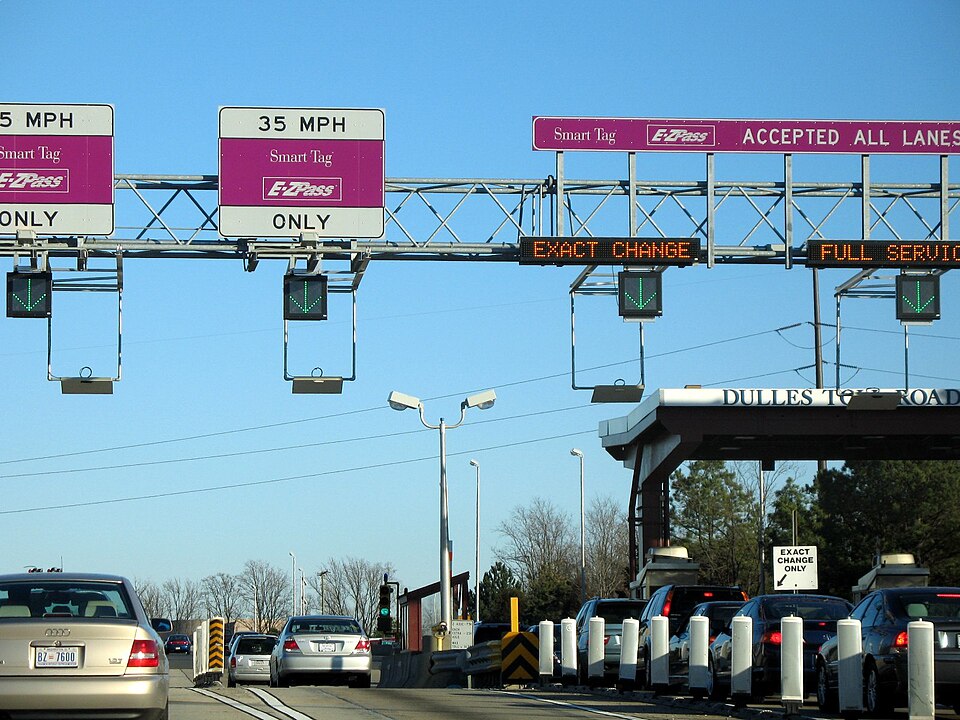
    Most US toll roads charge you electronically as you drive under an overhead gantry, without stopping. You pay with a windshield transponder such as E-ZPass, or by a bill mailed to the car’s registered owner after a camera reads the plate. This guide is for new US drivers and families. It explains transponders, pay-by-plate, express and HOT lanes, and the rental car trap.

    Key facts

    • Transponder: a small tag linked to a prepaid account. Tolls are deducted as you pass a reader.
    • E-ZPass: the E-ZPass Group says its member toll agencies stretch across 20 states, with over 64 million devices in use (as of November 2026).
    • Pay-by-plate (toll-by-mail): cameras photograph the plate and the toll agency bills the registered owner. Expect to pay more than transponder users in many systems.
    • Express and HOT lanes: FHWA describes high-occupancy toll (HOT) lanes as carpool lanes that solo drivers can use by paying a toll. The price often changes with traffic.
    • Learner permits: toll roads have no special learner rule of their own. Your state’s permit and teen license limits still apply.

    How do toll roads work?

    There are three common setups. You may meet all three in one trip.

    Type How you pay What to watch for
    All-electronic (cashless) toll road Transponder, or a bill by mail to the plate owner No booths and no cash. Do not stop or reverse at a gantry
    Toll plaza with lanes Transponder lanes, plus cash or card lanes where they still exist Signs above each lane show what it accepts. Choose early and avoid last-second lane changes
    Express, managed or HOT lanes Transponder, with free or discounted travel for carpools in some systems The posted price can change during the day. Rules on carpools differ by lane

    Transponders: E-ZPass and regional tags

    Each region runs its own toll account system. E-ZPass is the largest, covering member agencies in 20 states. Other systems include FasTrak in California, and state systems in places such as Texas and Florida. Some tags work across several systems and some do not, so check the toll agency’s coverage map before a long trip.

    Setting one up

    1. Open an account with your local toll agency online or by phone.
    2. Register every car you will use and keep the plate numbers up to date.
    3. Mount the tag where the instructions say, usually high on the windshield.
    4. Set up auto top-up so the balance does not run out.
    5. When you sell a car or change plates, update the account straight away.

    Parents adding a teen: the account belongs to whoever opened it, and tolls and any violations follow the plate. Make sure the car your teen drives is on the account.

    Pay-by-plate and toll-by-mail

    No transponder? Most cashless roads still let you through. A camera reads the plate and the toll agency mails a bill to the registered owner. Rules vary, but several things are common:

    • The plate rate is often higher than the transponder rate.
    • Unpaid bills can add late fees and further penalties, which each state and toll agency sets.
    • If you have just moved, update your address with the DMV or the bill may go to your old home.

    Some agencies also let you pay a trip online soon after driving it. Check the toll agency’s own site, and be wary of text messages asking you to pay unpaid tolls through a link. Go to the agency’s website directly instead.

    Express lanes and HOT lanes explained

    FHWA describes HOT lanes as HOV (carpool) lanes that also let vehicles without enough people pay a toll to use them. Under FHWA’s congestion pricing guidance, carpools, transit buses and emergency vehicles may ride free or at a reduced rate. Toll rates can be fixed by time of day or set dynamically, rising when traffic is heavy so the lane keeps moving. FHWA notes that communities use different names, such as Express Lanes, but the basic operation is the same.

    Switchable tags for carpools

    Some systems use a switchable transponder where you declare how many people are in the car. In the San Francisco Bay Area, the FasTrak Flex tag has positions for 1, 2 and 3+ occupants:

    • Set it before you start the trip.
    • Solo drivers pay the full toll on every Bay Area express lane.
    • Two-person discounts vary by lane, and 3+ ride free on the Bay Area express lanes.
    • FasTrak says the California Highway Patrol checks occupancy visually, and a carpool citation can exceed $400.

    Other regions have different rules. Read the signs at each lane entrance. Carpool lane basics, including when you may enter or leave, are in HOV and carpool lanes explained.

    Driving through a toll gantry: what to do

    • Keep your speed steady. Electronic gantries read at traffic speed. Follow any posted limit.
    • Never stop, reverse or cut across lanes because you think you are in the wrong one. The toll will be billed by plate.
    • At plazas, pick your lane early using the overhead signs, and watch for cars changing lanes.
    • Merging back after a plaza works like any freeway merge. See freeway driving for new drivers.

    Rental cars and borrowed cars

    This is where new drivers get surprised.

    • Many rental companies bill you for tolls you drive, often adding their own daily or per-toll service fee. Read the toll section of the rental agreement before you leave the lot.
    • If you bring your own transponder, check whether the rental agreement allows it and add the rental plate to your account for the dates you have it. Remove it when you return the car.
    • In a borrowed car, any toll bill goes to the owner. Agree up front who pays.

    Moving states? Your toll account may still work, but you need to update the plates and address once you re-register the car. See moving to a new state.

    Common questions

    Can I drive on a toll road with a learner permit?

    Toll roads do not have their own permit rules. Your state’s permit supervision rules apply, and some teen license limits, such as curfews, apply on any road.

    What happens if I drive through a toll without a transponder?

    On a cashless road, the camera reads your plate and a bill goes to the registered owner. Pay it on time to avoid extra fees.

    Does E-ZPass work in every state?

    No. The E-ZPass Group says its members cover 20 states. Check coverage before traveling elsewhere.

    Are express lanes worth it for a new driver?

    They can be calmer than packed general lanes, but entry and exit points are limited. Know your exit before you enter.

    Can I use the carpool lane with my parent in the car?

    If the lane’s minimum is two people, a learner and supervisor usually count as two. Check the occupancy rule on the signs and, for a tolled lane, set any switchable tag correctly.

    I got a text saying I owe tolls. Is it real?

    It might not be. Do not click the link. Log in to your toll account or contact the toll agency directly.

    Back to the main guide: learning to drive in the USA.

    Sources

    • E-ZPass Group, “E-ZPass Group home page” (e-zpassgroup.org)
    • Federal Highway Administration, Office of Operations, “High Occupancy Vehicle (HOV) Lanes” (ops.fhwa.dot.gov)
    • Federal Highway Administration, Office of Operations, “HOT Lanes Marketing Toolkit: HOT Lanes, Cool Facts” (ops.fhwa.dot.gov)
    • Federal Highway Administration, Office of Operations, “Congestion Pricing: A Primer” (ops.fhwa.dot.gov)
    • Bay Area FasTrak, “What are the switch positions on a FasTrak Flex and FasTrak CAV toll tag for?” and “Using your FasTrak Flex Toll Tag FAQs” (bayareafastrak.org)
  • What to Do If a Deer Runs in Front of Your Car (US)

    What to Do If a Deer Runs in Front of Your Car (US)

    Photo: David Kanigan, Pexels

    If a deer runs in front of your car, brake firmly, steer straight and stay in your lane. Do not swerve. US state driver manuals and DMVs give this same core advice, because swerving can put you into oncoming traffic, a tree or a ditch. This guide is for new US drivers. It covers when animal crashes peak, how to lower the risk, and what to do and report after hitting an animal.

    Key facts

    • Do: brake firmly and steer straight. Don’t: swerve. (New York DMV; Maine Driver’s License Manual.)
    • Deer dominate: a Federal Highway Administration (FHWA) report to Congress says the vast majority of recorded US animal crashes involve deer.
    • Peak season: fall, especially October and November, with a smaller spring peak in May and June (FHWA, 2008).
    • Peak times: around dawn and dusk. FHWA gives roughly 5 to 8 a.m. and 4 p.m. to midnight.
    • Scale: FHWA estimated 1 to 2 million wildlife-vehicle collisions a year. That estimate dates from 2008, so treat it as a rough guide.

    What to do if a deer runs in front of your car

    1. Brake firmly. Keep your foot down. Modern anti-lock brakes let you brake hard and still steer.
    2. Steer straight. Keep the car in your lane. The New York DMV warns that swerving can cause a collision with another vehicle, a tree, a pole or another object.
    3. Sound the horn if there is time. It may move the animal along.
    4. If a crash cannot be avoided, keep braking in a straight line. The Maine manual adds a technique for large animals like moose: let up on the brake just before impact, so the front of the car rises slightly, and duck down to protect yourself from glass.
    5. Expect more. Deer often travel in groups. If one crosses, slow down and watch for the next.

    Why swerving is the bigger danger

    The car is built to protect you in a frontal impact. A sudden swerve at speed can make you lose control, cross the center line or leave the road. For a deer-sized animal, a controlled straight-line stop is the safer choice for you and other drivers. Moose are a special case because of their height. See avoiding moose and deer collisions in Maine and driving in Alaska’s moose country.

    When are animal crashes most likely?

    Factor Higher risk Why
    Season October and November, then May and June Deer breeding season in the fall means more movement. The Maine manual says moose crashes peak in May and June.
    Time of day Dawn and dusk into the night Deer and other large animals are most active then, and visibility is poor.
    Location Rural two-lane roads, wooded edges, near fields and water Animals cross between feeding and cover areas.
    Signs Deer or wildlife crossing signs States place them where crashes are a known problem.

    How to reduce the risk

    • Slow down at night on rural roads, so you can stop within the distance your headlights show.
    • Use high beams when there is no oncoming traffic or car ahead. The Maine manual says high beams let you see twice as far as low beams.
    • Scan the road edges, not only the lane ahead. Deer eyes often reflect your headlights. Moose eyes usually sit above the beam.
    • Take crossing signs seriously, especially in fall at dusk.
    • Wear your seat belt. It is your main protection if you do hit something.

    More on rural roads and night technique: rural two-lane roads and night driving and high beams.

    What to do after hitting a deer or other animal

    1. Pull over safely if the car can be driven. Turn on your hazard lights.
    2. Stay in or near the car. Do not approach the animal. An injured deer can kick, and a moose can attack.
    3. Call the police or the local emergency number if the animal or debris blocks the road, anyone is hurt, or the car cannot be driven. The California Driver Handbook says to call the nearest humane society or law enforcement if you kill or injure an animal, and not to try to move an injured animal.
    4. Take photos of the car, the scene and the road for your insurer.
    5. Check the car before driving on. Look for leaks, broken lights and a damaged hood latch.
    6. Report the crash if your state requires it. See below.

    Do you have to report hitting a deer?

    It depends on your state and the damage. Reporting rules are set by each state and usually turn on injuries and the cost of the damage, not on what you hit. One example: in California, every driver must file a Form SR 1 with the DMV within 10 days if a collision caused more than $1,000 in property damage or anyone was injured or killed. Other states use different thresholds and forms, so check your state’s driver manual. The general steps after any crash are in what to do after a car crash in the US.

    Can you keep the deer? Some states allow it with a permit from the wildlife agency, and others do not. Never take an animal without checking with the state wildlife agency or the officer at the scene.

    Common questions

    Should I swerve to avoid a deer?

    No. Brake firmly and stay in your lane. Swerving is what turns many animal crashes into serious ones.

    Do deer whistles work?

    None of the official sources used here recommends them. Rely on speed, scanning and high beams instead.

    Is hitting a deer covered by insurance?

    It depends on your policy. Insurers often handle an animal strike under a different part of the policy from a crash with another car, and the minimum insurance most states require may not pay for damage to your own car. Check your policy, and call your insurer after the crash.

    What time of year should I be most careful?

    Fall, especially October and November, around dawn and dusk.

    What if a deer is standing in the road?

    Slow down or stop, use your horn, and wait for it to move. Do not try to drive around a large animal, and do not get out.

    Can animal crashes come up on the permit test?

    Yes, in some states. Maine’s manual includes moose and deer in its practice questions, for example. Read the animal section of your state manual.

    Back to the main guide: learning to drive in the USA.

    Sources

    • Federal Highway Administration, “Wildlife-Vehicle Collision Reduction Study: Report to Congress”, Chapter 2, FHWA-HRT-08-034, August 2008 (fhwa.dot.gov)
    • New York State DMV, “DMV and DEC warn drivers to be aware deer and moose more active during fall” (dmv.ny.gov)
    • Maine Bureau of Motor Vehicles, “Maine Driver’s License Manual”, Section 11 (maine.gov)
    • California DMV, “California Driver’s Handbook, Section 10: Financial Responsibility, Insurance Requirements, and Collisions” (dmv.ca.gov)
  • Drowsy Driving: Warning Signs and Why Teens Are at Risk (US)

    Drowsy Driving: Warning Signs and Why Teens Are at Risk (US)

    Photo: Sinitta Leunen, Pexels

    Drowsy driving means driving while too tired to stay fully alert, and it can end in a crash even if you never fully fall asleep. This guide is for US teens, new drivers and the parents who supervise them. It covers the warning signs, the times of day when drowsy crashes peak, why young drivers are more exposed, and the few things that actually help.

    Key facts

    • NHTSA reports 644 deaths in drowsy-driving-related crashes in 2024. It also says the true number is hard to pin down, because drowsiness often leaves no clear evidence after a crash.
    • NHTSA says drowsy crashes happen most often between midnight and 6 a.m., or in the late afternoon.
    • NHTSA lists drivers aged 17 to 23, and people who sleep less than six hours a night, among those at higher risk.
    • In a CDC survey of 19 states and DC, 4.2% of adult drivers said they had fallen asleep while driving at least once in the previous 30 days.
    • CDC says turning up the radio or opening a window has not been shown to keep drivers awake.

    What are the warning signs of drowsy driving?

    The CDC lists these signs. If you notice any of them, treat it as a signal to stop driving, not to push on.

    • Frequent yawning or blinking
    • Not remembering the last few miles you drove
    • Missing your exit
    • Drifting out of your lane
    • Hitting a rumble strip on the shoulder or center line

    Other things to watch for in yourself: heavy eyelids, nodding, wandering thoughts, or speeding up and slowing down without meaning to. A supervising parent may spot these before the learner does.

    Why are teens at higher risk?

    NHTSA says many teens do not get enough sleep at a time of life when their biological need for sleep goes up. Add early school starts, late homework, sports, part-time jobs and phones in bed, and many teens drive on short sleep without realizing it.

    Inexperience makes it worse. A tired new driver has less spare attention to start with, so the drop in reaction time hits harder. This is one reason most states limit late-night driving for teen license holders. See the curfew hours in US graduated driver licensing compared.

    What is highway hypnosis?

    The Alabama Driver Manual describes highway hypnosis as drowsiness or a loss of awareness brought on by monotony: wind noise, tires on the pavement and the steady hum of the engine on a long, unchanging expressway. To stay alert, keep your eyes moving between different parts of the road, near and far, left and right, and read the highway signs. Alabama also suggests a break every 100 miles or two hours, a nap before a long trip, and pulling off at the first rest stop once you feel drowsy, rather than trying to fight it or relying on stay-awake pills.

    When do drowsy crashes happen?

    Risk factor What NHTSA and CDC say What it means for you
    Time of day Most common between midnight and 6 a.m., or in the late afternoon The drive home after a late party and the drive after school or practice are both high risk
    Short sleep Under six hours a night raises risk One bad night counts, not only a pattern
    Crash type Often a single driver, with no passengers, running off the road at speed with no sign of braking The driver never reacted, which is why these crashes are so serious
    Rural roads Listed by NHTSA among higher-risk situations Long, dark, unchanging roads make it easier to drift off
    Alcohol and medicines CDC advises avoiding alcohol before driving Even a small amount adds to tiredness. Check medicine labels for drowsiness warnings

    What actually helps (and what does not)

    Before you drive

    • Sleep. CDC’s first advice is to get enough sleep before driving. Nothing else replaces it.
    • Plan around the risky hours. If you have a choice, avoid long drives between midnight and 6 a.m.
    • Share long drives. Swap drivers before anyone is struggling. A permit holder can only take a turn with a qualified supervisor awake beside them.
    • Get sleep problems checked. CDC advises treatment for sleep disorders. If you are tired all the time even after a full night, talk to a doctor.

    If you feel sleepy while driving

    1. Take the next safe exit, rest area or parking lot. Do not stop on the shoulder unless it is an emergency.
    2. Rest until you are no longer drowsy. CDC says getting off the road and resting is the only safe option.
    3. Call a parent or friend for a ride if you cannot rest safely.

    What does not work

    • Loud music
    • Opening the window
    • Telling yourself you are nearly home

    CDC says the radio and window tricks have not been found effective.

    Scenario: the drive home after a late shift

    You finish work at 11 p.m. after school and practice. You were up at 6 a.m., and the drive home is 25 minutes on a dark highway. Ten minutes in, you notice you cannot remember the last exit. That is a warning sign. Pull into the next lit gas station or parking lot, lock the doors and call home. Many families agree a “no questions asked” pickup rule for exactly this. You can build it into a parent-teen driving agreement.

    For parents supervising practice drives

    • Do not schedule practice when your teen is clearly exhausted, even if you are short on hours.
    • Plan night practice for soon after dark rather than close to midnight. Check how your state defines night hours for the log.
    • Stay alert yourself. A drowsy supervisor cannot take control in time.
    • Talk through the warning signs so your teen recognizes them when driving alone.

    More on planning sessions: teaching your teen to drive. Night technique, including headlights and glare, is in night driving in the US.

    Common questions

    Is drowsy driving illegal?

    Laws differ by state. Even where tiredness is not named as an offense, a driver who falls asleep and crashes can still face charges under the state’s general traffic laws, and insurance consequences. Check your state’s driver manual for its rules.

    Is drowsy driving as dangerous as drunk driving?

    Both slow your reactions and judgment. Drowsy crashes often involve no braking at all, which makes them severe. Treat serious tiredness as seriously as alcohol: do not drive.

    Does coffee or an energy drink fix it?

    Nothing replaces sleep. If you are already showing warning signs, stop driving and rest instead of relying on a drink.

    What is microsleep?

    A brief lapse, often only seconds, when your brain drifts off, sometimes without you noticing. At highway speed the car keeps going a long way with nobody steering.

    Will rumble strips wake me up?

    They are designed to alert drifting drivers, and CDC lists hitting one as a warning sign. If it happens to you, get off the road at the next safe place.

    Are teens allowed to drive late at night?

    It depends on your state and license stage. Most states limit late-night driving for new teen drivers, with exceptions such as work or school.

    Back to the main guide: learning to drive in the USA.

    Sources

    • National Highway Traffic Safety Administration, “Drowsy Driving: Avoid Falling Asleep Behind the Wheel” (nhtsa.gov)
    • National Highway Traffic Safety Administration, “Teen Safe Driving: How Teens Can Be Safer Drivers” (nhtsa.gov)
    • Alabama Law Enforcement Agency, “Alabama Driver Manual” (November 2024), Chapter 4: Highway Hypnosis and Fatigue (alea.gov)
    • Centers for Disease Control and Prevention, “Drowsy Driving: 19 States and the District of Columbia, 2009 to 2010”, Morbidity and Mortality Weekly Report (cdc.gov)