
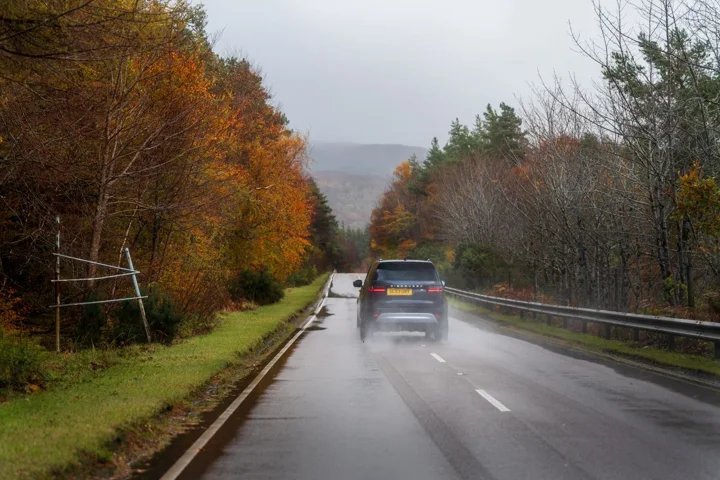
Photo: Michał Robak / Pexels. Illustrative photograph.
Skids, aquaplaning and ABS emergency stops are three different loss-of-grip problems, and the Highway Code for Great Britain gives a different response to each. A skid: remove the cause and steer into it. Aquaplaning: ease off and slow gradually. An ABS emergency stop: brake firmly and keep the pressure on. This guide is for learners and new drivers who want to know which is which, and how to avoid all three.
Quick answer: which response fits which problem?
| Situation | What it feels like | Highway Code response |
|---|---|---|
| Skid | The car slides, often the rear stepping out after harsh braking, acceleration or steering | Remove the cause: release the brake fully or ease off the accelerator. Steer in the direction of the skid (rule 119). |
| Aquaplaning in surface water | The steering suddenly feels light or unresponsive | Ease off the accelerator and slow down gradually (rule 227). No sudden braking or steering. |
| Emergency stop with ABS | Hard braking, pulsing or noise through the brake pedal | Follow the vehicle handbook. In an emergency, apply the footbrake firmly and do not release it until you have slowed to the speed you want (rule 120). |
| Brakes after deep water | Brakes feel weaker than normal | Test them at the first safe opportunity with gentle pressure. If they are not fully effective, apply light pressure while driving slowly to dry them (rule 121). |
Do not mix these up. “Release the brake” is skid advice. It is not what to do in an ABS emergency stop.
What causes a skid?
Rule 119 says skidding is usually caused by braking, accelerating or steering too harshly, or by driving too fast for the conditions. That makes a skid mostly preventable:
- Brake early and lightly, then more firmly as you begin to stop, easing off just before the car comes to rest (rule 117).
- Slow down before a bend, not in it.
- Avoid sudden actions on icy roads, which rule 231 says could cause loss of control.
- Do not coast in neutral or with the clutch down. Rule 122 says it removes engine braking and affects steering, especially on bends. See coasting and downhill control.
Steering into a skid
If the rear of the car slides to the right, steer smoothly to the right. If it slides left, steer left. At the same time, take away whatever started it: come off the brake fully or ease off the accelerator. Overcorrecting with big, fast steering inputs can start a second slide the other way.
What is aquaplaning and what should you do?
Aquaplaning happens when water builds up between the tyres and the road so the tyres lose grip. Rule 227 says that if the steering becomes unresponsive, it probably means water is preventing the tyres from gripping the road. The response:
- Ease off the accelerator.
- Hold the steering straight and steady.
- Let the car slow gradually until the tyres grip again.
- Do not brake hard or steer sharply while the tyres are not gripping.
Prevention is speed and tyres. Slow down in heavy rain, watch for standing water and spray, and keep tyres correctly inflated with good tread. See basic car maintenance.
How does ABS work in an emergency stop?
ABS (anti-lock brakes) stops the wheels locking under heavy braking, so you can still steer. Rule 120 says to follow your vehicle handbook, but in an emergency apply the footbrake firmly and do not release the pressure until you have slowed to the speed you want. It adds a warning: ABS should keep steering control, but do not assume a car with ABS will stop in a shorter distance.
Without ABS, rule 118 says brake immediately but try not to brake so harshly that the wheels lock, because locked wheels can lead to loss of control. Most learners drive cars with ABS, but check your practice car’s handbook.
How much further do you need to stop on wet or icy roads?
| Surface | Highway Code guidance |
|---|---|
| Dry | At least a two second gap to the vehicle in front |
| Wet | Stopping distances at least double; double the gap (rules 126 and 227) |
| Ice or snow | Stopping distances can be up to ten times greater (rules 126 and 230) |
Driving on ice and snow (rules 230 and 231)
- Drive with care even on treated roads, and expect conditions to change over short distances.
- Drive slowly in as high a gear as possible, and accelerate and brake very gently.
- Brake progressively on the straight before a bend, then steer smoothly round it.
- To check your grip, brake gently somewhere safe. Unresponsive steering, or tyres that go almost silent, can mean ice.
- Take care overtaking vehicles spreading salt or de-icer. Do not overtake a snowplough unless the lane you will use has been cleared.
- Listen to travel bulletins and read the variable message signs for weather and traffic ahead.
Rule 237 adds a hot weather risk: rain after a dry spell can make roads slippery. More in stopping distances explained.
Scenario: heavy rain on a dual carriageway
Spray cuts your view and water is pooling in lane one. Ease off early, double your gap and stay out of the deepest water. If the steering goes light, ease off the accelerator and wait for grip to come back. If a queue then appears suddenly ahead, that is a different problem: brake firmly and keep the pressure on, as rule 120 says for ABS. Different problems, different responses.
Common questions
Should I pump the brakes in a skid?
The Highway Code does not say to pump the brakes. For a skid caused by braking, it says release the brake pedal fully. In a car with ABS, the system does the work: brake firmly and hold it.
Does ABS mean I can brake later?
No. Rule 120 says not to assume a car with ABS will stop in a shorter distance.
Can I practise skids on the road?
No. Never try to cause a skid or aquaplane on a public road. Learn what the ABS feels like from your instructor, and treat the rest as theory.
Is aquaplaning on the theory test?
Wet roads, stopping distances and skids are covered under safety margins and vehicle handling.
What should I do after driving through a flood?
Test the brakes gently at the first safe opportunity (rule 121). Better still, avoid deep water you cannot see the bottom of.
Related: Highway Code weather rules and driver assistance systems. Back to learning to drive in Great Britain.
Sources
- Department for Transport, “The Highway Code: General rules, techniques and advice for all drivers and riders (103 to 158)” (gov.uk)
- Department for Transport, “The Highway Code: Driving in adverse weather conditions (226 to 237)” (gov.uk)