
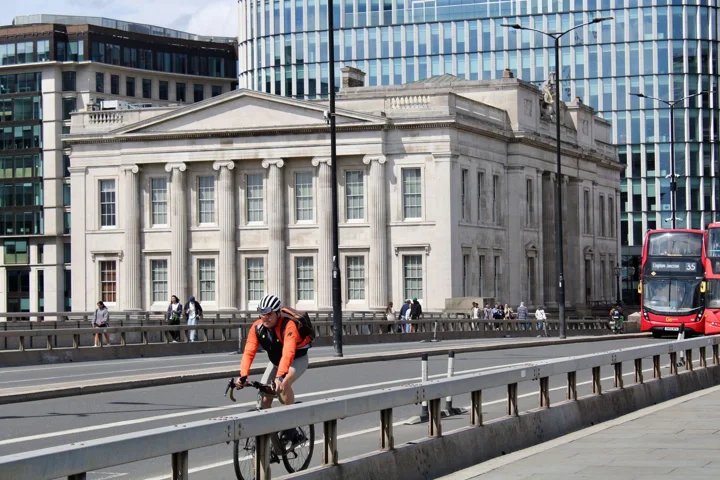
Photo: Gawon Lee / Pexels. Illustrative photograph.
The Highway Code rules for cyclists in Great Britain (Rules 59 to 82) tell people on bikes where to ride, how to signal and what equipment the law requires. Drivers need to know them too, because they explain why a cyclist rides in the middle of the lane, rides two abreast or signals right on a roundabout they are not leaving. This guide is for learner and new drivers in England, Scotland and Wales. It explains the cyclist rules from the driver’s seat and sets out what the Code asks of you in return.
Key facts
- Cyclists may ride in the centre of their lane on quiet roads, in slow traffic and when approaching junctions or road narrowings (Rule 72).
- On busy roads, cyclists are advised to keep at least 0.5 metres from the kerb when letting faster traffic pass (Rule 72).
- Cyclists can ride two abreast, which the Code says can be safer, especially in larger groups (Rule 66).
- Cyclists are not obliged to use cycle lanes or cycle tracks (Rule 61).
- At night a bicycle MUST have a white front light, a red rear light and a red rear reflector (Rule 60).
- Drivers should leave at least 1.5 metres when overtaking a cyclist at speeds up to 30 mph, and more at higher speeds (Rule 163).
Where should cyclists ride? Rule 72 road positions
Rule 72 describes two basic positions. Knowing them helps you understand what a cyclist is about to do.
| Position | When the Code suggests it | What it means for you |
|---|---|---|
| Centre of the lane | On quiet roads or streets (moving left to let faster vehicles pass when safe); in slower-moving traffic; at the approach to junctions or road narrowings where it would be unsafe to overtake | The cyclist is telling you it is not safe to pass yet. Wait behind. |
| At least 0.5 metres from the kerb (further if safer) | On busy roads with vehicles moving faster, letting traffic overtake when it is safe | You may overtake when safe, with at least 1.5 metres of space. |
Rule 67 also advises cyclists to leave at least a door’s width or 1 metre when passing parked cars. So a cyclist moving out past a row of parked cars is following the Code, not wobbling.
Riding two abreast (Rule 66)
Rule 66 says cyclists can ride two abreast and that it can be safer to do so, particularly in larger groups or when accompanying children or less experienced riders. It also says cyclists should be aware of drivers behind them and allow them to overtake, for example by moving into single file or stopping, when it is safe to do so.
For drivers, a pair of cyclists side by side is shorter to overtake than a long single-file line. You still need to give 1.5 metres from the outer rider.
Cycle lanes, tracks and bus lanes
- Cycle lanes are marked by a white line, which may be broken. Use of cycle lanes and tracks is not compulsory, and cyclists can choose the road if that is safer for them (Rule 61).
- Drivers MUST NOT drive or park in a cycle lane marked by a solid white line during its times of operation (Rule 140).
- Most bus lanes can be used by cyclists, as shown on the signs (Rule 65).
- Cyclists MUST NOT cycle on the pavement (Rule 64).
See bus lanes and cycle lanes for signs and operating times.
What cyclists must do by law
Rules that say MUST are legal requirements. For cyclists in Great Britain these include:
- At night: a white front light and red rear light lit, a red rear reflector, and amber pedal reflectors on cycles made after 1 October 1985 (Rule 60).
- Efficient brakes (Annex 1).
- Obeying all traffic signs and traffic light signals (Rule 69).
- Not crossing the stop line when lights are red. At an advanced stop line, cyclists may cross the first line on red but MUST NOT cross the final stop line (Rule 71).
- Not carrying a passenger unless the cycle is built or adapted for one, not holding on to a moving vehicle, and not riding dangerously, carelessly or inconsiderately, or under the influence of drink or drugs (Rule 68).
What is advice, not law
Rule 59 says cyclists should wear a correctly fitted cycle helmet and bright or reflective clothing. These are recommendations. There is no law in these rules requiring adult cyclists to wear a helmet or hi-vis, so do not assume a cyclist without one is breaking the law. Annex 1 also recommends a bell and points to Bikeability, the national cycle training scheme.
Cyclists at junctions: what drivers must watch for
Cyclists going straight ahead have priority
Rule 76 says a cyclist going straight ahead at a junction generally has priority over traffic waiting to turn into or out of the side road, unless signs or markings say otherwise. Rule H3 tells drivers not to cut across cyclists going ahead when turning, and not to turn if it would make them stop or swerve. See Rules H1 to H3 explained.
The left turn trap
Rule 182 tells drivers to use mirrors and signal well before turning left, not to overtake just before turning left, and to check for cyclists or motorcyclists coming up on the left. Rule 183 says give way to cyclists using a cycle lane or track from either direction, including when they pass a queue of traffic. Rule 167 says do not overtake a cyclist as you approach a junction where you plan to turn left: stay behind.
Crossing a cycle track
A cycle track is a route physically separated from motor traffic, often between the road and the pavement. Rule 140 says give way to cyclists approaching or using the track when you turn into or out of a junction, and be prepared to stop and wait for a safe gap. Tracks may carry cyclists in both directions, so look both ways along the track, not just in the direction cars come from. If a cyclist appears while you wait, stay put: do not speed up to get across first because the driver behind is impatient.
Advanced stop lines
Rule 178 says drivers MUST stop at the first white line of an advanced stop line when the lights are amber or red, and should avoid blocking the cyclist area. When the lights go green, give cyclists in front of you time and space to move off.
Turning right in two stages
Some junctions mark a two-stage right turn for cyclists (Rule 75). The cyclist goes straight ahead to a marked area, waits, then completes the turn when the lights on the far side go green. A cyclist waiting in that box is not lost.
Cyclists on roundabouts (Rules 78 to 80 and 186)
- Rule 79 says cyclists may ride in either the left or right lane when turning right, moving left before their exit and signalling. Cyclists who stay in the left lane signal right to show they are not leaving at the next exit.
- Rule 186 tells drivers to give cyclists priority on the roundabout, leave them plenty of room, not overtake them within their lane, and allow them to move across your path as they travel round.
- Rule 80 asks cyclists to give long vehicles plenty of room on roundabouts.
More on roundabouts in Rules 184 to 190 step by step and mini, double and spiral roundabouts.
Crossings
Cyclists should dismount at zebra, pelican and puffin crossings, and must not ride across equestrian crossings (Rule 81). At toucan crossings, cyclists may ride across with pedestrians on the green signal (Rule 82). As a driver, expect cyclists to appear at toucan crossings at more than walking pace.
Overtaking and opening doors
Rule 163 asks drivers to leave at least 1.5 metres when overtaking cyclists at speeds up to 30 mph, and more space at higher speeds. If you cannot, wait behind. The full detail is in overtaking cyclists: the 1.5 metre rule.
When you park, Rule 239 says you should, where you can, open the door with the hand on the opposite side (for example, your left hand for a door on your right). This makes you turn your head and look over your shoulder for cyclists, motorcyclists and pedestrians before the door swings out. The technique is often called the “Dutch Reach”. Rule 67 is why cyclists keep a door’s width from parked cars.
Scenario: a cyclist in the middle of the lane before a pinch point
You are behind a cyclist on a 30 mph road. Ahead there is a traffic island. The cyclist moves from near the kerb to the centre of the lane.
- Under Rule 72, this is the cyclist taking the centre of the lane at a narrowing where overtaking would be unsafe.
- Stay behind. There is not room for 1.5 metres beside the island.
- Once past the island, the cyclist may move back left. Overtake only when you can give 1.5 metres and see the road is clear.
Common questions
Do cyclists have to use cycle lanes?
No. Rule 61 says use of cycle lanes and tracks is not compulsory, and will depend on the cyclist’s experience and the conditions.
Is it legal for cyclists to ride two abreast?
Yes. Rule 66 says cyclists can ride two abreast and that it can be safer, but they should let drivers behind overtake when it is safe, for example by moving into single file.
Why do cyclists ride in the middle of the road?
Rule 72 advises the centre of the lane on quiet roads, in slow traffic and approaching junctions or narrowings where it would be unsafe for drivers to overtake.
Do cyclists have to wear a helmet in the UK?
The Highway Code says cyclists should wear one, but it is advice, not a legal requirement for cyclists in these rules.
Do cyclists have priority at junctions?
A cyclist going straight ahead generally has priority over traffic turning into or out of a side road, unless signs or markings say otherwise (Rule 76). Drivers should not turn across them (Rule H3).
Can cyclists go through red lights?
No. Rule 71 says cyclists MUST NOT cross the stop line on red. At an advanced stop line, they may cross the first line but not the final one.
Back to the main guide: Learning to Drive in Great Britain. For the theory test, revise the vulnerable road users topic.
Sources
- Department for Transport, “The Highway Code: Rules for cyclists (59 to 82)” (gov.uk)
- Department for Transport, “The Highway Code: Annex 1. You and your bicycle” (gov.uk)
- Department for Transport, “The Highway Code: Using the road (159 to 203)” (gov.uk)
- Department for Transport, “The Highway Code: General rules, techniques and advice for all drivers and riders (103 to 158)” (gov.uk)
- Department for Transport, “The Highway Code: Introduction” (gov.uk)
- Department for Transport, “The Highway Code: Waiting and parking (238 to 252)” (gov.uk)
- Department for Transport, “The Highway Code: Updates” (gov.uk)