Photo: P199, CC BY-SA 4.0, via Wikimedia Commons
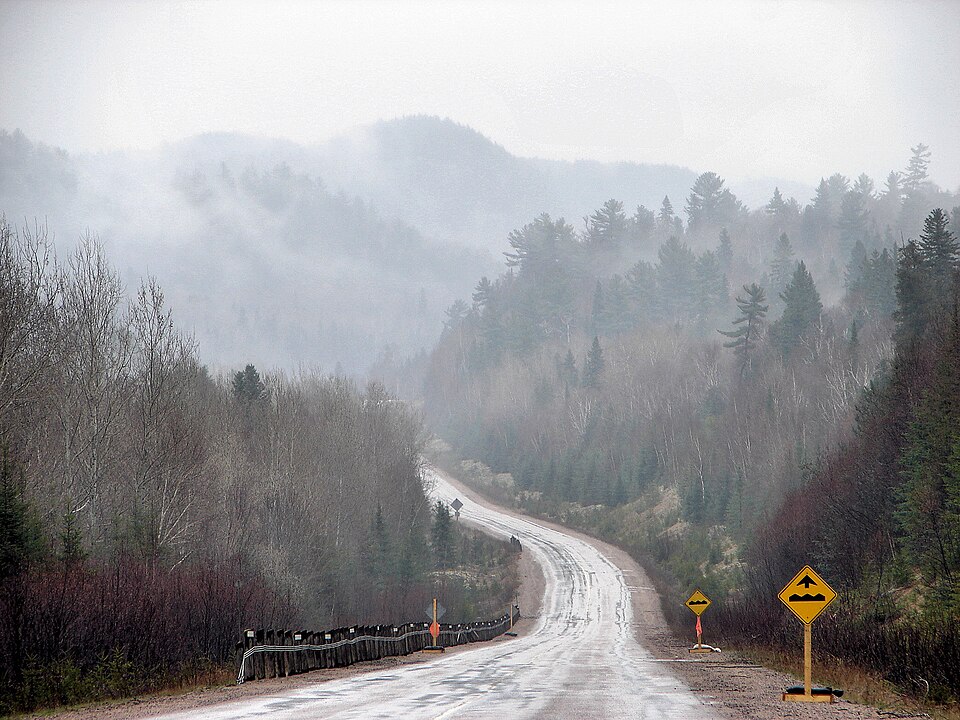
Driving in fog in Canada: slow down gradually, use your low-beam headlights (plus fog lights if you have them), leave a bigger gap and use the right edge of the road as your guide. If the fog gets too thick, pull completely off the road into a safe parking area and turn on your hazard lights. Never stop in a travel lane. That is the advice in Ontario’s MTO handbook, and the other provincial handbooks say much the same.
This guide covers fog, rain, hydroplaning and flooded roads. Snow, ice and whiteouts are in our winter driving guide.
Driving in fog: do and don’t
Ontario’s first advice is to avoid driving in fog: check the forecast and delay your trip if there is a fog warning. If you are caught in it:
Do
- Slow down gradually to a speed that suits the conditions.
- Turn on your full lighting system and use low beams. High beams reflect off the water droplets and make it harder to see.
- Use fog lights if your car has them, in addition to low beams.
- Increase your following distance and avoid passing, changing lanes or crossing traffic.
- Follow the right edge of the road rather than the centre line.
- Cut distractions, keep windows and mirrors clear, and use the defroster and wipers.
Don’t
- Stop on the travelled part of the road. Ontario warns you could become the first link in a chain-reaction collision.
- Speed up suddenly when the fog seems to clear. You may drive straight back into it.
- Speed up to pass a slow vehicle or to get away from a tailgater.
When to pull off
If visibility is dropping fast or the fog is too dense to continue, Ontario says pull completely off the road into a safe parking area, keep your low beams on and add your hazard lights. Other handbooks add:
- Saskatchewan: if you have slowed down and still cannot see 12 seconds ahead, get off the road as soon as you safely can.
- Nova Scotia: pull as far off as possible, secure the vehicle, turn on the flashers, leave from the passenger side and stay away from the road.
- Manitoba: if you are driving well below the speed limit, turn on your hazard lights so others know you are slow.
When must headlights be on in poor visibility?
Most provinces set a visibility distance below which headlights are required, not just at night.
| Province or territory | Headlights required when you cannot see clearly |
|---|---|
| Ontario | People or vehicles less than 150 metres away |
| British Columbia | Visibility under 150 metres |
| Alberta | Objects not clearly visible 150 metres ahead |
| Northwest Territories | Cannot see clearly 150 metres in front |
| Nova Scotia | No set distance: low beams and tail lights any time fog, rain, snow or poor light limits visibility (Using the Road Regulations, s. 72, in force 19 October 2026) |
| Manitoba | Visibility reduced to 60 metres (handbook) |
Daytime running lights are not enough in fog. Ontario says they must not be used as headlights in poor light, and on many cars they do not switch on the tail lights. For other provinces, check your provincial handbook.
Driving in rain
The first few minutes of rain are the most dangerous. PEI’s handbook explains why: the first drops loosen oil and dirt on the road and create a slippery film. Saskatchewan says roads are most slippery in the first 10 minutes of a storm; Nova Scotia says the first 10 to 15 minutes, especially after a dry spell.
- Slow down and drive so you can stop within the distance you can see (Ontario).
- Leave more space. Nova Scotia recommends four or more seconds of following distance in rain. More space also keeps you out of the spray from the vehicle ahead.
- Make only small, gentle movements with the brake, gas and steering (Saskatchewan).
- Use low beams and make sure your wiper blades clear the glass without streaking. Replace them if they do not.
- Avoid puddles: Ontario notes they can hide potholes, drench pedestrians, stall the engine and make your brakes less effective.
In Quebec, the government’s speed limit guidance says to slow down whenever visibility is reduced by darkness, fog, rain or snow, and SAAQ’s driving course material recommends low beams when rain or fog reduces visibility. Check the SAAQ guide for its full “special conditions” chapter.
What is hydroplaning and what do you do?
Hydroplaning (also called aquaplaning) happens when your tires ride up on a film of water and lose contact with the road. You lose the ability to brake, accelerate or steer properly.
| Handbook | Partial hydroplaning starts at about | Tires may be fully on the water at about |
|---|---|---|
| Prince Edward Island | 60 km/h | 90 km/h |
| Nova Scotia | 55 km/h | 85 km/h |
PEI adds that when the water is deeper than your tread, complete hydroplaning can be expected at 80 to 90 km/h.
If you hydroplane
- Take your foot off the accelerator and let the car slow down (PEI). PEI warns that even a slight turn or a gust of wind can start an uncontrollable skid.
- Keep the wheel steady. If you are only partly hydroplaning, you should be able to correct a skid as normal.
- If you are fully hydroplaning, PEI says all you can do is release the accelerator and ride it out until the tires grip again.
How to prevent it
- Good tires with deep tread let water escape from under the tire (Ontario, PEI).
- Slow down when roads are wet (Nova Scotia, Ontario).
- Keep tires properly inflated. Nova Scotia lists improper tire pressure as a factor.
Flooded roads and washouts
Ontario’s advice is simple: avoid driving on flooded roads, because water may stop your brakes from working. Water depth is hard to judge, so do not rely on a number you have heard elsewhere. The safest choice is the one Ontario gives: find another route.
If you had to drive through water
- Ontario: test your brakes afterwards when safe by stopping quickly and firmly at 50 km/h. The car should stop straight and the pedal should feel firm, not spongy. If it still pulls or feels spongy once dry, get it repaired immediately.
- Manitoba: test the brakes lightly after deep water. Dry them by driving slowly and applying them lightly.
- Nova Scotia: if the brakes are not responding normally in rain, press the brake gently with your left foot while keeping light pressure on the gas with your right, until they work normally.
If a vehicle ends up in water, Manitoba’s handbook says occupants have only about one minute to get out: undo seatbelts, open or break a window and get out straight away, sending children first.
Province-by-province: where to read more
- Ontario: MTO handbook, “Driving at night and in bad weather”.
- Quebec: SAAQ driver’s guide, special conditions section.
- Nova Scotia: Driver’s Handbook chapter 5, “Adverse Driving Conditions”.
- PEI: Driver’s Handbook chapter 4, “Highway, Weather and Visibility Conditions”.
- Manitoba: see our Manitoba poor driving conditions guide.
- Everywhere else: check your provincial handbook for its weather chapter.
For what to do if your car skids or breaks down in bad weather, see car emergencies in Canada. For night glare and high beams, see night driving in Canada. For the full licensing path, start with learning to drive in Canada.
Sources
- Government of Ontario, “The Official MTO Driver’s Handbook: Driving at night and in bad weather” (ontario.ca)
- Government of Ontario, “The Official MTO Driver’s Handbook: Getting ready to drive” (ontario.ca)
- Government of Prince Edward Island, “Driver’s Handbook” (princeedwardisland.ca)
- Government of Nova Scotia, “Driver’s Handbook” (novascotia.ca)
- SGI, “Saskatchewan Driver’s Handbook” (sgi.sk.ca)
- Manitoba Public Insurance, “Manitoba Driver’s Handbook: Reduced Visibility, Wet Brakes, Vehicle Plunging into Water” (apps.mpi.mb.ca)
- ICBC, “Learn to Drive Smart” (icbc.com)
- Alberta King’s Printer, “Use of Highway and Rules of the Road Regulation, AR 304/2002” (kings-printer.alberta.ca)
- Government of the Northwest Territories, “NWT Driver’s Manual: Basic” (idmv.inf.gov.nt.ca)
- Gouvernement du Québec, “Speed limits” (quebec.ca)
- SAAQ, “In-Car Session Workbook” (saaq.gouv.qc.ca)
- Government of Nova Scotia, “Using the Road Regulations” under the Traffic Safety Act, in force 19 October 2026, sections 2, 72 and 76 (novascotia.ca)