
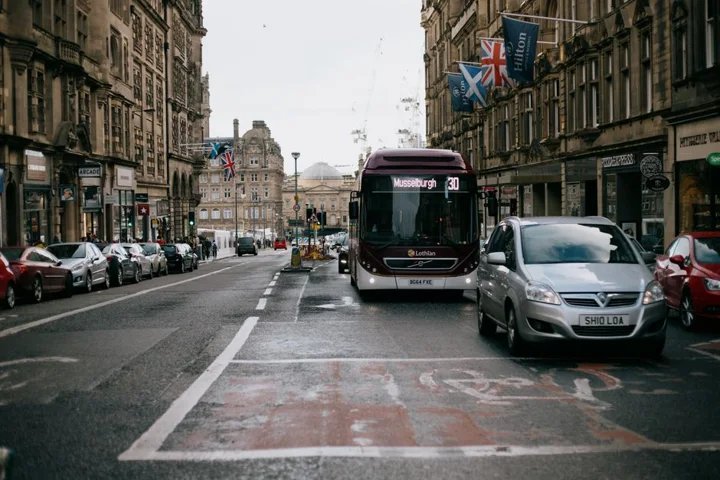
Photo: Sinitta Leunen / Pexels. Illustrative photograph.
Tailgating in Great Britain means driving so close you could not stop if the vehicle ahead braked suddenly, and the Highway Code calls it dangerous and intimidating. Under Rule 144 you MUST NOT drive dangerously, without due care and attention, or without reasonable consideration for others. This guide covers what Rules 144 to 147 mean in practice, what to do when someone tailgates or provokes you, and how queues and slow traffic fit in.
Key facts
- Rule 144: careless, inconsiderate and dangerous driving are all offences (Road Traffic Act 1988, sections 2 and 3).
- Rule 126: leave at least a two-second gap on fast roads; double it in the wet.
- Rule 147: do not get drawn into someone else’s bad driving. If you are agitated, pull over and calm down.
- Penalty: a careless driving fixed penalty was set at £100 and 3 points from 16 August 2013, with tailgating named as an example. In court, careless driving (CD10) carries 3 to 9 points and dangerous driving (DD40) 3 to 11. Check current amounts on gov.uk.
What counts as careless, inconsiderate or dangerous? (Rule 144)
| Offence (endorsement code) | Penalty points | How long it stays on your record |
|---|---|---|
| Driving without due care and attention (CD10) | 3 to 9 | 4 years from the offence |
| Driving without reasonable consideration for other road users (CD20) | 3 to 9 | 4 years from the offence |
| Dangerous driving (DD40) | 3 to 11 | 4 years from conviction |
Tailgating is given as an example of careless driving in the gov.uk announcement of the 2013 fixed penalties.
As a new driver, 6 points within two years of passing means you lose your licence: see the New Drivers Act. All codes: driving penalties and endorsement codes.
Rule 145 adds that you MUST NOT drive on or over a pavement, footpath or bridleway except to get lawful access to a property or in an emergency.
Someone is tailgating you: what to do
- Do not speed up to get away, and do not brake-test them.
- Gradually increase the gap to the vehicle in front, so you can brake gently if you need to.
- Keep to the speed limit and signal early.
- When safe, let them pass, for example by moving back to the left lane on a dual carriageway.
- If you feel stressed, find a safe place to stop (Rule 147).
The gap you need and why: stopping distances and the two-second rule.
Road rage and driving under pressure (Rules 146 and 147)
The Highway Code has no separate “road rage” rule. Rule 147 covers it:
- Be patient. Other drivers, especially learners and older drivers, make mistakes.
- Do not react to someone else’s bad behaviour.
- Do not drive up close to someone who pulled out in front of you to intimidate them.
- You MUST NOT throw anything out of a vehicle.
Rule 146 says adapt to the road and conditions and do not treat the speed limit as a target. Be ready for the road to be blocked beyond a blind bend, for vehicles emerging at junctions, and for unmarked junctions in side roads and country lanes where nobody has priority. Be prepared to stop at road works, crossings and traffic lights, and try to predict what pedestrians and cyclists will do: a child looking the other way may step out without seeing you.
Pressure as a learner
A queue behind your L plates does not change the rules. Drive at a speed that is safe for you and the road, and let faster traffic pass when you can safely pull in. Rule 217 asks other drivers to be particularly patient with learner and young drivers. See road users requiring extra care.
Queues and slow-moving traffic
- Rule 151: leave enough space to stop and to move round the vehicle in front if needed. Do not change lanes to the left to overtake, and do not block side road entrances.
- Rule 114: in a stationary queue, apply the parking brake and, once the traffic behind has stopped, release the footbrake so your brake lights do not dazzle the driver behind.
Box junctions and keeping side roads clear: road junctions explained.
Common questions
Is tailgating illegal in the UK?
There is no separate tailgating offence, but it is enforced as careless or dangerous driving. The gov.uk announcement of the 2013 fixed penalties names tailgating as an example of careless driving.
How much is the fine for tailgating?
The careless driving fixed penalty was set at £100 and 3 points in 2013. If it goes to court, penalties are higher. Check the current figure on gov.uk.
How close is too close?
Less than a two-second gap on a fast dry road. Rule 126 says that gap should be at least doubled on wet roads.
Should I brake-test a tailgater?
No. Braking suddenly to warn someone could itself be careless or dangerous driving. Increase your gap instead.
Can I flash my headlights at a slow driver?
No. Rule 110 says only flash headlights to let others know you are there, never to intimidate or send another message. See signalling correctly.
What does the theory test ask about this?
These scenarios appear in the attitude and safety margins topics.
Back to the main guide: Learning to Drive in Great Britain.
Sources
- Department for Transport, “The Highway Code: General rules, techniques and advice for all drivers and riders (103 to 158)” (gov.uk)
- GOV.UK, “Penalty points (endorsements): Endorsement codes and penalty points” (gov.uk)
- Department for Transport and Home Office, “New penalties for careless driving come into force” (gov.uk)