

Photo: Mariusz / Pexels. Illustrative photograph.
Traffic calming measures in Great Britain are physical features such as road humps, speed cushions and road narrowings, built to slow drivers down. Highway Code Rule 153 says slow down, keep a reduced speed through the whole stretch, give way where signs tell you to, and do not overtake. This guide also covers 20 mph zones, Home Zones, Quiet Lanes and single-track country roads.
Key facts
- Rule 153: keep to a reduced speed along the whole traffic-calmed stretch, not just at each hump. Do not overtake there.
- 20 mph zone: the entry sign warns of a 20 mph limit and traffic-calming features that may not be signed individually.
- Home Zones and Quiet Lanes (Rule 218): people may be using the whole street. Drive slowly and be ready to stop.
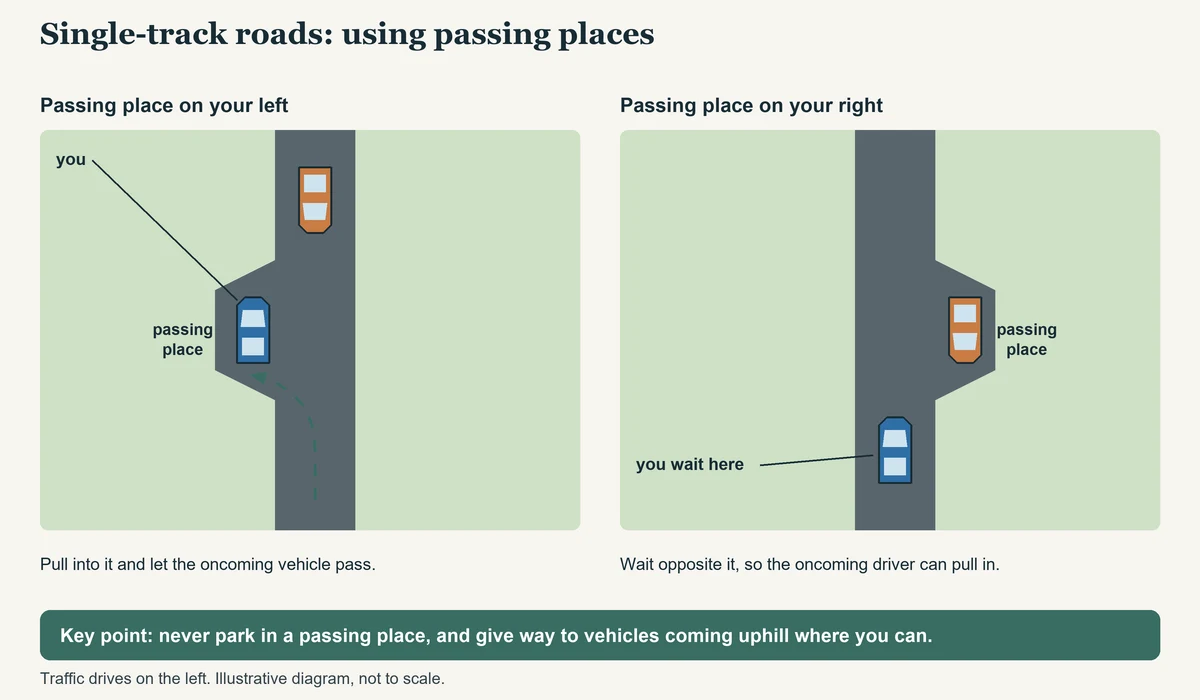
- Passing places (Rules 155 and 156): pull in on your left or wait opposite one on your right. Never park in one.
Types of traffic calming and how to drive them
| Feature | What it looks like | How to drive it |
|---|---|---|
| Road hump | Flat or round top across the road, sometimes a whole junction. Usually white triangle and edge markings | Slow down before it and keep the reduced speed to the next one |
| Speed cushion | Hump covering only part of a lane so buses and large emergency vehicles can straddle it | Slow down as for a full hump |
| Flat-top hump with crossing | Zebra, parallel or signal-controlled crossing on top of a hump | Expect pedestrians; crossing rules apply |
| Road narrowing (build-out) | Kerb build-outs on one or both sides, opposite or staggered | Obey priority signs. If none, keep a steady low speed and be ready to give way |
| Chicane | Staggered narrowings that make you weave | Slow, steady speed; give way where signed |
| Rumble strips | Raised strips or areas across the road, often rural | A warning of a hazard ahead (usually a bend or junction): slow down |
| Village gateway | Speed limit signs on yellow backing boards with the village name | Slow down and keep to the limit all the way through |

At an unprioritised narrowing, Know Your Traffic Signs says do not accelerate on the approach, keep a steady low speed, and let any cyclists go ahead of you.
Sign shapes and meanings: warning signs and road markings.
20 mph zones vs 20 mph limits
A 20 mph zone entry sign tells you two things: the limit is 20 mph, and there are traffic-calming features ahead that may not be signed one by one. Know Your Traffic Signs says to keep a steady low speed and avoid repeated speeding up and slowing down. Rule 152 notes that a 20 mph limit may apply in residential streets. More on limits: UK speed limits.
Home Zones, Quiet Lanes and shared space
- Home Zones: residential streets designed for people as well as traffic. Children may be playing anywhere in the road. Signs mark the entrance and end.
- Quiet Lanes: some minor rural roads in England and Wales, signed for shared use by walkers, cyclists, horse riders and motor vehicles.
- Shared space: streets where drivers, cyclists and pedestrians share the same space.
For all three the advice is the same: drive slowly and carefully, and be prepared to stop to give people extra time to make room for you to pass safely (Rule 218 and Know Your Traffic Signs).
Residential streets and country roads (Rules 152 to 156)
In town (Rule 152)
Drive slowly and carefully. Watch for vehicles pulling out, car doors opening, children and cyclists.
Country roads (Rule 154)
Slow down for bends and junctions. Expect pedestrians, horse riders, cyclists, farm vehicles and mud on the road.
Single-track roads (Rules 155 and 156)
- Look well ahead for oncoming vehicles.
- Pull into a passing place on your left, or wait opposite one on your right.
- Give way to vehicles coming uphill where you can.
- Be ready to reverse to a passing place if needed.
- If a driver behind wants to overtake, use a passing place in the same way to let them by.
- Slow down when passing pedestrians, cyclists and horse riders.
- Do not park in passing places.
More: learning to drive on rural roads.
Common questions
Can I overtake in a traffic-calmed area?
Rule 153 says you should not.
What speed should I go over speed humps?
The Highway Code gives no figure. Slow down before each hump and keep a reduced speed through the whole area.
Who has priority at a road narrowing?
Whoever the signs give priority to. If there are no signs, be ready to give way and let cyclists through first.
Is a Home Zone the same as a 20 mph zone?
No. A Home Zone has its own entry and end signs and means people may use the whole street. A 20 mph zone sets a speed limit and warns of traffic calming.
Can I park in a passing place on a single-track road?
No. Rule 156 says do not park in passing places.
Related: road users requiring extra care and pedestrian crossings. Back to the main guide: Learning to Drive in Great Britain.
Sources
- Department for Transport, “The Highway Code: General rules, techniques and advice for all drivers and riders (103 to 158)” (gov.uk)
- Department for Transport, “The Highway Code: Road users requiring extra care (204 to 225)” (gov.uk)
- Department for Transport, “Know Your Traffic Signs”, 2023 edition, traffic calming section (gov.uk)