
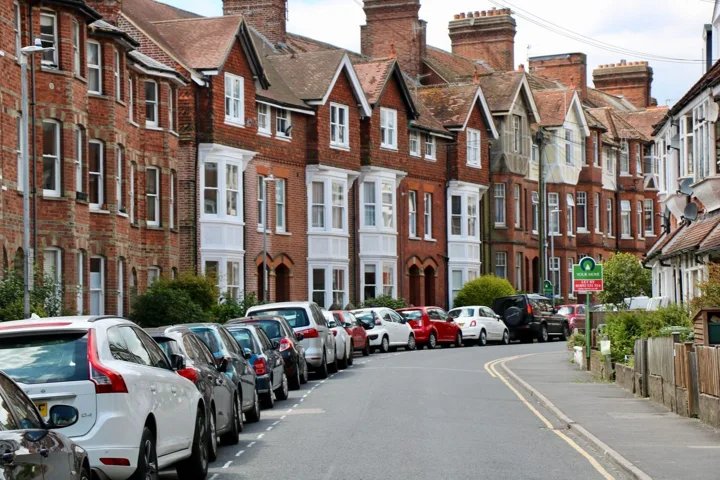
Photo: Ethan Wilkinson / Pexels. Illustrative photograph.
An urban clearway is a stretch of town road where you must not stop during the times shown on the signs, except for as long as necessary to pick up or set down passengers. Highway Code Rule 240 says you MUST NOT stop or park on an urban clearway within its hours of operation, apart from that passenger exception.
Urban clearways are used on busy roads into and out of towns, where a single parked car at rush hour can hold up a whole lane of traffic and buses.
How to recognise an urban clearway
- A sign with the no stopping symbol (a red cross on a blue circle with a red border), the words “Urban clearway” and the days and times it applies. The Highway Code caption for it reads: “No stopping during times shown except for as long as necessary to set down or pick up passengers”.
- Smaller plates along the road may repeat the times.
- There may be no yellow lines at all. The signs alone set the restriction.
Outside the times shown, the urban clearway does not apply, but any other restrictions, such as yellow lines or loading bans, still do.
Urban clearway, clearway and red route compared
| Restriction | When it applies | Can you stop to pick up or drop off passengers? |
|---|---|---|
| Urban clearway | During the times on the signs | Yes, for as long as necessary to do so |
| Clearway (no stopping sign, usually on main roads outside towns) | Whenever the sign applies (Highway Code caption: “No stopping (Clearway)”) | No. Rule 240 gives no passenger exception for clearways |
| Red route | Double red lines: at all times. Single red lines: during the times shown | No, except in marked bays. Licensed taxis and Blue Badge holders are treated differently (see our red routes guide) |
What counts as “picking up or setting down”?
Stopping just long enough for someone to get in or out. It does not cover waiting for a passenger to arrive, popping into a shop or loading goods. If you need to wait, find a legal parking place off the clearway.
Even when the passenger exception applies, the general rules still apply: do not stop where you would block a junction, a crossing, a bus stop or a cycle lane, and you MUST NOT stop on the zig-zag lines of a pedestrian crossing (Rules 240 and 243). The full list is in our guide to where you must never park.
Why it matters for learners
On the practical test you will be asked to pull up at the side of the road. Choosing a place on an urban clearway during its hours would be an unsafe or illegal place to stop, so read the signs before you pick your spot. The syllabus topic where you can and cannot park covers this, and our regulatory signs guide shows the no stopping and no waiting signs side by side.
Practice questions
These practice questions are written for this site to help you revise. They are not official DVSA questions.
Q1. You are on an urban clearway during its hours of operation. When may you stop?
A) To load or unload goods
B) To wait for a passenger who is still in a shop
C) For as long as necessary to pick up or set down passengers
D) At no time for any reason
Answer: C. You MUST NOT stop or park on an urban clearway within its hours of operation, except to pick up or set down passengers. (Highway Code Rule 240)
Q2. What does a blue circular sign with a red border and a red cross mean?
A) No waiting
B) No stopping (clearway)
C) No entry
D) End of all restrictions
Answer: B. The red cross on a blue background is the no stopping (clearway) sign. A single red diagonal line means no waiting. (Highway Code: Traffic signs)
Keep revising
See all the lines and kerb markings in our road markings guide and find more free material in our free study guides.
Sources
- Department for Transport, “The Highway Code: Waiting and parking (238 to 252)”, Rules 240 and 243 (gov.uk)
- Department for Transport, “The Highway Code: Traffic signs” (gov.uk)
Leave a Reply