
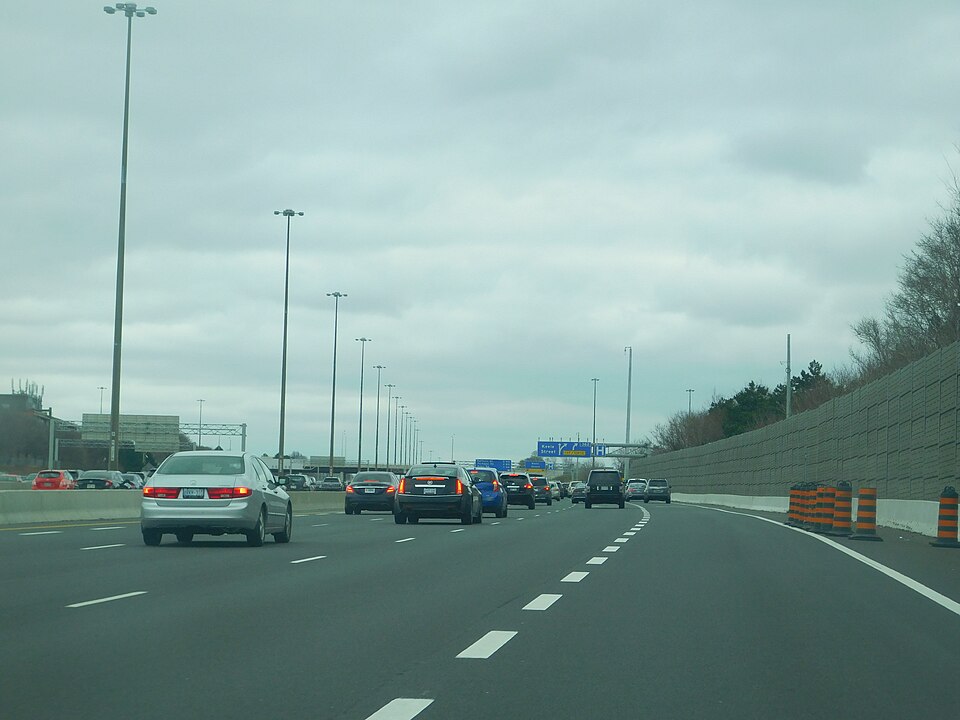
Photo: Adam Moss, CC BY-SA 2.0, via Wikimedia Commons
These are the 30 questions Canadian learner drivers and their parents ask most, each answered in a few lines for every province and territory where the rules differ, with a link to the full guide. Licensing in Canada is provincial, so an answer that is right in Ontario can be wrong in BC. Start with your own province, then use the links for the detail.
Key facts
- You can start at 14 in Alberta, 15 in Yukon, the NWT and Nunavut, and 16 in most other places.
- The learner stage usually lasts 12 months, often less with approved driver education.
- Getting from learner to full licence takes at least 2 years almost everywhere.
- Every jurisdiction requires zero alcohol for new drivers.
- Driver education is mandatory only in Saskatchewan and Quebec.
Getting started
1. How old do you have to be to get a learner’s licence in Canada?
16 in most provinces. Alberta allows 14. Yukon, the NWT and Nunavut allow 15, as does Saskatchewan for high school driver education students, and Manitoba allows 15 and a half for students in high school driver education. Applicants under 18 (under 19 in Newfoundland and Labrador) need a parent or guardian’s consent. Full table: learning to drive in Canada.
2. Do I need to take a driving course?
Only in Saskatchewan and Quebec. Saskatchewan requires high school training (30 hours in class, 6 in the car) or an SGI-certified instructor (6 and 6). Quebec requires the SAAQ’s Road Safety Education Program at a recognized driving school. See SGI driver education and Quebec’s mandatory driving course.
3. Does a driving course shorten the learner stage?
Yes, in several provinces. Ontario cuts G1 from 12 to 8 months, Nova Scotia from 12 to 9, and New Brunswick and Newfoundland and Labrador from 12 to 8. PEI cuts 365 days to 275. In BC an approved course cuts the N stage from 24 to 18 months for drivers under 25. Alberta driver training can take up to 6 months off the probationary period. See Ontario BDE, ICBC approved courses.
4. How much does it cost to get a licence?
Official fees differ by province, and lessons are the biggest cost. For example, ICBC charges $15 for the knowledge test and $10 for the learner licence. Province-by-province totals: cost of a driver’s licence in Canada.
5. I am an adult. Do I still go through graduated licensing?
In most provinces, yes, whatever your age. BC is the main exception, with shorter L and N stages for drivers 25 and older. See learning to drive as an adult in Canada.
6. I just moved to Canada. Can I swap my licence?
It depends on your country and province. Some licences exchange without tests, others go into graduated licensing. You also get a limited time to switch, for example 60 days in Ontario and 90 days in BC and Saskatchewan. See exchanging a foreign or out-of-province licence, new to Ontario, moving to BC, Quebec exchanges and international students and newcomers.
The knowledge test
7. How many questions are on the learner’s test?
It varies. ICBC’s test has 50 questions. Alberta’s has 30 and you need 25 to pass. Nova Scotia’s has two parts of 20 questions, with 16 correct needed in each. Newfoundland and Labrador needs 85%. Every province compared: knowledge tests compared across Canada.
8. Can I take the knowledge test online?
In BC, yes: ICBC offers it online or in an office, for the same $15 fee. See ICBC knowledge test. Other provinces are listed in the comparison guide above.
9. Can I take the test in a language other than English?
Often, yes. ICBC offers 12 languages, including French, Punjabi, Mandarin, Cantonese and Arabic. Alberta offers many languages too. See Alberta Class 7 test and taking the SAAQ tests in English or another language.
10. What should I study?
Your province’s official handbook. The questions come from it. Study guides: Ontario signs, BC signs, Alberta Driver’s Guide, Manitoba signs, SGI written test, Nova Scotia signs, New Brunswick, Newfoundland and Labrador, PEI, Yukon, NWT, Quebec signs in French.
Driving as a learner
11. Who can supervise me?
A fully licensed driver with a set amount of experience: 4 years in Ontario and Newfoundland and Labrador, 3 years in Manitoba (Class 5F) and New Brunswick, and 2 years in Quebec and Yukon. BC requires a supervisor aged 22 or older. Full table: supervising a learner driver in Canada.
12. Can I drive at night on a learner’s licence?
Most learner curfews run from midnight to 5 a.m. The NWT’s runs 11 p.m. to 6 a.m., and PEI’s 1 a.m. to 5 a.m. for drivers under 21. See Canadian graduated licensing compared.
13. Can I carry passengers as a learner?
Not in Nova Scotia, New Brunswick, Newfoundland and Labrador or the NWT, apart from your supervisor. BC allows one besides the supervisor (immediate family exempt). Ontario, Alberta and Saskatchewan allow passengers up to the number of seatbelts. In Saskatchewan, from midnight to 5 a.m., they must be immediate family. Carrying children: child car seat and booster rules.
14. Can a G1 driver go on the highway in Ontario?
Not on 400-series highways or high-speed expressways, unless the accompanying driver is a driving instructor. See Ontario G1 rules.
15. Do I need an L sign?
In BC, yes, on the back of the car. Yukon learners also show an L sign, PEI Stage 1 drivers a yellow L decal, and Newfoundland and Labrador novices a “NOVICE DRIVER” sign. See BC learner rules.
16. Can I use my phone on hands-free?
Not in BC (L and N), Saskatchewan (all GDL stages) or Yukon (learner and novice), where new drivers may not use any device. Every province bans hand-held use for all drivers. See distracted driving penalties across Canada.
17. Can I drive in another province or the US on my learner’s licence?
Licensing is provincial, so rules for out-of-province learners vary, and the US has its own rules. Read driving in another province on a learner or novice licence and driving in the US on a Canadian novice licence before you travel.
18. How many hours should I practise?
Yukon requires 50 logged hours. ICBC suggests at least 60 hours in BC, and SGI recommends at least 36 in Saskatchewan. See Yukon co-driver rules and the 50-hour log.
The road test
19. When can I take my road test?
After the minimum learner period: 12 months in most provinces (less with driver education), 9 months in Saskatchewan and Manitoba, 6 months plus 50 hours in Yukon. See your provincial pillar: Ontario, Quebec, BC, Alberta, Saskatchewan, Manitoba, Nova Scotia, New Brunswick, Newfoundland and Labrador, PEI, Yukon, NWT, Nunavut.
20. What do I bring to the road test?
Your learner licence, ID if required, and a registered, insured, roadworthy car with its papers. Some provinces add proof of driver education or a declaration form. Province-by-province list: road test day checklist.
21. Can I use my parents’ car, and does it have to be automatic?
Yes, if it passes the examiner’s check and is registered and insured. An automatic is fine for a Class 5 or G licence. See road test car checklist and automatic or manual for your road test.
22. How is the road test scored?
Each province has its own system. In Alberta, more than 75 points on a Class 5 test is a fail. In Quebec, the pass mark is 75%. Both provinces also have automatic fails for dangerous or illegal driving. See Alberta, SAAQ, Ontario G2, ICBC, SGI, Manitoba.
23. What happens if I fail?
You rebook and pay again. In Ontario you can retake after at least 10 days. See booking, rescheduling and failing a DriveTest road test.
24. Is there still a second road test?
Only in Ontario (the G test). BC replaced its Class 5 road test with a Driving Record Assessment on 19 October 2026, and Alberta dropped its advanced road test on 1 April 2023. See Ontario G road test and BC drops the Class 5 road test.
After you pass
25. What rules apply on a novice licence?
Zero alcohol everywhere, plus passenger limits, night rules and lower demerit limits that differ by province. See Canadian graduated licensing compared, Ontario G2, BC N, Alberta GDL, Quebec probationary, Saskatchewan novice, Manitoba intermediate, Nova Scotia 5N, New Brunswick Level 2, Newfoundland and Labrador, PEI, NWT.
26. How many demerit points can a new driver have?
Far fewer than a fully licensed driver. Quebec revokes a learner or probationary licence at 4 points. Alberta suspends GDL drivers at 8. Ontario suspends G1 and G2 drivers at 9. Manitoba and Saskatchewan use rating scales. See Quebec demerit table, Ontario, Alberta, BC, Manitoba, Saskatchewan, Nova Scotia, New Brunswick, Newfoundland and Labrador.
27. Until what age is the zero-alcohol rule?
21 and under in Ontario and Saskatchewan. Under 22 in Quebec, Newfoundland and Labrador, PEI and the NWT. Manitoba keeps it for the first 36 months of a full licence. See zero alcohol in Quebec until 22, Saskatchewan zero tolerance, impaired driving in Canada.
28. What counts as stunt or excessive speeding?
In Ontario, 40 km/h over on a road posted under 80 km/h, or 50 km/h over anywhere. BC impounds for 7 days at 40 km/h over, and Saskatchewan for 30 days at 50 km/h over. See excessive speeding and stunt driving across Canada and Saskatchewan speeding and stunting.
29. Do I need my own insurance?
The car you drive must be insured. ICBC asks owners to list a learner on the policy. BC, Saskatchewan, Manitoba and Quebec have public auto insurers. See car insurance for new drivers in Canada.
30. What do I need to buy my first car?
A safety inspection where your province requires one, registration in your name and insurance. Ontario needs a Safety Standards Certificate to plate a used car. See buying your first car in Canada.
Common questions
Where can I find what a term like Class 7 or DSR means?
In the Canadian driving licence glossary.
What winter rules should a learner know?
Quebec requires winter tires from 1 December to 15 March, and every province teaches winter skills. See winter driving in Canada and Quebec winter tire law.
Do the school bus and move-over rules differ by province?
The basics are the same: stop for flashing red school bus lights on undivided roads, and slow down and move over for stopped emergency vehicles. The details differ. See school bus rules and slow down, move over.
What should I do after a collision?
Stop, help anyone injured, exchange information and report it where required. Thresholds differ by province. See collision reporting rules by province and moose, deer and caribou.
Sources
- Government of Ontario, “Get a G driver’s licence: new drivers” and “Official MTO Driver’s Handbook” (ontario.ca)
- ICBC, “Preparing for your driver licensing tests”, form MV2022, October 2026 (icbc.com)
- ICBC, “Learn to Drive Smart” (icbc.com)
- Government of Alberta, “Get a driver’s licence: steps” and “Driver’s road test” (alberta.ca)
- Société de l’assurance automobile du Québec, “Passenger vehicle licence” (saaq.gouv.qc.ca)
- Manitoba Public Insurance, “Driver’s Handbook” (apps.mpi.mb.ca)
- SGI, “Saskatchewan Driver’s Handbook 2026-27” (sgi.sk.ca)
- Service Nova Scotia, “Learner’s (Beginner’s) Licence” (novascotia.ca)
- Government of New Brunswick, “Graduated licences” (gnb.ca)
- Government of Newfoundland and Labrador, “Graduated Driver Licensing Program” (gov.nl.ca)
- Government of Prince Edward Island, “Driver’s Handbook”, February 2022 (princeedwardisland.ca)
- Government of Yukon, “Get a driver’s licence” (yukon.ca)
- Government of the Northwest Territories, “NWT Driver’s Manual” (inf.gov.nt.ca)
- Government of Nunavut, “Apply for a driver’s licence” (gov.nu.ca)