Author: Get Driving Test Ready

  • Learning to Drive With a Disability in the US: Full Guide

    Learning to Drive With a Disability in the US: Full Guide

    Photo: SHVETS production, Pexels

    Many people with physical, sensory or learning disabilities drive in the US. The usual route is: a driver evaluation by a driver rehabilitation specialist, a prescription for any adaptive equipment, training in the adapted vehicle, then the same permit and road tests as everyone else, with restrictions on your license if you need specific equipment. This guide explains each step, who can pay, and what your state DMV does, as of November 2026.

    Key facts

    • Start with a driver evaluation. A driver rehabilitation specialist assesses your abilities in a clinic and behind the wheel, then recommends equipment and training.
    • CDRS (Certified Driver Rehabilitation Specialist) is the credential awarded through ADED, the Association for Driver Rehabilitation Specialists. ADED keeps a directory of specialists.
    • Equipment such as hand controls, spinner knobs, pedal extensions, lifts and special mirrors is fitted by a mobility equipment dealer. NHTSA encourages using experienced specialists and NHTSA-registered dealers and modifiers.
    • Licensing is state by state. You take the usual tests, and your license may carry restrictions, such as special controls or extra mirrors.
    • Funding help can come from your state’s vocational rehabilitation agency, the VA for eligible veterans, and workers’ compensation.

    Step 1: Get a driver rehabilitation evaluation

    A driver evaluation shows whether you can drive safely, with or without equipment, and which equipment and training you need. ADED describes it as a clinical assessment plus a behind-the-wheel assessment, and says it can average three to eight hours.

    Part What is checked
    Clinical assessment Physical function, vision, perception, attention, motor function and reaction time
    Behind-the-wheel assessment Actual driving performance on the road
    Result A recommendation on driving, a prescription for equipment, and a training plan

    How to find a specialist

    • Search the ADED directory for a Certified Driver Rehabilitation Specialist (CDRS) near you.
    • Ask a rehabilitation hospital, your doctor or an occupational therapist for a referral.
    • Ask your state vocational rehabilitation agency, which may also pay for the evaluation.

    ADED says state vocational rehabilitation agencies, workers’ compensation insurers and the Veterans Administration treat the CDRS as the standard for driver rehabilitation.

    Step 2: Choose and adapt a vehicle

    Don’t buy a car before the evaluation. The specialist’s prescription tells you which equipment you need, and not every car can take every adaptation.

    Common adaptations

    • Hand controls for the accelerator and brake
    • Steering devices, such as spinner knobs
    • Foot pedal extensions
    • Custom seating
    • Lifts and ramps for wheelchair users
    • Special or extra mirrors

    Choosing a dealer or installer

    • Take your prescription to a qualified mobility equipment dealer, who installs the equipment or modifies the car as prescribed.
    • NHTSA encourages people who need adaptive devices to work with NHTSA-registered dealers and modifiers.
    • Some states require dealers bidding on vocational rehabilitation jobs to be members of NMEDA’s Quality Assurance Program (NMEDA is the National Mobility Equipment Dealers Association).
    • Get the funding agreed in writing before work starts, if an agency is paying.

    Step 3: Train in the adapted vehicle

    Training is usually with the driver rehabilitation specialist or an instructor experienced with your equipment. NHTSA notes that state vocational rehabilitation departments and workers’ compensation pay for driver education and training under certain circumstances.

    Teens in high school can also ask for accommodations in driver ed. Rhode Island’s community college course accepts IEP and 504 Plans for course accommodations, and Montana’s Office of Public Instruction publishes guides for teaching driver ed to students with disabilities and to deaf or hard of hearing students.

    Step 4: Get your permit and license

    The licensing steps are the same as for any learner in your state: vision screening, knowledge test, permit, supervised practice where required, and the road test. Differences:

    • Test accommodations. Oral, audio, ASL and extra-time options for the knowledge test are covered in permit test help: oral and audio options.
    • Testing in your adapted car. You take the road test in a car fitted with the equipment you will use. In Utah, applicants who need accommodations or adaptive equipment test at the Driver License Division, not at a school.
    • Restrictions on your license. These tell police which equipment you must use.

    Examples of license restrictions

    State Restrictions it lists
    Nevada B: glasses or contact lenses. F: additional rearview mirrors. G: daylight driving only. 6: yearly vision exam. 7: yearly medical letter. 8: yearly driving test
    Connecticut Restrictions on a limited license can include daylight-only driving, corrective lenses, and vehicles with an automatic transmission or special controls

    Codes differ by state, so check your state’s list. Connecticut also offers driver training services for permanent state residents who are disabled; ask the DMV about eligibility.

    Medical review

    Some conditions lead to a medical review or a doctor’s report before licensing, and some restrictions need yearly reports (Nevada restriction 7). Ask your doctor and your state DMV what applies to you before you apply. Nevada also lets drivers add an optional medical indicator to the license, using its Confidential Physician Report (DMV Form DLD-7).

    Who pays: funding for evaluations, training and equipment

    Source What it may cover Who qualifies
    State vocational rehabilitation (VR) agency Driver evaluation, training and some vehicle modification costs Depends on the program and on the cause and nature of the disability
    Department of Veterans Affairs An automobile allowance toward a specially equipped vehicle, and adaptive-equipment grants (for example power steering, brakes, seats, windows or lift equipment) Veterans with a qualifying service-connected disability, such as loss or permanent loss of use of a hand or foot, permanent decreased vision in both eyes, a severe burn injury or ALS
    Workers’ compensation Driver education and training under certain circumstances People whose disability came from a work injury

    VA forms: the Application for Automobile or Other Conveyance and Adaptive Equipment (VA Form 21-4502) for the allowance, and the Application for Adaptive Equipment, Motor Vehicle (VA Form 10-1394) for equipment, taken to the prosthetic representative at your local VA medical center. Check the VA’s current rates page for amounts.

    Deaf and hard of hearing drivers

    • Florida includes a hearing test in its Class E exams; ask what Florida does if you don’t pass it.
    • Washington allows a sign language interpreter in the car for the drive test; Nevada and Colorado allow no interpreters on the drive test.
    • West Virginia lets you add a deaf or hard of hearing designation to your card, with certification on form DMV-DS-23P.

    Learning, attention and developmental disabilities

    For ADHD, autism, dyslexia and similar conditions, a driver rehabilitation evaluation can still help, even when no equipment is needed. It looks at attention, perception and reaction time. Practical steps:

    • Use audio or oral test versions where reading is the barrier.
    • Spread supervised practice over more, shorter sessions. A session plan: teaching your teen to drive.
    • Bring IEP or 504 documentation when you ask for test accommodations.

    Your checklist

    1. Talk to your doctor about driving.
    2. Contact your state VR agency (or the VA) about funding before you spend anything.
    3. Book a driver rehabilitation evaluation with a CDRS.
    4. Get the equipment prescription, then a vehicle that can take it.
    5. Have equipment fitted by a qualified, NHTSA-registered dealer or modifier.
    6. Train with a specialist in the adapted car.
    7. Ask the DMV about test accommodations and testing in your adapted car.
    8. Pass the tests and check the restriction codes on your license.

    Common questions

    Can I learn to drive with a physical disability?

    Often yes. Hand controls, steering devices, pedal extensions and lifts let many people drive. An evaluation tells you what will work for you.

    How long does a driver evaluation take?

    ADED says it averages three to eight hours, covering a clinical assessment and time behind the wheel.

    Do I take a different road test?

    No. You take your state’s standard road test, in a car with your prescribed equipment. Some states route you to a state test site rather than a school, as Utah does.

    Will my license say I have a disability?

    It will show restriction codes for equipment you must use, such as special controls or extra mirrors. Medical indicators, such as Nevada’s, are optional.

    Who pays for hand controls?

    Possibly your state vocational rehabilitation agency, the VA for eligible veterans, or workers’ compensation. Get approval before buying.

    Can I learn in a standard car and switch later?

    Train in the car and equipment you will test and drive in. Switching equipment later may mean more training and a new restriction.

    The general US licensing route: learning to drive in the USA. Adult learners: learning to drive as an adult. Vision standards: vision test by state.

    Sources

    • National Highway Traffic Safety Administration, “Adapting Motor Vehicles for People with Disabilities” and “Adapted Vehicles” (nhtsa.gov)
    • Association for Driver Rehabilitation Specialists, “Learn About CDRS”, “Information for Drivers and Passengers” and “Frequently Asked Questions” (aded.net)
    • U.S. Department of Veterans Affairs, “Automobile Allowance and Adaptive Equipment” (va.gov)
    • Nevada DMV, “Nevada Driver’s Handbook (DMV 700, March 2024)” (dmv.nv.gov)
    • Connecticut DMV, “Connecticut Driver’s Manual” (portal.ct.gov)
    • Utah State Board of Education, driver education testing pages (schools.utah.gov)
    • Florida Legislature, “Florida Statutes s. 322.12” (leg.state.fl.us)
    • Washington State Department of Licensing, “Drive test” (dol.wa.gov)
    • West Virginia DMV, “Driver’s Licensing Handbook” (dmv.wv.gov)
    • Montana Office of Public Instruction, traffic education guides (opi.mt.gov)
    • Community College of Rhode Island, “Driver Education” (ccri.edu)
  • Oral Permit Test and Audio Options: US Test Accommodations

    Oral Permit Test and Audio Options: US Test Accommodations

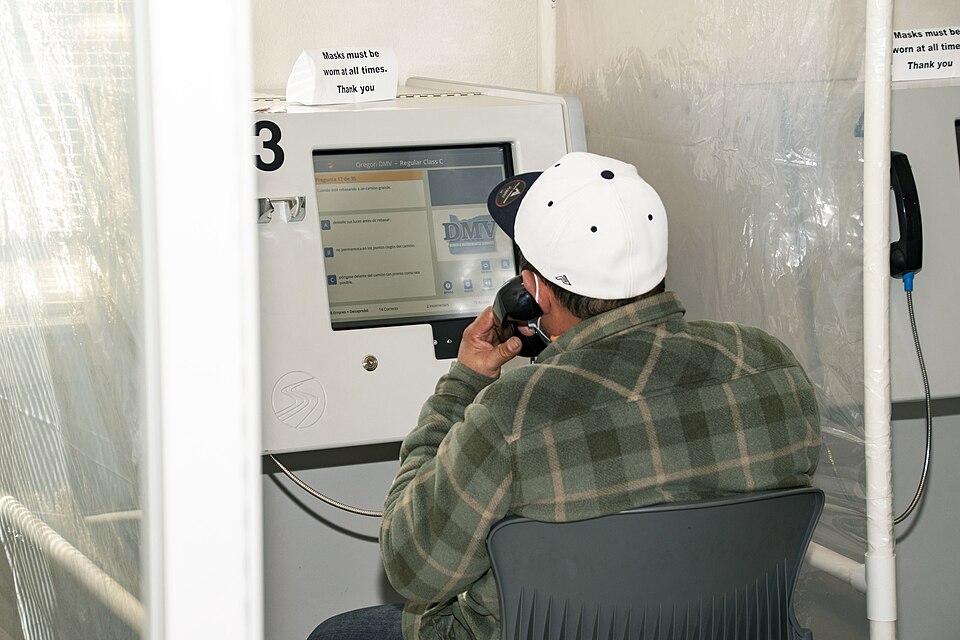
    Photo: OregonDOT, CC BY 2.0, via Wikimedia Commons

    If reading, hearing or test nerves make the permit test hard, most US states offer help. The usual options are an audio version through headphones, an oral test read by staff, American Sign Language (ASL) video or an interpreter, and in some states extra time or a paper test. You normally have to ask in advance. This guide shows what each state publishes and how to request it, as of November 2026.

    Key facts

    • Audio tests (questions read through headphones) are offered in many states, including Arkansas, Connecticut, Delaware, Massachusetts, Mississippi, North Carolina, Pennsylvania and West Virginia.
    • Oral tests on request: Nevada’s handbook says that if you have problems reading or understanding the written test, you may request an oral examination. Alabama, Georgia, Illinois, Iowa and Kentucky offer them too.
    • ASL: North Dakota runs automated ASL and audio testing at 8 offices. Idaho, Massachusetts and Virginia list ASL versions.
    • Extra time: Massachusetts lists extended time, a paper exam or a person-to-person oral exam for applicants with a disability, with documentation.
    • The test content doesn’t change. You answer the same questions, just in a different format.

    What help can you ask for on the permit test?

    Option What it is Good for
    Audio version The testing machine reads each question and answer through headphones Dyslexia, slow reading, English as a second language
    Oral test by staff An examiner reads the test to you Reading difficulties where the machine audio isn’t enough
    ASL video or interpreter Questions in American Sign Language, or an interpreter at the test Deaf and hard of hearing applicants
    Extended time or paper test More time, or a paper copy instead of a screen Learning disabilities, anxiety disorders, attention conditions (where your state offers it)
    Other language The test written or spoken in your language Limited English. See permit test in Spanish and other languages

    Permit test accommodations by state

    State What is published
    Alabama Oral exam on the automated testing equipment if you can’t read and understand the written test
    Alaska Multiple languages with audio playback
    Arkansas Oral exam: the kiosk reads questions and answers through headphones
    Colorado Questions read aloud in English or Spanish; sign language translation provided by the DMV; other ADA accommodations on request. The handbook also comes as an audiobook
    Connecticut Headset for an audio version. The DMV notes the audio was recorded from the November 2014 manual and isn’t up to date
    Delaware Audio tests with headphones on request. Call your DMV office to book a disability accommodation before you go
    District of Columbia Audio-assisted tests for applicants who need help reading
    Georgia Oral exams for reading disabilities, booked at your local Customer Service Center, which can also schedule an interpreter for hearing-impaired customers
    Hawaii (Honolulu) Questions can be read aloud; an oral test at the Kapalama center for $10 (as of November 2026)
    Idaho Written and aural (audio) versions in 11 languages, plus ASL on video
    Illinois Oral version in person on weekdays for a language barrier or a reading or learning disability; sign language interpreters arranged in advance
    Iowa Oral test given by an examiner or an automated device
    Kentucky Special appointment for an oral test given by staff, or for an interpreter. The signs section must be answered from your own knowledge
    Massachusetts Audio exam for anyone, with no paperwork. With a disability: extended time, a paper exam or a person-to-person oral exam, booked by phone with documentation such as a doctor’s letter or an IEP. ASL exam at a Service Center
    Mississippi A headset reads the questions and answers aloud. Interpreters need the Mississippi Interpreter Oath form
    Nevada Oral exam if you have problems reading or understanding the written test; audio in offices; interpreters allowed for the written test (you pay their fees) but not on the drive test
    New Jersey Oral test in English and Spanish with headphones; MVC-approved interpreter for deaf or hard of hearing applicants, paid by the MVC
    North Carolina Audio option through earphones
    North Dakota Automated ASL and audio testing at Fargo, Jamestown, Bismarck, Dickinson, Williston, Minot, Devils Lake and Grand Forks; Request for Reasonable Accommodations form SFN 60135 for anything else
    Oklahoma The manual says an oral test is available on request (may need an appointment); a live page says English only for now. Ask
    Pennsylvania Written and audio versions in 30 languages on request; sign language interpreter for deaf or hard of hearing applicants
    Utah Readers, interpreters and other accommodations at the Driver License Division. Schools giving the permit test can’t provide accommodations
    Vermont Ask for help with reading when you book, and the DMV will accommodate you
    Virginia The manual lists audio and ASL versions
    West Virginia Audio version with headphones for applicants with reading difficulties

    Not listed? Ask your state’s DMV what it offers. Colorado and North Dakota, for example, take requests for other accommodations. Or start from your state guide via US permit test by state.

    How to ask for an accommodation

    1. Decide what you need. Audio may be enough. If not, ask for an oral test, extra time or an interpreter.
    2. Contact the DMV before your visit. Oral exams and interpreters usually need a special appointment (Kentucky, Massachusetts, Delaware, Illinois).
    3. Bring documentation if asked. Massachusetts wants written documentation, such as a doctor’s letter or an IEP, for an oral exam. A school 504 Plan or IEP is good evidence elsewhere too.
    4. Use the right form. North Dakota has SFN 60135; Mississippi needs the Interpreter Oath form for interpreters.
    5. Allow time. Specialist appointments can take longer to arrange than a standard test.
    6. On the day, tell the staff at check-in which accommodation you booked.

    Help for test anxiety

    Ask your state whether anxiety on its own qualifies for a special format. If you have a diagnosed anxiety disorder, a learning disability or ADHD, ask about extended time or a quieter format in states that offer them, with your documentation. For everyone else, preparation is the best fix:

    • Study from the official handbook, not just apps. Many states publish audio handbooks (Colorado, Nebraska, Pennsylvania).
    • Take timed and untimed practice tests until you score well above the pass mark. Start with US permit practice tests.
    • Choose an audio version if reading under pressure is the problem. In Massachusetts anyone can choose it.
    • Book a time when the office is likely to be quiet, and arrive early with your documents ready: first permit documents checklist.
    • If you fail, the retake is usually soon: retake waiting periods by state.

    Accommodations on the road test

    The road test is in English in most states. Georgia says the driving test is in English only. Help in the car is limited:

    • Washington allows a sign language interpreter in the car.
    • Massachusetts allows an approved interpreter or trained service animal.
    • Louisiana allows an interpreter if needed.
    • California lets an interpreter help with the pre-drive check only.
    • Nevada and Colorado allow no interpreters on the drive test.

    If you are deaf or hard of hearing, ask when you book how the examiner will give directions. For adapted cars and medical evaluations, see learning to drive with a disability in the US.

    Common questions

    Can I have the permit test read to me?

    In most states, yes. Ask for the audio version or an oral test. Nevada, Alabama, Georgia, Illinois, Iowa and Kentucky all publish an oral option.

    Do I need proof of a disability for the audio test?

    Usually not for machine audio. Massachusetts lets anyone choose it. A staff-read oral test or extra time may need documentation, as in Massachusetts.

    Is the oral test easier?

    No. The questions are the same; only the format changes. In Kentucky you must still answer the signs section from your own knowledge.

    Can I bring my own interpreter?

    Sometimes. Nevada allows an interpreter for the written test if you lack English or Spanish skills, at your own cost. Mississippi needs the Interpreter Oath form. New Jersey and Pennsylvania arrange sign language interpreters. Virginia doesn’t allow translators for languages it already offers.

    Can I get extra time on the permit test?

    Massachusetts lists extended time for applicants with a disability. In other states, ask the DMV as a reasonable accommodation request.

    What if I have an IEP or 504 Plan at school?

    Bring it. It shows the DMV what support you already get. Rhode Island’s community college driver education course also accepts IEP and 504 Plans for course accommodations.

    Licensing routes by state: learning to drive in the USA.

    Sources

    • Nevada DMV, “Nevada Driver’s Handbook (DMV 700, March 2024)” (dmv.nv.gov)
    • Georgia Department of Driver Services, “Section 3: Testing Information” (dds.georgia.gov)
    • Alabama Law Enforcement Agency, “Alabama Driver Manual” (alea.gov)
    • Alaska DMV, “Alaska Driver Manual” (dmv.alaska.gov)
    • Arkansas State Police, “Audio Testing Instructions” (asp.arkansas.gov)
    • Colorado DMV, “Driver Written Test” and “Driver Education” (dmv.colorado.gov)
    • Connecticut DMV, “Knowledge Test” (portal.ct.gov)
    • Delaware DMV, “Delaware Driver Manual” (dmv.de.gov)
    • DC DMV, “Knowledge Tests” (dmv.dc.gov)
    • City and County of Honolulu, “Written Test” (honolulu.gov)
    • Idaho Transportation Department, “Knowledge Test” (itd.idaho.gov)
    • Illinois Secretary of State, “Driver’s License Testing” (ilsos.gov)
    • Iowa DOT, “Iowa Driver’s Manual” (iowadot.gov)
    • Kentucky State Police, “Driver Testing” (kentuckystatepolice.ky.gov)
    • Massachusetts RMV, “Learner’s Permit Exam” (mass.gov)
    • Mississippi Driver Service Bureau, “Class R Learner’s Permit” (driverservicebureau.dps.ms.gov)
    • New Jersey MVC, “Knowledge Test” and “New Jersey Driver Manual” (nj.gov)
    • NCDMV, “Driver License Tests” (ncdot.gov)
    • North Dakota DOT, “Knowledge Test” (dot.nd.gov)
    • Service Oklahoma, “Oklahoma Driver Manual” (oklahoma.gov)
    • PennDOT, “Pennsylvania Driver’s Manual” (pa.gov)
    • Utah State Board of Education and Utah Driver License Division, knowledge test pages (schools.utah.gov; dld.utah.gov)
    • Vermont DMV, “Learner’s Permit” (dmv.vermont.gov)
    • Virginia DMV, “Virginia Driver’s Manual” (dmv.virginia.gov)
    • West Virginia DMV, “Driver’s Licensing Handbook” (dmv.wv.gov)
    • Washington State Department of Licensing, “Drive test” (dol.wa.gov)
    • Louisiana OMV, “Class E Driver’s Guide” (expresslane.org)
    • California DMV, “California Driver’s Handbook: The Testing Process” (dmv.ca.gov)
    • Community College of Rhode Island, “Driver Education” (ccri.edu)
  • How to Book a DMV Road or Permit Test (and Get Earlier Slots)

    How to Book a DMV Road or Permit Test (and Get Earlier Slots)

    Photo: OregonDOT, CC BY 2.0, via Wikimedia Commons

    To book a US permit or road test, use your state’s online appointment system or phone line once you are eligible. In many states you can also book with an approved driving school or third-party tester. Earlier slots come from checking for cancellations, widening your search to other offices, using walk-in slots where they exist, and testing with a third party. This guide shows how booking works in each state that publishes its process, as of November 2026.

    Key facts

    • Most road tests need an appointment. Georgia and DC take no walk-ins for road tests; Alabama welcomes walk-ins at all testing sites.
    • Book only once you are eligible: permit held long enough, hours logged, driver’s ed done. A test booked too early can be refused on the day.
    • Third-party testers (approved driving schools or businesses) give the road test in Alabama, Alaska, Arizona, DC, Florida, Georgia, Indiana, Louisiana, Michigan, Pennsylvania, South Carolina, Tennessee and Texas. In Michigan, approved businesses give all road tests.
    • Cancellation rules have teeth. Late cancellations or no-shows cost money in DC, Massachusetts, Minnesota and Wisconsin.

    How to book a DMV test appointment, step by step

    1. Check you are eligible on the test date. Count your permit holding period and your supervised hours. Minimums by state: US graduated driver licensing compared.
    2. Do any pre-application online. California, for example, wants the driver’s license application filled in online before your office visit.
    3. Choose who tests you: the state agency, or a third-party tester where your state allows it (table below).
    4. Book online or by phone. Have your permit number, name and date of birth ready.
    5. Save the confirmation. Connecticut emails an appointment confirmation page you must bring.
    6. Line up your car and licensed driver for that slot. See which car you can use.
    7. Put the cancellation deadline in your calendar in case you need to move the date.

    How booking works in each state

    State How to book the road test Walk-ins and limits
    Alabama ALEA online scheduling for Stage II road skills, up to 2 weeks ahead Walk-ins welcome at all testing sites
    Alaska Online, or 907-269-5551 72-hour cancellation cutoff in the manual
    California DMV online appointment system Office visits need an appointment
    Connecticut Online; confirmation page emailed Reschedule at least 3 days ahead or lose the prepaid fee
    Delaware My Road Test (DMV Online Services), or phone Appointment based
    District of Columbia DC DMV Online Road Test Appointment Scheduler, 311 or (202) 737-4404 No walk-ins; cancel 48 hours ahead or pay $30
    Georgia DDS Online Services Appointment only; no walk-ins or same-day appointments
    Hawaii (Oahu) Online with the City and County of Honolulu Walk-ins not accepted
    Kentucky Appointment with Kentucky State Police Appointment only
    Maine The BMV schedules you at the nearest location and mails a notice You don’t pick the slot online
    Minnesota DVS shows next available dates for every exam station By law, DVS must offer an appointment within 14 days of your request once you are eligible, in your county or a neighboring one
    New York Road Test Scheduling System, or 1-518-402-2100 Bad weather can cancel tests; check the DMV cancellations page
    Pennsylvania PennDOT Driver and Vehicle Services website, or 1-800-423-5542 Appointment required
    South Carolina “Schedule a Road Test” page on the SCDMV site Check branch walk-in rules
    Tennessee Online, no login needed for a regular license road test Late arrivals can be canceled and become walk-ins
    Texas DPS online appointment scheduler, up to six months ahead Limited same-day and walk-in slots at offices

    State detail: California, Texas, Florida, New York, Pennsylvania, Georgia, Illinois, Ohio, North Carolina and Michigan.

    Third-party and driving school road testers

    A third-party tester is a business, usually a driving school, that the state certifies to give the official road test. The result counts the same as a DMV test. They often have earlier slots but charge their own fee.

    State Who can test you Rules worth knowing
    Alabama Approved private high school driver ed teachers (ALEA Third-Party Testing) Run through some school systems
    Alaska Driving schools and DMV Business Partner offices They set their own fees
    Arizona Authorized Third Party (ATP) providers that offer road tests MVD accepts the result
    District of Columbia DC DMV-certified third-party testers Fee up to $100; a school that taught you can’t test you; cancel any DMV booking if you switch
    Florida Third party administrators (TPAs) for the knowledge exam and driving skills test Under 18s can take the knowledge exam online through an approved TPA
    Georgia DDS-certified full-service driving schools Only for students who did the 30 and 6 hour course at that school
    Indiana Participating BMV-licensed driver education schools Often for students 16 or older with a permit
    Louisiana OMV-certified third party testers Private driving school students test at their school or another certified tester
    Michigan Driver testing businesses with Department of State agreements They give the road test; fees vary
    Pennsylvania PennDOT-certified third-party businesses Book with the tester, not PennDOT; they set the fee
    South Carolina One Stop Driver Training and Testing Programs SCDMV approves them
    Tennessee Driver Training and Testing Program (DTTP) schools 30 classroom hours and 6 behind the wheel first
    Texas DPS Third Party Skills Testing (TPST) providers Ask for the full price, including car rental

    State guides: Arizona, Georgia, Louisiana, Michigan, Pennsylvania, Texas, Florida and DC.

    How to find an earlier road test slot

    1. Check for cancellations often. Other people cancel every day, and Texas DPS says you can rebook immediately after canceling.
    2. Widen your search. Look at every office within reasonable driving distance, not just the nearest.
    3. Use a third-party tester if your state has them. Compare their price with the time saved.
    4. Use walk-in or same-day slots where they exist (Alabama, and limited slots in Texas). Arrive early and bring everything.
    5. Be flexible on day and time. A school-day slot may be free when after-school ones are gone.
    6. Book as soon as you know your eligibility date, even if it is weeks away. You can usually move it later.

    What to do if no appointments are free

    • Minnesota: ask for an appointment; DVS must offer one within 14 days once you are eligible.
    • Elsewhere: where your state has a booking phone line (Alaska, DC, New York, Pennsylvania), call and ask about other offices.
    • Check your permit’s expiry date. If waiting will run past it, ask about renewing or extending the permit before it lapses.
    • Keep practicing. Extra weeks are extra supervised hours. Use them on the skills you’re weakest at: see US road test by state.

    Booking the permit (knowledge) test

    Permit tests are often easier to get, and some states let you take them online:

    • Florida: under 18s can take the Class E knowledge exam online through an approved third party administrator.
    • Michigan: adults can take the knowledge test online since July 2025.
    • California: an online knowledge test is offered to eligible applicants; whether you can use it appears after you finish your online application.

    Formats and online options by state: US permit test by state. Bring the right papers: first permit documents checklist.

    Cancellation and no-show rules

    Missing a slot can cost money and push your retest back. Fees as of November 2026:

    • DC: cancel at least 48 hours ahead, or pay a $30 fee.
    • Massachusetts: the $35 fee is charged again for a no-show or a cancellation with under 72 hours’ notice.
    • Minnesota: $40 for a no-show or under 24 hours’ notice; $20 for 24 to 72 hours.
    • Connecticut: reschedule at least 3 days ahead or lose the prepaid fee.
    • Texas: DPS has said appointments are canceled if you are more than 30 minutes late.

    If you fail, retest waits are in retake waiting periods by state.

    Common questions

    How far ahead can I book a road test?

    It varies. Texas DPS allows up to six months; Alabama’s online system shows up to 2 weeks. Check your state’s system.

    Is a third-party road test easier?

    No. Testers follow the state’s test and scoring. The difference is availability, price and sometimes the car.

    Can I book a road test before I’m eligible?

    Some systems let you pick a date after your eligibility date. Make sure the test date itself falls after your permit holding period and hours are complete.

    Can I walk in for a road test?

    In Alabama, yes. Texas holds a limited number of walk-in slots. Georgia, DC and Oahu don’t accept walk-ins for road tests.

    Do I need to bring my appointment confirmation?

    Bring it. Connecticut requires the confirmation page, and it helps everywhere else. The full list is in the road test day checklist.

    What if bad weather cancels my test?

    The test is rescheduled. New York posts weather cancellations online, and Arkansas tests only in weather that is safe for testing.

    For the full licensing route in your state, start at learning to drive in the USA. Fees: driver’s license costs by state.

    Sources

    • Alabama Law Enforcement Agency, “Road Skills Test” and “Third-Party Testing” (alea.gov)
    • Alaska DMV, “Road Test Information” and “Alaska Driver Manual” (dmv.alaska.gov)
    • Arizona Department of Transportation, “Road Tests” and “Authorized Third Party” (azdot.gov)
    • California DMV, “Appointments” and “Instruction Permits” (dmv.ca.gov)
    • Connecticut DMV, “Road Test” (portal.ct.gov)
    • Delaware DMV, “Road Test” (dmv.de.gov)
    • DC DMV, “Road Skills Test” (dmv.dc.gov)
    • Florida Highway Safety and Motor Vehicles, “Third Party Administrators” and “Class E Knowledge Exam” (flhsmv.gov)
    • Georgia Department of Driver Services, “Section 3: Testing Information” and “Third Party Testing” (dds.georgia.gov)
    • City and County of Honolulu, “Road Test” (honolulu.gov)
    • Indiana BMV, “Skills Exam” (in.gov)
    • Kentucky State Police, “Driver Testing” (kentuckystatepolice.ky.gov)
    • Louisiana OMV, “Third Party Testers” (expresslane.org)
    • Maine BMV, “Road Test” (maine.gov)
    • Massachusetts RMV, “Road Test” (mass.gov)
    • Michigan Department of State, “Driver Testing” and July 2025 knowledge test announcement (michigan.gov)
    • Minnesota DPS Driver and Vehicle Services, “Road Test” (dps.mn.gov)
    • New York State DMV, “Schedule a road test” (dmv.ny.gov)
    • PennDOT, “Third-Party Non-Commercial Driver’s License Skills Testing Services” (pa.gov)
    • SCDMV, “Schedule a Road Test” (dmv.sc.gov)
    • Tennessee Department of Safety and Homeland Security, “Road Skills Test” (tn.gov)
    • Texas Department of Public Safety, “Driver License Appointments” and “Third Party Skills Testing” (dps.texas.gov)
    • Wisconsin DMV, “Road test” (wisconsindot.gov)
    • Arkansas State Police, “Driving Skills Test” (asp.arkansas.gov)
  • Can You Use a Backup Camera on the Road Test? Rules by State

    Can You Use a Backup Camera on the Road Test? Rules by State

    Photo: Luke Miller, Pexels

    In most US states you can use a backup camera on the road test, but not instead of looking. Examiners expect mirror checks and a turn of the head over your shoulder every time you reverse. Self-parking and other features that steer, brake or hold speed for you are a different matter: California, Nevada, Arizona and several other states ban them during the test. This guide sets out each state’s published rule, as of November 2026.

    Key facts

    • Backup cameras: allowed in most states that address them, as an aid only.
    • Automatic parking: banned or must be off in California, Maryland, Minnesota, Kentucky, Washington, West Virginia, Delaware and New York, among others.
    • Adaptive cruise control: not allowed in California, New York or Iowa, and Nevada bans cruise control.
    • Georgia lets you test in a car with driver-assist technology, but you must show you can drive without it.
    • Not addressed? Ask the examiner before you start, and practice with every feature off.

    Can you use a backup camera on the driving test?

    Usually yes, but the camera can’t be the only thing you use. Nevada’s handbook says drivers should not become complacent and dependent on rear cameras, and lists what safe backing looks like: side mirrors, rearview mirror, over-the-shoulder head checks, and the camera if fitted. California, Colorado, Kentucky and Wisconsin say much the same.

    The penalty for relying on the screen is real. West Virginia takes points for relying solely on the camera, and Pennsylvania examiners watch for your mirror and over-the-shoulder checks.

    Backup camera and parking assist rules by state

    State Allowed Not allowed or must be off
    Alaska Backup cameras and parking sensors, as aids only Ask the testing site
    Arizona Ask the testing site Driver assistance systems, including auto-drive and parking assistance. Maneuvers must be done manually
    California Backup cameras and blind spot monitors, but not instead of looking Automated parking, lane departure features and adaptive cruise control
    Colorado Backup cameras, blind spot alerts and lane departure warnings; they don’t replace physical checks Ask the testing site
    Delaware Backup cameras not addressed: ask Parking assist, including Intelligent Parking Assist, must be off
    Florida Ask the examiner about the rest of the test The backing maneuver is done without relying on mirrors or the camera
    Georgia Advanced driver assistance technology may be fitted You must show you can drive without it
    Indiana Backup cameras are exempt All other driver assistance technology, and interior cameras, must be off
    Iowa Safety features such as backup cameras Convenience features such as adaptive cruise control
    Kentucky Backup camera, with mirror and shoulder checks Parking assist. You must parallel park without assistance
    Maryland Backup cameras and audio backup warnings Automatic parking
    Massachusetts Backup cameras, parking sensors and self-parking features don’t have to be switched off Ask the testing site
    Minnesota Backup camera allowed, but not as your only check when backing Parking assist, including for parallel parking
    Nevada Cameras as an aid to mirrors and head checks “Certain safety features such as parking assist, cruise control, etc.”
    New Jersey Installed backup cameras and parking sensors Ask the testing site
    New York Backup warning, backup and surround cameras, parking sensors, blind spot monitor, rear cross-traffic alert, forward collision and lane departure warnings, automatic emergency braking, lane keeping assist Adaptive cruise control and automatic parallel parking. The examiner checks you didn’t rely on the technology
    Pennsylvania Ask the testing site Don’t depend on a camera when parallel parking
    Washington Ask the testing site Parallel parking must be done without parking-assist features
    West Virginia Camera as an aid only Relying solely on the camera costs points; hands-free parking features must be off
    Wisconsin Camera, but not as your only check Ask the testing site

    In Louisiana, Maine and North Dakota, ask the testing site about cameras. Ohio says to ask the exam station whether self-parking and other driver-assist features must be switched off.

    Which features count as “driver assistance”?

    New York’s split is the clearest model. Features that warn you are usually fine. Features that do the driving are usually banned.

    Usually allowed (warns or shows) Often banned (steers, brakes or holds speed)
    Backup camera, surround-view camera Automatic or self-parking (parallel and perpendicular)
    Parking sensors and backup beepers Adaptive cruise control
    Blind spot monitor, rear cross-traffic alert Cruise control of any kind (Nevada)
    Forward collision and lane departure warnings Lane departure features that steer (banned in California)

    Lane keeping assist and automatic emergency braking sit in between. New York allows them; California bans lane departure features; Indiana wants all driver assistance off except the backup camera. When in doubt, switch it off and ask.

    How to prepare if your car has driver-assist features

    1. Find out how to turn each feature off. Check the owner’s manual for self-parking, lane keeping and cruise settings.
    2. Practice every maneuver with them off. Parallel parking, backing in a straight line and three-point turns should feel normal with a blank screen.
    3. Build the head-check habit. Before and during every reverse: mirrors, then over the right shoulder, then a glance at the camera. Examiners watch your head, not the screen.
    4. Tell the examiner at the start what the car has, and ask which features to disable.
    5. Consider another car if yours can’t switch a banned feature off. See which car you can use for the road test.

    Maneuver technique: how to parallel park, backing up on the road test and three-point turns.

    What the examiner looks for when you reverse

    • Mirror checks before you move.
    • Turning your body and looking through the rear window. Wisconsin says to back no faster than a slow walk and to look through the rear window, not only at mirrors or the camera.
    • Checking both sides as the front of the car swings.
    • Control: slow speed, no curb strike, stopping when told.

    Hitting a curb or another object during a maneuver is a fail in several states. See common reasons people fail the US driving test.

    Common questions

    Can I fail for using my backup camera?

    Not for using it where it is allowed, but you can lose points or fail for relying on it. West Virginia takes points for relying solely on the camera, and Florida’s backing maneuver is done without relying on it.

    Do I have to cover the camera screen?

    None of the states listed here asks you to cover it. Indiana asks for interior cameras to be off, which is a different thing (cameras recording inside the car).

    Can I use parking sensors on the road test?

    New Jersey, New York, Alaska and Massachusetts allow them. Elsewhere, ask the examiner.

    Is self-parking allowed anywhere?

    Massachusetts says self-parking features don’t have to be switched off. Most other states that address it ban it. Plan to park yourself.

    What about a car with a 360-degree camera?

    New York lists surround cameras as allowed. Treat it like a backup camera everywhere else: a check, not a substitute.

    Can I use cruise control on the highway part of the test?

    No in Nevada, and adaptive cruise is out in California, New York and Iowa. Control your speed with your foot.

    More test-day rules: road test day checklist and US road test by state. Start your state’s route at learning to drive in the USA.

    Sources

    • California DMV, “California Driver’s Handbook: The Testing Process” (dmv.ca.gov)
    • Georgia Department of Driver Services, “Section 3: Testing Information” (dds.georgia.gov)
    • Nevada DMV, “Nevada Driver’s Handbook (DMV 700, March 2024)” (dmv.nv.gov)
    • New York State DMV, “Road test” (dmv.ny.gov)
    • Maryland MVA, “Behind-the-Wheel Tests” (mva.maryland.gov)
    • New Jersey MVC, “Road Test” (nj.gov)
    • Arizona Department of Transportation, “Road Tests” (azdot.gov)
    • Indiana BMV, “Driver’s Manual” and skills exam pages (in.gov)
    • Iowa DOT, “Prepare for Your Driving Test” (iowadot.gov)
    • Kentucky State Police, “Driver Testing” (kentuckystatepolice.ky.gov)
    • Minnesota DPS Driver and Vehicle Services, “Road Test” (dps.mn.gov)
    • Minnesota DPS Driver and Vehicle Services, “Minnesota Driver’s Manual” (June 2026) (dps.mn.gov)
    • Massachusetts RMV, “Road Test” (mass.gov)
    • Delaware DMV, “Road Test” (dmv.de.gov)
    • Washington State Department of Licensing, “Drive test” (dol.wa.gov)
    • West Virginia DMV, “Driver’s Licensing Handbook” (dmv.wv.gov)
    • Wisconsin DMV, “Motorists’ Handbook” (wisconsindot.gov)
    • Colorado DMV, “Drive Test” (dmv.colorado.gov)
    • Alaska DMV, “Road Test Information” (dmv.alaska.gov)
    • Florida Highway Safety and Motor Vehicles, “Official Florida Class E Driver License Handbook” (flhsmv.gov)
    • PennDOT, “Pennsylvania Driver’s Manual (PUB 95)” (pa.gov)
  • Can I Use a Rental Car for My Driving Test? US Test Car Rules

    Can I Use a Rental Car for My Driving Test? US Test Car Rules

    Photo: Eathan Hood, Pexels

    For a US road test you usually supply the car yourself. It can be your family’s car, a borrowed car, a driving school’s car or, in some states, a rental. Whichever you use, it needs current registration and plates, proof of insurance, and working safety equipment, or the examiner won’t start the test. This guide shows the rules for each type of car in the states that publish them, as of November 2026.

    Key facts

    • You bring the car. Georgia says it plainly: “You must provide the vehicle for the road test.” Most states work the same way.
    • Every test car needs valid registration and plates, an insurance card, and lights, signals, horn, brakes, belts, tires and wipers that work.
    • Rental cars are allowed in many states only if you are named on the contract. Nevada bans them. Connecticut says you can’t test in a rented vehicle without a valid license, which rules them out for permit holders.
    • Driving school cars are the easy route if your school offers testing or rents a car for the test. Ask for the full price.
    • A failed car check usually means no test, and in some states a lost fee.

    What every road test car needs

    Examiners check the car before you drive. Nevada’s handbook lists what its examiner checks, and it is typical:

    • vehicle registration and license plates
    • an insurance card
    • headlights, taillights, brake lights and turn signals
    • horn, seat belts, tires and windshield wipers
    • brakes, speedometer and muffler in good working order
    • a safe, clean passenger seat for the examiner

    California adds a driver’s window that opens, a clear windshield, two rearview mirrors (one on the left), at least 1/32 inch of tire tread, no donut spare, and a working parking brake. The full California list is in the California pre-drive safety check.

    Car problems that can stop the test

    • A dead brake light or turn signal (ask someone to watch while you test them).
    • A cracked windshield that blocks the view (California can postpone the test).
    • No air conditioning in an Arizona summer: ADOT says it won’t test after 12 noon in June, July and August in a car without working A/C.
    • Expired registration, or an insurance card that doesn’t match the car.
    • A dirty or cluttered passenger seat.

    Kentucky State Police say missing or broken equipment can cancel or reschedule your test. Massachusetts charges the road test fee again if your car fails the check.

    Can I use a rental car for my driving test?

    Sometimes. Rental rules are the most variable part of test car policy. Many rental contracts also forbid unlicensed drivers or driving tests, so read yours before you book.

    State Rental car rule (as published)
    Alabama Allowed only if your name is on the rental agreement as an additional driver
    Alaska Your name must be on the agreement as an authorized driver
    California Your name must be on the contract, and the contract must not exclude drive tests
    Connecticut “If you do not have a valid driver’s license you cannot test in a rented vehicle.” A long-term leased car can be used with proof of insurance
    District of Columbia Allowed only if you are listed on the contract as an approved driver
    Georgia Your name must be on the rental agreement, and the car must pass the safety inspection
    Hawaii Bring the original registration, inspection certificate and insurance card, with you named on the contract
    Idaho No rental if you are unlicensed or under 25
    Kentucky Your name must be on the contract as an operator
    Massachusetts The rental agreement plus a signed letter on company letterhead allowing the road test
    Minnesota In a rental, you must be listed as a driver on the rental agreement. Neighborhood electric vehicles are not allowed. Bring the original insurance card or policy (e-insurance accepted). Check with the rental company that its coverage applies
    Nevada Not allowed
    New Jersey Not accepted unless you are named on the agreement
    New York Bring the rental agreement and written permission to use the car for the road test
    South Carolina The contract must list you as insured
    Texas You must be listed as an authorized driver, and the rental company must allow driving tests
    Vermont Not allowed unless the rental company gives a letter accepting full responsibility for the road test
    Washington Allowed

    In Arkansas, Ohio and Virginia, ask the testing site about rental cars before you book. Rules change, so confirm with your DMV whichever state you are in.

    Using a borrowed car or a parent’s car

    A borrowed car is fine in the states covered here, as long as its paperwork is in order. Before test day:

    1. Check the registration is current and the plates are on the car. Georgia requires a valid registration or plate. For a car bought in the last 30 days, bring the bill of sale (7 days if bought from a private seller).
    2. Check the insurance card is for this car and in date, and that the policy covers you as a permit holder. Call the insurer if unsure.
    3. Bring the inspection paperwork where your state requires inspections. Hawaii asks for the inspection certificate, and New Hampshire says any required inspection sticker must be current.
    4. Learn the car. Practice in it beforehand. Some states, including Pennsylvania and California, check that you can work the controls: lights, wipers, defroster, hazards, horn and parking brake.
    5. Bring the owner, or a licensed adult who meets your state’s rules, to drive you there and home.

    Plates and car types that can be refused

    • Vermont won’t accept dealer plates (unless you are an immediate family member of the dealership) or agriculture, antique or exhibit plates.
    • Georgia tests Class C and D drivers only in a four-wheel vehicle.
    • Connecticut requires a vehicle appropriate for the license class you are applying for.

    Using a driving school car

    A school car is often the simplest choice. The school handles the registration and insurance paperwork. How it works depends on who gives the test:

    • The school is also the tester. In states with third-party testing, the school gives the test in its own car. Texas runs this through DPS Third Party Skills Testing: ask for the full price, including any vehicle rental, before you book. See taking your Texas road test at a driving school.
    • The school rents you its car for a DMV test. The school’s registration and insurance must be in the car, and some states treat it like a rental, so check the rules above.
    • The tester provides a car for a fee. In Louisiana, a certified third party tester may provide a vehicle for a fee. See Louisiana road skills test and third party testers.
    • Limits apply. In DC, third-party tests can’t use a DMV car, and a school that gave you lessons can’t also give you the road test. See the DC road skills test guide.

    Where to book these tests is covered in how to book a DMV test appointment.

    Who can be in the car during the test

    • Nevada: passengers and animals are not allowed.
    • Colorado: only you and the examiner. No interpreters, family, friends or pets.
    • Washington: you, the examiner, a service animal and a sign language interpreter only.
    • Massachusetts: your sponsor rides in the back, plus an approved interpreter or trained service animal if needed.

    Empty the back seat and trunk of loose items before you arrive.

    Cameras and driver-assist features

    Whatever car you use, some features may have to be off. California, Nevada and Arizona ban driver-assist features such as automated parking. Most states allow backup cameras but expect you to look over your shoulder. The state-by-state rules are in can you use a backup camera or parking assist on the road test.

    Test car checklist

    1. Registration card and plates current; bill of sale if the car is new.
    2. Insurance card for this car, in date, in the glove box.
    3. Rental contract naming you and any permission letter your state needs.
    4. Inspection certificate or sticker, where required.
    5. All lights, signals, horn, wipers and belts tested.
    6. Tires inflated with good tread; no donut spare.
    7. Any dashboard warning light fixed; enough fuel for the test.
    8. Clean windows and a clear passenger seat.
    9. You know where every control is.

    The full paperwork list is in the road test day checklist, and state test content is in US road test by state.

    Common questions

    Can I use my parent’s car if I am not on the insurance?

    Check with the insurer before the test. The examiner needs proof the car is insured, and you need to be covered to drive it. Policies differ on permit holders, so ask.

    Does the car need to be registered in my state?

    The states covered here ask for valid registration and plates, not specifically an in-state one. Some DMVs may still question an out-of-state car, so ask when you book.

    Can I take my road test in a car with a temporary tag?

    Often yes, with the right papers. Georgia accepts a car bought in the last 30 days with its bill of sale. Hawaii lists the sales contract, inspection certificate and decal, insurance card and a fitted temporary plate for a new car.

    What happens if my car fails the vehicle check?

    The test doesn’t go ahead. California reschedules; Massachusetts charges the fee again. Fix the problem and rebook.

    Can I use a manual car?

    Yes, if it meets the safety rules and you can drive it. Use the car you practiced in.

    Is a driving school car worth the cost?

    It helps if your family car is likely to fail the check, has features you would need to switch off, or isn’t insured for you. You also practice in the same car you test in.

    Sources

    • Nevada DMV, “Nevada Driver’s Handbook (DMV 700, March 2024)” (dmv.nv.gov)
    • Georgia Department of Driver Services, “Section 3: Testing Information” (dds.georgia.gov)
    • Connecticut DMV, “Connecticut Driver’s Manual” (portal.ct.gov)
    • California DMV, “California Driver’s Handbook: The Testing Process” (dmv.ca.gov)
    • Alabama Law Enforcement Agency, “Road Skills Test” (alea.gov)
    • Alaska DMV, “Road Test Information” (dmv.alaska.gov)
    • Arizona Department of Transportation, “Road Tests” (azdot.gov)
    • DC DMV, “Road Skills Test” (dmv.dc.gov)
    • Hawaii Department of Transportation and City and County of Honolulu, road test pages (hidot.hawaii.gov; honolulu.gov)
    • Idaho Transportation Department, “Idaho Driver’s Manual” (itd.idaho.gov)
    • Kentucky State Police, “Driver Testing” (kentuckystatepolice.ky.gov)
    • Louisiana OMV, “Class E Driver’s Guide” (expresslane.org)
    • Massachusetts RMV, “Road Test” (mass.gov)
    • Minnesota DPS Driver and Vehicle Services, “Road Test” and “Minnesota Driver’s Manual” (June 2026) (dps.mn.gov)
    • New Hampshire DMV, “Road Test” (dmv.nh.gov)
    • New Jersey MVC, “Road Test” (nj.gov)
    • New York State DMV, “Road test” (dmv.ny.gov)
    • SCDMV, “Regular License Testing” (dmv.sc.gov)
    • Texas Department of Public Safety, “Driving Test” (dps.texas.gov)
    • Vermont DMV, “Road Test” (dmv.vermont.gov)
    • Washington State Department of Licensing, “Drive test” (dol.wa.gov)
    • Colorado DMV, “Drive Test” (dmv.colorado.gov)
  • Left Turn Yield Rules in the US: Who Goes First When Turning Left

    Left Turn Yield Rules in the US: Who Goes First When Turning Left

    Photo: Raphael Loquellano, Pexels

    When you turn left in the US, you yield. The left-turning driver gives way to oncoming traffic going straight or turning right, and to pedestrians crossing the street you are turning into. A circular green light lets you turn, but it does not give you priority: only a green arrow makes the turn protected. This guide uses the New York and California handbooks to show how the rule works on the permit test and the road test.

    Key facts

    • Turning left = you yield to oncoming vehicles going straight or turning right (New York, California and Oregon all teach this).
    • Green circle: you may turn, but only after yielding to oncoming traffic and pedestrians.
    • Green arrow: a protected turn, because oncoming traffic is held at red (California).
    • Flashing yellow arrow: turn only after yielding to oncoming traffic (California).
    • Wheels straight while you wait, so a rear-end crash can’t push you into oncoming traffic (California).
    • Not sure the gap is big enough? Wait. No handbook penalizes a safe wait; many road tests penalize a forced turn.

    Who has the right of way when turning left?

    Oncoming traffic does. New York’s intersections chapter puts it this way: a driver turning left yields to an oncoming driver going straight or turning right. Oregon law also requires a left-turning driver to yield to oncoming traffic until the turn is safe. California’s handbook tells you to give the right-of-way to any pedestrian or approaching vehicle close enough to be dangerous.

    The rule holds even when you got to the intersection first and even when your light is green. US law names who must yield; it doesn’t hand anyone an absolute right to go. California adds that you should give up your right-of-way when that helps prevent a collision, and never assume other drivers will yield to you.

    Left turns at traffic lights: what each signal means

    Signal Can you turn left? Who yields
    Circular green Yes, when there is a safe gap You yield to oncoming traffic and to pedestrians. California: “Pedestrians have the right-of-way.”
    Green arrow Yes, protected Oncoming traffic is stopped. Still check for red-light runners and pedestrians finishing their crossing.
    Flashing yellow arrow Yes, after yielding You yield to oncoming traffic and pedestrians. It works like a circular green.
    Steady yellow (circle or arrow) Only if you can’t stop safely The signal is about to change. Don’t speed up to beat it.
    Red (circle or arrow) No, with one exception California allows a left on red from a one-way street onto another one-way street, after stopping, if no sign prohibits it, and after yielding to anyone with a green light.

    More on arrows and flashing signals in traffic signals in the US.

    How to make a left turn, step by step

    1. Get into position early. Move close to the center line, or into the left-turn lane at its opening. California says not to cross a solid line to get into the lane.
    2. Signal at least 100 feet before the turn (California) and check your left mirror and blind spot.
    3. If you must wait, stop at the right spot. At a signal, the New York road test marks you down for not stopping near the center of the intersection when waiting to turn left. Stop behind the line when the intersection ahead is full.
    4. Keep your wheels pointed straight. California warns that if your wheels point left and someone hits you from behind, you could be pushed into oncoming traffic.
    5. Judge the gap. Look left, right, then left again. Check the crosswalk you are turning into.
    6. Turn into the correct lane. From a two-way street onto a two-way street, finish in the lane closest to the middle of the road (California). From a one-way street, start from the far-left lane.
    7. Accelerate smoothly and let the steering wheel straighten in the new lane.

    Five left-turn traps that cause crashes and test fails

    1. The oncoming driver with a right signal on

    California’s handbook says don’t assume an oncoming vehicle with its right signal on will turn before it reaches you. Wait until it actually starts turning.

    2. The car hidden behind the turning car

    An oncoming vehicle that turns out of your path can reveal another one behind it, often going faster. Look past the first vehicle before you commit.

    3. Your view blocked by an opposing left-turner

    When a car facing you is also waiting to turn left, it can hide the lane beside it. If you can’t see that lane, you can’t judge the gap. Wait, or creep forward only as far as you need to see.

    4. Motorcycles and bicycles

    They are small and their speed is hard to judge. Look twice before turning left. California also notes that cyclists can legally use the left-turn lane for their own left turns. See sharing the road with motorcycles, bicycles and trucks.

    5. Pedestrians in the crosswalk you are turning into

    Drivers focused on oncoming cars often miss people crossing the side street. You must yield to them, even when you have found a gap in traffic. See pedestrians and crosswalks.

    Left turns into and out of driveways and parking lots

    • Turning left into a driveway crosses oncoming traffic, so the same rule applies: oncoming traffic and pedestrians on the sidewalk go first. California allows a left turn into a driveway across double yellow lines, and New York’s manual allows crossing double solid lines to turn left to enter or leave the highway. Check your state’s handbook and US pavement markings.
    • Turning left out of a driveway, alley or parking lot means yielding to everyone already on the road in both directions, and to pedestrians on the sidewalk first. Details in right of way at uncontrolled intersections, T-junctions and driveways.
    • On a road with a center turn lane, California says to enter the two-way left-turn lane within 200 feet of your turn. See center two-way left-turn lanes.

    Left turns at stop signs and uncontrolled intersections

    • All-way stop: the first to stop goes first. If you and an oncoming car stop together and you are turning left, the oncoming car going straight goes first. See four-way stops explained.
    • No signs at all: first to arrive goes first, and yield to the right on a tie. Turning left, you still yield to oncoming traffic.
    • Roundabouts: there is no left-turn conflict. You go around counterclockwise and yield on entry. See how to drive a roundabout in the US.

    What the road test examiner watches on a left turn

    • Signaling early and checking mirrors and the blind spot.
    • Correct lane position before and after the turn. Turns that are too wide or too short lose points on the New York road test.
    • Where you wait, and that your wheels stay straight.
    • Yielding to oncoming traffic and pedestrians. Forcing another driver to brake is a serious error in most states. See common reasons people fail the US driving test.
    • Not hesitating when the gap is clearly safe. Waiting through obvious gaps can also cost marks.

    New York learners: see what is on the New York road test and how it is scored.

    Practice questions: left turns

    These are unofficial practice questions written by Get Driving Test Ready. They test the same knowledge as US permit tests but don’t use official question wording.

    1. Your light is a circular green. You want to turn left, and an oncoming car is going straight. What should you do?

    • A. Turn first, because your light is green
    • B. Sound your horn and turn
    • C. Let the oncoming car pass, then turn when there is a safe gap
    • D. Turn quickly before the car reaches the intersection, whatever the distance

    Answer: C. A circular green allows the turn but doesn’t protect it. Left-turning drivers yield to oncoming traffic (handbook topic: intersections and turns).

    2. A flashing yellow left-turn arrow means:

    • A. Turn left after yielding to oncoming traffic and pedestrians
    • B. Left turns are prohibited
    • C. The turn is protected; oncoming traffic has a red light
    • D. Stop and wait for a green arrow

    Answer: A. The flashing yellow arrow permits the turn after yielding (handbook topic: traffic signals).

    3. While you wait to turn left across traffic, your front wheels should be:

    • A. Turned left, ready to go
    • B. Pointed straight ahead
    • C. Turned right, toward the curb
    • D. It doesn’t matter

    Answer: B. If you are hit from behind with your wheels turned left, you can be pushed into oncoming traffic (handbook topic: turning left).

    4. An oncoming car has its right turn signal on. You want to turn left. What is the safest choice?

    • A. Turn now, because the car will turn right
    • B. Flash your headlights and go
    • C. Go if the car is slowing at all
    • D. Wait until the car actually starts its turn

    Answer: D. A signal shows intent only. The driver may go straight (handbook topic: turning left).

    5. You are turning left from a one-way street onto a two-way street. Which lane should you start from?

    • A. Any lane, if you signal
    • B. The far-left lane
    • C. The far-right lane
    • D. The center lane

    Answer: B. Start left turns from a one-way street from the far-left lane (handbook topic: turning left).

    6. You are turning left on a green arrow. A pedestrian is still finishing a crossing in the street you are entering. What should you do?

    • A. Continue, because the arrow is protected
    • B. Swerve around the pedestrian
    • C. Yield and let the pedestrian finish crossing
    • D. Sound the horn so they hurry

    Answer: C. A protected arrow stops oncoming cars, but you must still yield to pedestrians in the crosswalk (handbook topic: pedestrians and right of way).

    7. You are turning left into a driveway across a lane of oncoming traffic. Who goes first?

    • A. Oncoming traffic, then pedestrians on the sidewalk, then you
    • B. You, because you signaled
    • C. You, because driveways have priority
    • D. Whoever is faster

    Answer: A. A left into a driveway crosses traffic, so you yield to oncoming vehicles and to people on the sidewalk (handbook topic: right of way).

    8. When may you turn left on a red light in California?

    • A. Never
    • B. From any street, after a full stop
    • C. From a one-way street onto another one-way street, after stopping, if no sign prohibits it
    • D. Only on a red arrow

    Answer: C. California allows this one case, after a stop and after yielding to traffic and pedestrians with a green light. Other states have their own rules (handbook topic: traffic signals).

    More practice: US permit practice tests, including the New York and California sets.

    Common questions

    Does turning left on green mean I have the right of way?

    No. A circular green lets you turn, but you yield to oncoming traffic going straight or turning right, and to pedestrians. Only a green arrow makes the turn protected.

    Who goes first: left turn or right turn, when cars face each other?

    The right-turning car. The left-turning driver yields to oncoming traffic going straight or turning right.

    Can I wait in the middle of the intersection to turn left?

    At a signal, yes, when the space is clear. New York’s road test expects you to wait near the center of the intersection. Don’t enter if the far side is blocked and you would be stuck when the light changes.

    What if the light turns red while I am waiting in the intersection?

    Finish the turn once oncoming traffic stops, clearing the intersection with care. You entered legally, so complete the turn safely rather than stopping in the middle.

    Is a “Pittsburgh left” or any local left-first habit legal?

    Not under the yield rule in state handbooks. Don’t turn left in front of oncoming traffic because a local habit says you can, and never do it on a road test.

    Is the left-turn rule the same in every state?

    The basic yield rule is the same in the handbooks checked here. Details differ, such as left on red, center turn lanes and whether you may cross double yellow lines. Check your own state’s manual through learning to drive in the USA.

    Sources

    • New York State DMV, “Chapter 5: Intersections and Turns” and “New York State Driver’s Manual” (dmv.ny.gov)
    • California DMV, “California Driver’s Handbook: Navigating the Roads” (dmv.ca.gov)
    • California DMV, “California Driver’s Handbook: Laws and Rules of the Road” (dmv.ca.gov)
    • Oregon DMV, “Oregon Driver Manual: Turns and Intersections” (oregon.gov)
  • Texas Permit Practice Test: 40 Free Sign and Traffic Law Qs

    Texas Permit Practice Test: 40 Free Sign and Traffic Law Qs

    Photo: Farragutful, CC BY-SA 4.0, via Wikimedia Commons

    The Texas learner license test has three parts: vision, highway signs and traffic laws. This free practice test covers the two written parts with 40 original questions, including the topics Texas law says the exam must test: signs in English, Texas traffic laws, your duties toward cyclists and how phones and other distractions affect driving. The questions are unofficial practice written from Texas law and the Texas Driver Handbook topics; they are not DPS questions.

    What the Texas permit test covers

    Part What is tested Who can give it
    Vision Eyesight Classroom and online driver ed providers, or DPS
    Highway signs Signs that regulate, warn or direct traffic, in English Driver ed providers (including parent-taught) or DPS
    Traffic laws Texas traffic laws, cyclist rights and duties, distractions Driver ed providers (including parent-taught) or DPS

    One application and fee covers three tries at each part. The DL-7 handbook (January 2026) sets the pass mark at 70 percent. It does not give a question count, so ask your provider or Texas DPS rather than relying on figures from unofficial sites. More detail in the Texas learner license test guide.

    Highway signs (questions 1 to 12)

    1. What does a red octagon mean?

    • A. Slow down for a curve
    • B. Stop completely
    • C. Yield
    • D. Do not pass

    Answer: B. The eight-sided shape is used only for STOP. Stop at the line, before the crosswalk, or where you can see cross traffic. Handbook topic: signs, signals and markings.

    2. Which sign shape is used for a YIELD sign?

    • A. Downward-pointing triangle
    • B. Pennant
    • C. Circle
    • D. Pentagon

    Answer: A. YIELD signs are red and white triangles pointing down. Slow down and give the right of way, stopping if needed. Handbook topic: signs.

    3. A yellow diamond with a curved arrow warns that:

    • A. You must turn
    • B. The lane is for turning only
    • C. The road curves ahead
    • D. The road is closed

    Answer: C. Yellow diamonds are warning signs. Slow down before the curve, not in it. Handbook topic: warning signs.

    4. A pentagon-shaped sign (like a house) marks:

    • A. A school zone or school crossing
    • B. A rest area
    • C. A hospital
    • D. An exit

    Answer: A. The five-sided shape is reserved for school signs. Handbook topic: signs.

    5. A round yellow sign with an X and two letter Rs means:

    • A. Rough road ahead
    • B. Roundabout
    • C. Right lane reduced
    • D. Railroad crossing ahead

    Answer: D. This is the advance warning sign for a railroad crossing. Slow down, look and listen. Handbook topic: signs.

    6. A sideways, pennant-shaped yellow sign on the left side of the road means:

    • A. Bike lane ahead
    • B. Two-way traffic ends
    • C. No passing zone begins
    • D. Road narrows

    Answer: C. The pennant marks the start of a no passing zone. Handbook topic: signs.

    7. Orange signs are used for:

    • A. Hospitals
    • B. Construction and work zones
    • C. Evacuation routes only
    • D. Toll roads

    Answer: B. Orange marks a work zone. Slow down, follow flaggers and watch for workers. Handbook topic: signs.

    8. A white rectangle reading SPEED LIMIT 45 is a:

    • A. Guide sign
    • B. Suggested speed only
    • C. Warning sign
    • D. Regulatory sign you must obey

    Answer: D. White rectangular signs with black letters are usually regulatory. The posted number is a maximum, not a target. Handbook topic: regulatory signs.

    9. A brown sign with white lettering usually points to:

    • A. A recreation area or cultural site
    • B. A hazard
    • C. A school
    • D. An interstate exit

    Answer: A. Brown signs guide you to parks, recreation and points of interest. Green signs give directions; blue signs show services. Handbook topic: guide signs.

    10. A red sign with white letters reading DO NOT ENTER tells you:

    • A. Parking is not allowed
    • B. The road ahead floods
    • C. You may enter only to turn around
    • D. You must not enter that road or ramp from your direction

    Answer: D. DO NOT ENTER marks a one-way road or ramp you would be entering the wrong way. Handbook topic: regulatory signs.

    11. A flashing yellow light at an intersection means:

    • A. Only emergency vehicles may enter
    • B. Stop, then go
    • C. Slow down and proceed with caution
    • D. Stop and wait for green

    Answer: C. Flashing yellow is a caution signal. Flashing red means stop as at a STOP sign. Handbook topic: signals.

    12. Two solid yellow lines down the center of the road mean:

    • A. A bus lane
    • B. Passing is allowed in either direction
    • C. The road is one way
    • D. No passing in either direction

    Answer: D. Double solid yellow lines prohibit passing for traffic in both directions. Handbook topic: pavement markings.

    Right of way and turns (questions 13 to 20)

    13. At a four-way stop, you arrive at the same time as a car on your right. Who goes first?

    • A. The car on your right
    • B. Whoever is going straight
    • C. Whoever honks
    • D. You

    Answer: A. When two drivers arrive together, the driver on the left yields to the driver on the right. Handbook topic: right of way.

    14. You are turning left at an intersection with a green light but no arrow. You must yield to:

    • A. Only buses
    • B. Nobody
    • C. Oncoming traffic and pedestrians in the crosswalk
    • D. Traffic behind you

    Answer: C. A left turn on a plain green is not protected. Wait for a safe gap. Handbook topic: right of way, turning.

    15. Unless a sign prohibits it, you may turn right on a red light in Texas after:

    • A. Coming to a complete stop and yielding to pedestrians and other traffic
    • B. Slowing down
    • C. Honking your horn
    • D. Waiting 30 seconds

    Answer: A. A full stop and yield are required. Handbook topic: turning.

    16. You are leaving a private driveway to enter a street. You must:

    • A. Expect traffic to stop for you
    • B. Yield only to trucks
    • C. Yield to pedestrians on the sidewalk and to traffic on the street
    • D. Sound your horn and pull out

    Answer: C. Vehicles entering a road from a driveway or alley yield to everyone already there. Handbook topic: right of way.

    17. An emergency vehicle with siren and flashing lights approaches from behind. You should:

    • A. Speed up and keep going
    • B. Pull as far right as you safely can and stop until it passes
    • C. Stop where you are, even in an intersection
    • D. Change to the left lane

    Answer: B. Yield by pulling to the right edge, clear of intersections, and stopping. Handbook topic: right of way, emergency vehicles.

    18. When entering a roundabout, you should:

    • A. Yield to traffic already in the roundabout
    • B. Travel clockwise
    • C. Expect traffic in the circle to stop for you
    • D. Stop inside the circle

    Answer: A. Slow down, yield to circulating traffic and pedestrians, and travel counterclockwise. Handbook topic: intersections.

    19. A pedestrian is in a marked crosswalk as your light turns green. You should:

    • A. Go, because you have the green
    • B. Honk
    • C. Wait until the pedestrian has crossed your path
    • D. Drive around them

    Answer: C. Pedestrians lawfully in a crosswalk have the right of way. Handbook topic: pedestrians.

    20. When a traffic officer’s signals conflict with a traffic light, you obey:

    • A. The officer
    • B. Whichever is more convenient
    • C. Neither; stop and wait
    • D. The traffic light

    Answer: A. An officer directing traffic overrides signs and signals. Handbook topic: signals.

    Speed, space and sharing the road (questions 21 to 28)

    21. The posted limit is 60 mph, but fog has cut visibility to a few hundred feet. Driving at 60 mph is:

    • A. Required to keep traffic flowing
    • B. Legal and safe because it is the limit
    • C. Unsafe, because you must drive at a speed reasonable for conditions
    • D. Allowed with hazard lights on

    Answer: C. Speed limits are maximums for good conditions. Slow down so you can stop within the distance you can see. Handbook topic: speed.

    22. Following too closely is most dangerous because:

    • A. It makes the driver ahead speed up
    • B. You may not be able to stop in time if the vehicle ahead stops suddenly
    • C. It is illegal only on highways
    • D. It wastes fuel

    Answer: B. Leave enough space to stop safely, and more on wet roads, at night and behind large vehicles. Handbook topic: following distance.

    23. Texas law says the knowledge exam must test your rights and duties toward bicyclists. When passing a cyclist on a narrow road, you should:

    • A. Honk until the cyclist moves off the road
    • B. Slow down and pass only when you can leave plenty of room
    • C. Pass as closely as possible to get by quickly
    • D. Pass on the right

    Answer: B. Cyclists have the right to use the road. Wait for a safe gap and give them room. Handbook topic: sharing the road.

    24. You cannot see a large truck’s side mirrors. This means:

    • A. The truck is about to exit
    • B. You are likely in the truck’s blind spot
    • C. You are at a safe distance
    • D. The truck driver can see you

    Answer: B. If you cannot see the driver in the mirror, the driver cannot see you. Do not linger beside trucks or cut in front of them. Handbook topic: sharing the road, trucks.

    25. You are behind a school bus that stops with red lights flashing and its stop arm out. You must:

    • A. Pass on the left carefully
    • B. Slow to 10 mph
    • C. Stop and stay stopped until the bus moves, the bus driver signals you to proceed, or the red warning lights stop flashing; proceed only when safe
    • D. Stop only if children are visible

    Answer: C. In Texas, drivers coming from either direction must stop while the red lights flash. The law allows you to proceed when the bus resumes motion, its driver signals you to proceed, or its visual signal is no longer operating. Check for children before moving. Oncoming drivers on a separate roadway need not stop; a center turn lane alone does not create separate roadways. There is also a limited exception for a controlled-access highway loading zone where pedestrians may not cross. Fines run from $500 to $1,250. Handbook topic: school buses.

    26. A police car is stopped on the shoulder with its emergency lights on. Under move over rules, you should:

    • A. Stop beside the police car
    • B. Keep your speed and lane
    • C. Honk as you pass
    • D. Move out of the lane next to it if you safely can, or slow down

    Answer: D. Texas law says move out of the lane next to the stopped vehicle if there are two or more lanes your way. If you cannot, slow to 20 mph below the posted limit, or to 5 mph where the limit is under 25 mph. The rule also covers tow trucks, TxDOT and utility vehicles with lights on. Handbook topic: sharing the road.

    27. Before changing lanes on a highway, you should:

    • A. Check mirrors, signal, and look over your shoulder at your blind spot
    • B. Signal and move immediately
    • C. Brake, then change lanes
    • D. Check only the rearview mirror

    Answer: A. Mirrors leave blind spots. A quick head check before moving shows whether a vehicle is beside you. Handbook topic: lane changes.

    28. You are approaching a railroad crossing and the lights begin flashing. You should:

    • A. Drive around the gate if no train is visible
    • B. Stop and wait until the lights stop and it is safe
    • C. Stop on the tracks
    • D. Speed up to cross before the train

    Answer: B. Never race a train or drive around lowered gates, and never stop on the tracks. Handbook topic: railroad crossings.

    Alcohol, drugs and phones (questions 29 to 33)

    29. In Texas, a driver under 21 commits an offense when driving with:

    • A. A BAC of 0.08 or more only
    • B. Alcohol only if they crash
    • C. Any detectable amount of alcohol in their system
    • D. A BAC of 0.05 or more

    Answer: C. Texas has zero tolerance for minors: driving with any detectable alcohol is “Driving Under the Influence of Alcohol by a Minor”. Zero tolerance is an additional rule: drivers under 21 can also be prosecuted for DWI if intoxicated, including at a BAC of 0.08 or more or through impairment below that level. Handbook topic: alcohol and drugs.

    30. A minor’s test confirms detectable alcohol below 0.08 while driving. For a first offense, the driver license suspension is:

    • A. 7 days
    • B. 30 days
    • C. 60 days
    • D. 2 years

    Answer: C. The DL-7 (January 2026) and TABC give 60 days for a first offense, and the DL-7 gives 120 for a second and 180 for a third or later. A DUI by a minor also brings a fine of up to $500, community service and an alcohol awareness course. Handbook topic: alcohol and drugs.

    31. What is the legal limit of intoxication for drivers 21 and over in Texas?

    • A. 0.02
    • B. 0.05
    • C. 0.08
    • D. 0.10

    Answer: C. A BAC of 0.08 or more meets the legal definition of intoxication. DWI can also be established by loss of normal mental or physical faculties below that level. Those rules apply to drivers under 21 as well, alongside their stricter any-detectable-alcohol rule. Handbook topic: alcohol and drugs.

    32. Which of these can slow your reactions as much as alcohol?

    • A. Sunglasses
    • B. Chewing gum
    • C. Some prescription and over-the-counter medicines
    • D. Bottled water

    Answer: C. Many legal medicines cause drowsiness. Read labels and ask a pharmacist before driving. Handbook topic: alcohol and drugs.

    33. A 17-year-old Texas driver wants to make a hands-free call while driving. Is this allowed?

    • A. Yes, if a parent is in the car
    • B. Yes, but only on highways
    • C. Yes, hands-free is always allowed
    • D. No. Drivers under 18 may not use a wireless device, even hands-free, except in an emergency

    Answer: D. Section 545.424 bans all wireless device use by drivers under 18, handheld or hands-free, except in an emergency. The statewide texting ban applies on top. See Texas phone and texting laws. Handbook topic: distracted driving.

    Texas learner and provisional license rules (questions 34 to 40)

    34. What is the minimum age for a Texas learner license?

    • A. 14
    • B. 15
    • C. 15 and a half
    • D. 16

    Answer: B. You can get a learner license at 15 after the driver ed classroom phase and the vision, sign and law tests. You may start the classroom part at 14. Handbook topic: your license.

    35. Who must sit in the front passenger seat while you drive on a Texas learner license?

    • A. A licensed driver of any age
    • B. Nobody, if you are on a quiet road
    • C. Any passenger aged 18 or older
    • D. A licensed driver aged 21 or older with at least one year of driving experience

    Answer: D. The supervisor must be at least 21, licensed, with at least a year of experience, and in the front passenger seat. Handbook topic: graduated driver license.

    36. How long must a Texas driver under 18 hold a learner (or hardship) license before getting a provisional license?

    • A. 30 days
    • B. 3 months
    • C. 6 months
    • D. 12 months

    Answer: C. The minimum holding period is six months. See Texas provisional license and GDL rules. Handbook topic: graduated driver license.

    37. A 16-year-old with a Texas provisional license is driving alone. How many passengers under 21 who are not family may ride along?

    • A. Three
    • B. None
    • C. One
    • D. Two

    Answer: C. No more than one passenger under 21 who is not a family member. Family members and passengers 21 or older do not count. Handbook topic: graduated driver license.

    38. Provisional license holders under 18 may not drive between midnight and 5 a.m. unless:

    • A. They are with friends
    • B. They have a full tank of gas
    • C. The roads are empty
    • D. They are going to work, a school-related activity or dealing with a medical emergency

    Answer: D. Work, school activities and medical emergencies are the exceptions. The limits also lift when a qualifying supervisor (21+, licensed at least one year) is in the front seat. Handbook topic: graduated driver license.

    39. Before the Texas driving test, every applicant must complete an Impact Texas Drivers program within:

    • A. 7 days before the test
    • B. 30 days before the test
    • C. 90 days before the test
    • D. 1 year before the test

    Answer: C. The free DPS video course (ITTD for teens, ITAD for adults) must be completed within 90 days before the driving test. See ITTD explained. Handbook topic: your license.

    40. As part of teen driver education, how many hours of behind-the-wheel practice must be logged?

    • A. 20 hours, 5 at night
    • B. 30 hours, 10 at night
    • C. 40 hours, 6 at night
    • D. 50 hours, 10 at night

    Answer: B. Teens log 30 hours of practice, at least 10 at night, on top of instruction. Handbook topic: your license.

    How to read your score

    The official knowledge-exam pass mark is 70%. Our 36-of-40 practice target is a study suggestion, not a DPS requirement or a prediction that you will pass. Below that, go back to the handbook section named under each question you missed.

    Score Next step
    36 to 40 Check the explanations for any guesses or mistakes, then consider booking if you can apply the rules consistently.
    30 to 35 Reread the sections you missed, then retake this set.
    Under 30 Work through the Texas Driver Handbook chapter by chapter first, starting with signs.

    Sign questions are the fastest to fix.

    Common questions

    Are these the real Texas permit test questions?

    No. They are original, unofficial practice questions written from Texas law and the topics in the Texas Driver Handbook (DL-7).

    How many questions are on the Texas permit test, and what is the passing score?

    Ask your driver education provider or DPS for both figures, and prepare to know every handbook topic rather than aiming for a minimum.

    Can I take the Texas permit test online?

    Yes, through a licensed online driver education provider as part of your course. Parent-taught students take the sign and law tests through their course provider and the vision test at DPS.

    Is the sign test in English?

    Yes. You must understand highway signs written in English. A Spanish version of the test is available, but sign text stays in English.

    What if I fail?

    One application and fee gives you three tries at each part. After a third fail you submit a new application and fee.

    Where can I find the full route to a Texas license?

    See learning to drive in Texas, parent-taught driver ed and practice tests for other states.

    Sources

    • Texas Department of Public Safety, “Texas Driver Handbook” (DL-7, revised January 2026), chapters 1 and 10 (dps.texas.gov)
    • Texas Legislature, “Transportation Code Chapter 521”, sections 521.161, 521.162 and 521.204 (statutes.capitol.texas.gov)
    • Texas Legislature, Penal Code sections 49.01 and 49.04, and Alcoholic Beverage Code section 106.041 (tcss.legis.texas.gov)
    • Texas Legislature, “Transportation Code section 545.424, Operation of Vehicle by Person Under 18 Years of Age” (statutes.capitol.texas.gov)
    • Texas Department of Public Safety, “Texas Driver Handbook” (DL-7) (dps.texas.gov)
    • Texas Department of Public Safety, “Testing in Other Languages” (dps.texas.gov)
    • Texas Department of Licensing and Regulation, “Getting the Learner License” and “Getting a Provisional Driver’s License” (tdlr.texas.gov)
    • Texas Alcoholic Beverage Commission, “Underage Drinking” (tabc.texas.gov)
    • Texas Department of Transportation, “Underage drinking and driving” (txdot.gov)
    • National Highway Traffic Safety Administration, “Move Over” (nhtsa.gov)
    • Texas Legislature, “Transportation Code sections 545.066 and 545.157” (statutes.capitol.texas.gov)
  • Pennsylvania Permit Practice Test: Two Free 18-Question Sets

    Pennsylvania Permit Practice Test: Two Free 18-Question Sets

    Photo: Hao Chen, Pexels

    The Pennsylvania permit test (PennDOT’s Knowledge Test) has 18 multiple-choice questions and you need 15 correct, so you can miss only 3. This page gives you two practice sets of exactly that length, 36 original questions in all, built from the Pennsylvania Driver’s Manual (PUB 95). They are unofficial practice, not PennDOT’s question bank.

    Pennsylvania knowledge test: the numbers

    • 18 questions, 15 correct to pass (about 83%).
    • Three areas: signs, Pennsylvania driving laws and safe driving practices.
    • One attempt per day. After a fail, retest the next business day or later.
    • Taken at a PennDOT Driver License Center with your DL-180 and, under 18, your DL-180TD.

    Documents, languages and fees: see the Pennsylvania permit test guide.

    Why short tests are unforgiving

    With 18 questions, every miss costs about 5.6%. Four wrong answers is a fail. Treat a practice score of 15 or 16 as borderline and keep going until you reliably hit 17 or 18.

    Practice set 1 (questions 1 to 18)

    1. The traffic signal at an intersection is not working at all. You should treat the intersection as:

    • A. An open intersection where the main road has priority
    • B. A yield intersection for side streets only
    • C. A four-way stop
    • D. Closed until police arrive

    Answer: C. PUB 95 says a non-functioning signal is treated as though it were a four-way STOP. Manual: Chapter 2, signals.

    2. At a four-way stop, two vehicles arrive at the same time, side by side at right angles. Who goes first?

    • A. The larger vehicle
    • B. The vehicle on the right
    • C. The vehicle on the left
    • D. The vehicle that signals first

    Answer: B. The first vehicle to arrive goes first. If two arrive together, the driver on the left yields to the driver on the right. Manual: Chapter 2, signs.

    3. In Pennsylvania you may turn left on a red light, after stopping and yielding, only when:

    • A. You are turning from a one-way street onto another one-way street
    • B. A police officer is present
    • C. No oncoming traffic is visible
    • D. You are turning onto a highway ramp

    Answer: A. Left on red is allowed from the left lane of a one-way street onto another one-way street, unless a sign forbids it. Right on red is allowed after a stop unless a sign says no. Manual: Chapter 2, signals.

    4. A flashing yellow arrow means:

    • A. The turn lane is closed
    • B. Stop and wait for a green arrow
    • C. Your turn is protected; oncoming traffic is stopped
    • D. You may turn with caution, but must first yield to oncoming traffic and pedestrians

    Answer: D. The turn during a flashing yellow arrow is not protected. Oncoming traffic has a green light. Manual: Chapter 2, signals.

    5. When the yellow lights on a school zone speed sign are flashing, the speed limit is:

    • A. 10 mph
    • B. 15 mph
    • C. 20 mph
    • D. 25 mph

    Answer: B. Drive no faster than 15 mph when the signals flash or during the times shown. Speeding in a school zone adds 3 points and a fine. Manual: Chapter 2, school zone signals.

    6. A single broken yellow center line on a two-lane road means:

    • A. The road is one way
    • B. Passing is allowed on either side when it is safe
    • C. Only trucks may pass
    • D. No passing in either direction

    Answer: B. A broken yellow center line lets traffic in either direction pass when conditions are safe. A double solid yellow line means no passing for either direction. Manual: Chapter 2, pavement markings.

    7. The center line has a solid yellow line on your side and a broken yellow line on the other side. You:

    • A. May pass only at night
    • B. May pass only motorcycles
    • C. May not pass
    • D. May pass when it is safe

    Answer: C. You may pass only when the broken line is on your side. A solid line on your side means no passing. Manual: Chapter 2, pavement markings.

    8. Yield signs in Pennsylvania are:

    • A. Triangular
    • B. Diamond-shaped
    • C. Eight-sided
    • D. Round

    Answer: A. YIELD signs are three-sided triangles; STOP is the only eight-sided sign. Manual: Chapter 2, signs.

    9. On dry pavement, what following distance does PUB 95 recommend behind the vehicle ahead?

    • A. 1 second
    • B. 2 seconds
    • C. 4 seconds
    • D. 8 seconds

    Answer: C. The 4-second rule gives you time to steer or brake around a hazard on dry pavement. Leave more in bad weather, behind trucks and buses, and when driving downhill. Manual: Chapter 3, space management.

    10. Pennsylvania law requires low beams when you are within how many feet of an oncoming vehicle?

    • A. 200 feet
    • B. 300 feet
    • C. 500 feet
    • D. 1,000 feet

    Answer: C. Use low beams within 500 feet of an oncoming vehicle and when following within 300 feet. Manual: Chapter 3, driving at night.

    11. When must your headlights be on in a posted Pennsylvania work zone?

    • A. Only at night
    • B. Only when workers are present
    • C. Never; parking lights are enough
    • D. At all times while you travel through it, day or night

    Answer: D. Headlights are required through every posted work zone, whatever the time of day. Daytime running lights alone are not enough. Manual: Chapter 2 and Chapter 3, work zones.

    12. You are passing a bicycle. How much space must you leave?

    • A. At least 3 feet
    • B. At least 2 feet
    • C. At least 6 feet
    • D. At least 4 feet

    Answer: D. Leave at least 4 feet. You may cross a double yellow line to do it when it is safe. Manual: Chapter 3, sharing the road.

    13. A school bus is stopped with red lights flashing and stop arm extended. You are coming toward it on the same undivided road. You must:

    • A. Stop only if you are behind the bus
    • B. Stop at least 10 feet from the bus and stay stopped until the lights stop, the arm is withdrawn and children are safe
    • C. Stop at least 50 feet away, then pass
    • D. Slow down and pass carefully

    Answer: B. Traffic behind and coming toward the bus stops at least 10 feet away. Not stopping brings 5 points and a 60-day suspension. See Pennsylvania’s stop, slow and move over rules. Manual: Chapter 3, school buses.

    14. The only time you do not have to stop for a school bus with red lights flashing in Pennsylvania is when:

    • A. You are late for school
    • B. No children are visible
    • C. You are on the opposite side of a divided highway, with a barrier or median between you
    • D. The bus is on a one-way street

    Answer: C. On the opposite side of a divided highway (barrier, guide rail or a median of grass, trees or rocks), slow down and continue with caution. Manual: Chapter 3, school buses.

    15. Pennsylvania’s Move Over law requires you to:

    • A. Move into a lane not next to an emergency response area or marked disabled vehicle, or slow down if you cannot
    • B. Speed up to clear the area quickly
    • C. Stop behind any vehicle with flashing lights
    • D. Honk to warn responders

    Answer: A. If you cannot move over safely, reduce speed. Breaking the law brings 2 points and a fine starting at $500. Manual: Chapter 3, Move Over law.

    16. A driver under 21 in Pennsylvania is considered to be driving under the influence at a BAC of:

    • A. .02 percent or more
    • B. .05 percent or more
    • C. .08 percent or more
    • D. .10 percent or more

    Answer: A. Pennsylvania’s zero tolerance rule treats .02 as DUI for drivers under 21. The adult limit is .08. See the Pennsylvania point system, DUI and underage drinking rules. Manual: Chapter 4.

    17. You are arrested for DUI and refuse a breath or blood test for the first time. Your license is:

    • A. Suspended for 6 months, only if you are over 21
    • B. Automatically suspended for 1 year
    • C. Suspended for 30 days
    • D. Not affected unless you are convicted

    Answer: B. A first refusal brings an automatic 1-year suspension, even if you are later found not guilty of DUI. Manual: Chapter 4, chemical testing.

    18. Your accelerator pedal sticks and the car keeps speeding up. You should:

    • A. Pump the gas pedal hard
    • B. Turn the ignition to LOCK
    • C. Shift to neutral and brake
    • D. Reach down and pull the pedal up with your hand

    Answer: C. Keep your eyes on the road, try tapping the pedal, then shift to neutral and brake if it stays stuck. Do not turn the key to LOCK, as you lose steering. Manual: Chapter 3, driving emergencies.

    Practice set 2 (questions 19 to 36)

    19. A flashing red traffic light means:

    • A. The signal is being repaired; ignore it
    • B. The same as a STOP sign
    • C. Yield only to pedestrians
    • D. Slow down and continue

    Answer: B. Stop completely, look both ways, and go only when the intersection is clear. Manual: Chapter 2, signals.

    20. A steady yellow light appears as you approach an intersection. You are not close enough to be inside it. You should:

    • A. Turn right without signaling
    • B. Stop suddenly no matter what
    • C. Speed up to beat the red
    • D. Slow down and prepare to stop

    Answer: D. Steady yellow warns that red is about to appear. If you are already in the intersection or cannot stop safely, continue through carefully. Manual: Chapter 2, signals.

    21. An orange sign with black lettering usually identifies:

    • A. A scenic route
    • B. A school zone
    • C. A hospital route
    • D. A maintenance, construction or utility work area

    Answer: D. Orange signs mark work areas where workers or equipment may be on or near the road. Manual: Chapter 2, work zone signs.

    22. At some highway on-ramps a signal alternates between green and red during rush hour. This is a ramp meter. You should:

    • A. Use the shoulder to bypass it
    • B. Ignore it if traffic looks light
    • C. Enter on red if no one is behind you
    • D. Wait for green before entering the highway

    Answer: D. Ramp meters control the flow onto busy highways. On a single-lane ramp, one car enters on each green. Manual: Chapter 2, ramp-metering signals.

    23. Who may supervise a Pennsylvania junior learner’s permit holder?

    • A. Any licensed driver aged 18 or older
    • B. Any passenger aged 16 or older
    • C. A licensed driver at least 21, or a licensed parent, guardian, person in loco parentis or spouse who is 18 or older
    • D. A driving instructor only

    Answer: C. The supervisor must be one of those people and must sit in the front seat. Manual: Chapter 1, junior learner’s permit.

    24. On a junior learner’s permit, how many passengers may ride in the car?

    • A. No more than the number of seat belts
    • B. Two
    • C. Any number
    • D. One

    Answer: A. Drivers under 18 may not carry more passengers than there are seat belts. Manual: Chapter 1, junior learner’s permit.

    25. Before a Pennsylvania driver under 18 can take the road test, how much supervised skill-building must be certified?

    • A. 30 hours, including 5 at night
    • B. 50 hours, including 10 at night
    • C. 65 hours, including 10 at night and 5 in bad weather
    • D. 100 hours, including 20 at night

    Answer: C. Under 18s need 65 hours (10 at night and 5 in bad weather) and must wait six months from the permit issue date. Manual: Chapter 1.

    26. A Pennsylvania junior license holder may not drive, unless an exception applies, between:

    • A. 10 p.m. and 5 a.m.
    • B. 11 p.m. and 5 a.m.
    • C. Midnight and 6 a.m.
    • D. 1 a.m. and 5 a.m.

    Answer: B. The curfew is 11 p.m. to 5 a.m. unless a parent, guardian, person in loco parentis or spouse 18 or older is with you, or you carry a notarized affidavit for work, public or charitable service or volunteer fire company duty. See Pennsylvania junior license rules. Manual: Chapter 1.

    27. For the first six months on a junior license, how many passengers under 18 who are not immediate family may ride with you (without a parent or guardian in the car)?

    • A. One
    • B. Three
    • C. None
    • D. Two

    Answer: A. One for the first six months, then up to three. The higher limit does not apply if you have had an at-fault crash or any driving conviction. Manual: Chapter 1, junior driver’s license.

    28. A junior driver faces a mandatory 90-day suspension for:

    • A. One seat belt warning
    • B. 6 or more points, or driving 26 mph or more over the limit
    • C. Failing to renew a registration
    • D. Any parking ticket

    Answer: B. Six points, or a conviction for 26 mph or more over the posted limit, means a 90-day suspension for a junior driver. Manual: Chapter 1, junior driver’s license.

    29. How close to the curb must you park in Pennsylvania?

    • A. No more than 24 inches
    • B. No more than 12 inches
    • C. No more than 18 inches
    • D. No more than 6 inches

    Answer: B. Park no more than 12 inches from the curb. Manual: Chapter 3, parking.

    30. You may not park within how many feet of a fire hydrant?

    • A. 10 feet
    • B. 15 feet
    • C. 20 feet
    • D. 30 feet

    Answer: B. Within 15 feet of a hydrant is no parking. It is 20 feet from a crosswalk at an intersection and 30 feet from a stop sign, yield sign or flashing signal at the roadside. Manual: Chapter 3, parking.

    31. When is a U-turn allowed in Pennsylvania?

    • A. Only on curves where traffic is slow
    • B. Only at the crest of a hill
    • C. Only if it can be made without endangering traffic, with drivers from all directions at least 500 feet away and able to see you
    • D. Anywhere, if you signal

    Answer: C. U-turns are banned on curves, near the crest of a hill and where a sign forbids them. Manual: Chapter 3, U-turns.

    32. Low beam headlights shine about 250 feet ahead. To avoid overdriving your headlights on a dark road, PUB 95 says you should not drive faster than:

    • A. 35 mph
    • B. 45 mph
    • C. 55 mph
    • D. 65 mph

    Answer: B. At 55 mph it takes more than 250 feet to stop, which is beyond what low beams show you. Manual: Chapter 3, driving at night.

    33. A front tire blows out. The car pulls hard to one side. You should:

    • A. Hold the wheel tightly, stay off the brake and slowly take your foot off the gas
    • B. Brake hard to stop immediately
    • C. Let go of the wheel so the car straightens
    • D. Accelerate to regain control

    Answer: A. PUB 95 warns that braking after a blowout can make you skid and lose control. Steer smoothly to a safe spot; you can ride on the flat tire to get there. Manual: Chapter 3, driving emergencies.

    34. Your brake pedal goes down farther than usual and the brake warning light is on. A helpful step is to:

    • A. Speed up to reach a garage faster
    • B. Pump the gas pedal
    • C. Shift to a lower gear to help slow the car
    • D. Turn off the engine

    Answer: C. Many newer cars have split braking systems, so you may still have braking at two wheels. Push harder on the pedal, shift down, and pull over safely. Manual: Chapter 3, brake failure.

    35. A blind pedestrian with a white cane is waiting to cross. You must:

    • A. Continue if your light is green
    • B. Yield the right of way: slow down and prepare to stop
    • C. Honk to let them know you are coming
    • D. Yield only in a marked crosswalk

    Answer: B. Yield to blind pedestrians, whether they use a white cane, a guide dog or are being led. Manual: Chapter 3, sharing the road with pedestrians.

    36. Within how many days must you tell PennDOT about a change of address?

    • A. 10 days
    • B. 15 days
    • C. 30 days
    • D. 60 days

    Answer: B. Report a name or address change within 15 days. Manual: Chapter 5, laws and related issues.

    Score both sets

    Correct out of 18 Result on the real standard
    17 or 18 Pass with a margin
    15 or 16 Pass, but one bad day away from a fail
    14 or fewer Fail. Reread Chapters 2 to 4 of PUB 95

    PUB 95 ends Chapters 2, 3 and 4 with review questions and an answer key, and PennDOT has free question sets and a practice app. Use them with these sets. Questions in Pennsylvania often turn on numbers: 15 mph school zones, 4 seconds of following distance, 4 feet past a bicycle, 10 feet from a school bus, 12 inches from the curb and .02 for drivers under 21.

    Common questions

    Are these PennDOT’s real test questions?

    No. They are original, unofficial practice questions written from PUB 95. The real test draws on the same three areas: signs, driving laws and safe driving.

    How many can you miss on the PA permit test?

    3. You need 15 of 18 correct.

    Can I take the test again the same day if I fail?

    No. You can retest the next business day or later, at any center. Keep your DL-180 and DL-180TD, as you need them for the retest.

    Which PUB 95 chapters should I focus on?

    Chapter 2 (signals, signs and markings), Chapter 3 (learning to drive) and Chapter 4 (your driving record). Chapter 1 rules on permits and junior licenses also come up.

    What happens after I pass?

    You get a learner’s permit valid for one year. See learning to drive in Pennsylvania and the Pennsylvania road test guide.

    Are there practice tests for other states?

    Yes. See US permit practice tests by state.

    Sources

    • PennDOT, “Pennsylvania Driver’s Manual, PUB 95”, Chapters 1 to 5 (pa.gov)
    • PennDOT, “Testing”, Online Driver’s Manual (pa.gov)
    • PennDOT, “Test Your Knowledge” (pa.gov)
  • North Carolina Permit Practice Test: Sign Test and Knowledge Test

    North Carolina Permit Practice Test: Sign Test and Knowledge Test

    Photo: Beth Fitzpatrick, Pexels

    To get a North Carolina learner permit you pass a vision test, a road sign test and a computer knowledge test at NCDMV. On the sign test you must identify 9 of 12 signs; on the knowledge test you need 80%. This free practice test has both: 12 sign questions and 30 knowledge questions. They are original and unofficial, written from the North Carolina Driver Handbook topics and state rules; they are not NCDMV’s questions.

    The NCDMV permit tests at a glance

    Test What it checks Pass standard
    Vision Eyesight 20/40 or better in at least one eye for no restriction
    Road signs Signs and their meanings 9 of 12 correct (Class C)
    Knowledge Traffic laws and safe driving 80% correct (ask NCDMV for the question count)

    An audio option lets you listen to knowledge questions through earphones. What to bring and the rest of the process: the NC DMV permit test guide.

    Part 1: Road sign test (questions 1 to 12)

    NCDMV shows you signs to identify. Here, each question describes a sign by its shape, color and message. Score 9 or more to pass this part.

    1. A red, eight-sided sign means:

    • A. Wrong way
    • B. Stop
    • C. Yield
    • D. Do not enter

    Answer: B. The octagon is reserved for STOP signs. Handbook: Chapter 5, signs.

    2. A triangle pointing down, red and white, means:

    • A. Stop
    • B. Lane ends
    • C. Yield
    • D. Merge

    Answer: C. Slow down and give the right of way; stop if needed. Handbook: Chapter 5, signs.

    3. A yellow diamond-shaped sign is a:

    • A. Warning sign for a hazard ahead
    • B. Regulatory sign
    • C. Recreation sign
    • D. Guide sign

    Answer: A. Diamonds, usually yellow, warn of hazards or changes ahead. Handbook: Chapter 5, warning signs.

    4. A pentagon-shaped sign means:

    • A. No passing
    • B. School zone or school crossing
    • C. Rest area
    • D. Hospital

    Answer: B. The five-sided shape is used only for school signs. Handbook: Chapter 5, signs.

    5. A round, yellow sign means:

    • A. Rest stop
    • B. Road closed
    • C. Railroad crossing ahead
    • D. Roundabout

    Answer: C. The round yellow sign is the advance warning for a railroad crossing. Handbook: Chapter 5, signs.

    6. A white rectangular sign reading SPEED LIMIT 35 is a:

    • A. Warning sign
    • B. Guide sign
    • C. Suggested speed
    • D. Regulatory sign

    Answer: D. White rectangles are regulatory: speed limits, lane use and similar rules. Handbook: Chapter 5, signs.

    7. A green rectangular sign shows:

    • A. School zones
    • B. Work zones
    • C. Warnings
    • D. Directions and distances

    Answer: D. Green signs are guide signs. Handbook: Chapter 5, guide signs.

    8. An orange diamond sign reading ROAD WORK AHEAD means:

    • A. Speed up to pass the zone
    • B. A work zone is ahead; slow down and watch for workers
    • C. Detour for trucks only
    • D. The road is closed

    Answer: B. Orange signs mark work zones. Handbook: Chapter 5, signs.

    9. A yellow pennant-shaped sign on the left side of the road means:

    • A. No passing zone
    • B. Hill ahead
    • C. Narrow road
    • D. Lane ends

    Answer: A. The pennant marks where a no passing zone begins. Handbook: Chapter 5, signs.

    10. A blue sign beside the interstate points to:

    • A. A school
    • B. Motorist services
    • C. A work zone
    • D. A police station only

    Answer: B. Blue signs show services such as gas, food and lodging. Handbook: Chapter 5, guide signs.

    11. A white X-shaped crossbuck sign marks:

    • A. An intersection with a stop sign
    • B. A railroad crossing
    • C. A closed road
    • D. A pedestrian crossing

    Answer: B. The crossbuck stands at the crossing; yield to any train. Handbook: Chapter 5, signs.

    12. A sign with a red circle and slash over a right arrow means:

    • A. Keep right
    • B. No right turn
    • C. Right turn only
    • D. Right lane ends

    Answer: B. A red slashed circle prohibits the action shown. Handbook: Chapter 5, signs.

    Part 2: Knowledge test (questions 13 to 42)

    Score this part out of 30. 24 or more correct is 80%, the NCDMV pass standard.

    School buses: the North Carolina favorite

    13. On a two-lane road, a school bus coming toward you stops to load children. In North Carolina you must:

    • A. Keep going, because you are on the other side
    • B. Stop
    • C. Slow to 15 mph
    • D. Stop only if children are on your side

    Answer: B. On a two-lane road, all traffic in both directions stops. See the North Carolina school bus stopping law. Handbook: Chapter 4, school buses.

    14. The road has two lanes plus a center turning lane. A school bus going the other way stops. You must:

    • A. Stop
    • B. Honk and continue
    • C. Use the center lane to pass
    • D. Continue, because the turn lane divides the road

    Answer: A. A center turning lane on a two-lane road does not count as a divider. Oncoming traffic still stops. Handbook: Chapter 4, school buses.

    15. On a four-lane road with no median, a school bus stops on the other side. You must:

    • A. Stop
    • B. Change lanes and continue
    • C. Continue slowly
    • D. Stop only if you are in the left lane

    Answer: A. On a four-lane road without a median, traffic in both directions stops. Handbook: Chapter 4, school buses.

    16. On a four-lane road divided by a median, a school bus stops on the opposite side. You:

    • A. May continue with caution
    • B. Must stop and wait for the driver’s signal
    • C. Must stop
    • D. Must turn around

    Answer: A. Oncoming traffic may continue only on a four-lane road with a median, or a road of four or more lanes with a center turning lane. Traffic following the bus always stops. Handbook: Chapter 4, school buses.

    17. On a five-lane road (four travel lanes plus a center turning lane), a school bus going the other way stops. You:

    • A. Must use the turn lane to go around
    • B. Must stop and turn off your engine
    • C. Must stop
    • D. May continue with caution

    Answer: D. Four or more lanes with a center turning lane is one of the two layouts where oncoming traffic does not stop. Handbook: Chapter 4, school buses.

    Right of way and driving rules

    18. Two cars reach a four-way stop at the same time. Who goes first?

    • A. The bigger car
    • B. The car on the right
    • C. The car on the left
    • D. The car that honks

    Answer: B. The driver on the left yields to the driver on the right. Handbook: Chapter 4, right of way.

    19. You are turning left at a green light with no arrow. You must yield to:

    • A. Vehicles behind you
    • B. Parked cars
    • C. No one
    • D. Oncoming vehicles and pedestrians

    Answer: D. Plain green allows the turn but does not protect it. Handbook: Chapter 4, turns.

    20. An emergency vehicle with siren and lights approaches. You should:

    • A. Ignore it if it is behind you
    • B. Speed up
    • C. Pull to the right edge and stop until it passes
    • D. Stop in the intersection

    Answer: C. Yield by pulling over to the right and stopping, clear of intersections. Handbook: Chapter 4, emergency vehicles.

    21. A patrol car is stopped on the shoulder with lights flashing. You should:

    • A. Keep your speed and lane
    • B. Flash your lights
    • C. Stop next to it
    • D. Move over a lane if safe, or slow down

    Answer: D. Move over laws protect responders at the roadside. Handbook: Chapter 4, emergency vehicles.

    22. Unless a sign prohibits it, you may turn right on red after:

    • A. Slowing down
    • B. Waiting one minute
    • C. Flashing your headlights
    • D. A complete stop and yielding to pedestrians and traffic

    Answer: D. Stop fully, then yield. Handbook: Chapter 4, turns.

    23. A flashing red light means:

    • A. Stop, then go when it is safe
    • B. Slow down
    • C. The signal is broken; ignore it
    • D. Wait for green

    Answer: A. A flashing red light works like a STOP sign. Handbook: Chapter 5, signals.

    24. A solid yellow line on your side of the center line means:

    • A. Bike lane
    • B. You may pass when clear
    • C. Do not pass
    • D. Bus lane

    Answer: C. Passing is not allowed from the side with the solid line. Handbook: Chapter 5, pavement markings.

    25. The posted limit is 55 mph, but fog is heavy. You should:

    • A. Drive 55 mph
    • B. Follow the car ahead closely
    • C. Use high beams to see better
    • D. Slow down to a speed that is safe for the conditions

    Answer: D. Drive at a speed safe for conditions, and use low beams in fog. Handbook: Chapter 4, speed and weather.

    26. When another vehicle is passing you, you should:

    • A. Brake hard
    • B. Move toward the center
    • C. Speed up
    • D. Keep right and do not speed up

    Answer: D. Help the passing driver complete the pass safely. Handbook: Chapter 4, passing.

    27. Before changing lanes on an interstate, you should:

    • A. Slow down first
    • B. Signal, check your mirrors and look over your shoulder
    • C. Check only your mirrors
    • D. Signal and change immediately

    Answer: B. A head check covers the blind spots your mirrors miss. Handbook: Chapter 4, interstate driving.

    28. A pedestrian is crossing at a crosswalk as your light turns green. You should:

    • A. Let the pedestrian finish crossing
    • B. Honk
    • C. Drive around them
    • D. Go, since you have the green light

    Answer: A. Yield to pedestrians in crosswalks. Handbook: Chapter 6, pedestrians.

    29. You are driving next to a large truck and cannot see its mirrors. You should:

    • A. Stay there; the driver knows you are there
    • B. Move ahead or drop back out of its blind spot
    • C. Honk continuously
    • D. Brake suddenly

    Answer: B. If you cannot see the truck’s mirrors, the driver cannot see you. Handbook: Chapter 6, trucks.

    Alcohol and the law

    30. For a North Carolina driver under 21, driving after drinking any alcohol is:

    • A. Legal below 0.08
    • B. Legal if no crash happens
    • C. Only a warning
    • D. An offense in its own right, separate from DWI

    Answer: D. The under-21 offense does not require impairment or a 0.08 reading. A single drink can be enough to be charged. See NC provisional licensee alcohol and DWI rules. Handbook: Chapter 2, alcohol and the law.

    31. What blood alcohol level is the adult line for DWI in North Carolina?

    • A. 0.02
    • B. 0.05
    • C. 0.08
    • D. 0.10

    Answer: C. 0.08 is the adult line. Commercial drivers have a 0.04 limit. Handbook: Chapter 2.

    32. Under North Carolina’s insurance points system, a conviction for driving after drinking while under 21 adds how many insurance points?

    • A. 1
    • B. 2
    • C. 4
    • D. 12

    Answer: C. It carries 4 Safe Driver Incentive Plan points and a 90% rate increase. DWI carries 12 points and a 340% increase. Handbook: Chapter 3.

    33. When you drive in North Carolina you have agreed, if charged with an implied-consent offense, to:

    • A. Pay a fine in cash
    • B. Take a chemical test of your breath or blood
    • C. Let police drive your car
    • D. Surrender your phone

    Answer: B. This is implied consent. Refusal has its own license penalties. Handbook: Chapter 2.

    34. What is the only thing that lowers blood alcohol?

    • A. Food
    • B. Exercise
    • C. Coffee
    • D. Time

    Answer: D. Alcohol leaves the body at a steady rate. Handbook: Chapter 2.

    Your permit and the GDL levels

    35. What is the minimum age for a North Carolina Level 1 limited learner permit?

    • A. 14 and a half
    • B. 15
    • C. 15 and a half
    • D. 16

    Answer: B. The permit is from 15, after an approved driver education course. You can start driver ed at 14 and a half. Handbook: Chapter 1.

    36. For the first 6 months on a Level 1 permit, you may drive only between:

    • A. 6 a.m. and 9 p.m.
    • B. 5 a.m. and 9 p.m.
    • C. 5 a.m. and 10 p.m.
    • D. 6 a.m. and midnight

    Answer: B. 5 a.m. to 9 p.m. for the first 6 months, always with a supervisor. After that, any time with a supervisor. Handbook: Chapter 1, graduated licensing.

    37. A Level 1 supervising driver must have been licensed for at least:

    • A. 1 year
    • B. 2 years
    • C. 5 years
    • D. 10 years

    Answer: C. The supervisor is a parent, grandparent, guardian or approved responsible person, licensed at least 5 years, in the front passenger seat. Handbook: Chapter 1.

    38. How long must you hold a Level 1 permit before Level 2?

    • A. 6 months
    • B. 9 months
    • C. 12 months
    • D. 18 months

    Answer: B. 9 months, cut from 12 in 2021. You must also be 16 with no moving, seat belt or phone convictions in the past 6 months. See NC graduated license Levels 1, 2 and 3. Handbook: Chapter 1.

    39. A Level 2 driver driving without a supervisor may carry how many passengers under 21 who are not household members?

    • A. One
    • B. Three
    • C. Two
    • D. None

    Answer: A. One passenger under 21 who is not a member of your household, when no supervisor is in the car. Check the current DL-214 handout for exceptions. Handbook: Chapter 1.

    40. May a North Carolina Level 1 permit holder use a mobile phone while driving?

    • A. No, mobile device use is prohibited while driving
    • B. Yes, at red lights
    • C. Yes, hands-free only
    • D. Yes, for texting only

    Answer: A. Mobile device use is prohibited on a Level 1 permit, and Level 2 drivers may not use a mobile phone while driving either. Handbook: Chapter 1.

    41. What is the vision standard for an unrestricted North Carolina license?

    • A. 20/20 in both eyes
    • B. 20/40 or better in at least one eye
    • C. 20/70 in one eye
    • D. 20/100 with glasses

    Answer: B. Below 20/40 means a corrective lens restriction. Wear your glasses or contacts to the test if you use them. Handbook: Chapter 1, tests.

    42. Since October 1, 2026, teens applying for a North Carolina permit no longer need:

    • A. A driver education certificate
    • B. A Driving Eligibility Certificate from their school
    • C. A vision test
    • D. Proof of identity

    Answer: B. Session Law 2026-46 ended the DEC requirement. Driver education and the NCDMV tests are still required. Handbook: Chapter 1 (check the current edition).

    Scoring both parts

    Part Questions Pass on the NCDMV standard
    Road signs 1 to 12 9 or more correct
    Knowledge 13 to 42 24 or more correct (80%)

    The school bus questions trip up more people than any other topic. If you missed any of 13 to 17, reread the table in the school bus law guide until you can say from memory which two road layouts let oncoming traffic continue.

    Common questions

    Are these the real NCDMV questions?

    No. They are original, unofficial practice questions written from North Carolina Driver Handbook topics and North Carolina rules.

    How many questions are on the NC knowledge test?

    The state rule sets the pass mark at 80%. Ask NCDMV for the number of questions.

    How many signs do I need to get right?

    9 of 12 for a Class C (regular car) license.

    Can I take the NC permit test online?

    Plan to test at an NCDMV office, and book an appointment if you can.

    Do adults take the same tests?

    Yes. Adults 18 and over take the knowledge, sign, vision and road tests.

    Where next?

    See learning to drive in North Carolina or practice tests for other states.

    Sources

    • North Carolina Division of Motor Vehicles, “North Carolina Driver Handbook” (ncdot.gov)
    • North Carolina Office of Administrative Hearings, “19A NCAC 03B .0201 Driver’s License Examination and Online Renewal” (reports.oah.state.nc.us)
    • North Carolina Department of Public Safety, “School Bus Safety” (ncdps.gov)
    • North Carolina Department of Administration, Division of Non-Public Education, “Teen Drivers” (doa.nc.gov)
    • North Carolina Department of Public Instruction, “Driver and Traffic Safety Education Program Administrative Policies & Procedures Manual” (dpi.nc.gov)
    • North Carolina Department of Insurance, “Safe Driver Incentive Plan (Insurance Points)” (ncdoi.gov)
  • New York Permit Practice Test: Two Free 20-Question Mock Tests

    New York Permit Practice Test: Two Free 20-Question Mock Tests

    Photo: Enrique, Pexels

    The New York DMV permit test has 20 multiple-choice questions. You pass with 14 correct, and at least 2 of the 4 road sign questions must be right whatever your total. This page gives you two full mock tests in that format, 40 original questions in all, each with the answer and the part of the New York State Driver’s Manual (MV-21) it comes from. They are unofficial practice, not the DMV’s own questions.

    How the New York permit test is scored

    Rule Detail
    Questions 20 multiple choice
    Pass mark 14 correct (70%)
    Road sign rule At least 2 of the 4 sign questions correct
    Topics Rules of the road, safe driving, road signs, alcohol and drug laws

    Score each mock test below the same way: count your total, then check your sign questions (the first four of each test) separately. A total of 16 with only 1 sign right is still a fail. More on test day in the New York DMV permit test guide.

    Mock test 1 (questions 1 to 20)

    Road sign questions (1 to 4)

    1. Most New York warning signs are which color and shape?

    • A. Red octagon
    • B. Green rectangle
    • C. Yellow diamond
    • D. White circle

    Answer: C. Warning signs are usually yellow with black lettering or symbols, and most are diamond-shaped. Manual: Chapter 4, warning signs.

    2. A green rectangular sign with white letters is most likely a:

    • A. Regulatory sign
    • B. School sign
    • C. Destination or direction (guide) sign
    • D. Construction sign

    Answer: C. Green guide signs show destinations, directions and distances. Manual: Chapter 4, destination signs.

    3. A sign with a red circle and a slash over a U-shaped arrow means:

    • A. U-turn ahead
    • B. No U-turn
    • C. Road curves sharply
    • D. U-turns allowed on red

    Answer: B. The red slashed circle forbids the action shown. Manual: Chapter 4, regulatory signs.

    4. A round yellow sign with an X and the letters RR warns you:

    • A. Of a rest area
    • B. That the right lane is closing
    • C. Of a railroad crossing ahead
    • D. To reduce speed for a roundabout

    Answer: C. The round sign is the advance warning for a railroad crossing. Slow down, look and listen. Manual: Chapter 4 and Chapter 10, railroad crossings.

    Rules of the road and safe driving (5 to 20)

    5. A flashing red traffic light means:

    • A. Turn right only
    • B. Proceed with caution without stopping
    • C. The same as a STOP sign: stop, yield, and go when it is safe
    • D. The light will soon turn green

    Answer: C. The manual treats a flashing red signal exactly like a STOP sign. Manual: Chapter 4, traffic signals.

    6. In New York City, may you turn right on a steady red light?

    • A. Only between midnight and 6 a.m.
    • B. Yes, after a full stop, unless a sign forbids it
    • C. No, not unless a sign allows it
    • D. Yes, without stopping if clear

    Answer: C. Elsewhere in the state you may turn right on red after a full stop unless a sign forbids it. In New York City you may not, unless a sign permits it. Manual: Chapter 4, traffic signals.

    7. If no speed limit is posted outside New York City, the most you may drive is:

    • A. 45 mph
    • B. 50 mph
    • C. 55 mph
    • D. 65 mph

    Answer: C. The statewide limit is 55 mph unless another limit is posted. New York City’s limit is 25 mph unless posted otherwise. Manual: Chapter 8, speed.

    8. The speed limit in New York City, unless another limit is posted, is:

    • A. 20 mph
    • B. 25 mph
    • C. 30 mph
    • D. 35 mph

    Answer: B. The manual gives 25 mph as the New York City limit when no other limit is posted. Manual: Chapter 8, speed.

    9. A school bus stopped ahead of you has its red lights flashing. You are on the opposite side of a divided highway. You must:

    • A. Keep going, because a median separates you
    • B. Stop before you reach the bus
    • C. Slow to 15 mph
    • D. Sound your horn and pass

    Answer: B. In New York, traffic from either direction must stop for a school bus with flashing red lights, including on the opposite side of a divided highway. See New York school bus and move over laws. Manual: Chapter 6, passing school buses.

    10. How far from a stopped school bus with flashing red lights should you stop?

    • A. At least 50 feet
    • B. At least 10 feet
    • C. At least 20 feet
    • D. At least 5 feet

    Answer: C. The manual says stop at least 20 feet away from the bus. Manual: Chapter 6.

    11. You hear a siren and see an ambulance coming toward you in the opposite lane of a two-way road. You must:

    • A. Keep driving, because it is on the other side
    • B. Stop in your lane immediately
    • C. Pull over to the right edge of the road and stop until it passes
    • D. Speed up to get out of its way

    Answer: C. New York requires you to pull over and stop for an emergency vehicle from any direction, even one in the opposite lane of a two-way road. If you are in an intersection, clear it first. Manual: Chapter 5, emergency vehicles.

    12. A driver under 21 has a BAC of .03. Under New York’s Zero Tolerance Law, the license will be:

    • A. Suspended for 30 days
    • B. Marked with a warning only
    • C. Suspended for six months
    • D. Unaffected, because it is below .08

    Answer: C. A BAC from .02 to .07 for a driver under 21 brings a six-month suspension. A .02 BAC could come from one drink. See New York DWI and Zero Tolerance. Manual: Chapter 9.

    13. In New York, a BAC of more than .05 is legal evidence that you are:

    • A. Below any limit that matters
    • B. Impaired
    • C. Sober
    • D. Aggravated DWI

    Answer: B. More than .05 is evidence of impairment, .08 or higher is evidence of intoxication, and .18 or more is evidence of aggravated DWI. Manual: Chapter 9.

    14. Under New York’s implied consent law, by driving in the state you have:

    • A. Agreed to let police search your trunk
    • B. Already given your consent to a chemical test if arrested for an alcohol or drug violation
    • C. Waived your right to a lawyer
    • D. Agreed to carry a first aid kit

    Answer: B. Refusing a chemical test leads to license suspension at arraignment, and the refusal can be raised in court. Manual: Chapter 9.

    15. You may not park within how many feet of a fire hydrant (unless a licensed driver stays in the car)?

    • A. 5 feet
    • B. 10 feet
    • C. 15 feet
    • D. 25 feet

    Answer: C. No parking, stopping or standing within 15 feet of a hydrant, unless a licensed driver remains in the vehicle to move it. Manual: Chapter 7, parking rules.

    16. Parking or standing is not allowed within how many feet of a traffic light, STOP sign or YIELD sign?

    • A. 10 feet
    • B. 20 feet
    • C. 30 feet
    • D. 50 feet

    Answer: C. The limit is 30 feet. It is 20 feet from a crosswalk at an intersection. Manual: Chapter 7, parking rules.

    17. How far ahead must you signal a turn or lane change in New York?

    • A. At least 50 feet
    • B. At least 25 feet
    • C. At least 500 feet
    • D. At least 100 feet

    Answer: D. The law requires a turn or lane change signal at least 100 feet ahead. Manual: Chapter 5, turns.

    18. To check your following distance, the New York manual recommends the:

    • A. Two-second rule
    • B. One-car-length rule
    • C. Ten-second rule
    • D. Half-mile rule

    Answer: A. Pick a fixed object; when the car ahead passes it, count “one thousand one, one thousand two.” If you reach the object before you finish, you are too close. Increase the gap in bad conditions. Manual: Chapter 8, space cushion.

    19. You must switch to low beams when an oncoming vehicle is within:

    • A. 200 feet
    • B. 300 feet
    • C. 500 feet
    • D. 1,000 feet

    Answer: C. Use low beams within 500 feet of an oncoming vehicle and within 200 feet of a vehicle ahead, even if it is in another lane. Manual: Chapter 10, night driving.

    20. New York law requires headlights when:

    • A. Only in fog
    • B. You are on a highway only
    • C. Weather conditions require windshield wipers
    • D. It is after 10 p.m. only

    Answer: C. Headlights are required from half an hour after sunset to half an hour before sunrise, when visibility is under 1,000 feet, and whenever you need wipers for rain, snow, sleet or fog. Daytime running lights do not count. Manual: Chapter 10.

    Mock test 2 (questions 21 to 40)

    Road sign questions (21 to 24)

    21. The only eight-sided sign you will see means:

    • A. Yield
    • B. No turn on red
    • C. Do not enter
    • D. Stop

    Answer: D. The octagon is reserved for STOP. Stop at the stop line, before the crosswalk, or where you can see cross traffic if there are no markings. Manual: Chapter 4, regulatory signs.

    22. A yellow pentagon-shaped sign (shaped like a house) warns of:

    • A. A hospital
    • B. A school zone or school crossing
    • C. A deer crossing
    • D. A park

    Answer: B. The five-sided shape marks schools and school crossings. Manual: Chapter 4, warning signs.

    23. An orange diamond sign with a flagger symbol means:

    • A. A work zone with a flagger ahead
    • B. A border crossing
    • C. A railroad flagman only
    • D. A parade route

    Answer: A. Orange signs mark work zones. Obey flaggers, slow down and expect lane changes. Manual: Chapter 4 and Chapter 8, work zones.

    24. A downward-pointing triangle with a red border means:

    • A. Danger, road ends
    • B. Yield the right of way
    • C. Stop
    • D. Merge ahead without slowing

    Answer: B. The YIELD sign tells you to slow down and give way, stopping if necessary. Manual: Chapter 4, regulatory signs.

    Rules of the road and safe driving (25 to 40)

    25. What is the minimum age for a New York learner permit?

    • A. 15
    • B. 15 and a half
    • C. 16
    • D. 17

    Answer: C. You can apply for a learner permit at 16. Students from 15 years and 11 months can take the written test at a participating school, but the permit itself is issued at 16. Manual: Chapter 1, driver licenses.

    26. How long must a junior permit be held before the road test?

    • A. 30 days
    • B. 3 months
    • C. 6 months
    • D. 12 months

    Answer: C. A junior permit must be held in valid status for at least six months before the road test. Manual: Chapter 1.

    27. The MV-262 certifies how much supervised practice before a junior driver’s road test?

    • A. 30 hours, 5 after sunset
    • B. 40 hours, 10 after sunset
    • C. 50 hours, 15 after sunset
    • D. 65 hours, 10 after sunset

    Answer: C. A parent or guardian certifies at least 50 hours of practice, at least 15 after sunset. Manual: Chapter 1, preparing for the road test.

    28. With a junior license, how many passengers under 21 who are not immediate family may ride with you?

    • A. One
    • B. Two
    • C. None
    • D. No limit

    Answer: A. Junior drivers may not carry more than one passenger under 21 unless they are immediate family. Everyone must wear a seat belt, one per person. See New York junior license rules. Manual: Chapter 1, junior operator restrictions.

    29. Where may a New York learner permit holder never drive, even with a supervisor?

    • A. In any parking lot
    • B. On any state highway
    • C. On any road after dark
    • D. On bridges and tunnels of the Triborough Bridge and Tunnel Authority

    Answer: D. Permit holders may not drive in DMV road test areas, on New York City park streets, on Triborough Bridge and Tunnel Authority bridges and tunnels, or on four named Westchester parkways. Manual: Chapter 1, permit restrictions.

    30. How many points does a conviction for passing a stopped school bus add to your New York record?

    • A. 2
    • B. 4
    • C. 5
    • D. 8

    Answer: D. Passing a stopped school bus carries 8 points. Using a mobile phone or portable electronic device while driving carries 5. Manual: Chapter 2.

    31. How many points does using a hand-held mobile phone or portable electronic device while driving add?

    • A. 2
    • B. 3
    • C. 5
    • D. 11

    Answer: C. It carries 5 points. Junior and probationary drivers also face suspension for a phone or texting conviction. Manual: Chapter 2 and Chapter 8.

    32. If you get 11 or more points within 24 months in New York, then:

    • A. Nothing happens until 20 points
    • B. Your license may be suspended
    • C. You must retake the permit test only
    • D. Points are erased automatically

    Answer: B. DMV notifies you by mail that your license will be suspended. Manual: Chapter 2, point system.

    33. When railroad crossing lights flash and gates come down, you must stop at least:

    • A. 5 feet from the tracks
    • B. 15 feet from the tracks
    • C. 50 feet from the tracks
    • D. 100 feet from the tracks

    Answer: B. Stop at least 15 feet from the tracks and do not cross until the lights and bell stop and the gates are fully up. Never drive around a gate. Manual: Chapter 4 and Chapter 10.

    34. Double solid yellow center lines mean:

    • A. You may not pass or change lanes across them, except to turn left into or out of a driveway or to make a permitted U-turn
    • B. The lane is for buses
    • C. You may pass if the road is clear
    • D. You are entering a one-way street

    Answer: A. Double solid lines mean no passing in either direction. Manual: Chapter 4, pavement markings.

    35. On a two-way road, you may not pass another vehicle within how many feet of a railroad crossing?

    • A. 50 feet
    • B. 100 feet
    • C. 200 feet
    • D. 300 feet

    Answer: B. Passing is not allowed within 100 feet of a railroad crossing on a two-way road, or within 100 feet of a bridge, tunnel or viaduct when your view is obstructed. Manual: Chapter 6, passing.

    36. Before changing lanes, mirrors alone are not enough because:

    • A. The law requires you to honk first
    • B. Mirrors are illegal to use while moving
    • C. Mirrors show only the road ahead
    • D. Even well-adjusted mirrors leave blind spots, so you must look over your shoulder

    Answer: D. Always take a quick look over your shoulder before changing lanes or passing. Manual: Chapter 6, passing.

    37. In heavy rain your tires start riding on a film of water and the steering feels light. This is called:

    • A. Fishtailing
    • B. Hydroplaning
    • C. Skidding
    • D. Overdriving

    Answer: B. Hydroplaning can cause a complete loss of traction and steering. Slow down even more; good tires with deep tread help prevent it. Manual: Chapter 10.

    38. You are on a slippery expressway posted at 55 mph. Driving at 50 mph:

    • A. Can still get you a ticket if it is not a reasonable speed for the conditions
    • B. Is required as a minimum speed
    • C. Is always legal because it is below the limit
    • D. Is too slow and illegal

    Answer: A. The manual warns that an officer can ticket a speed that is not reasonable for hazardous conditions, even below the posted limit. Manual: Chapter 8, speed.

    39. When a vehicle is passing you on the left, you should:

    • A. Move left to block it
    • B. Speed up
    • C. Stay in your lane, keep right and do not speed up
    • D. Brake hard

    Answer: C. Help the passing driver get by safely by holding your lane and speed or slowing slightly. Manual: Chapter 6, being passed.

    40. Before a school bus stops to let children off, its driver will usually turn on:

    • A. Hazard lights only
    • B. Flashing yellow lights
    • C. High beams
    • D. A green light

    Answer: B. Flashing yellow means the bus is about to stop; slow down and get ready. Flashing red means it has stopped and you must stop too. Manual: Chapter 6.

    Check your score

    Mock test Sign questions Pass on the real standard
    Test 1 1 to 4 14 or more of 20, with at least 2 of questions 1 to 4
    Test 2 21 to 24 14 or more of 20, with at least 2 of questions 21 to 24

    The real test can pull from any chapter, so if one topic cost you more than two marks, reread that chapter and its end-of-chapter questions. Signs are the cheapest marks to secure: see US road signs by shape and color and US traffic signals.

    Common questions

    Are these questions from the real New York permit test?

    No. They are original, unofficial questions written from the New York State Driver’s Manual. The manual itself has practice quizzes for Chapters 4 to 11 and road signs; use those too.

    How many can I get wrong on the NY permit test?

    6, as long as you get at least 2 of the 4 sign questions right.

    Which chapters matter most?

    Chapters 4 to 11, which cover traffic control, intersections, passing, parking, defensive driving, alcohol, special conditions and sharing the road. Chapter 1 numbers (ages, hours and restrictions) also turn up.

    Can I take the permit test online?

    Applicants under 18 can take it online before their office visit. Adults take it at a DMV office.

    What do I do after I pass?

    Practice under the permit rules, complete the 5-hour Pre-Licensing Course or driver education, then book the road test. See learning to drive in New York and what is on the New York road test.

    Where are other states’ practice tests?

    See US permit practice tests by state.

    Sources

    • New York State DMV, “New York State Driver’s Manual and Practice Tests” (MV-21), Chapters 1, 2 and 4 to 10 (dmv.ny.gov)
    • New York State DMV, “Prepare For and Take Your Permit Test” (dmv.ny.gov)