Author: Get Driving Test Ready

  • Florida Driver’s License Cost and How to Book FLHSMV Tests

    Florida Driver’s License Cost and How to Book FLHSMV Tests

    Photo: Chris S, Pexels

    Getting a Florida driver license costs $48 for the learner’s license and $48 for an original Class E license under state law, plus $10 for each knowledge exam retake and $20 for each driving skills retake, as of November 2026. You book your Florida Highway Safety and Motor Vehicles (FLHSMV) tests through your county’s driver license or tax collector office, or test with an approved third party administrator. This guide sets out every fee, how booking works county by county, and what happens if you fail or need to cancel.

    Key facts

    • Learner’s license: $48 (FLHSMV fee page).
    • Original Class E license: $48 (Florida Statutes 322.21). It includes the state driver education fee.
    • Retests: $10 per knowledge exam retake, $20 per driving skills retake (s. 322.12).
    • Learner’s license holders pay no fee for passing the driving exam, and no replacement license fee when they move up (s. 322.12).
    • Tax collector offices add a $6.25 service fee per driver license transaction (FLHSMV).
    • Booking is handled office by office. Use your county page on flhsmv.gov to find the right booking system.

    How much does a Florida driver license cost?

    Item Fee (as of November 2026) Where it comes from
    Learner’s license (Class E learner) $48 FLHSMV fees page
    Original Class E driver license $48 s. 322.21(1)(b)
    Knowledge exam retake (after a fail) $10 each time s. 322.12(1)
    Driving skills test retake (after a fail) $20 each time s. 322.12(1)
    Driving skills exam for a learner’s license holder No fee for passing s. 322.12(2)
    Replacement license $25 (waived for learner’s license holders when they upgrade) s. 322.21(1)(e), s. 322.12(2)
    Tax collector service fee $6.25 per driver license transaction FLHSMV
    Driver education course (needed for the learner’s license) Set by the provider s. 322.1615
    Third party administrator exams Set by the provider s. 322.56

    A worked example

    A 15 year old passes the knowledge exam at the first try and pays $48 for the learner’s license (plus $6.25 if the office is a tax collector). One failed knowledge attempt before that would have added $10. Later, under s. 322.12(2), passing the driving exam carries no fee for a learner’s license holder, and there is no replacement license fee for the upgrade. One failed road test adds $20. Ask your office to confirm the total at the upgrade, since county service fees can apply. For other states, see driver’s license costs by state.

    Where do you take the Florida tests?

    Option Knowledge exam Driving skills test
    FLHSMV driver license office or county tax collector office Yes, any age Yes, at offices that offer road tests
    Third party administrator (TPA), in person Yes Yes, with an approved TPA
    Third party administrator, online Under 18 only No

    Not every office does everything. FLHSMV county pages show examples: some locations give no written exams or road tests, some counties send learner’s license exams to full-service offices or third party providers, and many give road tests only by appointment. Check your county page before you book.

    Before the learner’s license you must also pass vision and hearing tests and finish an approved driver education course. See Florida learner’s license rules and Florida permit documents.

    How to book a Florida test appointment

    1. Find your county on the FLHSMV “Locations” pages. Each county page lists its offices and how they take bookings.
    2. Use the booking route it gives. Many counties link to an online scheduler; some tax collector offices run their own system on their website; some offices book by phone.
    3. Choose the right service, such as learner’s license exam or road test. Road tests are often a separate appointment type.
    4. Prepare for the day: documents, fee, and for a road test an insured, registered car and a licensed driver 21 or older to bring you. See road test day checklist.

    Walk-ins: availability varies by office, and county pages such as Pinellas and Alachua say road tests are by appointment only. Don’t rely on a walk-in for a test without checking your county page. General booking tips are in how to book a DMV test appointment.

    Testing with a third party administrator

    Florida law lets FLHSMV contract schools and businesses to give the knowledge and skills tests. The test must be the same as the state’s, and the state accepts the results. Things to know:

    • Under 18s can take the Class E knowledge exam online through an approved third party administrator. Applicants 18 and over test in person.
    • If you pass with a third party, you may be picked for a free, mandatory retest at an office, without prior notice. Failing that retest means a re-exam fee at your next attempt.
    • The provider sets its own price. Ask for it upfront and confirm the provider is FLHSMV-approved.

    Full details: taking Florida tests with a third party administrator.

    If you fail, or need to cancel

    • Failed knowledge exam: pay $10 for each retake.
    • Failed driving test: pay $20 for each retake. Use the time to fix the faults the examiner noted. See every maneuver the Florida examiner checks.
    • Waiting time between attempts: ask your office when you can rebook. See retake waiting periods by state.
    • Canceling or rescheduling: follow the instructions in your booking confirmation or contact the office or tax collector you booked with. If you used a third party administrator, its own cancellation terms apply.

    Common questions

    How much is a learner’s permit in Florida?

    $48 for the learner’s license, as of November 2026, plus a $6.25 service fee at a tax collector office. Driver education course fees are extra.

    Is the Florida road test free?

    For learner’s license holders, passing the driving exam carries no fee under s. 322.12. Retakes after a fail cost $20 each. Third party administrators charge their own fees.

    Can I take the Florida permit test online?

    Yes, if you are under 18, through an approved third party administrator. You may be selected for a free retest at an office.

    Does Florida take walk-ins for the driving test?

    Many offices give road tests by appointment only. Check your county’s FLHSMV location page.

    Why is the fee higher at the tax collector?

    Tax collector offices add a $6.25 service fee to each driver license transaction.

    How do I study for the knowledge exam?

    Use the Florida handbook, then try the Florida permit practice test and read the Florida Class E knowledge test guide.

    Related guides

    Sources

    • Florida Legislature, “Florida Statutes s. 322.12, Examination of applicants” (leg.state.fl.us)
    • Florida Legislature, “Florida Statutes s. 322.21, License fees” (leg.state.fl.us)
    • Florida Legislature, “Florida Statutes s. 322.1615, Learner’s driver license” and “s. 322.56, Contracts for administration of driver license examination” (leg.state.fl.us)
    • Florida Highway Safety and Motor Vehicles, “Fees” and “Frequently Asked Questions” (flhsmv.gov)
    • Florida Highway Safety and Motor Vehicles, “Class E Knowledge Exam and Driving Skills Test” and county “Locations” pages (flhsmv.gov)
  • California Permit Documents Checklist: What to Bring to the DMV

    California Permit Documents Checklist: What to Bring to the DMV

    Photo: Ellin Beltz, CC BY-SA 3.0, via Wikimedia Commons

    To get a California learner’s permit, you need a completed driver’s license application, one proof of identity, your Social Security number (if you are eligible for one), proof of California residency and, if you are under 18, a driver education certificate and your parents’ signatures. Whether you need one residency document or two depends on whether you choose a standard card or a REAL ID. This checklist follows the California DMV’s current document lists, as of November 2026.

    Key facts

    • Age: 15 and a half to apply as a minor. At 18 or over, no driver ed or parent signature is needed.
    • Identity: one document, such as a US passport or certified US birth certificate.
    • Residency: one document for a standard (federal non-compliant) card; two different documents for a REAL ID.
    • Teens can use a parent’s residency documents with a birth certificate that shows the relationship.
    • Under 18: a Certificate of Completion or Enrollment of Driver Education, and parent or guardian signatures.
    • Fee: the $46 application fee (original Class C license, as of November 2026). It covers 12 months and three tries at each test.

    The California permit checklist (under 18)

    1. California Driver’s License or ID Card Application, completed online (eDL 44) before your visit, or on paper (DL 44).
    2. Parent or guardian signature. If both parents or guardians have custody, both must sign. They can sign the online application electronically.
    3. Proof of identity (one document: see below).
    4. Social Security number, if you are eligible. The DMV verifies it with the Social Security Administration while you are in the office. You don’t need it if you are legally present but not eligible for a number.
    5. Proof of California residency (one or two documents: see below). Not needed if you have already been issued a California ID card.
    6. Driver education certificate: a Certificate of Completion of driver education, or proof of enrollment in an integrated driver education and training program, issued by your school. Took driver ed in another state? The DMV may accept form DL 33 completed by that school.
    7. Name change document, if your current name is different from your identity document.
    8. Payment for the application fee. See California license fees and test booking.

    At the office you’ll also pass a vision exam, have your photo and thumbprint taken, and take the knowledge test. Knowledge tests aren’t given after 4:30 p.m., so book an earlier appointment.

    Proof of identity: which documents work?

    You need one. It must show your full name and date of birth.

    REAL ID (bear and star card) Also accepted for a standard card
    Valid US passport or passport card (the DMV’s preferred document) Military ID card or DD-214
    Original or certified copy of a US birth certificate from a city, county or state vital statistics office (not “abbreviated” or “abstract” certificates) Canadian birth certificate or valid Canadian passport
    Certificate of Naturalization or Certificate of US Citizenship American Indian Card or Federal Proof of Indian Blood Degree
    US Certificate of Birth Abroad or Consular Report of Birth Abroad Refugee Travel Document or Permanent Resident Re-entry Permit
    Valid Permanent Resident Card Court order stating name, birth date and place of birth or legal presence
    Foreign passport with valid US visa and approved I-94
    Valid Employment Authorization Document (I-766)

    These are highlights. The full lists are on the DMV’s REAL ID checklist and its Federal Non-Compliant DL/ID Card Documents List (DL 1144). If you can’t prove lawful presence, California also issues AB 60 licenses, which have their own document list. See licenses regardless of immigration status.

    Proof of residency: one document or two?

    Standard (federal non-compliant) REAL ID
    How many One Two different documents
    Copies Photocopies, “informational copies” and computer printouts accepted Printed documents
    Name and address First and last name; California mailing address matching your application First and last name on both, with the same mailing address as your application

    Accepted residency documents include:

    • Home utility bill or cell phone bill (the DMV’s preferred choice)
    • School document from a US school that includes your date of birth
    • Bank or credit card records
    • Insurance documents, including medical, dental, vision and vehicle
    • Medical documents
    • Rental or lease agreement signed by the owner and tenant
    • Mortgage bill, deed or property tax bill
    • Employment documents
    • US Postal Service change of address confirmation
    • Documents from a US government agency

    No documents in your own name? Use your parent’s

    If nothing has your own name on it, the DMV lets a minor use residency documents in a parent’s name by also bringing a tracing document, such as your birth certificate, that shows the relationship. Children in foster or group-home care can use agency forms SOC 154, SOC 154A or SOC 156. If the parent’s name has changed since your birth certificate (for example, through marriage), bring their name change document too.

    Standard card or REAL ID: which should you pick?

    A REAL ID is optional. You don’t need one to drive. It matters only if you want to use your card instead of a passport to board domestic flights or enter secure federal buildings. The TSA does not require travelers under 18 to show ID when flying with a companion within the US. If you already have the documents, applying for a REAL ID now saves a later trip. See REAL ID and your first US driver’s license.

    Driver education: the one document teens forget

    • Under 17 and a half: you must bring the driver education certificate of completion, or proof you are enrolled in an integrated driver education and training program.
    • At 17 and a half or older: you can get a permit without driver education, but you still need driver education and training to get a license before 18.
    • Your permit isn’t valid for driving until you start driver training. Your instructor signs it to validate it.

    Details: California driver education and driver training explained and what teens need for a California permit.

    Applying at 18 or older

    Bring the application, one identity document, your Social Security number and your residency documents. You don’t need driver education or a parent’s signature. See getting a California license at 18 or older.

    Before you leave home

    • Application completed online, with both parents’ signatures if both have custody
    • Identity document is the original or a certified copy, not a photocopy
    • Residency: one document (standard) or two different ones (REAL ID), plus your birth certificate if they are in a parent’s name
    • Driver education certificate (under 17 and a half)
    • Glasses or contacts if you need them for the vision exam
    • Appointment before 4:30 p.m. testing cutoff
    • You’ve studied: California knowledge test and California permit practice test

    Common questions

    Do I need my Social Security card for a California permit?

    You need to provide the number, if you are eligible for one. The DMV verifies it with the Social Security Administration during your visit. Ask the DMV whether to bring the card.

    Can I use a photocopy of my birth certificate?

    No. Identity documents must be an original or certified copy. Photocopies are accepted only for residency documents on a standard card.

    Can I use my school ID or report card?

    A school document from a US school that includes your date of birth counts as a residency document. It is not on the identity list.

    Do both parents have to sign?

    If both parents or guardians have custody, yes. They can sign the online application electronically.

    What if my name on the bills doesn’t match my birth certificate?

    Bring a document that links the names, such as a marriage certificate, adoption document or court name change order.

    How long is the application good for?

    12 months. If you haven’t met all the requirements by then, you reapply and pay again.

    Related guides

    Sources

    • California DMV, “Learner’s Permits” (dmv.ca.gov)
    • California DMV, “REAL ID Checklist” and “What Is REAL ID?” (dmv.ca.gov)
    • California DMV, “Federal Non-Compliant DL/ID Card Documents List (DL 1144, Rev. 11/2025)” (dmv.ca.gov)
    • California DMV, “Fast Facts 19: Provisional Licensing (FFDL 19)” (dmv.ca.gov)
    • California DMV, “Driver’s Licenses” and “Licensing Fees” (dmv.ca.gov)
  • Texas Learner Permit Documents Checklist: What to Bring to DPS

    Texas Learner Permit Documents Checklist: What to Bring to DPS

    Photo: StuckInLagToad, CC BY-SA 4.0, via Wikimedia Commons

    To get a Texas learner license (the permit stage for 15 to 17 year olds), you bring proof of identity, your Social Security number, proof of US citizenship or lawful presence, two proofs of Texas residency, a school attendance form (VOE) or diploma, and your driver education certificate, plus a parent or guardian to sign. This checklist sets out exactly which documents the Texas Department of Public Safety (DPS) rules accept, as of November 2026, so you get it right the first time.

    Key facts

    • Who: Texas teens aged 15 to 17 who are enrolled in an approved driver education course.
    • Identity: one primary document (such as a US passport), or two secondary documents, or one secondary plus two supporting documents.
    • Residency: two documents with your name and Texas address, or a residency affidavit from a family member you live with.
    • School form: VOE valid 30 days from signing during the school year, 90 days in summer break.
    • Driver ed: the “For Learner License Only” part of the Texas Driver Education Certificate.
    • Fee: $15 for a learner license under state law (Transportation Code 521.421), as of November 2026. The DL-7 handbook adds a $1 administrative fee, so $16. Check the DPS fees page before you go.

    Before you go: are you eligible?

    • You are at least 15 and under 18.
    • You are enrolled in an approved commercial, public school or parent-taught driver education course. Coursework can’t start before your 14th birthday.
    • You have finished the classroom hours needed for the learner license: the first 6 hours if you are on the concurrent method, or the whole classroom phase (at least 24 hours) on the block method.

    Parent-taught? See Texas parent-taught driver education step by step.

    The Texas learner license documents checklist

    1. Completed application for a Texas driver license, signed by your parent or legal guardian (see below).
    2. Proof of identity (see the table).
    3. Social Security number. DPS records it and verifies it with the Social Security Administration.
    4. Proof of US citizenship or lawful presence. For US citizens, a US passport or US birth certificate usually serves. Non-citizens must show a document from the appropriate US agency that authorizes them to be in the US.
    5. Two proofs of Texas residency in your name, or a residency affidavit (see below).
    6. VOE form signed by your school, or a high school diploma or GED.
    7. Texas Driver Education Certificate, with the “For Learner License Only” section completed by your course.
    8. Test results from your driver education provider, if it gave you the knowledge test. Anything your course didn’t do is done at the DPS office.
    9. Evidence of financial responsibility for each vehicle you own, or a statement that you do not own one. The DL-7 asks all original applicants for this.
    10. Any permit or license from another state you have held, or a DPS affidavit that it was lost, stolen or expired.
    11. The fee. See Texas license fees and test booking.

    Which identity documents does Texas accept?

    DPS rules sort identity documents into three groups. Every document must be verifiable.

    Group Examples
    Primary (one is enough) Unexpired US passport; US citizenship (naturalization) certificate with photo; unexpired USCIS document with photo; unexpired US military ID; foreign passport with US visa and I-94 (conditions apply); Texas license or ID within two years of expiry
    Secondary Original or certified copy of a birth certificate from a US state vital statistics office (or a US territory, DC or Canadian province); US Department of State Certification of Birth Abroad; certified court order showing a name or gender change
    Supporting School records; Social Security card; insurance policy at least two years old; vehicle title; military records; voter registration card; and others listed in the rule

    What you need: one primary document, or two secondary documents, or one secondary document plus two supporting documents. A common set for a teen: a US passport on its own, or a certified birth certificate plus two supporting documents such as a school record and a Social Security card.

    Proof of Texas residency for teens

    DPS asks original applicants for two documents showing your name and Texas home address. At least one must show you have lived in Texas for at least 30 days, unless you surrender a valid out-of-state license or ID. Accepted documents include:

    • A Texas high school, college or university report card or transcript for the current school year
    • A current car insurance card or policy, or homeowners or renters insurance
    • A utility or service bill dated within 180 days, including cell phone, internet or streaming bills
    • Bank or credit card statements dated within 180 days
    • Mail from a government agency dated within 180 days
    • A pay stub dated within 180 days, or a W-2 or 1099 for the most recent tax year
    • A lease, deed or mortgage statement

    Two documents from the same source for different months don’t count. Mail with a forwarding label isn’t accepted.

    No bills in your name? Use the residency affidavit

    Many teens use this. A family member you live with completes a Texas residency affidavit. You then bring a document showing your relationship to them (for example, your birth certificate naming your parent) plus two acceptable residency documents in their name.

    The VOE and school rules

    • A school official completes the Verification of Enrollment and Attendance (VOE) form.
    • It is valid for 30 days from the date it is signed while school is in session, and 90 days during summer break. Get it close to your appointment date.
    • Homeschooled? You can bring the VOE, or a letter from your instructor with the same information (without the school name and district).
    • If you already have a diploma or GED, bring that instead.

    Who signs for a minor?

    The person who has custody of you signs the application: usually a parent. If you aren’t in a parent’s custody, a guardian or someone with power of attorney from your parent signs. Failing that, the rules allow your employer, the county judge or a Department of Family and Protective Services custodian. Teens who are or have been married, or who have had the disabilities of minority removed by a court, can bring that proof instead of a parent’s signature.

    Does a Texas learner license come as a REAL ID?

    The documents above (identity, Social Security number, lawful presence and two proofs of address) match the federal REAL ID minimum. Ask DPS whether the card you’ll receive is REAL ID compliant. See REAL ID and your first US driver’s license.

    Before you leave home

    • Originals or certified copies of identity documents, not photocopies
    • Names match across documents (bring a court order or other proof if not)
    • VOE signed within the last 30 days (90 in summer)
    • Residency documents dated within 180 days, where the rule sets a date
    • Driver education certificate with the learner section filled in
    • Parent or guardian with you to sign
    • Appointment booked: see booking a Texas DPS appointment
    • Ready for any tests not done by your course: see the Texas permit test guide and the Texas permit practice test

    Common questions

    Do I need my Social Security card for a Texas permit?

    The rules require the number, and DPS verifies it with the Social Security Administration. The card is listed as a supporting identity document, so it can help make up your identity set. If you have never been issued a number, DPS has a Social Security affidavit for you to sign.

    Can I use my parent’s bills as proof of residency?

    Yes, through the residency affidavit. Your parent completes it, and you bring proof of your relationship plus two residency documents in their name.

    How long is the Texas VOE good for?

    30 days from the date it is signed during the school year, and 90 days during summer break.

    Is a photocopy of my birth certificate OK?

    No. The rule calls for an original or certified copy issued by a vital statistics office.

    I’m 18. Do I need these documents?

    The identity, Social Security, lawful presence and residency documents, yes. The learner license, VOE and parent signature rules are for 15 to 17 year olds. Adults follow a different route: see the Texas adult driver ed course and ITAD.

    I just moved to Texas. What changes?

    Bring any out-of-state permit or license. If you surrender a valid out-of-state license, the 30-day Texas residence requirement doesn’t apply. See moving to Texas.

    Related guides

    Sources

    • Texas Department of Public Safety, “Texas Driver Handbook” (DL-7, revised January 2026), chapter 1, How to Obtain a Texas Driver License (dps.texas.gov)
    • Texas Department of Public Safety, “37 Texas Administrative Code Section 15.24 Identification of Applicants” (text via law.cornell.edu)
    • Texas Department of Public Safety, “37 Texas Administrative Code Section 15.27 Issuance Requirements for Minor Driver License Applicants” and “Section 15.28 Learner, Provisional and Hardship License Requirements” (text via law.cornell.edu)
    • Texas Department of Public Safety, “37 Texas Administrative Code Section 15.42 Social Security Number” and “Section 15.49 Proof of Domicile” (text via law.cornell.edu)
    • Texas Legislature, “Transportation Code Chapter 521, Sections 521.142 and 521.421” (tcss.legis.texas.gov)
    • Texas Department of Licensing and Regulation, “Verification of Enrollment and Attendance” (tdlr.texas.gov)
  • DMV Terms Explained: US Driving Glossary in Plain English

    DMV Terms Explained: US Driving Glossary in Plain English

    Photo: RDNE Stock project, Pexels

    DMV terms can be confusing because every US state names its permits, licenses and offices differently. This plain-English glossary explains the words learners and parents meet most: permit, provisional license, GDL, sponsor, implied consent, SR-22, points, plus state-specific names such as JOL, TIPIC, POP and Class CP. Each entry names the state it comes from, because a term in one state may mean nothing in the next. Checked November 2026.

    Who runs licensing in your state?

    There is no national driver’s license. Each state and DC runs its own system, and the agency is not always called the DMV.

    Name Stands for State
    DMV Department of Motor Vehicles (the general term, and the actual name in California and many other states) Many
    DPS Department of Public Safety (driver licenses) Texas
    FLHSMV Florida Highway Safety and Motor Vehicles Florida
    DDS Department of Driver Services Georgia
    BMV Bureau of Motor Vehicles Ohio
    MVA Motor Vehicle Administration Maryland
    RMV Registry of Motor Vehicles Massachusetts
    MVC Motor Vehicle Commission New Jersey
    PennDOT Pennsylvania Department of Transportation Pennsylvania
    NCDMV North Carolina Division of Motor Vehicles North Carolina

    In some states, county offices (such as Florida’s tax collectors or Ohio’s deputy registrars) handle licensing on the state’s behalf.

    Licensing stages: permit to full license

    GDL (graduated driver licensing)

    The three-stage system every state uses for new young drivers: a learner’s permit, then an intermediate (provisional) license with limits, then a full license. NHTSA says all 50 states and DC use it. Compare the rules in US graduated driver licensing compared.

    Permit (learner’s permit, instruction permit)

    The first stage. You may drive only with a qualified supervising driver beside you. California calls it a learner’s permit or instruction permit; under 18s get a provisional instruction permit.

    Learner license / learner’s license

    The permit stage in Texas (“learner license”) and Florida (“learner’s driver license”). Despite the name, it is still a supervised permit.

    Provisional or intermediate license

    The middle stage. You can drive alone, but with limits such as a night curfew and passenger limits. California and Texas call it a provisional license; Arkansas uses “intermediate license”.

    Full or unrestricted license

    The final stage, without GDL limits. The class letter differs: Class C in California, Texas and Georgia; Class E in Florida; Class O in Nebraska.

    Hardship license

    A restricted license some states issue to minors with a proven need to drive, for example for work or family reasons. Texas calls it a minor’s restricted driver license.

    State-specific license names

    Term State What it is
    Class CP Georgia Instructional permit, from 15
    Class D Georgia Provisional license, from 16, until you upgrade to Class C at 18
    TIPIC Ohio Temporary Instruction Permit Identification Card, the permit, from 15 and a half
    JOL Massachusetts Junior Operator License, for drivers aged 16 and a half to 18
    LPE Nebraska School Learner’s Permit, from 14
    SCP Nebraska School Permit, for driving to and from school
    LPD Nebraska Learner’s permit, from 15
    POP Nebraska Provisional Operator’s Permit, the license for 16 and 17 year olds
    Level 1, 2, 3 North Carolina Limited learner permit, limited provisional license, full provisional license
    AB 60 license California A license for residents who can’t prove lawful presence. It can’t be a REAL ID.

    More: Georgia Class CP and Class D, Ohio TIPIC, Massachusetts JOL, Nebraska POP, North Carolina levels and licenses regardless of immigration status.

    People in the car

    Supervising driver

    The licensed adult who must sit beside a permit holder. The minimum age varies: California allows a parent, guardian, licensed driver 25 or older or a certified instructor; Florida requires a licensed driver 21 or older in the front passenger seat.

    Sponsor

    Used in some states for the adult responsible for a learner. In Delaware, the parent or guardian who sponsors a teen’s graduated license. In Massachusetts, the licensed adult (21 or older, licensed at least a year) who must come to the road test. See Delaware GDL rules.

    Examiner

    The official, or approved third-party tester, who gives your road test.

    Tests and courses

    Knowledge test (written test, permit test)

    The multiple-choice test on the handbook, signs and laws. Pass marks vary: California’s is 80%. See US permit test by state.

    Road test (skills test, drive test, behind-the-wheel test)

    The practical driving test. California calls its scored drive test the DPE (Driving Performance Evaluation). See US road test by state.

    Third-party tester (TPA)

    An approved driving school or business that gives the test for the state. Florida calls them third party administrators (TPAs).

    Driver’s ed (driver education) and driver training

    Classroom or online lessons (education) and in-car lessons (training). California treats them as separate requirements.

    State course names

    • ITTD / ITAD (Texas): Impact Texas Teen Drivers and Impact Texas Adult Drivers, free video courses taken before the road test. See ITTD explained.
    • VOE (Texas): Verification of Enrollment and Attendance, the school form under 18s bring for a learner license.
    • TLSAE (Florida): Traffic Law and Substance Abuse Education course, now for applicants 18 and over. See the Florida TLSAE course.
    • ADAP (Georgia): Alcohol and Drug Awareness Program for teens.

    Laws and penalties

    Implied consent

    By driving, you agree to a breath, blood or urine test if police suspect you of DUI. California says refusing leads to suspension or revocation of your license. See implied consent and DUI.

    DUI / DWI / OUI

    Driving under the influence, driving while intoxicated, operating under the influence. Different states use different names for the same offense.

    Zero tolerance

    Laws setting a very low alcohol limit for drivers under 21. See zero tolerance laws.

    Points

    Marks added to your driving record for traffic convictions. Too many in a set period can lead to suspension, and some states act sooner for teens on provisional licenses. See points systems and suspensions.

    Moving violation

    A traffic offense committed while the car is moving, such as speeding or an illegal U-turn. These usually carry points.

    Suspension and revocation

    A suspension takes your driving privilege away for a set time. A revocation cancels it, and you must reapply.

    Restriction and endorsement

    A restriction limits how you may drive (for example, corrective lenses). An endorsement adds permission (for example, a motorcycle). See license restriction codes.

    Insurance and paperwork

    Financial responsibility

    Proof that you can pay for damage you cause, usually liability insurance. See minimum car insurance by state.

    SR-22

    A certificate your insurer files with the state to prove you carry insurance, usually after a suspension or serious offense. California calls it the California Insurance Proof Certificate (SR 22).

    SR 1

    In California, the collision report each driver must file with the DMV after certain crashes. Other states have their own forms.

    No-fault (PIP)

    States where your own personal injury protection pays your injury costs first, whatever caused the crash. Florida and Hawaii are examples. See car insurance for new drivers.

    REAL ID

    A license that meets federal ID rules for domestic flights and secure federal buildings. California marks it with a golden bear and star. You don’t need one to drive. See REAL ID and your first license.

    Title and registration

    The title proves ownership of a car. The registration lets it be driven on public roads. See your first car: title, registration and inspection.

    Reciprocity

    An arrangement that lets you swap a license from another state or country without retaking some tests. See foreign license reciprocity.

    Road words

    Common questions

    What is the difference between a permit and a license?

    A permit lets you drive only with a qualified supervising driver. A license lets you drive alone, though a provisional license still has limits.

    Is a provisional license the same as an intermediate license?

    Yes, broadly. Both are the middle GDL stage. States just use different names, and the limits differ.

    What does GDL stand for?

    Graduated driver licensing: permit, then provisional license, then full license.

    What is an SR-22 and do new drivers need one?

    It is proof of insurance your insurer files with the state, usually required after a suspension. Most new drivers never need one.

    Why is my state’s permit called something else?

    Each state writes its own laws. A TIPIC in Ohio, a Class CP in Georgia and a learner license in Texas are all the permit stage.

    Where do I find my state’s terms?

    In your state’s driver handbook. State guides are linked from learning to drive in the USA.

    Sources

    • National Highway Traffic Safety Administration, “Countermeasures That Work: Graduated Driver Licensing” (nhtsa.gov)
    • California DMV, “California Driver’s Handbook”, “Learner’s Permits” and “What Is REAL ID?” (dmv.ca.gov)
    • Texas Department of Public Safety, “37 Texas Administrative Code Chapter 15, Driver License Rules” (text via law.cornell.edu)
    • Texas Legislature, “Transportation Code Chapter 521” (tcss.legis.texas.gov)
    • Florida Legislature, “Florida Statutes ss. 322.095, 322.1615 and 322.56” (leg.state.fl.us)
    • Georgia Department of Driver Services, “Section 6: Teen Driving Laws”, Georgia Driver’s Manual (dds.georgia.gov)
    • Ohio Bureau of Motor Vehicles, “Application Information for Standard and Compliant Ohio Driver License or ID Card (BMV 5745)” (dam.assets.ohio.gov)
    • Massachusetts Registry of Motor Vehicles, “Junior Operator License (JOL) requirements” (mass.gov)
    • Nebraska DMV, “Provisional Operator’s Permit (POP)” and “Driver’s License (Class O)” (dmv.nebraska.gov)
    • North Carolina Department of Administration, “Teen Drivers” (doa.nc.gov)
    • Delaware Division of Motor Vehicles, “Graduated Driver License” (dmv.de.gov)
    • Texas Department of Licensing and Regulation, “Verification of Enrollment and Attendance” (tdlr.texas.gov)
  • How to Register a Car: Title, Registration and Inspection (US)

    How to Register a Car: Title, Registration and Inspection (US)

    Photo: Oregon Department of Transportation, CC BY 2.0, via Wikimedia Commons

    To register a car in the US, you insure it, transfer the title into your name, pass any inspection your state requires, and register it with your state DMV or county office, usually within a set number of days of buying it. The steps are the same in every state, but the deadlines, fees and inspection rules are not. This guide walks a new driver (or parent) through buying a first car, with real examples from California, Texas, Florida, Pennsylvania and Hawaii, as of November 2026.

    Key facts

    • Title: the legal proof of who owns the car. The seller signs it over; you apply for a new one in your name.
    • Deadlines to transfer after a sale: California 10 days; Texas 30 days; Florida 30 days (a $20 late fee applies after that).
    • Seller’s duty in California: file a Notice of Transfer and Release of Liability within 5 days.
    • Inspections vary: Pennsylvania and Hawaii require yearly safety inspections; California requires smog checks; Texas ended its general safety inspection for most noncommercial vehicles from January 1, 2025, and charges an annual $7.50 replacement fee instead, with emissions tests still required in some counties.
    • Insurance comes first. You need proof of insurance to register, and to drive the car home.

    The order to do things in

    1. Check the car and its paperwork before you pay. The seller’s name should be on the title. If there is a lienholder (a bank still owed money), the lien must be released.
    2. Arrange insurance from the day you take the car. See minimum car insurance by state.
    3. Get the signed title (and a bill of sale if your state uses one) and any smog or inspection certificate the seller must provide.
    4. Apply to transfer the title and registration at your DMV or county office, by the state deadline, and pay the fees and any sales or use tax.
    5. Get your plates and registration sticker, and keep the registration card and insurance card in the car.
    6. Book any inspection your state requires, and put the renewal dates in your calendar.

    Title transfer: what the buyer and seller each do

    State Buyer Seller Where
    California Report the change of ownership within 10 days. Bring the signed California Certificate of Title and a smog certification if required. Fees vary by transfer type (use the DMV fee calculator). File a Notice of Transfer and Release of Liability within 5 days. Give the buyer a valid smog certification. DMV office or by mail
    Texas File the title with the county tax assessor-collector within 30 days of the sale date (Transportation Code 501.145). This also transfers the registration. Sign the title over to the buyer. County tax assessor-collector
    Florida Apply for the new title within 30 days of delivery. A $20 fee is added for filing late (Florida Statutes 319.23). Sign the title over to the buyer. County tax collector or license office

    If you buy from a licensed dealer, the dealer often handles the title and registration paperwork for you. Ask what they file and when your plates or registration will arrive.

    Lost title? In California, the owner files an Application for Replacement or Transfer of Title (REG 227) first. Other states have their own form.

    Which states require a vehicle inspection?

    There is no national rule. Inspection programs fall into three types, and some states use more than one:

    Type Examples (checked November 2026)
    Yearly safety inspection Pennsylvania (private passenger vehicles, once a year); Hawaii (at least once a year, and you can’t register without a current certificate)
    Emissions (smog) testing California smog checks at registration and renewal in listed counties, and on most sales; Pennsylvania emissions tests in designated counties, done with the safety inspection; Texas emissions tests in certain counties
    No general safety inspection for private cars Texas, for most noncommercial vehicles since January 1, 2025, when a $7.50 annual inspection program replacement fee was added to registration

    Many other states fall into one of these groups. Check your state DMV’s vehicle pages before you buy (state guides are linked from learning to drive in the USA), because a car that fails inspection can’t be registered in states that require one.

    California smog check details

    • Exempt: gasoline vehicles 1975 or older, diesel vehicles 1997 or older (or over 14,000 pounds), electric vehicles, and gasoline vehicles less than eight model years old (which pay a smog abatement fee instead).
    • Selling: the seller must give the buyer a valid smog certification. If the car is less than four years old, no inspection is needed and the buyer pays a smog transfer fee.

    Hawaii

    Hawaii links insurance, inspection and registration in a chain: you need a Hawaii insurance card to pass the safety inspection, and a current inspection certificate to register. See Hawaii vehicle safety inspection and no-fault insurance.

    Insurance before you drive

    States generally require liability insurance (or another form of financial responsibility), and many ask for proof when you register. Insure the car before you drive it home. If you are a teen on a parent’s policy, the car and you as a driver both need to be on it. See car insurance for new drivers and adding a teen driver to your insurance.

    Registration and plates

    • Who registers it: a state DMV (California) or a county office (Texas county tax assessor-collectors, Florida tax collectors, Hawaii counties).
    • What you pay: registration fees, often local fees, and sales or use tax on the purchase. Check your state’s fee calculator or county office.
    • Renewal: usually yearly. Some states only renew after the inspection or smog check is done.
    • Moving states: you’ll need to register in your new state within its deadline. See moving to a new state and, for Texas, moving to Texas.

    Using your car for the road test

    If you plan to take your road test in your new car, it must be registered and insured (and inspected, where required) on test day. Bring the documents. See which car you can use for the road test and the road test day checklist.

    First car checklist

    • Title in the seller’s name, signed over to you, with any lien released
    • Bill of sale with price, date, VIN and both signatures
    • Smog or inspection certificate, if your state requires the seller to provide one
    • Insurance card for the car
    • Your driver’s license or ID
    • Payment for title, registration, tax and local fees
    • Calendar reminders for registration renewal and inspection

    Common questions

    Can I drive a car home right after buying it?

    Only if it is insured and your state allows it on the seller’s plates or a temporary permit. Rules on plates staying with the car or the seller differ. Ask your DMV or county office before you collect the car.

    How long do I have to register a car after buying it?

    It depends on the state: 10 days in California, 30 days in Texas and Florida. Missing the deadline usually means a late fee, such as Florida’s $20.

    Does Texas still have car inspections?

    Since January 1, 2025, most noncommercial vehicles no longer need the general safety inspection. Owners pay a $7.50 inspection program replacement fee with registration. Emissions tests still apply in some counties. Check the Texas DMV or DPS for your county.

    Can a teen own and register a car?

    Rules on minors owning or registering vehicles vary by state. Many families keep the car in a parent’s name. Check your state DMV.

    What is the difference between a title and a registration?

    The title shows who owns the car. The registration lets you drive it on public roads and must be renewed, usually yearly.

    Do electric cars need a smog check?

    In California, no. Electric vehicles are exempt from smog inspections.

    Sources

    • California DMV, “Title Transfers and Changes” and “Smog Inspections” (dmv.ca.gov)
    • Texas Legislature, “Transportation Code Section 501.145” and “Chapter 548, Section 548.510” (tcss.legis.texas.gov)
    • Florida Legislature, “Florida Statutes s. 319.23, Application for, and issuance of, certificate of title” (leg.state.fl.us)
    • Pennsylvania Department of Transportation, “PUB 45, Vehicle Equipment and Inspection Regulations” and “Chapter 177, Emission Inspection Program” (pa.gov)
    • Hawaii Department of Transportation, “Hawaii Driver’s Manual” and “Updates to motor vehicle safety inspection fees for 2025” (hidot.hawaii.gov)
  • How to Change Lanes Safely: Blind Spots and City Traffic (US)

    How to Change Lanes Safely: Blind Spots and City Traffic (US)

    Photo: Chris F, Pexels

    To change lanes safely in the US: signal, check your mirrors, look over your shoulder into your blind spot, make sure the gap is big enough, then move smoothly into the center of the new lane without slowing down. This guide is for learners practicing in city traffic and preparing for the road test. It covers the mirror-signal-shoulder routine, what blind-spot monitors can and can’t do, when you must not cross a solid line, and the lane-change mistakes examiners mark most.

    Key facts

    • California’s routine: signal, mirrors, check traffic behind and beside you, look over your shoulder, check blind spots, make sure there is space. You don’t need to slow down first.
    • Texas law: stay within a single lane and move out of it only when it can be done safely; use your signal to change lanes.
    • Never change lanes across double solid white lines, and don’t cross solid lines when merging or exiting (California).
    • Blind-spot monitors may be used on the California drive test, but they don’t replace a head check.
    • On California’s drive test, not checking mirrors and over your shoulder before a lane change is listed as a dangerous maneuver.

    How to change lanes, step by step

    This sequence follows the California Driver’s Handbook, with the head-check detail from Pennsylvania’s manual.

    1. Decide early. Last-minute lane changes increase the risk of a crash. If you miss your lane or turn, keep going and turn around legally later.
    2. Check your mirrors (rearview, then the side mirror on the side you are moving to) to see what is behind and beside you.
    3. Signal. Give other drivers time to see it before you move.
    4. Look over your shoulder in the direction you plan to move. Turn only your head, not your body or the steering wheel, so the car doesn’t drift.
    5. Check the gap. There must be enough space in the next lane for your car, with room in front and behind. Look ahead in the new lane too.
    6. Move smoothly into the center of the new lane, keeping your speed. California says it is not necessary to slow down before a lane change.
    7. Cancel the signal and settle back to a safe following distance. See following distance and space cushion.

    Crossing several lanes? Do them one at a time, signaling and checking your blind spot for each lane.

    Where are your blind spots?

    Every vehicle has blind spots: areas you can’t see in your mirrors or looking straight ahead. For most cars they are at the sides, slightly behind the driver. Pennsylvania calls them the left-rear and right-rear areas and says to always check them by turning your head before changing lanes.

    California lists when to check them. Before you:

    • change lanes or merge
    • turn at an intersection, especially across a bike lane
    • back up, leave a parking space or parallel park
    • pull out from the curb
    • open your car door

    Motorcycles and bicycles fit easily into a blind spot, so look for them specifically. See sharing the road with motorcycles, bicycles and trucks. And don’t sit in someone else’s blind spot: California says avoid driving directly alongside other vehicles.

    Blind-spot monitors and lane-keeping systems

    A blind-spot warning light is an aid. It can’t tell you whether the gap is big enough for you, so treat it as a second check after your own head turn, never instead of it.

    On the road test, rules differ by state. California allows backup cameras and blind spot monitors on the drive test, but says they are not a replacement for a visual check of your mirrors and blind spots. It does not allow advanced driver assistance features such as lane departure systems or adaptive cruise control during the test. For each state’s rule, see backup cameras and parking assist on the road test.

    When you must not cross a line

    Marking Can you change lanes across it?
    Broken white line Yes, when safe. It separates lanes going the same way.
    Single solid white line California says don’t cross solid lines when merging or exiting, and enter a turn lane at its opening rather than across a solid line.
    Double solid white lines Never (California). Often used to separate an HOV lane: see HOV and carpool lanes.
    Double solid yellow lines No passing over them. They separate traffic going opposite ways.

    For the full system of lines, see US pavement markings.

    Lane changes in city traffic

    • Choose your lane early. California: use the left lane to pass or turn left and the right lane to enter or exit traffic or pull to the curb.
    • Stay in one lane as much as possible. Don’t weave.
    • Don’t change lanes in an intersection. Once you start through, keep going in your lane.
    • Bike lanes: in California you may enter a bike lane within 200 feet of a right turn, after checking for cyclists in your blind spot.
    • Buses and parked cars: expect doors to open and buses to pull out. Leave space rather than squeezing past.
    • Signal timing: Texas law requires a signal to change lanes, and for turns at least 100 feet before. Signal long enough for drivers to react.

    Common road-test faults

    Fault How to fix it
    No head check, or a head check the examiner can’t see Turn your head clearly every time. In California this can count as a critical error.
    Signal on and moving at the same moment Signal, check, then move.
    Forgetting to cancel the signal Check the dashboard once you are settled in the new lane.
    Slowing down before changing lanes Keep pace with traffic. California says you don’t need to slow down.
    Cutting in too close in front Wait for a gap with space in front and behind.
    Drifting while looking over your shoulder Turn your head, not your shoulders or the wheel.
    Crossing a solid line to reach a turn lane Enter turn lanes at the opening. California: don’t cross any solid line.

    For your own state’s handbook rules, start from learning to drive in the USA. More road test advice: common reasons people fail the driving test and freeway driving for new drivers.

    Common questions

    What is the correct order: mirror, signal, shoulder?

    California lists signal, mirrors, traffic behind and beside you, over-the-shoulder look and blind-spot check. Checking your mirrors first tells you whether the move is possible before you signal. Either way, the head check comes last, just before you move.

    How long should you signal before changing lanes?

    Long enough for others to react. Texas requires a signal for lane changes and at least 100 feet before a turn. California asks for a signal five seconds (about 400 feet) before a freeway exit.

    Is it illegal to change lanes without signaling?

    In states such as Texas, yes: the law requires a signal to change lanes. Check your state code for the exact rule.

    Can I rely on my blind-spot monitor on the road test?

    No. California allows it but says it doesn’t replace your mirror and blind-spot checks. Some states require driver assistance features to be off. See the state-by-state guide linked above.

    Can you change lanes in an intersection?

    California’s advice is that once you start moving through an intersection, you keep going. Pick your lane before the intersection and stay in it until you are through.

    Should you slow down to change lanes?

    No. California says it is not necessary to slow down before a lane change. Match the speed of the lane you are moving into.

    Sources

    • California DMV, “California Driver’s Handbook: Navigating the Roads”, “Safe Driving” and “The Testing Process” (dmv.ca.gov)
    • California DMV, “Driving Performance Evaluation score sheet” (dmv.ca.gov)
    • Pennsylvania Department of Transportation, “Pennsylvania Driver’s Manual: Managing Space” and “Turning, Merging, and Passing” (pa.gov)
    • Texas Legislature, “Transportation Code Sections 545.060 and 545.104” (tcss.legis.texas.gov)
  • Following Distance: The 3-Second Rule, Space Cushion and Scanning

    Following Distance: The 3-Second Rule, Space Cushion and Scanning

    Photo: Marius-Laurentiu Butan, Pexels

    How many seconds of following distance do you need? US state handbooks give a minimum of 3 to 4 seconds on a dry road: California teaches the three-second rule, Pennsylvania a 4-second rule, and Florida’s road test looks for 4 seconds. You add more time in rain, snow, fog and other bad conditions. This guide shows how to count the gap, when to stretch it, how far ahead to scan and how to keep an escape route, for learners and the parents who supervise them.

    Key facts

    • California: three seconds of space to the vehicle ahead; scan at least 10 seconds ahead.
    • Pennsylvania: 4 seconds on dry pavement; keep at least 8 feet of space on one side as an escape path, or leave more space in front.
    • Florida road test: the examiner checks for a following distance of about 4 seconds.
    • Texas: the law requires an “assured clear distance” that lets you stop safely. The Texas handbook (DL-7) adds 2 seconds at 30 mph or less and 4 seconds above 30 mph.
    • Bad weather: every handbook checked says increase the gap. None of them give a single extra figure.

    How to count the gap (the seconds rule)

    1. Pick a fixed marker ahead: a sign, pole, shadow or road marking.
    2. When the rear bumper of the vehicle ahead passes it, start counting: “one thousand one, one thousand two, one thousand three, one thousand four”.
    3. If your front bumper reaches the marker before you finish your count, you are too close. Ease off the gas and count again.

    Pennsylvania’s manual uses exactly this method and says that reaching the marker in less than four seconds means you are following too closely. Seconds work better than car lengths because the gap automatically grows with your speed.

    What does each state handbook say?

    State Following distance Scanning or space advice
    California Three seconds of space; use the three-second rule to avoid tailgating Scan the road at least 10 seconds ahead; don’t stay in another driver’s blind spot
    Pennsylvania 4 seconds on dry pavement Keep a space cushion on all sides; 8 feet to one side as an escape path
    Florida About 4 seconds, checked on the driving skills test See the Florida handbook
    Texas An “assured clear distance” so you can stop without hitting the vehicle ahead or swerving into another (Transportation Code 545.062) Handbook guidance: 2 seconds at 30 mph or less, 4 seconds above 30 mph (DL-7)

    If your state isn’t listed, its handbook will give its own figure. The safest habit is to use the higher number you find and add time whenever conditions are worse than a dry, clear road. State guides are linked from learning to drive in the USA.

    When to add more time

    Pennsylvania’s manual lists when to allow a longer following distance than usual. California adds a few more. Together they cover:

    • Wet, slippery or unpaved roads. California says allow more space in rain, snow or mud, and increase following distance in fog or smoke.
    • Ice and packed snow. See driving in snow, fog and rain.
    • A tailgater behind you. The extra space in front lets you brake gently.
    • Following trucks, buses, vans or cars towing trailers, whose drivers can’t see you and may slow suddenly, or that block your view ahead.
    • Following school buses, taxis, buses and hazardous-materials trucks, which must stop at railroad crossings.
    • Approaching slow vehicles, including bicycles.
    • Following motorcycles, especially on metal bridge gratings, railroad tracks or gravel (California).
    • Driving downhill, or stopped on an uphill where the vehicle ahead may roll back.
    • Driving at night, when you see less. See night driving.

    No handbook checked gives a fixed number of extra seconds. California’s rule of thumb for poor visibility is that you should always be able to stop within the space you can see ahead.

    Scanning ahead: how far should you look?

    California tells drivers to keep their eyes moving and scan at least 10 seconds ahead, so the faster you go, the further ahead you look. Other handbooks may use a different figure, so use your state’s number for the test.

    What to look for while you scan:

    • Brake lights two or three cars ahead, not just the car in front.
    • Traffic signals that have been green a long time.
    • Pedestrians, cyclists, parked cars with someone inside, and cars waiting to pull out of driveways.
    • Lane closures and work zones. See work zones.

    Check your mirrors every few seconds too, so you always know what is behind and beside you.

    Space cushion and escape routes

    Pennsylvania divides the space around your car into six areas: ahead, both sides, the two rear corners (your blind spots) and directly behind. Its advice for each:

    • Ahead: 4 seconds or more.
    • Sides: avoid driving alongside other vehicles on multi-lane roads. They block your view and close your escape route, and you are probably in their blind spot. Keep space from parked cars, where doors can open.
    • Escape path: if you don’t have at least 8 feet of space on at least one side, increase your following distance.
    • Behind: keep a steady speed and signal early. If someone tailgates, move right if you can.
    • Rear corners: these are blind spots. Turn your head to check them before changing lanes. See lane changes and blind spots.

    Where there are hazards on both sides, such as parked cars on the right and oncoming traffic on the left, Pennsylvania says to slow down and steer a middle course between them.

    Choose between hazards. California’s handbook says to deal with hazards one at a time, and to give the most space to whichever is more dangerous. Its example: an oncoming car on your left and a cyclist ahead on your right. Slow down, let the car pass first, then move left to give the cyclist at least 3 feet.

    Someone cuts in or tailgates you

    • A car merges in front too closely. California: take your foot off the accelerator to rebuild the gap. Don’t brake hard unless you have to.
    • A tailgater behind you. California: keep your course and speed, then merge right when safe and let them pass. Pennsylvania: if there is no right lane, wait until the road ahead is clear and tap your brakes gently to slow down gradually.

    Following distance on the road test

    Examiners watch your gap the whole drive, including when you stop behind another car. Florida lists following distance as a skill on its test. Too close behind another vehicle is an easy, repeated mark to lose, so count your seconds out loud during practice drives until it becomes automatic. See common reasons people fail the driving test.

    Common questions

    Is it the 2-second, 3-second or 4-second rule?

    US handbooks checked use 3 seconds (California) or 4 seconds (Pennsylvania, and Florida’s road test). Use your own state’s figure for the knowledge test. On the road, more is safer.

    How many car lengths should you leave?

    The handbooks checked use seconds, not car lengths, because the right distance depends on your speed. Counting seconds handles that for you.

    How much following distance in rain?

    More than on a dry road. California and Pennsylvania both say to increase the gap on wet roads but don’t give a fixed number.

    Is tailgating illegal?

    Yes. State laws ban following too closely. Texas law, for example, requires a distance that lets you stop safely without hitting the vehicle ahead, and the Texas handbook suggests 2 seconds at 30 mph or less and 4 seconds above that.

    How far ahead should you scan?

    California says at least 10 seconds ahead. Check your state’s handbook for its figure.

    What is a space cushion?

    Open space around your car on all sides, so you have time and room to react if someone makes a mistake. Pennsylvania calls the side space your escape path.

    Sources

    • California DMV, “California Driver’s Handbook: Safe Driving” and “Navigating the Roads” (dmv.ca.gov)
    • Pennsylvania Department of Transportation, “Pennsylvania Driver’s Manual: Managing Space” (pa.gov)
    • Florida Highway Safety and Motor Vehicles, “Florida Class E Driver License Handbook” (flhsmv.gov)
    • Texas Legislature, “Transportation Code Section 545.062, Following distance” (tcss.legis.texas.gov)
  • Center Turn Lane Rules: How to Use a Two-Way Left-Turn Lane

    Center Turn Lane Rules: How to Use a Two-Way Left-Turn Lane

    Photo: Michael Rivera, CC BY 4.0, via Wikimedia Commons

    A center two-way left-turn lane is the shared lane in the middle of a road, marked with a solid line on the outside and a broken line on the inside, that drivers going either way use only to turn left. Center turn lane rules are simple: enter it close to your turn, don’t drive along it, and never use it to pass. Some states also set a maximum distance, such as 200 feet in California and 300 feet in Washington. This guide covers entering, how far you may travel and pulling out of a driveway into it, as of November 2026.

    Key facts

    • Markings: a solid yellow line on the outer edge and a broken yellow line on the inner edge, on both sides, often with white arrows pointing in opposite directions (federal MUTCD standard).
    • Use: left turns (and in California, U-turns) by traffic from both directions. It is not a travel lane or passing lane.
    • Distance limits: California 200 feet; Washington 300 feet. Many states set no figure but say don’t enter too soon.
    • Biggest danger: a driver coming the other way in the same lane.

    How do you recognize a two-way left-turn lane?

    The federal Manual on Uniform Traffic Control Devices (MUTCD), which sets the standard for road markings across the US, describes it this way: each side of the lane has a normal broken yellow line and a normal solid yellow line, with the broken line toward the center lane and the solid line toward the traffic lane. Pairs of white arrows, one pointing each way, are used near the start of the lane, and signs may also mark it.

    The quick test: solid on your side, broken on the inside, means you may cross into it to turn left. Don’t confuse it with a painted median or double solid yellow lines, which you must not drive in. For the full line system, see US pavement markings.

    How far can you drive in a center turn lane?

    State Rule Source
    California You may only drive for 200 feet in the center left turn lane. Enter it within 200 feet of the turn. California Driver’s Handbook
    Washington No vehicle may travel further than 300 feet within the lane. Signal at least 100 feet before the turn. No passing in it. RCW 46.61.290
    Pennsylvania No distance stated. Don’t enter too soon: the longer you drive in it, the more likely you are to meet someone head-on. Pennsylvania Driver’s Manual
    Texas On a three-lane, two-way road, you may use the center lane only to pass when it is clear, to prepare for a left turn, or where signs or markings assign it to your direction. Transportation Code 545.060

    Texas’s rule covers three-lane roads in general, not only marked turn lanes. Where the lane is marked as a two-way left-turn lane, the markings control its use. If your state isn’t listed, check the turning section of your handbook (state guides are linked from learning to drive in the USA). If no figure is given, treat a short distance, such as the 200 feet California uses, as a safe habit.

    Entering the center turn lane: step by step

    1. Signal left early. Pennsylvania says at least 3 to 4 seconds before you enter the lane.
    2. Check mirrors and your left blind spot. California tells you to look over your shoulder before moving in.
    3. Look ahead along the lane for drivers coming toward you in the same lane, and for drivers pulling out of driveways on your left.
    4. Move in completely. Don’t leave the back of your car sticking out into the travel lane.
    5. Slow and stop if needed, opposite the driveway or street you want, keeping your wheels straight while you wait.
    6. Turn only when the gap is big enough in oncoming traffic, and the driveway or crosswalk you are turning across is clear of pedestrians.

    Pulling out of a driveway into the center lane

    Pennsylvania’s manual allows drivers turning left out of a cross street or driveway to use the center lane to finish the turn before merging into traffic. Washington’s law also describes the lane as for vehicles turning left from or into the roadway. If you do this:

    1. Wait for a gap in the traffic coming from your left.
    2. Check the center lane in both directions. Drivers already in it, preparing to turn, have it before you.
    3. Pull fully into the center lane and stop if you need to.
    4. Signal right, check your mirrors and blind spot, then merge into the travel lane when there is a gap. Don’t ride along the center lane looking for one.

    If traffic is heavy or your state’s handbook doesn’t mention this move, it is safer to wait for a gap in both directions and turn straight into the travel lane.

    What you must not do

    • Use it to pass or overtake. California and Washington both say so, and Pennsylvania calls it a turning lane only.
    • Drive along it to skip a line of traffic, or as a merge lane for a long stretch.
    • Enter it far from your turn.
    • Turn left from the travel lane next to it. Washington’s law says that where a center turn lane is provided, no vehicle may turn left from any other lane.

    Scenario: two drivers, one lane

    You move into the center lane to turn left into a gas station. A car ahead, coming the other way, has also moved into the center lane to turn into a store on its left. You are now pointed at each other. The rule from every handbook checked is the same: watch for oncoming drivers in the lane before you enter, enter close to your turn, and stop if you have to. The shorter the time you spend in the lane, the less likely this is.

    Common questions

    Can you drive in the center turn lane to merge into traffic?

    Briefly, after turning out of a driveway or cross street, some states allow it (Pennsylvania’s manual describes it). Don’t drive along the lane as a merge lane. California limits any driving in it to 200 feet and Washington to 300 feet.

    How far before a turn can you enter the center turn lane?

    California says within 200 feet of the turn. Washington limits travel in the lane to 300 feet. Other states just say not too soon.

    Can you pass a car using the center turn lane?

    No. California calls it “not a regular traffic lane or passing lane”, and Washington’s law bans overtaking in it.

    Can you make a U-turn from the center turn lane?

    California’s handbook says the center left turn lane can be used to prepare for a U-turn. You still need a legal place to finish it. See U-turn rules.

    Who has the right of way in a center turn lane?

    California says to respect the right of way of any vehicle, bicyclist or motorcyclist already in the lane, and always yield to pedestrians. When you turn across oncoming traffic, you yield to it. See left-turn yield rules.

    Is the center turn lane on the road test?

    Examiners can route you along roads with one. They watch for a signal, a blind-spot check, entering close to the turn and entering fully. A pass in the center lane would be an illegal maneuver.

    Sources

    • Federal Highway Administration, “Manual on Uniform Traffic Control Devices, Part 3: Markings, Section 3B” (mutcd.fhwa.dot.gov)
    • California DMV, “California Driver’s Handbook: Navigating the Roads” (dmv.ca.gov)
    • Washington State Legislature, “RCW 46.61.290, Required position and method of turning” (app.leg.wa.gov)
    • Pennsylvania Department of Transportation, “Pennsylvania Driver’s Manual: Turning, Merging, and Passing” (pa.gov)
    • Texas Legislature, “Transportation Code Section 545.060” (tcss.legis.texas.gov)
  • Are U-Turns Legal? US U-Turn Rules and Where They Are Banned

    Are U-Turns Legal? US U-Turn Rules and Where They Are Banned

    Photo: MarkBuckawicki, CC0, via Wikimedia Commons

    Are U-turns legal in the US? Usually yes, where no sign bans them and you can see and be seen by other traffic, but each state sets its own limits. This guide is for learner and new drivers. It explains the places where U-turns are commonly banned (business districts, curves, hilltops, railroad crossings, one-way streets) and shows how California, Pennsylvania, Texas and Florida word their rules, as of November 2026.

    Key facts

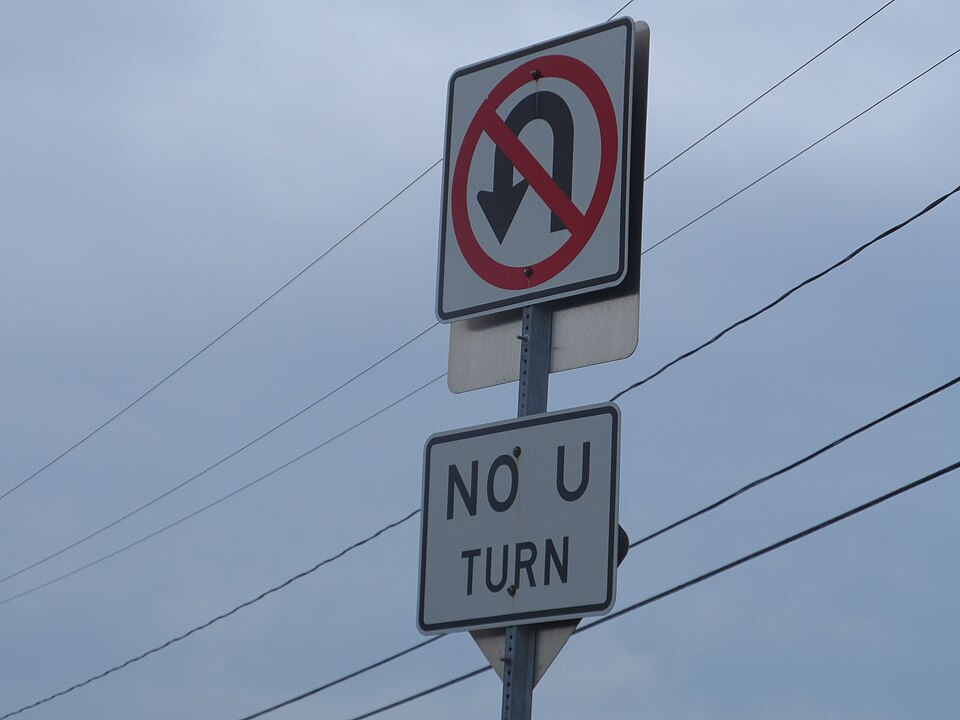
    • No state allows a U-turn where a NO U-TURN sign is posted.
    • Most limits are about visibility: you must be able to see oncoming traffic, and it must be able to see you, from a set distance.
    • California: 200 feet of clear view in each direction, and no U-turns in business districts except at intersections or divider openings.
    • Pennsylvania: traffic from all directions should be at least 500 feet away, and no U-turns on curves or near a hill crest.
    • Texas: no turning around near a curve or hill crest unless approaching drivers can see you within 500 feet.
    • Florida: legal only if it is safe, doesn’t interfere with other traffic and isn’t banned by a sign.

    Where U-turns are banned in most states

    The wording varies, but these places come up again and again in state handbooks and traffic codes:

    • Where a NO U-TURN sign is posted. This applies at intersections too, even on a green light.
    • On curves and near the top of a hill. Drivers coming the other way can’t see you in time.
    • At or on a railroad crossing. See railroad crossings.
    • On one-way streets. You would end up facing the wrong way.
    • Across a median, curb or painted barrier. On a divided highway, turn only at an opening provided for it.
    • Where you can’t see far enough in both directions.

    If you miss a turn, the California handbook’s advice works everywhere: keep driving until you can safely and legally turn around. On a freeway, that means taking the next exit. See freeway driving for new drivers.

    California U-turn rules

    The California Driver’s Handbook gives the most detailed list of any state checked. To make a U-turn, signal and use the left turn lane or far-left lane.

    You may make a U-turn Never make a U-turn
    Across a double yellow line Where a NO U-TURN sign is posted
    In a residential district, if no vehicles are approaching within 200 feet At or on a railroad crossing
    At an intersection on a green light or green arrow, unless a sign bans it On a divided highway by crossing a divider, curb, strip of land or two sets of double yellow lines
    On a divided highway, through an opening in the center divider When you can’t see clearly for 200 feet in each direction
    On a one-way street
    In front of a fire station, or using a fire station driveway to turn around
    In business districts, except at an intersection or a divider opening

    A business district is the part of a city or town where most offices and businesses are. A center left turn lane can also be used to prepare for a U-turn in California. See center two-way left-turn lanes.

    Pennsylvania, Texas and Florida compared

    State What the rule says Distance in the rule
    Pennsylvania Allowed only if it doesn’t endanger other traffic. Not allowed on curves or when approaching or near the crest of a hill, or where a NO U-TURN sign is posted. Drivers from all directions at least 500 feet away and able to see you clearly
    Texas You may not turn to go the opposite way when approaching a curve or hill crest if drivers coming from either direction can’t see you within 500 feet (Transportation Code 545.102). 500 feet, near curves and crests
    Florida Turning to go the opposite way is allowed only if it can be done safely, without interfering with other traffic, and isn’t banned by posted signs (Florida Statutes 316.1515). A violation is a moving violation. None stated

    Cities can add their own bans with signs, so the sign at the spot always wins. For other states, check the turning section of your state handbook. State guides are linked from learning to drive in the USA.

    How to make a safe U-turn, step by step

    1. Pick a legal spot. No sign against it, straight road, clear view both ways, not a business block mid-street (in California), not near a hill or curve.
    2. Signal left early and move into the left turn lane or the lane closest to the center.
    3. Stop or slow and check oncoming traffic, cross traffic, pedestrians and cyclists. Check your mirrors for anyone coming up behind.
    4. Turn the wheel fully and go around in one smooth movement, at walking pace.
    5. Finish in the correct lane going the other way, usually the lane nearest the center or the right lane if the road is narrow, then build up speed.

    If the road is too narrow to turn in one go, a U-turn isn’t the right move. Use a three-point turn instead, or drive on to a place where you can turn around. See three-point turns and turnabouts.

    Scenario: can you U-turn here?

    • A quiet residential street in California, no cars within 200 feet, no sign. Yes.
    • A shopping street downtown, mid-block, in California. No. Business districts allow U-turns only at an intersection or divider opening.
    • A green light at a big intersection with no sign. In California, yes. Watch for right-turning drivers coming from the cross street, who may also think they have the gap. If a sign bans it, no.
    • Just before the top of a hill on a country road in Pennsylvania or Texas. No. Oncoming drivers can’t see you in time.
    • Across the double yellow lines to turn around. In California the handbook allows a U-turn across a single set of double yellow lines, but never across two sets spaced two or more feet apart (a barrier). Check your own state.

    U-turns on the road test

    Examiners may ask you to turn around, but many states test a three-point turn or another turnabout instead of a U-turn. Either way, they score the same things: signaling, full observation before and during the turn, smooth control, and not choosing an illegal or unsafe place. An illegal U-turn in front of an examiner is the kind of dangerous or illegal maneuver that can end a test. See US road test by state and common reasons people fail the driving test.

    Common questions

    Is a U-turn at a traffic light legal?

    Often yes. California allows it on a green light or green arrow unless a NO U-TURN sign is posted. Other states may treat signal-controlled intersections differently or post signs, so look for a sign before you go.

    Can you make a U-turn on a double yellow line?

    In California, yes, across a single set of double yellow lines. Not across two sets of double yellow lines two or more feet apart, which count as a barrier. Rules differ elsewhere.

    Are U-turns illegal in a business district?

    In California, yes, except at an intersection or through an opening in a divided highway. Some other states have similar rules or use signs. Check your state handbook.

    How far must you be able to see before a U-turn?

    California says 200 feet in each direction. Pennsylvania says oncoming drivers should be at least 500 feet away and able to see you. Texas uses 500 feet near curves and hilltops.

    Can I U-turn in a center turn lane?

    California allows the center left turn lane to be used to prepare for a U-turn. You still need a legal, clear place to finish the turn.

    What is the penalty for an illegal U-turn?

    It is usually a moving violation, which may add points to your record. Florida’s law classes it as a moving violation. For how points work, see points systems and license suspensions.

    Sources

    • California DMV, “California Driver’s Handbook: Navigating the Roads” (dmv.ca.gov)
    • Pennsylvania Department of Transportation, “Pennsylvania Driver’s Manual: Turning, Merging, and Passing” (pa.gov)
    • Texas Legislature, “Transportation Code Chapter 545, Section 545.102” (tcss.legis.texas.gov)
    • Florida Legislature, “Florida Statutes s. 316.1515, Limitations on turning around” (leg.state.fl.us)
  • How to Pass on a Two-Lane Road: US Rural Driving Rules

    How to Pass on a Two-Lane Road: US Rural Driving Rules

    Photo: Max Andrey, Pexels

    To pass on a two-lane road, you need a broken yellow line on your side, a long clear view of oncoming traffic and enough room to get back into your lane well before any hill, curve, intersection or bridge. Pennsylvania says that at 45 mph you need about a quarter mile of clear road. This guide is for new US drivers and permit test takers. It covers the official passing rules and distances, no-passing zones, being passed, farm equipment and the slow-moving vehicle sign, gravel roads and rural road edges.

    Key facts

    • Read the center line. A broken yellow line on your side means you may pass when safe; a solid yellow line on your side means you may not.
    • No passing within 100 feet of an intersection, railroad crossing, bridge or tunnel in California, Pennsylvania, Alaska and Idaho, or when a hill or curve hides oncoming traffic.
    • How much road you need: about 1/4 mile at 45 mph (Pennsylvania). California says a hill or curve should be at least 1/3 mile ahead.
    • Return when you see the passed car’s headlights in your rearview mirror (Pennsylvania).
    • Orange triangle on the back: a slow-moving vehicle, designed for 25 mph or less.

    How to pass on a two-lane road, step by step

    1. Stay well back from the vehicle ahead so you can see past it (Alaska). Don’t swing across the center line just to look.
    2. Check the markings and signs. You need a broken yellow line on your side and no NO PASSING ZONE sign.
    3. Look far ahead for oncoming traffic, hills, curves, intersections, driveways and anything that could put a car in the passing lane (Pennsylvania, California).
    4. Check your mirrors and blind spot; someone may already be passing you (Pennsylvania, Idaho).
    5. Signal left early.
    6. Move out and accelerate. Pennsylvania says you need to be going about 10 mph faster than the vehicle you are passing.
    7. Pass without lingering. Idaho says to complete the pass before you come within 200 feet of oncoming traffic, and before a no-passing zone starts.
    8. Signal right once you can see the passed vehicle in your rearview mirror. Pennsylvania says to wait until you can see both of its headlights.
    9. Return to your lane and cancel the signal. Keep your speed; don’t cut in and slow down.

    Alaska’s manual also says to sound your horn to warn the driver ahead that you intend to pass.

    If you start to pass and it doesn’t look right

    Idaho says that if you start to pass but decide you can’t make it, pull back and wait for another opening. Brake gently, drop back behind the vehicle and signal back in.

    When you may not pass

    Situation Rule
    Solid yellow line on your side of the center line No passing (California, Alaska)
    Double solid yellow lines No passing in either direction (California)
    Approaching a hill or curve where you can’t see oncoming traffic No passing (California, Pennsylvania, Alaska, Idaho)
    Within 100 feet of an intersection or railroad crossing No passing (California, Pennsylvania, Alaska, Idaho, unless a sign or signal allows it)
    Within 100 feet of a bridge, tunnel or viaduct No passing (California, Pennsylvania; Alaska for posted narrow bridges; Idaho when the view is blocked)
    At crossroads and driveways No passing (California)
    School bus stopped with red lights and stop arm No passing (Alaska, Idaho). See school bus stopping laws.
    A vehicle ahead stopped at a crosswalk for a pedestrian No passing (Idaho)
    Passing would mean leaving the pavement Never (California, Idaho)
    A center turn lane Not for passing (Alaska, California)

    Alaska adds that the end of a no-passing zone doesn’t mean it is safe to pass, only that you can see further ahead. Line meanings are explained in US pavement markings.

    Passing on the right on a two-lane road

    Only when the driver ahead is turning left and you can pass safely without leaving the paved road (California, Idaho). Pennsylvania says you must stay on the berm or shoulder in that case. Never pass on the left when a driver is signaling a left turn (California).

    Speed while passing: the Idaho exception

    Most states give no extra speed for passing. Idaho does: in a passenger car, motorcycle or pickup that isn’t towing, you may go up to 15 mph over the limit to pass a vehicle traveling below the limit on a two-lane road posted at 55 mph or more. It doesn’t apply in work zones, and you must slow back to the limit as soon as practicable.

    Being passed

    • Don’t speed up. Alaska says it is unlawful to increase your speed while being passed.
    • Keep your lane and speed (California), or move to the right side of your lane to give the passing driver room and a better view (Idaho).
    • Help if a pass goes wrong. Alabama says that if a passing car can still complete the pass, slow down to let it in; if it must drop back, speed up to leave room behind you. If a crash is almost certain and the shoulder is good, move onto the shoulder.

    Turnouts and letting traffic pass

    • California: on a two-lane road where passing is unsafe, you must use a turnout to let traffic by when you are driving slowly and five or more vehicles are behind you.
    • Idaho: a vehicle going slower than normal traffic and delaying three or more vehicles in a rural area or on a two-lane highway must turn off where safe to let them pass.

    Farm equipment and slow-moving vehicles

    The slow-moving vehicle (SMV) emblem is an orange triangle with a red border, carried by vehicles designed to travel at 25 mph or less: tractors and other farm equipment, horse-drawn vehicles and some road maintenance vehicles.

    • By day, the orange center can be seen from more than one-fifth of a mile; at night, the red border reflects in your headlights (Alaska).
    • Slow down early. You close on a 25 mph vehicle very fast from 55 mph.
    • Stay a safe distance back and don’t honk to pass (Pennsylvania), which can frighten horses.
    • Watch for wide loads and sudden turns into fields and driveways, and pass only where it is legal and you can see far ahead.
    • Idaho limits most slow-moving vehicles to daylight hours, but farm equipment on non-interstate highways may travel at other times with flashing lights visible for 500 feet.

    Gravel and dirt roads

    • Expect the change. Alabama’s handbook shows a warning sign for road surfaces changing to gravel or dirt.
    • Lower speed limits may apply. Alabama’s statutory limit on an unpaved road is 35 mph, against 45 mph on county paved roads and 55 mph elsewhere, unless posted otherwise.
    • Adjust to the surface. California’s basic speed law says your speed must depend on the road surface, including graveled roads.
    • Practical tips (general guidance, not from a handbook): brake earlier and more gently, steer smoothly, leave extra distance for dust and flying stones, and slow down before curves rather than in them.

    Road edges and drop-offs

    Pennsylvania notes that drop-offs, where the shoulder is lower than the pavement, are common on rural roads. If your wheels go off, ease off the gas, don’t brake hard or jerk the wheel, slow right down, then steer back gently. Full steps: vehicle emergencies.

    More rural road hazards

    • Speed limits: California’s maximum on a two-lane undivided highway is 55 mph unless posted otherwise.
    • Cyclists: take one hazard at a time. With an oncoming car and a cyclist ahead, slow down, let the car pass, then move left to pass the cyclist with plenty of room: at least three feet in California, at least four feet in Pennsylvania’s example.
    • Animals: see deer and animal collisions.
    • Railroad crossings without gates are common in the country. See railroad crossings.
    • Night: passing at night is the most dangerous kind, because oncoming cars seem further away than they are (Pennsylvania). See night driving and high beams.
    • Trucks: see sharing the road with trucks.

    Permit test practice: passing and rural roads

    These are unofficial practice questions, written for this guide.

    1. On a two-lane road, a solid yellow line is on your side and a broken yellow line is on the other side. Can you pass? A) Yes, if the road looks clear B) No C) Only on the right D) Only if the other driver waves you by. Answer: B. A solid yellow line on your side means no passing (handbook: pavement markings).
    2. In many states, you may not pass within how many feet of an intersection or railroad crossing? A) 50 B) 100 C) 200 D) 500. Answer: B. 100 feet (handbook: passing).
    3. When is it safe to return to your lane after passing? A) As soon as your front bumper clears the car B) When you can see the car’s headlights in your rearview mirror C) After counting to two D) When the other driver flashes their lights. Answer: B. (Pennsylvania manual: passing).
    4. A vehicle with an orange triangle on its back is usually designed to travel at: A) 15 mph or less B) 25 mph or less C) 35 mph or less D) 45 mph or less. Answer: B. (handbook: slow-moving vehicles).
    5. Another car is passing you. You should: A) Speed up B) Keep your speed or slow slightly and stay in your lane C) Move toward the center line D) Brake hard. Answer: B. Increasing speed while being passed is unlawful in Alaska (handbook: being passed).
    6. Why is passing at night especially dangerous? A) Passing is banned at night B) Oncoming headlights make cars seem further away than they are C) Center lines aren’t visible D) Speed limits are higher. Answer: B. (Pennsylvania manual: passing on a two-lane road).

    More practice: US permit practice tests.

    Common questions

    How do you pass on a two-lane road?

    Check for a broken yellow line on your side and a long clear view, check mirrors and blind spot, signal, accelerate to about 10 mph faster than the vehicle, pass, and return once you can see its headlights in your mirror.

    How far ahead must the road be clear?

    Pennsylvania says about 1/4 mile at 45 mph; California says a hill or curve should be at least 1/3 mile ahead. Idaho says to finish the pass before you come within 200 feet of oncoming traffic.

    Can you speed to pass?

    In most states, no: the limit still applies. Idaho allows up to 15 mph over in limited cases on two-lane roads posted at 55 mph or more.

    Can you pass a tractor on a double yellow line?

    Not by these handbooks’ rules: double solid yellow lines mean no passing. Wait for a passing zone, or for the driver to pull over when safe.

    Should I honk before passing?

    Alaska’s manual says to sound your horn to warn the driver ahead. Pennsylvania says not to honk to pass farm tractors and horse-drawn vehicles. Use the horn lightly, and never near horses.

    What does the end of a no-passing zone mean?

    Only that you can see further ahead. Alaska says it doesn’t mean it is safe to pass. Check for yourself.

    Back to learning to drive in the USA. Related: speed limits and the basic speed law and work zone rules.

    Sources

    • California DMV, “California Driver’s Handbook: Section 6, Navigating the Roads; Section 7, Laws and Rules of the Road (Continued); Section 8, Safe Driving (Continued)” (dmv.ca.gov)
    • Pennsylvania Department of Transportation, “Pennsylvania Driver’s Manual” PUB 95, Chapter 3: Turning, Merging and Passing; Reactions to Slow Moving Traffic (pa.gov)
    • Alaska Division of Motor Vehicles, “Alaska Driver Manual” (Rev. 10/2025), Passing and Slow Moving Vehicles (dmv.alaska.gov)
    • Idaho Transportation Department, “Idaho Driver’s Manual” (July 2026), Passing and Slow-Moving Vehicle (itd.idaho.gov)
    • Alabama Law Enforcement Agency, “Alabama Driver Manual” (November 2024), speed limits, warning signs and driving emergencies (alea.gov)