
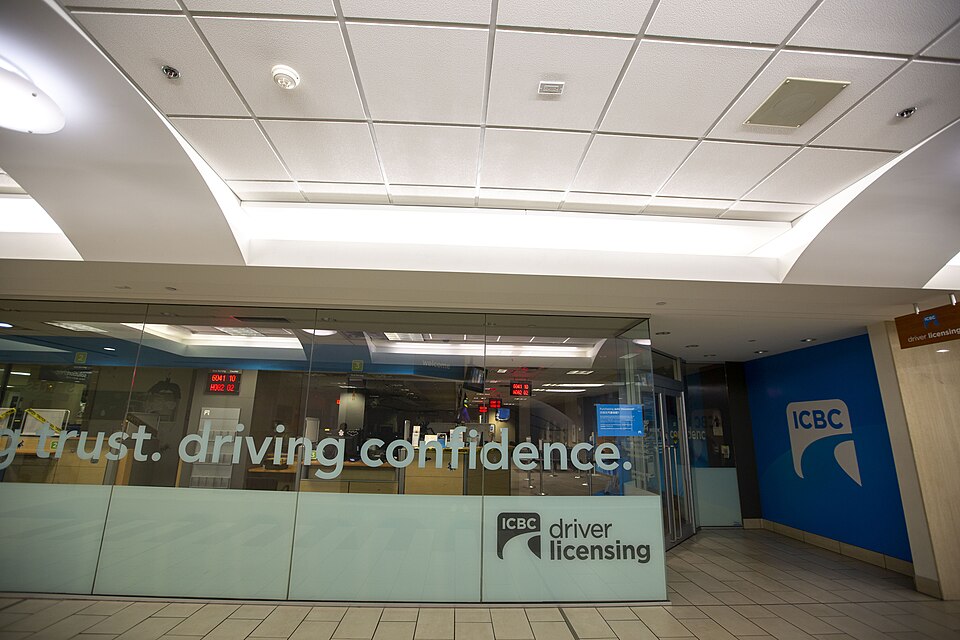
Author: Get Driving Test Ready

  • Moving to BC: Exchange Your Licence with ICBC Within 90 Days

    Moving to BC: Exchange Your Licence with ICBC Within 90 Days

    Photo: GoToVan, CC BY 2.0, via Wikimedia Commons

    If you move to British Columbia, you can drive on your valid licence from another province, state or country for 90 days, then you need a BC licence from ICBC. Whether you swap it straight over or take tests depends on where your licence is from, and whether you get a full Class 5 or start in graduated licensing depends on how much non-learner driving experience you can prove. This guide walks through both, step by step.

    Key facts

    • Deadline: 90 days after you move to BC.
    • Other Canadian provinces and territories: exchange at an ICBC driver licensing office, usually without tests.
    • Outside Canada: some licences exchange without testing; others need a knowledge test and road test.
    • Full Class 5: you must prove at least two years of non-learner driving. Less than that means a Class 7 (N) with graduated licensing restrictions.
    • You surrender your old licence. You can legally hold only one driver’s licence in BC.
    • Update ICBC within 10 days whenever you change address.

    Who needs to switch to a BC licence?

    Anyone who becomes a BC resident, within 90 days. ICBC advises applying well inside that window. You don’t need a BC licence if you are:

    • a tourist visiting for up to six months
    • a full-time student with a valid student exemption at a designated BC educational institution
    • a Seasonal Agricultural Worker Program (SAWP) worker, for up to 12 months on a valid home licence
    • ordinarily resident outside BC

    How to exchange your licence: step by step

    1. Book an appointment at an ICBC driver licensing office.
    2. Bring: accepted primary and secondary ID (most Government of Canada immigration documents count as primary ID), your current licence, proof of driving experience, and money for the licence fee.
    3. Translation: if your licence or records are not in English, ICBC may ask for a translation by an ICBC-approved translator. Requirements depend on the issuing country.
    4. Tests if required: vision screening, and a knowledge test and road test if your licence is not from an exchange jurisdiction.
    5. Surrender your old licence when you qualify for the BC one.

    Applications that need extra verification are put on hold. Any unpaid fines or debts owed to BC courts, the province or ICBC must be settled first. Check the current licence fee on ICBC’s Fees page.

    Moving to BC from another province

    • ICBC can usually look up the date you were first licensed in your Canadian province or territory, so you often don’t need paper proof.
    • If you are coming from Ontario, Manitoba, Saskatchewan, Yukon or Nunavut, ICBC asks for additional documents. Check the list on ICBC’s Proving your driving experience page before your appointment.
    • Coming from another province on a novice or learner licence? See the table below. You get credit for the time you have been driving.

    Moving to BC from another country

    ICBC exchanges licences from certain jurisdictions without extra testing, listed under “licence exchange jurisdictions” on its Moving from outside Canada page. ICBC’s handbook says holders of these licences can usually exchange the same day:

    • United States
    • Australia, New Zealand
    • Austria, France, Germany, the Netherlands, Switzerland, the United Kingdom
    • Japan, South Korea

    ICBC’s online ID guide also names Belgium, Guernsey, Ireland, the Isle of Man, Jersey and Taiwan as reciprocal countries. Confirm your country on ICBC’s exchange list before your appointment.

    From any other country you take a knowledge test and road test. Prepare with the ICBC knowledge test guide, the BC road signs and rules of the road chapters of Learn to Drive Smart.

    Will I get a full Class 5 or an N?

    Your experience BC licence you can get
    Two years or more on a full, non-learner licence, with proof Full-privilege licence (exempt from graduated licensing)
    Less than two years non-learner, or no proof Class 7 (N) with N restrictions, with credit for your driving time
    Out-of-province learner’s licence only Class 7L learner licence, with L restrictions
    Licence expired over three years ago, with no proof of recent driving Knowledge test and road test required

    ICBC’s handbook words the experience rule differently: 24 months of non-learner driving if you are under 25, or 12 months if you are 25 or older. Ask the driver licensing office which applies to you.

    If you start on an N in BC, you graduate through the Driving Record Assessment, not a second road test, since 19 October 2026.

    What counts as proof of driving experience?

    • An original, current licence printed by the issuing authority showing your first-issue date, or
    • An original driver record or letter of experience from the licensing body: signed or on its letterhead, with its contact details, your name, date of birth, licence number, licence classes and the original issue date.

    Photocopies and email printouts are not accepted, unless a copy has been approved and stamped by the licensing body. Emailed records can’t be used for the graduated licensing exemption. You can combine documents from more than one country to reach two years. If you already exchanged without proof, take the originals back to an office.

    Insurance credit

    Separately from licensing, ICBC credits up to 15 years of driving experience (learner time excluded) towards your insurance once it receives proof of your original licence date. Proof sent by email or fax must come directly from the licensing body, only some countries can use this route, and it can take up to 30 days to appear on your record.

    Enhanced driver’s licence (EDL)

    BC no longer issues the enhanced driver’s licence. ICBC says the program has been discontinued and existing EDLs stay in circulation until they expire. If you still hold one, changing the address needs an in-person appointment and a fee for the replacement card.

    Common questions

    Can I keep driving on my foreign licence after 90 days?

    No, not once you are a BC resident, unless one of the exemptions above applies. Book your exchange early, and check with ICBC before relying on an international driving permit.

    I’m an international student. Do I need a BC licence?

    Not if you are a full-time student with a valid student exemption at a designated BC institution. Otherwise the 90-day rule applies.

    Do I need a road test if I’m from Ontario?

    Not for a normal Canadian exchange, but bring the additional documents ICBC asks Ontario drivers for to prove experience.

    I had my licence two years back home but only have a photocopy. What now?

    ICBC won’t accept it. Ask your licensing authority for an original record or letter of experience, or a stamped copy, and get it translated by an ICBC-approved translator if needed.

    Can I keep my old licence as a backup?

    No. You must surrender every driver’s licence you hold, and you can only hold one in BC.

    Do I need a test from the US?

    US licences are on the list ICBC’s handbook names for same-day exchange. Confirm on the exchange list when you book.

    Back to the full guide: Learning to drive in BC. For other provinces: exchanging a foreign or out of province licence in Canada.

    Sources

    • ICBC, “Learn to Drive Smart, Chapter 9: Your licence” (icbc.com)
    • ICBC, “Moving and your licence” (icbc.com)
    • ICBC, “Moving from outside Canada” (icbc.com)
    • ICBC, “Moving from within Canada” (icbc.com)
    • ICBC, “Proving your driving experience” (icbc.com)
    • ICBC, “Driver licensing identification requirements” (apps.icbc.com)
    • ICBC, “B.C. government-issued credentials: card security features” (icbc.com)
    • ICBC, “Graduated licensing” (icbc.com)
  • ICBC-Approved Driving Courses: Do They Shorten Your BC N?

    ICBC-Approved Driving Courses: Do They Shorten Your BC N?

    Photo: GoToVan, CC BY 2.0, via Wikimedia Commons

    An ICBC-approved Graduated Licensing Program (GLP) course can cut your BC novice (N) stage from 24 months to 18, but only if you are under 25, finish the course while you are still a learner, and keep a clean record. This guide covers what the course includes, who qualifies, how much time it saves under the October 2026 rules, and how to pick a driving school.

    Key facts

    • Course length: at least 32 hours (16 in class, 12 on the road, 4 flexible).
    • Must be completed within one year, while you hold your L.
    • Saves 6 months of N time for drivers under 25: you can apply for the Driving Record Assessment after 18 months instead of 24.
    • You need a clean record during the N stage: no at-fault crashes, violations or prohibitions.
    • Bonus: two Grade 11 credits for high school students.
    • Only schools with an ICBC Driving School Licence carrying a GLP designation can run approved courses.

    Does an ICBC-approved course shorten your N?

    Yes, by six months, if you meet every condition:

    1. You are under 25. Drivers 25 and older already have a 12-month N stage and get no reduction.
    2. You complete the approved course during your learner stage. A course taken after you pass the Class 7 road test does not count.
    3. You finish it within one year.
    4. Your N record stays clean: no at-fault crashes, violations or prohibitions. ICBC’s handbook applies this test to the first 18 months of your N.

    From 19 October 2026 the reward is a Driving Record Assessment after 18 months of safe N driving, instead of 24. There is no longer a Class 5 road test at the end of the N stage.

    The course does not shorten the learner stage. You still need at least 12 months as an L (9 if you are 25 or older) before the Class 7 road test.

    Worked example: starting your L at 16

    Step Without a course With an approved course
    L licence 16 16 (course finished during the L)
    Earliest Class 7 road test 17 17
    Earliest Driving Record Assessment 19 18 and a half
    Full Class 5 (after 12 restricted months) 20 19 and a half

    These dates assume minimum times and no prohibitions. A prohibition in the N stage resets your N time to zero, with or without a course.

    What is in an ICBC-approved GLP course?

    Part Minimum hours
    In-class instruction (theory) 16
    On-road instruction 12
    Flexible or discretionary time 4
    Total 32

    When you finish, the school gives you a Declaration of Completion. High school students take it to their school office for two Grade 11 credits.

    Is an approved course worth it?

    • Worth it if: you are under 25, still on your L, and want your full licence six months sooner. The 12 hours on the road also build towards the 60 hours of practice ICBC suggests before the Class 7 road test.
    • Less value if: you are 25 or older (no time saved), or you already hold your N (too late for the reduction). Ordinary lessons may suit you better.
    • No time saved if: you get a violation, at-fault crash or prohibition during the N stage.

    Schools set their own prices. Before training starts and before you pay, a school must give you a written statement of its fees and possible extra charges, how many people may ride in the car and why, the actual practice-driving time in each lesson, the price per lesson and its refund policy. It must also give you an itemized statement of the services provided and a receipt for every payment.

    Compare totals, not headline prices. A one-hour booking may include less than an hour at the wheel, and the road-test car or pickup may cost extra. Keep the written terms and receipts in case of a dispute.

    How to choose a BC driving school

    Every driving school and instructor in BC must be licensed by ICBC. ICBC publishes a map of approved GLP schools on icbc.com (Find a driving school). The list is not an endorsement. Questions ICBC suggests asking:

    • Are the school and instructors licensed? Schools must post these licences where customers can see them.
    • Do you offer an ICBC-approved GLP course? Can I see the course outline?
    • Can I see your written rates, hours, class sizes and refund policy?
    • What teaching methods do you use (one-on-one, classroom groups)?
    • How experienced are your instructors, and how recent is their training?
    • How do you involve parents or supervisors?
    • How do you maintain your training cars? Do you have a manual (standard) car if I want one?
    • What do I need before I start?

    Also ask people who have used the school. Schools must follow ICBC’s Driving School Code of Conduct, and ICBC takes complaints about instructors and schools and lists those suspended or terminated.

    Course vs lessons

    Licensed BC schools offer on-road lessons alone, on-road lessons with in-class group teaching, and the approved GLP course. Only the approved course earns the N reduction and school credits. Lessons alone can still help you prepare for the Class 7 road test.

    Common questions

    Can I take the course after I get my N?

    You can take lessons, but the six-month N reduction only applies to an approved course completed during the learner stage.

    Does the course let me take the road test sooner?

    No. The minimum learner time stays the same. The saving comes in the N stage.

    I’m 26. Is there any reduction?

    No. ICBC’s reduction is for drivers under 25. Your N stage is already 12 months.

    What if I get a ticket during my N?

    A violation during the N stage cancels the reduction, so you would need the full 24 months. An excessive speed or device conviction also blocks the Driving Record Assessment.

    How do I know a course is ICBC-approved?

    The school displays a valid ICBC Driving School Licence with a GLP designation, and appears on ICBC’s list of approved GLP schools.

    Does the course get me an insurance discount?

    Ask an Autoplan broker whether any discount applies to you.

    Back to the full guide: Learning to drive in BC. Related: BC learner licence rules, BC N licence rules, penalty points and prohibitions.

    Sources

    • ICBC, “Learn to Drive Smart, Chapter 9: Your licence” (icbc.com)
    • ICBC, “Changes to the Graduated Licensing Program” (icbc.com)
    • ICBC, “Graduated licensing” (icbc.com)
    • ICBC, “New drivers or riders” (icbc.com)
    • ICBC, “Choosing your driving school: GLP schools” (icbc.com)
    • Province of British Columbia, Motor Vehicle Act Regulations, section 27.06 (bclaws.gov.bc.ca)
  • ICBC Penalty Points and Driver Risk Premium for New BC Drivers

    ICBC Penalty Points and Driver Risk Premium for New BC Drivers

    Photo: Ruth Hartnup, CC BY 2.0, via Wikimedia Commons

    New BC drivers pay for driving offences three ways: the ticket fine, penalty points that lead to an ICBC Driver Penalty Point premium, and for serious offences, a separate Driver Risk Premium. On an L or N, offences also bring warning letters, prohibitions and lost GLP time. This guide explains each penalty, what it costs as of November 2026, and how it affects your path to a full Class 5.

    Key facts

    • Speeding ticket: 3 penalty points and a fine of $138 to $483 (ICBC).
    • Electronic device ticket: $368 and 4 penalty points. L and N drivers cannot use any device, even hands-free.
    • Four or more points at the end of a 12-month period means a Driver Penalty Point (DPP) premium bill from ICBC.
    • One excessive speeding conviction, one Criminal Code driving conviction or two device convictions in three years can trigger the Driver Risk Premium (DRP).
    • A prohibition in the N stage resets your N time to zero. Reinstatement costs $250.
    • Going 40 km/h or more over the limit: police can impound the vehicle for 7 days.

    How ICBC penalty points work

    Most tickets under BC’s Motor Vehicle Act carry penalty points as well as a fine. ICBC adds up your points and bills you a Driver Penalty Point premium if you have four or more points at the end of a 12-month assessment period. The more points, the bigger the bill.

    • The premium is billed once a year.
    • It is separate from your Autoplan insurance, so you pay it even if you don’t own or insure a vehicle.
    • Unpaid driver premiums and unpaid tickets must be cleared before you can renew or get a new licence, and can affect whether you can buy Autoplan.

    Check the current point-to-premium scale on ICBC’s Driver Penalty Point Premium page.

    Example points from ICBC

    Offence Points Fine
    Speeding 3 $138 to $483, rising the further over the limit you are
    Using an electronic device 4 $368

    One device ticket on its own puts you at four points, enough for a DPP premium bill.

    What triggers the Driver Risk Premium in BC?

    You pay the DRP if your record shows any of these in the past three years:

    • one or more driving-related Criminal Code convictions
    • one or more 10-point Motor Vehicle Act convictions
    • one or more excessive speeding convictions
    • two or more roadside suspensions or prohibitions
    • two or more electronic device convictions

    ICBC reviews your record each year just before your assessment date, usually your birthday. One offence can show up on more than one yearly bill because ICBC looks back three years. Like the DPP premium, the DRP is billed even if you don’t own a vehicle.

    How much is the Driver Risk Premium?

    ICBC’s table (amounts as of 1 October 2021) shows how fast it climbs:

    Number of convictions Criminal Code Roadside suspensions, device use or excessive speed
    2 $4,602 $453
    3 $9,988 $526
    5 $29,376 $685
    10 $29,376 $1,383

    A single Criminal Code conviction is listed at $1,108 a year. Check the current amounts on ICBC’s Driver Risk Premium page before relying on them.

    ICBC says giving up your licence for the whole billing period may eliminate the DRP, and for at least 30 days may reduce it. You arrange this by appointment at a driver licensing office.

    Extra penalties for L and N drivers

    The Superintendent of Motor Vehicles watches GLP records closely, and the threshold for action is stricter than for fully licensed drivers.

    • Breaking an L or N restriction (passengers, L or N sign, hours, devices) can bring a fine and penalty points.
    • A ticket can lead to a warning letter, probation or a prohibition.
    • More points or a serious offence can mean a prohibition of one month to a year or more.
    • One device ticket is enough for ICBC to review a GLP driver’s record, and it may lead to a prohibition.

    Your licence card: the rules

    Always carry your licence when you drive, and tell ICBC within 10 days when your name or address changes. Never lend your licence, alter it or use one that is not valid. Licence and ID card fraud, including using or holding someone else’s licence, letting someone use yours, or giving false information to get one, carries a fine of $400 to $20,000, up to six months in jail, or both. Keep the card on you rather than in the car, and if it is lost report it to police and ICBC straight away.

    The Driver Improvement Program

    RoadSafetyBC runs the Driver Improvement Program. Every offence added to your record is reviewed. If you keep offending:

    1. You may get a warning letter.
    2. You may be put on probation. More offences during probation can lead to a prohibition.
    3. If you build up offences quickly, you can be prohibited without any warning first.

    What a prohibition does to your licence stage

    Stage Effect of a driving prohibition
    Learner (L) Your L time stops counting until you have served the prohibition and been reinstated, so the learner stage is extended.
    Novice (N) All N time is lost. After reinstatement you need a fresh 24 consecutive prohibition-free months (12 if you are 25 or older).
    Class 5 with 0 BAC/BDC restriction The 12-month restriction period starts again.

    Separately, any excessive speeding or device conviction during your N period stops you passing the Driving Record Assessment that replaced the Class 5 road test on 19 October 2026. You need no such convictions, and no prohibitions or suspensions, during the qualifying period.

    Driving while prohibited can mean impoundment, a large fine and jail. To be reinstated you pay a $250 fee, plus any outstanding fines and ICBC premiums.

    An impaired driving conviction costs more than the penalties above. ICBC can deny your insurance claim if you crash, so you pay for the damage yourself, your rates rise, some jobs become closed to you, and countries such as the United States and Mexico can refuse you entry.

    Alcohol and drug penalties for new BC drivers

    L and N drivers, and Class 5 drivers in the 12-month restricted period, must have zero alcohol and zero drugs, including THC. The BC government’s RoadSafetyBC page (updated 15 October 2026) sets out what happens:

    • Any alcohol, THC or cocaine: police can serve a 12-hour suspension. It cannot be reviewed, and you can’t drive until it ends and you get your licence back from police.
    • The suspension is recorded and may lead to a longer prohibition, penalty points and a vehicle impoundment.
    • Another prohibition means starting your N period again.
    • At 0.05 or higher, or if your driving is affected by drugs, you also face the same penalties as fully licensed drivers, below.

    Immediate Roadside Prohibition (IRP) costs

    Approximate totals before tax, from RoadSafetyBC (costs may change):

    Reading Prohibition Impoundment Approximate total
    First Warn (0.05 or higher) 3 days 3 days $600
    Second Warn in 5 years 7 days 7 days $780
    Third Warn in 5 years 30 days 30 days $1,330
    Fail (0.08 or higher) or refusal 90 days 30 days $1,430

    Totals include towing and storage, an administrative penalty and the $250 reinstatement fee. RoadSafetyBC can also require the Responsible Driver Program or the Ignition Interlock Program, which cost extra. Two roadside prohibitions also trigger the Driver Risk Premium.

    24-hour prohibitions and ADPs

    • 24-hour prohibition: when police believe alcohol or drugs affected your driving. It stays on your record permanently. You have seven days to apply for a review.
    • Administrative Driving Prohibition (90 days): for a blood alcohol of 0.08 or more, a blood drug level at the set limit (for THC, 5 ng/mL) within two hours of driving, or a failed or refused Criminal Code demand. An ADP also brings the Driver Risk Premium.

    Criminal Code penalties are covered in impaired driving in Canada for new drivers.

    When can police impound your vehicle in BC?

    As well as impaired driving, police can impound the vehicle you are driving for:

    • driving unlicensed
    • driving while suspended or prohibited
    • excessive speeding (40 km/h or more over the posted limit)
    • street racing or stunt driving
    • riding, or letting a passenger ride, while improperly seated

    The first impoundment is 7 days, rising to 30 or 60 days for repeat offenders. The owner pays towing and storage. If you borrow a parent’s car and it is impounded, they pay to get it back.

    Common questions

    Does one speeding ticket reset my N in BC?

    No. A ticket alone does not reset the clock; a prohibition does. But a speeding ticket’s points can lead to Driver Improvement action, and an excessive speeding conviction blocks the Driving Record Assessment.

    How many points before an N driver is prohibited?

    RoadSafetyBC does not use one fixed number. Each record is reviewed individually, and the threshold for GLP drivers is stricter. Read the Driver Improvement Policies and Guidelines on the RoadSafetyBC website for detail.

    Do I pay the Driver Penalty Point premium if I don’t own a car?

    Yes. Both driver premiums are billed to the driver, not the vehicle.

    Is the Driver Risk Premium the same as my insurance going up?

    No. It is a separate yearly bill. Convictions can also raise optional Collision and Extended Third Party Liability premiums.

    What happens if an L driver gets a prohibition?

    Your learner time stops counting until you are reinstated, so your earliest Class 7 road test date moves back.

    Can I appeal a 12-hour suspension?

    No. RoadSafetyBC says 12-hour suspensions cannot be reviewed. You can apply for a review of 24-hour, IRP and ADP prohibitions.

    Back to the full guide: Learning to drive in BC. Related: BC N licence rules, BC learner licence rules, BC personal strategies.

    Sources

    • ICBC, “Learn to Drive Smart, Chapter 9: Your licence” (icbc.com)
    • ICBC, “Driver Risk Premium” (icbc.com)
    • ICBC, “Driver Penalty Point Premium” (icbc.com)
    • ICBC, “Distracted driving” (icbc.com)
    • ICBC, “Speed” (icbc.com)
    • ICBC, “Licence suspensions” (icbc.com)
    • ICBC, “Changes to the Graduated Licensing Program” (icbc.com)
    • Government of British Columbia, RoadSafetyBC, “Alcohol and drug related driving prohibitions and suspensions” (gov.bc.ca)
  • BC Road Signs, Signals and Markings: Knowledge Test Guide

    BC Road Signs, Signals and Markings: Knowledge Test Guide

    Photo: Hinto, CC BY-SA 3.0, via Wikimedia Commons

    This guide covers the road signs, traffic lights and pavement markings in ICBC’s Learn to Drive Smart chapter 3, the material behind the sign questions on the BC knowledge test. You read a sign by its shape, its colour and its message. The facts most often tested are school and playground zone times, light meanings and yellow line passing rules. Read it with ICBC’s road signs practice test, since the signs themselves are pictures.

    School and playground zones in BC

    Sign Limit When it applies
    School zone with a speed tab only As shown (for example 30 km/h) 8 a.m. to 5 p.m. on school days
    School zone with times on the tab As shown The hours on the tab, on school days
    School zone, 50 km/h version 50 km/h 8 a.m. to 5 p.m. on school days when children are on the roadway or shoulder
    Playground zone 30 km/h Every day, dawn to dusk

    School zone and school crosswalk signs are fluorescent yellow-green. The zone ends at the back of the school zone sign on the other side of the street. ICBC examiners say speeding through school and playground zones is a common reason for failing the road test.

    Sign types by shape and colour

    Type What it does Examples
    Regulatory States a law; ignoring it is an offence under the BC Motor Vehicle Act Stop, yield, speed limit, do not enter, one way, no right turn on red, keep right, winter tires or chains required
    School, playground, crosswalk Extra caution zones School zone, playground zone, pedestrian-activated crosswalk
    Lane use and turn control Which lanes may turn or go straight; turn control signs hang over the intersection Left turn only, straight or right, two lanes must turn left
    Parking Where and when you can park No parking, time-limited parking, disabled parking
    Reserved lane Marked with a white diamond Bus only, bus and HOV, reserved curb lane ahead
    Warning Mostly yellow diamonds; hazards ahead Sharp curve, merging traffic, right lane ends, roundabout ahead, deer
    Object markers Mounted on the obstruction itself; pay special attention and pass on the side shown Obstruction, keep right; obstruction, keep left; obstruction, keep right or left
    Construction Work zones; obey them and traffic control persons Crew working, traffic-control person ahead, fine notice for speeding in a work zone
    Information and destination Routes, distances in kilometres, services Trans-Canada Highway marker, hospital, gas
    Railway Crossings; always yield to trains Railway crossing ahead, stop then proceed, stay stopped until gate is fully raised

    BC highway signs worth knowing

    • Slow vehicle pullout: slow traffic delaying 5 vehicles must use the pullout.
    • Keep right except to pass and move right if driving slower.
    • Winter tires or chains must be used when the sign is displayed. See winter driving in Canada for new drivers.
    • Stay off this road in major disasters: emergency vehicles only.
    • Remove sunglasses, tunnel ahead, snow shed ahead, use headlights ahead.

    What BC traffic lights mean

    Signal Meaning
    Steady red Stop. After a full stop you may turn right, or left onto a one-way street, unless a sign forbids it.
    Steady yellow Stop before the intersection unless you cannot safely stop in time.
    Steady green Go if the intersection is clear.
    Flashing red Stop, then go when safe.
    Flashing yellow Slow down and proceed with caution.
    Flashing green Pedestrian-controlled light. Go only if the intersection is clear.
    Green arrow Turn in the arrow’s direction.
    Flashing green arrow with steady green Turn in the arrow’s direction or go straight.
    Flashing green arrow with steady red Left turn allowed; through traffic stops.
    Yellow arrow Advance left signal is ending. Stop unless you cannot safely do so.
    Steady white rectangle Transit priority signal: only buses may go.

    Lane control signals

    • Signals hung over each lane show whether you may drive in it, must not drive in it, or must move out into a lane showing a green arrow.
    • All flashing yellow: slow down and proceed with caution.

    Yellow lines: passing rules

    Marking Meaning
    Single broken yellow Passing allowed when safe
    Broken and solid yellow Pass only when the broken line is on your side and it is safe
    Double solid yellow No passing
    Single solid yellow Passing allowed with extra caution
    Double broken yellow Reversible lane; lane control signals show whether you may use it
    Solid and broken pairs on both sides of a lane Two-way left-turn lane, shared by both directions

    Yellow lines separate traffic moving in opposite directions: a yellow line on your left means oncoming traffic is on the other side of it.

    White lines and other markings

    • White lines separate lanes going the same way. Solid: do not change lanes. Broken: change when safe.
    • Stop line: stop before it.
    • Crosswalk lines: stop for pedestrians in the crosswalk. Some have lights in the pavement.
    • HOV lanes: thick solid or broken lines with white diamonds.
    • Bicycle lane: bicycle outline, sometimes a diamond; cyclists ride with the adjacent traffic.
    • Painted island: keep right; do not drive on or over it.
    • Driving over freshly painted, wet markings is illegal.

    Common questions

    What are BC school zone hours?

    8 a.m. to 5 p.m. on school days, unless the sign shows other hours.

    Are BC playground zones in effect on weekends?

    Yes. The 30 km/h playground limit applies every day from dawn to dusk.

    What does a white rectangle traffic light mean in BC?

    It is a transit priority signal. Only buses may go.

    Can I pass on a single solid yellow line in BC?

    ICBC’s guide says passing is allowed with extra caution. You may also cross one to pass a cyclist when safe.

    What colour are warning signs?

    Most are yellow and diamond-shaped. School zone and school crosswalk signs are fluorescent yellow-green.

    What should I do if all traffic lights are out?

    Treat the intersection as a four-way stop.

    Back to the full guide: Learning to drive in BC. Related: ICBC knowledge test, BC rules of the road, Sharing BC roads.

    Sources

    • ICBC, “Learn to Drive Smart, chapter 3: Signs, signals and road markings” (icbc.com)
    • ICBC, “Learn to Drive Smart, chapter 4: Rules of the road” (icbc.com)
    • ICBC, “Tuning Up for Drivers” (icbc.com)
    • ICBC, “Take the practice knowledge test” (icbc.com)
    • ICBC, “Graduated licensing” (icbc.com)
  • Sharing BC Roads: Cyclists, School Buses, Transit and Horses

    Sharing BC Roads: Cyclists, School Buses, Transit and Horses

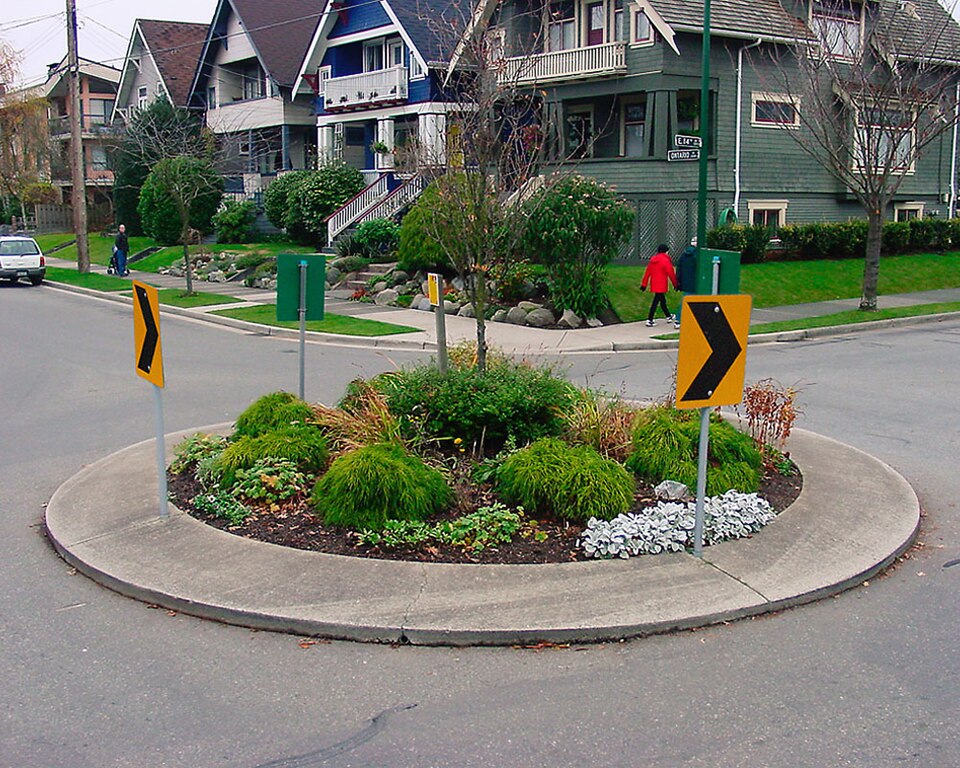
    Photo: Crispin Semmens, CC BY-SA 2.0, via Wikimedia Commons

    This guide covers the BC rules for sharing the road with pedestrians, cyclists, motorcycles, large vehicles, school and transit buses, emergency and roadside vehicles, construction zones, trains and horses, from ICBC’s Learn to Drive Smart chapter 6. These rules turn up on the knowledge test and the Class 7 road test. The numbers learners most often need are in the first table.

    BC sharing-the-road numbers

    Rule Requirement
    Passing a cyclist, pedestrian, mobility device user or horse rider At least 1.0 m; at least 1.5 m where the limit is above 50 km/h; at least 0.5 m if they are on a sidewalk or protected cycle lane
    Following a motorcycle At least 3 seconds
    Following a fire truck At least 150 m back
    Passing a stopped vehicle with flashing lights, limit 80 km/h or more No faster than 70 km/h
    Passing a stopped vehicle with flashing lights, limit under 80 km/h No faster than 40 km/h
    Yielding to a transit bus pulling out On roads with limits of 60 km/h or lower
    Stopping at a railway crossing No closer than 5 m and no further than 15 m from the nearest rail
    Stalled on a track Get everyone out and at least 30 m away
    Construction zones Posted limits apply 24 hours a day; fines are double

    Pedestrians

    You must yield to pedestrians:

    • in marked crosswalks, if they are close to your half of the road
    • at intersections, even with no marked crosswalk
    • when you are turning
    • when entering a road from a driveway or alley

    Never pass a vehicle that is slowing or stopped at a crosswalk or intersection for a pedestrian: it is illegal, and the driver may be shielding someone you cannot see. Check a crosswalk is empty before entering, even on green. If a visually impaired person raises their white cane, stop and give them the right-of-way, without revving or honking. It is always the driver’s responsibility to avoid hitting a pedestrian.

    Cyclists

    • Cyclists have the same rights and responsibilities as drivers. Yield to them as you would to any vehicle.
    • Shoulder check before opening your door, pulling away from the curb and moving right. Dooring is one of the most common causes of cyclist crashes.
    • A cyclist may move toward the middle of the lane to avoid glass, potholes or a narrow lane, or to turn left.
    • The passing gap is measured from the widest part of your car, usually the mirror, to the furthest part of the person or their equipment, such as handlebars. It is a minimum, not a target.
    • You may cross a single or double yellow centre line to pass a vulnerable road user if it is safe. Signal first. If you cannot leave the full gap, stay back until you can.
    • On a multi-lane road, change lanes rather than squeeze past.
    • Do not honk unless warning them; it can cause a fall.

    Motorcycles

    • Never share a lane with a motorcycle; it needs the whole lane.
    • Keep at least 3 seconds behind; motorcycles can stop very quickly.
    • Look hard for oncoming motorcycles before turning left. Their speed is hard to judge.
    • A rider in the left of the lane may just be making themselves visible, not turning.

    Other cars and light trucks

    Drivers of cars, vans and pickups can be as unpredictable as anyone else: tired, impatient, impaired, not looking ahead, or in a car with brake or signal lights that do not work. Watch their vehicle language, leave space, and use see-think-do around them as you would around a cyclist or a truck.

    Large vehicles

    • If you cannot see both of a truck’s mirrors, the driver cannot see you.
    • Do not sit on the right of a truck that may turn right; you can be squeezed against the curb.
    • After passing, wait until you see the truck’s headlights in your rear-view mirror before pulling back in.
    • Uphill behind a truck, leave extra space; it may roll back.
    • Trucks can slow with engine retarders without brake lights showing.
    • On BC logging roads, use headlights and always yield to logging trucks.

    School buses in BC

    When a school bus has alternating flashing red lights at the top, you must stop whether you are approaching from the front or the rear. Vehicles in all lanes must stop. Do not move until the bus moves on or the driver turns off the lights and pulls in the stop sign. Flashing amber lights warn that the bus is about to stop. For other provinces’ rules see school bus stopping rules across Canada.

    Transit buses

    On roads with a limit of 60 km/h or lower, let a transit bus that is signalling and showing a yield-to-bus sign pull out from the curb lane or a stop. Change lanes if you can; otherwise slow down.

    Emergency and roadside vehicles

    Approaching with lights and siren

    All traffic in both directions must pull over and stop, usually to the right (to the left if you are in the left lane of a divided highway or on a one-way street). Do not stop in an intersection. Exception: on a divided highway with the emergency vehicle on the other side of the median, you may not need to stop. Never drive over a fire hose.

    Stopped with flashing lights

    The rule covers any vehicle authorized to show flashing yellow, red, white or blue lights: police, fire, paramedics, tow trucks, highway maintenance and utility crews, commercial vehicle inspectors, conservation officers, land surveyors, animal control and garbage collectors. Slow to 70 km/h (limit 80 km/h or more) or 40 km/h (limit below 80 km/h), and move out of the nearest lane if safe. It does not apply when you are on the opposite side of a divided highway. Breaking it can bring a ticket and penalty points. Canada-wide comparison: slow down, move over laws.

    Construction zones

    • Obey traffic control persons and signs from start to end of the zone.
    • Posted construction limits apply 24 hours a day; fines are doubled.
    • Merge early for lane closures, avoid lane changes inside the zone and leave space around crews.

    Trains

    • Trains always have the right-of-way. Most need about 2 km to stop, and passenger trains in Canada travel at up to 160 km/h.
    • Stop for lowered gates or flashing red lights, and wait for gates to rise fully.
    • Watch for a second train behind the first.
    • Do not stop on the tracks for a red light beyond the crossing; wait before it unless there is room.
    • In a manual car, change down before crossing, never on the tracks.
    • If stuck, get everyone 30 m away, then call the number on the back of the crossing sign, or 911.

    Horses

    Horses may be ridden on most public roads, and riders and carriage drivers have the same rights as motorists. Slow down, leave extra room when passing, avoid the horn, and stop if the rider is struggling to control the horse.

    Common questions

    What do flashing amber lights on a BC school bus mean?

    The driver is preparing to stop. Slow down and be ready: once the red lights flash, every lane must stop, from the front or the rear.

    How much space must I give a cyclist in BC?

    At least 1.0 m, or 1.5 m where the limit is above 50 km/h.

    How slow must I go past a tow truck with flashing lights?

    70 km/h on roads posted 80 km/h or more; 40 km/h on roads posted below 80 km/h.

    Do I have to let buses merge?

    Yes, on roads posted 60 km/h or lower, when the bus is signalling and shows a yield-to-bus sign.

    Are construction zone limits only for working hours?

    No. When posted, they apply 24 hours a day.

    Back to the full guide: Learning to drive in BC. Related: BC rules of the road, See-think-do, wildlife collisions in Canada.

    Sources

    • ICBC, “Learn to Drive Smart, chapter 6: Sharing the road” (icbc.com)
    • ICBC, “Learn to Drive Smart, chapter 5: See-think-do” (icbc.com)
    • ICBC, “Graduated licensing” (icbc.com)
    • Government of British Columbia, “Vulnerable road users” (gov.bc.ca)
  • BC Rules of the Road: Intersections, Roundabouts, HOV, U-Turns

    BC Rules of the Road: Intersections, Roundabouts, HOV, U-Turns

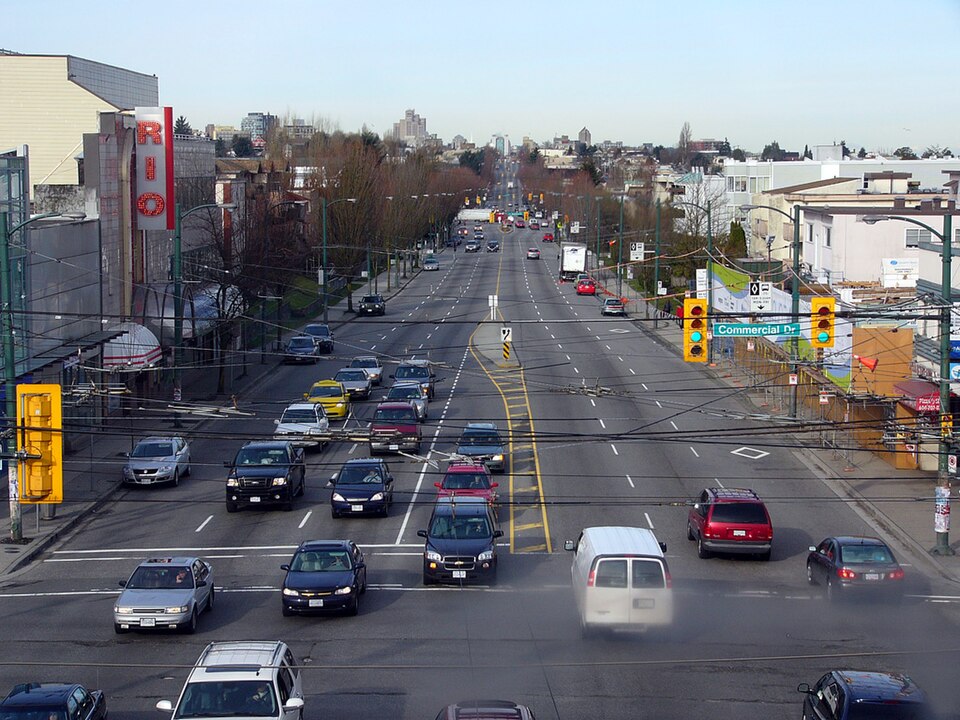
    Photo: Richard Drdul, CC BY-SA 2.0, via Wikimedia Commons

    This is a study guide to BC’s rules of the road from ICBC’s Learn to Drive Smart chapter 4: who yields at each type of intersection, how traffic circles differ from roundabouts, lane choice, HOV and bus lanes, when U-turns are illegal, passing and parking distances. The short answer on roundabouts: yield to traffic already in it, go counter-clockwise, never change lanes inside, and signal right before you exit.

    Right-of-way at BC intersections

    Situation Who goes first
    Uncontrolled intersection The vehicle that arrived first. If two arrive together, the vehicle on the left yields to the one on the right. Treat an unmarked T-intersection the same way.
    Four-way stop First to arrive and stop fully goes first. Same time: the one on the right. Facing each other: the left-turner yields to the one going straight.
    Two-way stop Through-street traffic has the right-of-way. Between two stopped drivers, the one turning left yields, unless already in the intersection and turning.
    Yield sign Traffic on the through road. Enter without stopping only if it is clear.
    Left turn on a green light Oncoming traffic; wait for a safe gap. If the light turns yellow while you are in the intersection, you may complete the turn.
    Lights out or all flashing Treat it as a four-way stop.
    Traffic control person present Follow their directions.

    Red lights and arrows

    • After a full stop on a steady red, you may turn right, or turn left onto a one-way street, unless a sign forbids it.
    • A flashing green arrow with a steady red: you may turn left; through traffic stops.
    • When the advance arrow ends and only the green light shows, you can still turn left but must yield to pedestrians and oncoming traffic.
    • A stale green (green for a while) may turn yellow soon. Pick your “point of no return” as you approach.
    • Backing into an intersection or over a crosswalk is illegal.

    Where to stop

    1. Just before the stop line, if there is one.
    2. No stop line: just before the crosswalk, marked or unmarked. An unmarked crosswalk exists at an intersection wherever the sidewalk edges on either side would join if extended across the road, so missing paint does not mean there is no crossing.
    3. No line, crosswalk or sidewalk: just before you enter the intersection.

    Traffic circle vs roundabout in BC

    Traffic circle Roundabout
    Where Mostly residential neighbourhoods Usually larger, sometimes multi-lane
    Yield to Traffic in the circle; posted signs. Arriving together: the vehicle on your right. No signs: treat as uncontrolled. Pedestrians in the approach crosswalk, then traffic already in the roundabout
    Direction Counter-clockwise; turn right to enter and right to leave Counter-clockwise
    Lanes Single Left lane: straight or left. Right lane: right or straight. No lane changes inside.
    Exit Turn right out Signal right before you exit; yield to pedestrians at the exit crosswalk

    In a roundabout, do not ride alongside trucks or buses: they may need more than one lane. If an emergency vehicle is coming, do not block the circle; stop before entering, or exit and then stop.

    Using lanes correctly

    • On multi-lane highways use the right-hand lanes. On freeways with three or more lanes each way, use the centre or right lanes.
    • Turn into the matching lane: from a two-way road onto a two-way road, centre lane to centre lane. One-way to one-way, left lane to left lane.
    • In a designated lane, follow the arrows. Do not move into or out of it inside the intersection.
    • Two-way left-turn lanes are shared by both directions; watch for oncoming turners.
    • Where there are two turning lanes, finish in the matching lane: far-left lane into the far-left lane, the next lane into the next lane. Read the lane-use signs and markings before the turn.
    • You may turn left mid-block, even across a solid double yellow line, if it is safe, does not impede traffic and no sign prohibits it.
    • Legally, you must signal every lane change. Do not change lanes in an intersection.
    • Leftmost lane rule: where there are two or more marked lanes in your direction (not counting bus, HOV or designated-use lanes), the limit is 80 km/h or more and traffic is moving at 50 km/h or more, you must leave the leftmost lane when a vehicle comes up behind you in it, if it is safe. Exceptions: you are passing another vehicle, letting traffic merge, getting ready to turn left or exit, or passing an official vehicle stopped at the roadside. It never means speeding up or cutting into an unsafe gap.

    Cul-de-sacs

    A cul-de-sac is a street closed at one end, and most are built with a turning area so you can come back out without reversing. Slow down well before the end and keep to the right as you go around. Nearly all of them are residential, so expect children playing, cars backing out of driveways and people stepping out from between parked vehicles.

    If parked cars or a tight layout leave no clean way round, stop somewhere safe and rethink rather than squeezing through. A missed turn that lands you in a cul-de-sac is a good chance to practise slow, careful observation, not a quick steering exercise.

    Other ways to turn around are a series of turns at intersections, a legal U-turn, or a two-point or three-point turn. In a two-point turn you stop near the side of the road, back into a driveway, then drive out the other way. In a three-point turn you turn sharp left mid-block, stop short of the curb, back up to your right, then drive off in the opposite direction. Only do either when it is clear and no other traffic is near.

    When is a U-turn illegal in BC?

    • if it interferes with other traffic
    • on a curve
    • on or near a hill crest where other traffic cannot see you within 150 metres
    • where a sign prohibits it
    • at an intersection with a traffic light
    • in a business district, except at an intersection without a traffic light
    • where a municipal bylaw prohibits it

    HOV, bus and bicycle lanes

    • HOV lanes (white diamond) are for buses and carpools; on some roads motorcycles, bicycles and taxis too. Signs show the hours and minimum occupants. Most run 24 hours. Enter and exit only at broken lines.
    • Bus lanes are for buses and sometimes cyclists. Vanpools of six or more may use them if a “Vanpool Permitted” tab is shown.
    • Bicycle lanes: do not drive, stop or park in one. Cross only where the line is broken or to enter or leave a driveway, and yield to cyclists.
    • To turn right off a street with a reserved lane, move into it where permitted and when safe.

    Passing and merging

    • Pass on the right only on a roadway with two or more lanes, or when the driver ahead is turning left. Never use the shoulder.
    • Stay within the speed limit while passing.
    • Speeding up while someone is passing you is illegal.
    • Whenever you move into another lane, pulling out from the curb or changing lanes, traffic already in that lane has the right-of-way, whether it is a car, a motorcycle or a bicycle. Leave a gap big enough that nobody has to slow down for you.
    • On a highway passing lane, keep right unless you are passing. When a sign shows the passing lane is ending, drivers in both lanes must merge before it ends.
    • If your own lane ends ahead, adjust your speed within the limit and wait for a safe gap. If the lane beside you is ending, help those drivers in by adjusting your speed or moving over.
    • On a freeway entrance, obey any ramp meter (a signal that lets vehicles onto the ramp a few at a time) and start scanning freeway traffic for a gap while still on the ramp. Match speed in the acceleration lane (solid white line), then merge in the merging area (broken line). Avoid stopping in either.
    • Most exits are numbered. Know yours before you set off so you can move to the right lane in good time. Signal, keep your speed until you are in the exit lane, then slow down gradually.
    • Missed your exit? Carry on to the next one. Never reverse or cut across the painted area.
    • When someone is merging beside you, help if it is safe: move left a lane or adjust your speed to open a gap.

    Leaving a driveway or alley

    In a business or residential area, pulling out of a driveway, alley, parking lot or private road is two checks. First stop before the sidewalk, or where people may be walking, and yield to pedestrians. Then move up and yield to traffic on the road, waiting for a safe gap. A clear road does not cancel the sidewalk stop, and a hedge or parked van that blocks your view is a reason to creep forward slowly and look again.

    BC parking distances

    Do not park Distance
    From a fire hydrant Within 5 m
    From a crosswalk or intersection Within 6 m
    From a stop sign or traffic light Within 6 m
    From the nearest rail of a railway crossing Within 15 m

    Also illegal: on a sidewalk or boulevard, across a driveway, lane or intersection entrance, in a bicycle lane, on a bridge or in a highway tunnel, where you block a sign, at yellow or red curbs, and in disabled spaces unless you display a valid permit and the vehicle is there to transport a person with a disability, who may be the driver or a passenger. Park within 30 cm of the curb.

    Wheels on a hill

    • Uphill with a curb: turn the wheels left.
    • Uphill without a curb, or downhill with or without one: turn right.
    • Rolling or mountable curb, uphill: turn right.
    • Set the parking brake. Automatic in park; manual in reverse facing downhill, first facing uphill or on the level.

    Common questions

    Who yields at a BC roundabout?

    Drivers entering yield to pedestrians in the crosswalk and to traffic already in the roundabout.

    Can I turn right on red in BC?

    Yes, after a full stop and when clear, unless a sign forbids it. You may also turn left on red onto a one-way street.

    Can I cross a double solid yellow line in BC?

    Not to pass another vehicle. You may cross it to turn left mid-block, into a driveway for example, if it is safe and not prohibited. You may also cross a single or double yellow centre line to pass a cyclist, pedestrian or other vulnerable road user with the legal gap, if it is safe; see Sharing BC roads.

    What if two cars reach an uncontrolled intersection together?

    The car on the left yields to the car on the right.

    Can I drive in an HOV lane alone?

    Only if signs allow it for your vehicle type. Otherwise you can cross one only to turn, at a broken line.

    How close to the curb must I park?

    Within 30 cm (one foot), parallel to the curb.

    Back to the full guide: Learning to drive in BC. Related: BC road signs, signals and markings, ICBC knowledge test, Sharing BC roads.

    Sources

    • ICBC, “Learn to Drive Smart, chapter 4: Rules of the road” (icbc.com)
    • ICBC, “Graduated licensing” (icbc.com)
    • Province of British Columbia, Motor Vehicle Act, sections 119, 151.1, 176 and 179 (bclaws.gov.bc.ca)
    • Province of British Columbia, Motor Vehicle Act Regulations, B.C. Reg. 26/58, Division 38, sections 38.03 and 38.08 (bclaws.gov.bc.ca)
  • See Think Do: ICBC’s Hazard Perception Method Explained

    See Think Do: ICBC’s Hazard Perception Method Explained

    Photo: Philippe Giabbanelli, CC BY 3.0, via Wikimedia Commons

    See-think-do is the driving method in ICBC’s Learn to Drive Smart guide and the core of what BC examiners score on the Class 7 road test. See: scan for hazards. Think: decide which hazard is most dangerous and pick the safest solution. Do: act using speed control, steering, space margins and communication. This guide turns each step into habits and numbers you can practise and that the knowledge test asks about.

    The numbers to know

    Habit ICBC guideline
    Look ahead At least 12 seconds: 1 to 2 blocks in the city, half a kilometre on the highway
    Observation cycle (ahead, sides, mirrors) Every 5 to 8 seconds
    Following distance, good conditions At least 2 seconds
    High-speed roads; behind a large vehicle or motorcycle; when tailgated; on unpaved roads At least 3 seconds
    Bad weather, uneven or slippery roads 4 seconds
    Stopped behind another vehicle About one car length (more behind a large vehicle)
    Reaction time About 0.75 seconds to see-think plus 0.75 seconds to do, before the car begins to slow
    Shoulder check At least 45 degrees over the shoulder you are moving toward
    Passing a cyclist or pedestrian At least 1.0 m; 1.5 m where the limit is above 50 km/h; 0.5 m if they are on a sidewalk or protected cycle lane

    See: observation and hazard perception

    Where to look

    • Ahead: 12 seconds, scanning side to side for parked cars, doors and children.
    • Behind: rear-view mirror before you slow or stop; side mirror before any change of position.
    • Blind spots: shoulder check before pulling out, pulling over, changing lanes, turning and opening your door. Cameras and blind spot detectors do not replace it.
    • Intersections: left, centre, right, then left again. ICBC notes almost 60 per cent of BC crashes happen at intersections.
    • Backing up: 360-degree check, then turn your body to look out the rear window.

    Four kinds of hazard

    1. Space conflicts: two road users heading for the same space, such as a car backing out of a driveway.
    2. Surprises: anything unpredictable, like a car door swinging open in front of a cyclist.
    3. Vision blocks: a stopped bus, a hill crest, a truck in the next lane, fog.
    4. Poor road conditions: gravel, ice, deep puddles, pavement turning to gravel.

    On the road test you name hazards out loud. Practise by calling them out on every drive and asking your supervisor what you missed.

    Think: assess the risk, choose a solution

    When several hazards appear at once, decide which is most dangerous first. Then predict the result of each option: can you slow down without skidding, is there space to steer onto the shoulder, will the horn help? The right answer usually depends on where the space is.

    Scenario from the handbook

    On a two-lane highway curve, a car passes you over a solid double yellow line, a truck appears in the oncoming lane and a branch lies ahead. The passing car may cut in front of you to escape the truck. The handbook lists three options: slow down, steer out of the way, or sound the horn. Weigh each one: is the road too slippery to brake hard, is there room on the shoulder, is there a car close behind?

    Do: the four skills

    Speed control

    • Default BC limits: 50 km/h in cities and towns, 80 km/h outside, 20 km/h in lanes and alleys within municipalities, unless signs say otherwise.
    • The posted limit is the maximum for ideal conditions.
    • Slow before a curve, not in it. If you lose traction in a curve, ease off the accelerator rather than braking.
    • Cover the brake when you see a hazard ahead.
    • Coasting downhill in neutral or with the clutch in is illegal.
    • Never drive faster than you can stop within the distance you can see.
    • Physics works against you at speed. Traction drops on wet, sandy or slippery roads and with worn or badly inflated tires. Inertia keeps you going straight in a curve. Gravity lengthens your stopping distance downhill. A high centre of gravity (SUVs, pickups, camper vans, roof loads) makes a vehicle more likely to tip on a fast curve.

    Steering

    • Both hands on the outside of the wheel, at 9 and 3 or 10 and 2. With an airbag, 9 and 3 or 8 and 4 may be better.
    • Look well ahead where you want to go; your hands follow your eyes.

    Lane tracking

    ICBC uses “lane tracking” for getting into the correct lane before a turn and ending up in the correct lane after it. Turning right, go from the right lane into the right lane of the cross street, unless markings allow a turn from a centre lane. Turning left on two-way roads, arc smoothly from the centre lane into the centre lane; from a one-way street, turn from the left lane; onto a one-way street, finish in the left lane.

    Space margins

    • Use the following distances in the table above.
    • If someone tailgates, slow slightly to open more space in front, change lanes or let them pass.
    • On a two-lane road stay fairly close to the centre line; in the curb lane keep away from opening doors.
    • Elsewhere, drive near the centre of your lane and stay out of other drivers’ blind spots. On a multi-lane road the right lane is often the safest choice.
    • Gaps from a stop in ideal conditions: about 2 seconds per lane to cross, 5 seconds to turn right and reach 50 km/h, 7 seconds to turn left. Add 2 seconds for safety.

    Communication

    • Signal early, clearly and only for what you mean; check it cancels.
    • Tap the brake to flash brake lights before slowing.
    • Use the horn only when it helps prevent a crash.
    • Make eye contact with pedestrians and cyclists. Avoid waving people through.
    • Read vehicle language: lane position and speed tell you more than a signal that might be wrong.

    How to practise the two-second rule

    1. Pick a fixed object ahead, like a sign.
    2. When the vehicle ahead passes it, count “one thousand and one, one thousand and two.”
    3. If you reach the object before you finish, drop back.
    4. On a highway, count to three.

    Common questions

    What does see-think-do mean in BC?

    See hazards, think about the risk and the safest response, then do the manoeuvre using speed control, steering, space margins and communication.

    Is see-think-do on the ICBC knowledge test?

    The test covers the content of Learn to Drive Smart, which includes chapter 5. Learn the following distances and scanning times.

    Does the Class 7 road test score see-think-do?

    Yes. ICBC says it assesses observation, hazard perception, speed control, space margins, steering and communication.

    What is the safe following distance in rain?

    Four seconds in bad weather or on slippery roads.

    Why does ICBC say not to wave pedestrians across?

    They may step into hazards you cannot see, such as a car in the next lane.

    Back to the full guide: Learning to drive in BC. Related: ICBC Class 7 road test, Sharing BC roads, Emergency strategies for BC drivers.

    Sources

    • ICBC, “Learn to Drive Smart, chapter 4: Rules of the road” (icbc.com)
    • ICBC, “Learn to Drive Smart, chapter 5: See-think-do” (icbc.com)
    • ICBC, “Learn to Drive Smart, chapter 9: Your licence” (icbc.com)
    • ICBC, “Tuning Up for Drivers” (icbc.com)
    • ICBC, “Graduated licensing” (icbc.com)
  • BC N Licence Rules: Passengers, Devices and When the N Comes Off

    BC N Licence Rules: Passengers, Devices and When the N Comes Off

    Photo: Ruth Hartnup, CC BY 2.0, via Wikimedia Commons

    With a BC novice (Class 7, N) licence you can drive alone, but you must display an N sign, carry only one passenger outside your immediate family (unless a supervisor aged 22 or older sits beside you), keep zero alcohol and drugs in your system, and use no electronic devices, even hands-free. The N sign and passenger limits stop applying when you turn 25. This guide covers every N rule, the penalties and how you graduate under the October 2026 changes.

    BC N licence rules by age

    Rule Under 25 25 or older
    Zero blood alcohol Yes Yes
    Zero blood drug concentration (including THC) Yes Yes
    No hand-held or hands-free devices Yes Yes
    N sign on the rear Yes, until you turn 25 No
    One-passenger limit Yes, until you turn 25 No
    Minimum time before the Driving Record Assessment 24 months (18 with an approved course taken as an L) 12 months

    There is no curfew on an N licence. The 5 a.m. to midnight rule is for learners only.

    How many passengers can an N driver carry in BC?

    One, unless one of these applies:

    1. The passengers are your immediate family: parents, children, spouse, brothers, sisters and grandparents, including step and foster relationships.
    2. A supervisor sits beside you who is 22 or older and holds a valid Class 1, 2, 3, 4 or 5 licence with no 0 BAC/BDC restriction.
    3. You are taking driver training, supervised by a licensed driver training instructor.

    Scenarios

    • Two friends after school: not allowed, unless a qualified supervisor is beside you.
    • Your sister and two cousins: your sister is immediate family; cousins are not, so only one cousin can ride.
    • Four friends with your aunt (aged 45, full Class 5) in the front seat: allowed, because she qualifies as a supervisor.

    Can N drivers use Bluetooth, GPS or music?

    No. N drivers must not use hand-held or hands-free devices: phones, music players, portable gaming devices or GPS systems. If you need one, pull over and stop where it is safe. A device conviction also blocks you from passing the Driving Record Assessment.

    The N sign

    • Display the official N sign in the back windshield or on the rear, visible to drivers behind.
    • Replacements are free at any driver licensing office, and you can download a temporary sign from icbc.com.
    • Not required if you are 25 or older.

    When does the N come off?

    From 19 October 2026, after your novice period you apply for a Driving Record Assessment at an ICBC driver licensing office, not a second road test. You need:

    • 24 consecutive safe months if under 25, or 18 if you completed an approved GLP course as a learner
    • 12 months if 25 or older
    • no excessive speed or device convictions, and no prohibitions or suspensions, in that time

    You then hold a Class 5 with a zero alcohol and drug restriction for 12 months before full privileges.

    GLP penalties for N drivers

    • Breaking an N restriction can bring a fine and penalty points.
    • The Superintendent of Motor Vehicles watches GLP records closely; you can get a warning letter, probation or a prohibition. Intervention thresholds are stricter than for fully licensed drivers.
    • Any alcohol or drug can mean an immediate roadside suspension or prohibition, and impoundment.
    • A prohibition resets your N clock to zero. Once reinstated, you need a fresh 24 (or 12) consecutive prohibition-free months.
    • Reinstatement after a prohibition costs $250 (ICBC handbook figure).
    • ICBC’s handbook lists the fine for using an electronic device at $368 and 4 penalty points; check current fines before relying on this figure.

    More: penalty points, Driver Risk Premium and prohibitions and impaired driving penalties for new drivers in Canada.

    Common questions

    Can I drive at night on my N in BC?

    Yes. There is no N curfew in BC.

    Do I need the N sign if I am 26?

    No. The N sign and passenger limits do not apply once you are 25.

    Can I use Apple CarPlay or Android Auto for maps on my N?

    No. GPS and hands-free devices are banned for all GLP drivers.

    Does my boyfriend or girlfriend count as immediate family?

    Only a spouse is listed. A partner who is not your spouse counts as your one passenger.

    What happens to my N time if I get a speeding ticket?

    A ticket alone does not reset the clock; a prohibition does. But an excessive speed conviction stops you passing the Driving Record Assessment, and points can lead to a prohibition.

    Can I drive in other provinces on my BC N?

    Rules change when you cross a border. Check the other province’s rules before you go; see graduated licensing compared.

    Back to the full guide: Learning to drive in BC. Related: BC learner licence rules, ICBC-approved driving courses.

    Sources

    • ICBC, “Learn to Drive Smart, chapter 9: Your licence” (icbc.com)
    • ICBC, “Graduated licensing” (icbc.com)
    • ICBC, “Graduated Licensing Program changes” (icbc.com)
  • ICBC Class 7 Road Test: What Examiners Score and How to Prepare

    ICBC Class 7 Road Test: What Examiners Score and How to Prepare

    Photo: GoToVan, CC BY 2.0, via Wikimedia Commons

    The ICBC Class 7 road test is the one road test in BC’s graduated licensing program: pass it and you get your novice (N) licence. It takes about 40 minutes, and a driver examiner scores your see-think-do skills, your manoeuvres and your hazard perception, which you show by naming hazards out loud. You can book it after 12 months on your L (9 if you are 25 or older). Here is what the examiner looks for and how to prepare.

    Key facts

    • Length: about 40 minutes
    • Eligible: after at least 12 months as a learner (9 months if 25 or older)
    • Recommended practice: at least 60 hours, logged in your driver experience log
    • Booking: online at icbc.com/roadtest; booking itself is free
    • Cancelling: give 48 hours’ notice or pay a $25 fee (as of November 2026)
    • Retest waits: 14 days after a first attempt, 30 days after a second, 60 days after any later attempt

    What does the Class 7 road test assess?

    1. Pre-trip check

    The examiner checks that you know where the controls are, wear your seatbelt, and adjust the seat, mirrors and head restraints.

    Set the car up the way ICBC’s handbook (chapter 2) describes, before you start the engine and never while moving:

    • Seat: upright, back pressed in, right foot reaching the floor behind the brake with a slight bend in the leg, arms slightly bent on the wheel. Sit at least 25 cm (10 in) from the steering wheel airbag.
    • Head restraint: top at least level with the top of your head, and as close to the back of your head as you can get it.
    • Seatbelt: snug across the chest and low over the hips, never under the arm or behind the back. It is the law in BC. As the driver, you must make sure passengers under 16 are belted or in the right child seat; passengers 16 and over are responsible for wearing their own belt (Motor Vehicle Act s. 220).
    • Mirrors: rear-view to show as much behind as possible; side mirrors set so only a sliver of your own car shows, to shrink the blind spots.
    • Controls and warning lights: know the lights, wipers, defroster, hazard lights and parking brake without searching. Airbag, brake or ABS warning lights that stay on need a mechanic, and can also get your road test cancelled.

    Before any drive, walk round for a quick pre-trip check: glass clean, lights and signals working, tires with good tread and no cuts or bulges, no fluid patches underneath, and nothing in front of or behind the car. Every few weeks check oil, coolant, washer and brake fluid, belts, hoses and tire pressure (cold, using the figure on the driver’s door sticker, not the tire). A space-saver spare is for short trips at no more than 80 km/h, and cannot be used on the road test.

    2. See-think-do skills, all the way through

    Observation, hazard perception, speed control, space margins, steering and communication. See see-think-do explained.

    3. Hazard perception, out loud

    At set points the examiner asks you to name the hazards you see. If English is not your first language and you do not know a word, you may point and say “hazard.” Useful words from ICBC’s list: pedestrian, cyclist, too close, can’t see, blind spot, wet road, pulling out, construction, children.

    4. Manoeuvres

    Your test may include:

    • intersections: straight through, right turn, left turn
    • entering traffic, and pulling over and stopping at the side of the road
    • backing up
    • changing lanes
    • parking on a hill and starting on a hill
    • angle parking, parallel parking and stall parking (forward and reverse)
    • two- and three-point turns
    • merging on and off a highway
    • general driving: straight roads, hills and curves

    What the examiner looks for, manoeuvre by manoeuvre

    Manoeuvre Show the examiner you can
    Straight through an intersection Slow on approach, scan left, centre, right and left again, stop fully and in the right position, leave space behind the car ahead
    Right turn Signal well ahead, shoulder check right for cyclists and pedestrians, turn without braking mid-turn, no wide swing or cut corner
    Left turn Position correctly, judge the gap, keep the correct lane through the turn
    Lane change Mirror, signal, shoulder check, take only a safe gap, centre in the new lane
    Parallel parking Choose a suitable space, check all round, stop the right distance from the curb and other cars
    Hill parking Turn the wheels correctly, secure the vehicle, pull away smoothly
    Reverse stall parking 360-degree vision check, back in smoothly, judge position
    Highway entry and exit Speed up in the acceleration lane (within the limit), slow in the exit lane
    Backing up Turn to look behind, glance forward when needed, steady control

    Common reasons drivers fail, according to ICBC examiners

    • Speeding through school and playground zones, which ICBC names as a common reason for failing
    • Rolling stops or stopping in the wrong position at stop signs
    • Missing the right shoulder check before a right turn
    • Skipping mirror, signal and shoulder check on lane or direction changes
    • Following too closely
    • Not scanning an intersection on a green light
    • Keeping up with speeding traffic instead of the posted limit

    Your vehicle: common reasons ICBC refuses it

    You supply the car. ICBC may cancel the test if the vehicle has:

    • brake, signal or headlights not working, or badly cracked lenses
    • a cracked windshield or illegal tint (no aftermarket tint on the windshield or front side windows)
    • a horn that does not work
    • missing plates, insurance or registration (BC passenger cars need front and rear plates)
    • faulty or frayed seatbelts
    • unsafe tires, or a temporary spare
    • airbag, brake or ABS warning lights on
    • doors or windows that do not work from inside and outside
    • a faulty or very loud exhaust
    • unsafe modifications, such as a racing steering wheel or a heavily lowered or raised body
    • a fuel gauge or charge near empty

    The interior must be clean and scent-free. Check the vehicle for outstanding safety recalls. In a car-share vehicle where you are not the named member, bring an original signed letter on company letterhead for each attempt.

    Rules on the day

    • Bring one primary and one secondary ID, your current licence, vehicle registration and insurance, the plate number, and payment for the test and licence fees.
    • Only you and the examiner in the car: no translators, children or pets (guide and service dogs excepted).
    • No audio or video recording devices; using one can cancel your test.
    • Turn off GPS and navigation. Turn off driver assistance features if possible; ask the examiner if unsure.
    • The examiner stays quiet apart from directions, will not try to trick you and will not ask you to do anything illegal. Ask if a direction is unclear.

    A four-week plan before the test

    1. Week 1: work through Tuning Up for Drivers with your supervisor and fill gaps in your 60 hours.
    2. Week 2: practise every manoeuvre on the list above, especially parallel parking and hill parking.
    3. Week 3: drive in rain, at night and in heavy traffic. Name hazards out loud on every drive.
    4. Week 4: drive routes near the test office, focusing on school zones, stop positions and shoulder checks.

    Common questions

    How long is the ICBC Class 7 road test?

    About 40 minutes.

    Can I use my backup camera on the road test?

    ICBC asks you to turn off driver assistance features where possible and to ask the examiner what you can use. ICBC’s handbook says cameras and blind spot detectors do not replace shoulder checks, so look over your shoulder whatever the car has.

    How soon can I retake the Class 7 road test?

    14 days after a first attempt, 30 days after a second and 60 days for any later attempt.

    Can my parent ride along?

    No. Only the examiner and the driver may be in the vehicle.

    Do I get feedback if I fail?

    Yes. The examiner discusses your result and you get a road test form with feedback. Review it before you rebook.

    Is there still a Class 5 road test after this?

    No. Since 19 October 2026 the Driving Record Assessment replaced it. See BC drops the Class 5 road test.

    Do third-party booking sites work?

    ICBC says third-party sites that charge a fee or collect your information are not affiliated with it. Booking a road test is free.

    Back to the full guide: Learning to drive in BC. Related: BC learner licence rules, BC N licence rules, ICBC-approved driving courses.

    Sources

    • ICBC, “Learn to Drive Smart, chapter 9: Your licence” (icbc.com)
    • ICBC, “Learn to Drive Smart, chapter 2: You and your vehicle” (icbc.com)
    • ICBC, “Tuning Up for Drivers” (icbc.com)
    • ICBC, “Prepare for your road test appointment” (icbc.com)
    • ICBC, “Graduated licensing” (icbc.com)
    • ICBC, “Learn to Drive Smart, chapter 5: See-think-do” (icbc.com)
    • Province of British Columbia, Motor Vehicle Act, section 220 (bclaws.gov.bc.ca)
  • BC Learner Licence Rules: Supervisor, Passengers, Hours, L Sign

    BC Learner Licence Rules: Supervisor, Passengers, Hours, L Sign

    Photo: Ruth Hartnup, CC BY 2.0, via Wikimedia Commons

    With a BC learner (Class 7L) licence you can drive only with a qualified supervisor aged 22 or older beside you, between 5 a.m. and midnight, with no more than one extra passenger outside your immediate family, an L sign on the back, zero alcohol and drugs, and no phone or other device, even hands-free. These rules apply for at least 12 months (9 if you are 25 or older). Here is each rule and what breaking one costs.

    BC L licence restrictions checklist

    Rule What ICBC requires
    Supervisor Sits beside you. Aged 22 or older, with a valid Class 1, 2, 3, 4 or 5 licence and no 0 BAC/BDC restriction.
    Passengers One passenger besides your supervisor, unless the others are immediate family.
    Hours Only between 5 a.m. and midnight.
    L sign Official L sign in the back windshield or on the rear, visible to drivers behind.
    Alcohol Zero blood alcohol content.
    Drugs Zero blood drug concentration, including cannabis (THC).
    Devices No hand-held or hands-free devices: phones, music players, portable gaming devices or GPS.

    Who can supervise a learner driver in BC?

    • At least 22 years old
    • Holds a valid Class 1, 2, 3, 4 or 5 licence
    • Does not have a 0 BAC/BDC restriction. Drivers still in the GLP, or in the 12-month Class 5 restricted period, cannot supervise.

    Check the front of their licence for the class and restrictions. ICBC lowered the minimum supervisor age from 25 to 22 on 19 October 2026. ICBC also suggests choosing someone patient, who explains clearly, drives safely and has time to practise with you.

    Who counts as immediate family?

    ICBC defines immediate family as your parents, children, spouse, brothers, sisters and grandparents, including step and foster relationships. Any number of them can ride with you. Friends, cousins and partners who are not your spouse count toward the one-passenger limit.

    Scenario: the drive to school

    Your mom supervises, your younger brother and sister are in the back, and you offer a lift to one friend. Allowed: the siblings are immediate family and the friend is your one passenger. A second friend would break the limit.

    Can a BC learner use GPS or Bluetooth?

    No. The ban covers hands-free use too, including GPS and music devices, and it still applies while you are stopped at a red light or sitting in slow traffic. Plan your route before you go, or have your supervisor navigate. If you must use a device, pull over and stop where it is safe.

    If your supervisor calls a turn too late, carry on in your lane and let them work out the next safe route. A missed turn is never a reason for a sudden lane change.

    The L sign

    • You get it with your licence.
    • Free replacements are available at any driver licensing office.
    • You can download a temporary L sign from icbc.com.

    What happens if you break a learner rule?

    • You can be fined and get penalty points.
    • More points or serious offences can mean a prohibition of one month to a year or more.
    • Any alcohol or drug can bring an immediate roadside suspension or prohibition, and vehicle impoundment.
    • A prohibition stops your learner clock: no time counts toward your road test until you have served it and your licence is reinstated.
    • Reinstatement after a prohibition costs $250 (ICBC handbook figure).
    • Driving outside your licence restrictions can breach your insurance, so a crash claim may be denied.

    More: penalty points, Driver Risk Premium and prohibitions.

    How long you stay on your L

    • Under 25: at least 12 months before the Class 7 road test.
    • 25 or older: at least 9 months.
    • The licence is valid for two years. Renewing it means retaking the knowledge test.
    • ICBC recommends at least 60 hours of practice, logged in the driver experience log you get with your L.

    Common questions

    Can I drive on the highway with my L in BC?

    ICBC’s list of learner restrictions does not include a highway ban. The Class 7 road test can include merging on and off a highway, so practise it with your supervisor.

    Can my 19-year-old sibling supervise me?

    No. Supervisors must be at least 22.

    Can I drive at 4:30 a.m. with a supervisor?

    No. Learners may drive only between 5 a.m. and midnight, whoever is supervising.

    Does my supervisor count toward the passenger limit?

    No. You may carry one passenger aside from your supervisor, plus any immediate family.

    Back to the full guide: Learning to drive in BC. Next: ICBC Class 7 road test and BC N licence rules. Compare other provinces in graduated licensing compared.

    Sources

    • ICBC, “You have a Class 7L licence” (icbc.com)
    • ICBC, “Learn to Drive Smart, chapter 9: Your licence” (icbc.com)
    • ICBC, “Graduated licensing” (icbc.com)
    • ICBC, “Distracted driving” (icbc.com)