Author: Get Driving Test Ready

  • Parallel Parking in Ontario: Test Steps, Hills and Parking Rules

    Parallel Parking in Ontario: Test Steps, Hills and Parking Rules

    Photo: Raysonho, CC0, via Wikimedia Commons

    Parallel parking is on the Ontario G2 road test, along with the three-point turn and the roadside stop. It is not on the G test for now. This guide gives the MTO handbook’s parallel parking steps, which way to turn your wheels on a hill, the legal distances to keep from hydrants and intersections, and how to do a three-point turn and a U-turn.

    Is parallel parking on the Ontario road test?

    Manoeuvre G2 road test G road test
    Parallel parking Yes Not included until further notice
    Roadside stop Yes Not included until further notice
    Three-point turn Yes Not included until further notice

    Parking aids such as automatic parking and back cameras may not be used on the test. You must show mirror and shoulder checks. What the examiner marks: Ontario G2 road test.

    How to parallel park: the handbook steps

    Look for a space about 1.5 times the length of your vehicle. Park on the right side, facing the direction of traffic. On a one-way road you may park on either side unless signs say otherwise.

    1. Check traffic, signal and pull alongside the vehicle in front of the space, about 1 metre from it.
    2. Stop when your rear bumper lines up with its rear bumper.
    3. Check all around and both blind spots. Reverse slowly, turning the wheel fully toward the curb.
    4. When you can see the outside rear corner of the vehicle in front, straighten the wheels and keep reversing.
    5. Turn the wheel fully toward the road to swing the front in line with the curb.
    6. If you are not parallel, drive forward to straighten.
    7. Set the parking brake and select park (first or reverse in a manual).
    8. Engine off, key out, check for traffic and cyclists before opening the door, lock the vehicle.

    What loses marks

    • Hitting or mounting the curb.
    • Touching another vehicle.
    • Ending up outside the space markings.
    • Missing the signal, mirror or blind-spot checks when pulling out.

    Parking on a hill in Ontario: which way do your wheels go?

    Facing Turn the front wheels Why
    Downhill Toward the curb or right shoulder If it rolls, it goes into the curb, not traffic
    Uphill, with a curb Toward the road The tires catch the curb if it rolls back
    Uphill, no curb Sharply right If it rolls back, it goes off the road

    Memory aid: only uphill with a curb turns the wheels away from the curb. Every other case turns them right. Always set the parking brake as well.

    Where you cannot park in Ontario

    Keep away from Distance
    A fire hydrant At least 3 m
    An open public entrance to a hotel, theatre or public hall At least 6 m
    An intersection At least 9 m
    An intersection with traffic lights At least 15 m
    The nearest rail of a level railway crossing At least 15 m
    A bridge Not on it or within 100 m of it
    A curve, hill or anywhere you cannot see 125 m both ways Do not park

    Also never park:

    • on the travelled part of a road (use the shoulder if you must stop)
    • blocking a parked vehicle, sidewalk, crosswalk, pedestrian crossing or road entrance
    • where you obstruct traffic or snow clearing

    Municipal parking bylaws

    Cities set their own parking rules, and the handbook warns that not all bylaws are posted on signs. Check your municipality’s rules on things like overnight and winter parking.

    The roadside stop

    1. Mirrors and blind spot before slowing.
    2. Signal before slowing, unless a side road or driveway between you and your stopping point would make the signal misleading. Then signal after you pass it.
    3. Stop parallel to the curb, no more than about 30 cm away, without blocking an entrance.
    4. Cancel the signal, hazards on, park and parking brake.
    5. To leave: hazards off, left signal, mirrors and blind spot, accelerate smoothly, cancel the signal.

    How to do a three-point turn

    Use it to turn around on a narrow road. Never on a curve, near a railway crossing or hilltop, or near a bridge or tunnel that blocks your view.

    1. Start from the far right side of the road. Signal left.
    2. When clear both ways, move forward, turning sharply left toward the far curb.
    3. Stop before the curb and shift into reverse.
    4. Signal right. Check traffic again and back slowly, turning sharply right, to the other side.
    5. Stop, shift to drive, check traffic and drive off.

    On the test, use the whole road, reverse only once, and do not touch the curb.

    U-turns

    • Illegal on a curve, on or near a railway crossing or hilltop, or near a bridge or tunnel that blocks your view.
    • Never make one unless you can see at least 150 metres in both directions.
    • Check that no sign prohibits it.

    Reversing

    • Turn and look over your shoulder in the direction you are moving: right shoulder for straight back or to the right, left shoulder for reversing left. Check the other side too.
    • Watch the front end swing when you turn.
    • Reversing on a divided road with a limit over 80 km/h, including its shoulder, is illegal except to help someone.

    Accessible parking permits

    Park in an accessible space only if the permit is yours or belongs to a passenger, and it is displayed. The same applies to accessible pick-up and drop-off areas. Misuse brings fines and loss of the permit.

    Common questions

    How big a space do I need to parallel park?

    About 1.5 times your vehicle’s length, according to the handbook.

    Can I use my backup camera when parallel parking on the test?

    No. Back cameras and automatic parking may not be used.

    How far from a fire hydrant do I park in Ontario?

    At least 3 metres.

    Which way do I turn my wheels parking downhill?

    Toward the curb or the right shoulder.

    Is there a three-point turn on the G test?

    Not at present. Ontario has removed it from the G test until further notice because the G2 test covers it.

    Can I park on the left side of a one-way street?

    Yes, unless signs say otherwise.

    More Ontario guides: intersections and roundabouts, sharing the road, booking your road test. Back to learning to drive in Ontario.

    Sources

    • Government of Ontario, “The Official MTO Driver’s Handbook: Parking along roadways” (ontario.ca)
    • Government of Ontario, “The Official MTO Driver’s Handbook: Changing directions” (ontario.ca)
    • Government of Ontario, “The Official MTO Driver’s Handbook: The Level Two road test” (ontario.ca)
    • Government of Ontario, “Get a G driver’s licence: new drivers” (ontario.ca)
  • New to Ontario: Exchange Your Licence or Claim Foreign Experience

    New to Ontario: Exchange Your Licence or Claim Foreign Experience

    Photo: Adam Moss, CC BY-SA 2.0, via Wikimedia Commons

    If you move to Ontario, you can drive on your valid licence from another province or country for 60 days. After that you need an Ontario licence. Whether you can simply exchange it, or must test, depends on where it was issued. From 1 July 2026, people from countries without an exchange agreement can also claim up to 12 months of foreign driving experience.

    Key facts

    • 60 days on your old licence after you move to Ontario.
    • Exchange with no tests (other than vision) from any Canadian province or territory, any U.S. state and 19 other countries and territories.
    • Everyone else: vision and knowledge tests for a G1, then road tests, with up to 12 months’ experience credit from 1 July 2026.
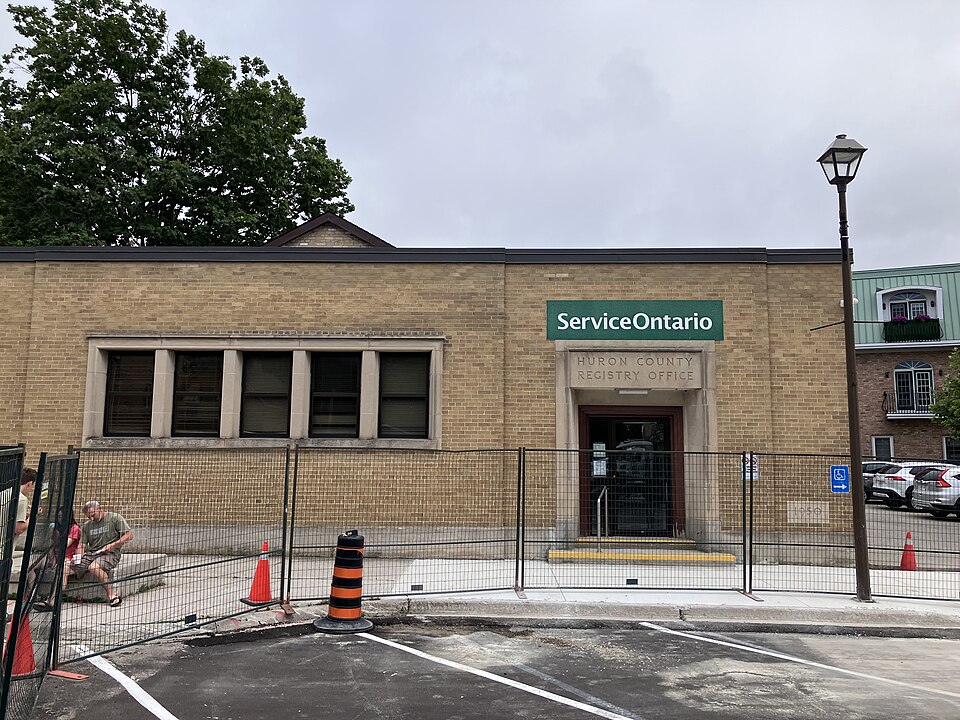
    • Apply in person at a DriveTest centre or ServiceOntario at Bay and College in Toronto.
    • Since 11 May 2026 you must declare that Ontario is your primary residence and that you are in Canada legally.

    Visiting or moving? Which rules apply

    You are What you need
    A visitor staying under 3 months A valid licence from home, insurance for the vehicle, and the vehicle permit (original or exact copy). You must be at least 16.
    A visitor from another country staying over 3 months An International Driver’s Permit from your home country. You cannot get one once you are in Ontario.
    A new Ontario resident Your valid licence for 60 days, then an Ontario licence.

    Can I exchange my licence in Ontario?

    Ontario has exchange agreements with:

    • every Canadian province and territory, and the Canadian Armed Forces
    • U.S. states (not U.S. territories or protectorates)
    • Australia, Austria, Belgium, Croatia, Denmark, France, Germany, Great Britain, Hungary, the Isle of Man, Japan, Kosovo, New Zealand, Northern Ireland, the Republic of Ireland, South Korea, Switzerland, Taiwan and Ukraine

    With an equivalent class of licence from one of these, you get a full Class G. If you have less than two years of total driving experience, the handbook says you get credit for your experience and enter Level Two (G2). Once you reach two years you can take the G road test.

    What cannot be exchanged

    • Learner’s permits from anywhere.
    • Licences cancelled for reasons such as alcohol-related offences, demerit points or a prohibition, or suspended for a Criminal Code offence.
    • Motorcycle classes from several listed countries, including Austria, Belgium, Croatia, France, Germany, Japan, South Korea, Taiwan and Ukraine.
    • Commercial classes issued outside Canada (you may get a G or GM instead).
    • Driving instructor and school bus (Class B or E) licences.

    If you applied before your country signed its agreement and failed a test, you are not eligible for a G exchange until you pass that test at the same level.

    Licences from countries without an agreement

    1. Bring your valid foreign licence and ID, and pay the fees.
    2. Pass a vision test and a knowledge test. You get a G1. Study with the G1 knowledge test guide.
    3. Claim experience credit (below) to shorten your G1 wait.
    4. Pass the G2 road test.
    5. Hold your G2 for at least 12 months, then pass the G road test.

    The foreign experience credit from 1 July 2026

    Since 1 July 2026, applicants from a jurisdiction without an exchange agreement can claim up to 12 months of driving experience by showing an original, valid foreign licence. Only experience from the past three years counts.

    Experience credited What happens
    12 months Take the G2 road test straight away. Then wait 12 months as a G2 before the G road test.
    6 months Hold your G1 until you reach 12 months in total before the G2 test, or 8 months with an approved beginner driver education course.

    When you need a letter of authentication

    Your licence card may show a recent issue date even though you have driven for longer. Example from ontario.ca: your licence was issued 6 months ago but you have more than 6 months of experience. To get full credit (up to 12 months) you need an authentication letter that:

    • comes from your embassy, consulate or the licensing agency that issued the licence
    • confirms the licence is authentic
    • is dated within the previous 6 months
    • is in English or French

    What to bring to DriveTest

    • Your original, valid out-of-province or foreign licence, with a visible expiry date.
    • Original ID showing your legal name and date of birth, such as a passport, citizenship card or certain immigration documents. Photocopies and expired documents are refused.
    • Original documents proving your driving experience, in English or French.
    • A completed application form stating how long you have been driving.
    • Payment for fees. Check the current amounts with DriveTest.

    You also take a vision test. If your licence is not in English or French, bring a certified translation dated within six months. Ontario.ca lists who may translate; check it before you pay for one.

    Common questions

    How long can I drive in Ontario on my foreign licence?

    As a new resident, 60 days. As a visitor, up to 3 months on your home licence, or longer with an International Driver’s Permit.

    Do I have to take a road test to exchange a UK licence?

    Great Britain and Northern Ireland are on Ontario’s exchange list, so an equivalent licence exchanges for a G. You still take a vision test. Less than two years’ experience puts you in Level Two.

    My country is not on the list. Do I start from zero?

    You start with the G1 knowledge test, but since 1 July 2026 you can claim up to 12 months of experience from the past three years, which can let you take the G2 road test straight away.

    Can I exchange a learner’s permit?

    No, not from any jurisdiction.

    I have a novice licence from another province. What happens?

    Ontario.ca says no authentication letter is needed for a novice licence from another province. Ask DriveTest which Ontario level you will enter.

    Can I get an International Driver’s Permit after I arrive?

    No. It must come from your home country before you travel.

    Ontario guides: learning to drive in Ontario, booking a DriveTest road test, Ontario signs. Moving between provinces: exchanging a licence in Canada.

    Sources

    • Government of Ontario, “Exchange an out-of-province driver’s licence” (ontario.ca)
    • Government of Ontario, “The Official MTO Driver’s Handbook: Getting your driver’s licence” (ontario.ca)
    • Government of Ontario, “Get a G driver’s licence: new drivers” (ontario.ca)
    • Government of Ontario, “Drive in Ontario: visitors” (ontario.ca)
  • Ontario Highway Driving Tips for G2 Drivers: Merging and the 400s

    Ontario Highway Driving Tips for G2 Drivers: Merging and the 400s

    Photo: Benson Kua, CC BY-SA 2.0, via Wikimedia Commons

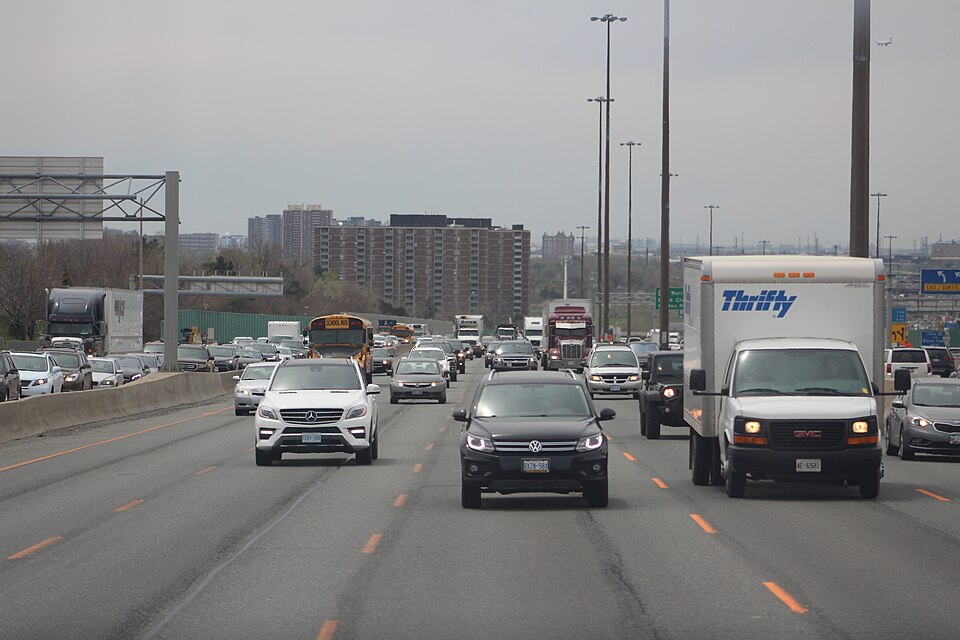
    Once you pass your G2 road test you can drive alone on Ontario’s 400-series highways, and you need that highway experience before the G road test. This guide covers merging, lane changes, exits, HOV lanes and speed limits, plus what the examiner checks on the freeway part of the G test.

    Key facts

    • G1 drivers may not use 400-series highways or high-speed expressways unless the accompanying driver is a licensed driving instructor. G2 drivers may.
    • For the G test you sign a Declaration of Highway Driving Experience covering roads of 80 km/h or more.
    • Many sections that were 100 km/h are now 110 km/h. Follow the posted sign.
    • Stunt driving starts at 150 km/h on any road, including 110 km/h sections.
    • Keep right except to pass. Trucks are barred from the far left lane on many freeways with three or more lanes each way.

    Ontario highway speed limits

    Road Limit
    No sign, inside cities, towns and villages 50 km/h
    No sign, outside cities, towns and villages 80 km/h
    Most 400-series sections 100 km/h or 110 km/h as posted
    Stunt driving threshold 150 km/h on any road (lower thresholds also apply; see stunt driving penalties)

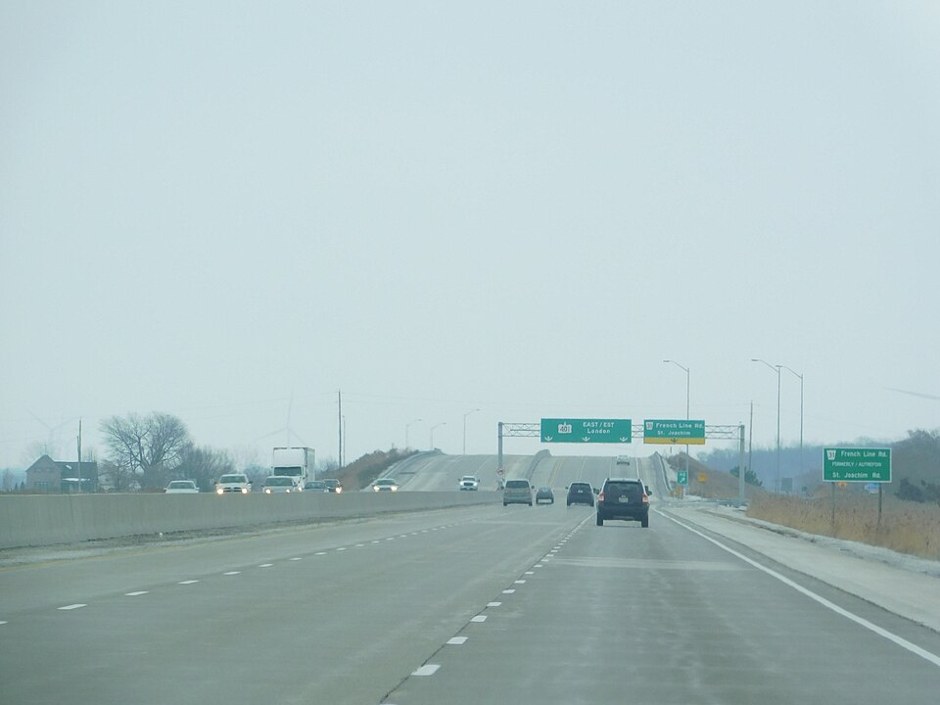
    Ontario raised the limit to 110 km/h on nearly 89% of the provincial highway network that was posted at 100 km/h, about 1,811 km in total (ontario.ca, updated September 2026). The first 110 km/h sections, from 2019, were the QEW between Hamilton and St. Catharines, Highway 402 between Sarnia and London, and Highway 417 from Gloucester to the Quebec border. Ontario.ca does not list every 110 km/h section in text, so read the signs.

    The limit is a maximum. The examiner also marks you down for driving unreasonably slowly.

    How to merge onto an Ontario freeway

    1. On the ramp: check mirrors and your left blind spot for a gap in the nearest lane.
    2. Signal once freeway traffic can see you.
    3. In the acceleration lane: speed up to match freeway traffic and adjust your speed to time the merge.
    4. Merge smoothly into the centre of the nearest lane, with a two- to three-second gap to the car ahead.
    5. Cancel your signal.

    Some ramps join on the left, which puts you straight into the fastest lane. Get up to speed quickly.

    Already on the freeway and see someone merging? Move left if it is safe, to leave them room.

    Driving along: lanes, spacing and scanning

    • Keep right. Use the left lane to pass, then move back.
    • Check mirrors every 5 to 10 seconds. Look 12 to 15 seconds ahead (the handbook’s general advice is 15 to 20 seconds, or as far as you can see).
    • Keep at least a two- to three-second gap. Two seconds is the minimum in ideal conditions only.
    • Stay out of other vehicles’ blind spots and do not sit close behind large trucks.
    • Never cut in front of another vehicle. A slower vehicle cutting in front of a faster one is dangerous and illegal.
    • Never pass a moving snow plow.

    Changing lanes on the highway

    1. Check ahead, your mirrors and the blind spot for a space. On roads with three or more lanes, also watch for a car moving into the same space from two lanes over.
    2. Signal.
    3. Shoulder-check again.
    4. Move smoothly into the centre of the new lane, keeping your speed or gently increasing it. Do not slow down.
    5. Cancel the signal.

    Avoid weaving and unnecessary lane changes. If a slower car is ahead in the left lane, wait for it to move right instead of darting around it on the right.

    Leaving the freeway

    1. Exit signs appear well ahead. Move to the right lane early.
    2. Check mirrors and, if there is a lane to your right, that blind spot.
    3. Signal before the exit lane and enter it at its start, without crossing solid lines.
    4. Do not slow down until you are fully in the exit lane.
    5. Slow gradually to the ramp’s posted speed and check your speedometer. After high-speed driving you tend to underestimate your speed (velocitization).
    6. Be ready to stop at the end of the ramp.

    Missed your exit? Take the next one. Never stop or reverse. Reversing on a divided road with a limit over 80 km/h, including the shoulder, is illegal except to help someone in trouble.

    HOV lanes in Ontario

    • Open 24 hours a day, 7 days a week.
    • For vehicles with at least 2 people, plus buses, motorcycles, licensed taxis, airport limousines and emergency vehicles. The handbook also lists green-plate electric vehicles and HOT permit holders where permitted.
    • Large trucks are not allowed, whatever the number of occupants.
    • Do not cross the striped buffer. Enter and leave only at the marked entry and exit zones.

    What the examiner checks on the G test freeway section

    Part Checks
    Entering Mirror and blind-spot checks, signal timing, speed matched, smooth merge, signal cancelled
    Driving along Mirrors every 5 to 10 seconds, steady legal speed, 2 to 3 second gap, avoiding blind spots
    Lane changes Traffic check, signal, final blind-spot check, smooth move to lane centre, signal cancelled
    Exiting Checks, early signal, enters exit lane at its start, no slowing until in the exit lane

    The G test currently leaves out parallel parking, roadside stops, three-point turns and residential driving, so the highway section carries more weight. See the Ontario G road test.

    A practice plan for new G2 drivers

    1. Start on a quiet 80 km/h highway in daylight.
    2. Move to a 400-series highway outside rush hour and practise ramps until merges feel routine.
    3. Add lane changes, then multi-lane sections and busier times.
    4. Finish with night and wet-weather drives with an experienced driver.
    5. Keep a note of your highway trips. You will need to sign the declaration before the G test.

    Common questions

    Can a G1 driver drive on the 401?

    Only with a licensed driving instructor. G1 drivers may not use 400-series highways or high-speed expressways otherwise. Full G1 rules: Ontario G1 rules.

    Is the speed limit on the 401 110 km/h?

    Some sections are 110 km/h and some are 100 km/h. Always follow the posted sign.

    What should I do if no one lets me merge?

    Adjust your speed in the acceleration lane to fit a gap. Merging traffic must find a gap, but drivers on the freeway should move over to help when it is safe.

    Can I drive in the HOV lane alone in my G2?

    Not in a regular car. You need at least 2 people in the vehicle, unless your car is one of the exempt types listed above.

    How long should I keep my signal on when changing lanes?

    Signal before you move and cancel it once you are in the new lane. Do the final blind-spot check after signalling.

    Do G2 drivers have any highway restrictions?

    No highway restrictions, but zero blood alcohol and the under-19 passenger rules still apply. See G2 rules.

    Related: winter driving in Canada, slow down, move over, sharing Ontario roads. Back to learning to drive in Ontario.

    Sources

    • Government of Ontario, “The Official MTO Driver’s Handbook: Freeway driving” (ontario.ca)
    • Government of Ontario, “The Official MTO Driver’s Handbook: Changing positions” (ontario.ca)
    • Government of Ontario, “The Official MTO Driver’s Handbook: Driving along” (ontario.ca)
    • Government of Ontario, “The Official MTO Driver’s Handbook: Changing directions” (ontario.ca)
    • Government of Ontario, “The Official MTO Driver’s Handbook: The Level Two road test” (ontario.ca)
    • Government of Ontario, “The Official MTO Driver’s Handbook: Getting your driver’s licence” (ontario.ca)
    • Government of Ontario, “Raising speed limits on Ontario highways” (ontario.ca)
  • Ontario Streetcar Rules and Sharing the Road With Cyclists

    Ontario Streetcar Rules and Sharing the Road With Cyclists

    Photo: Transportfan70, CC BY 4.0, via Wikimedia Commons

    In Ontario you pass a streetcar on the right (unless you are on a one-way road) and stop at least 2 metres behind its rear doors while passengers get on or off. This guide sets out that rule and the other sharing-the-road rules in the MTO handbook: the 1-metre cyclist passing law, trucks, buses, farm machinery and horse-drawn buggies. Each section says what to do, so you can use it for G1 study and real driving.

    Key facts

    • Streetcars: pass on the right; stop 2 metres behind the rear doors at stops without a passenger island.
    • Cyclists: leave at least 1 metre when passing, where practical. Breaking this rule means a fine and 2 demerit points.
    • Slow-moving vehicle sign: orange triangle with a red border, meaning 40 km/h or less.
    • Pedestrian crossovers: wait until people have crossed the whole road.
    • School bus with red lights flashing: stop at least 20 metres behind it.

    Streetcars: Ontario rules for Toronto drivers

    • Passing: pass streetcars on the right. You may pass on the left only on a one-way road.
    • At a stop: stop at least 2 metres behind the rear doors while passengers board or leave, and wait.
    • Safety islands: where a stop has a separate island or zone for passengers, you do not have to stop. Pass at a reasonable speed and expect people to move suddenly.
    • Tracks: cross streetcar or railway tracks at a 90° angle, which matters most for cyclists.
    • Transit signals: a white vertical bar signal is for transit vehicles. Other traffic must yield to them.

    Cyclists

    Situation What to do
    Passing a cyclist Change lanes if you can. Leave at least 1 metre where practical. Penalty: fine and 2 demerit points.
    Cyclist moves within their lane They are avoiding hazards or making themselves seen. It is not an invitation to pass in the same lane.
    Following Leave extra space. Bicycles have no brake lights.
    Turning right across a bike lane Check your right blind spot, enter the bike lane only when safe, then turn.
    Turning left Wait for oncoming bicycles to pass.
    Bike box at a light Stop behind it, not in it.
    Opening your door Check mirrors and blind spot. Use the “Dutch reach”: open the driver’s door with your right hand so you turn to look.
    Horn Avoid it. If you must, tap lightly while still some distance away.

    Slower cyclists ride about 1 metre from the curb or parked cars, but they may use any part of the lane they need for safety. E-bikes and e-scooters are also appearing on Ontario roads, so treat them the same way.

    Pedestrians

    • Never pass a vehicle stopped at a crosswalk. Someone may be crossing in front of it.
    • At pedestrian crossovers, school crossings and where a crossing guard is working, stop and yield the entire road. Details and penalties are in driving through Ontario intersections.
    • People using motorized wheelchairs and medical scooters are pedestrians.
    • Take extra care near seniors, people with disabilities, and anyone using a white cane or guide dog. Hybrid and electric cars make little noise when slowing, which is harder for people with low vision to detect.

    Motorcycles, mopeds and limited-speed motorcycles

    • They are hard to see. Check twice before turning or changing lanes.
    • A motorcycle is entitled to a full lane. Pass it by changing lanes.
    • Turn signals on motorcycles may not cancel automatically. Do not pull out until you are sure the rider is actually turning.
    • Waiting behind one to turn left? Do not pull alongside it.

    Large trucks and buses

    • Blind spots: if you cannot see the driver’s face in their side mirror, they cannot see you.
    • Right turns: trucks swing wide. Stay well back and do not move into the space beside the truck until it has cleared the corner.
    • Stopped behind one: leave room, because it may roll back when it starts.
    • Passing: trucks need far longer to stop, so leave more room before cutting back in. Expect turbulence and spray.
    • Freeways: on many with three or more lanes each way, trucks may not use the far left lane.
    • Municipal buses: when a bus in a bus bay signals left to pull out, let it back into traffic.

    Farm machinery and the slow-moving vehicle sign

    The slow-moving vehicle sign is an orange triangle with a red border. It means the vehicle travels at 40 km/h or less.

    • Most tractors and combines go no faster than 40 km/h, and slower when towing.
    • Slow down early. Stay well back so the operator can see you.
    • Pass only when the road ahead is clear and passing is legal. Farm equipment may be wide or about to turn into a field.
    • Expect farm vehicles after dark at planting and harvest time.

    Horse-drawn vehicles

    Buggies are among the slowest vehicles on Ontario roads and usually travel on the shoulder. Look for the slow-moving vehicle sign and reflective tape.

    • Keep a safe following distance.
    • When passing, leave as much space as you can and avoid sudden noise, so you do not startle the horse.
    • When one approaches from the other direction, move to the far right of your lane.

    School buses, snow plows and emergency vehicles

    • School bus, amber lights flashing: slow down and prepare to stop. Red lights or stop arm: stop, at least 20 metres back if you are behind it. On a road with a median, only traffic behind the bus stops. Fines and the rules in other provinces: school bus stopping rules across Canada.
    • Snow plows: never pass a moving snow plow.
    • Emergency vehicles and tow trucks: see slow down, move over.
    • Flashing green lights: volunteer firefighters and volunteer medical responders may show a flashing green light on their own vehicles. The handbook asks you to yield to them.

    Passing other vehicles safely

    • Signal left, check that the way is clear ahead and behind, and watch for cyclists, small vehicles, left-turning traffic and anyone pulling out.
    • Return to your lane only when you can see the whole front of the vehicle you passed in your inside mirror, and signal first. If it speeds up, do not race it.
    • No passing within 30 metres of a pedestrian crossover, and no passing left of the centre line within 30 metres of a bridge, viaduct or tunnel. Do not pass near the top of a hill or on a curve where you cannot see oncoming traffic.
    • The right shoulder may be used only to pass a vehicle turning left, and only if the shoulder is paved. Never pass on the left shoulder.
    • Passing on the right is allowed on multi-lane or one-way roads, and when passing a streetcar or a vehicle turning left. Do not dart around a slower car to do it.
    • When someone passes you on an undivided road, move to the right and slow down if needed.
    • At night, use low beams as you come up behind a vehicle, then switch to high beams once you are alongside it.

    Police stops

    If police signal you to pull over, stop as far to the right as is safe, on the shoulder or a quieter side street if there is one, and stay in the vehicle. Hand over your licence, the vehicle permit (or a copy) and the insurance card when asked. There is no 24-hour grace period for producing them. Follow police directions even when they conflict with signs or signals.

    Common questions

    Can you pass a streetcar on the left in Toronto?

    Only on a one-way road. Otherwise pass on the right, and stop 2 metres behind the rear doors at stops without a passenger island.

    What is the fine for passing a cyclist too closely in Ontario?

    The handbook says a fine and 2 demerit points. Check the current fine amount with the Ministry of Transportation.

    Can I cross a solid line to give a cyclist 1 metre?

    The handbook says to pass cyclists by changing lanes. Only do it where passing is legal and the way ahead is clear. Otherwise wait behind.

    What does the orange triangle on a tractor mean?

    It is the slow-moving vehicle sign: the vehicle goes 40 km/h or less.

    Do I stop for a streetcar if there is a safety island?

    No. Pass at a reasonable speed and watch for passengers stepping off the island.

    Should I honk to warn a cyclist I am passing?

    Usually not. If you must, tap the horn lightly while still well back.

    More Ontario guides: freeway driving, parking in Ontario, wildlife on Canadian roads. Back to learning to drive in Ontario.

    Sources

    • Government of Ontario, “The Official MTO Driver’s Handbook: Sharing the road with other road users” (ontario.ca)
    • Government of Ontario, “The Official MTO Driver’s Handbook: Driving along” and “Dealing with particular situations” (ontario.ca)
    • Government of Ontario, “The Official MTO Driver’s Handbook: Changing positions” (ontario.ca)
    • Government of Ontario, “The Official MTO Driver’s Handbook: Signs” (ontario.ca)
    • Government of Ontario, “The Official MTO Driver’s Handbook: Parking along roadways” (ontario.ca)
    • Government of Ontario, “The Official MTO Driver’s Handbook: Freeway driving” (ontario.ca)
    • Government of Ontario, “The Official MTO Driver’s Handbook: Traffic lights” (ontario.ca)
  • Ontario Roundabout Rules, Four-Way Stops and Crossovers

    Ontario Roundabout Rules, Four-Way Stops and Crossovers

    Photo: Lynxano, CC BY 4.0, via Wikimedia Commons

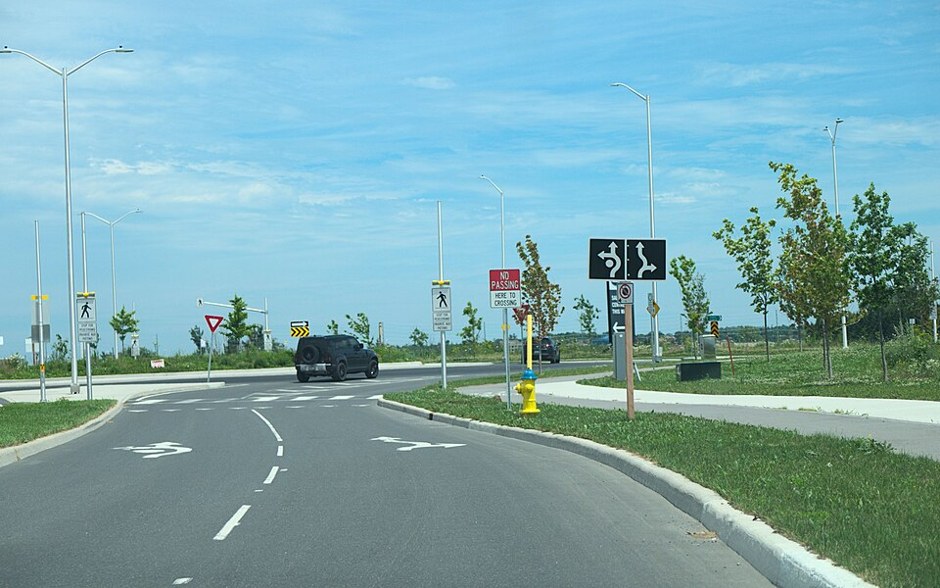
    Ontario’s roundabout rule is simple: traffic already in the roundabout has the right-of-way, so you yield at the entrance and go when there is a gap. This guide covers that and the other intersection rules on the G1 test and both road tests: four-way stops, uncontrolled intersections, turns on red, where to stop, and the pedestrian crossover rule that catches many new drivers.

    Who goes first? Ontario right-of-way at a glance

    Situation Rule
    Four-way stop The first vehicle to come to a complete stop goes first. If two stop at the same time, the vehicle on the left yields to the one on the right.
    Uncontrolled intersection (no signs or lights) If two vehicles arrive at the same time from different roads, the driver on the left yields to the driver on the right.
    Traffic lights not working Treat it as an all-way stop. Yield to vehicles already in the intersection and to those entering from your right.
    Turning left or right You yield. Left: to oncoming traffic and pedestrians. Right: to pedestrians, and check your blind spot for cyclists.
    Leaving a driveway or private road Yield to vehicles on the road and pedestrians on the sidewalk.
    Roundabout Yield to traffic already in it.
    Pedestrian crossover or school crossing with a guard Stop and wait until people have crossed the whole road.

    Signalling never gives you the right-of-way. Make sure the way is clear first.

    Where exactly do you stop?

    At a stop sign or red light, come to a complete stop:

    1. at the stop line, if there is one
    2. if not, at the crosswalk, marked or unmarked
    3. if there is no crosswalk, at the edge of the sidewalk
    4. if there is no sidewalk, at the edge of the intersection

    If traffic is backed up through an intersection on a main road, stop before entering and wait until there is room on the other side. This does not apply when you are turning left or right.

    How to drive a roundabout in Ontario

    Approaching

    • Read the signs and choose your exit before you arrive.
    • Two-lane roundabout: left lane to turn left or go straight; right lane to turn right or go straight. Never enter from the right lane if you want to turn left.
    • Slow down and watch for pedestrians before the yield line.

    Entering

    • Check vehicles already in the roundabout and those waiting, including cyclists.
    • Enter when there is an adequate gap. Do not enter directly beside a vehicle already circulating, because it may leave at the next exit.
    • Travel counter-clockwise and keep to the right of the central island.

    Inside

    • Do not stop except to avoid a collision. You have the right-of-way over entering traffic.
    • Do not change lanes.
    • Missed your exit from the inside lane? Go around again.

    Exiting

    • Once you pass the exit before yours, signal right.
    • Leave in the same lane position you entered: left lane stays left, right lane stays right.
    • From the left lane, watch for vehicles on your right that are still circulating. Watch for pedestrians at the exit.

    Trucks, cyclists and emergency vehicles

    • Large vehicles may swing wide, use the apron, or take both lanes before entering. Do not ride alongside them.
    • Cyclists usually ride in the centre of the lane, or dismount and use the crosswalks.
    • Emergency vehicle coming? Do not stop inside. Leave at your intended exit, drive past the traffic island, then pull over to the right.

    Pedestrian crossovers: the full-road yield rule

    A pedestrian crossover is a marked crossing without traffic lights, usually with signs, ladder-style markings, a “shark teeth” yield line and sometimes overhead flashing lights that pedestrians activate with a button.

    At a crossover, a school crossing, or anywhere a crossing guard is working, drivers and cyclists must stop and yield the entire width of the road. You may go only when pedestrians and the guard have crossed and are safely on the sidewalk. It does not matter that the person is on the far side of the road from you.

    • Do not pass any vehicle within 30 metres of a pedestrian crossover.
    • Penalty for failing to yield at a crossover, crosswalk or school crossing: a fine of up to $1,000 and 4 demerit points (ontario.ca, page dated December 2021). Fines double in Community Safety Zones.

    Crosswalks at lights and stop signs

    Ordinary crosswalks at signals or stop signs are different. There, you yield to pedestrians in your path, but you only have to wait for the entire road to clear when a school crossing guard is present.

    School crossing guards

    When a guard shows a red and white stop sign, stop before the crossing and stay stopped until everyone, including the guard, has left the road.

    Turning at lights: green arrows and turns on red

    • Flashing green or left green arrow with a green light: you may turn left, go straight or turn right from the proper lane. Oncoming traffic faces a red.
    • Left green arrow with a red light: turn left from the left-turn lane. A yellow arrow means do not start the turn.
    • Right on red: allowed unless a sign forbids it. Stop completely, wait until clear, yield to pedestrians.
    • Left on red: only from a one-way road onto a one-way road, after a complete stop.
    • Flashing red: treat as a stop sign. Flashing yellow: go through with caution.
    • Transit signal (white vertical bar): for buses and streetcars only. Everyone else yields.

    If your turn signals or brake lights stop working, use hand and arm signals until they are fixed.

    Waiting to turn left? Keep your wheels straight until you can complete the turn. Lane choice for each kind of turn is in the handbook’s “Changing directions” section.

    Scenario: the crossover test trap

    You are in the right lane of a four-lane road. A pedestrian steps into a crossover from the far curb. You must stop at the yield line and wait until they reach the sidewalk on your side. Driving through once they have passed your lane is a failure to yield.

    Common questions

    Who goes first at a four-way stop in Ontario?

    The first vehicle to stop completely. If two stop at the same time, the one on the left yields to the one on the right.

    Do I signal when entering a roundabout?

    The handbook asks you to signal your exit. Signal right once you pass the exit before yours.

    Can I turn left on a red light in Ontario?

    Only from a one-way road onto another one-way road, after a full stop.

    What is the difference between a crosswalk and a crossover?

    A crosswalk is usually at lights or stop signs. A crossover has no traffic lights and is marked with signs, markings and sometimes flashing lights. At a crossover you wait for the whole road to clear.

    Can I stop inside a roundabout to let someone in?

    No. Stop only to avoid a collision. Circulating traffic has the right-of-way.

    I stopped past the stop line. Should I back up?

    No. Ontario’s road-test guidance says not to reverse; wait until it is safe to go.

    Related Ontario guides: signs and pavement markings, sharing the road, the G2 road test, school bus rules. Back to learning to drive in Ontario.

    Sources

    • Government of Ontario, “The Official MTO Driver’s Handbook: Driving through intersections” (ontario.ca)
    • Government of Ontario, “The Official MTO Driver’s Handbook: Changing directions” (ontario.ca)
    • Government of Ontario, “The Official MTO Driver’s Handbook: Stopping” (ontario.ca)
    • Government of Ontario, “The Official MTO Driver’s Handbook: Traffic lights” (ontario.ca)
    • Government of Ontario, “The Official MTO Driver’s Handbook: The Level Two road test” (ontario.ca)
    • Government of Ontario, “Driving near pedestrian crossovers and school crossings” (ontario.ca)
  • DriveTest Road Test Booking in Ontario: Cancel, Reschedule, Fail

    DriveTest Road Test Booking in Ontario: Cancel, Reschedule, Fail

    Photo: Adam Moss, CC BY-SA 2.0, via Wikimedia Commons

    This guide is for Ontario learners booking a G2 or G road test with DriveTest. It covers how to book, the 48-hour cancellation rule, what happens if your test is declared out-of-order, and what to do after a fail, including what happens if your G1 or G2 is about to expire.

    Key facts

    • Book online, by phone (647-776-0331 or 1-888-570-6110) or in person at any DriveTest centre. You prepay the fee to book.
    • Cancel at least 48 hours before your appointment or you lose the prepaid road-test fee.
    • Out-of-order test: you lose 50% of the fee and must pay it back before you can rebook.
    • Fail: wait at least 10 days before the next test.
    • You have five years to get from G1 to a full G, or you start over.

    How to book a DriveTest road test in Ontario

    You need:

    • your Ontario driver’s licence number and its expiry date
    • a preferred test location, plus a second and third choice
    • a preferred date and time
    • payment for the road-test fee, which must be prepaid

    The handbook says the Ministry of Transportation and DriveTest do not charge any fee just to book a road test. Be wary of anyone offering to book a test for a charge.

    When can you book?

    Test Earliest you can take it
    G2 road test (G1 exit) 12 months after getting your G1, or 8 months with a government-approved driver education course
    G road test (G2 exit) 12 months after getting your G2

    For the G test you also need highway experience on roads of 80 km/h or more and must complete a Declaration of Highway Driving Experience form. See the Ontario G road test guide.

    Fees

    Your first G1 payment covers the knowledge test, your first road test and a five-year licensing fee. Later road tests and retests are paid separately. Check the current fees on DriveTest before booking.

    Cancelling or rescheduling: the 48-hour rule

    Ontario.ca says you must cancel at least 48 hours before your appointment to avoid a cancellation fee. The handbook is more specific: if you cancel or reschedule with less than 48 hours’ notice, or do not show up, your prepaid road-test fee is not refunded.

    The fee stays as a credit on your driving record only in certain extenuating circumstances, such as a death in your immediate family.

    DriveTest’s help pages add a few practical points (check them before relying on them):

    • You can change or cancel online with your licence number and expiry date.
    • Arriving late counts the same as missing the test.
    • If bad weather stops you attending, ask to reschedule within 3 days of the missed appointment.
    • If DriveTest announces a service disruption, do not cancel online. DriveTest cancels affected tests itself so you keep your fee.
    • After several cancellations or reschedules in six months, you have to call instead of using the website.
    • Once your licence has expired, you cannot change a booking online.

    What is an out-of-order road test?

    The examiner declares a test out-of-order when your vehicle does not meet ministry standards, or when some other reason stops the test going ahead. The vehicle must be fit, in proper working condition, plated and insured, and a G1 driver must bring an accompanying driver to the centre.

    • You lose 50% of the road-test fee.
    • The other 50% stays as a credit on your driving record.
    • You must pay the missing 50% before you can book again.

    Recording devices: switch off any dash cam, action camera or phone recording before you arrive. A recording device left on is grounds for an out-of-order test. If a built-in camera cannot be turned off, you must tell the examiner it is not recording the inside of the car or pointing at them; if you cannot confirm that, the test is declared out-of-order.

    If you think your car might fail the vehicle check, contact the DriveTest centre before your test day. The common vehicle faults are listed in the G2 road test guide.

    What happens if you fail a road test in Ontario?

    1. The examiner gives you a report of your skills and mistakes. Use it to plan practice.
    2. Wait at least 10 days. That is the minimum gap between road tests.
    3. Rebook and pay the road-test fee again.
    4. If you are a G1 driver, your accompanying driver has to drive you home.

    Check with DriveTest for any limit on the number of attempts. Your licence expiry dates still apply.

    What if your G1 or G2 expires?

    Situation What Ontario says
    Failed the G2 test, G1 still valid Book the road test again.
    G1 has expired Start over and pay the test fees again.
    G2 about to expire Pass the G1 road test (the G2 test) again to get five more years as a G2.
    Five years since starting, no full G Start the whole process again.

    Book early if your expiry date is close. A failed test plus the 10-day wait can push you past it.

    Common questions

    Can I get a refund if I cancel a day before my test?

    No. Cancelling with less than 48 hours’ notice means the prepaid fee is not refunded, except in extenuating circumstances such as a death in your immediate family.

    How soon can I retake my G2 test after failing?

    After at least 10 days.

    Does an out-of-order test count as a fail?

    No, but it costs you half the fee, and you must pay that half back before rebooking.

    Can someone else book my road test for me?

    Anyone with your licence number and expiry date can book. Neither the ministry nor DriveTest charges a booking fee, so do not pay a third party for booking.

    Can I take my G road test at a different centre from my G2?

    Yes. You choose the location when you book, with second and third choices.

    My G1 expired after I failed. Do I keep my knowledge test pass?

    No. Ontario says you start over and pay the test fees again.

    More Ontario guides: learning to drive in Ontario, the G2 road test, the G road test and the BDE course.

    Sources

    • Government of Ontario, “The Official MTO Driver’s Handbook: Getting your driver’s licence” (ontario.ca)
    • Government of Ontario, “Get a G driver’s licence: new drivers” (ontario.ca)
    • DriveTest, “Payments, Cancellations, & Refunds” and “Cancelling a Road Test Appointment” (drivetest.ca)
    • DriveTest, “Road Test Vehicle Requirements” (drivetest.ca)
  • Is the Ontario BDE Course Worth It? The 8-Month G1 Shortcut

    Is the Ontario BDE Course Worth It? The 8-Month G1 Shortcut

    Photo: Gogerr, CC BY-SA 4.0, via Wikimedia Commons

    An Ontario beginner driver education (BDE) course cuts your G1 time from 12 months to 8, so you can take the G2 road test four months sooner. It must be a government-approved course of at least 40 hours, and it may earn you an insurance discount, though that is not guaranteed. Here is what the course includes, how to check a school, and how to decide if it is worth it for you.

    Key facts

    • Time saved: four months off Level One (G1 goes from 12 to 8 months).
    • Minimum 40 hours: 20 classroom, 10 in-vehicle, 10 flexible.
    • In-vehicle training must be completed within one year of starting the classroom part.
    • Only government-approved schools count. The ministry publishes approved and revoked lists.
    • Schools set their own prices. The ministry cannot refund driving school fees.

    What an approved BDE course must include

    Part Minimum Rules
    Classroom (digital or in person) 20 hours Up to 40 students in person or 20 online. You get the course textbook and the Official MTO Driver’s Handbook.
    In-vehicle 10 hours Licensed instructor; no more than two students per instructor; starts after classroom instruction; finished within one year of starting the classroom part.
    Flexible 10 hours Classroom, digital, in-vehicle, simulator or home-link (homework) instruction.

    Limits on pace: no more than 2 hours of in-vehicle training per day, and after 5 hours of classroom in a day, no more than 1 hour in the car that day.

    The handbook says driver training covers strategic driving, risk perception, avoiding distraction, freeway driving, night driving and bad conditions.

    How the 8-month shortcut works

    1. Get your G1 and enrol with an approved school as early as you can.
    2. Finish the course. The school certifies you online, and your driver record is updated through the ministry.
    3. Once you have held your G1 for 8 months, you can take the G2 road test.

    To prove you completed BDE, you can order your driver’s licence history (a $12 fee applies).

    Timing matters: under the licensing regulation, a BDE certificate counts toward the 8-month shortcut for two years from the date it is issued.

    The shortcut can be lost. If a third escalating sanction cancels your novice licence, you lose any time discount you earned. See Ontario demerit points and escalating sanctions.

    Is BDE worth it? Weigh it up

    Points for Points against
    G2 test four months sooner (full G possible in 20 months instead of 24) Course fees, set by each school
    Supervised practice from a licensed instructor, who can take a G1 on any road, including 400-series highways Insurance savings are possible but not guaranteed
    Possible insurance discount; ask your insurer Only 10 hours are guaranteed in the car; you still need plenty of practice with your accompanying driver
    Structured teaching of hazard perception, night and freeway driving The saving only matters if you are ready for the road test at 8 months

    Quick decision check

    • Need your G2 quickly for work or school? BDE is the only way to cut G1 time.
    • No experienced accompanying driver at home? Instructor hours give you safe practice, including highway driving you cannot do with a family member on a G1.
    • Mainly after cheaper insurance? Get quotes with and without BDE first, because Ontario says a discount is up to your insurer.

    How to choose an approved driving school

    1. Check the school is on the ministry’s list of government-approved driving schools, and not on its revoked list. Not every driving school offers approved courses.
    2. Confirm the course meets the 20 + 10 + 10 hour minimum.
    3. Ask for written costs of every part, including use of the car for the road test and any retest.
    4. Ask about instructor experience, student-to-teacher ratio and progress reports.
    5. Ask friends or family for recommendations.

    Warning signs from the handbook: any school or service that promises a licence without testing, guarantees a road test pass, or charges more than the posted licence fees. The ministry and DriveTest do not charge to book road tests.

    Problems with a school

    • Complaints about a school or instructor go to the ministry by email at [email protected], with your details, the school and instructor names, what happened, and when and where.
    • Fee disputes can go to Consumer Protection Ontario.
    • The ministry audits approved schools and can revoke their licences.

    Common questions

    How much does BDE cost in Ontario?

    There is no set price. Government-approved schools set their own rates, which vary across Ontario.

    Can I do the BDE classroom part online?

    Yes. The 20 classroom hours can be digital or in person. The in-vehicle hours cannot.

    Does BDE reduce G2 time too?

    No. It only shortens Level One. G2 still lasts at least 12 months.

    Can I take BDE if I am new to Ontario?

    Yes. With 6 months of credited foreign experience, Ontario says the 12-month G1 wait can be reduced to 8 months with an approved BDE course. See New to Ontario.

    Can I use the school’s car for my road test?

    Ask the school. The handbook lists use of the vehicle for the road test as something to check in the school contract.

    What if my school closes or is revoked?

    Revoked schools no longer provide approved courses. Check the ministry’s lists before you pay.

    Back to learning to drive in Ontario. Related: G1 rules.

    Sources

    • Government of Ontario, O. Reg. 340/94 (Drivers’ Licences), s. 28 (e-Laws, ontario.ca)
    • Government of Ontario, “Government-approved driving schools” (ontario.ca)
    • Government of Ontario, “The Official MTO Driver’s Handbook: Getting your driver’s licence” (ontario.ca)
    • Government of Ontario, “Get a G driver’s licence: new drivers” (ontario.ca)
    • Government of Ontario, “Understanding demerit points” (ontario.ca)
  • Ontario Traffic Signs and Pavement Markings: G1 Study Guide

    Ontario Traffic Signs and Pavement Markings: G1 Study Guide

    Photo: Jason Zhang, CC BY-SA 3.0, via Wikimedia Commons

    Ontario road signs are grouped by shape and colour, and the G1 knowledge test has a section on them. Learn the five sign families first, then the signs that look alike, then lights and pavement markings. This study guide follows the Official MTO Driver’s Handbook chapter on traffic signs and lights.

    Ontario sign shapes and colours

    Sign Shape and colour Meaning
    Stop Eight-sided, red with white letters Come to a complete stop
    Yield Triangle, white with a red border Let traffic in or near the intersection go first; stop if necessary
    School zone Five-sided, fluorescent yellow-green with black symbols Slow down and watch for children
    Railway crossing X-shaped, white with red outline Tracks cross the road; slow, look both ways, be ready to stop
    Regulatory Usually rectangular or square, white or black background Must be obeyed
    Warning Usually diamond, yellow with black Hazard or unusual condition ahead
    Temporary condition Usually diamond, orange with black Road work, detours, lane closures, traffic control people
    Information and direction Usually rectangular, green with white Distances, destinations, services
    Slow-moving vehicle Orange triangle with red border Vehicle ahead travels at 40 km/h or less

    On regulatory signs, a green circle means you may or must do the activity shown. A red circle with a line through it means it is not allowed.

    Regulatory signs that are easy to mix up

    Sign What you may do between the signs
    No stopping Nothing. Do not stop, even for a moment.
    No standing Stop only to load or unload passengers.
    No parking Stop only to load or unload passengers or merchandise.

    Other regulatory signs to know:

    • Stop for school bus when signals are flashing. A version on multi-lane highways with no centre median tells drivers in both directions to stop. See school bus stopping rules.
    • School zone speed limit: a lower limit applies during school hours when the yellow lights flash.
    • Community safety zone: the community has identified a special risk to pedestrians, and traffic offences inside carry increased fines.
    • Pedestrian crossover: be prepared to stop and yield to pedestrians.
    • Yield to bus (on the back of transit buses): yield to a bus at a bus stop once it signals to pull out.
    • Lane designation signs (overhead or painted): you must travel in the direction shown for your lane.
    • Reserved lanes: buses, taxis, vehicles carrying three or more people, or bicycles, all the time or at set hours. HOV signs also mark where you cannot change lanes into or out of an HOV lane.
    • Two-way left-turn lane: the lane is only for left turns from either direction.
    • No right turn on red, no U-turn, do not enter, do not pass, slow traffic keep right.

    Warning signs worth memorizing

    • Curve with a speed tab underneath: the tab shows the maximum safe speed for the curve. Ramps have their own safe-speed signs.
    • Chevrons (arrowheads in groups) guide you round a sharp curve. A checkerboard border on a turn sign warns of danger.
    • Intersection ahead: the arrow shows which direction has right-of-way.
    • Roundabout ahead: counter-clockwise arrows show traffic direction. See Ontario intersections and roundabouts.
    • Hazard marker: downward lines point to the side you may safely pass.
    • Merge: two roads join, and drivers on both share responsibility for merging safely.
    • Right lane ends: merge left safely.
    • Hidden school bus stop, deer crossing, snowmobiles cross, fallen rock, water over road, bridge lifts or swings, pavement ends.
    • Share the road: give cyclists and other vehicles safe space.

    Temporary condition signs

    • Construction zone: extra caution and be ready for a lower limit.
    • A sign marking doubled Highway Traffic Act fines for speeding in a construction zone when workers are present.
    • Traffic control person ahead; lane closed ahead; detour markers; flashing arrow boards; grooved or milled pavement (stopping may be affected).
    • Do not pass a pilot or pace vehicle bearing the sign.

    Information signs: one fact the test likes

    Freeway interchange numbers show the distance in kilometres from where the freeway begins. Interchange 204 on Highway 401 is 204 km from Windsor. Subtract one number from another to get the distance between them.

    Other signs in the handbook worth recognizing:

    • Emergency Detour Route (EDR) markers guide traffic around an unplanned closure of a provincial highway.
    • A long commercial vehicle (LCV) placard on the back of a truck means a double-trailer combination up to about 40 metres long. Allow extra room, because it is long and limited in speed.
    • Numbers along the bottom of some information signs are emergency response markers that help emergency crews and drivers pick a route.
    • Changeable message signs over freeways warn of delays, collisions and lane closures ahead.

    Traffic lights in Ontario

    Signal What to do
    Green Go, turn left or right after yielding to vehicles and pedestrians already in the intersection
    Yellow (amber) Stop if you safely can; otherwise go with caution
    Red Stop. Right turn allowed after a full stop when clear, unless a sign forbids it. Left on red allowed only from a one-way road onto a one-way road, after a full stop.
    Flashing green, or green arrow with green light Advance green: turn left, go straight or turn right from the proper lane; oncoming traffic has a red
    Left green arrow with red light Turn left from the left-turn lane; opposite left-turners may also be turning
    Yellow arrow after a green arrow Don’t start the turn; stop if safe
    Flashing red Full stop, go when safe
    Flashing yellow Proceed with caution
    Blank (power failure) Treat as an all-way stop
    White vertical bar (transit priority) For transit vehicles only; yield to them

    At a fully protected left turn with separate left-turn lights, you cannot start turning left once the through traffic gets its green.

    Pedestrian signals

    • White walking symbol: pedestrians may cross and have right-of-way.
    • Orange hand, flashing or steady: pedestrians must not start crossing. Anyone already crossing still has right-of-way.
    • Pedestrians may not cross on a flashing green or a left-turn green arrow unless a pedestrian signal allows it.

    Pavement markings in Ontario

    • Yellow lines separate opposite directions. White lines separate traffic going the same way.
    • Solid line on your left: unsafe to pass. Broken line on your left: you may pass if the way is clear.
    • Continuity lines (wider, closer broken lines): on your left, your lane is ending or exiting; on your right, your lane continues.
    • Stop line: one white line across the road. No line? Stop at the crosswalk, then the sidewalk edge, then the intersection edge.
    • Crosswalk: two parallel white lines, though intersection crosswalks are not always marked.
    • White lane arrows: move only in the direction shown.
    • Pedestrian crossover: double white parallel lines with an X in each approach lane, plus signs and overhead yellow lights. Stop before the line and wait until pedestrians have fully crossed the road.
    • Two solid lines around an object such as a bridge pier guide you away from it, and the object has yellow and black markings.

    Common questions

    How many sign questions are on the G1 test?

    DriveTest says the test has two or three sections, one of which is on signs, and you can check the question count with DriveTest. See the Ontario G1 knowledge test guide.

    Can you turn right on a red light in Ontario?

    Yes, after a complete stop and when the way is clear, unless a sign says no.

    What does a five-sided sign mean?

    A school zone. Slow down and watch for children.

    What colour are construction signs in Ontario?

    Orange with black letters or symbols, usually diamond-shaped.

    What is the difference between a pedestrian crossover and a crosswalk?

    A crossover is marked by specific signs, overhead yellow lights and double white lines with an X. You must stop and wait until the pedestrian has completely crossed the road.

    Are Ontario signs bilingual?

    In designated bilingual areas, yes. Messages may be on one sign or on an English sign followed by a French one.

    Back to learning to drive in Ontario.

    Sources

    • Government of Ontario, “The Official MTO Driver’s Handbook: Signs” (ontario.ca)
    • Government of Ontario, “The Official MTO Driver’s Handbook: Traffic lights” (ontario.ca)
    • Government of Ontario, “The Official MTO Driver’s Handbook: Pedestrian signals” (ontario.ca)
    • Government of Ontario, “The Official MTO Driver’s Handbook: Pavement markings” (ontario.ca)
    • DriveTest, “Knowledge Tests” (drivetest.ca)
  • Ontario Stunt, Distracted and Careless Driving Penalties

    Ontario Stunt, Distracted and Careless Driving Penalties

    Photo: Dillan Payne, CC BY-SA 4.0, via Wikimedia Commons

    In Ontario, stunt driving includes going 40 km/h or more over the limit on roads under 80 km/h, or 50 km/h or more over anywhere. It brings an immediate 30-day licence suspension and a 14-day vehicle impoundment at the roadside. Distracted driving costs a novice a 30-day suspension on a first conviction, and careless driving carries 6 demerit points. Here are the definitions and penalties every G1 and G2 driver should know.

    Penalties at a glance

    Offence Main penalties Extra for G1/G2
    Distracted driving (first conviction) $615 if settled out of court, up to $1,000 in court; 3 points and 3-day suspension for full licence holders No points; 30-day suspension
    Careless driving Up to $2,000; 6 points; up to 6 months in jail; suspension up to 2 years Escalating sanction (30-day suspension for a first occurrence)
    Stunt driving or street racing Immediate 30-day suspension; 14-day impoundment; $2,000 to $10,000; 6 points; 1 to 3-year suspension on first conviction At least 30-day suspension; possible cancellation

    Distracted driving in Ontario

    What is illegal

    While driving, including stopped in traffic or at a red light, you must not:

    • hold or use a phone or other hand-held device to text, dial or browse. You may touch it only to call 911.
    • use a hand-held entertainment device such as a tablet or games console
    • have a screen visible to you that is unrelated to driving, such as a video
    • program a GPS by hand. Voice commands are fine.

    Allowed: hands-free use with an earpiece, lapel button or Bluetooth, and a securely mounted phone or GPS touched only to start, answer or end a call. Built-in or mounted GPS screens may be viewed.

    Eating, drinking, grooming and reaching for things are not covered by the distracted driving law, but you can still be charged with careless or dangerous driving for them.

    Distracted driving penalties

    Conviction Fine Full licence (A to G, M) Novice (G1, G2, M1, M2)
    First $615 out of court, up to $1,000 in court 3 points, 3-day suspension 30-day suspension, no points
    Second $615 out of court, up to $2,000 in court 6 points, 7-day suspension 90-day suspension
    Third or more $615 out of court, up to $3,000 in court 6 points, 30-day suspension Licence cancelled; you redo graduated licensing

    A licence reinstatement fee is due after every suspension.

    Careless driving

    Careless driving means driving without due care and attention, or without reasonable consideration for others on the road. Any distraction, including a hands-free device, can lead to the charge if you endanger people.

    • Careless driving: fines up to $2,000, 6 demerit points, up to six months in jail, and a suspension of up to two years.
    • Careless driving causing bodily harm or death: fines of $2,000 to $50,000, 6 points, up to two years in jail, a court suspension of up to five years and a mandatory driver improvement course.
    • Dangerous driving is a criminal offence, with jail terms of up to 10 years for causing bodily harm or 14 years for causing death.

    What counts as stunt driving in Ontario?

    • 40 km/h or more over the limit on a road with a limit under 80 km/h
    • 50 km/h or more over the limit on any road
    • 150 km/h or more anywhere, including freeway sections posted at 110 km/h
    • driving to stop another vehicle passing
    • deliberately cutting off another vehicle
    • deliberately driving too close to another vehicle, a pedestrian or a fixed object

    Street racing includes two or more vehicles driving in a way that shows the drivers are competing, chasing another vehicle, and weaving through traffic with repeated high-speed lane changes. The full list is in Ontario Regulation 455/07 under the Highway Traffic Act.

    Examples

    • 70 km/h in a 50 km/h zone: 20 over. Speeding, not stunt driving.
    • 90 km/h in a 50 km/h zone: 40 over on a road under 80. Stunt driving.
    • 130 km/h on a 100 km/h highway: 30 over. Speeding with 4 points, and for a novice at least a 30-day suspension on conviction.
    • 150 km/h on a 110 km/h freeway section: stunt driving.

    Stunt driving and street racing penalties

    • immediate 30-day licence suspension at the roadside
    • immediate 14-day vehicle impoundment, whether or not you own the vehicle
    • fine of $2,000 to $10,000
    • 6 demerit points and a mandatory driver improvement course on conviction
    • post-conviction suspension: 1 to 3 years for a first conviction, 3 to 10 years for a second, lifetime (reducible after 10 years under certain criteria) for a third, lifetime with no reduction for a fourth
    • possible jail of up to six months

    Aggressive driving and road rage

    The MTO handbook lists tailgating, speeding and failing to yield as aggressive behaviours that can spark road rage. Several stunt driving behaviours above, such as deliberately cutting off or crowding another vehicle, are the same moves, so they can bring the stunt penalties. The handbook calls street racing the most serious form of aggressive driving, and it can also lead to Criminal Code charges.

    • Do not compete, retaliate or try to “educate” another driver. Leave enforcement to the police.
    • Do not return aggression: avoid eye contact and do not gesture back. Keep away from erratic drivers.
    • If you feel threatened, stay in the car with the doors locked, call police if you have a phone, and use your horn and signals to attract attention.
    • If you think you are being followed, do not drive home. Go to a police station or a busy public place.

    Speeding fines in Ontario

    Over the limit Fine per km/h over Demerit points
    Under 20 km/h $3.00 None listed under 16 over; 3 from 16 over
    20 to under 30 km/h $4.50 3
    30 to under 50 km/h $7.00 4
    50 km/h or more $9.75 6

    Fine rates are as of June 2020, per Ontario.ca. Example: 40 km/h over is 40 x $7 = $280.

    Why these matter more on a G1 or G2

    Ontario.ca says novice drivers face at least a 30-day suspension and possible cancellation for any conviction for speeding 30 km/h or more over, following too closely, careless driving, leaving a collision scene or stunt driving. These are escalating sanctions, and a third occurrence cancels your licence. See Ontario demerit points for new drivers.

    Convictions for aggressive, careless or stunt driving also bring a substantial insurance increase, or can make you uninsurable.

    Common questions

    Is it stunt driving to go 50 over on the 401?

    Yes. 50 km/h or more over the limit is stunt driving on any road.

    Can I use my phone at a red light in Ontario?

    No. The distracted driving law applies while you are stopped in traffic or at a red light.

    Can I use Google Maps on a mounted phone?

    Yes, if the phone is securely mounted. Set the route before you leave, or use voice commands. Programming it by hand while driving is illegal.

    Do G2 drivers get demerit points for texting?

    No points, but a 30-day suspension for a first conviction, 90 days for a second and cancellation for a third, plus the fine.

    Is my car impounded if a friend was driving it for stunt driving?

    Yes. The 14-day roadside impoundment applies whether or not the driver owns the vehicle.

    Is eating while driving illegal in Ontario?

    Not under the distracted driving law, but you can be charged with careless driving if it puts others at risk.

    Back to learning to drive in Ontario. Also see impaired driving in Canada for new drivers and G2 rules.

    Sources

    • Government of Ontario, “Distracted driving” (ontario.ca)
    • Government of Ontario, “Speeding and aggressive driving” (ontario.ca)
    • Government of Ontario, “The Official MTO Driver’s Handbook: Dealing with particular situations” (ontario.ca)
    • Government of Ontario, “The Official MTO Driver’s Handbook: Other ways to lose your licence” (ontario.ca)
    • Government of Ontario, “Understanding demerit points” (ontario.ca)
  • Ontario Demerit Points for New Drivers and Escalating Sanctions

    Ontario Demerit Points for New Drivers and Escalating Sanctions

    Photo: Raysonho, CC0, via Wikimedia Commons

    For Ontario G1 and G2 drivers, 2 demerit points bring a warning letter, 6 a second warning, and 9 or more a 60-day suspension. Serious offences also trigger Novice Driver Escalating Sanctions: 30 days, then 90 days, then cancellation of your licence. This guide shows how the two systems work together and how many points each offence carries.

    Demerit point thresholds: novice vs fully licensed

    Points G1, G2, M1, M2 (novice) Full licence
    2 to 5 Warning letter None
    6 to 8 Second warning letter Warning letter
    9 to 14 60-day suspension Second warning letter
    15 or more 60-day suspension 30-day suspension
    • Points stay on your record for two years from the offence date.
    • You start at zero and gain points. You don’t “lose” points.
    • After a novice suspension, your points are reduced to 4. Reach 9 again and you can be suspended for six months.
    • The suspension runs from the date you surrender your licence. If you don’t surrender it, you can lose it for up to two years.

    Novice Driver Escalating Sanctions

    Escalating sanctions apply on top of the normal penalty if you are convicted of:

    • breaking any graduated licensing condition (for example a G1 driving without an accompanying driver, or a G2 with alcohol in their blood)
    • a Highway Traffic Act offence worth 4 or more demerit points, such as careless driving, street racing or speeding 30 km/h or more over
    • an offence with a court-ordered suspension that would have carried 4 or more points
    Occurrence Sanction
    First 30-day suspension
    Second 90-day suspension
    Third Novice licence cancelled. You reapply and start again, retaking every test and paying every fee. You lose any time discount and credited time.

    The handbook says escalating sanctions count occurrences within a five-year period.

    Points recorded as zero

    When an offence triggers an escalating sanction, the handbook says the points are recorded as zero and do not count toward the 9-point total. You get the suspension instead.

    Worked example

    A G2 driver is convicted of following too closely (4 points). That triggers a 30-day escalating suspension, and the 4 points are recorded as zero. Six months later they are convicted of failing to signal (2 points): a warning letter, because 2 points is the novice warning level. A year later, a conviction for driving 35 km/h over (4 points) is their second escalating occurrence: a 90-day suspension.

    How many demerit points? Ontario offences table

    Points Examples
    7 Failing to remain at the scene of a collision; failing to stop for police
    6 Careless driving; racing; 40 km/h or more over on roads under 80 km/h; 50 km/h or more over; failing to stop for a school bus
    5 Bus driver failing to stop at an unprotected railway crossing
    4 30 to 49 km/h over; following too closely; failing to stop at a pedestrian crossover
    3 16 to 29 km/h over; hand-held device or unrelated display screen; failing to yield; running a stop sign, light or railway signal; failing to slow and move over for a stopped emergency vehicle or tow truck; improper passing; wrong way on a one-way road; radar detector; HOV lane misuse
    2 Improper turns; failing to signal; failing to lower high beams; failing to obey signs; failing to share the road; unnecessary slow driving; improper opening of a door; driver without a seatbelt; failing to secure a child or a passenger under 16

    Distracted driving works differently for novices: no demerit points, but a 30-day suspension for a first conviction, 90 days for a second and cancellation for a third. See distracted, careless and stunt driving in Ontario.

    Points from outside Ontario

    Convictions in another Canadian province or territory, New York or Michigan add points to your Ontario record as if the offence happened in Ontario. These include speeding, running a stop sign or signal light, failing to stop for a school bus, racing, leaving a collision scene and careless driving.

    Surrendering your licence and getting it back

    • Surrender in person at any ServiceOntario centre or by mail to the Ministry of Transportation, Driver Control Section. You cannot surrender at a DriveTest centre.
    • After a suspension you may have to retake the vision, written and road tests.
    • A reinstatement fee applies every time your licence is suspended.

    Common questions

    How many demerit points can a G2 have in Ontario?

    You are suspended for 60 days at 9 points. A warning letter starts at 2.

    Do demerit points affect insurance?

    Ontario.ca says convictions for aggressive, careless or stunt driving bring a substantial insurance increase or can make you uninsurable. Ask your insurer about other convictions.

    How long do demerit points last in Ontario?

    Two years from the offence date.

    Do points from a distracted driving ticket count for a G2?

    No points are recorded for novice drivers convicted of distracted driving. You get a suspension instead: 30 days for a first conviction.

    Does a speeding ticket in Quebec count?

    Yes. Convictions in other provinces and territories add points to your Ontario record.

    Back to learning to drive in Ontario. Related: G1 rules, G2 rules.

    Sources

    • Government of Ontario, “Understanding demerit points” (ontario.ca)
    • Government of Ontario, “The Official MTO Driver’s Handbook: Keeping your driver’s licence” (ontario.ca)
    • Government of Ontario, “The Official MTO Driver’s Handbook: Other ways to lose your licence” (ontario.ca)
    • Government of Ontario, “Distracted driving” (ontario.ca)
    • Government of Ontario, “Speeding and aggressive driving” (ontario.ca)