Category: Ireland

  • E Scooter Rules Ireland: Motorcyclists and Other Road Users

    E Scooter Rules Ireland: Motorcyclists and Other Road Users

    Photo: Mike Jones / Pexels. Illustrative photograph.

    E-scooters have been legal on Irish public roads since 20 May 2024. Riders must be at least 16, the scooter is limited to 20 km/h, and they are banned from footpaths and motorways. This guide explains what drivers in Ireland need to know about sharing the road with e-scooter users and motorcyclists, plus quick links for the other road users the Rules of the Road asks you to look out for.

    Key facts

    • E-scooter rules in force from 20 May 2024 (Road Traffic (Electric Scooter) Regulations 2024).
    • Minimum age 16. Maximum design speed 20 km/h. One person, standing, no seat.
    • No e-scooters on footpaths (except to get on or off them) or on motorways.
    • Overtaking a cyclist or e-scooter user in prohibited circumstances: €120 and 3 penalty points.
    • Most e-scooter offences carry a €50 fixed charge.
    • Motorcyclists are hard to see because of their narrow profile. Check mirrors and blind spots at every junction and lane change.

    E-scooter rules in Ireland

    In law, an e-scooter is a type of “powered personal transporter” (PPT), a category created by the Road Traffic and Roads Act 2023. The 2024 regulations set the rules for e-scooters specifically.

    Rule Detail
    Minimum age 16 to use one in a public place
    Speed Maximum design speed 20 km/h. The speed limit for e-scooters is 20 km/h, or lower where the road limit is lower
    Motor power No more than 0.4 kW continuous rated power
    Size No more than 2,000 mm long, 800 mm wide and 1,500 mm high
    Passengers and goods One person only. No carrying goods. No seat
    Towing Not allowed. A rider must not hold on to another moving vehicle
    Lights Front and rear position lamps and reflectors, lit during lighting-up hours
    Brakes Two independent brakes, front and rear
    Warning device A bell, horn or other audible warning device
    Wheels At least 200 mm diameter including the tyre
    Modifications Banned if they raise the speed or power, or make it unsafe
    Where Not on footpaths except for access, not on motorways, and not into pedestrianised streets except on a cycle track
    Phones Holding a mobile phone while riding is an offence

    E-scooter fixed charges

    As of November 2026, a €50 fixed charge applies to e-scooter offences including speeding, riding without reasonable consideration, riding on a footpath, carrying a passenger or goods, running a red light, missing lights or brakes, and holding a phone.

    What drivers should do around e-scooters

    • Expect them in cycle lanes and on the road, moving at up to 20 km/h. They are small and quiet.
    • Overtake as you would a cyclist. The 2024 overtaking offence covers e-scooter users as well as cyclists: €120 and 3 points. Passing distances are in sharing the road with cyclists.
    • Allow for wobble. Small wheels react badly to potholes, gravel and wet ironwork, so a rider may swerve suddenly.
    • Check before opening your door and before turning left across a cycle lane.
    • Look for under-16s. A young rider is breaking the law but is still a road user you must avoid.

    The current edition of the Rules of the Road, which reflects the law at 1 March 2025, covers e-scooters, e-bikes and e-mopeds. Later changes to the law are not in it.

    E-bikes and e-mopeds: what a car driver should expect

    An e-bike whose motor only helps while the rider pedals, cuts out at 25 km/h and is rated at no more than 250 W is treated as a bicycle. A pedal-assisted L1e-A e-moped, with a motor of up to 1 kW whose help cuts out at 25 km/h, can also use cycle tracks and with-flow bus lanes. The L1e-A class also includes throttle-powered machines, and these do not get that lane permission. Nor do faster L1e-B e-mopeds. You cannot always tell the type by looking at it.

    For your own driving, the point is observation. A quiet rider in a cycle lane can reach a junction faster than you expect. Check the lane again before you turn across it, leave room when you pass, and do not judge their speed by the size of the vehicle. If a rider is in a lane they should not be in, wait rather than force the issue.

    Motorcyclists: what drivers need to know

    Riders are especially vulnerable in a crash. The Rules of the Road tells drivers to watch for motorcyclists (and cyclists):

    • at junctions
    • where cycle tracks merge with roads
    • when you change lanes
    • when you open your door
    • when stopping and turning, especially left
    • when reversing

    The best protection is to use your mirrors and recheck blind spots.

    Why motorcyclists get missed

    Drivers tend to look for larger objects, not the narrow outline of a motorbike. At a junction, look twice in each direction and judge the speed of any single headlight before pulling out.

    Turning right

    Check your mirrors for a motorcyclist overtaking you as you approach the turn.

    Overtaking a motorcyclist

    Never cut in after passing. Give extra room in wet, windy or icy weather and on poor surfaces, where riders may need to steer around potholes. Gravel, sand, water and rough surfaces can unsettle a bike.

    Reading a rider’s signals

    • Riders use dipped headlights and high-visibility clothing to be seen.
    • A learner motorcyclist wears a yellow fluorescent tabard with L plates front and back. A novice wears one with N plates. Give them extra space.
    • A rider whose indicators might not be seen may use hand signals as well.

    Other road users

    The Rules of the Road reminds drivers that a vehicle has no greater right of way than any other road user, so drive defensively: expect the unexpected and make way when needed. The other groups have their own guides:

    Common questions

    Are e-scooters legal in Ireland?

    Yes, since 20 May 2024, as long as the scooter meets the 2024 regulations and the rider is 16 or older.

    Can e-scooters use the footpath in Ireland?

    No. Riding along or across a footpath is an offence, except to get to or from a property beside it.

    How fast can an e-scooter go in Ireland?

    20 km/h at most, and less where the road limit is lower.

    Do I need to give e-scooters the same space as cyclists?

    Yes. The overtaking offence applies to both, and the same passing guidance makes sense.

    Can e-scooters go on the motorway?

    No. The Roads Act 1993, as amended in 2023, bans powered personal transporters from motorways.

    Why do motorcyclists ride in the middle of the lane?

    Riders choose a position to see and be seen and to avoid poor road surfaces. Treat it as their lane and don’t squeeze past.

    Back to learning to drive in Ireland.

    Sources

    • Irish Statute Book, “S.I. No. 199/2024, Road Traffic (Electric Scooter) Regulations 2024” (irishstatutebook.ie)
    • Irish Statute Book, “Road Traffic and Roads Act 2023 (No. 16 of 2023)”, powered personal transporter definition and Roads Act 1993 amendments (irishstatutebook.ie)
    • Irish Statute Book, “S.I. No. 227/2024, Road Traffic Act 2010 (Part 3) (Fixed Charge Offences) Regulations 2024”, Schedules 4 and 7 (irishstatutebook.ie)
    • Law Reform Commission, “Road Traffic Act 2002, Revised”, First Schedule (revisedacts.lawreform.ie)
    • Road Safety Authority, “Rules of the Road”, Sections 16, 19 and 20 (Revision 5, hosted on garda.ie)
    • Road Safety Authority, “E-bikes and e-mopeds” (powered personal transportation) (rsa.ie)
    • Irish Statute Book, “S.I. No. 222/2024, Road Traffic (Traffic and Parking) (Amendment) Regulations 2024”, definition of L1e-A e-moped (irishstatutebook.ie)
    • Department of Transport, “L1e-A E-Moped” (gov.ie)
  • Tiredness, Drugs and Road Rage: Safe Driving in Ireland

    Tiredness, Drugs and Road Rage: Safe Driving in Ireland

    Photo: Adrien Olichon / Pexels. Illustrative photograph.

    In Ireland it is an offence to drive under the influence of any intoxicant, including prescribed and over-the-counter medicines, to the point where you can’t properly control the vehicle, and Gardaí can test your saliva for drugs at the roadside. Tiredness has no legal limit but causes “micro sleeps” that can last up to 10 seconds. This guide covers drugs, driver fatigue, road rage and litter, as set out in Section 13 of the Rules of the Road.

    Key facts

    • “Drugs” in road traffic law includes legal prescribed and over-the-counter medicines.
    • Gardaí can require a roadside oral fluid (saliva) drug test, including at checkpoints.
    • Gardaí can require five impairment tests. Refusing is an offence. Tell the Garda first about any medical condition or disability that could affect them.
    • A 4 second micro sleep at 90 km/h means about 100 metres with no one in control.
    • The only cure for serious lack of sleep is sleep.
    • Driving without reasonable consideration: €80 fixed charge and 2 penalty points (4 on conviction).

    Drugs and driving in Ireland

    The law covers cars, motorbikes, trucks, buses, bicycles and animal-drawn vehicles. Intoxicants include alcohol and drugs, taken separately or together. There are two ways to commit a drug driving offence:

    1. Impairment: driving under the influence of an intoxicant to the point where you can’t properly control the vehicle. This applies to medicines too.
    2. Specified levels: driving with cannabis, cocaine or heroin in your blood above set levels, whether or not you seem impaired. The levels and penalties are in drink and drug driving limits in Ireland.

    How does roadside drug testing work in Ireland?

    Under the Road Traffic Act 2010 (as amended), a Garda can require you to give a sample of oral fluid from your mouth using a drug-testing device. This can happen:

    • after a crash, after a traffic offence, or if the Garda suspects you have taken drugs
    • at a mandatory intoxicant testing checkpoint, where the Garda doesn’t need any suspicion

    If the Garda doesn’t have a device with them, you can be required to wait for up to an hour until one arrives. After you give a saliva sample, you can be required to wait up to 30 minutes for the result. A positive roadside result is a screening result, not a blood level. It can lead to arrest and a blood specimen at a Garda station.

    Since 1 December 2022 Gardaí have used the Securetec Drugwipe 6s roadside test, which screens for cannabis, cocaine, benzodiazepines, opiates, amphetamine and methamphetamine.

    Impairment tests

    If a Garda suspects you are driving under the influence of drugs, they can ask you to do up to five tests:

    • pupil dilation
    • balance
    • walk and turn
    • one leg stand
    • finger to nose

    The Garda first asks whether you have a disability or medical condition that might stop you doing them. Refusing is an offence. The Garda can arrest you based on how you perform, and the results can be used in court with any blood or urine results.

    Medicines

    • Check the leaflet, and ask your pharmacist or doctor, whether a new medicine, a changed dose or a combination could affect your driving. Don’t stop or change prescribed treatment on your own.
    • Tell your insurer about important changes in your medical fitness to drive. See medical requirements for an Irish learner permit.

    Driver tiredness and fatigue

    Tired drivers are a major road safety risk. When you are fighting sleep you are likely to have micro sleeps of up to 10 seconds, even with your eyes open.

    Any driver can be affected. The Rules of the Road names these groups as especially high risk:

    • night workers, and people driving home after a night shift
    • lorry drivers and company car drivers
    • men, particularly those aged 18 to 24 and over 50
    • skilled manual workers

    What to do if you feel tired at the wheel

    1. Before a trip, get enough sleep and plan where you can take a safe break.
    2. Never start a drive if you are fighting sleep.
    3. If you get tired on the way, stop somewhere safe. Don’t use the hard shoulder of a motorway for a rest.
    4. Emergency measure only: drink one or two cups of strong coffee or a caffeinated drink, then nap for no more than 20 minutes (set an alarm). Caffeine takes about 20 minutes to work; a longer nap can leave you groggy.
    5. After the nap, get some fresh air and stretch your legs, if it is safe. The RSA fatigue campaign suggests 15 minutes. Neither figure is a legal rule, and a nap does not make you fit to drive.
    6. Don’t push on because you are nearly home. Many tiredness crashes happen within a few minutes of the destination, as the body starts to relax.

    Opening a window or turning up the radio does not replace sleep. If you are still tired after a break, don’t drive on: rest properly or get another way home.

    Road rage and aggressive driving

    Road rage is uncontrolled anger that leads to intimidation or violence against another road user. Aggressive driving is inconsiderate driving, such as:

    • speeding and tailgating
    • changing lanes without indicating
    • weaving in and out of traffic
    • over-using the horn or flashing headlights

    If another driver tries to provoke you

    • Don’t react.
    • Don’t speed up, brake or swerve suddenly. It can cause a crash or look like a challenge.
    • Stay calm and focus on finishing your journey safely.
    • Once you are safely stopped, report dangerous driving to your local Garda station or through the Garda Traffic Watch online form. In an emergency, call 999 or 112.

    Driving without reasonable consideration for other road users is an offence in its own right: €80 fixed charge and 2 penalty points, or 4 on conviction, as of November 2026. EDT lesson 11, “Driving calmly”, works on this. See EDT lesson by lesson.

    Litter

    Throwing litter from a vehicle is irresponsible, and it can create a hazard for other road users and for you.

    Common questions

    Can I drive on prescription medicine in Ireland?

    Yes, unless it affects your ability to drive. The impairment offence covers prescribed and over-the-counter medicines. Check the leaflet or ask your pharmacist or doctor.

    Do Gardaí do roadside drug tests in Ireland?

    Yes. They use an oral fluid (saliva) test, both when they suspect drugs and at checkpoints where no suspicion is needed.

    Can I refuse a roadside drug test?

    Refusing a specimen or the impairment tests when required is an offence.

    Is driving tired illegal in Ireland?

    There is no tiredness limit, but the Rules of the Road says you should not drive while tired or fatigued. A tired driver who drives badly can still face prosecution for careless or dangerous driving.

    Does a 20 minute nap fix tiredness?

    It is an emergency measure only, with coffee first. The RSA says the only cure for serious lack of sleep is sleep.

    What should I do if someone tailgates me aggressively?

    Keep a steady speed, keep left, and let them pass when it is safe. Don’t brake-test them. Report dangerous behaviour to the Gardaí.

    Related: the two second rule and stopping distances, penalty points in Ireland. Back to learning to drive in Ireland.

    Sources

    • Road Safety Authority, “Rules of the Road”, Section 12 Assisting Gardaí and Section 13 Factors that affect safe driving (Revision 5, hosted on garda.ie)
    • Law Reform Commission, “Road Traffic Act 2010, Revised”, sections 9 to 11 (as amended) (revisedacts.lawreform.ie)
    • Irish Statute Book, “S.I. No. 227/2024, Road Traffic Act 2010 (Part 3) (Fixed Charge Offences) Regulations 2024”, Schedule 5 (irishstatutebook.ie)
    • Law Reform Commission, “Road Traffic Act 2002, Revised”, First Schedule (revisedacts.lawreform.ie)
    • Road Safety Authority, “New roadside drug testing system launched at Christmas and New Year road safety appeal”, 1 December 2022 (rsa.ie)
    • An Garda Síochána, “Traffic Watch” online reporting form (garda.ie)
  • Driving at Night and Using Your Horn in Ireland

    Driving at Night and Using Your Horn in Ireland

    Photo: Jack B / Unsplash. Illustrative photograph.

    At night in Ireland you must drive at a speed that lets you stop within the distance your lights show to be clear, and use headlights whenever conditions require them. You must not sound your horn in a built-up area between 11.30 pm and 7 am unless there is a traffic emergency. This guide covers headlight use, dazzle, and when the horn is and isn’t allowed, for learners and new drivers.

    Key facts

    • Driving faster than lets you stop within the distance you can see to be clear: €160 fixed charge and 3 penalty points (5 on conviction).
    • The Rules of the Road says main beam lights about 100 metres ahead on an unlit road and dipped beam about 30 metres, in good conditions. A car at 100 km/h covers 30 metres in about a second.
    • Fog lights: only in dense fog or falling snow. Turn them off at all other times.
    • No horn in a built-up area from 11.30 pm to 7 am, except in a traffic emergency.
    • The horn never gives you right of way.

    Before you drive in the dark

    • Clean all lights, indicators, reflectors, number plate lighting and the windscreen, inside and out.
    • Check the red rear lights and number plate light work.
    • Make sure the headlights are aimed correctly. Out-of-line lights see less and can dazzle oncoming drivers even when dipped.

    For bulb and lamp checks, see vehicle safety checks in Ireland.

    How fast should you drive at night?

    Slow enough to stop inside the distance your lights show. Article 7 of the Traffic and Parking Regulations makes this a legal duty at all times, not only at night. In practice:

    Lights Typical view on an unlit road What it means
    Main beam About 100 m Use it on unlit roads when nobody is ahead or coming towards you
    Dipped beam About 30 m At 100 km/h you cover that in about a second, so slow down when you dip

    Pedestrians and unlit bicycles are very hard to see in the dark, especially with oncoming glare. On rural roads, expect walkers on your side of the road. See tractors, animals and rural roads.

    When to use dipped headlights in Ireland

    If conditions mean you need headlights to drive safely, you must use them. Use dipped headlights:

    • just after dusk and before dawn, at the start and end of lighting-up hours
    • when stopped in traffic, when meeting other traffic, and when following another vehicle
    • in built-up areas with good street lighting, and on continuously lit roads outside them
    • in dense fog, falling snow or heavy rain, and when daylight is fading
    • generally, to avoid inconveniencing other traffic

    Use main beam at other times, as long as it will not dazzle anyone. When you dip for oncoming traffic, slow down to suit the shorter view. In lit towns, dipped beam (or dim-dip) is better than sidelights alone. When stopped at the side of the road (other than in traffic) or parked, switch to sidelights or parking lights rather than leaving headlights on.

    Lighting-up hours are defined in Irish road traffic regulations as running from half an hour after sunset to half an hour before sunrise. Switch your headlights on earlier if poor light or weather calls for it.

    Daytime running lights

    If your car doesn’t have daytime running lights, the Rules of the Road advises driving with dipped headlights on during the day.

    Daytime running lights help others see you in daylight. They are not headlights. They don’t light the road ahead, and on many cars the rear lights stay off while they are on. When daylight fades or a heavy shower darkens the sky, switch to dipped headlights yourself. A bright dashboard doesn’t prove your outside lights are on.

    Fog lights

    Only in dense fog or falling snow. Left on in clear weather, they cause glare and can dazzle other drivers.

    Dazzle and following at night

    • Dazzled by oncoming lights: slow down, stop if you need to, and look towards the left verge until the vehicle passes. Watch for pedestrians and cyclists on your side.
    • Dazzled from behind: switch the rear-view mirror to its night setting.
    • Red lights ahead of you: dip your headlights so you don’t dazzle that driver.
    • Don’t drive on the tail lights of the car in front. It gives a false sense of security and draws you in too close and too fast. Keep your gap; see the two second rule.
    • Junction markers: some junctions have coloured road studs or delineator posts to show where they are at night or in poor visibility.

    Night driving as a learner

    EDT lesson 12 is night driving, and the RSA advises practising in the dark before your test. The learner permit conditions in the Rules of the Road don’t include a night-time ban, but you still need a qualified accompanying driver every time. See EDT lesson by lesson and accompanying a learner driver.

    When can you use your horn in Ireland?

    Only to:

    • warn other road users of danger, or
    • make them aware of you for safety reasons when reasonably necessary.

    Don’t use it in a built-up area between 11.30 pm and 7 am unless there is a traffic emergency.

    Situation Horn?
    Young school children near the road who may not have seen you You may use it to let them know you are there, but slow down and be ready to stop. Never use it to tell a child to cross
    Animals on the road ahead Avoid it. It can frighten them
    Saying hello, or telling off another driver No. Over-use of the horn is listed as aggressive driving
    Someone pulling out who hasn’t seen you Yes, as a warning. It does not give you priority, so be ready to brake

    Penalties

    Offence Fixed charge Points on payment Points on conviction
    Driving too fast to stop within the distance you can see to be clear €160 3 5
    Vehicle not fitted with the required lamps €60 1 3

    As of November 2026. Late payment adds 50%. See penalty points in Ireland.

    Common questions

    Can learner drivers drive at night in Ireland?

    Yes, with a qualified accompanying driver and L plates, as at any other time. Practise in the dark before your test; EDT lesson 12 covers it.

    When should I switch from main beam to dipped?

    When you meet oncoming traffic, when you are following another vehicle, in lit areas, and whenever main beam would dazzle someone. Slow down when you dip, because you can see much less.

    Is it illegal to beep your horn at night in Ireland?

    In a built-up area, between 11.30 pm and 7 am, you must not use it unless there is a traffic emergency. Outside those hours, use it only as a safety warning.

    Should I leave my headlights on when I pull in?

    No. Use sidelights or parking lights when stopped at the roadside or parked.

    Can I flash my headlights to let someone out?

    The Rules of the Road lists over-use of flashing headlights as aggressive driving. A flash can easily be misread, so don’t rely on it to give or take priority.

    Back to learning to drive in Ireland.

    Sources

    • Road Safety Authority, “Rules of the Road”, Sections 4, 5, 13 and 19 (Revision 5, hosted on garda.ie)
    • Irish Statute Book, “S.I. No. 182/1997, Road Traffic (Traffic and Parking) Regulations 1997”, article 7 (irishstatutebook.ie)
    • Irish Statute Book, “S.I. No. 199/2024, Road Traffic (Electric Scooter) Regulations 2024”, definition of lighting-up hours (irishstatutebook.ie)
    • Irish Statute Book, “S.I. No. 227/2024, Road Traffic Act 2010 (Part 3) (Fixed Charge Offences) Regulations 2024”, Schedules 2 and 6 (irishstatutebook.ie)
    • Law Reform Commission, “Road Traffic Act 2002, Revised”, First Schedule (revisedacts.lawreform.ie)
  • Reversing, U Turns and Towing in Ireland: The Rules

    Reversing, U Turns and Towing in Ireland: The Rules

    Photo: atelierbyvineeth / Pexels. Illustrative photograph.

    In Ireland you must never reverse from a minor road onto a major road, you may only make a U-turn where it is completely safe and not prohibited, and any vehicle towing a trailer or caravan is limited to 80 km/h on every road, motorways included, or to the posted limit where that is lower. Learner permit holders in category B must not tow at all. This guide sets out what the Rules of the Road and the regulations say, with the fixed charges as of November 2026.

    Key facts

    • Reversing onto a major road from another road is illegal.
    • No U-turn where a No U-turn sign is provided on a dual carriageway or a road with a central reserve or traffic island.
    • Towing speed limit: 80 km/h on all public roads, including motorways. Where the posted limit is lower, the lower limit applies.
    • A category B licence covers a trailer of 750 kg MAM or less behind a category B vehicle, or a heavier trailer if the car and trailer together have a MAM of no more than 3,500 kg. For a trailer over 750 kg with a combined MAM over 3,500 kg and up to 4,250 kg, you need code 96 on your B licence or a BE licence. Heavier needs category BE.
    • Learner permit holders driving a car must not tow a trailer.
    • Trailers must be insured, even when parked.

    How to reverse safely in Ireland

    The law (article 12 of the Road Traffic (Traffic and Parking) Regulations 1997) says three things: before reversing you must make sure it will not endanger other traffic or pedestrians; you must not reverse onto a major road from another road; and you may only reverse onto a public road from a place beside it (a driveway, for example) when it is clear that doing so is safe.

    Two junction views: on the left a car drives past a side road and reverses into it, then rejoins forwards on the left; on the right a car reversing out of a minor road onto a major road, marked illegal.
    Turning around by reversing into a side road, never out of one. Illustrative diagram, not to scale.

    The Rules of the Road adds the method:

    1. Look all around: in front, behind, over both shoulders and in your mirrors.
    2. Take special care where small children may be, such as schools, playgrounds, residential roads, car parks and your own driveway. You cannot see a small child behind the car in your mirror.
    3. If your view is restricted, ask someone to help, standing where you can see them. Stop at once if you lose sight of them.
    4. Give way to traffic and pedestrians.
    5. Take extra care in the dark. If in doubt, get out and check.
    6. To turn around using a side road, reverse from the major road into the minor road, slowly and far enough to take up the correct position on the left when you rejoin. Never the other way round.

    On the driving test you reverse around a corner. See Irish driving test manoeuvres for how it is set up and marked.

    When can you make a U-turn in Ireland?

    Only when traffic conditions make it completely safe. Before you turn:

    • Check there are no signs or markings that prohibit it, such as a No U-turn sign or a continuous white centre line.
    • Check the road is not one way.
    • Pick a place where you can see clearly in all directions.
    • Give way to all other road users, and look carefully for cyclists and motorcyclists.
    • Don’t delay or block pedestrians crossing.
    • Make sure there is room to finish the turn smoothly.

    On 2+1 roads with a centre barrier, you turn around by first turning left onto a minor road and using the U-turn area provided there.

    The turnabout on the driving test is a three-point turn, not a U-turn. It is covered in the manoeuvres guide.

    Penalties for reversing and U-turn offences

    Offence Fixed charge Points on payment Points on conviction
    Breaking the reversing rules €60 1 3
    U-turn where banned by a No U-turn sign €60 2 4

    Fixed charges are from the Road Traffic Act 2010 (Part 3) (Fixed Charge Offences) Regulations 2024; points are from the Road Traffic Act 2002. Paying late adds 50%. See penalty points in Ireland.

    Towing in Ireland: who can tow what

    You hold You can tow
    Learner permit, category B Nothing. Towing a trailer is not allowed.
    Full category B licence A trailer with a MAM of 750 kg or less, or a heavier trailer as long as the car and trailer together have a MAM of no more than 3,500 kg
    Category B with code 96 A trailer over 750 kg MAM where the car and trailer together have a MAM over 3,500 kg but no more than 4,250 kg
    Category BE A category B car with a trailer of up to 3,500 kg MAM

    MAM (maximum authorised mass) is the plated maximum weight, not what the trailer happens to weigh today. Check the plates on both the car and the trailer. For example, a car with a 2,500 kg MAM and a trailer with a 1,500 kg MAM come to 4,000 kg, which is over the ordinary B limit even when the trailer is empty. Separately, check the car maker’s towing limits for braked and unbraked trailers. For the full list of categories, see Irish driving licence categories.

    What is the towing speed limit in Ireland?

    80 km/h on all public roads for any vehicle drawing another vehicle: a trailer, caravan, horsebox or a towed car. This is set by the Road Traffic (Ordinary Speed Limits) regulations (S.I. 546 of 2008, as amended in 2022). Where the road limit is lower, the lower limit applies. So on a 120 km/h motorway you still tow at no more than 80 km/h, and on a 60 km/h local road the limit is 60 km/h. Speeding carries a €160 fixed charge and 3 penalty points.

    Trailer equipment checklist

    • Tow bar and coupling: strong enough and securely attached.
    • Brakes: a trailer needs brakes, including a parking brake and a breakaway brake, if its MAM is over 750 kg or more than half the laden weight of the towing vehicle, whichever is lower.
    • Breakaway brake or secondary coupling: a breakaway brake stops the trailer if it comes loose. Older trailers without one must have a secondary coupling (a chain or wire rope). Make sure it is connected.
    • Lights: the trailer must have the prescribed lamps and number plate lighting. Missing trailer lamps: €60 fixed charge and 1 penalty point.
    • Insurance: every trailer must have third party cover, towed or parked in a public place. It doesn’t display a disc.
    • Long combinations: over 13 metres must show a LONG VEHICLE sign on the back of the last trailer.

    Loading a trailer

    • Spread the load evenly and tie it down. Keep the nose weight (the downward force of the drawbar on the tow ball) within the limit in the car handbook.
    • Rear overhang: no more than 3 metres beyond the back of the trailer.
    • Over 1 metre of rear overhang: mark it with a red flag or cloth at least 300 mm square by day, and a red reflector and red light at night.
    • Side overhang: no more than 300 mm beyond the side of the trailer (loose unbaled farm produce excepted). At night, mark it with lights showing white to the front and red to the back, as close to the edge of the load as possible.
    • Overloading a vehicle beyond its permitted weight is a €200 fixed charge offence.

    Towing another car

    • No more than 4.5 metres between the two vehicles.
    • If the gap is more than 1.5 metres, put a warning device on the tow rope or bar, such as a white flag at least 30 cm square.
    • Someone must sit in the towed car to steer it, and they must hold a licence for that category of vehicle.
    One car towing another with a rope, no more than 4.5 metres between them, and a white flag on the rope.
    Rules for towing another car. Illustrative diagram, not to scale.

    Common questions

    Can a learner driver tow a trailer in Ireland?

    No. A learner permit holder in category B, C, C1, D or D1 must not tow a trailer. Once you hold a full B licence, check whether the trailer needs code 96 or category BE, which has its own learner permit and test.

    Can I tow a caravan on a full B licence?

    Yes, if the caravan’s MAM is 750 kg or less, or the car and caravan together come to no more than 3,500 kg MAM. So a 3,500 kg car with a 750 kg caravan (4,250 kg in total) is fine on an ordinary B licence. If the caravan is over 750 kg and the combined MAM is over 3,500 kg but no more than 4,250 kg, you need code 96 on your licence or a BE licence. Always check both plates and the car maker’s towing limit.

    Can I tow at 100 km/h on a motorway?

    No. The limit for any towing combination is 80 km/h on all roads, motorways included.

    Can I reverse out of my driveway onto the road?

    Yes, but only when it is clear that it won’t endanger traffic or pedestrians. Reversing in and driving out forward gives you a better view.

    Can I do a U-turn across a solid white line?

    No. The Rules of the Road lists a continuous white centre line as a marking that prohibits a U-turn.

    Does a trailer need its own insurance?

    It must be covered by third party insurance whether it is towed or parked in a public place. Ask your insurer whether your car policy covers towing or whether the trailer needs separate cover.

    Related: speed limits in Ireland, vehicle safety checks. Back to learning to drive in Ireland.

    Sources

    • Road Safety Authority, “Rules of the Road”, Sections 1, 2, 5 and 10 (Revision 5, hosted on garda.ie)
    • Irish Statute Book, “S.I. No. 182/1997, Road Traffic (Traffic and Parking) Regulations 1997”, articles 12 and 35 (irishstatutebook.ie)
    • Irish Statute Book, “S.I. No. 332/2012, Road Traffic (Traffic and Parking) (Amendment) Regulations 2012”, article 35 as substituted (irishstatutebook.ie)
    • Irish Statute Book, “S.I. No. 546/2008, Road Traffic (Ordinary Speed Limits) Regulations 2008” and “S.I. No. 255/2022” amendment (irishstatutebook.ie)
    • Irish Statute Book, “S.I. No. 227/2024, Road Traffic Act 2010 (Part 3) (Fixed Charge Offences) Regulations 2024” (irishstatutebook.ie)
    • Law Reform Commission, “Road Traffic Act 2002, Revised”, First Schedule (revisedacts.lawreform.ie)
    • Road Safety Authority, “Types of licences” and “Car and light van with trailer (BE)” (rsa.ie)
    • National Driver Licence Service, “Licence categories and codes” (ndls.ie)
  • Exchanging a Foreign Driving Licence in Ireland: Who Can Swap

    Exchanging a Foreign Driving Licence in Ireland: Who Can Swap

    Photo: Anna Lupa / Pexels. Illustrative photograph.

    You can exchange a full driving licence for an Irish one, without a test, only if it was issued by an EU or EEA country or by a “recognised state” that Ireland has an exchange agreement with. That list includes the UK, Switzerland, Australia, New Zealand, Japan, South Korea, South Africa, Taiwan, Georgia, Moldova and seven Canadian provinces. Licences from anywhere else, including the US, cannot be exchanged: you start as a learner. This guide sets out the list as of November 2026, the automatic-only catch and what non-exchangeable licence holders do instead.

    Key facts

    • Only full licences can be exchanged. Learner and provisional permits cannot.
    • Exchanges are handled by the National Driver Licence Service (NDLS).
    • UK licences have been exchangeable under a bilateral agreement since 31 December 2020 (11 p.m.).
    • Several agreements (Australia, New Zealand, Canadian provinces) give you an automatic-only Irish licence unless your manual test is confirmed.
    • A licence that was itself obtained by exchanging a licence from a non-recognised country generally cannot be exchanged again in Ireland.
    • Your Irish licence will show code 70 (exchange of recognised driving licence).

    Which licences can be exchanged in Ireland?

    Each recognised state is designated by its own Order under section 23A of the Road Traffic Act 1961. The table summarises them.

    Issued by Categories Manual or automatic Order
    EU member states, Iceland, Liechtenstein, Norway Matching categories As on your licence S.I. 527/2007 and EU law
    United Kingdom (including Northern Ireland) Matching categories As on your licence S.I. 683/2020
    Gibraltar, Guernsey, Isle of Man, Jersey Matching categories As on your licence S.I. 527/2007
    Japan, South Africa, South Korea, Switzerland Matching categories As on your licence S.I. 527/2007
    Australia Matching categories Automatic only, unless the Australian authority confirms a manual test S.I. 158/2023
    New Zealand Car, motorbike, moped and work vehicle categories Automatic only, unless a manual test is confirmed S.I. 402/2010
    Taiwan Car, motorbike, moped and work vehicle categories As on your licence S.I. 402/2010
    Ontario Matching categories Automatic only S.I. 413/2014
    Manitoba A1 and B Automatic only for B, unless you prove a manual test S.I. 118/2015
    Newfoundland and Labrador A1 and B Automatic only, unless a manual test is confirmed S.I. 14/2016
    British Columbia AM, A1 and B Automatic only, unless a manual test is confirmed S.I. 372/2017
    Saskatchewan A1, AM and B Automatic only for B, unless a manual test is confirmed S.I. 238/2019
    Alberta A1, AM and B Automatic only for B, unless a manual test is confirmed S.I. 74/2020
    New Brunswick A1, AM and B Automatic only for B, unless a manual test is confirmed S.I. 615/2021
    Georgia Matching categories Automatic only if your Georgian licence is automatic only S.I. 317/2024
    Moldova (from 27 April 2026) Matching categories Automatic only if your Moldovan licence is automatic only S.I. 172/2026

    The NDLS publishes the working list and any conditions, such as how long ago your licence can have expired, so check it before you apply.

    What “automatic only unless a manual test is confirmed” means

    For these places the Irish licence you get is limited to automatic cars, unless the licensing authority that issued your licence confirms you passed your test in a manual car. If that authority later issued you an automatic-only licence, the manual entitlement is not granted. For Ontario the Order gives automatic only, with no manual exception. To drive manual in Ireland after an automatic-only exchange, you would need to pass an Irish manual test.

    Licences gained by exchange elsewhere

    The Orders don’t apply to a licence that a recognised state issued in exchange for a licence from a country Ireland does not recognise. For example, if you swapped a US licence for one in a country on the list, that second licence generally can’t then be exchanged in Ireland. The UK Order has a limited exception for some categories.

    Ukraine

    Ukrainian licences held by people with temporary protection in Ireland are recognised for driving here while that permission is valid (S.I. 434/2022). That is recognition for use, not an exchange arrangement.

    UK licences after Brexit

    Ireland and the UK signed an agreement on the mutual exchange of driving licences, given effect by the Road Traffic (Recognition of Foreign Driving Licences) (United Kingdom) Order 2020 from 11 p.m. on 31 December 2020. A full UK licence, including one from Northern Ireland, can be exchanged for an Irish licence in the matching categories. Learner (provisional) licences cannot.

    How to exchange your licence

    1. Check your licence is from a country or province in the table and is a full licence.
    2. Apply to the NDLS. Since 19 May 2025 every licence application must include evidence that you have a legal right to live in Ireland.
    3. Send your foreign licence with the application, as the 2006 Regulations require, along with the identity and other documents the NDLS lists. If you have a condition on the medical list, or will be 75 or older, include a D501 medical report. See medical and eyesight requirements.
    4. Check fees, document lists and processing times on the NDLS website before you book.

    If the right-to-reside document you used expires, your Irish licence can be revoked unless you show the NDLS new evidence within 30 days.

    If your licence can’t be exchanged

    Licences from countries not in the table, such as the US and India, and from Canadian provinces and territories not listed, can’t be swapped. You follow the normal route:

    1. pass the Driver Theory Test
    2. get a learner permit
    3. complete Essential Driver Training. Some holders of a foreign licence can apply for reduced EDT and an exemption from the six month rule.
    4. pass the driving test

    See also the six month rule and learner driver insurance.

    Common questions

    Can I exchange a US driving licence in Ireland?

    No. No US state is on Ireland’s recognised list as of November 2026. You need to go through the learner permit, EDT and driving test process, though you may qualify for reduced EDT.

    Can I exchange a Canadian licence?

    Only from Ontario, Manitoba, Newfoundland and Labrador, British Columbia, Saskatchewan, Alberta or New Brunswick. Most give an automatic-only Irish licence unless your manual test is confirmed.

    Can I exchange an Indian driving licence in Ireland?

    No. India is not a recognised state for exchange.

    Does my Irish licence show that it was exchanged?

    Yes. It carries code 70, “exchange of recognised driving licence”. For the other codes and categories, see Irish driving licence categories.

    Can I exchange a learner permit from another country?

    No. Every Order covers full licences only and excludes permits issued to learn or drive provisionally.

    My Australian licence is manual. Will my Irish one be?

    Only if the Australian licensing authority confirms you passed your test in a manual vehicle. Otherwise you get automatic only.

    Back to learning to drive in Ireland.

    Sources

    • Irish Statute Book, “S.I. No. 527/2007, Road Traffic (Recognition of Foreign Driving Licences) Order 2007”, as amended by S.I. No. 158/2023 (irishstatutebook.ie)
    • Irish Statute Book, “S.I. No. 402/2010, Road Traffic (Recognition of Foreign Driving Licences, New Zealand and Taiwan) Order 2010” and S.I. No. 247/2023 (irishstatutebook.ie)
    • Irish Statute Book, Recognition of Foreign Driving Licences Orders for Ontario (S.I. No. 413/2014), Manitoba (S.I. No. 118/2015), Newfoundland and Labrador (S.I. No. 14/2016), British Columbia (S.I. No. 372/2017), Saskatchewan (S.I. No. 238/2019), Alberta (S.I. No. 74/2020) and New Brunswick (S.I. No. 615/2021) (irishstatutebook.ie)
    • Irish Statute Book, “S.I. No. 683/2020, Road Traffic (Recognition of Foreign Driving Licences) (United Kingdom) Order 2020” (irishstatutebook.ie)
    • Irish Statute Book, “S.I. No. 158/2023, Road Traffic (Recognition of Foreign Driving Licences) (Australia) Order 2023” (irishstatutebook.ie)
    • Irish Statute Book, “S.I. No. 317/2024, Road Traffic (Recognition of Foreign Driving Licences) (Georgia) Order 2024” and “S.I. No. 172/2026, (Moldova) Order 2026” (irishstatutebook.ie)
    • Irish Statute Book, “S.I. No. 434/2022, Road Traffic (Recognition of Foreign Driving Licences Held by Relevant Persons) (Ukraine) Order 2022” (irishstatutebook.ie)
    • Irish Statute Book, “S.I. No. 193/2025, Road Traffic (Licensing of Drivers) (Amendment) Regulations 2025” (irishstatutebook.ie)
    • Road Safety Authority, “Rules of the Road”, Section 1 Renewing and exchanging a licence (Revision 5, hosted on garda.ie)
  • Medical and Eyesight Requirements for an Irish Learner Permit

    Medical and Eyesight Requirements for an Irish Learner Permit

    Photo: Ammad Rasool / Pexels. Illustrative photograph.

    Most people applying for a first car or motorbike learner permit in Ireland need only an eyesight report (form D502), completed by an optician or doctor. You need a full medical report (form D501) instead if you have certain medical conditions, take medication likely to affect your driving, are applying for a truck or bus permit, or will be 75 or older. This guide explains which applies to you, what the eyesight standard is, and what the forms involve.

    Key facts

    • Eyesight report: form D502, by a registered ophthalmic optician or registered doctor.
    • Medical report: form D501, by a registered doctor.
    • You sign the form in front of the optician or doctor.
    • A medical report covers your eyesight too, so you don’t need both.
    • Under the 2006 Regulations you don’t need a new eyesight report if you have already provided one, or a medical report, with an earlier application.
    • Mandatory medical report age: 75, raised from 70 in February 2022.

    Do you need an eyesight report or a medical report?

    Your situation What to send
    First learner permit for a car, motorbike, moped or work vehicle (B, A, A1, A2, AM, W), no relevant medical condition Eyesight report (D502)
    You have a condition on the medical list below, or take medication likely to affect your driving Medical report (D501)
    You will be 75 or older on the day the permit starts, or will turn 75 within 3 months of applying Medical report (D501)
    Truck or bus permit (C1, C, D1, D and their trailer categories) Medical report (D501)
    You already gave an eyesight or medical report with an earlier application No new eyesight report needed, though a medical condition that develops or changes still needs a D501

    The RSA also asks for a D502 if you used to need glasses or contact lenses for driving and no longer do, so your licence record can be updated. See how to get a learner permit in Ireland for the full application.

    Which conditions need a medical report (D501)?

    The Rules of the Road lists these. It says the list is not exhaustive:

    • diabetes treated with insulin or sulphonylurea tablets (not diabetes managed by diet or other tablets)
    • epilepsy
    • stroke or TIA with symptoms lasting more than one month
    • fits or blackouts
    • brain surgery, brain abscess, severe head injury needing in-patient treatment, brain or spinal tumour, or spinal injury
    • an implanted cardiac pacemaker or defibrillator (ICD)
    • repeated attacks of sudden disabling dizziness
    • chronic neurological conditions such as multiple sclerosis, motor neurone disease, Parkinson’s or Huntington’s disease
    • serious memory problems or periods of confusion
    • persistent alcohol or drug misuse or dependency
    • serious psychiatric illness or mental health problems
    • sleep apnoea syndrome or narcolepsy
    • any condition affecting your peripheral vision, total loss of sight in one eye, or a condition affecting both eyes (not colour blindness, short sight or long sight)
    • a serious hearing deficiency that has worsened since your last application
    • a persisting arm or leg problem that means you need a certain type of vehicle or adapted controls
    • severe learning disability

    If you have had a serious heart rhythm problem that ever made you lose consciousness, the RSA says to see your doctor before applying. You cannot hold a learner permit if you depend on, or regularly abuse, mind-altering substances. If in doubt about whether a condition counts, ask your GP and check the current NDLS guidance before you apply.

    What is the eyesight standard for driving in Ireland?

    The Licensing of Drivers Regulations 2006, as amended, and the current NDLS D502 form set out the eyesight standards. For a car or motorbike:

    • visual acuity of at least 0.5 (decimal) using both eyes together, with glasses or contact lenses if you need them
    • an adequate horizontal field of vision
    • with total functional loss of vision in one eye or use of only one eye, acuity of at least 0.5 (6/12) in the remaining eye, with corrective lenses if needed. A competent medical authority must confirm adaptation, and that eye must meet the applicable field standard

    If you need glasses or lenses to meet the standard, the report says so and your permit and licence carry code 01 (sight correction). You must then wear them every time you drive, including on your driving test.

    How the forms work

    1. Download the D501 or D502 from the NDLS website, or get it from the optician or doctor.
    2. The optician or doctor completes the form. You sign it in front of them.
    3. Upload or post it with your learner permit application. The 2006 Regulations require the report to be dated no more than one month before you apply. Check the current validity period on the NDLS form.

    Learner permits and licences at 70 and over

    Until 21 February 2022 anyone aged 70 or over needed a medical report with every application. S.I. 53/2022 raised that age to 75. Car licences for older drivers also run for shorter periods: if you are 65 to 71 when the licence starts, it runs until the day before your 75th birthday, and from 72 it is granted for 3 years.

    Common questions

    Do I need an eyesight test for a learner permit in Ireland?

    Yes, for a first car or motorbike permit you need an eyesight report (D502), unless you are sending a medical report (D501) instead.

    Can an optician fill in the D502?

    Yes. A registered ophthalmic optician or a registered doctor can complete it. Only a registered doctor can complete the D501 medical report.

    I wear glasses. Is that a problem?

    No. You can meet the standard with glasses or contact lenses. Your licence will show code 01 and you must wear them whenever you drive.

    Is colour blindness a problem for driving in Ireland?

    The Rules of the Road medical list excludes colour blindness from the eye conditions that need a medical report.

    I have type 1 diabetes. Can I still learn to drive?

    Diabetes treated with insulin is on the list that needs a D501 medical report. Your doctor assesses whether you meet the fitness standard, so talk to them before you apply.

    Do I need a new eyesight report for my second or third learner permit?

    Not if you already provided one with an earlier application. See learner permit rules from November 2026.

    Back to learning to drive in Ireland. Related: Irish driving licence categories and after you pass in Ireland.

    Sources

    • Road Safety Authority, “Rules of the Road”, Section 1 Eyesight and medical reports, and Appendix 1 List of medical report requirements (Revision 5, hosted on garda.ie)
    • Irish Statute Book, “S.I. No. 537/2006, Road Traffic (Licensing of Drivers) Regulations 2006”, Regulation 41 and Schedules 3 and 7 (irishstatutebook.ie)
    • Irish Statute Book, “S.I. No. 53/2022, Road Traffic (Licensing of Drivers) (Amendment) Regulations 2022” (irishstatutebook.ie)
    • Irish Statute Book, “S.I. No. 193/2025, Road Traffic (Licensing of Drivers) (Amendment) Regulations 2025”, licence codes table (irishstatutebook.ie)
    • Road Safety Authority, “Learner permit” (rsa.ie)
    • Government of Ireland, S.I. No. 544/2010, substitution of Schedule 7 Eyesight standards, Group 1 paragraph 2(d), 11 November 2010 (irishstatutebook.ie)
    • National Driver Licence Service, current D502 Eyesight Report, Group 1 paragraph D (ndls.ie)
  • Tractors, Animals and Rural Roads in Ireland: Driver Guide

    Tractors, Animals and Rural Roads in Ireland: Driver Guide

    Photo: Bob Jenkin / Pexels. Illustrative photograph.

    On rural roads in Ireland you share narrow lanes with tractors, cattle, sheep, horses and walkers, and the default limit on rural local roads has been 60 km/h since 7 February 2025. This guide covers what the Rules of the Road expects when you meet animals, horse riders and farm machinery, and the law that applies. It suits learners practising on country roads with their accompanying driver.

    Key facts

    • Default speed limit on rural local roads (L roads): 60 km/h since 7 February 2025, unless signs show otherwise.
    • Slow down and be ready to stop when approaching or overtaking animals.
    • The Rules of the Road says that if a person in charge of animals signals you to slow down or stop, you must obey.
    • Avoid using your horn near animals. It can frighten them.
    • If appropriate, stop and let a horse and rider pass.
    • Overtaking where it is prohibited or unsafe: €80 fixed charge and 3 penalty points (5 on conviction).

    Speed on rural local roads

    The Department of Transport cut the default limit on rural local roads from 80 km/h to 60 km/h on 7 February 2025. A speed limit is a maximum, not a target. On a narrow lane with blind bends and grass up the middle, you may need to go far slower. The law says you must always be able to stop within the distance you can see to be clear. See speed limits in Ireland and stopping distances.

    Meeting animals on the road

    Cattle, sheep and herds

    1. Slow right down as soon as you see animals or a warning sign.
    2. Watch the person in charge. If they signal you to slow or stop, you must do it.
    3. Don’t sound your horn or rev the engine.
    4. Wait, and creep past only when the herder signals and you can see there is room. Give the animals plenty of space and don’t drive into a closing gap between them.

    Warning signs on roads where animals are common show cattle and farm animals, deer or wild animals, sheep, and horses. See Irish road signs explained.

    People herding animals have duties too: they must take reasonable steps so the animals don’t block traffic or pedestrians, and at night they should carry a lamp showing white to the front and red to the back and wear a reflective armband.

    Horses and riders

    Take special care:

    • near riding schools and places where horses are likely
    • when overtaking horses, especially loose horses and horse-drawn vehicles
    • when approaching a horse and rider: if appropriate, stop and let them pass

    The law requires you to take all reasonable precautions when you meet or overtake an animal, including stopping before you reach it where that is appropriate. If a rider raises a hand on a narrow stretch, slow down and wait.

    Riders must keep to the left and should wear a high-visibility vest and riding helmet. A rider leading a second horse should keep the led horse on the left, so the rider is between it and the traffic.

    Horse-drawn vehicles

    They follow the normal rules, including keeping left, and the driver uses cyclists’ hand signals. They must have two red rear reflectors and, at night, a lamp on the right-hand side showing white to the front and red to the back.

    Tractors and farm machinery

    Tractors are covered by the normal road traffic law on licensing, insurance, motor tax and lights. The Rules of the Road says a tractor driver should keep left to let faster traffic pass, and must have a mirror giving an adequate view behind.

    Tractors must carry loose loads such as silage, slurry, sand or gravel so none spills on the road. Lime, dusty material, offal and other offensive loads must be fully covered with a tarpaulin.

    Getting past a tractor safely

    • Hang back so you can see past it and the driver can see you in the mirror.
    • Remember a tractor or trailer may be wider than it looks and may turn into a field gate with little warning.
    • Overtake only on a clear, long enough stretch with no continuous white line, no junction and no bend or hill ahead. See overtaking rules in Ireland.
    • If the driver pulls in to let you by, still check the road is clear before you go. A tractor slowing and edging left near a gate may be about to swing out to turn, so hang back until you can see what it is doing.
    • Before you move back in, make sure you have cleared the whole tractor, trailer and any load, not just the cab.

    Mud and spilled material on the road after farm work can reduce grip. Slow down where you see it.

    Walkers and cyclists on country roads

    Where there is no footpath, pedestrians must walk as near as possible to the right-hand side of the road, facing oncoming traffic. Expect them around bends on your side. The RSA advises walkers to wear high-visibility clothing by day and reflective clothing at night outside built-up areas, but many won’t. For cyclists, see sharing the road with cyclists.

    Common questions

    What is the speed limit on a country lane in Ireland?

    The default on rural local roads is 60 km/h since 7 February 2025, unless a sign shows a different limit. Drive slower when the road demands it.

    Should I beep at cattle to move them?

    No. The Rules of the Road says to avoid using your horn when animals are in front of you, as it might frighten them.

    A farmer is waving at me to stop. Do I have to?

    Yes. If a person in charge of animals gives a signal to slow down or stop, you must obey it.

    Can I overtake a tractor on a continuous white line?

    No. You must not cross a continuous white line to overtake, whatever you are passing.

    What should I do when I meet a horse on a narrow road?

    Slow down, give it as much room as you can and pass slowly without revving or sounding the horn. If appropriate, stop and let the horse and rider pass.

    Can a learner practise on rural roads?

    Yes, with a qualified accompanying driver and L plates. See accompanying a learner driver.

    Related: driving at night and using your horn and hazard perception for Irish learners. Back to learning to drive in Ireland.

    Sources

    • Road Safety Authority, “Rules of the Road”, Section 18 Rules for pedestrians, Section 19 Animal traffic and Section 20 Other road users (Revision 5, hosted on garda.ie)
    • Department of Transport, “Speed limits on rural and local roads change from 80km/h to 60km/h” (gov.ie)
    • Irish Statute Book, “S.I. No. 182/1997, Road Traffic (Traffic and Parking) Regulations 1997”, articles 7, 10, 25 and 48 (irishstatutebook.ie)
    • Irish Statute Book, “S.I. No. 227/2024, Road Traffic Act 2010 (Part 3) (Fixed Charge Offences) Regulations 2024” (irishstatutebook.ie)
    • Law Reform Commission, “Road Traffic Act 2002”, First Schedule, revised (revisedacts.lawreform.ie)
  • Pedestrian Crossings in Ireland: Zebra and Pelican Rules

    Pedestrian Crossings in Ireland: Zebra and Pelican Rules

    Photo: Jonathan Borba / Pexels. Illustrative photograph.

    At a zebra crossing in Ireland you must give way to pedestrians who are on it or waiting at it. At a pelican crossing, a flashing amber light means pedestrians have priority. This guide explains each type of pedestrian crossing from the driver’s side, plus school wardens, junctions and the parking and overtaking bans near crossings. It is based on the Rules of the Road, the current crossing rules, with separate penalty references below.

    Key facts

    • Zebra crossing: recognise the designated signs and markings; some crossings have no flashing yellow beacons. Yield to pedestrians waiting to cross or already crossing.
    • Pelican crossing: flashing amber after the red means give way to pedestrians still crossing. Go only when the crossing is clear.
    • Don’t overtake or park in the zig-zag area either side of a crossing.
    • Where the specified crossing or traffic-light layout has no footpath build-out, the parking restriction includes 15 metres on the approach and 5 metres beyond. Other signs, markings and obstruction rules still apply.
    • When a school warden raises the Stop sign you must stop. Failing to: €160 fixed charge and 2 penalty points (5 on conviction).

    When must a driver give way to pedestrians in Ireland?

    The Rules of the Road says you must give way to pedestrians:

    A zebra crossing seen from above with zig-zag areas on both sides, a car stopped behind the stop line, one person waiting at the kerb and one on the crossing.
    Giving way at a zebra crossing. Illustrative diagram, not to scale.
    • on or at a zebra crossing, even if they are only waiting to cross
    • on or at a pelican crossing when the amber light is flashing
    • crossing the road in front of you when you move off, for example from traffic lights or a parking space
    • at a junction, if they have already started crossing

    The traffic regulations add that when you drive out of a driveway or other place onto a public road, you yield to pedestrians as well as traffic. Failing to yield right of way carries an €80 fixed charge and 2 penalty points (4 on conviction).

    Types of pedestrian crossing in Ireland

    Crossing How to recognise it What drivers do
    Zebra Designated zebra signs and striped crossing, with or without Belisha beacons; watch for zig-zag markings Slow down and be ready to stop. Give way to anyone on it or waiting. Stop behind the stop line if there is one and don’t enter any part of the crossing.
    Pedestrian lights Traffic lights for drivers, red and green man for pedestrians, usually a push button Obey the traffic lights as normal.
    Pelican Pedestrian lights where a flashing amber follows the red Red: stop. Flashing amber: give way to pedestrians on the crossing, then go when it is clear.
    Traffic lights at a junction Ordinary junction lights, sometimes no pedestrian signals When turning on green, give way to pedestrians crossing the road you are turning into.
    Toucan Signal-controlled crossing for pedestrians and cyclists Obey your vehicle signal and watch for both walking and cycling movements. A signal for another road user is not permission for your car to go.
    Parallel or combined zebra A designated zebra layout that includes a cycle crossing, which may also be beaconless Yield to pedestrians and the specified cycle, e-moped and e-scooter users waiting or crossing. Use the designated layout; do not assume every ordinary cycle lane has the same priority.
    Courtesy crossing An uncontrolled crossing place, often raised, coloured or patterned The surface alone does not give zebra-crossing priority. Approach very slowly, observe intentions and avoid putting anyone at risk.
    Traffic island A refuge in the middle of the road The island alone does not establish crossing priority. Check the controls on each stage and watch for people waiting on the island.
    Pelican crossing lights: a red light meaning stop, followed by a flashing amber meaning give way to pedestrians still on the crossing and go only when it is clear.
    The pelican crossing light sequence for drivers. Illustrative diagram, not to scale.

    Do not wait for someone to step into your path before yielding at a designated zebra. Current regulations include waiting pedestrians and designated crossings without beacons. At a refuge, check the next stage rather than assuming that the signal or gap used for the first half also covers the second.

    At a parallel or combined crossing, check the cycle approach as well as the pedestrian kerb. A rider can reach the crossing while your car is still approaching. If traffic queues beyond it, wait until there is room for your whole vehicle beyond the crossing.

    Zebra crossings: the details that catch people out

    • A pedestrian who puts a foot on the crossing is signalling they want to cross. Stop.
    • If the zebra has a central island, each side is a separate crossing.
    • The current pedestrian rule requires use of the designated crossing rather than crossing elsewhere within 15 metres. That does not remove your duty to avoid someone who crosses in the wrong place.

    School wardens

    Adult school wardens wear a reflective hat and coat and carry a Stop sign. The law lets them stop traffic. When the sign is raised, you must stop and stay stopped until:

    1. the children have crossed
    2. the sign is lowered
    3. the warden is back on the footpath

    Junior school wardens are senior primary pupils who work in teams of six. When they signal, stay stopped until every junior warden has returned to the footpath. Never park where you block a warden’s view.

    Driving near pedestrians: what the Rules of the Road asks

    • Watch for people stepping out between parked cars, and for people walking to and from buses.
    • Give extra time to older people, people with disabilities and children.
    • Take care beside footpaths with young children, coming out of driveways, in car parks and when reversing. You can’t see a small child behind the car in your mirror. If in doubt, get out and check.
    • Take care passing a school bus where children are getting on or off.
    • On a rural road without footpaths, pedestrians should walk facing you on the right-hand side of the road, so expect them on your side.

    Put the observation into practice

    A bus hides the crossing approach. Children have just got off and one disappears behind the bus. Ease back and keep a speed that gives you time to stop if someone emerges. A gap beside the bus is not evidence that nobody is in it. Do not wave a child across another lane or a cycle track that you cannot control.

    A person pauses on a refuge. Check which stage they intend to cross and whether it has its own signals. Someone using a mobility aid may need more time or space. Stay clear of the crossing while you wait; pressure from a driver behind does not create a safe gap.

    A courtesy crossing looks like a zebra. Read the actual signs, markings and lights. Slow enough to deal with a person already crossing, even though the paving itself does not establish zebra priority. If another lane is still moving, avoid a gesture that could be mistaken for an assurance that the whole road is safe.

    If you are walking to a lesson

    Use the footpath where one is provided. Without one, keep near the right edge of the road, facing approaching traffic. On a narrow or busy road, walk in single file. Bright clothing by day, reflective clothing at night and a torch help others see you; they do not guarantee that a driver has noticed you.

    Choose a place with a clear view, away from bends, hill crests and parked vehicles. Look and listen, let approaching traffic pass and check again before crossing. Keep watching as you cross. A bus, contraflow lane, cycle track or tram route can contain a movement you did not see in the main traffic stream. Never cross directly in front of a stopped bus.

    Fixed charges and penalty points

    Offence Fixed charge Penalty points (payment / conviction)
    Failing to stop for a school warden’s Stop sign €160 2 / 5
    Failing to yield right of way €80 2 / 4
    Failing to obey traffic lights €80 3 / 5
    Driving along or across a footpath (other than to get in or out of a property) €60 1 / 3
    Parking contrary to article 36 near a crossing or traffic lights (distinct from dangerous parking) €60 No points listed for that parking entry

    For the applicable offence and current payment stages, see penalty points in Ireland and parking rules in Ireland.

    Related: junctions in Ireland, traffic lights and signals and Irish road markings. Back to learning to drive in Ireland.

    Sources

    • Road Safety Authority, “Rules of the Road”, current-linked edition reflecting law at 1 March 2025, printed pages 216 to 224; and current “Pedestrian safety” guidance (rsa.ie)
    • Law Reform Commission, revised “S.I. No. 182/1997, Road Traffic (Traffic and Parking) Regulations 1997”, articles 8, 13, 30, 36, 46 and 47C, including October 2025 amendments (revisedacts.lawreform.ie)
    • Irish Statute Book, “S.I. No. 227/2024, Road Traffic Act 2010 (Part 3) (Fixed Charge Offences) Regulations 2024” (irishstatutebook.ie)
    • Law Reform Commission, “Road Traffic Act 2002”, First Schedule, revised (revisedacts.lawreform.ie)
  • Garda Hand Signals and Emergency Vehicles in Ireland

    Garda Hand Signals and Emergency Vehicles in Ireland

    Photo: atelierbyvineeth / Pexels. Illustrative photograph.

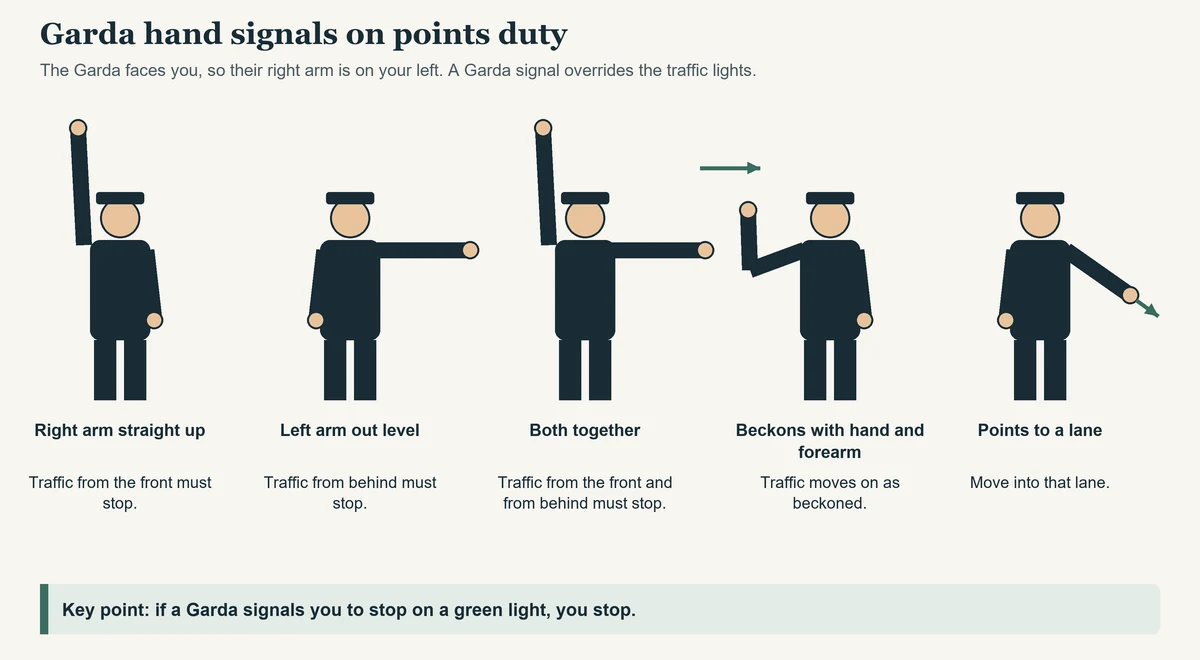
    In Ireland a Garda directing traffic overrides the traffic lights, so you need to recognise the five Garda hand signals and know what to do when stopped at a checkpoint. This guide covers both, plus how to let an ambulance, fire engine or Garda car through safely. It follows Section 12 and Section 20 of the Rules of the Road and the current fixed charges.

    Key facts

    • Garda signals override traffic lights. If a Garda signals you to stop on a green light, you stop.
    • Failing to obey a Garda’s signal: €80 fixed charge and 1 penalty point (3 on conviction).
    • Failing to stop when a Garda requires you to: €80 and 2 penalty points (5 on conviction).
    • You must carry your driving licence or learner permit whenever you drive.
    • For emergency vehicles: pull over only where it is safe, never mount the kerb unless you absolutely have to, and never go through a red light to make room unless a Garda directs you.

    Garda hand signals in Ireland

    These are the signals set out in the Road Traffic (Traffic and Parking) Regulations 1997 for a Garda on points duty. Drivers and pedestrians must act on them.

    Five figures of a Garda facing the driver: right arm up to stop traffic from the front, left arm level to stop traffic from behind, both together, beckoning to move on, and pointing to a lane.
    The five Garda hand signals on points duty. Illustrative diagram, not to scale.
    What the Garda does What it means
    Right arm raised straight up above the shoulder Traffic approaching from the front must stop.
    Left arm held out horizontally from the shoulder Traffic approaching from behind must stop.
    Right arm raised straight up and left arm held out horizontally at the same time Traffic approaching from the front and from behind must stop.
    Beckons with the hand and forearm Traffic from the front, the right or the left, or traffic already stopped, moves on as beckoned.
    Points towards a particular lane Move into that lane.

    A direction from a Garda controlling traffic also overrides the normal rules in the regulations. Ignoring a Garda’s direction carries an €80 fixed charge.

    Signalling to a Garda on points duty

    Use your indicator, or the arm signal from the regulations:

    • Straight ahead: raise your forearm and hand upwards, palm to the front.
    • Turning left (car driver): point your right forearm and hand, fingers extended, to the left.
    • Turning right: extend your right arm fully to the right, palm to the front.

    The driving test includes hand signals. See Irish driving test pre-test checks and traffic lights, driver signals and hand signals.

    What a Garda can ask you to do

    If a Garda asks, you must:

    • show your driving licence or learner permit, which you must carry whenever you drive
    • let the Garda examine the discs displayed on your windscreen
    • produce your NCT or roadworthiness certificate, where relevant, at a named Garda station within 10 days
    • produce a valid motor insurance certificate to a Garda within 10 days
    • produce the vehicle registration certificate at any reasonable time
    • stop and let the Garda check the vehicle for defects
    • give your name and address, and write your signature
    • give a roadside breath or saliva (oral fluid) sample
    • do impairment tests if a Garda suspects drug driving, telling them first about any disability or medical condition that could affect how you do them

    Checkpoints and breath tests

    Gardaí can set up mandatory testing checkpoints and require breath or saliva tests from drivers without suspecting they have been drinking or taking drugs. Refusing a breath sample, or refusing impairment tests when required, is an offence. Revenue officials can also stop and examine vehicles. For the alcohol limits that apply to learners and novices, see drink driving limits in Ireland.

    Failing to produce a licence to a Garda carries 1 penalty point (3 on conviction) under the penalty points schedule.

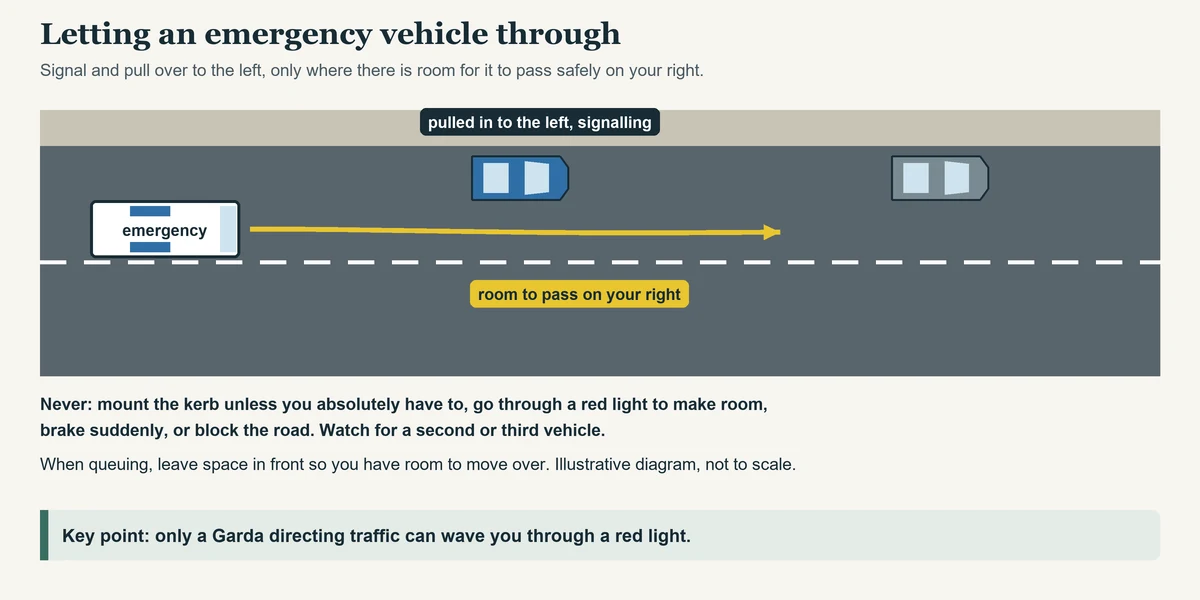
    What to do when an emergency vehicle approaches

    Gardaí, fire brigades and ambulances on an emergency call can be exempt from some traffic rules, as long as they don’t endanger other road users. Your job is to clear the way safely.

    A car pulled in to the left and signalling while an emergency vehicle passes on its right, with what not to do listed below.
    Letting an emergency vehicle pass safely. Illustrative diagram, not to scale.
    1. Stay alert. Keep in-car noise low enough to hear sirens. Expect emergency vehicles from behind or from a side road at junctions.
    2. Check all mirrors to judge the vehicle’s speed, and look for pedestrians, cyclists and motorcyclists.
    3. Signal and pull over to the left, only where there is room for the emergency vehicle to get past safely on your right.
    4. On a dual carriageway or motorway, move left when it is safe. Garda guidance says emergency vehicles usually overtake in the right-hand lane. Don’t stop in the middle of the road or on the hard shoulder unless you are told to.
    5. Stay there until it has passed. Watch for a second or third vehicle.
    6. Signal and rejoin traffic gradually when it is safe.

    When queuing, leave space in front so you have room to move over. You can’t pull in if you are boxed in nose to tail.

    Never

    • mount the kerb unless you absolutely have to, and only if you are certain no pedestrians are near
    • go through a red light or speed to make room. Stay behind the line and let the emergency driver find a way round you, unless a Garda directs you
    • brake suddenly or block the road
    • tailgate an emergency vehicle, race after it through lights, or overtake one showing flashing lights unless directed

    If a Garda motorcyclist with blue lights stops at a junction ahead of you to escort other vehicles, stop and stay there until the escorted vehicles have passed or the Garda waves you on.

    Common questions

    Can I go through a red light to let an ambulance pass?

    No. Stay behind the line and let the ambulance find a way round you. Only a Garda directing traffic can wave you through a red light.

    A Garda waves me on but the light is red. What do I do?

    Follow the Garda. A Garda’s signal overrides the traffic lights.

    Do I have to carry my licence in Ireland?

    Yes. The Rules of the Road says you must carry your licence or learner permit at all times when driving.

    What happens if I don’t stop for a Garda?

    Failing to stop when required by a Garda carries an €80 fixed charge and 2 penalty points, or 5 points on conviction, as of November 2026. See penalty points in Ireland.

    Can a Garda breath test me at a checkpoint for no reason?

    Yes, at a Mandatory Alcohol Testing checkpoint. Refusing is a criminal offence.

    What should I do if an emergency vehicle comes up behind me on a narrow road?

    Signal, then pull in where it is wide enough for it to pass safely, even if that means going a little further. Don’t stop on a bend or the brow of a hill.

    Related: what to do at the scene of a crash. Back to learning to drive in Ireland.

    Sources

    • Road Safety Authority, “Rules of the Road”, Section 1 Carrying a driving licence, Section 12 Assisting Gardaí, Section 20 Emergency services vehicles (Revision 5, hosted on garda.ie)
    • Irish Statute Book, “S.I. No. 182/1997, Road Traffic (Traffic and Parking) Regulations 1997”, articles 6 and 19 and Second Schedule Tables B and C (irishstatutebook.ie)
    • Irish Statute Book, “S.I. No. 227/2024, Road Traffic Act 2010 (Part 3) (Fixed Charge Offences) Regulations 2024”, Schedule 5 (irishstatutebook.ie)
    • Law Reform Commission, “Road Traffic Act 2002”, First Schedule, revised (revisedacts.lawreform.ie)
    • An Garda Síochána, “Roads policing message: emergency vehicles”, Crimecall, 31 March 2025 (garda.ie)
    • Law Reform Commission, “Road Traffic Act 2010”, sections 9 to 11, revised (revisedacts.lawreform.ie)
  • Parking Rules in Ireland: Clearways, Disabled Bays and No Parking

    Parking Rules in Ireland: Clearways, Disabled Bays and No Parking

    Photo: Phil Evenden / Pexels. Illustrative photograph.

    Parking rules in Ireland come from the Rules of the Road and the Road Traffic (Traffic and Parking) Regulations 1997. This guide lists where you cannot park even without a sign, explains clearways, yellow lines, disc parking and disabled bays, and gives the fixed charges as of November 2026. It is written for learners and new drivers, and the same rules come up in the theory test.

    Key facts

    • No parking within 5 metres of a junction, unless parking spaces are clearly marked.
    • No parking within 15 metres before or 5 metres after a pedestrian crossing or traffic lights.
    • Double yellow lines: no parking at any time. Single yellow line: no parking during the times on the nearby plate.
    • Clearway: no stopping or parking during the signed hours, except when queuing in traffic.
    • Parking in a disabled bay without a permit: €150 fixed charge.
    • Parking on a footpath: €80. Dangerous parking: €80 and 3 penalty points.

    How to park correctly

    • Park close to and parallel with the kerb, facing the direction of traffic, unless bays are marked out.
    • If a bay is marked, park fully inside it.
    • Handbrake on, engine off, first gear or reverse (P in an automatic).
    • Check for cyclists, motorcyclists and pedestrians before opening a door. Passengers should get out on the kerb side.
    • Lock the car. Don’t leave headlights on: use only sidelights or parking lights if you need lights.

    Where you cannot park in Ireland, even without a sign

    Even if there is no “no parking” sign or yellow line, the Rules of the Road says you must not stop or park:

    A street seen from above with red no parking zones 15 metres before and 5 metres after a pedestrian crossing, and 5 metres either side of a junction, plus a car parked parallel to the kerb facing the traffic flow.
    No parking distances near crossings, lights and junctions. Illustrative diagram, not to scale.
    • in a disabled persons parking space without a valid permit on display
    • on white or yellow zig-zag lines at a zebra, pelican or pedestrian lights crossing, or on the crossing itself
    • 15 metres before or 5 metres after a pedestrian crossing or traffic lights
    • on yellow “SCHOOL KEEP CLEAR” zig-zags
    • near the entrance or exit of a fire, ambulance or Garda station
    • in a bus stop or taxi rank (marked BUS or TAXIS)
    • beside a single or double continuous white line along the centre of the road
    • wholly or partly on a footpath, grass margin, cycle lane or track, or median strip
    • within 5 metres of a junction, unless spaces are clearly marked
    • in a casual trading area during trading hours
    • in a contra-flow bus lane at any time, or a with-flow bus lane during its hours
    • in a loading bay (marked LOADING)
    • across an entrance to a property, unless the occupier agrees
    • in a tram lane while it is in force (24 hours unless a plate says otherwise)
    • on the approach to a level crossing
    • where the kerb is lowered for wheelchair users

    You must never park at a corner, a bend, the brow of a hill, a hump-back bridge or a sharp dip, or where you block the view of a school warden. And you must not park anywhere that interferes with traffic or endangers other road users.

    Signs and lines that control parking

    Sign or marking What it means
    Double yellow lines No parking at any time on that side of the road.
    Single yellow line with plate No parking during the times shown on the plate.
    Parking permitted sign with plate Parking allowed only during the times shown, and for the length of time shown if restricted.
    Parking prohibited sign with plate No parking during the times shown.
    Clearway sign with plate No stopping or parking during the times shown, even where disc or meter parking normally applies. You may stop only while waiting in a queue of traffic.
    Disc parking sign Buy a disc for a set time and leave by the end of it. You can’t park again in the same street within one hour.
    Loading bay (LOADING) Goods vehicles loading or unloading only, for up to 30 minutes.

    For the full set of markings, see Irish road markings. For bus lanes and Luas tram lanes, see bus lanes, Luas trams and light rail.

    Disabled parking bays

    Wheelchair users need the extra-wide bay to open their door fully and transfer between wheelchair and car. Only a vehicle displaying a disabled person’s parking permit, parked for the convenience of the permit holder, may use one. Two separate fixed charges apply:

    • parking or stopping in the bay with no permit: €150
    • using a permit in the bay when it is not for the convenience of the permit holder (for example, borrowing a relative’s permit): €200

    Fixed charges for parking offences in Ireland

    As of November 2026, under the Fixed Charge Offences Regulations 2024. Paying late adds 50%, and not paying leads to court. Penalty points apply only where shown.

    Offence Fixed charge Penalty points
    Misusing a disabled permit in a disabled bay €200 None
    Parking in a disabled bay without a permit €150 None
    Parking in a dangerous position €80 3 (5 on conviction)
    Parking on a footpath, grass margin or median strip €80 None
    Parking in a signed cycle track €80 None
    Parking in a bus lane or bus-only street €80 None
    Parking in an EV charging bay when not charging €80 None
    Stopping or parking in a tram lane €60 None
    Stopping or parking in a clearway €40 None
    Stopping or parking at a school entrance €40 None
    Parking in a loading bay €40 None
    Other prohibited places (near a junction or crossing, yellow lines, bus stop and so on) €40 None
    Parking in a pedestrianised street during its hours €40 None

    A Garda decides whether parking is “dangerous”. The Rules of the Road gives the example of a car that forces a pedestrian onto the road. On top of these Garda fixed charges, councils run their own pay-and-display, clamping and towing schemes, and you pay a release fee to get a clamped or removed car back. Those fees vary by council, so check the local authority.

    Common questions

    How close to a junction can I park in Ireland?

    No closer than 5 metres, unless parking spaces are clearly marked closer.

    Can I park half on the footpath on a narrow street?

    No. Parking wholly or partly on a footpath is not allowed and carries an €80 fixed charge. If it forces pedestrians onto the road, it can be treated as dangerous parking with penalty points.

    Can I stop in a clearway to drop someone off?

    Not during its signed hours. The only stopping allowed is while you are waiting in a line of traffic.

    Can I park on a single yellow line in the evening?

    Only outside the times on the information plate nearby. Read the plate every time.

    Is parking a learner car on a footpath during a lesson allowed?

    No. Learners follow the same parking law as everyone else, and the driving test includes parking safely. See Irish driving test manoeuvres.

    Do parking fines give penalty points?

    Most parking offences don’t. Dangerous parking does: 3 points if you pay the fixed charge, 5 on conviction. See penalty points in Ireland.

    Related: pedestrian crossings and sharing the road with cyclists. Back to learning to drive in Ireland.

    Sources

    • Road Safety Authority, “Rules of the Road”, Section 10 Parking (Revision 5, hosted on garda.ie)
    • Irish Statute Book, “S.I. No. 182/1997, Road Traffic (Traffic and Parking) Regulations 1997”, articles 36 to 45 (irishstatutebook.ie)
    • Irish Statute Book, “S.I. No. 227/2024, Road Traffic Act 2010 (Part 3) (Fixed Charge Offences) Regulations 2024”, Schedules 1, 3, 5, 6 and 8 (irishstatutebook.ie)
    • Law Reform Commission, “Road Traffic Act 2002”, First Schedule, revised (revisedacts.lawreform.ie)
    • Law Reform Commission, “Road Traffic Act 2010”, Part 3 Fixed charge offences, revised (revisedacts.lawreform.ie)