Category: Ireland

  • Two Second Rule and Stopping Distances in Ireland (Metres)

    Two Second Rule and Stopping Distances in Ireland (Metres)

    Photo: Aaron King / Pexels. Illustrative photograph.

    In Ireland the two-second rule means staying at least two seconds behind the vehicle in front, and at least four seconds in the wet. This guide explains how to check the gap, gives the RSA’s minimum stopping distances in metres for dry and wet roads, and shows why speed matters so much. Learners need these figures for the Driver Theory Test and for the driving test itself.

    Key facts

    • Keep at least a 2 second gap in the dry and double it (4 seconds) in the wet.
    • Minimum stopping distance at 50 km/h: 25 m dry, 36 m wet.
    • At 100 km/h: 70 m dry, 121 m wet. At 120 km/h: 102 m dry, 169 m wet.
    • The RSA says these are absolute minimums. Real stopping distances are often much longer.
    • In a road tunnel the recommended minimum gap for a car is 50 metres.
    • Driving too fast to stop within the distance you can see to be clear is an offence: €160 fixed charge and 3 penalty points.

    How to check the two-second rule

    1. On a dry road, pick a fixed point ahead, such as a lamp post or road sign.
    2. When the back of the vehicle in front passes it, say “Only a fool breaks the two-second rule”.
    3. If you reach the point before you finish the sentence, you are too close. Ease off and drop back.
    4. In wet weather, say it twice.
    A car following another past a lamp post, with the phrase Only a fool breaks the two-second rule, and labels for at least 2 seconds in the dry and 4 in the wet.
    Checking your gap with the two-second rule. Illustrative diagram, not to scale.

    The Rules of the Road calls this gap your “safe headway”. If you tailgate and the driver in front brakes suddenly, you may not have time to react, and if you run into them you will be liable for the damage.

    Severe weather needs more than the wet-weather gap

    Four seconds is a starting point for wet roads, not a promise that you can stop on snow or ice. The current Rules of the Road says that in severe snow, fog or ice you may need to repeat the two-second phrase four or five times, which is about eight to ten seconds. Slow down as well as dropping back. If you cannot see far enough ahead to stop safely, a longer gap alone does not make your speed safe.

    The RSA also advises against using cruise control in heavy rain, hail, snow, fog or ice. Learn how to switch your car’s system off while you are parked, and control your speed yourself when conditions get worse.

    What two seconds looks like in metres

    The gap grows with speed because you cover more ground each second. Simple arithmetic gives these approximate figures:

    Speed Distance covered in 2 seconds Distance in 4 seconds (wet)
    50 km/h about 28 m about 56 m
    80 km/h about 44 m about 89 m
    100 km/h about 56 m about 111 m

    That is why counting seconds works better than guessing metres: it adjusts to your speed automatically. It does not adjust for grip or visibility, so add more time when conditions are worse.

    If another car moves into the gap you were keeping, ease off smoothly to rebuild it. Don’t brake hard or speed up to close the space.

    Stopping distances in Ireland: the RSA tables

    Total stopping distance is the distance you travel while reacting plus the distance the car needs to brake to a stop. These are the RSA’s recommended minimums for a car.

    Bar chart of RSA minimum stopping distances for a car at 30 to 120 km/h, split into reaction and braking distance, dry and wet. At 120 km/h the total is 102 m dry and 169 m wet.
    RSA minimum stopping distances for a car, dry and wet, in metres.

    Dry road

    Speed (km/h) Reaction distance (m) Braking distance (m) Total minimum stopping distance (m)
    30 6 6 12
    40 8 10 18
    50 10 15 25
    60 12 21 33
    80 16 36 52
    100 20 50 70
    120 24 78 102

    Wet road

    Speed (km/h) Reaction distance (m) Braking distance (m) Total minimum stopping distance (m)
    20 4 5 9
    30 6 10 16
    40 8 17 25
    50 10 26 36
    60 12 37 49
    70 14 50 64
    80 16 65 81
    100 20 101 121
    120 24 145 169

    Source of the tables: Transport Research Laboratory (UK) 2012 figures, as published by the RSA in the Rules of the Road.

    Three patterns worth remembering

    • Reaction distance in the tables is the speed divided by five: 50 km/h gives 10 m, 100 km/h gives 20 m.
    • Double the speed, nearly four times the braking. The RSA notes braking distance on a wet road rises from at least 26 m at 50 km/h to at least 101 m at 100 km/h.
    • Wet roads add a lot at speed. At 120 km/h the wet total is 67 m longer than the dry total.

    What makes stopping distances longer

    The Rules of the Road splits stopping into four parts:

    • Perception time: seeing a hazard and recognising it. This can be 0.25 to 0.5 seconds or more.
    • Reaction time: moving your foot from accelerator to brake. Usually 0.25 to 0.75 seconds, but it can be as long as 1.5 seconds.
    • Vehicle reaction time: depends on the condition of the car, especially the brakes.
    • Braking capability: brakes, tyre pressure and tread, vehicle weight, suspension and the road surface.

    The first two are down to you. Alcohol, drugs, tiredness and poor concentration all slow them. The RSA gives an example: a perception and reaction time of 4 seconds at 100 km/h means the car travels 110 metres before the brakes even come on. See tiredness, drugs and road rage and vehicle safety checks for tyres and brakes.

    Speed and pedestrians

    The Rules of the Road quotes RoSPA (UK) figures for a pedestrian hit by a car:

    Impact speed Pedestrians killed
    60 km/h 9 out of 10
    50 km/h 5 out of 10
    30 km/h 1 out of 10

    The law: stopping within the distance you can see

    Under the Road Traffic (Traffic and Parking) Regulations 1997, you must not drive faster than lets you stop within the distance you can see to be clear. As of November 2026 this offence carries a €160 fixed charge and 3 penalty points, or 5 points on conviction. The Rules of the Road also says you must stop on the correct side of the road, in a controlled way, without risk to anyone. Don’t overcorrect by crawling: driving so slowly that you hold up traffic can provoke dangerous overtaking. But never let an impatient driver behind push you above a speed that is safe for what you can see. See speed limits in Ireland.

    Common questions

    Is the two-second rule the law in Ireland?

    The two-second rule itself is RSA guidance. The law is that you must be able to stop within the distance you can see to be clear, and tailgating makes that impossible.

    What gap should I leave on a motorway?

    Still at least two seconds in the dry and four in the wet. In tunnels the recommended minimum gap is 50 metres for a car and 100 metres for other vehicles. See motorways and tunnels.

    Do I need to learn the stopping distance tables for the theory test?

    Stopping distances are part of the Rules of the Road, which the theory test questions are based on. See Irish theory test topics.

    What is the stopping distance at 80 km/h?

    At least 52 metres on a dry road and 81 metres on a wet road.

    Someone is tailgating me. What should I do?

    Increase the gap in front of you so you can brake more gently if needed. That gives the driver behind more time to react.

    Does the driving test check following distance?

    The Rules of the Road lists the headings the test assesses, including allowing sufficient clearance to other traffic, reacting promptly to hazards and adjusting speed appropriately. Sitting too close to the car in front touches all three. See common reasons for failing the Irish driving test.

    Back to learning to drive in Ireland.

    Sources

    • Road Safety Authority, “Rules of the Road”, Section 8 Driving safely in traffic: the two-second rule, and Stopping distance for cars, Tables 5 and 6; Section 11 Tunnels (Revision 5, hosted on garda.ie)
    • Irish Statute Book, “S.I. No. 182/1997, Road Traffic (Traffic and Parking) Regulations 1997”, article 7 (irishstatutebook.ie)
    • Irish Statute Book, “S.I. No. 227/2024, Road Traffic Act 2010 (Part 3) (Fixed Charge Offences) Regulations 2024” (irishstatutebook.ie)
    • Law Reform Commission, “Road Traffic Act 2002”, First Schedule, revised (revisedacts.lawreform.ie)
    • Road Safety Authority, “Rules of the Road”, current edition reflecting the law at 1 March 2025, printed pages 115 to 116 (following distance in bad weather and cruise control) (rsa.ie)
  • Bus Lanes, Luas Trams and Light Rail: Rules in Ireland

    Bus Lanes, Luas Trams and Light Rail: Rules in Ireland

    Photo: Donovan Kelly / Pexels. Illustrative photograph.

    In Ireland you must not drive a car in a bus lane during its hours of operation, and never in a contra-flow bus lane. Tram lanes, used by the Luas in Dublin, are for trams while they are in force: the regulations allow a car in one only for a few narrow purposes, and TFI Luas tells motorists road vehicles are not allowed in them. Follow the signs and markings at each location. This guide explains the signs and markings, who may use bus lanes, the exceptions for getting in and out of premises, how to drive near trams, and the fines, as of November 2026.

    Key facts

    • Bus lanes are marked by a blue and white upright sign, a continuous white line and the words “Lána Bus” on the road.
    • The information plate shows the hours. Bus lanes normally run 7am to 7pm or at peak times. Outside those hours all traffic may use a with-flow bus lane.
    • Contra-flow bus lanes are for buses (and permitted cyclists) at all times.
    • Driving in a bus lane: €60 fixed charge. Parking in one: €80.
    • Tram lanes operate 24 hours unless a plate shows other times.

    Who can use a bus lane in Ireland?

    During its hours of operation, a with-flow bus lane may be entered only by:

    • large public service vehicles (buses)
    • pedal cycles
    • L1e-A e-mopeds (pedal-assisted only, with the motor cutting out at 25 km/h) and electric scooters; throttle-powered and L1e-B e-mopeds are not included
    • taxis and wheelchair accessible taxis being used in the course of business

    A private car may cross a with-flow or contra-flow bus lane only to:

    • get into or out of premises or property next to the bus lane, or
    • get into or out of a road inset next to the bus lane to load or unload goods.

    With-flow, contra-flow and bus-only streets

    Type What it is Can a car use it?
    With-flow bus lane Runs the same direction as the traffic beside it, usually on the left (near side), sometimes on the right (off side) Only outside the hours on the information plate
    Contra-flow bus lane Runs against the traffic beside it No, day or night
    Bus-only street A whole street reserved for buses Only for access to a building or side road

    If a Yield sign appears at the end of a bus lane, the bus must give way as it merges back into traffic.

    Reading the information plate

    The white plate with the blue bus lane sign shows when the lane is reserved for buses. Hours differ from street to street, so read every plate rather than assume 7am to 7pm.

    Trams and the Luas: signs and rules for drivers

    Sign or marking What it means
    Blue tram lane sign (left or right) A tram lane runs beside your lane. Do not drive in it while it is in force (see the narrow exceptions below)
    No Entry with plate “Except Trams” Street for trams only. No other traffic
    No Entry with plate “Except Trams and Access” You may enter only to get into or out of a building
    “LÁNA TRAM” on the road A section of road shared by trams and vehicles
    Warning sign: tramway crossing ahead Pedestrians may be crossing the tracks
    Warning sign: overhead electric cables Tram wires above. Take care with high loads

    When may a car enter a tram lane?

    A tram lane is marked by the blue tram lane sign and a continuous white line, and the information plate shows when it is in force. During those times, the 2003 tram regulations (S.I. No. 98/2003, article 8) say you must not enter it with any vehicle other than a tram, with only these exceptions:

    • crossing it solely to get into or out of premises or property next to it
    • crossing it solely to get into or out of a road next to it
    • crossing it solely to get into or out of a road inset next to it to load or unload goods
    • entering it solely to overtake another vehicle

    These are narrow exceptions, not a second traffic lane. You may not drive along it, stop or park in it, or use it for any other reason. TFI Luas’s own advice to motorists is that road vehicles are not allowed in tram lanes, which are for trams only. If you are not sure an exception applies, stay out, and check with the Department of Transport or your ADI.

    Driving safely near trams

    • Trams have their own light signals. Do not follow a tram through a traffic light junction unless permitted.
    • Obey the traffic lights at tram junctions and keep yellow boxes completely clear.
    • Do not stop or park in a tram lane while it is in force.
    • Watch for pedestrians crossing at tram stops and crossing points.
    • Give cyclists room near tram tracks: rails are slippery and wheels can catch in the grooves.
    • Never touch overhead wires, even indirectly with a long load.
    • Before crossing the tracks, make sure there is room for your whole car beyond them and beyond any yellow box. Luas advises leaving space for the traffic in front to clear the tramway first.
    • Never tailgate a tram. It may stop at a platform or junction and cannot steer round a car.
    • Leave extra stopping distance in wet or icy weather, so you are not braking hard on the rails.
    • On a shared tramway, check the signs and markings first. Luas’s own advice is that if you are not completely sure you can drive there, don’t.
    • If you miss a turn, carry on and find a legal route. Don’t reverse or U turn across the tracks.

    Example: a tram goes but your light stays red

    You are stopped beside a tram. Its signal changes and it moves off. Your light is still red, so you stay put. When your own light turns green, check there is space beyond the tracks before you go.

    Cycle tracks: crossing without cutting in

    Don’t drive along or park on a cycle track. Where you need to cross one, for example to turn into a driveway or side road:

    • check your mirror and blind spot early, then again just before you turn, as a cyclist behind can be alongside within seconds
    • look both ways on two-way and shared tracks, where pedestrians and riders move at different speeds
    • wait outside the track until it is clear, rather than nosing in to claim your place
    • don’t stop across the track while you wait for a gate or a gap in traffic

    Your indicator tells riders what you plan to do. It does not give you priority over them.

    Fines for bus lane and tram lane offences

    Offence Fixed charge
    Driving in a bus lane or on a bus-only street €60
    Parking in a bus lane or on a bus-only street €80
    Entering a tram lane with a vehicle other than a tram €60
    Stopping or parking in a tram lane €60
    Entering a tram-only street €40

    Fixed charges as of November 2026. Parking in a contra-flow bus lane is banned at all times, and in a with-flow lane during its hours. See parking rules in Ireland.

    Common questions

    Can I drive in a bus lane in Ireland outside its hours?

    Yes, in a with-flow bus lane outside the times on the information plate. Never in a contra-flow bus lane.

    Can I use a bus lane to turn left?

    The regulations list two reasons a car may cross a bus lane: to enter or leave premises next to it, or a loading inset. At junctions, follow the road markings and signs, and ask your ADI how local layouts work.

    Are taxis allowed in bus lanes?

    Yes, in with-flow bus lanes, when used in the course of business. Not in contra-flow lanes.

    Can I drive in a bus lane as a learner during the test?

    No. The same rules apply to every driver, and the tester marks failing to obey signs and road markings as a fault.

    Can I drive on the Luas tracks?

    Where LÁNA TRAM marks a shared section, trams and vehicles use the same road, so take extra care. Keep out of a marked tram lane while it is in force, apart from the narrow crossing and overtaking exceptions above, and never drive on a tram-only street unless its plate says “Except Trams and Access” and you need access.

    Back to learning to drive in Ireland. Related: Irish road signs, road markings, level crossings, cyclists.

    Sources

    • Road Safety Authority, “Rules of the Road”, Section 6 Buses, trams, rail and light rail signs, Section 10 Parking and Section 19 Respecting other road users (Revision 5, hosted on garda.ie)
    • TFI Luas, “Safe Driving Around Luas” (luas.ie), read November 2026
    • Irish Statute Book, “S.I. No. 98/2003, Road Traffic (Traffic and Parking) (Amendment) Regulations 2003”, articles 8 to 10 tram lanes and tram-only streets (irishstatutebook.ie)
    • Irish Statute Book, “S.I. No. 332/2012, Road Traffic (Traffic and Parking) (Amendment) (No. 2) Regulations 2012”, article 32 Bus lanes (irishstatutebook.ie)
    • Irish Statute Book, “S.I. No. 222/2024, Road Traffic (Traffic and Parking) (Amendment) Regulations 2024” (irishstatutebook.ie)
    • Law Reform Commission, revised “S.I. No. 182/1997, Road Traffic (Traffic and Parking) Regulations 1997”, article 32 as substituted by S.I. No. 473/2025, revised to 13 October 2026 (revisedacts.lawreform.ie)
    • Irish Statute Book, “S.I. No. 227/2024, Road Traffic Act 2010 (Part 3) (Fixed Charge Offences) Regulations 2024” (irishstatutebook.ie)
    • Road Safety Authority, “E-bikes and e-mopeds” (powered personal transportation) (rsa.ie)
  • Good Driving Practice in Ireland: Moving Off, Position, Lanes

    Good Driving Practice in Ireland: Moving Off, Position, Lanes

    Photo: Oleksandr Kobuta / Pexels. Illustrative photograph.

    Good driving practice in Ireland starts with the basics the Rules of the Road sets out in Section 5: moving off safely, keeping the right road position on the left, changing lanes without cutting anyone up, and slowing or stopping at the side of the road. These are also the skills the driving test marks most often. Each routine is below as a step-by-step list.

    Key facts

    • You must drive on the left-hand side of the road in Ireland. Failing to keep left is a €60 fixed charge and 2 penalty points (4 on conviction), as of November 2026.
    • When moving off from the kerb you must signal and give way to other traffic and pedestrians.
    • When changing lanes you must give way to traffic already in the lane you are moving into.
    • Signalling does not give you the right of way.

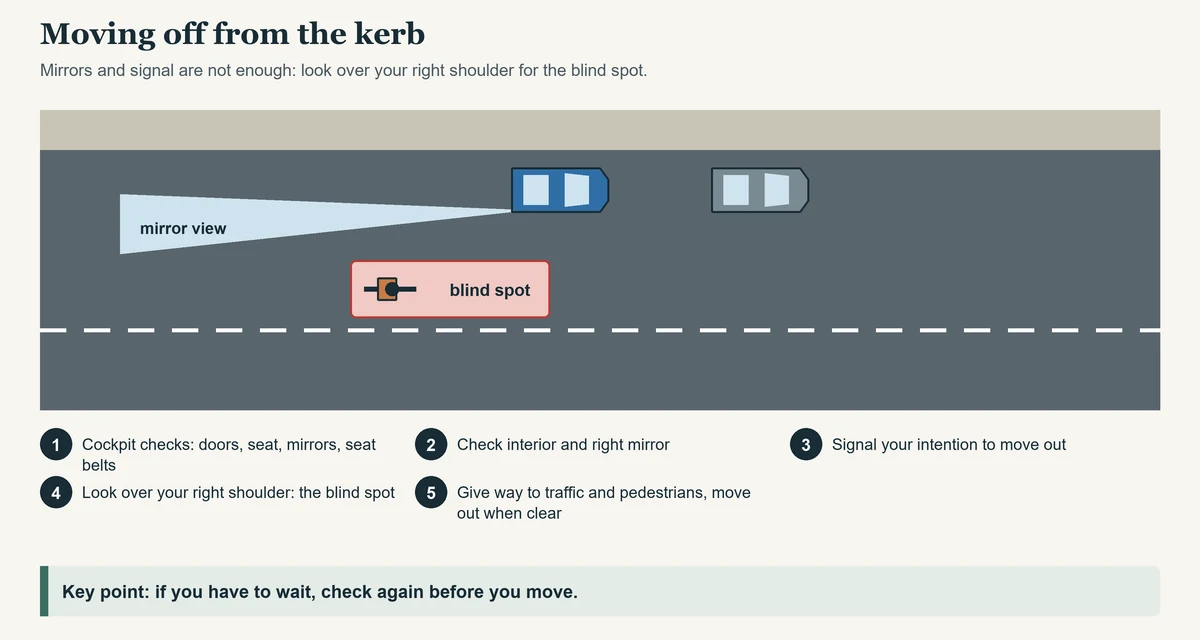
    Moving off: the routine

    1. Cockpit checks: doors, bonnet and boot closed; seat and head restraint adjusted; mirrors clean and adjusted; every seat belt fastened.
    2. Mirrors: check the interior and right mirror.
    3. Signal your intention to move out.
    4. Blind spot: look over your right shoulder. Traffic, cyclists and pedestrians can be beside the car where the mirrors do not show.
    5. Give way to traffic and pedestrians, then move out when clear.
    6. Build speed to the normal safe and legal flow of traffic.
    A car parked at the left kerb with its mirror view behind and a blind spot beside the rear where a cyclist is hidden, with the five steps for moving off.
    Why you check over your right shoulder before moving off. Illustrative diagram, not to scale.

    If you have to wait after checking, check again before you move: a cyclist or pedestrian may have come into the space. Missing the blind spot check when moving off is one of the RSA’s most common reasons for failing. See common reasons for failing.

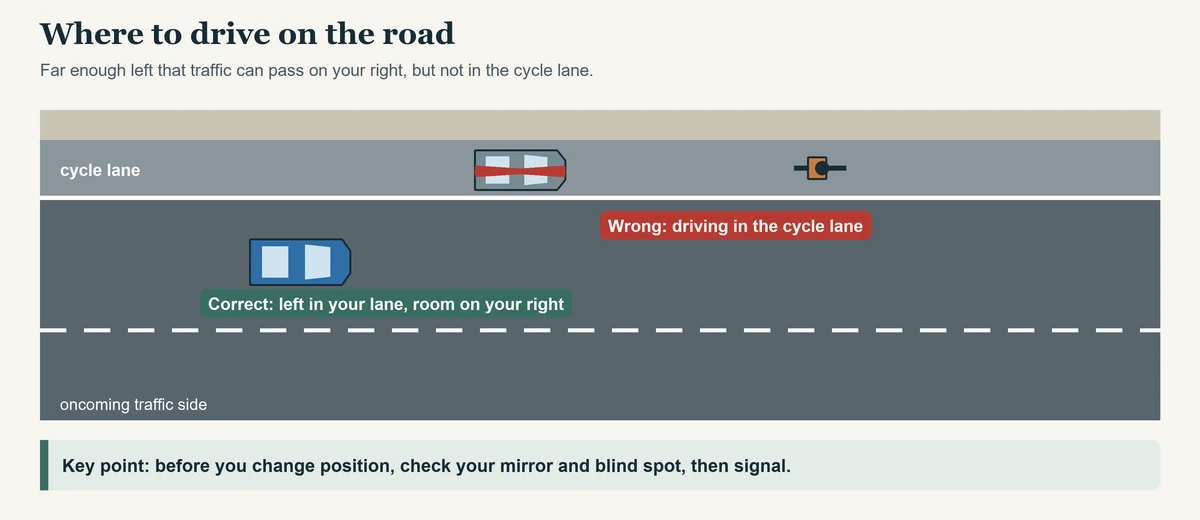
    What is the correct road position in Ireland?

    Drive far enough to the left that traffic can safely pass or overtake on your right, but not so far left that you drive in a cycle lane or block or endanger cyclists or pedestrians.

    A car driving on the left of its lane with room to be passed on the right, and a crossed out car driving in the cycle lane.
    Correct road position: on the left, but not in the cycle lane. Illustrative diagram, not to scale.

    Before you change position, for example to overtake, turn right or pass parked cars, cyclists, horse riders or pedestrians:

    1. Make sure it is safe.
    2. Check your mirror for vehicles coming up on your right, and check your blind spot.
    3. Signal clearly and in good time, then move.

    Buses, schools and cyclists

    • Let signalling buses back into traffic after they pick up or drop off passengers.
    • Near schools and bus stops, watch for pedestrians and children and be ready to stop.
    • At an advanced stop line, let cyclists move off ahead of you.
    • Turning left, watch for cyclists and mopeds near the kerb. Do not overtake a cyclist just before you turn left.
    • The RSA advises leaving at least 1 metre when passing a cyclist where the speed limit is 50 km/h or less, and at least 1.5 metres where it is above 50 km/h. See sharing the road with cyclists.

    How to change lanes safely

    1. Only change lanes for a good reason.
    2. Check your mirrors in plenty of time.
    3. At speed, take a quick sideways glance to check for a vehicle that has dropped out of mirror view.
    4. Signal, then move when it is clear and safe. Give way to traffic already in the lane.
    5. Approaching a junction, follow lane arrows and signs. They tell you which direction traffic in that lane must take.

    Slowing down or stopping at the side of the road

    1. Check your mirror to make sure you can slow and stop safely.
    2. Signal that you are pulling in.
    3. Your brake lights show you are slowing. If you think they may not be seen or are not working, use the slowing-down arm signal (right arm moved up and down outside the window). Get faulty brake lights fixed straight away.
    4. Use a lay-by if there is one, or stop close to the left-hand edge.
    5. Do not leave headlights on when stopped. Use sidelights or parking lights if you need lights.

    Scenario: pulling out from a parked position on a busy street

    You are parked on the left with a car parked ahead. A cyclist is coming up behind. Mirror, signal, blind spot: you see the cyclist, so you wait with the signal on and let them pass. Check again, then move out, leaving room past the parked car before returning to your normal position. Moving out in front of the cyclist would force them to react, which the tester marks as a fault.

    Common questions

    What does the Rules of the Road say about keeping left?

    You must drive on the left-hand side of the road, far enough left for others to pass on your right, but not in a cycle lane.

    Do I always have to signal when moving off?

    Yes. The Rules of the Road says you must signal and give way when moving off from the kerb. The signal never replaces looking.

    Can I overtake on the left?

    Only in limited cases, such as when the driver in front is turning right. See overtaking rules in Ireland.

    What is a blind spot check?

    A look over your shoulder to see the area your mirrors do not cover. Do it before moving off and changing lanes.

    Where am I allowed to reverse or make a U turn?

    See reversing, U turns and towing in Ireland.

    Back to learning to drive in Ireland. Related: junctions, signals and hand signals.

    Sources

    • Road Safety Authority, “Rules of the Road”, Section 1 (message to overseas drivers) and Section 5 Good driving practice (Revision 5, hosted on garda.ie)
    • Road Safety Authority, “Repeating your test” (rsa.ie)
    • Irish Statute Book, “S.I. No. 227/2024, Road Traffic Act 2010 (Part 3) (Fixed Charge Offences) Regulations 2024” (irishstatutebook.ie)
    • Law Reform Commission, “Road Traffic Act 2002”, First Schedule, revised (revisedacts.lawreform.ie)
    • Road Safety Authority, “Cyclists campaign” (rsa.ie)
  • Vehicle Safety Checks in Ireland: Tyres, Lights and Mirrors

    Vehicle Safety Checks in Ireland: Tyres, Lights and Mirrors

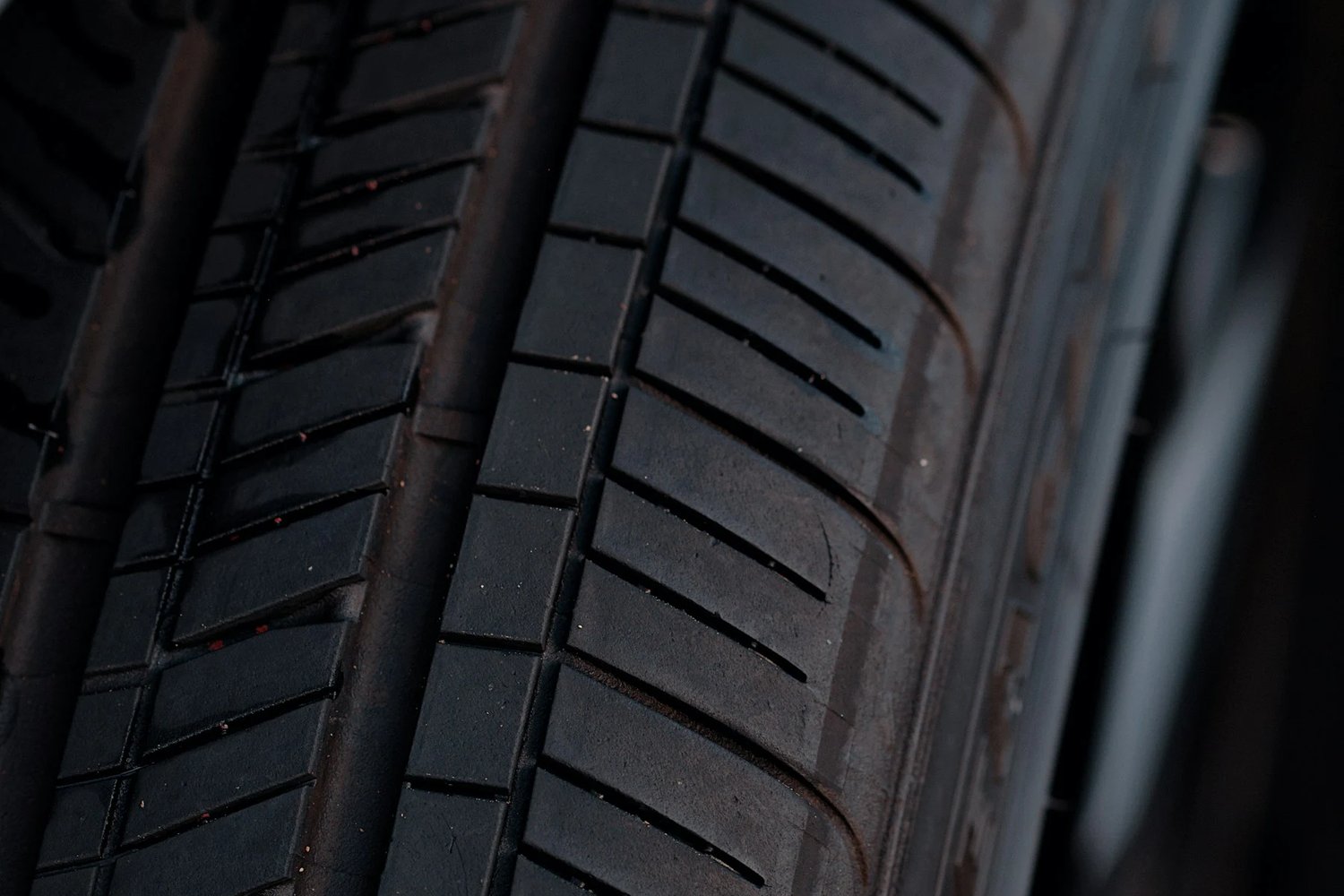
    Photo: Leiada Krözjhen / Unsplash. Illustrative photograph.

    In Ireland the driver is responsible for making sure the car is roadworthy, and it is an offence to drive an unsafe vehicle on a public road. This checklist follows Section 4 of the Rules of the Road: tyres, lights and reflectors, windscreens, mirrors, roof racks and registration plates. Use it weekly, and the day before your driving test.

    Key facts

    • Minimum tyre tread: 1.6 mm across the main treads (1 mm for motorcycles and vintage vehicles).
    • Defective or worn tyres: €80 fixed charge and 2 penalty points (4 on conviction), as of November 2026.
    • Fog lights only in dense fog or falling snow.
    • Windscreens on vehicles registered since January 1986 must be laminated glass.
    • Registration plates: plain black characters on a plain white reflective background, no italics or shadows.

    What must I check regularly?

    The Rules of the Road says you must make sure these are checked regularly: steering, brakes, front and rear lamps, indicators, reflectors, rear view mirrors, safety belts, speedometer, tyres, windscreen wipers, horn and silencer.

    Tyres

    Check Standard
    Tread depth At least 1.6 mm over the main treads. Replace before you reach it
    Pressure Every tyre, including the spare, to the manufacturer’s figure
    Damage No cuts, cracks or bulges, which can cause a blow-out
    Matching Tyres must be the same on any axle. Do not mix radial and cross ply on one axle
    Replacements New, e-marked tyres from a reputable dealer. Avoid second-hand tyres
    Space saver spare Only to finish the journey or get to a tyre dealer, under the speed stamped on it

    Not accepted on the driving test: a space saver fitted to the car. See your car for the Irish driving test.

    Lights and reflectors

    Front Rear
    Two headlights (white or yellow) Two red tail lights
    Two white sidelights Two red brake lights
    Amber indicators Two red reflectors
    Number plate lighting
    Amber indicators
    • Reversing lights must be white or yellow.
    • Use fog lights only in dense fog or falling snow, and switch them off when it clears.
    • You must not fit blue or red flashing lights. Flashing lights other than indicators are for the Gardai, ambulances and other designated vehicles.
    • Get professional advice before modifying lights, and tell your insurer: some modifications can invalidate your policy.
    • Keep lights, reflectors and number plate lights clean.

    Quick check: switch on the lights and hazards and walk round. For brake lights, ask someone to press the pedal, or reverse up to a wall or garage door and look in the mirror.

    Windscreens and wipers

    • Laminated glass is required on vehicles registered since January 1986, and on any replacement windscreen on older cars.
    • Keep wiper blades in good condition and the washer fluid topped up.
    • Keep the windscreen and windows clean and free of clutter.

    Mirrors

    • Your car must give you a view behind and to each side, through mirrors or an approved digital camera system that replaces them. A reversing camera or parking sensor is not a replacement for mirrors. Keep mirrors, camera lenses and screens clean, and learn where their blind spots are.
    • Keep them clean, undamaged and correctly positioned.
    • You must use them before signalling, moving off, changing lanes, overtaking, slowing, stopping, turning and opening doors.

    Roof racks, roof boxes and bike racks

    • Fit the rack or box securely.
    • The load must not block your view in any direction.
    • Never overload it, or load it so it could fall off or make the car unstable.
    • Check it is mounted and the load secured before you set off. The same applies to roof and rear bike racks.

    Registration plates

    • Plain black characters on a plain white reflective background, in one of the legal formats for vehicles registered since 1 January 1991.
    • No italics or shadows. Keep them clean and readable.
    • You must not interfere with a registration plate.

    Other safety responsibilities

    The Rules of the Road says the driver must keep the vehicle in good working order and have these checked regularly, not just the items above:

    • Brakes and steering: the two systems you rely on most to avoid a crash.
    • Horn: it must work.
    • Speedometer: you cannot keep to the limit without one that works.
    • Silencer (exhaust): part of the regular checks.
    • Indicators, safety belts and windscreen wipers: also on the must-check list.
    • Loads: anything on a roof rack or in a roof box must be completely secured before you set off, must not block your view, must not overload the rack and must not be able to fall off.

    The same section adds two duties to passengers: never leave infants or young children alone in a car, even briefly, and never leave animals alone in a vehicle. It also covers phones. Under section 3 of the Road Traffic Act 2006 you must not hold a mobile phone while driving in a public place, and holding includes supporting it with another part of your body, such as between your ear and shoulder. The law gives a defence if you were calling the emergency services or dealing with a genuine emergency, but that is not general permission to handle a phone. Even hands-free, a call can distract you, so the safest choice is to let calls wait until you have stopped somewhere safe and legal. Holding a phone is a penalty point offence (see penalty points in Ireland). Avoid headphones or loud entertainment systems that stop you hearing sirens or horns. Towing a trailer brings its own rules: see reversing, U-turns and towing in Ireland.

    Electric cars and driver assistance

    If you practise in an electric car, learn how to charge it and how to use the charging point safely, following the car and charger instructions. If a cable, plug or charger looks damaged, do not use it. Know how the car shows that it is ready to move, and how its controls differ from the car you usually drive.

    Find out which driver assistance features your car has, and what their warnings mean, before you set off. A parking alert, lane warning or automatic braking does not replace your own observation, steering and braking. Ask your instructor to explain any unfamiliar controls while you are parked, and keep an observation routine that works when a feature is switched off or not working.

    Useful to keep in the car

    The RSA suggests a first aid kit, at least one high-vis vest or jacket, at least one red warning triangle, and a torch.

    Common questions

    What is the legal tyre tread depth in Ireland?

    1.6 mm over the main treads for most vehicles. 1 mm for motorcycles and vintage vehicles.

    What are the penalties for bald tyres?

    €80 fixed charge and 2 penalty points on payment, 4 on conviction (as of November 2026).

    Can I drive with one brake light out?

    No. Two working red brake lights are required, and the test will not go ahead with a brake light out.

    When can I use fog lights?

    Only in dense fog or falling snow.

    Which technical checks come up on the driving test?

    The tester asks you to demonstrate checks on items such as tyres, lights, reflectors, indicators, oil, coolant, washer fluid, steering, brakes and horn. See pre-test checks.

    Back to learning to drive in Ireland. Related: tax, insurance and the NCT, seat belts and child car seats, driving at night.

    Sources

    • Road Safety Authority, “Rules of the Road”, Section 4 Vehicle safety and Section 3 The driving test (Revision 5, hosted on garda.ie)
    • Irish Statute Book, “S.I. No. 227/2024, Road Traffic Act 2010 (Part 3) (Fixed Charge Offences) Regulations 2024” (irishstatutebook.ie)
    • Law Reform Commission, “Road Traffic Act 2002”, First Schedule, revised (revisedacts.lawreform.ie)
    • Law Reform Commission, Revised Acts, Road Traffic Act 2006, section 3 (revisedacts.lawreform.ie)
    • Road Safety Authority, “Rules of the Road”, current edition reflecting the law at 1 March 2025, printed pages 40 (electric vehicles and driver assistance) and 44 (mirrors and approved camera systems) (rsa.ie)
  • Tax, Insurance and the NCT: Driving Legally in Ireland

    Tax, Insurance and the NCT: Driving Legally in Ireland

    Photo: RDNE Stock project / Pexels. Illustrative photograph.

    To drive legally in Ireland you need a valid licence or learner permit on you, a taxed and insured car with the discs displayed, and an NCT certificate once the car is 4 years old. This guide covers each requirement, the NCT age rules, and the fines and points for getting them wrong, as of November 2026.

    The legal checklist before every drive

    The Rules of the Road says you must be able to answer yes to each of these:

    1. Am I carrying my driving licence or learner permit?
    2. Is the car taxed, with the tax disc on the windscreen?
    3. Is the insurance valid and does it cover me?
    4. Is the insurance disc on the windscreen?
    5. If I am a novice, are N plates front and rear? (Learners: L plates.)
    6. Is the car roadworthy, with a current NCT disc if it is over 4 years old?

    Carrying your licence or learner permit

    You must carry your driving licence or learner permit with you at all times when driving, in every category. Failing to produce a licence to a Garda carries 1 penalty point on payment, 3 on conviction. Driving without a licence carries 2 points on payment and 5 on conviction.

    Motor tax

    Every motor vehicle must be taxed before it goes on the road, and the tax disc must be displayed. Not displaying a tax disc is a €60 fixed charge offence.

    A Bill introduced in 2026 (the National Vehicle and Driver File, Road Traffic and Roads Bill 2026, Bill No. 83 of 2026) proposes ending the paper motor tax disc. Until it becomes law, keep displaying the disc.

    Insurance

    • Every driver must be insured to drive the vehicle in a public place.
    • Driving without insurance is a serious offence. It goes to court and carries 5 penalty points on conviction.
    • You must tell your insurer relevant information before you drive, such as important changes in your medical fitness to drive.
    • Display a current insurance disc. Not displaying it is a €60 fixed charge offence.
    • Trailers must be covered by third party insurance, whether towed or parked in a public place, even though they carry no disc.

    Learners: you must be named on, or covered by, the policy for the car you drive, and for the test you must show the insurance certificate. See learner driver insurance in Ireland.

    When does a car need an NCT in Ireland?

    Car age (from first registration) NCT rule
    Under 4 years No NCT needed
    4 years First NCT due
    4 to 10 years Every 2 years
    Over 10 years Every year
    • The test is due on the anniversary of the car’s first registration.
    • Display the NCT disc on the windscreen.
    • You can choose voluntary early testing more than 90 days before the due date.
    • Older classic cars can have different rules. Check your car’s due date on the NCTS website using the registration number.

    Using a car without a valid NCT certificate: €60 fixed charge and 3 penalty points (5 on conviction).

    Commercial vehicles, such as goods vehicles, buses and ambulances over a year old, take the Commercial Vehicle Roadworthiness (CVR) test every year instead.

    Fines and points at a glance

    Offence Fixed charge Points (payment / conviction)
    No tax disc displayed €60 None listed
    No insurance disc displayed €60 None listed
    No NCT certificate €60 3 / 5
    No insurance Court only 5 on conviction
    Driving without a licence None listed 2 / 5
    Failing to produce a licence to a Garda None listed 1 / 3

    As of November 2026. “None listed” means no fixed charge for that offence appears in the 2024 fixed charge regulations. Learners and novices are banned at 7 points. See penalty points in Ireland.

    Common questions

    Can I drive a car that is not taxed if it is insured?

    No. A vehicle must be taxed before it is taken on the road.

    Does a learner need the NCT disc on the test car?

    Yes, if the car is old enough to need an NCT. A missing or out-of-date disc means the test does not go ahead. See your car for the Irish driving test.

    Is the paper tax disc gone?

    Not yet. A 2026 Bill proposes removing it, but until it is law you must display the disc.

    When is the first NCT on a new car?

    When the car is 4 years old, on the anniversary of its first registration.

    Do I need to carry my licence or is a photo enough?

    The Rules of the Road says you must carry your driving licence or learner permit at all times when driving.

    Back to learning to drive in Ireland. Related: vehicle safety checks, N plates.

    Sources

    • Road Safety Authority, “Rules of the Road”, Section 1 Carrying a licence, Driving legally, Tax, Insurance and National car test (Revision 5, hosted on garda.ie)
    • Irish Statute Book, “S.I. No. 227/2024, Road Traffic Act 2010 (Part 3) (Fixed Charge Offences) Regulations 2024”, Schedule 6 (irishstatutebook.ie)
    • Law Reform Commission, “Road Traffic Act 2002”, First Schedule, revised (revisedacts.lawreform.ie)
    • Houses of the Oireachtas, “National Vehicle and Driver File, Road Traffic and Roads Bill 2026”, as initiated (oireachtas.ie)
    • National Car Testing Service, “FAQ” (ncts.ie)
  • Irish Driving Licence Categories: AM to DE and What B Covers

    Irish Driving Licence Categories: AM to DE and What B Covers

    Photo: Ruben Boekeloo / Pexels. Illustrative photograph.

    An Irish driving licence or learner permit covers only the categories printed on it, and each category has its own minimum age for a first learner permit. A category B car licence starts at 17. This guide sets out every category from AM to DE, what B lets you drive and tow, the conditions attached to categories, and a short note on Driver CPC for bus and truck drivers.

    Key facts

    • Category B (car): minimum age 17 for a first learner permit.
    • AM (moped), A1 (light motorcycle) and W (work vehicles and land tractors): minimum age 16.
    • Under 16 you must not use any vehicle in a public place.
    • B lets you tow a trailer up to 750 kg MAM, or a heavier one if the car and trailer together are no more than 3,500 kg.
    • Learners in categories B, C, C1, D and D1 must not tow a trailer at all.

    Irish driving licence categories and minimum ages

    The Rules of the Road uses the categories in place since 19 January 2013. Older licences may show the previous names (EB, EC, EC1, ED, ED1).

    Category Minimum age What it covers
    AM 16 Mopeds
    A1 16 Motorcycles up to 125 cc, 11 kW and 0.1 kW/kg; motor tricycles up to 15 kW
    A2 18 Motorcycles up to 35 kW and 0.2 kW/kg, not derived from a vehicle of more than double its power
    A 24, or 20 with progressive access Any motorcycle; motor tricycles (not under 21)
    B 17 Cars and light vans up to 3,500 kg MAM with no more than 8 passenger seats; quadricycles not in AM
    BE 17 Category B vehicle with a trailer up to 3,500 kg MAM
    W 16 Work vehicles and land tractors
    C1 18 Trucks over 3,500 kg and up to 7,500 kg, up to 8 passengers; trailer up to 750 kg
    C1E 18 C1 with a trailer over 750 kg, combination up to 12,000 kg (also B with a trailer over 3,500 kg, up to 12,000 kg combined)
    C 21, or 18 with CPC Trucks over 3,500 kg, up to 8 passengers; trailer up to 750 kg
    CE 21, or 18 with CPC C with a trailer over 750 kg
    D1 21 Minibuses up to 16 passengers and 8 m long; trailer up to 750 kg
    D1E 21 D1 with a trailer
    D 24, or 21 with CPC Buses with more than 8 passenger seats; trailer up to 750 kg
    DE 24, or 21 with CPC D with a trailer over 750 kg

    What does a category B licence cover?

    • Cars, 4x4s and vans with a maximum authorised mass (MAM) of 3,500 kg or less and no more than 8 passenger seats.
    • A trailer of 750 kg MAM or less.
    • A heavier trailer only if the car and trailer MAMs together come to 3,500 kg or less.

    MAM is the weight of the vehicle plus the most it is designed to carry. It is usually on a metal plate fixed by the manufacturer, sometimes called the design gross vehicle weight.

    When you need BE

    To tow a heavier trailer with a car you need category BE. BE covers a car and trailer combination over 3,500 kg and under 7,000 kg. There is no six month wait before a BE test. Towing rules: reversing, U turns and towing in Ireland.

    Conditions attached to categories

    • Automatic only (code 78): pass the test in an automatic and your licence is restricted to automatics.
    • Motorcycles: A2 is limited to 35 kW or less. Category A has no power limit. Progressive access lets you move up from A1 or A2 after holding the lower category for 2 years.
    • Learner conditions: L plates, accompanying driver (B, C, D categories), no motorways, no towing. See the six month rule and L plates.
    • Medical reports: required for C and D categories and for some medical conditions. See medical and eyesight requirements.

    Driver CPC in brief

    Driver CPC (Certificate of Professional Competence) is for professional bus drivers (D1, D1E, D, DE) and truck drivers (C1, C1E, C, CE). New professional drivers pass a theory test, get a learner permit, pass a case study test, and pass practical tests. To keep CPC, drivers complete 35 hours of periodic training every 5 years (42 hours to keep both bus and truck). It is not needed for private, non-business use or for vehicles limited to 45 km/h.

    Common questions

    What age can I start driving a car in Ireland?

    17, for a category B learner permit. You must pass the theory test first.

    Can I drive a tractor at 16?

    Yes, on a category W learner permit or licence. W learners do not need L plates but must not carry a passenger unless the vehicle is built for one and the passenger is a qualified driver.

    Can I tow a caravan on a B licence?

    Only if the caravan is 750 kg MAM or less, or the car and caravan MAMs together are 3,500 kg or less. Otherwise you need BE.

    Can I drive a minibus on a car licence?

    Not if it has more than 8 passenger seats. That needs D1 or D.

    Does a car licence let me ride a moped?

    Not automatically. Check the categories shown on your licence. Each category you want to ride or drive must appear on it.

    How long is a car licence valid?

    Normally 10 years for cars and motorcycles, and 5 years for trucks and buses.

    Back to learning to drive in Ireland. Related: getting a learner permit, after you pass.

    Sources

    • Road Safety Authority, “Rules of the Road”, Section 1 Driving licences and categories of vehicles, and Section 2 Conditions for learner permit holders (Revision 5, hosted on garda.ie)
    • Irish Statute Book, “S.I. No. 719/2007, Road Traffic (Licensing of Learner Drivers) Regulations 2007” (irishstatutebook.ie)
  • After You Pass in Ireland: Your Full Licence and Novice Period

    After You Pass in Ireland: Your Full Licence and Novice Period

    Photo: Raul Ling / Pexels. Illustrative photograph.

    Passing the Irish driving test does not give you a full licence on the spot. The tester gives you a Certificate of Competency, and you then apply to the NDLS for your full licence. This guide covers what to do after you pass, what you can and cannot do in the meantime, the €65 licence fee and the two-year novice period, as of November 2026.

    Key facts

    • You get a Certificate of Competency when you pass. It is valid for 2 years from the cert date.
    • Apply to the NDLS for your full licence: €65 for a car licence, as of November 2026.
    • Until you hold the full licence you are still a learner: you need an accompanying driver and L plates.
    • A first full licence starts a 2-year novice period with N plates.
    • If you let the certificate expire, you have to pay for and sit the test again.

    What happens right after you pass?

    1. The tester tells you the result and you get a Certificate of Competency. Any restriction, such as code 78 for an automatic, is listed on it and later shown as a code on your licence.
    2. You keep driving as a learner. The RSA says you can drive unaccompanied only once you hold a full, valid driving licence. Keep the L plates on and keep your qualified accompanying driver with you.
    3. Apply for your full licence straight away (see below).
    4. Swap L plates for N plates when the full licence arrives.

    How to apply for your full Irish driving licence

    Option What you need
    Online at the NDLS A Public Services Card and verified MyGovID. The NDLS already holds an electronic record of your pass, so you do not upload the certificate.
    In person at an NDLS centre A completed and signed application form, your Certificate of Competency, your current learner permit, and evidence of PPSN and address if changed. Your photo is taken at the centre.

    Fee: €65 for a full car licence, as of November 2026. A car licence is normally valid for 10 years. You must be normally resident in Ireland to apply.

    Do not let the certificate run out

    You must exchange the Certificate of Competency for a full licence within 2 years of the cert date. After that it is no longer valid and you would need a new test. Apply in the first week, not the last month.

    Your novice period: the first 2 years

    A first-time full licence holder is a novice driver for 2 years from the date of the first full licence.

    Rule Novice driver
    N plates Front and rear for 2 years, on any vehicle you are licensed to drive
    No N plates €120 fixed charge and 2 penalty points (4 on conviction)
    Penalty points ban 7 points in 3 years (12 for other full licence holders)
    Alcohol limit 20 mg per 100 ml of blood
    Accompanying a learner Not allowed: an accompanying driver needs 2 years on a full licence
    Motorways Allowed once you hold the full licence

    The novice period applies only once. If you later add another category after the 2 years, you are not a novice again in the new category. Full details: N plates in Ireland.

    First things to practise once you are full

    • Motorway driving, ideally with an ADI first. See motorways and tunnels in Ireland.
    • Night driving and rural roads in different weather.
    • Check your car insurance: tell your insurer you have passed, because your policy and premium may change.

    Common questions

    Can I drive alone the day I pass?

    No. You need the full licence in your hand first. Until then, drive accompanied and display L plates.

    How long does the Certificate of Competency last?

    2 years from the cert date. Exchange it for a full licence before then.

    How much is a full driving licence in Ireland?

    €65 for a car licence, as of November 2026.

    Do I need my certificate to apply online?

    No. The NDLS has an electronic record of your pass. Bring it if you apply in person.

    Do I have to display N plates if I passed in an automatic?

    Yes. The N plate rule applies to every first-time full licence holder. The automatic restriction is separate.

    Back to learning to drive in Ireland. Related: penalty points, drink driving limits, licence categories.

    Sources

    • Road Safety Authority, “After you pass your test” (rsa.ie)
    • Road Safety Authority, “Novice drivers” (rsa.ie)
    • National Driver Licence Service, “Apply for a driving licence” (ndls.ie)
    • Road Safety Authority, “Rules of the Road”, Section 1 Full driving licence and Section 3 What happens when your test is finished (Revision 5, hosted on garda.ie)
    • Irish Statute Book, “S.I. No. 227/2024, Road Traffic Act 2010 (Part 3) (Fixed Charge Offences) Regulations 2024” (irishstatutebook.ie)
    • Law Reform Commission, “Road Traffic Act 2002”, sections 3 and 5 and First Schedule, revised (revisedacts.lawreform.ie)
  • Booking the Irish Driving Test: MyRoadSafety, Fees, Cancellations

    Booking the Irish Driving Test: MyRoadSafety, Fees, Cancellations

    Photo: Yan Krukau / Pexels. Illustrative photograph.

    You book the Irish driving test online through MyRoadSafety, the RSA’s customer portal. First you apply and pay, then you wait for an invitation to pick a date. This guide covers who can apply, the steps, the €85 fee, the reschedule and cancellation rules that cost people their fee, and how waiting times work, as of November 2026.

    Key facts

    • Apply on MyRoadSafety with a verified MyGovID, or by registering your details with the RSA. A postal application form also exists.
    • Test fee: €85 (check the current fee on rsa.ie before paying).
    • You need your driver number: field 4(d) on your learner permit.
    • Tests cannot be booked by phone or email.
    • Reschedule or cancel more than 10 days before the test. Inside 10 days, or on a third reschedule, you lose the fee.
    • You cannot reschedule within 2 days of the appointment.

    Can I apply for the driving test yet?

    To sit a category B test you must:

    Applying early puts you on the list sooner, but only accept a date you will be ready for.

    How to book the driving test in Ireland, step by step

    1. Log in to MyRoadSafety. Use a verified MyGovID (this needs a Public Services Card) or register your details with the RSA.
    2. Apply for a driving test. Choose the category and your preferred test centre, and enter your driver number from 4(d) on your learner permit.
    3. Add special accommodation if you need it. Select “Add special accommodation” to tell the RSA about any needs.
    4. Pay the fee. €85 by card.
    5. Wait for your invitation. When dates open at your centre, the RSA invites you to book an appointment. If your centre has no dates, you can join the waiting list or check availability at other centres.
    6. Book your slot from the invitation and read the appointment notice. It lists everything you must bring and the vehicle rules for the day.

    Reschedule and cancellation rules

    Situation What happens to your fee
    Reschedule more than 10 days before the test (1st or 2nd time) Kept
    Reschedule a 3rd time Lost. You pay for a new test
    Reschedule or cancel within 10 days of the test Lost
    Within 2 days of the test Rescheduling is not possible
    You do not attend Lost

    Changes are made in MyRoadSafety under “My bookings”. The RSA may refund at its discretion in some cases, for example if you are emigrating. Ask before assuming.

    Ways to lose your fee on the day

    The Rules of the Road says the test is cancelled and you lose the fee if:

    • you are late (be at the centre at least 10 minutes early)
    • the car does not show the correct discs or L plates
    • the car is not roadworthy
    • you do not have the correct vehicle for the test category

    Since 9 March 2026 you must also show a valid certificate of motor insurance for the test car. See the Irish driving test explained.

    How long are driving test waiting times in Ireland?

    They vary a lot between centres and change month to month. The RSA publishes current waiting times for each test centre on rsa.ie. Before you apply:

    • compare the centres you could reach
    • remember you must bring a suitable car to whichever centre you choose, at least 10 minutes early
    • plan EDT so you finish it before your likely invitation

    Common questions

    Can my instructor book the test for me?

    The application is made through your own MyRoadSafety account, using your driver number. Your instructor can help you through it.

    Can I change test centre after applying?

    The RSA lets you view availability at other centres when yours has no dates. Check MyRoadSafety for the current option to move.

    Do I need to have finished EDT before applying?

    You must have completed EDT before you sit the test. Many learners apply while they are still doing lessons so they are on the list sooner.

    What if I am sick on the day?

    Inside 10 days you normally lose the fee. Contact the RSA through MyRoadSafety, since refunds are at its discretion.

    How much is a retest?

    Each new application costs the test fee again, €85 as of November 2026.

    Can I book by phone?

    No. Tests cannot be scheduled over the phone or by email.

    Back to learning to drive in Ireland. Related: common reasons for failing, pre-test checks.

    Sources

    • Road Safety Authority, “How to apply” for the driving test (rsa.ie)
    • Road Safety Authority, “Driving test terms and conditions” (rsa.ie)
    • Road Safety Authority, Help and support, “How do I apply for a driving test and add myself to the waiting list” (rsa.ie)
    • Road Safety Authority, Help and support, “I need to cancel my test” (rsa.ie)
    • Road Safety Authority, “Driving test centres” (rsa.ie)
    • Road Safety Authority, “Rules of the Road”, Section 3 The driving test (Revision 5, hosted on garda.ie)
  • Common Reasons for Failing the Irish Driving Test

    Common Reasons for Failing the Irish Driving Test

    Photo: Harry Tucker / Pexels. Illustrative photograph.

    Most people who fail the Irish driving test fail on observation: not looking properly when moving off, at junctions, at roundabouts and when changing lanes. The RSA also names poor anticipation, road position, progress, and mirror and signal use. This guide takes each one and shows what the tester sees and how to fix it before your test.

    Key facts

    • The RSA lists inadequate observation (moving off, junctions, roundabouts, changing lanes) as the most common reason candidates are unsuccessful.
    • One Grade 3 (dangerous or potentially dangerous) fault is enough to fail.
    • Repeated Grade 2 faults on the same item also fail you. See Irish driving test marking.
    • If you fail, you get a detailed report of your faults by email. Go through it with your ADI.

    What the RSA tester assesses

    The Rules of the Road lists the headings your drive is judged under:

    • positioning the vehicle correctly and in good time
    • taking proper observation
    • reacting promptly and properly to hazards
    • using mirrors properly, in good time and before signalling
    • allowing enough clearance to pedestrians, cyclists and other traffic
    • giving correct signals in good time
    • keeping reasonable progress and avoiding undue hesitancy
    • using the vehicle controls properly
    • adjusting speed
    • obeying traffic lights, signs and road markings
    • yielding right of way
    • reversing, turnabout and parking

    The most common reasons for failing, and how to fix each one

    Reason What the tester sees The fix
    Observation moving off Pulling out after a mirror check only, missing the blind spot Mirrors, signal if needed, then look over your right shoulder every time you move off from the kerb
    Observation at junctions Emerging without looking both ways properly, or looking but not seeing a cyclist Slow early, look right, left and right again, and keep looking as you emerge. Creep forward where the view is blocked
    Observation at roundabouts Entering with traffic approaching from the right, or not checking mirrors before changing lane or exiting Yield to traffic from the right, check the left mirror before your exit
    Observation changing lanes Moving across with no blind spot check Mirror, signal, quick sideways glance, then move only if the lane is clear
    Anticipation Late reaction to a car pulling out, a bus moving off or a pedestrian stepping out Scan well ahead, cover the brake near hazards, ask “what could happen next?”
    Road position Too close to the centre line, drifting, or cutting corners turning right Keep left, far enough out to stay off any cycle lane. Approach right turns just left of the centre
    Progress Waiting at a junction or roundabout when it was safe to go, or driving well under the limit Go when the gap is safe. Undue hesitancy is marked as a fault, the same as rushing
    Mirrors Signalling or braking before checking the mirror Mirror before you signal, change speed or change direction
    Signals Late, missing, misleading or left flashing Signal in good time, cancel after the turn, and do not signal too early for a turn past a side road

    Faults that end up as Grade 3

    A fault is graded as dangerous or potentially dangerous when it puts you or another road user at risk. Faults that often lead to this:

    • emerging so another driver has to brake or swerve
    • failing to yield at a Stop or Yield sign
    • going through a red light or crossing a continuous white line
    • passing a cyclist too closely

    A practice plan for the last month

    1. Ask your ADI for a mock test using the RSA headings above.
    2. Practise moving off again and again in one session, saying each check out loud.
    3. Pick a route with busy junctions and roundabouts, and drive it with your sponsor until your observations are automatic.
    4. Practise the manoeuvres until each is controlled and observed. See Irish driving test manoeuvres.
    5. Learn the pre-test checks and hand signals so you do not start the test with faults. See pre-test checks.

    Common questions

    What is the number one reason for failing the driving test in Ireland?

    Inadequate observation, according to the RSA. It covers moving off, junctions, roundabouts and changing lanes.

    Can I fail for driving too slowly?

    Yes. “Maintaining reasonable progress and avoiding undue hesitancy” is an assessed heading, so repeated hesitancy can add up to a fail.

    Can I fail before I start driving?

    The test does not go ahead if the car is wrong, unroadworthy or missing the right discs or L plates. You lose the fee. Wrong answers to the oral questions are also marked.

    Does stalling fail you?

    Not on its own. It becomes a problem if it causes danger, such as stalling while emerging into traffic, or if it keeps happening.

    Can I appeal a fail?

    If you believe the test was not conducted properly or fairly, you can appeal to the District Court. The court can refuse the appeal or, if it finds the test was not properly conducted, direct the RSA to give you a free retest.

    How soon can I resit?

    You can apply again straight away. You keep the same learner permit rules while you wait. See booking the Irish driving test.

    Back to learning to drive in Ireland and the Irish driving test explained. Related: junctions, roundabouts, good driving practice.

    Sources

    • Road Safety Authority, “Repeating your test” (rsa.ie)
    • Road Safety Authority, “Making your mark: marking guidelines for the driving test” (rsa.ie)
    • Road Safety Authority, “Rules of the Road”, Section 3 The driving test, Section 5 Good driving practice and Section 9 Junctions and roundabouts (Revision 5, hosted on garda.ie)
  • Six Month Rule and L Plates in Ireland: What Learners Must Know

    Six Month Rule and L Plates in Ireland: What Learners Must Know

    Photo: Mario Spencer / Pexels. Illustrative photograph.

    In Ireland, if this is your first learner permit for a car, you must have held it for at least 6 months on the day of your driving test. Until you hold a full licence you must also display L plates front and rear and keep off motorways. This guide covers the six month rule, who is exempt, the legal L plate specification and the other learner conditions, as of November 2026.

    Key facts

    • First-time learner permit holders in categories AM, A1, A2, A, B and W cannot sit a driving test until 6 months after the permit start date.
    • The rule is about the test date. You can apply for the test before the 6 months are up.
    • L plates: a red letter L at least 15 cm high on a white background, displayed front and rear.
    • No L plates: €120 fixed charge and 2 penalty points (4 on conviction).
    • Learners must not drive on a motorway, tow a trailer (car, bus or truck permits) or carry passengers for payment.

    What is the six month rule in Ireland?

    The Rules of the Road says a first-time learner permit holder in categories A, A2, A1, B, AM or W is not allowed to take a driving test for 6 months after the start date of the permit. To sit the test you must have held a valid learner permit for at least 6 months on the day of the test. The RSA says the reason is experience: the longer a learner drives under supervision, the less likely they are to crash.

    “First time” means one of these:

    • you have never held a learner permit in that category, or
    • your last learner permit in that category expired 2 years or more ago. From 1 November 2026 a permit like that cannot be renewed: you start again and the new permit counts as a first permit.

    For category B you must also have finished all 12 Essential Driver Training lessons before the test. Six months is a minimum. Most learners need longer to get through EDT and enough practice.

    Who is exempt from the six month rule?

    • Category BE (car and trailer) learners.
    • Motorcyclists moving up a category who have held the lower category (A1 or A2) for at least 2 years.
    • Holders of a current full licence in the same category from another country for more than 6 months. They must send the RSA their original licence and a letter of entitlement from that country’s licensing authority.

    Worked example

    Aoife’s first car learner permit starts on 10 January. The earliest she can sit the test is 10 July. She can apply for the test in January, so she is on the list while she completes EDT. See booking the Irish driving test.

    L plates in Ireland: the legal specification

    The Road Traffic (Licensing of Drivers) Regulations 2006 (as amended in 2007) say a learner driving a category B vehicle must display:

    • rectangular plates or signs bearing the letter “L”
    • the letter not less than 15 centimetres high
    • in red on a white ground
    • in clearly visible vertical positions to the front and rear of the vehicle
    Learner category Where the L goes
    B (car), BE, C, C1, D, D1 and their trailer categories Plates on the front and rear of the vehicle
    AM, A1, A2, A (moped and motorcycle) On a yellow fluorescent tabard worn over your clothes, front and back of your torso, letter at least 15 cm high
    W (work vehicle, tractor) Not required

    Practical points:

    • Do not fix plates where they block your view through the windscreen or rear window.
    • The plates must be clearly visible, so replace faded or curled ones.
    • At the driving test, missing or incorrect L plates mean the test does not go ahead and you lose the fee. See your car for the Irish driving test.

    What happens if a learner drives without L plates?

    Failing to display an L plate or tabard is a fixed charge offence: €120 and 2 penalty points if you pay, or 4 points if convicted in court (as of November 2026). Learners are banned at 7 points, so this matters. See penalty points in Ireland.

    Other conditions every Irish learner must follow

    Condition What it means for a car learner
    Accompanied at all times By someone who has held a full licence in the same category for 2 continuous years. See accompanying a learner driver.
    L plates Front and rear, as above
    No motorways Driving on a motorway on a learner permit is an offence. See motorways and tunnels in Ireland.
    No trailers Category B, C, C1, D and D1 learners must not tow
    No paid passengers You must not carry any passenger for payment or reward
    Carry your permit Have your learner permit with you whenever you drive
    Alcohol The lower 20 mg limit applies to learners

    Common questions

    Does the six month rule start from the theory test or the permit?

    From the start date of your first learner permit. The theory test date does not count.

    Can I book my test before the 6 months are up?

    You can apply. The test itself must fall on or after the date you have held the permit for 6 months.

    Does the six month rule apply to my second learner permit?

    No. It applies only to a first-time learner permit in the category. An ordinary renewal does not restart the 6 months. If your previous permit in that category expired 2 years or more ago, you must start again under the rules from 1 November 2026, the new permit counts as a first permit and the 6 months apply again.

    Do I have to take the L plates off when my parent drives the car?

    The law sets out what a learner must display. It does not require a full licence holder to remove them. Taking them off when you are not driving avoids confusing other drivers.

    Can I use magnetic L plates?

    Yes, if they meet the specification and stay clearly visible front and rear. Check them before every drive, because they can fall off.

    Can a learner drive on a dual carriageway?

    The ban is on motorways. Dual carriageways are not motorways, but take them only when you and your accompanying driver are confident.

    Back to learning to drive in Ireland. Next: learner permit rules from November 2026.

    Sources

    • Road Safety Authority, “Rules of the Road”, Section 1 Six month rule, Section 2 The learner driver and Section 3 The driving test (Revision 5, hosted on garda.ie)
    • Irish Statute Book, “S.I. No. 537/2006, Road Traffic (Licensing of Drivers) Regulations 2006” (irishstatutebook.ie)
    • Irish Statute Book, “S.I. No. 719/2007, Road Traffic (Licensing of Learner Drivers) Regulations 2007” (irishstatutebook.ie)
    • Irish Statute Book, “S.I. No. 227/2024, Road Traffic Act 2010 (Part 3) (Fixed Charge Offences) Regulations 2024” (irishstatutebook.ie)
    • Law Reform Commission, “Road Traffic Act 2002”, First Schedule, revised (revisedacts.lawreform.ie)
    • Road Safety Authority, “Learner permit” (rsa.ie)
    • National Driver Licence Service, “Frequently Asked Questions”, learner permit questions (ndls.ie)