Category: Ireland

  • Irish Driving Eyesight Standard: 6/12, Field, One Eye, Colour

    Irish Driving Eyesight Standard: 6/12, Field, One Eye, Colour

    Photo: Pavel Danilyuk / Pexels. Illustrative photograph.

    To drive a car in Ireland you need binocular visual acuity of at least 6/12 (0.5 decimal) on a Snellen chart, using glasses or contact lenses if you need them. Your field of vision must be at least 120 degrees across, extending at least 50 degrees to the left and right and 20 degrees up and down, with no defects within the central 20 degrees. You can drive with sight in one eye once you have adapted, and colour blindness does not affect your licence at all.

    These are the Group 1 standards in Sláinte agus Tiomáint (Chapter 7, 13th edition, April 2026). Questions about your own eyes belong with your optometrist or ophthalmologist.

    The Group 1 eyesight standard

    Standard Group 1 (car, motorcycle, tractor) Tell the NDLS?
    Acuity At least 6/12 (0.5 decimal) with both eyes, corrected if needed Yes, if you do not meet it
    Field of vision At least 120 degrees horizontal; at least 50 degrees left and right and 20 degrees up and down; no defects within the central 20 degrees Yes, for a significant field defect
    One eye Allowed once your doctor says you have adapted, the remaining eye meets the standard and has a normal field Only if you were advised to stop driving for 6 months or more
    Colour blindness Allowed, no restriction No
    Night blindness Daylight driving allowed if acuity and field standards are met; decided case by case Yes
    Double vision Stop driving when detected; drive again once it is controlled by glasses (with or without prism) or a patch Yes

    Driving with sight in one eye

    For licensing, “monocular” means complete loss of sight in one eye; if there is any light perception you are not considered monocular. You may drive when a doctor confirms you have adapted, your remaining eye meets the 6/12 standard and its field has no defect caused by disease. You only need to tell the NDLS if you were advised to stop driving for 6 months or longer. If you wear a patch to control double vision, the one-eye rules apply.

    Progressive eye conditions

    If you have a condition likely to cause progressive loss of acuity or field, the guidelines say the NDLS should be told and, on medical advice, a 1 or 3-year licence may be appropriate so your sight is reviewed regularly.

    • Glaucoma, retinitis pigmentosa and similar: judged against the field standard above.
    • Cataract: you may drive if you meet the acuity and field standards; a specialist examination is advised if there is doubt.
    • Double vision: exceptionally, stable uncorrected double vision lasting 6 months or more may be acceptable with medical support showing you have adapted.

    Glasses, contact lenses and code 01

    If you need correction to meet the standard, your permit or licence carries code 01, meaning you must wear your glasses or contact lenses whenever you drive.

    Bioptic telescopes

    The guidelines state that bioptic telescope devices are not accepted for driving by the NDLS. You cannot use one to reach the acuity standard. More detail, including the GB position, is in Bioptic telescopes and driving in the UK and Ireland.

    How your eyesight is checked

    For a learner permit, your eyesight is confirmed on a D502 eyesight report, or on a D501 medical report if you need one for another condition. Who can complete each form, and when a new report is needed, is covered in Medical and eyesight requirements for an Irish learner permit, so it is not repeated here. If your eyes may be affected by diabetes, see Diabetes and your Irish learner permit.

    Common questions

    What does 6/12 mean in practice?

    It means that, using both eyes, you can read at 6 metres the line a person with standard vision can read at 12 metres. Your optometrist measures it on a Snellen chart.

    I am colour blind. Do I need to declare it?

    No. Colour blindness is permitted with no restriction, and you need not notify the NDLS.

    Want to understand the eyesight report before your appointment? Our sister site Driving Eyesight Test has an Ireland eyesight report page on drivingeyesighttest.com. It is a practice guide only, not an eye test.

    Back to the hub: Driving with a medical condition or disability in Ireland.

    Sources

    • Road Safety Authority and National Office for Traffic Medicine, “Sláinte agus Tiomáint: Medical Fitness to Drive Guidelines”, 13th edition, April 2026, Chapter 7 “Visual disorders” (rsa.ie)
    • National Driver Licence Service, “Vision and driving” leaflet and eyesight report information (ndls.ie)

  • Heart Conditions, Stroke, Fainting and Sleep Apnoea: Irish Rules

    Heart Conditions, Stroke, Fainting and Sleep Apnoea: Irish Rules

    Photo: Thirdman / Pexels. Illustrative photograph.

    Most heart conditions, a past stroke, fainting and sleep apnoea do not stop you getting an Irish learner permit, but several of them mean a short break from driving or a medical report first. For a car (Group 1), the guidelines say no driving for 4 weeks after a stroke and 1 week after a TIA. A simple faint with a clear trigger does not need to be reported. Moderate or severe sleep apnoea that causes daytime sleepiness means no driving until treatment controls it.

    These are the Group 1 rules in Sláinte agus Tiomáint and its driver leaflets, 13th edition, April 2026. Your doctor or specialist will advise when you personally can drive again.

    Stroke and TIA

    Event Group 1 rule Tell the NDLS?
    TIA (mini-stroke) No driving for 1 week No
    Stroke No driving for 4 weeks, then drive if clinical recovery is satisfactory Only if a significant problem remains after 4 weeks, especially with visual field, thinking or attention, or limb function

    Minor limb weakness alone does not need to be reported unless you need a particular type of vehicle or adapted controls. Some drivers also need an on-road assessment with a specialist. If you will need an adapted car, see Learning to drive in Ireland with a disability.

    Fainting and blackouts

    Type of episode Group 1 rule Tell the NDLS?
    Simple faint (reflex vasovagal syncope) with a clear trigger, warning signs, and not likely to happen sitting or lying down Permitted to drive No
    A single blackout that is probably a simple faint, with a normal ECG and no sign of heart disease Permitted to drive No
    A single blackout likely to be heart-related No driving for 6 months if no cause is found; 3 months if the cause is found and treated Yes, if no cause is found

    Warning signs that a blackout may be heart-related include an abnormal ECG, signs of heart disease, an episode at the wheel or while sitting or lying, or more than one episode in 6 months. Other unexplained blackouts are assessed by a specialist.

    Heart conditions

    Group 1 rules from the guidelines’ cardiovascular chapter:

    • Heart attack or unstable angina: if successfully treated by angioplasty, no driving for 1 week, provided no other urgent procedure is planned and your heart’s pumping function meets the standard. Otherwise, no driving for 4 weeks.
    • Angina: stop if you have symptoms at rest, with emotion or at the wheel; drive again when symptoms are under control.
    • Planned angioplasty or stent: no driving for 2 days.
    • Atrial fibrillation or other arrhythmia causing dizziness or fainting: no driving until the cause is identified and controlled for at least 4 weeks. The NDLS need not be told unless symptoms are distracting or disabling.
    • Pacemaker: no driving for 1 week after it is fitted.
    • Open heart surgery (bypass): at least 4 weeks.
    • Catheter ablation (not for a ventricular arrhythmia): at least 2 days.
    • Implantable cardioverter defibrillator (ICD): depends on why it was fitted and whether it has delivered a shock. For an ICD fitted after a dangerous heart rhythm, the guidelines say no driving for 6 months after the first implant; for a preventive ICD in someone without symptoms, 4 weeks. Your cardiologist will confirm what applies.

    Any heart medicine that causes side effects affecting driving, such as drowsiness, means you should not drive.

    Obstructive sleep apnoea (OSAS)

    Moderate or severe OSAS with excessive daytime sleepiness must be reported. The guidelines define moderate as an apnoea-hypopnoea index (AHI) of 15 to 29 and severe as 30 or more, both with excessive daytime sleepiness.

    • You must not drive until your symptoms are controlled with ongoing treatment, confirmed by a medical professional, and you keep using your treatment. If you use CPAP, ask your sleep clinic what nightly use they need to see, and bring your machine’s usage record to reviews; the full rules are in Sláinte agus Tiomáint on rsa.ie and ndls.ie.
    • After that, you are reviewed periodically, and a 1 to 3-year licence may be granted.
    • Narcolepsy is covered separately in the neurology chapter.

    The OSAS leaflet stresses that the responsibility not to drive while sleepy rests with the driver.

    Driver information leaflets

    The NDLS publishes plain-language health and driving leaflets, including ones on stroke and TIA, OSAS, epilepsy and diabetes, plus one for drivers recently treated in an emergency department. They are on ndls.ie, and are worth printing for your GP appointment.

    Related: Epilepsy and driving in Ireland and Tiredness, drugs and road rage. Back to the hub: Driving with a medical condition or disability in Ireland.

    Sources

    • Road Safety Authority and National Office for Traffic Medicine, “Sláinte agus Tiomáint: Medical Fitness to Drive Guidelines”, 13th edition, April 2026, Chapters 2, 3 and 9 (rsa.ie)
    • National Driver Licence Service, health and driving information leaflets, including “OSAS and Driving” (ndls.ie)
  • Diabetes and Your Irish Learner Permit: Insulin, Hypos and the D501

    Diabetes and Your Irish Learner Permit: Insulin, Hypos and the D501

    Photo: Nataliya Vaitkevich / Pexels. Illustrative photograph.

    Yes, you can get an Irish learner permit if you have diabetes, including type 1 on insulin. If you are treated with insulin, or with tablets that can cause hypos (such as sulphonylureas), you must tell the NDLS when you apply, and your doctor completes a D501 medical report. For a car (Group 1), you must have had no more than one severe hypo needing another person’s help in the last 12 months, have good hypo awareness, and check your glucose at times relevant to driving. If you meet the standard, a licence of 1 to 3 years may be issued.

    These rules come from Sláinte agus Tiomáint, 13th edition, April 2026. Your diabetes team is the right source for treatment advice.

    Do you need to tell the NDLS?

    How your diabetes is treated Tell the NDLS?
    Insulin Yes, when applying or renewing
    Tablets that can cause hypos (sulphonylureas, glinides) Yes, same rules as insulin
    Other tablets, or non-insulin injectables No, unless diabetic eye problems affect your sight or field of vision
    Diet alone No, unless diabetic eye problems affect your sight or field of vision
    Temporary insulin (for example gestational diabetes) Only if you have disabling hypos, or treatment lasts more than 3 months (or more than 3 months after delivery)

    The form side, including which box to tick and who completes the D501, is in Medical and eyesight requirements for an Irish learner permit.

    The Group 1 standard if you use insulin

    1. No more than 1 episode of hypoglycaemia needing another person’s help in the preceding 12 months.
    2. Appropriate awareness of hypoglycaemia.
    3. An understanding of the risks of hypoglycaemia.
    4. Glucose monitoring at times relevant to driving.
    5. Regular medical review.
    6. No other disqualifying complication, such as a visual field defect.

    If you meet the standard, the guidelines say a 1 to 3-year licence may be issued.

    Recurrent severe hypos and impaired awareness

    • Recurrent severe hypoglycaemia (more than one episode needing help in 12 months): a licence is not issued or renewed unless supported by a specialist in endocrinology and diabetes and regular medical assessment. For recurrent severe hypos while awake, not until at least 3 months after the most recent one.
    • Impaired awareness (no warning symptoms at all): you must not drive once this is confirmed. You can drive again when your consultant or GP reports that awareness has returned.
    • You must tell the NDLS if you have more than one severe hypo needing help within 12 months.
    • Continuous glucose monitors: you may use one to check your glucose for driving a car, but you must also carry finger-prick testing kit. Confirm with a finger-prick reading if the monitor shows 4.0 mmol/L or below, if you have hypo symptoms, or if the reading does not match how you feel. An alarm does not replace your own awareness of a hypo. If you become reliant on alarms to recognise one, stop driving, contact your diabetes team and notify the NDLS.

    Before and during every drive

    The NDLS diabetes-and-driving leaflet currently linked by the HSE advises:

    • Carry your meter and strips, and ID showing you have diabetes.
    • Check before driving and every two hours while driving.
    • 5.0 mmol/L or less: have a snack. Below 4.0 mmol/L, or if you feel hypo: do not drive; treat it and retest to make sure you are above 5.1 mmol/L.
    • If a hypo starts while driving: stop as soon as it is safe, switch off, take the keys out and move out of the driver’s seat. Do not drive until 45 minutes after your glucose has returned to normal.
    • Keep fast-acting carbohydrate within reach in the car.
    • Take regular meals, snacks and breaks at least every two hours on long journeys, and avoid alcohol.

    The guidelines point out that driving on after you become aware you are not fit to drive is an offence.

    Tips for EDT lessons and the test

    • Build a glucose check into the start of each lesson, and tell your instructor you will stop if you need to.
    • Keep your meter and glucose in the instructor’s car, not just your bag.
    • On test day, check before you leave and again before the test, and allow time to wait out a low.
    • Diabetes can affect eyesight. The NDLS leaflet recommends a full eye test at least every year.

    Related: Irish driving eyesight standard and Epilepsy and driving in Ireland. Back to the hub: Driving with a medical condition or disability in Ireland.

    Sources

    • Road Safety Authority and National Office for Traffic Medicine, “Sláinte agus Tiomáint: Medical Fitness to Drive Guidelines”, 13th edition, April 2026, Chapter 4 (rsa.ie)
    • National Driver Licence Service, “Diabetes and Driving” driver leaflet, current PDF linked by the HSE (ndls.ie)
    • National Driver Licence Service, medical reports (ndls.ie)
  • Speed Limits in Ireland 2026: Motorway, National, Regional, Local

    Speed Limits in Ireland 2026: Motorway, National, Regional, Local

    Photo: Raul Ling / Pexels. Illustrative photograph.

    Speed limits in Ireland are set by road type: 120 km/h on motorways, 100 km/h on national primary roads, 80 km/h on regional roads and 60 km/h on rural local roads (cut from 80 km/h on 7 February 2025). Built-up areas default to 50 km/h, and councils are moving many urban streets to 30 km/h by 31 March 2027. This guide covers each limit, what changed, and the vehicle limits that apply on top.

    Key facts

    • Speed limits in Ireland are in km/h. A limit is the maximum, not a target speed.
    • Rural local roads (L roads, or roads with no number) dropped from 80 km/h to 60 km/h on 7 February 2025.
    • Urban 30 km/h limits are being brought in street by street by local authorities. Nationwide rollout is expected by 31 March 2027.
    • Learners and novices follow the same limits as everyone else. A speeding offence is 3 penalty points, though, and they are banned at 7 points.
    • Speeding fixed charge: €160 and 3 penalty points (5 if convicted in court), as of November 2026.

    What are the speed limits in Ireland?

    Road type How to recognise it Default limit (November 2026)
    Motorway Blue signs, M numbers 120 km/h
    National primary road Green signs, N numbers 100 km/h
    National secondary road Green signs, N numbers 100 km/h, unless signed lower; the planned 80 km/h default is not yet in force (see below)
    Regional road White signs, R numbers 80 km/h
    Rural local road L numbers or no number 60 km/h since 7 February 2025
    Built-up area (city, town, borough) Urban streets 50 km/h, or 30 km/h where a council has signed it

    A default limit applies whenever no speed limit sign says otherwise. Where a sign shows a different figure, the sign wins.

    What changed in 2025 and 2026?

    Rural local roads: 60 km/h

    From 7 February 2025 the default limit on rural local roads fell from 80 km/h to 60 km/h. The Department of Transport says these are roads that mainly serve local traffic, marked with an “L” and a number or with no number at all. The Road Traffic Act 2024 sets the 60 km/h local roads limit in law, outside built-up areas.

    The rural speed limit sign now means 60 km/h

    The rural speed limit sign is a white circle with five black diagonal lines, used on some narrow rural roads instead of a number. It used to mean 80 km/h. Since 7 February 2025 it means a maximum of 60 km/h.

    Urban roads: 50 km/h to 30 km/h

    The next phase covers built-up areas. Many urban roads, especially residential streets and town and village centres, are moving from 50 km/h to 30 km/h. Local authorities introduce the changes after consultation and legal steps. The Department of Transport expects nationwide implementation by 31 March 2027. Until a street is signed 30 km/h, the limit shown on the signs applies.

    National secondary roads: 80 km/h is planned

    The Road Traffic Act 2024 provides for a cut on national secondary roads from 100 km/h to 80 km/h. That change is in section 8 of the 2024 Act, and it needs a commencement order before it takes effect. The Irish Statute Book lists section 8 as not yet commenced (updated to 21 October 2026), so the default on national secondary roads is still 100 km/h. Watch for a Department of Transport announcement of a start date. A council can set a lower special speed limit on a particular stretch, so the sign on the road is what you obey.

    Special and periodic speed limits

    Councils can set special limits, for example:

    • outside schools at drop-off and collection times
    • in tunnels, where the limit can drop if a lane is closed
    • on a series of bends
    • at roadworks

    A periodic limit applies only at the times shown, either on a plate under the sign or on an electronic sign that is blank outside those times. While it is lit, it is the legal limit.

    Speed limits for vehicles

    Some vehicles have their own maximum, whatever the road limit. Where the vehicle and road limits differ, the lower one applies.

    Vehicle Vehicle limit
    Any vehicle towing a trailer, caravan or horsebox 80 km/h on all roads
    Goods vehicle over 3,500 kg 80 km/h (90 km/h on motorways)
    Bus or coach designed to carry standing passengers 65 km/h on all roads
    Bus or coach not designed for standing passengers 80 km/h (100 km/h on motorways and dual carriageways)

    So a car towing a caravan on a 120 km/h motorway is still limited to 80 km/h.

    What happens if you speed in Ireland?

    Outcome Penalty (November 2026)
    Pay within 28 days €160 and 3 penalty points
    Pay in the next 28 days €240 (50% more) and 3 penalty points
    Convicted in court 5 penalty points and a fine set by the court

    Speed is checked by Gardaí, GoSafe vans, static cameras and average speed camera zones. It is an offence to carry or use any device that detects or interferes with Garda speed equipment. If a camera catches your car, the registered owner gets the notice and must name the driver within 28 days. See penalty points in Ireland.

    Driving at the right speed, not just under the limit

    The law also requires you to drive at a speed that lets you stop within the distance you can see to be clear. Driving too fast for the conditions is a separate fixed charge offence (€160 and 3 points), even if you are under the posted limit. Driving too slowly is not an offence in itself, but the Rules of the Road says you should keep up with the flow of traffic where it is safe. For gaps and stopping distances, see the two second rule and stopping distances.

    On a 60 km/h local road the safe speed is often well below the limit. Slow down more when:

    • a bend or high hedge hides the exit, since a parked van, walkers or an animal may be just out of sight
    • the road is too narrow for two cars, because an oncoming driver needs stopping room in the same space
    • there are gateways, mud on the road or farm machinery, which can mean a slow or wide vehicle is about to appear
    • it is wet, dark or the sun is low

    If someone follows closely, keep the speed the road allows. Don’t speed up into a bend or brake sharply. Let them pass when a safe place comes up.

    Common questions

    What is the speed limit on a country road in Ireland?

    Rural local roads (L roads or unnumbered roads) are 60 km/h by default since 7 February 2025. Regional R roads are 80 km/h. Signs override the default.

    Is there a lower speed limit for learner drivers?

    No. Learners and novices follow the same limits. The difference is the ban threshold: 7 penalty points instead of 12.

    What is the speed limit in a housing estate?

    The default in a built-up area is 50 km/h, but many estates are being signed 30 km/h. Follow the sign at the entrance.

    Can I go over the limit to overtake?

    No. Only fire engines, ambulances and Garda vehicles may exceed the road limit. See overtaking rules in Ireland.

    Is the 80 km/h limit on national secondary roads in force?

    Not yet. The cut is in section 8 of the Road Traffic Act 2024, but the Irish Statute Book lists that section as not yet commenced (updated to 21 October 2026). Until a commencement order is made, the default stays 100 km/h. Obey the signs, and check the Department of Transport for any start date.

    What does the white circle with black diagonal lines mean?

    It is the rural speed limit sign. Since 7 February 2025 it means a maximum of 60 km/h. Don’t read it as the similar looking national speed limit sign used in Great Britain, which has a different meaning there.

    Related: motorways and tunnels in Ireland, Irish road signs explained, tractors and rural roads, reversing, U turns and towing. Back to learning to drive in Ireland.

    Sources

    • Department of Transport, “Speed limits on rural and local roads change from 80km/h to 60km/h” (gov.ie)
    • Department of Transport, “Slower Speeds, Safer Roads” (gov.ie)
    • Department of Transport, “About the Slower Speeds Campaign” and “Policy background” (gov.ie)
    • Department of Transport, “How Slower Speeds are Enforced” (gov.ie)
    • Irish Statute Book, “Road Traffic Act 2024”, Part 3 Speed Limits (irishstatutebook.ie)
    • Irish Statute Book, “Road Traffic Act 2024”, Commencement table, updated to 21 October 2026 (irishstatutebook.ie)
    • Law Reform Commission, “Road Traffic Act 2004”, section 7, revised, with annotations on Road Traffic Act 2024 section 8 (revisedacts.lawreform.ie)
    • Irish Statute Book, “S.I. No. 227/2024, Road Traffic Act 2010 (Part 3) (Fixed Charge Offences) Regulations 2024” (irishstatutebook.ie)
    • Law Reform Commission, “Road Traffic Act 2002”, First Schedule, revised (revisedacts.lawreform.ie)
    • Law Reform Commission, “Road Traffic Act 2010”, Part 3 Fixed charge offences, revised (revisedacts.lawreform.ie)
    • Road Safety Authority, “Rules of the Road”, Section 8 Speed limits (Revision 5, hosted on garda.ie)
  • Roadworks Signs and Traffic Calming in Ireland

    Roadworks Signs and Traffic Calming in Ireland

    Photo: Jan van der Wolf / Pexels. Illustrative photograph.

    Roadworks signs in Ireland are orange, not yellow: diamond or rectangular, with a black border and black symbols or words. When you see them, slow down, obey any Stop/Go board and keep to the roadworks speed limit. This guide explains the roadworks signs, temporary speed limits and the traffic calming features you meet in Irish towns and estates, with fixed charges as of November 2026.

    Key facts

    • Roadworks signs: orange with a black border. Ordinary warning signs are yellow.
    • At a Stop board you must stop. Go only when the board shows “Go” or “Téigh”. Ignoring it is an offence.
    • Councils can set a roadworks speed limit as low as 20 km/h for the duration of the works, for up to 12 months per order.
    • Don’t park at roadworks.
    • Traffic calming: islands, gateways, mini-roundabouts, build-outs, chicanes, pinch points, ramps, speed cushions and speed tables.
    • Breaking the mini-roundabout rules: €60 fixed charge and 1 penalty point.

    What do roadworks signs look like in Ireland?

    They use the same shapes as warning signs, but in orange. That colour tells you the hazard is temporary and that a temporary layout or speed limit may apply. For the other sign families, see Irish road signs explained.

    Common roadworks signs

    Sign What to do
    Roadworks ahead Slow down and look for workers, vehicles and a changed layout
    Temporary traffic signals ahead Be ready to stop at portable lights
    Flagman ahead Someone will control traffic by hand. Follow their signs
    Queues likely Expect stopped traffic; leave room to stop
    Lane closed (nearside, offside, or two lanes of three or four) Move into the open lane early and merge in turn
    One-lane or two-lane crossover (out and back) Traffic is being moved to the other carriageway and back again
    Move to left / move to right Follow the lane shift
    Loose chippings, slippery road, uneven surface Slow down and keep your distance; chippings can be thrown up
    Hump or ramp Temporary ramp across the road
    Site access on left or right Works vehicles may pull out
    Overhead electric cables Take care with high loads
    Pedestrians cross to left or right The footpath is diverted across the road

    Information plates at roadworks

    Plates under or beside the main signs show detours (ahead, left, right, end of detour), road closed, hard shoulder closed, use hard shoulder, unfinished road surface, concealed entrance, the type of works, a cautionary speed, and the distance or length the works cover. Barrier boards and chevron boards mark the edge of the works.

    Stop/Go boards at roadworks

    1. When the Stop board faces you, stop. You may only go when the Go (or Téigh) side is shown.
    2. Where plant or machinery is crossing the road, you must stop at a Stop sign whichever direction you come from.
    3. The boards can be held by a person or operated mechanically. Both carry the same legal force.
    A yellow warning diamond beside an orange roadworks diamond, and a two sided Stop and Go board, with Go only when Go or Teigh shows.
    Orange roadworks signs and the Stop/Go board. Simplified illustration, not the official sign design.

    Speed limits at roadworks

    Under section 10 of the Road Traffic Act 2004, a council chief executive can apply a special speed limit to a road where works are being carried out. It must be at least 20 km/h, it lasts for the duration of the works, and a single order can last no more than 12 months. Section 10A gives a similar power on national managed roads. The limit is shown on regulatory speed signs (red ring, white background). Breaking it carries the speeding fixed charge: €160 and 3 penalty points. Motorways can also have lower signed limits at roadworks. See speed limits in Ireland.

    Driving through roadworks: checklist

    • Slow down as soon as you see the first orange sign.
    • Get in lane early when a lane is closed.
    • Leave a bigger gap; queues form suddenly.
    • Watch for workers on foot and vehicles leaving site entrances.
    • Read the electronic variable message signs. They give live information about roadworks and changed layouts.
    • Don’t park at roadworks.

    Traffic calming in Irish towns and villages

    Traffic calming slows traffic and manages its flow at junctions. Entering a calmed town or village, you will see an information sign, often with the place name and a speed limit sign. Expect:

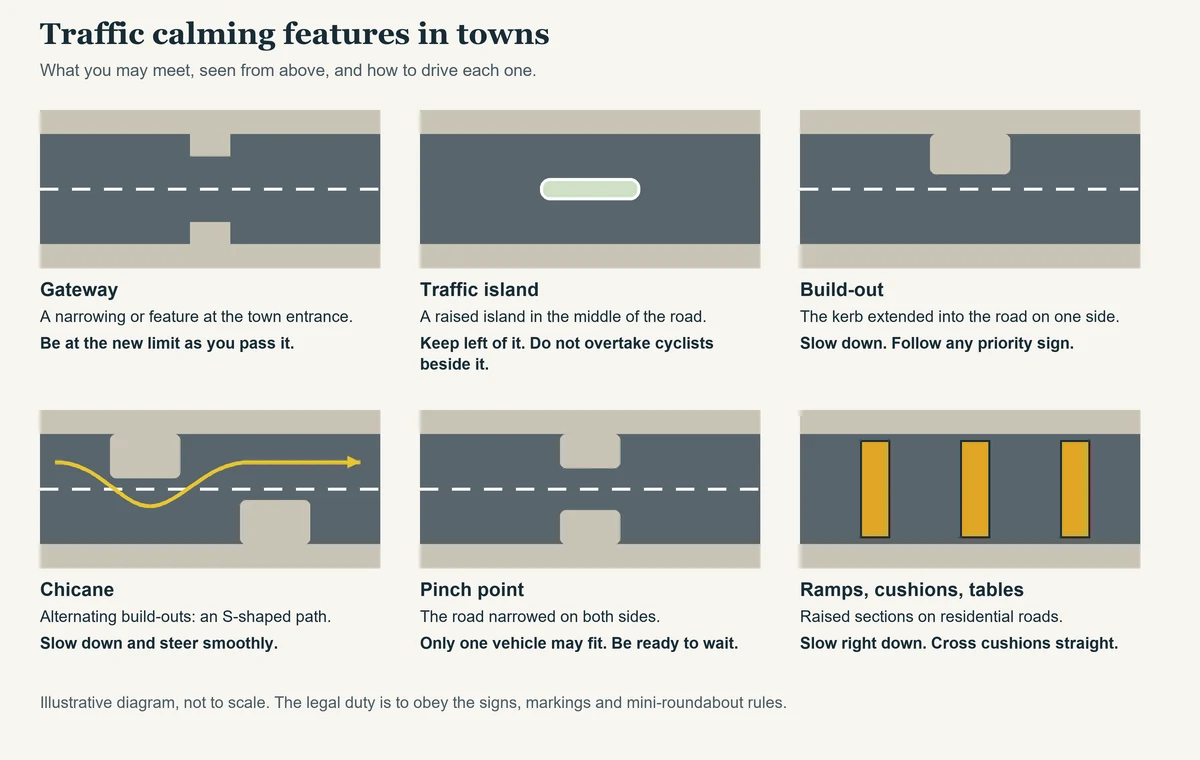
    Six road views from above showing a gateway, traffic island, build-out, chicane, pinch point and ramps, with how to drive each one.
    Traffic calming features and how to drive them. Illustrative diagram, not to scale.
    Feature What it is How to drive it
    Gateway A narrowing or feature at the town entrance Be at the new limit by the time you pass it
    Traffic island A raised island in the middle of the road Keep left of it; don’t overtake cyclists alongside it
    Build-out The kerb extended into the road on one side Slow down; follow any priority sign telling you to give way to oncoming traffic
    Chicane Alternating build-outs forcing an S-shaped path Slow down and steer smoothly
    Pinch point The road narrowed on both sides Only one vehicle may fit. Be ready to wait
    Mini-roundabout A small painted or slightly raised roundabout Follow the mini-roundabout rules; drive around the central marking
    Ramps, speed cushions, speed tables Raised sections, signed on residential roads Slow right down; cross cushions straight

    The “how to drive it” column is practical guidance; the legal duties are to obey the signs, road markings and the mini-roundabout rules. For mini-roundabouts in detail, see roundabouts in Ireland.

    Slow zones in housing estates

    A Slow Zone sign marks a 30 km/h area, usually a self-contained estate of local roads. Expect speed bumps and the unexpected: children, parked cars and people stepping out.

    Penalties

    Offence Fixed charge Points on payment Points on conviction
    Speeding, including through a roadworks limit €160 3 5
    Breaking the mini-roundabout rules €60 1 3
    Not complying with mandatory traffic signs €60 2 4
    Not complying with prohibitory traffic signs €60 1 3

    As of November 2026. See penalty points in Ireland for the full table.

    Common questions

    What colour are roadworks signs in Ireland?

    Orange, with a black border and black symbols or words. Permanent warning signs are yellow.

    Is the speed limit at roadworks legally binding?

    Yes, when it is shown on a regulatory speed limit sign. Councils set them by order under the Road Traffic Act 2004. A “cautionary speed” plate is advice; still follow it.

    What happens if I drive past a Stop board?

    It is an offence. You must wait until the board shows Go or Téigh.

    Do I have to stop at roadworks lights when nobody is coming?

    Yes. Temporary signals are traffic lights. Red means stop.

    What is the speed limit in a Slow Zone?

    30 km/h.

    Will roadworks come up in the theory test?

    Sign recognition is part of the theory test and the driving test questions. See Irish theory test topics.

    Back to learning to drive in Ireland.

    Sources

    • Road Safety Authority, “Rules of the Road”, Section 6 and Section 23 Warning signs for roadworks (Revision 5, hosted on garda.ie)
    • Law Reform Commission, “Road Traffic Act 2004, Revised”, sections 2, 10 and 10A (revisedacts.lawreform.ie)
    • Irish Statute Book, “S.I. No. 227/2024, Road Traffic Act 2010 (Part 3) (Fixed Charge Offences) Regulations 2024”, Schedules 2 and 6 (irishstatutebook.ie)
    • Law Reform Commission, “Road Traffic Act 2002, Revised”, First Schedule (revisedacts.lawreform.ie)
  • Level Crossings, Low Bridges and Road Tunnels in Ireland

    Level Crossings, Low Bridges and Road Tunnels in Ireland

    Photo: Joaquin Carfagna / Pexels. Illustrative photograph.

    At a railway level crossing in Ireland you must obey the signs and lights, slow down, be ready to stop and never stop on the tracks. At an unattended crossing you stop at least 2 metres from the line, look and listen, then cross quickly. This guide covers the four types of Irish level crossing, what to do if you stall, low railway bridges and road tunnel lane signs, all from the Rules of the Road and current fixed charges.

    Key facts

    • Never stop on the railway tracks. Don’t enter a yellow box at a level crossing unless you can clear it without stopping.
    • Flashing red lights at a level crossing mean stop, exactly like a red traffic light.
    • At an unattended crossing, stop at least 2 metres before the railway line, look, listen, then cross quickly.
    • You must shut and fasten iron gates after you, even if they were open when you arrived.
    • Ignoring the lights or signs at a level crossing: €80 fixed charge and 2 penalty points (5 on conviction).
    • If your vehicle hits a railway bridge, you must report it straight away, even if there is no visible damage.

    The Rail Cross Code

    The Rules of the Road gives one routine to use every time you cross at an unattended crossing:

    A car stopped at least 2 metres before a railway line at an unattended crossing, with the four steps of the Rail Cross Code.
    The Rail Cross Code at an unattended level crossing. Illustrative diagram, not to scale.
    1. Always expect a train.
    2. Stop, look and listen. Stop at least 2 metres before the railway line. Look right and left for train lights. Listen for a horn or whistle.
    3. Give way to trains. Let any train pass, then look right and left again.
    4. Cross quickly once the railway is clear.

    The four types of level crossing in Ireland

    Type What protects it What you must do
    Unattended, with iron gates Gates only, which users open and shut themselves. Found on minor roads. Stop clear of the gates, open both gates, drive forward and stop 2 metres from the line, handbrake on, look and listen, cross, stop well clear on the far side, then shut and fasten both gates.
    Attended, with gates or barriers worked by railway staff Railway staff Slow down and be ready to stop. The crossing is open only when the gates are fully open to the road.
    Automated, traffic lights only Road traffic lights, no barriers Obey the lights. If you are already on the crossing when they change, keep going and clear it quickly.
    Automated, barriers and flashing red lights Barriers that lower when a train approaches, plus amber and flashing red lights (sometimes an alarm) Amber means stop if you safely can. Flashing red means stop. Wait until all lights are out and the barriers are up. Never zigzag round the barriers.
    Three stages at an automated crossing: amber means stop if you safely can, flashing red with the barrier down means stop, and you go only when all lights are out and the barriers are up.
    What the lights mean at an automated level crossing. Simplified illustration, not the official sign design.

    Extra steps at an unattended gated crossing

    The RSA describes these crossings as potentially dangerous and says to use a bridge or a staffed or automated crossing if one is available. Before crossing:

    • switch off your phone and music
    • open the driver and passenger windows so you can hear
    • read the instructions at the crossing
    • get a helper to work the gates if you can

    Failing to shut and fasten the gates is an offence.

    What to do if you stall on a level crossing

    If your vehicle stalls or an animal strays onto the line:

    1. Get everyone well clear of the railway.
    2. Leave the vehicle or animal where it is.
    3. Phone the railway controller on the number displayed at the crossing.
    4. Give the “crossing number” shown on the plate at the crossing. Each crossing has its own number.

    When to phone the railway before crossing

    At crossings with iron gates or automatic half barriers, or on minor roads protected only by lights, you should phone for permission first if you are taking across:

    • a long, low, wide, heavy or slow vehicle
    • dangerous goods or an exceptional load
    • a crowd of people or a herd of animals

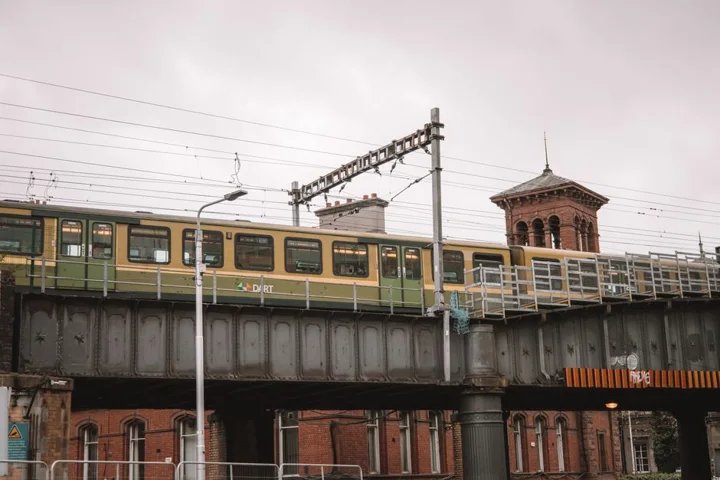
    On electrified lines such as the DART, the safe headroom under the overhead wires is 5 metres (16 ft 4 in).

    Railway bridges and low bridges

    Railway bridges carry an identification plate with a bridge number and Iarnród Éireann’s emergency phone number.

    • If you hit a bridge: report it immediately, damage or not. Phone the number on the plate, say what happened and give the bridge number. If you can’t get through, tell a Garda immediately. Failing to report is an offence.
    • Height restriction sign: you must not pass unless your vehicle, including any load, is lower than the height shown. The law says a vehicle must not pass the sign if its height equals or exceeds the figure.
    • Restricted headroom warning sign: gives advance notice of the height limit, in feet and inches first, then metres.
    • Arch bridges: the signed height is only available across part of the arch. “Goalpost” markings show that width.
    • Bridges over the railway may have weight, axle, width or axle-count limits. Gross weight, axle weight and width signs mean you cannot go past if your vehicle exceeds the figure.

    Most of this matters more for vans, campervans and towing, but learners are tested on the signs. RSA advice: know your height, know your route.

    Road tunnel lane signs

    Lane control signs hang above each lane at and inside road tunnels. When they are working, amber lights at the top and bottom flash in turn.

    Sign Meaning
    Green arrow pointing down Lane open. You may use it.
    Red X Lane closed. Stop. It has the same effect as a stop sign.
    Green arrow pointing left Move into the left-hand lane, following the normal rules for changing lanes.
    Green arrow pointing right Move into the right-hand lane, following the normal rules for changing lanes.
    Goods vehicle with axle number Goods vehicles and large non-passenger vehicles with that number of axles or more must stay in the left-hand lane. This does not apply if the left lane shows a red X, the right lane shows a green arrow, or the left lane is blocked.

    Tunnel speed limits are either a standard sign or a variable message sign: a black square with a red circle and white or yellow numbers. Both are maximums, not targets. Ignoring a lane control sign carries a €60 fixed charge.

    For driving through a tunnel (the 50 metre gap, what to do in a breakdown or fire), see motorways and tunnels in Ireland. Each tunnel operator signs its own restrictions on the approach, so read them.

    Common questions

    Can I stop on a level crossing if traffic ahead is queuing?

    No. You must never stop on the tracks. Wait before the crossing until there is room on the far side for your whole vehicle.

    What does a flashing amber light at a level crossing mean?

    The Rules of the Road says the amber light works like an amber traffic light: stop if you safely can. Flashing red then means stop.

    The barriers went up but a light is still flashing. Can I go?

    No. Wait until all the lights have gone out and the barriers are fully raised. Another train may be coming.

    The gates at an unattended crossing were already open. Do I still close them?

    Yes. You must shut and fasten them after you, whatever state you found them in.

    How many points for going through a level crossing on red?

    Failing to obey traffic lights or signs at a railway level crossing carries a €80 fixed charge and 2 penalty points, or 5 points on conviction in court. See penalty points in Ireland.

    Where do I learn the other signs?

    See Irish road signs explained, Irish road markings and bus lanes, Luas and light rail.

    Back to learning to drive in Ireland.

    Sources

    • Road Safety Authority, “Rules of the Road”, Section 6 Railway level crossings, Railway bridges and overhead structures, Road tunnel signs (Revision 5, hosted on garda.ie)
    • Irish Statute Book, “S.I. No. 182/1997, Road Traffic (Traffic and Parking) Regulations 1997”, articles 31 and 34 (irishstatutebook.ie)
    • Irish Statute Book, “S.I. No. 227/2024, Road Traffic Act 2010 (Part 3) (Fixed Charge Offences) Regulations 2024” (irishstatutebook.ie)
    • Law Reform Commission, “Road Traffic Act 2002”, First Schedule, revised (revisedacts.lawreform.ie)
  • Irish Road Signs Explained: Regulatory, Warning and Information

    Irish Road Signs Explained: Regulatory, Warning and Information

    Photo: Dahlia E. Akhaine / Pexels. Illustrative photograph.

    Irish road signs fall into three groups: regulatory signs you must obey, warning signs for hazards ahead, and information signs for directions. Colour and shape tell you which group a sign belongs to before you can read it. Warning signs are yellow diamonds, roadworks signs are orange, and regulatory signs are mostly round with a red border. This guide decodes each group as set out in the RSA’s Rules of the Road. It is what you need for the theory test and for the sign questions on the driving test.

    Key facts

    • Regulatory signs: usually circular, with a red border and black symbols on white. Mandatory direction signs are blue and white.
    • Stop is the only octagonal (eight-sided) sign.
    • Warning signs: diamond or rectangular, yellow with a black border and black symbol.
    • Roadworks signs: the same shapes, but orange.
    • Information signs: blue on motorways, green on national roads, and white with black text on regional and local roads.
    • Speed limits are shown in km/h.

    Shapes and colours at a glance

    Look Type What to do
    Red octagon Stop Stop completely at the line, however quiet the road looks
    Yield sign reading “Yield” or “Géill Slí” Yield Give way to traffic on the major road
    Circle with red border, white background Prohibition or limit Must obey (no entry, no right turn, speed limit, parking prohibited)
    Blue circle, white symbol Mandatory instruction Must do (turn left, keep left, straight ahead)
    Yellow diamond, black border Warning Slow down and expect the hazard shown
    Orange diamond or rectangle Roadworks Take extra care and reduce speed
    Blue rectangle Motorway information Motorway rules apply
    Green rectangle National road information Directions and distances
    White rectangle, black text Regional and local road information Directions and distances
    Generic shapes for each Irish sign family: red octagon for Stop, red bordered circle for bans and limits, blue circle for mandatory instructions, yellow and orange diamonds for warnings and roadworks, and blue, green and white information rectangles.
    Irish sign families by shape and colour. Simplified illustration, not the official sign design.

    Regulatory signs: what you must obey

    Regulatory signs show what the law requires. They include upright signs, road markings and traffic lights. The common upright signs are:

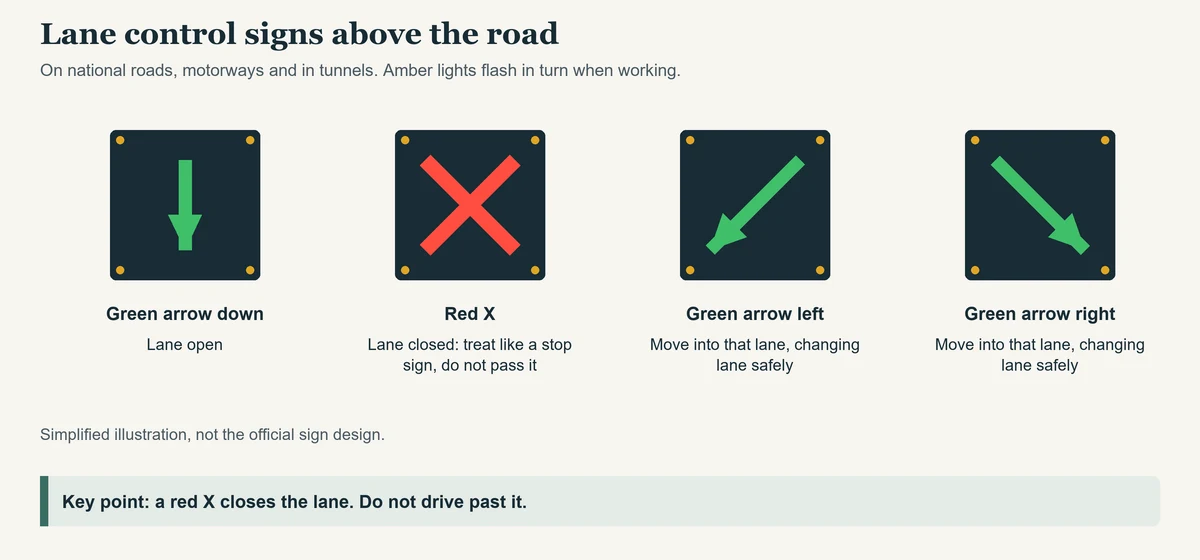
    Four overhead lane control signs: green arrow down for lane open, red X for lane closed, and green diagonal arrows telling you to move into that lane.
    Lane control signs on national roads, motorways and in tunnels. Simplified illustration, not the official sign design.
    • Speed limit signs: a red circle with the limit in km/h, for example 50, 60, 80, 100 and 120. The rural speed limit sign, a white circle with black diagonal stripes, can be used on rural local roads instead of a 60 km/h number sign. Since 7 February 2025 it means a maximum of 60 km/h, not 80 km/h. It is not a national speed limit sign like the one used in the UK, and on a narrow lane you may need to drive well below 60 km/h. See speed limits in Ireland 2026.
    • No entry, no right turn, no left turn, no U-turn and no overtaking.
    • Parking signs: parking prohibited, parking permitted, disc parking and clearway. See parking rules in Ireland.
    • Size and weight limits: maximum width, height, length, gross weight and axle weight.
    • Lane signs: with-flow bus lane, contra-flow bus lane, tram lanes and the start and end of cycle tracks. See bus lanes, Luas trams and light rail.
    • School warden stop sign: you must stop.

    Stop and Yield

    At a Stop sign you must stop completely before entering the major road. At a Yield sign you must give way to traffic on the major road and wait until it is safe. Yield signs can read “Yield”, “Yield Right of Way” or “Géill Slí”. Both carry 3 penalty points on payment of the fixed charge, or 5 on conviction, if ignored. See junctions in Ireland.

    Traffic lane control signs

    These are found on national roads, motorways and in tunnels. When they are working, amber lights flash in turn at the top and bottom.

    • Green arrow pointing down: the lane is open.
    • Red X: the lane is closed. Treat it like a stop sign and do not pass it.
    • Green arrow pointing left or right: move into that lane, following the normal rules for changing lane safely.

    One-way streets

    At the entrance you see a blue “straight ahead” sign. At the wrong end you see No Entry road markings, and sometimes an upright No Entry sign. Do not pass them.

    Warning signs: hazards ahead

    Warning signs are yellow diamonds or rectangles with a black border and a black symbol. The Rules of the Road groups them as:

    • Junctions: crossroads, T-junction, Y-junction, side road, staggered crossroads, and junctions with a dual carriageway. A thicker arm shows the more important road.
    • Bends and corners: dangerous bend, series of bends, dangerous corner, and chevron boards for a sharp change of direction.
    • Road layout: roundabout, mini-roundabout, road narrows, dual carriageway ends, merging traffic, two-way traffic, lane loss, and the start of a climbing or passing lane.
    • Road surface and gradient: slippery road, steep ascent or descent, sharp dip, hump-back bridge, and a series of bumps.
    • Users and animals: school ahead, children crossing, pedestrian crossing, cyclists, cattle, sheep, deer, and accompanied horses.
    • Rail and trams: level crossings with or without gates, barriers or lights, and tram lane crossings. See level crossings, low bridges and tunnels.
    • Other hazards: traffic signals ahead, low bridge with height shown, overhead cables, tunnel, crosswinds, falling rocks, and unprotected quay or river.

    Roadworks signs and Stop/Go boards

    Roadworks signs use the same shapes as warning signs but are orange. At manual traffic control you must stop at the Stop board. Go only when it shows “Go” or “Téigh”. Ignoring them is an offence. More in roadworks signs and traffic calming.

    Information and motorway signs

    • Advance direction signs are colour coded by road type: blue for motorway, green for national and white for regional or local.
    • Motorway countdown signs mark 300 m, 200 m and 100 m to the next exit.
    • Motorway ends 500 m ahead, end of motorway, and lane gain, where an extra lane joins.
    • Variable message signs show changing electronic information about speed limits, roadworks, new layouts and safety.

    See motorways and tunnels in Ireland.

    Emergency diversion symbols

    When a motorway is closed, traffic can be sent along a signed diversion marked with a symbol: a square, triangle, circle or diamond, either filled in or outlined. Note the symbol at the start of the diversion and follow that same symbol at each junction until the diversion ends. Do not switch to a different symbol because it looks quicker.

    Variable speed signs

    Electronic signs can show two kinds of speed. A regulatory variable speed limit is a legal limit, and you must keep to it. A cautionary speed is a warning: slow down to a safe speed for the hazard ahead. Read any message shown with it, such as a queue or lane closure warning. A blank sign does not change the normal speed limit for the road.

    Traffic calming and slow zones

    Town entry signs may come with a speed limit and traffic calming features such as islands, chicanes, build-outs, pinch points and mini-roundabouts. Signs on residential roads warn of ramps, speed cushions or speed tables. A Slow Zone sign marks a 30 km/h area, usually in housing estates.

    Common questions

    What colour are warning signs in Ireland?

    Yellow with a black border and symbol, usually diamond shaped. Roadworks warnings are orange.

    Why are Irish speed signs in km/h?

    All speed limits in the Republic of Ireland are set in kilometres per hour. Your speedometer’s km/h scale is the one to follow.

    What is the difference between a blue and a red circle sign?

    A red-bordered circle tells you what you must not do, or sets a limit. A blue circle tells you what you must do.

    Are road markings signs too?

    Yes. Road markings have the same legal status as upright signs. See Irish road markings.

    How many signs come up on the driving test?

    Under the RSA’s 2025 procedures, the oral part includes 6 road sign questions. See pre-test checks.

    Does the theory test include signs?

    Yes. Road signs are part of the Driver Theory Test question bank. See Irish theory test topics.

    Back to learning to drive in Ireland.

    Sources

    • Road Safety Authority, “Rules of the Road”, Section 6 Traffic signs and road markings and Sections 21 to 25 sign catalogues (Revision 5, hosted on garda.ie)
    • Road Safety Authority, “Standard procedures and requirements for conducting driving tests 2025” (rsa.ie)
    • Law Reform Commission, Road Traffic Act 2002, First Schedule, revised (revisedacts.lawreform.ie)
    • Road Safety Authority, “Rules of the Road”, current edition reflecting the law at 1 March 2025, printed pages 118 to 119 (rural speed limit sign), 159 (diversion symbols) and 166 to 167 (variable speed signs) (rsa.ie)
    • Road Safety Authority, “Rural speed limit” campaign page (rsa.ie)
  • Your Car for the Irish Driving Test: NCT, Tax, Insurance

    Your Car for the Irish Driving Test: NCT, Tax, Insurance

    Photo: Mike Bird / Pexels. Illustrative photograph.

    In Ireland you bring your own car to the driving test, and if it is not right on the day, the test does not go ahead and you lose your €85 fee. This checklist covers everything the RSA requires of a category B test car as of November 2026. That includes the insurance certificate rule in force since 9 March 2026.

    Key facts

    • Since 9 March 2026 you must show a valid certificate of motor insurance proving you are insured to drive the test car. Digital versions are accepted.
    • The car must display valid motor tax and insurance discs, plus an NCT disc where the car needs one.
    • L plates go on the front and rear.
    • Dashcams and any audio or video recording equipment must be removed, or switched off and not recording.
    • A space saver spare fitted to the car is not accepted.
    • A dashboard warning light showing a fault, before or during the test, may mean the test is not conducted or not completed. Get faults fixed before test day.

    Does the car meet the category B standard?

    The RSA sets minimum standards so you are tested in a vehicle that represents the whole licence category. For category B, the Rules of the Road describes it as a four-wheeled car or light van that:

    • has a maximum authorised mass of no more than 3,500 kg
    • carries no more than 8 passengers
    • can reach at least 100 km/h

    The RSA’s leaflet “Representative vehicles for your driving test” has the full detail. Check it if you are unsure whether your car qualifies.

    Automatic cars: if you pass in an automatic, your licence is restricted to automatics (code 78 on the licence). The tester will record it and tell you before the test ends.

    Paperwork and discs checklist

    Item Requirement
    Learner permit Your current Irish learner permit for category B
    Insurance certificate Valid certificate showing you are insured to drive this car. If your name is not on it, also bring an email or letter on headed paper from the insurer confirming cover
    Insurance disc Valid displayed disc. The RSA tester procedures also accept an insurer-issued electronic disc printed in colour, in the required format, under the interim arrangements from 9 March 2026
    Motor tax disc Valid and displayed
    NCT disc Valid, if the car is old enough to need an NCT
    Roadworthiness statement At the centre you read and sign a statement that the car is roadworthy and the insurance is in place and adequate

    For more on keeping a car legal, see tax, insurance and the NCT and learner driver insurance in Ireland.

    A home-printed insurance disc must be in colour and meet the prescribed format, including a legible registration number (or fleet wording) and the white or green band. A certificate on a phone does not replace the displayed disc. The RSA’s tester procedures set out this interim acceptance; some public preparation pages still use the older “original disc” wording.

    L plates: the exact rule

    Front and rear, a rectangular plate showing a red letter L at least 15 cm high on a white background. See the six month rule and L plates.

    Condition of the car

    • Tyres: tread above the legal minimum of 1.6 mm, with no bulges, cuts or severe uneven wear. No space saver spare fitted.
    • Lights: all working. Both rear brake lights must work or the test will not go ahead.
    • Front passenger seat: securely mounted and adjustable, with a working seat belt and a head restraint to the manufacturer’s specification.
    • Handbrake: in good working order.
    • Wipers and washers: working, with washer fluid in the reservoir.
    • Doors: in working order.
    • Dashboard: no warning lights showing a malfunction.
    • Recording devices: dashcam removed, or switched off and not recording.

    Use vehicle safety checks in Ireland the week before.

    The day before: 10 minute check

    1. Walk round with the lights, indicators and hazards on. Get someone to press the brake pedal.
    2. Check tyre tread and pressures.
    3. Top up the washer fluid.
    4. Check the tax, insurance and NCT discs are in date and on the windscreen.
    5. Pack the insurance certificate, plus the insurer’s letter if needed, and your learner permit. Even if you have a digital certificate, bring a printed copy as a precaution.
    6. Fit the L plates front and rear.
    7. Take down the dashcam.
    8. Arrange a qualified accompanying driver for the journey to the centre. See accompanying a learner driver.

    Common questions

    Can I use my parent’s car for the test?

    Yes, if you are insured to drive it. If your name is not on the certificate, bring the certificate plus an email or headed letter from the insurer confirming you are covered.

    Can I use my driving instructor’s car?

    Yes, if it meets the same rules and you are insured to drive it on the test. Check this with your ADI.

    Is a digital insurance certificate accepted?

    Yes. The RSA’s current insurance help page accepts an original or copy of the certificate, including a digital version. If you are not named on it, bring the insurer’s email or headed letter confirming your cover as well. You can cover other people’s personal details while keeping the evidence of your own cover readable. A windscreen disc is still required and is a separate document. Keep a printed certificate backup if practical, so a flat battery or inaccessible file does not cause difficulty.

    My car broke down before the test. Can I use another one?

    Only if you are insured to drive the replacement. Get its insurance certificate, plus an insurer’s letter if you are not named, and check its discs, L plates and condition. Documents for your usual car do not carry over.

    Can I do the test in an electric or automatic car?

    Yes. Your full licence will be restricted to automatics (code 78).

    What happens if a warning light comes on during the test?

    The RSA says a warning light showing a malfunction or defect may mean the test is not completed, and the tester decides. Don’t gamble on it: have any fault fixed before your test, or use another car. If the test is stopped, get the repair done before you rebook.

    Do I lose my fee if my car fails the checks?

    Yes. A test cancelled because the car is not roadworthy, is missing the correct discs or L plates, or is not suitable means losing the fee.

    Related: the Irish driving test explained, pre-test checks, booking the test. Back to learning to drive in Ireland.

    Sources

    • Road Safety Authority, “Prepare your car, light van and trailer for the driving test” (rsa.ie)
    • Road Safety Authority, “Checklist for your practical driving test” (rsa.ie)
    • Road Safety Authority, “New insurance rules for driving tests” (rsa.ie)
    • Road Safety Authority, “Driving test terms and conditions”, insurance certificate wording as indexed (rsa.ie)
    • RTÉ News, report on driving tests and insurance evidence, 26 March 2026 (rte.ie)
    • Road Safety Authority, “Representative vehicles for your driving test” (rsa.ie)
    • Road Safety Authority, “Standard procedures and requirements for conducting driving tests 2025” (rsa.ie)
    • Road Safety Authority, “Rules of the Road”, Section 3 and Appendix 5 (Revision 5, hosted on garda.ie)
    • RSA tester procedures, 20 February 2026, printed pages 8, 9 and 13 (rsa.ie)
  • Breaking Down on an Irish Motorway: Step by Step Checklist

    Breaking Down on an Irish Motorway: Step by Step Checklist

    Photo: Sarah777, Public domain, via Wikimedia Commons

    If you break down on an Irish motorway, get onto the hard shoulder as far left as you can, get everyone out through the left-hand doors, wait behind the crash barrier and call the Gardaí. Don’t put out a warning triangle. This checklist follows the Rules of the Road step by step and covers tunnels, ordinary roads and what to keep in the car. Learners can’t drive on motorways, so it is aimed at newly qualified drivers and at learners who want to know the drill before they pass.

    Key facts

    • You may stop on a motorway only if you break down, a Garda signals you to, there is an emergency, at roadworks or at a toll plaza.
    • The law requires you to move the vehicle off the carriageway to the left if you possibly can, and to notify the Gardaí from the nearest phone as soon as possible.
    • Never place a warning triangle on a motorway. The RSA says it is too dangerous.
    • Carry at least two high-visibility vests.
    • Stopping or parking on a motorway without a valid reason: €40 fixed charge.

    Motorway breakdown checklist

    1. Get off the live lanes

    • Look for a marked parking area or lay-by if the car is still moving.
    • Otherwise pull onto the hard shoulder and park as far left as you can, with no part of the car on the carriageway.
    • Switch on your hazard warning lights. If you can’t reach the hard shoulder, hazards are your main way to warn other drivers.

    2. Get everyone out, on the left

    • Put on a high-visibility vest before you get out.
    • Leave by the left-hand doors, and make sure passengers do the same.
    • Leave animals in the car. In an emergency, keep them under control on the verge.
    • Don’t walk on the motorway. Keep everyone, especially children, away from the lanes and the hard shoulder.

    3. Wait in a safe place

    • Wait on the embankment side, well behind the crash barrier.
    • If you can’t get out safely, stay in the car with your seat belt on and hazards flashing.

    4. Call for help

    • Use the roadside emergency phone if you can. It tells the Gardaí your exact location automatically.
    • On a mobile, you will need to give your location. Use the marker signs described below.
    • Accept help from a Garda or from road authority staff. The law says you must not leave the vehicle on the motorway longer than necessary.

    5. Don’t

    • Don’t put a warning triangle on the motorway.
    • Don’t try to repair the car on the hard shoulder.
    • Don’t try to remove debris from the road. Report it instead.

    6. Rejoining

    Build up speed on the hard shoulder before merging into traffic, and watch for other vehicles stopped on the hard shoulder ahead.

    How to tell the Gardaí where you are

    Many motorways and dual carriageways have two kinds of location marker:

    Marker Where What it shows
    Location Reference Indicator (LRI) Upright sign on a pole Road number, direction of travel (N, S, E or W) and kilometres from the start of the road
    Location Reference Marking (LRM) Painted on the hard shoulder Route and direction, distance from the start of the route, and the direction to the nearest emergency phone

    The Rules of the Road example: an LRM reading M7 heading west at 72.5 km tells the Gardaí exactly where to send help.

    If you break down in a tunnel

    • Switch off the engine and switch on hazard lights.
    • Listen to the tunnel radio station for instructions.
    • Go to an emergency station and use the emergency phone to tell the tunnel operator.
    • Check the electronic signs for information.

    If there is smoke or fire in your own vehicle, switch off, get out at once, use the emergency phone and leave by the nearest exit. More in motorways and tunnels in Ireland.

    Breaking down on other roads

    Off the motorway the same principles apply: get off the road if you can, hazards on, vest on, passengers out on the safe side. The Rules of the Road says you can use a reflective warning triangle on other roads, placed far enough back to give approaching traffic enough warning, and not where it would be unsafe to place it. Near a bend, make sure traffic from both directions gets a warning. Heavy goods vehicles and buses must carry a triangle.

    If your car stalls on a railway level crossing, follow the separate steps in railway level crossings, low bridges and tunnels.

    What to keep in the car

    The Rules of the Road suggests:

    • at least two high-visibility vests (it says to carry two for motorway driving)
    • a torch
    • a first aid kit
    • a warning triangle (required for HGVs and buses)

    Before a long motorway journey, check tyre pressures, oil, coolant and fuel. See vehicle safety checks in Ireland.

    Common questions

    Can I use the hard shoulder to make a phone call?

    No. You may stop on a motorway only for a breakdown, an emergency, roadworks, a toll plaza or a Garda signal. Leave at the next exit or use a service area.

    Should I put a warning triangle behind my car on the motorway?

    No. The RSA says not to place any warning device on a motorway because it is too dangerous.

    Who do I call if I break down on a motorway?

    The Gardaí, using the roadside emergency phone where possible. In an emergency, dial 999 or 112.

    Should I stay in the car or get out?

    Get out by the left-hand doors and wait behind the barrier if you can do so safely. If you can’t, stay in with your seat belt on and hazards flashing.

    Is there a fine for stopping on the motorway?

    Stopping or parking on a motorway without a lawful reason carries a €40 fixed charge as of November 2026. A genuine breakdown or accident is an exception.

    What if I realise I am driving the wrong way?

    The Rules of the Road says to pull onto the hard shoulder immediately, stop, and dial 999 or 112. Don’t try to turn the car. Wait for help in a safe place.

    Related: what to do at the scene of a crash and after you pass in Ireland. Back to learning to drive in Ireland.

    Sources

    • Road Safety Authority, “Rules of the Road”, Section 4 Vehicle safety, Section 11 Motorways and tunnels (Stopping and parking, What to do if your vehicle breaks down, Tunnels) and Section 14 Correct behaviour at the scene of an accident (Revision 5, hosted on garda.ie)
    • Irish Statute Book, “S.I. No. 182/1997, Road Traffic (Traffic and Parking) Regulations 1997”, article 33 (irishstatutebook.ie)
    • Irish Statute Book, “S.I. No. 227/2024, Road Traffic Act 2010 (Part 3) (Fixed Charge Offences) Regulations 2024”, Schedule 8 (irishstatutebook.ie)
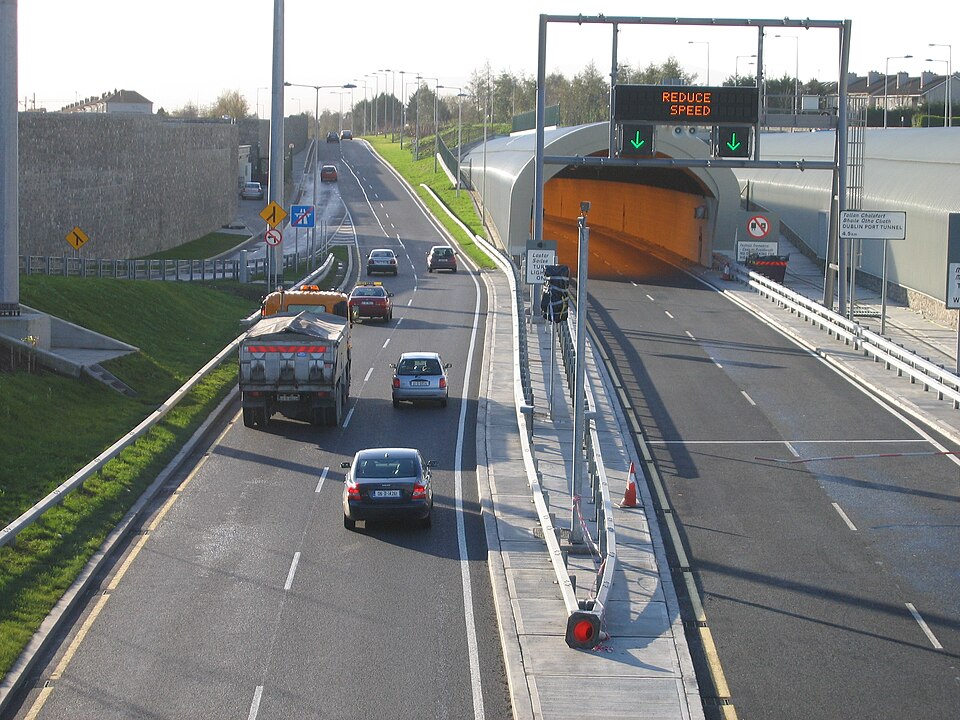
  • Motorways and Tunnels in Ireland: Rules for New Drivers

    Motorways and Tunnels in Ireland: Rules for New Drivers

    Photo: Sarah777 at en.wikipedia, Public domain, via Wikimedia Commons

    Learner permit holders cannot drive on Irish motorways: only people with a full licence for the vehicle category may use them. So your first motorway drive usually comes after you pass the test, often with N plates. This guide covers the 120 km/h limit, joining and leaving, lane use, stopping and the rules for road tunnels, so that first drive is not a surprise.

    Key facts

    • Motorway limit: 120 km/h unless signs show lower, or your vehicle has a lower limit (80 km/h when towing).
    • Banned from motorways: learner drivers, cyclists, pedestrians, animals, vehicles of 50cc or less, vehicles that cannot do at least 50 km/h, invalid carriages and vehicles without inflated tyres.
    • No turning, reversing, U-turns, or picking up and setting down passengers.
    • Stop only for a breakdown, an emergency, roadworks, a toll plaza, or if a Garda signals you.
    • In a tunnel the recommended minimum gap for a car is 50 metres.

    Can learner drivers drive on a motorway in Ireland?

    No. The “Motorway ahead” sign lists who must not enter, and that includes anyone who does not hold a full driving licence for the category of vehicle they are driving. Dual carriageways that are not motorways are not covered by this ban, so learners can practise higher speeds and lane changes there. Novice drivers on N plates may use motorways. See N plates in Ireland.

    Motorway signs to know

    Sign Meaning
    Motorway ahead A motorway entrance is ahead. The road users shown on the sign must not enter.
    Entry to motorway You are now on a motorway and motorway rules apply.
    Countdown markers (3, 2, 1 bars) 300 m, 200 m and 100 m to the next exit.
    Motorway ends 1 km / 500 m ahead Distance to the end of the motorway.
    Lane gain An extra lane is joining the motorway.

    See Irish road signs explained.

    How to join a motorway

    1. Use the slip road and acceleration lane to build up speed.
    2. Signal right early.
    3. Check mirrors and blind spot for a gap in the left lane.
    4. Give way to traffic already on the motorway. Do not drive on the hatched markings.
    5. Match the speed of traffic in the left lane and merge.
    6. Stay in the left lane until you have settled to the speed before thinking about overtaking.

    Lane discipline

    Lane Use it for
    Lane 1 (left, next to the hard shoulder) Normal driving. Keep left unless overtaking.
    Lane 2 on a 2-lane motorway Overtaking only, then move back. Also to make room for merging traffic.
    Lane 2 on a 3-lane motorway You may stay here while slower traffic is in Lane 1.
    Lane 3 on a 3-lane motorway Only when Lanes 1 and 2 are moving in queues and you need to overtake or make room for merging traffic.
    • Overtake on the right. Passing on the left is allowed only in slow-moving queues where your lane is moving faster.
    • Signal before every lane change. Moving from Lane 3 to Lane 1 is two separate signals and two manoeuvres.
    • Goods vehicles over 3,500 kg, anything towing a trailer or caravan, and buses designed for standing passengers must not use the outside lane except to pass an obstruction.
    • Keep at least a two-second gap. Use hazard lights briefly to warn traffic behind if the queue ahead slows sharply.

    Leaving the motorway

    1. Plan ahead using the 2 km and 1 km exit signs, and get into Lane 1 early.
    2. Signal left by the countdown markers.
    3. Keep your speed until you are in the deceleration lane, then slow down. Use your speedometer to check you are within the lower limit.
    4. Watch for lower limits and sharp bends on slip roads.
    5. Missed your exit? Carry on to the next one. Never cross the ghost island or reverse on the hard shoulder.

    Stopping, breaks and breakdowns

    You may only stop on a motorway if you break down, there is an emergency, there are roadworks, you are at a toll plaza, or a Garda signals you. The hard shoulder is for emergencies only. Plan rest stops at service areas and lay-bys. Before a long trip, check tyre pressures, oil, coolant and fuel.

    If you break down, get onto the hard shoulder, leave by the left-hand doors, and wait behind the crash barrier. Do not put a warning triangle on a motorway. Full steps are in breaking down on an Irish motorway.

    If you ever find yourself driving against the traffic, pull onto the hard shoulder, stop, and call 999 or 112. Do not try to turn.

    Tolls

    Slow down and keep a safe gap approaching a toll plaza. Barrier tolls take cash, card or electronic tags depending on the lane. The M50 uses barrier-free eFlow tolling, so there is no booth: check the payment rules before you use it.

    Rules for road tunnels in Ireland

    Before you enter

    • Check you have enough fuel.
    • Take off sunglasses and switch on dipped headlights.
    • Tune to the radio frequency shown at the entrance for safety messages.
    • Keep at least 50 metres from the vehicle in front (100 metres for vehicles other than cars and motorcycles).

    In the tunnel

    • Keep in lane. Do not overtake, turn or reverse.
    • Do not stop except in an emergency.
    • Obey the speed limit, including variable limits shown on electronic signs.

    If traffic stops or something goes wrong

    Situation What to do
    Told to stop Keep a safe gap, hazard lights on, engine off, listen to the radio and watch the signs.
    Breakdown or crash Engine off, hazard lights on, use the emergency station phone to tell the tunnel operator.
    Fire in your vehicle Switch on your hazard lights and drive out of the tunnel if you can. If you cannot, pull over, switch off the engine, leave the vehicle at once and use the nearest emergency exit. Call for help from a safety panel.
    Fire in another vehicle If it is behind you, drive out. If it is ahead, engine off, leave the car and walk to the nearest emergency exit.

    More on tunnel and bridge signs in level crossings, low bridges and road tunnels.

    Motorway penalties

    Offence Points on payment Points on conviction Fixed charge
    Speeding 3 5 €160
    Driving against the flow of traffic 2 4 €80
    Driving on a part that is not the carriageway, such as the hard shoulder 1 3 €80
    Restricted vehicle in the outside lane 1 3 €80
    Stopping or parking on a motorway None listed None listed €40

    Fixed charges as of November 2026. Novice drivers are banned at 7 points. See penalty points in Ireland.

    Common questions

    Can I drive on the motorway with N plates?

    Yes. The ban covers drivers without a full licence for the category. Once you have a full licence you can use motorways.

    Can my instructor take me on the motorway as a learner?

    No. The ban is about the licence you hold, not who sits beside you.

    Can I drive home on the motorway straight after passing my test?

    No. Passing gives you a certificate of competency, not a full licence. Keep to all the learner permit rules, including no motorways and a qualified accompanying driver, until you hold your full licence. See after you pass in Ireland.

    Is there a minimum speed on Irish motorways?

    Vehicles that cannot reach 50 km/h are banned, and you must not drive in a way that interferes with other motorway traffic. Keep up with the flow within the limit.

    Can I use my phone to call for help on the hard shoulder?

    Yes, once stopped and safely out of the car. Roadside emergency phones tell the Gardaí your exact location. If you use a mobile, the location markers on posts and on the hard shoulder show the road, direction and distance.

    What is the speed limit when towing on a motorway?

    80 km/h for any vehicle towing a trailer, caravan or horsebox, and you must stay out of the outside lane.

    Related: speed limits in Ireland, after you pass in Ireland, the two second rule and stopping distances, overtaking rules in Ireland. Back to learning to drive in Ireland.

    Sources

    • Road Safety Authority, “Rules of the Road”, Section 8 Speed limits and Section 11 Motorways and tunnels (Revision 5, hosted on garda.ie)
    • Law Reform Commission, “Road Traffic Act 2002”, First Schedule, revised (revisedacts.lawreform.ie)
    • Irish Statute Book, “S.I. No. 227/2024, Road Traffic Act 2010 (Part 3) (Fixed Charge Offences) Regulations 2024” (irishstatutebook.ie)
    • Dublin Port Tunnel, “Safety Information”, Vehicle Fire (dublintunnel.ie)
    • Jack Lynch Tunnel, “Safety Information”, Vehicle Fire (jacklynchtunnel.ie)