Category: Australia

  • NT Road Users Handbook Study Guide: Each Section in Plain English

    NT Road Users Handbook Study Guide: Each Section in Plain English

    Photo: DaHuzyBru, CC BY-SA 4.0, via Wikimedia Commons

    The NT Road Users’ Handbook is the official book for the Northern Territory driver knowledge test. The handbook says questions can come from any section. The current edition is the Fifth Edition, August 2020, a free 172-page PDF from the NT Government that can also be downloaded in eight sections. This study guide summarises each section in plain English, points out the NT-specific rules learners most often miss, and links to a deeper guide for each topic. It is part of the guide to learning to drive in the Northern Territory.

    Is the 2020 handbook still current?

    As of November 2026 the NT Government still links the August 2020 Fifth Edition. Some newer documents have since been updated, such as A Guide to the Driving Test (2nd Edition, April 2026). Where a web page and the handbook differ, follow the current NT Government web page and check with the MVR on 1300 654 628. Example: the speed limits page adds an instructor exception to the 80 km/h learner limit that the handbook does not mention.

    How to study it

    1. Read sections 2, 5 and 7 closely: licences, general road rules and penalties carry most of the hard facts.
    2. Read sections 3 and 4 for the safe-driving questions, and for your driving test.
    3. Test yourself with the official Class C question bank PDF and the free online practice test. Details: NT driver knowledge test.

    Important information (front pages)

    • Tell the MVR within 14 days if your name, address or other details change, or if a licence or number plate is lost or stolen.
    • Demerit limits: 5 points in 12 months or 12 in 3 years for learners and P platers, and 12 in 3 years for full licence holders.
    • Living in the NT for 3 months makes you a resident, and you must transfer an interstate licence. A current one transfers free.
    • Carry your licence whenever you drive. Supervisors must carry theirs too.
    • Your photo is stored and must be updated every 10 years.
    • Privacy: the MVR keeps your photo, licence and registration history, and can share it with police, other government bodies and the national driver and vehicle database as the law allows.
    • Check a used car for money owing on the Personal Property Securities Register (PPSR), and check its ANCAP safety rating.

    Section 1: how to use the handbook

    It explains the eight sections and confirms that test questions can come from any of them.

    Section 2: licences

    • The four stages: learner licence, at least 6 months of supervised driving, the practical test, then the provisional licence (2 years under 25, 1 year at 25 or over).
    • Licence classes: C (cars up to 4.5 tonnes GVM), LR, MR, HR, HC, MC and R.
    • Medical fitness: you must tell the Registrar about any condition that could affect your driving.
    • Organ donation: your NT licence does not record it. Register your decision on the Australian Organ Donor Register.
    • Learner rules: zero alcohol, 80 km/h, L plates, a full licence holder beside you, no phone at all. See NT learner licence rules.
    • DriveSafe NT: see DriveSafe NT.
    • The practical test and P plate rules: see the NT practical driving test and NT P plate rules.

    Section 3: road safety

    • Phones: fully licensed drivers may only make or take audio calls, or use navigation, with the phone in a commercial mount or usable without touching. Learners and P platers cannot use a phone at all.
    • Other distractions: the handbook lists talking with passengers, tuning the radio, listening to music, smoking, eating or drinking, shaving, applying make-up, reading a map, and events outside the car. For the phone rules see NT P plate rules and phone rules for L and P platers in each state.
    • Duty of care: every road user must avoid crashing or causing a crash. You must not drive without due care or without consideration for others, and you can be held accountable for a crash even if you broke no road rule.
    • Speeding: you can be speeding below the limit if conditions are poor.
    • Alcohol and drugs: only time lowers your blood alcohol. Read medicine labels for driving warnings. See zero alcohol for learners and P platers.
    • Fatigue: stop and rest as soon as you feel drowsy. See driver fatigue.
    • Passengers: as the driver you must make sure every passenger is in a seatbelt or approved child restraint. Never carry more people than there are seatbelts, anyone in a ute tray, the boot or a trailer, or anyone with part of their body outside the car. Noisy passengers or friends urging you to take risks are a distraction, so limit numbers and agree the ground rules before you set off. See seatbelts and child car seats.
    • Night driving: you see less and animals are more active. Slow down so you can stop within the distance your headlights show, and dip to low beam for oncoming traffic and when following another vehicle. See headlights and high beam.
    • Crashes and first aid: you must stop if you are involved in a crash. If you come across one and help has not arrived, call 000. The handbook recommends a first aid course (St John Ambulance NT and Red Cross run them, and St John has a free online crash-scene course called First@Scene). See what to do after a crash.
    • Sharing the road with pedestrians, trucks and buses, cyclists, motorcyclists and ridden animals. A motorised wheelchair that cannot go over 10 km/h counts as a pedestrian. Users sit lower than most pedestrians, so they are easy to miss: look for them at crossings and driveways and give them extra time.

    Section 4: safe driving

    This section matches what the driving examiner scores. NT-specific points:

    • Road trains: they can weigh over 115 tonnes, travel at up to 100 km/h and be up to 53.5 metres long. When overtaking one, wait until you see both its headlights in your mirror before moving back. See sharing the road with trucks and road trains.
    • Long vehicles: a vehicle over 7.5 metres, including a car towing a caravan, must stay at least 200 metres behind another long vehicle.
    • Following distance: about 3 seconds, doubled to at least 6 seconds on wet or slippery roads.
    • Speed management: drive at a speed that lets you stop within the clear distance ahead. If you cannot see at least 5 seconds ahead, slow down. Brake rather than swerve when something appears.
    • Crash avoidance space: keep clear space all around the car by adjusting your speed and position. To the front you need about 3 seconds: roughly 1.5 to react and 1.5 to respond. Allow more in rain or darkness, and leave space when stopped behind another vehicle so you can steer around it.
    • Rollovers are a major cause of NT road deaths. If you drift off the seal, slow gradually and ease back on without braking. Never swerve at speed for an animal.
    • Animals: many NT roads are unfenced. Expect cattle, kangaroos, pigs, camels and large birds, especially at dawn, dusk and night. See kangaroos and wildlife.
    • Long-range driving: avoid driving more than 10 hours a day and stop at least every two hours. Rest areas are every 80 to 120 km on major roads. See driver fatigue.
    • Road conditions: corrugations, dust, bushfire smoke in the dry season (May to October), floodwater and crocodiles, and what to do if you are bogged. See outback and remote driving.
    • Tyres: at least 1.5 mm of tread.
    • Techniques: posture, seatbelts worn low, flat and firm, two-stage braking, push-pull or hand-over-hand steering, driver assist systems and eco driving.

    Section 5: general road rules

    The NT applies the Australian Road Rules, so most of this section matches other states: see the Australian Road Rules explained. NT points to know:

    • Speed limits: 60 km/h default in built-up areas, 110 km/h outside them, 130 km/h on signed sections of the Stuart, Barkly, Victoria and Arnhem highways. See NT speed limits explained.
    • Alcohol limits: zero for learners, P platers and full licence holders on a Z condition. Under 0.05 for other full licence holders.
    • Wig wags: flashing early-warning lights before some intersections, warning that the signals ahead are about to change. Slow down when they flash, even if the lights ahead are green.
    • Left turn on red only where a “left turn on red permitted after stopping” sign is shown, giving way to traffic from the right.
    • Processions: you must not interfere with or interrupt a funeral cortege or an authorised procession, or any vehicle or person forming part of it. Always obey police directions.
    • Stock signs, injured animals and warning triangles for crashes and breakdowns. Place a triangle 50 to 150 metres behind your car, and keep a high-visibility vest in the car to wear at the roadside.
    • Bridges: many are narrow. If you think two vehicles cannot fit, give way to the other driver, and slow down on bridges only wide enough for two.
    • Give way, turning, roundabouts, traffic lights, markings, signs, lanes, overtaking, parking, lights, emergency vehicles, level crossings, towing and crashes. See giving way, roundabouts, road signs and parking.

    Section 6: vehicle registration

    • Compulsory third party (CTP) insurance is paid with your registration. The NT scheme is no-fault and is run by the Motor Accidents Compensation Commission (MACC). It does not cover damage to cars or property.
    • Benefits are cut by 25 per cent for not wearing a seatbelt. Driving unregistered or unlicensed removes some benefits.
    • Driving an unregistered vehicle is an offence, and you can be personally liable for injuries.
    • Renewal notices arrive about five weeks before expiry. If an inspection is required, an Authorised Inspector does it, then you renew online or in the NTREGO app.
    • Number plates must be readable from 20 metres within a 45-degree arc. Bike racks that cover the plate need a bike rack plate.
    • Police or transport inspectors can issue defect notices for unroadworthy vehicles.

    Section 7: penalties

    • Demerit points, fines, suspension, disqualification and, for serious offences, prison.
    • Speeding penalties rise with how far over the limit you are.
    • Hooning (street races, burnouts, damaging road surfaces): police can seize your vehicle on the spot for up to 48 hours.
    • Drink driving penalties rise with your alcohol level and any previous offences, and can include lifetime disqualification. Repeat offenders go on the alcohol ignition lock program.
    • Unpaid fines go to the Fines Recovery Unit, which can have your licence and registration suspended.

    Section 8: glossary and MVR offices

    Definitions of handbook terms, plus MVR contact details. The MVR Contact Centre is 1300 654 628.

    Common questions

    Where do I get the NT Road Users’ Handbook?

    It is free as a PDF on the NT Government website, either in full or in sections. You can also buy a printed copy at an MVR office.

    Is everything on the knowledge test in the handbook?

    Yes. The handbook says all the information you need to pass is in it, and that any section can be tested.

    Is there a separate book for learning to drive?

    Yes. The NT Learner Drivers’ Guide (January 2020) has step-by-step driving procedures and an optional logbook. A Guide to the Driving Test (April 2026) explains the practical test.

    Which parts are unique to the NT?

    The licence rules, the 130 km/h highway sections, road trains, the 200 metre gap for long vehicles, wig wags, unfenced roads with stock, and the wet and dry season hazards.

    Sources

    • Northern Territory Government, “Road Users’ Handbook”, Fifth Edition, August 2020 (nt.gov.au)
    • Northern Territory Government, “Road Users’ Handbook” download page (nt.gov.au)
    • Northern Territory Government, “Speed limits” (nt.gov.au)
    • Motor Vehicle Registry, “A guide to the Driving Test”, 2nd Edition, April 2026 (nt.gov.au)
    • Motor Vehicle Registry, “Learner Drivers’ Guide”, Second Edition, January 2020 (nt.gov.au)
    • Motor Vehicle Registry, “Class C Knowledge Test” question bank, January 2021 (nt.gov.au)
  • NT Speed Limits Explained: 130 km/h Zones and Learner Limits

    NT Speed Limits Explained: 130 km/h Zones and Learner Limits

    Photo: Bidgee, CC BY 3.0, via Wikimedia Commons

    Northern Territory speed limits default to 60 km/h in built-up areas and 110 km/h outside them, and some sections of four highways are signed at 130 km/h. Learners are capped at 80 km/h and P platers at 100 km/h, whatever the sign says. This guide covers every NT limit a learner needs, from school zones and school buses to cameras and unsigned outback roads. It is part of the guide to learning to drive in the Northern Territory.

    NT speed limits at a glance

    Where or who Limit
    Built-up area, no sign 60 km/h, unless the town has gazetted a lower default (many use 50 km/h or less)
    Outside built-up areas, no sign 110 km/h
    Signed sections of the Stuart, Barkly, Victoria and Arnhem highways 130 km/h
    School zone, on school days during signed times 40 km/h
    Local traffic area 40 km/h
    Shared zone Often 10 km/h. Give way to all pedestrians.
    Roadworks As signed, and enforceable
    Learner drivers 80 km/h maximum
    Provisional drivers 100 km/h maximum
    Buses over 5 tonnes GVM and other heavy vehicles over 12 tonnes GVM 100 km/h maximum

    Learner and P plate speed limits

    Your licence limit applies on every road, even a 110 or 130 km/h highway. Where the posted limit is lower than your licence limit, the posted limit applies.

    • Learners: 80 km/h. The NT Government speed limits page says this applies “unless accompanied by a licensed driving instructor”. The handbook and licence page give no exception, so check with the MVR before relying on it. Going over the learner limit on your driving test is a fail item. More: NT learner licence rules.
    • P platers: 100 km/h. More: NT P plate rules.

    On a 110 or 130 km/h road you will be slower than most traffic. Keep left, use overtaking lanes as intended (stay in the left lane unless overtaking), and let faster vehicles pass.

    Which NT roads are 130 km/h?

    The NT Government lists sections of the Stuart, Barkly, Victoria and Arnhem highways as having a 130 km/h maximum “as indicated”. The 130 km/h limit applies only where it is signposted. The NT Government does not publish a list of the exact stretches on its speed limits page, and limits on sections can change, so always follow the signs. Learners and P platers cannot drive at 130 km/h.

    What counts as a built-up area?

    A built-up area has buildings next to the road no more than 100 metres apart, or street lights less than 100 metres apart for at least 500 metres (or the whole road if it is shorter). If the town uses a lower default such as 50 km/h, you will see a sign on each road into it.

    Roads with no speed signs

    Many unsealed and remote roads have no speed signs. The default limit for that area or road type still applies, but you should drive to the conditions. On dirt and gravel, vehicles take longer to stop and are more likely to skid or roll over, and dust can hide ruts and potholes. See outback and remote driving.

    Regulatory and advisory signs

    • Regulatory signs: white with the number in a red circle. This is the legal maximum.
    • Advisory signs: yellow, often before curves, bends and crests. They show a recommended maximum for an average car in good conditions.

    Driving needlessly slower than the limit and conditions allow is also an offence under the handbook.

    School zones and school buses

    • School zones are 40 km/h between the school zone and end school zone signs, on gazetted school days and only at the times on the sign.
    • Take extra care passing stationary buses from 7am to 9.30am and 2.30pm to 5pm.
    • When a bus shows flashing orange lights, it is picking up or dropping off school children. The handbook recommends 40 km/h or less. If the bus shows a speed limit sign between the lights, that limit is enforceable while the lights flash. The lights keep flashing for about 30 seconds after the doors close.
    • On the NT driving test, exceeding 40 km/h past a bus with flashing lights is a fail item.

    How school zones differ across Australia: school zones in every state.

    Speed and red-light cameras in the NT

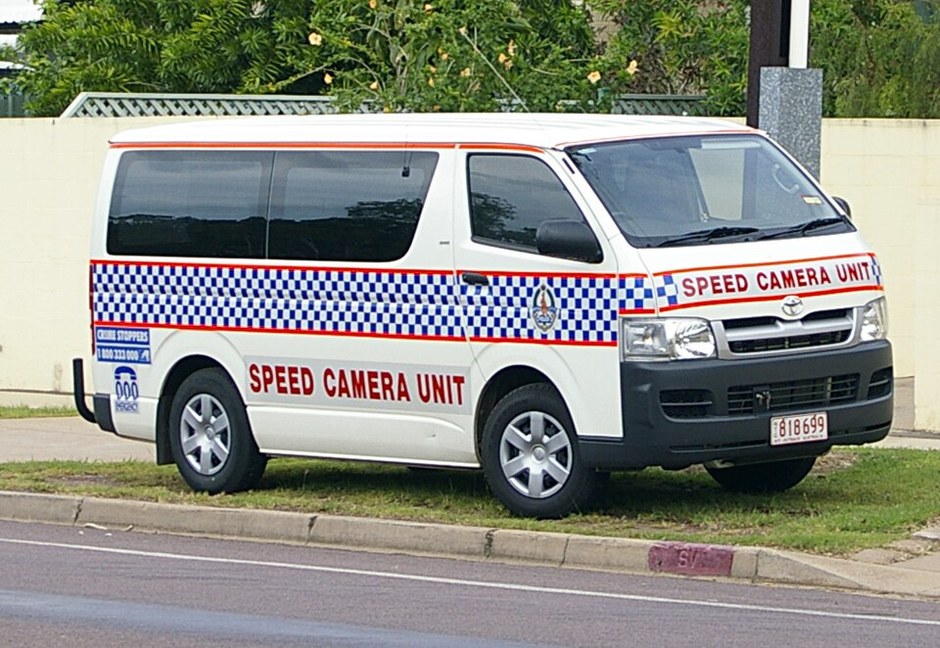
    Fixed speed cameras, combined safety cameras (speed and red light) and mobile speed camera vans operate across the NT. Penalties for speeding include fines, demerit points and suspension, and they increase the further over the limit you are. On Ls or Ps, 5 demerit points in 12 months suspends your licence.

    Why a few km/h matters

    The handbook gives a worked example. Two cars, one at 60 km/h and one at 65 km/h, brake at the same point for a truck 38 metres ahead. The 60 km/h car hits it at 5 km/h. The 65 km/h car hits it at 32 km/h.

    Common questions

    Is there an open speed limit in the NT?

    No. The handbook says all NT roads have a speed limit. Unsigned rural roads and highways default to 110 km/h, and the highest posted limit is 130 km/h on signed sections.

    Can P platers drive 110 km/h in the NT?

    No. Provisional drivers are limited to 100 km/h.

    How fast can learners drive in the NT?

    80 km/h, or the posted limit if it is lower.

    Are school zone times the same everywhere in the NT?

    The times are shown on each school zone sign. Always read the sign.

    How fast do road trains travel?

    Up to 100 km/h, and they can be up to 53.5 metres long. See sharing the road with trucks and road trains.

    Sources

    • Northern Territory Government, “Speed limits” (nt.gov.au)
    • Northern Territory Government, “Road Users’ Handbook”, Fifth Edition, August 2020 (nt.gov.au)
    • Northern Territory Government, “Get your driver licence” (nt.gov.au)
    • Northern Territory Government, “Demerit points” (nt.gov.au)
    • Motor Vehicle Registry, “A guide to the Driving Test”, 2nd Edition, April 2026 (nt.gov.au)
  • DriveSafe NT: Free Lessons and Subsidies for Learner Drivers

    DriveSafe NT: Free Lessons and Subsidies for Learner Drivers

    Photo: Kgbo, CC BY-SA 4.0, via Wikimedia Commons

    DriveSafe NT is the Northern Territory Government’s driver education and licensing program. For a $110 enrolment fee, you get more than $600 in subsidies: theory classes, your L and P licence and test fees, ten $50 lesson vouchers and two attempts at the practical driving test. It is open to any Territory resident aged 16 or over. This guide explains what is included, how to enrol and each step from Theory One to your Ps. For the full licence path, see learning to drive in the Northern Territory.

    What DriveSafe NT includes

    • A participant pack: the Participant Handbook and Driving Log, and the Road Users’ Handbook
    • Theory classes and road safety lessons
    • Learner and provisional licence and test fees (car hire is not included)
    • Ten e-vouchers worth $50 each towards lessons with an approved driving instructor
    • Two attempts at the Practical Driving Assessment (the driving test)
    • A 30-minute St John Ambulance NT online driver first aid course
    • Online tools to track your progress

    Lesson prices are set by each instructor. You pay anything above the $50 voucher directly to the instructor.

    Is DriveSafe NT worth it?

    Compare the enrolment fee with the standard costs it replaces (as of November 2026):

    Cost Without DriveSafe With DriveSafe
    Enrolment None $110
    Theory test $20 per attempt Included
    Learner licence $29 Included (first issue)
    Provisional licence $61 (under 25) or $40 (25 and over) Included
    Practical test Set by the examiner Two attempts included
    Driving lessons Full price $500 in vouchers off

    If you plan to take paid lessons, the vouchers alone are worth far more than the enrolment fee. The trade-off is structure: you must attend theory classes and complete set driving competencies before you can test.

    Where DriveSafe NT runs

    The DriveSafe NT website lists Darwin, Katherine, Nhulunbuy, Tennant Creek and Alice Springs, plus remote locations and communities. The NT Government licence page describes the urban program for Darwin, Palmerston, Katherine and Alice Springs. If you live outside the main towns, call DriveSafe NT on 1800 121 411 or read getting a licence in remote NT communities.

    How to enrol

    1. Gather your evidence of identity and evidence of NT residency documents.
    2. Fill in a DriveSafe NT enrolment form.
    3. Fill in an L1 application for an NT driver licence.
    4. Take the forms and the $110 enrolment fee to a Motor Vehicle Registry office, or a post office with MVR functions. You cannot enrol online.
    5. Keep your receipt. The customer ID on it is your username for the DriveSafe NT portal, and your PIN arrives by text or email.

    The DriveSafe NT steps, from enrolment to Ps

    1. Theory One class. Book it in the portal. It runs over two nights (three hours each, Wednesday and Thursday) or for six hours on a Saturday. Pass it and your learner licence receipt is emailed to you the next morning. The card arrives by post in 2 to 4 weeks.
    2. First five e-vouchers. Request them in the portal, one per week. Each voucher is valid for 72 hours, so request it on the morning of your lesson. Unused vouchers go back into your account.
    3. Driving competencies 1 to 11 with an approved instructor, recorded in your Driving Log.
    4. First aid course. Complete the 30-minute online course and save the certificate.
    5. Theory Two class. Three hours on a Thursday afternoon or a Saturday. Bring your first aid certificate. It covers responsible and safe driver behaviour, hazard perception, registration and insurance, and what to do if you see a crash.
    6. Last five e-vouchers and driving competencies 12 to 23.
    7. Practical Driving Assessment. You become eligible once you have held your Ls for 6 continuous months and finished both theory classes and all 23 competencies. You can attempt it twice under the program. After you pass, your provisional licence receipt is emailed the next morning.

    The program is designed to fit the 6-month minimum learner period, but the handbook says you can take up to two years to finish it. You cannot fast-track: the 6-month rule is set by NT law. How the assessment works: the NT practical driving test.

    What is not covered

    • Lesson costs above $50 per voucher
    • Hire of the assessor’s vehicle for the driving assessment
    • A third or later test attempt, plus extra lessons, car hire and the provisional licence fee after that point

    Common questions

    Can I join DriveSafe NT if I already have my Ls?

    Yes. Take your learner licence, the enrolment form and the fee to an MVR office. You attend the first theory class but skip the knowledge test, and your vouchers unlock afterwards. Your new learner licence is backdated to your original issue date, and its expiry is extended.

    Do I still need to study the handbook?

    Yes. The Learner Drivers’ Guide says to study the Road Users’ Handbook even if you go through DriveSafe NT. Use the NT handbook study guide.

    Can I pick my own driving school?

    Most NT driving schools are registered with DriveSafe NT, and the program lists approved instructors. You can change instructors at any time. Book lessons directly with the instructor.

    Can I join if I have a drink or drug driving charge?

    You may not be eligible. Contact the MVR to check, as you might need to do a drink and drug driver education course first.

    Are there lessons in Aboriginal languages?

    DriveSafe NT’s online learning modules come in English and with instruction in Warlpiri, Yolngu Matha, Murrinh Patha and Kriol.

    How do I contact DriveSafe NT?

    Phone 1800 121 411 or email [email protected].

    Sources

    • DriveSafe NT, “Everything you need to know about DriveSafe” (drivesafe.nt.gov.au)
    • Northern Territory Government, “Get your driver licence” (nt.gov.au)
    • Northern Territory Government, “Driver and rider licence fees” (nt.gov.au)
    • Northern Territory Government, “Road Users’ Handbook”, Fifth Edition, August 2020 (nt.gov.au)
    • Motor Vehicle Registry, “Learner Drivers’ Guide”, Second Edition, January 2020 (nt.gov.au)
  • NT P Plate Rules: 100 km/h, Zero Alcohol and No Phones

    NT P Plate Rules: 100 km/h, Zero Alcohol and No Phones

    Photo: Cuddy Wifter, CC BY-SA 3.0, via Wikimedia Commons

    On Northern Territory P plates you must keep to 100 km/h, have zero alcohol, display red P plates and use no mobile phone function at all, not even hands-free. You hold your Ps for 2 years if you are under 25, or 1 year if you are 25 or older. This guide covers every provisional condition in the NT, the automatic-only rule, demerit limits and how to get a free 10-year full licence. It is part of the guide to learning to drive in the Northern Territory.

    NT provisional licence conditions

    Rule NT P plater requirement
    Speed 100 km/h maximum, even on 110 or 130 km/h roads. Obey lower limits where signed.
    Alcohol Zero blood or breath alcohol
    P plates Front and rear of the vehicle, with the letter P not hidden. Also on the back of any trailer.
    Mobile phone No use of any function of a phone or other communication device, including hands-free and loudspeaker
    Screens No TV or visual display unit operating where you or other drivers can see it
    Seatbelts You must make sure every passenger is wearing a seatbelt or approved restraint
    Supervising You must not supervise a learner driver
    Licence Carry your provisional licence every time you drive
    Towing Allowed, with a P plate on the back of the trailer

    The NT has one P stage. There is no P1 and P2 split, no passenger limit and no night curfew in the NT handbook or on the NT licence pages. Compare other states in P plate rules in every state.

    P plate display rules

    • A red letter P on a white background, at least 150 mm by 150 mm.
    • Clearly visible at the front and rear (rear only on a motorcycle). Upright mounting is recommended.
    • In a window, make sure tint, louvres, spoilers or a load in a ute tray do not hide the plate.
    • Remove the plates when someone who is not a provisional driver is driving.

    Why 100 km/h matters on NT roads

    The NT default limit outside built-up areas is 110 km/h, and some highway sections are 130 km/h. As a P plater you stay at 100 km/h on all of them. Road trains can also travel at up to 100 km/h, so expect to share the road with them at similar speeds. See NT speed limits explained and sharing the road with trucks and road trains.

    Passed in an automatic? The A condition

    If you pass your test in an automatic, your provisional licence carries an automatic-only condition for the first 12 months. During that time you can drive a manual only if a full licence holder supervises you. After 12 months you can have the condition removed at an MVR office. To drive a manual alone sooner, pass the driving test again in a manual car with a foot-operated clutch.

    Demerit points and losing your Ps

    Your provisional licence is suspended at 5 or more demerit points in any 12 months, or 12 or more in any 3 years.

    Points reached Suspension
    5 to 8 3 months
    9 to 12 4 months
    13 or more 5 months
    • A suspension is added to the end of your provisional period.
    • If your licence is cancelled, the full provisional period starts again when it is reissued.
    • A court can order an extra provisional period for some traffic offences.
    • Points do not reset when you upgrade. Points from your Ps can still suspend your licence after you go to a full licence.
    • Instead of serving a suspension, you may be eligible for a 12-month good driving behaviour option.

    Moving to a full licence

    When your provisional period ends, you can upgrade to an open C class licence. You pay the full licence fee unless you qualify for the free licence.

    Free 10-year licence for safe novice drivers

    You can get a free 10-year open licence if you:

    • held an NT provisional licence continuously for 12 months or more
    • have no traffic infringements or suspensions
    • apply in the last six weeks of your provisional licence, or no later than six months after it expires

    It is only issued at an MVR office. As of November 2026, a paid 10-year open licence costs $210.

    Zero alcohol continues (the Z condition)

    After your Ps you must keep to zero alcohol for a further 12 months or until you turn 25, whichever comes first. The condition stays on your licence until you apply to remove it, which you can do once you are 25 or have held your open licence for 12 months. More: zero alcohol for learners and P platers.

    Common questions

    How long are you on your Ps in the NT?

    2 years if you are under 25 when you get them, 1 year if you are 25 or older.

    Can NT P platers use a phone for maps?

    No. Provisional drivers cannot use any function of a mobile phone while driving, including navigation, hands-free and loudspeaker.

    Can I carry passengers on my NT Ps?

    The NT handbook and licence pages set no passenger limit for provisional drivers. You must make sure every passenger wears a seatbelt or approved restraint.

    Can I teach my sibling to drive on my Ps?

    No. Only a full Australian licence holder can supervise a learner.

    What does a provisional licence cost in the NT?

    As of November 2026: $61 for 2 years (under 25) or $40 for 1 year (25 and over). DriveSafe NT participants do not pay.

    Do my NT P plate rules apply interstate?

    Rules differ between states. Read driving interstate on L or P plates before a trip.

    Sources

    • Northern Territory Government, “Get your driver licence” (nt.gov.au)
    • Northern Territory Government, “Road Users’ Handbook”, Fifth Edition, August 2020 (nt.gov.au)
    • Northern Territory Government, “Demerit points” (nt.gov.au)
    • Northern Territory Government, “Driver and rider licence fees” (nt.gov.au)
    • Northern Territory Government, “Speed limits” (nt.gov.au)
    • Motor Vehicle Registry, “A guide to the Driving Test”, 2nd Edition, April 2026 (nt.gov.au)
  • NT Practical Driving Test: 3 Manoeuvres and How You Fail

    NT Practical Driving Test: 3 Manoeuvres and How You Fail

    Photo: Kgbo, CC BY-SA 4.0, via Wikimedia Commons

    The NT practical driving test is a recorded drive of about 40 minutes with an authorised driving examiner. It includes three compulsory manoeuvres: a reverse parallel park, a three-point turn and a kerbside stop or hill start. To pass you need at least 90 per cent and no fail items. This guide explains how to book, what the examiner scores, the exact manoeuvre standards from the Northern Territory’s official guide, and every way you can fail. It is part of the guide to learning to drive in the Northern Territory.

    Before you can book

    • You must have held your NT learner licence continuously for at least 6 months. A test taken while your licence is suspended, cancelled or expired is not valid.
    • You must test at a location nearest to where you usually live. You can ask for an exemption if, for example, you study or work full time elsewhere in the NT.
    • DriveSafe NT participants must also finish the program requirements first: see DriveSafe NT.

    How to book an NT driving test

    You book directly with an authorised driving examiner approved by the Registrar of Motor Vehicles. The NT Government lists examiners, their phone numbers, whether you can use your own car and whether they hire out cars (manual, automatic or both) for:

    • Darwin City, Casuarina and Palmerston
    • Alice Springs
    • Katherine
    • Nhulunbuy, Yulara, Tennant Creek and Jabiru (planned visits only, so contact the examiner for dates)

    The MVR sets the minimum test fee, but each examiner sets their own price, and car hire costs extra. DriveSafe NT participants do not pay the test fee. Never offer an examiner extra money or gifts: bribery is against the law and ends the test. Remote residents can test through DriveSafe NT or at a police station: see remote NT licensing.

    Your test car checklist

    If you use your own car, the examiner checks it before you start. It must be registered and roadworthy, with L plates displayed. It cannot be used if it has:

    • missing or broken seatbelts
    • broken, dirty or discoloured indicators or brake lights
    • a cracked windscreen that blocks your view (minor cracks are allowed)
    • unsafe tyres, damaged mirrors, missing door handles, badly damaged rims or missing wheel nuts
    • large fluid leaks (air-conditioning drips are fine)
    • dual brakes that do not work, or sharp edges from body damage
    • a convertible roof that cannot be closed
    • training aids that could help you, or loose objects in the cabin
    • a prohibited driver assistance feature that cannot be switched off

    The Learner Drivers’ Guide also says to check the speedometer works, as the test stops if it does not. Bring your current learner licence (or licence receipt plus photo ID) and arrive at least 10 minutes early.

    Driver assistance (ADAS) you cannot use

    Most driver assistance features can stay on, but you must show you can drive without them. Using any of these fails the test:

    Prohibited feature What it does
    Lane centering assistance Keeps the car centred in its lane
    Adaptive intelligent speed assistance Restricts the car to the speed limit
    Cruise control and adaptive cruise control Holds a set speed
    Active parking assistance Steers the car into a parking space
    Active driving assistance (“autopilot”) Takes control for short periods

    You can glance at a reversing camera or sensors, but you must still use your mirrors and head checks.

    What the examiner scores

    The examiner directs you around the course, scores each zone and records any fail items. You are assessed on:

    • Speed management: safe and legal speed, a gap of at least 3 seconds to the car ahead, slowing down if you cannot see 5 seconds ahead.
    • Road positioning: keeping at least 1 metre of space from other vehicles and hazards where you can, and keeping left on crests and curves.
    • Decision-making: choosing safe gaps without forcing others to brake. Turning down clearly safe gaps can also fail you.
    • Responding to hazards: covering the brake, easing off, or moving away from a car that might pull out.
    • Vehicle control: smooth steering, braking and gear changes, using the park brake properly and signalling in time.

    Observation runs through everything. Head-check your blind spot when leaving or returning to the kerb, changing lanes, merging, turning, reversing and manoeuvring.

    The three compulsory manoeuvres

    Manoeuvre Standard to meet
    Reverse parallel park No more than 4 direction changes. Reverse no more than 4 metres back from the rear of the car you park behind. Finish 1 to 2 metres from the car in front and parallel to the kerb (front and rear wheels within 10 cm of each other). Aim for under 50 cm from the kerb; more than 1 metre is a fail. Wheels must not touch the kerb or sit on parking lines. Active parking assistance must be off.
    Three-point turn No more than 5 direction changes, but use 3 if the road allows. Check left and right before every movement.
    Kerbside stop or hill start Parallel to the kerb (10 cm variance). Aim for under 50 cm from the kerb without touching it; more than 1 metre is a fail. Not on parking lines. Rolling back more than 50 cm when moving off is a fail.

    Hitting or mounting the kerb at any point in the test is a fail.

    Why you might fail: the fail items

    A fail item means you do not pass, whatever your score. The test usually carries on so you get full feedback. The fail items are:

    1. Disobeying signs, signals or markings: for example, not stopping within 1 metre of a stop line (with no part over it), going through a yellow light when you could safely stop, or crossing a continuous line unnecessarily.
    2. Failing to give way: to traffic with priority, pedestrians, emergency vehicles, or a bus with a give way sign pulling out from a stop.
    3. Colliding with anything: including mounting a traffic dome, the kerb or a roundabout.
    4. An illegal act: such as an unlawful U-turn, the wrong lane at a roundabout, not wearing a seatbelt, or touching a phone or smart watch.
    5. Exceeding the speed limit: including the 80 km/h learner limit, 40 km/h school zones, 40 km/h past a bus with flashing lights, and roadworks limits.
    6. Examiner intervention: any verbal or physical help, even being told to release the handbrake.
    7. Causing a potentially dangerous situation: unsafe overtaking, or giving way unnecessarily on a priority road.
    8. Losing control: rolling back more than 50 cm, wheelspin, coasting in neutral or with the clutch down, or using a banned ADAS feature.
    9. Wrong speed for conditions: too fast, too slow, or following too closely.
    10. 3 or more signalling errors. Signal for at least 5 seconds before leaving the kerb.
    11. Unreasonably obstructing others: such as entering an intersection when the road ahead is blocked.
    12. A manoeuvre below standard (see the table above).
    13. 3 or more missed observation checks.

    Immediate fail and test termination

    The examiner stops the test and records an immediate fail if you do something dangerous to the public or refuse to co-operate. The test is also ended if you are suspected of being affected by alcohol or drugs, offer a bribe, behave aggressively, there is a crash (whoever is at fault), the car is unsuitable or breaks down, you refuse to be recorded, you get outside help, or extreme weather makes it unsafe.

    After the test

    • The examiner tells you the result, gives general feedback and hands you a test sheet showing where to improve.
    • Passed: take the test sheet to an MVR office and pay the provisional licence fee before your learner licence expires. The pass is valid for 12 months. If you tested in an automatic, you get an A condition for the first 12 months of your Ps. Next step: NT P plate rules.
    • Failed: you cannot retest until the next day. The guide suggests waiting a few days to practise first.
    • Let your supervisor drive home. Many learners find it hard to concentrate straight after the test.

    Common questions

    How long is the NT driving test?

    About 40 minutes on the road.

    What is the pass mark?

    At least 90 per cent, with no fail items.

    Is the NT driving test recorded?

    Yes. Every test is filmed from start to finish, covering the road ahead and the inside of the car. The examiner must keep the recording for 6 months.

    Can my supervisor sit in the back?

    No. Only you, the examiner and, sometimes, an MVR licensing compliance officer can be in the car.

    Can I use my reversing camera?

    Yes, but you fail if you rely on it without checking your mirrors and looking around. Active parking assistance must be switched off.

    How do I practise the manoeuvres?

    The Learner Drivers’ Guide gives step-by-step procedures for each one. For parking rules in general, see parking rules in Australia.

    Sources

    • Motor Vehicle Registry, “A guide to the Driving Test”, 2nd Edition, April 2026 (nt.gov.au)
    • Northern Territory Government, “Take a practical driving test with an authorised driving examiner” (nt.gov.au)
    • Northern Territory Government, “Get your driver licence” (nt.gov.au)
    • Northern Territory Government, “Road Users’ Handbook”, Fifth Edition, August 2020 (nt.gov.au)
    • Motor Vehicle Registry, “Learner Drivers’ Guide”, Second Edition, January 2020 (nt.gov.au)
  • NT Learner Licence Rules: 80 km/h, Supervisors and Practice Hours

    NT Learner Licence Rules: 80 km/h, Supervisors and Practice Hours

    Photo: Cuddy Wifter, CC BY-SA 3.0, via Wikimedia Commons

    On a Northern Territory learner licence you must keep to 80 km/h, have zero alcohol, show L plates and have a full licence holder beside you every time you drive. There are no compulsory logbook hours, but the NT Government recommends about 100 hours of practice. This guide lists every learner condition, the rules for your supervisor, and what can get your Ls suspended. It is part of the guide to learning to drive in the Northern Territory.

    NT learner licence conditions at a glance

    Rule What it means for you
    Speed 80 km/h maximum, even on 110 or 130 km/h roads. Obey lower limits where signed.
    Alcohol Zero blood or breath alcohol. No alcoholic drinks or food containing alcohol before driving.
    Supervisor A full Australian licence holder in the front passenger seat at all times
    L plates Front and rear of the car, plus the back of any trailer
    Mobile phone No use of any function, including hands-free, loudspeaker and maps
    Screens No TV or visual display unit operating where you or other drivers can see it (mounted navigation and reversing screens excepted)
    Seatbelts You must make sure everyone in the car is wearing a seatbelt or approved restraint
    Licence Carry your learner licence every time you drive
    Vehicle Only the class your licence allows. No construction or agricultural vehicles on a C class learner licence.
    Towing Allowed, with an L plate on the back of the trailer

    The 80 km/h learner limit

    The handbook and the NT Government licence page set 80 km/h as the most you can drive on Ls, whatever the signs say. The NT Government speed limits page adds that the limit applies “unless accompanied by a licensed driving instructor”. That exception does not appear in the handbook, so if you plan to go faster than 80 km/h with an instructor, confirm it with the MVR first. Going over the learner limit on your driving test is a fail item. More on limits: NT speed limits explained.

    L plate rules

    • A black letter L on a yellow background, at least 150 mm by 150 mm.
    • Clearly visible at the front and rear (rear only on a motorcycle). The handbook recommends mounting them upright, not flat on the bonnet or boot.
    • A roof-mounted L sign does not replace the front and rear plates.
    • If a plate is in a window, make sure tint, louvres, spoilers or a load in a ute tray do not hide it.
    • Take the plates off when a fully licensed driver is driving.

    Who can supervise a learner in the NT?

    Your supervisor can be an adult relative, a friend or a driving instructor. They must:

    • hold a current full Australian driver licence (not a learner, provisional or overseas licence)
    • sit in the front passenger seat, right next to you, the whole time (including parking practice)
    • carry their full licence
    • have a blood alcohol concentration under 0.05 (paid driving instructors must be at zero)
    • not be affected by drugs

    The supervisor takes responsibility for your driving and is treated as the driver for most legal purposes. A P plater cannot supervise you.

    How many hours of practice do you need?

    There is no minimum. You only need to hold your learner licence continuously for 6 months before the practical test. The NT Government recommends about:

    • 20 or more hours to learn how to operate the car’s controls
    • another 80 hours to learn to be a low-risk driver

    Practise in different conditions: day, night and rain. The NT Learner Drivers’ Guide includes a free logbook with short codes for road type (MR major road, M minor road, U unsealed), weather and traffic. Log every drive, even a five-minute trip to the shops. Professional lessons help, but paying for every hour is not required. Ask a fully licensed parent, relative or friend to practise each new skill with you between lessons.

    Choosing a driving instructor

    All paid driving instructors in the NT must be registered and follow a code of practice. The handbook suggests checking that your instructor holds professional indemnity and public liability insurance. You can change instructors at any time. DriveSafe NT participants get subsidised lesson vouchers: see DriveSafe NT.

    Demerit points on your Ls

    Your learner licence is suspended if you get 5 or more demerit points in any 12 months, or 12 or more in any 3 years. You are suspended for 3 months at 5 to 8 points, 4 months at 9 to 12, and 5 months at 13 or more. A suspension also breaks your 6 continuous months: a practical test taken while your licence is suspended, cancelled or expired is not valid. After the licence is reactivated, you need another 6 continuous months before you can test.

    Keeping your 6 months unbroken

    • A learner licence lasts 2 years.
    • You can renew it in the six weeks before it expires by passing the theory test again and paying the fee.
    • If it expires first, you must hold the reissued licence for 6 months before you can sit the practical test.

    Common questions

    Do NT learners need a logbook?

    No. The logbook in the Learner Drivers’ Guide is optional. DriveSafe NT participants use their own Participant Handbook and Driving Log.

    Can I drive on the highway on my Ls?

    Yes, but never above 80 km/h. On high-speed highways, keep left and let faster traffic, including road trains, pass. See sharing the road with trucks and road trains.

    Can my older brother on his Ps supervise me?

    No. Your supervisor must hold a full licence. Provisional drivers are banned from supervising learners.

    Can I use Google Maps on my phone as a learner?

    No. Learners cannot use any mobile phone function while driving, including navigation, hands-free calls or loudspeaker.

    Can I tow a trailer on my Ls?

    Yes. You must put an L plate on the back of the trailer as well. For towing rules, see towing on L or P plates.

    Do NT learner rules apply if I drive interstate?

    Interstate rules can differ. Check driving interstate on L or P plates before you travel.

    Sources

    • Northern Territory Government, “Get your driver licence” (nt.gov.au)
    • Northern Territory Government, “Road Users’ Handbook”, Fifth Edition, August 2020 (nt.gov.au)
    • Motor Vehicle Registry, “Learner Drivers’ Guide”, Second Edition, January 2020 (nt.gov.au)
    • Northern Territory Government, “Speed limits” (nt.gov.au)
    • Northern Territory Government, “Demerit points” (nt.gov.au)
    • Northern Territory Government, “Driver licence classes and conditions” (nt.gov.au)
  • NT Driver Knowledge Test: 30 Questions, 26 to Pass

    NT Driver Knowledge Test: 30 Questions, 26 to Pass

    Photo: DaHuzyBru, CC BY-SA 4.0, via Wikimedia Commons

    The NT driver knowledge test (the theory test, often called the learners test) has 30 multiple-choice questions, and you need at least 26 right to pass. It is the first step to a Northern Territory learner licence. This guide covers who can sit it, where, the $20 fee, what the questions cover, and what happens after you pass or fail. For the full licence path, see learning to drive in the Northern Territory.

    Key facts

    • 30 questions picked at random from a pool of more than 300.
    • Pass mark: 26 out of 30 (you can get no more than 4 wrong).
    • Fee: $20 per attempt as of November 2026. Free for DriveSafe NT participants.
    • Minimum age: 16, and you must be an MVR customer.
    • Verbal test or interpreter available at some MVR offices.
    • A pass stays valid for 12 months if you do not get your licence straight away.

    Who can sit the NT theory test?

    You must be at least 16 and a Motor Vehicle Registry (MVR) customer. If you are not one yet, bring evidence of your identity and NT residency when you sit the test. You also need a completed L1 application for an NT driver licence form.

    Where and when you take it

    • At any MVR office, up to one hour before the office closes.
    • You can book an appointment at MVR Darwin online through Territory Services.
    • DriveSafe NT participants sit the knowledge test at the end of their first theory class instead.
    • In remote areas, non-participants can sit it at their local police station: see getting a licence in remote NT communities.

    How the test works

    Each question has three answer options, (a), (b) and (c). The questions come from the official Class C question bank, which covers the whole NT Road Users’ Handbook. During the test you must not:

    • get help from anyone or use the handbook, notes, websites or a phone
    • speak or signal to anyone except the registry officer
    • leave the test area

    Anyone caught cheating fails immediately and is banned from taking another test for two weeks.

    What topics are in the NT question bank?

    The NT Government publishes the full question bank (“Class C Knowledge Test”, January 2021) as a free PDF. Its questions cover:

    • traffic signs and what they mean
    • intersections, give way rules and turning
    • lanes, merging and road markings
    • speed limits, including the learner limit
    • alcohol, drugs and penalties
    • seatbelts and passengers
    • pedestrians, cyclists, motorcyclists and long vehicles
    • wet weather, fog, night driving and parked vehicles
    • crashes: what you must report and what details you must give
    • licence rules, such as whether a P plater can supervise a learner (they cannot)

    How to prepare

    1. Read the whole NT Road Users’ Handbook. The handbook says any section can be tested. Use the NT handbook study guide as a checklist.
    2. Work through the official question bank PDF. Cover the answers and test yourself.
    3. Take the free practice driver knowledge test on the NT Government website as many times as you like.
    4. Learn the NT numbers that come up: speed limits, zero alcohol for L and P drivers, and demerit point limits.
    5. Spend extra time on give way rules, intersections and signs, which come up again and again in the bank. The giving way in Australia guide covers the national rules.

    Help with reading or English

    If you are not confident with reading or writing, or find English difficult, you can ask for a verbal (spoken) test or an interpreter at some MVR offices. To arrange one:

    1. Call MVR on 1300 654 628 or visit an MVR office to check what is available in your area.
    2. Book the test.
    3. Pay the theory test fee before you sit it.

    Interpreters come from the Interpreting and Translating Service NT (ITSNT). If you are not an Australian resident or citizen, you may need to pay ITSNT a fee. If you have a physical or mental impairment, talk to the MVR before booking so arrangements can be made.

    After you pass

    1. Pass an eye test at the MVR office, or hand in a recent eye examination from your doctor or optometrist.
    2. Pay the learner licence fee ($29 for 2 years as of November 2026; free the first time for DriveSafe NT participants).
    3. Your learner licence is mailed to you. You can start driving once you have your driver licence receipt.

    Then read the NT learner licence rules before your first drive.

    If you fail

    You can resit as many times as you need, but each attempt costs the fee again. The Learner Drivers’ Guide says you cannot sit it more than once a day. You get a different set of questions each time.

    Common questions

    How many questions can I get wrong on the NT learners test?

    Four. You need at least 26 of the 30 correct.

    Can I do the NT knowledge test online?

    No. Only the practice test is online. The real test is at an MVR office, through DriveSafe NT, or at a police station in remote areas.

    Is the NT test the same as other states?

    No. Each state and territory runs its own theory test. The NT test is based on the NT Road Users’ Handbook, including NT rules such as the 80 km/h learner limit.

    Do I have to renew my learner licence by resitting the test?

    Yes. To renew a learner licence you pass the theory test again and pay the learner licence fee. Do it in the last six weeks before expiry so your 6 months on Ls is not broken.

    How long is my pass valid?

    12 months. After that, you must pass the test again to get your learner licence.

    Sources

    • Northern Territory Government, “Get your driver licence” (nt.gov.au)
    • Northern Territory Government, “Driver and rider licence fees” (nt.gov.au)
    • Motor Vehicle Registry, “Class C Knowledge Test” question bank, January 2021 (nt.gov.au)
    • Northern Territory Government, “Road Users’ Handbook”, Fifth Edition, August 2020 (nt.gov.au)
    • Motor Vehicle Registry, “Learner Drivers’ Guide”, Second Edition, January 2020 (nt.gov.au)
    • DriveSafe NT, “Everything you need to know about DriveSafe” (drivesafe.nt.gov.au)
  • Learning to Drive in the NT: Ls, Ps and Full Licence Guide

    Learning to Drive in the NT: Ls, Ps and Full Licence Guide

    Photo: Lobster1, CC BY-SA 3.0, via Wikimedia Commons

    Learning to drive in the Northern Territory starts with a learner licence at 16. You must hold it for at least 6 continuous months, then pass a practical driving test to get your P plates. There is no hazard perception test and no compulsory logbook hours. This guide covers each stage of the NT C class (car) licence, the conditions on your Ls and Ps, and the fees as of November 2026.

    Key facts

    • Minimum age: 16. You must first become a Motor Vehicle Registry (MVR) customer.
    • Theory test: 30 multiple-choice questions, 26 correct to pass.
    • Learner licence: at least 6 continuous months before the driving test. Zero alcohol, 80 km/h maximum, a full licence holder beside you.
    • Recommended (not compulsory) practice: about 20 hours to learn the controls, plus about 80 hours to become a low-risk driver.
    • Provisional licence: 2 years if you are under 25, 1 year if you are 25 or older. Zero alcohol, 100 km/h maximum.
    • DriveSafe NT, the NT Government’s driver education program, covers your theory test, licence and test fees and gives more than $600 in subsidies.

    The four stages of the NT graduated licensing scheme

    Stage What you do Minimum time
    1. Learner licence (L) Pass the driver knowledge test and an eye test Age 16
    2. Supervised driving Practise with a full licence holder beside you 6 consecutive months
    3. Provisional licence (P) Pass the practical driving test 2 years (under 25) or 1 year (25 and over)
    4. Full (open) licence Upgrade at the end of your P period Zero alcohol continues for a further 12 months or until you turn 25, whichever is sooner

    Before you apply: become an MVR customer

    Go to an MVR office with evidence of your identity and evidence that you live in the NT. You must be at least 16, and an MVR officer takes your photo. You learn the road rules one of two ways:

    • study the NT Road Users’ Handbook and take the practice theory test, or
    • enrol in DriveSafe NT, which runs theory classes for you.

    Use the NT Road Users’ Handbook study guide to work through the handbook section by section. If you live in a remote community, the process runs through DriveSafe NT visits or your local police station: see getting a licence in remote NT communities.

    Step 1: pass the theory test and get your learner licence

    The driver knowledge test has 30 multiple-choice questions drawn at random from a pool of more than 300. You need at least 26 correct. A verbal test or an interpreter is available at some MVR offices. After you pass, you take an eye test (or bring a recent report from your doctor or optometrist) and pay the learner licence fee. An unused pass stays valid for 12 months.

    Full details, including what is on the test and how to prepare: NT driver knowledge test.

    Step 2: learn to drive on your Ls

    Your learner licence conditions:

    • zero blood alcohol
    • no faster than 80 km/h, even where the sign shows more
    • L plates (black L on yellow) at the front and rear, and on the back of any trailer
    • a full Australian licence holder in the front passenger seat at all times (not a learner, P plater or overseas licence holder)
    • no use of any mobile phone function, including hands-free

    The NT has no minimum logbook hours. The NT Learner Drivers’ Guide includes an optional logbook to track your practice. Rules on supervisors, towing and demerit points: NT learner licence rules.

    Your learner licence lasts 2 years. If it is about to expire, renew it in the last six weeks by redoing the theory test and paying the fee. That keeps your 6-month clock running. If you let it expire, you must hold the reissued licence for another 6 months before you can sit the driving test.

    Step 3: pass the practical driving test

    You book directly with an authorised driving examiner once you have held your Ls continuously for 6 months. The test takes about 40 minutes, is recorded on camera, and includes three compulsory manoeuvres: a reverse parallel park, a three-point turn and a kerbside stop or hill start. You need a score of at least 90 per cent and no fail items. You must sit the test at a location nearest to where you usually live, unless you get an exemption (for example, if you study or work full time elsewhere in the NT).

    What examiners check and every fail item: the NT practical driving test.

    After you pass, take your test sheet to an MVR office and pay the provisional licence fee before your learner licence expires. A pass is valid for 12 months.

    Step 4: drive on your Ps, then upgrade

    Provisional drivers must have zero alcohol, keep to 100 km/h or less, display red P plates front and rear (and on a trailer), use no phone function at all and never supervise a learner. If you passed in an automatic, you are limited to automatics for the first 12 months unless a full licence holder supervises you. Details: NT P plate rules.

    At the end of your P period you can upgrade to a full licence. If you held an NT provisional licence for at least 12 continuous months with no traffic infringements or suspensions, you can get a free 10-year open licence. Apply in the last six weeks of your Ps, or within six months after they expire, at an MVR office.

    NT licence fees (as of November 2026)

    Item Fee
    Theory test $20
    Learner licence (2 years) $29
    Provisional licence, under 25 (2 years) $61
    Provisional licence, 25 or over (1 year) $40
    DriveSafe NT enrolment $110
    Open licence: 1, 2, 5 or 10 years $40, $61, $122 or $210
    Practical driving test Set by the examiner you book

    Fees are subject to regulatory change, so check the NT Government driver and rider licence fees page before you go. DriveSafe NT participants do not pay the theory test fee, the first learner licence fee, the provisional licence fee or the practical test fee: see DriveSafe NT lessons and subsidies.

    Demerit points on Ls and Ps in the NT

    Your learner or provisional licence is suspended if you reach 5 or more points in any 12 months, or 12 or more in any 3 years.

    Points Suspension
    5 to 8 3 months
    9 to 12 4 months
    13 or more 5 months

    Points stay active for up to 3 years and do not reset when you move from Ps to a full licence. A suspension on your Ps is added to your provisional period. If your provisional licence is cancelled, the full period starts again.

    Licence classes and medical fitness

    • Class C covers vehicles up to 4.5 tonnes gross vehicle mass (GVM). You cannot drive construction or agricultural vehicles on a C class learner licence.
    • Heavier vehicles need a heavy vehicle class (LR, MR, HR, HC or MC). Motorcycles need class R.
    • You must tell the Registrar of Motor Vehicles about any medical condition, disability or eyesight problem that could affect your driving. Most conditions do not stop you being licensed. Conditions such as glasses (S) or automatic only (A) may be added.

    Important information for every NT licence holder

    • Carry your licence every time you drive. A supervisor must also carry their full licence.
    • Tell the MVR within 14 days if your name, address or other details change.
    • Moved from interstate? After 3 months living in the NT you must transfer to an NT licence. A current interstate licence transfers at no cost. Read driving interstate on L or P plates for visiting rules.
    • Learn the NT speed limits, including the 130 km/h highway sections you cannot use at full speed on Ls or Ps: NT speed limits explained.

    Compare the NT with other states: learner rules in every state and P plate rules in every state. NT driving brings its own hazards, so also read outback and remote driving and sharing the road with road trains.

    Common questions

    Do I need logbook hours in the NT?

    No. There is no minimum number of supervised hours. The NT Government recommends about 100 hours in total: 20 or more to learn the controls and another 80 to become a low-risk driver.

    Is there a hazard perception test in the NT?

    No. The NT car licence path has a theory test and a practical driving test only. Hazard response is assessed during the practical test.

    How long does it take to get a full licence in the NT?

    At least 2 years and 6 months if you are under 25 (6 months on Ls plus 2 years on Ps). At least 18 months if you are 25 or older.

    Can I get my Ls at 15 and a half in the NT?

    No. You must be at least 16 to become an MVR customer and apply.

    Who can supervise me?

    Anyone with a full Australian licence: an adult relative, a friend or a driving instructor. Their blood alcohol must be under 0.05 (zero for paid instructors).

    Can I drive a manual if I passed my test in an automatic?

    Only with a full licence holder supervising you, for the first 12 months of your Ps. After that you can have the condition removed at an MVR office, or pass a test in a manual earlier.

    Sources

    • Northern Territory Government, “Get your driver licence” (nt.gov.au)
    • Northern Territory Government, “Road Users’ Handbook”, Fifth Edition, August 2020 (nt.gov.au)
    • Northern Territory Government, “Driver and rider licence fees” (nt.gov.au)
    • Northern Territory Government, “Demerit points” (nt.gov.au)
    • Northern Territory Government, “Driver licence classes and conditions” (nt.gov.au)
    • Northern Territory Government, “Take a practical driving test with an authorised driving examiner” (nt.gov.au)
    • Motor Vehicle Registry, “A guide to the Driving Test”, 2nd Edition, April 2026 (nt.gov.au)
    • Motor Vehicle Registry, “Learner Drivers’ Guide”, Second Edition, January 2020 (nt.gov.au)
  • NSW Car Registration, Pink Slips and Roadworthiness Guide

    NSW Car Registration, Pink Slips and Roadworthiness Guide

    Photo: OSX, public domain, via Wikimedia Commons

    Every vehicle driven on NSW roads must be registered, and every registered car needs CTP insurance (a green slip). Most cars more than 5 years old also need a yearly safety check (a pink slip) before you can renew. This guide is for new drivers buying or running their first car in NSW: what to check before you buy, the 14-day transfer deadline, pink and blue slips, number plates and the roadworthiness rules police can enforce.

    Key facts

    • Driving an unregistered, uninsured car is illegal. You face a fine and demerit points, and CTP insurance does not cover you in a crash.
    • Bought a registered car? Transfer the registration into your name within 14 days.
    • Renew on or before the due date. Registration not renewed within 3 months of expiry is cancelled.
    • Pink slip: a yearly safety check for most light vehicles more than 5 years old. It is valid for 6 months.
    • You must be at least 16 to be the registered operator of a car. You do not need a driver licence, but you do need a Transport for NSW customer number.

    Before you buy a used car

    1. Run a free rego check through Service NSW with the number plate. It shows the expiry date, whether the registration is suspended or cancelled, any restrictions or concessions, and the CTP insurer and policy expiry.
    2. Check it is legal for your licence. P1 and P2 drivers cannot drive high performance or engine-modified cars. See banned high performance cars for NSW P platers.
    3. Look at safety ratings. The Road User Handbook suggests checking ANCAP ratings or the Used Car Safety Ratings Buyer’s Guide. Features like autonomous emergency braking, lane support and side curtain airbags cut crash risk or injury.
    4. Be wary of flood-damaged cars. Transport for NSW advises a thorough inspection and advice before buying, as some flood-damaged cars are sold privately or at auction.
    5. Use the green slip calculator on nsw.gov.au to compare CTP prices, and the registration calculator to estimate costs.

    Registering a car in your name

    Situation What you do
    Used car, registration current or expired less than 3 months Transfer the registration within 14 days to avoid a late fee and fines
    Used car with cancelled or interstate registration Re-register it: inspection, CTP and a service centre visit
    Brand new car The dealer usually arranges registration and CTP for you

    Transferring registration after you buy

    • CTP insurance transfers to you automatically with the registration.
    • You can transfer online if the seller has lodged a Notice of Disposal, you hold a NSW driver licence and the car is NSW-registered.
    • Otherwise go to a service centre with an Application for Transfer of Registration form, proof of identity and proof you are entitled to register the car. You pay a transfer fee and stamp duty (unless exempt).
    • If you have an eTag, add the new car to your account.

    A car can only be registered in one name. The registered operator is responsible for it, even if they are not the owner.

    CTP green slips

    Compulsory third party (CTP) insurance, known as a green slip, is required to register every vehicle except trailers and caravans. You need it before each renewal. If you drive an unregistered car and crash, CTP does not cover you, and the penalties are severe.

    Pink slips: the safety check for renewal

    • Most light vehicles more than 5 years old need a yearly safety inspection report (pink slip) to renew. The 5 years counts from the month and year on the compliance plate (or the build date for imported vehicles).
    • Your renewal notice tells you if you need one.
    • Only an Authorised Inspection Scheme (AIS) station can do it. Look for the AIS sign out the front. Results go to Transport for NSW electronically.
    • A NSW pink slip is valid for 6 months. Interstate reports are valid for 42 days or less.
    • Mobile pink slip providers can come to you. The pink slip fee is the same, but a call-out fee may apply.

    If your car fails

    • Fix it before you renew. You must not drive it except to get it repaired or inspected.
    • Repair it within 14 days and return to the same station: no extra inspection fee. After 14 days, you pay again.

    Blue slips (AUVIS inspections)

    An Authorised Unregistered Vehicle Inspection Scheme check, formerly called a blue slip, checks safety, design and identity. You need one if:

    • the registration expired more than 3 months ago
    • the car has come from another state, territory or country
    • it has no number plates
    • it is a write-off approved for re-registration.

    An AUVIS report is valid for 42 days.

    Renewing registration

    • Renew online, by phone on 13 22 13 or at a service centre, up to 3 months before the due date.
    • Once registration expires, the car is unregistered and you must not drive it. You can still renew within 3 months, but the expiry date stays the same, so you lose that time.
    • After 3 months, the registration is cancelled. You must hand in the plates, get an inspection and CTP, and register it again.
    • You can only drive an unregistered car to get or renew registration, or with an unregistered vehicle permit.

    Number plate rules

    • Plates must be fixed to the front and back, issued by Transport for NSW, and match the Certificate of Registration.
    • They must be clean and undamaged, readable from at least 20 m, and visible within a 45 degree arc from the centre of the car.
    • Do not cover them with L or P plates, a bike rack or a tow bar.
    • Plate covers must be clear, clean, untinted, non-reflective and flat.
    • The rear plate needs a light for night driving. A trailer needs its own rear plate.
    • Never alter, deface or swap plates onto another vehicle. There are penalties for hiding any part of a plate.

    Roadworthiness: what police check

    Police can stop and inspect your car at any time. If it is unsafe, you can get a Defect Notice, for example if the car:

    • is too noisy, drips oil or blows too much smoke
    • has an unsafe or non-compliant bull bar
    • has a badly fitted accessory, such as a spotlight mount or winch.

    Repair it by the date on the notice, or your registration can be suspended.

    Your own checks

    • Tyres (including the spare): at least 1.5 mm tread, correct pressure, no cracks, bumps or uneven wear.
    • Lights: headlights, brake lights and indicators. You must not drive at night without working lights.
    • Wipers, washers, horn and seatbelts all working.
    • Airbags: a faulty airbag makes the car unsafe.

    Modifications

    A significant modification must be certified by a licensed certifier under the Vehicle Safety Compliance Certification Scheme before the car can be registered. Modifications can also affect insurance and warranty. P1 and P2 drivers must not drive cars with engine modifications that increase performance.

    Driving posture and towing basics

    The handbook’s setup checklist:

    • Sit upright with a clear view and easy reach of the controls.
    • Set the steering wheel low and facing your chest. This also helps the airbag work best.
    • Adjust the head restraint for your height.
    • Wear the seatbelt low on your hips, with no twists.
    • Set the mirrors.
    • Keep your arms and knees slightly bent, with thumbs on the rim.
    • Brace your body with your left foot.

    Towing rules: tow only one trailer at a time, never carry people in a trailer or caravan, and secure and cover loads. Learners cannot tow, and P1 drivers are limited to light trailers. See towing on L or P plates.

    Ecodriving and littering

    • Do not overfill the fuel tank.
    • Use air conditioning only when needed. It is most efficient above 60 km/h.
    • Check tyre pressures regularly.
    • Switch off for long stops.
    • Remove roof and bike racks when you are not using them.
    • Service the car regularly.
    • Keep a steady speed and avoid over-revving.
    • You must not throw rubbish or cigarette butts from a car. A lit cigarette brings a heavy fine and demerit points.

    Common questions

    Does my car need a pink slip to be registered in NSW?

    Only if it needs one for renewal, which is most light vehicles more than 5 years old. Your renewal notice will say so.

    Can I register a car if I am on my Ls?

    Yes. You must be at least 16 to register a car. You do not need a licence at all, only a Transport for NSW customer number. A NSW licence lets you transfer online.

    Can I drive my new car home before transferring the rego?

    Yes, if its registration is current. You then have 14 days to transfer it into your name.

    What happens if my rego expired last week?

    The car is unregistered, so do not drive it. You can renew within 3 months of expiry, but the new period still ends on the original expiry date.

    Does the car for my NSW Driving Test need to be registered?

    Yes. The car you bring must be registered, safe for road use and ready to drive. See the NSW Driving Test.

    Can I use tinted number plate covers?

    No. Covers must be clear, clean, untinted, non-reflective and flat.

    Back to the main guide: learning to drive in NSW. Study the full chapter with our NSW Road User Handbook study guide.

    Sources

    • Transport for NSW, “Road User Handbook” (nsw.gov.au)
    • NSW Government, “Safety checks and vehicle inspections” (nsw.gov.au)
    • NSW Government, “Buying and registering a vehicle” (nsw.gov.au)
    • NSW Government, “Transferring registration when buying a vehicle” (nsw.gov.au)
    • NSW Government, “Early or late registration renewal” (nsw.gov.au)
    • NSW Government, “Vehicle number plates” (nsw.gov.au)
    • NSW Government, “Unregistered vehicles” (nsw.gov.au)
  • NSW Road User Handbook Study Guide: Every Chapter Explained

    NSW Road User Handbook Study Guide: Every Chapter Explained

    Photo: MDRX, CC BY-SA 4.0, via Wikimedia Commons

    The NSW Road User Handbook is the official Transport for NSW guide you study for the Driver Knowledge Test (DKT), and it underpins the Hazard Perception Test and Driving Test too. It has 12 chapters. This study guide sets out what each chapter covers, what matters most for the tests, and where to find a plain-English breakdown of every topic. It also covers the short sections learners often skip, such as one-way streets, narrow bridges and funeral processions.

    Key facts about the handbook

    • Publisher: Transport for NSW. Free to download from nsw.gov.au.
    • Edition: the English PDF linked from nsw.gov.au (about 7 MB, 212 pages) is the February 2026 edition: its back page is dated 02/2026. The download address still contains “2022-11”, so do not judge the edition by the file name. Transport for NSW says the handbook is reviewed and updated periodically.
    • Printed copy: $16 at a service centre (as of 1 July 2026).
    • Languages: English, plus 8 community languages: Arabic, Chinese Simplified, Chinese Traditional, Farsi, Korean, Spanish, Thai and Vietnamese. Road rules and safety information on nsw.gov.au is available in 66 languages through the site’s language function.
    • Interpreters: a free interpreter service is available for the DKT and HPT. Phone 13 22 13.
    • “Must” and “should”: “must” or “must not” marks a legal rule. “Should” marks safe driving advice. DKT questions test both.
    • It is a summary of the law, not the law itself. The full NSW Road Rules are on legislation.nsw.gov.au.

    How to study the NSW Road User Handbook

    1. Read chapters 2 and 3 first. Licence rules and safe driving behaviour (speed, alcohol, phones, seatbelts) come up constantly, and the rules for learners are different from those for full licence holders.
    2. Do chapters 5 to 7 with a pen. Giving way, traffic lights, roundabouts, turning, lanes and markings are the rules people get wrong. Sketch each diagram and say who goes first.
    3. Skim chapters 8 to 12, then come back. Parking distances, warning signs, vehicle rules and penalties are mostly fact recall.
    4. Practise questions as you finish each chapter. The handbook points you to the DKT test questions and the NSW Practice Test on nsw.gov.au. Reread any section where you miss a question.
    5. Keep it for your Ls. Your supervisor should reread it too, and the handbook remains the rulebook for your HPT and Driving Test.

    Test details: NSW Driver Knowledge Test, NSW Hazard Perception Test and NSW Driving Test.

    Chapter by chapter

    Chapter (page) Main topics Plain-English guides
    1. Introduction (1) How to use the handbook, interpreter service This page
    2. Licences (6) The 7 steps, licence classes, L, P1 and P2 restrictions, medical conditions, interstate and overseas licences, supervisors Learning to drive in NSW, L, P1 and P2 restrictions, log book, P1 to P2 to full, banned cars, supervising, moving to NSW
    3. Safe driving behaviour (30) Speed limits, alcohol, drugs, seatbelts, child seats, phones, screens, fatigue, hooning, stopping distance, common crashes NSW speed limits, school zones, zero alcohol, seatbelts and child seats, NSW phone rules, fatigue
    4. Sharing with other road users (71) Pedestrians, bicycle riders, motorcycle riders, horse riders, trucks and buses passing cyclists, motorcyclists, trucks and buses
    5. Stopping, giving way and turning (82) Stop and give way signs, traffic lights, roundabouts, intersections, turning, U-turns, indicating, pedestrian and railway crossings, narrow bridges, one-way streets giving way, traffic lights, roundabouts, pedestrian crossings, level crossings
    6. Overtaking and merging (124) Overtaking, merging, changing lanes, motorways and freeways overtaking and merging, learners on motorways
    7. Road lanes, lines and markings (140) Road lines, slip lanes, median turning lanes, bicycle, bus, tram, truck and transit lanes, shared paths, keep left or right road markings, NSW transit and bus lanes
    8. Parking (156) No parking areas, restricted parking signs, ways to park parking rules
    9. Warnings and road hazards (167) Warning signs, roadworks, wildlife, crashes, breakdowns, emergency vehicles, funeral processions, poor conditions, distractions, lights and horns road signs, wildlife, after a crash, emergency vehicles, rain, fog, smoke and floods, lights and horns, car emergencies
    10. Vehicle safety and compliance (185) Registration, number plates, roadworthiness, safety features, towing, driving posture NSW registration and pink slips, towing on L or P plates
    11. Your vehicle and the environment (194) Littering, cigarette butts, ecodriving NSW registration guide (ecodriving section)
    12. Penalties (195) Fines, demerit points, loss of licence, interlocks, driver education courses, impoundment, prison, toll notices NSW demerit points, double demerits

    For the shared national rules behind chapters 4 to 9, see the Australian Road Rules explained.

    The short sections learners often miss

    Common crashes in NSW

    The handbook says almost 80 per cent of NSW casualty crashes (where someone is killed or injured) are one of five types. These are also the most common crashes for P drivers:

    1. hitting the rear of another vehicle (rear-end)
    2. colliding with a vehicle coming from the left or right
    3. colliding with a vehicle coming from the opposite direction
    4. running off a straight road and hitting an object or parked vehicle
    5. running off the road on a curve or bend and hitting an object or parked vehicle.

    The fix the handbook gives: manage your speed and fatigue, keep a safe stopping distance, and take extra care at intersections and when overtaking.

    Wildlife and livestock

    • Slow down at animal and stock warning signs.
    • Animals are more active near waterholes and creeks, and harder to see at sunrise and sunset.
    • If an animal is on or near the road, slow down and brake in a controlled way. Never swerve. You could lose control or hit oncoming traffic.
    • After hitting an animal, stop only if it is safe. For injured native wildlife, contact WIRES (1300 094 737, 24 hours). For a pet, contact the owner, police or the RSPCA.

    Carrying the correct licence

    • Always have your current licence for the class of vehicle with you. Police can ask to see it at any time, and not having it or refusing to show it can bring a fine.
    • Using a digital licence? Keep the phone charged and the screen intact so it can be read.
    • Driving without a current, correct licence can mean large fines and even prison, rising for repeat offences within 5 years. You must not let an unlicensed person drive your car.

    Skateboards, foot scooters, rollerblades and mobility scooters

    • People on skateboards, foot scooters (without a motor) and rollerblades count as pedestrians. They may use the road only in daylight, where the limit is 50 km/h or less and there is no white dividing line (or it is a one-lane, one-way street).
    • Give them room: an uneven or wet surface can unsettle them, and they move faster than walkers, so look twice when entering or leaving a driveway.
    • Mobility scooters and motorised wheelchairs follow pedestrian rules and must not be able to exceed 10 km/h. They are low and easy to miss near driveways.

    Horse riders

    • Horse riders may use any road unless a sign says otherwise, and two may ride side by side within 1.5 m of each other.
    • When passing a horse, whether ridden, led or pulling a vehicle: slow down, leave plenty of room, and stop if the rider is struggling to control it.
    • Never sound your horn or rev the engine near a horse.

    Animals in your car

    Pets should travel secured in a suitable part of the car. You must not drive with an animal on your lap, while an animal is being led from the car (by you or a passenger), or with an animal tied to the outside of the car. When you park, never leave a child or an animal alone in the car: heat, loose controls such as the handbrake and windows, and theft of the car all put them at risk.

    Funeral processions

    You must not interrupt a funeral or official procession, and you can be fined for interfering with one. Slow down and stay behind it.

    Narrow bridges and roads

    • At a narrow bridge or road with a “Give way” sign, you must slow down, prepare to stop and give way to vehicles coming from the opposite direction.
    • With no sign, you should still give way to approaching vehicles.
    • Oversize vehicles may use the centre of a bridge. Be ready to stop and wait until they are off it.

    One-way streets

    • “One way” and “Two way” signs are regulatory, so you must obey them.
    • On a one-way street, drive only in the direction of the arrow.
    • To turn right from a one-way street, turn from the far right side of the road.

    Other official NSW handbooks to study

    • Hazard Perception Handbook: for the HPT. It covers crash patterns of P drivers, low-risk driving, scanning and common hazards.
    • A Guide to the Driving Test: for the practical test. It covers how the test is scored, manoeuvres and fail items. See NSW Driving Test manoeuvres and fail items.

    Common questions

    Which edition of the NSW Road User Handbook is current?

    The February 2026 edition (dated 02/2026 on its back page) is the one nsw.gov.au links to as of November 2026. If you have an older printed or saved copy, download it again. Laws can change between editions, so check nsw.gov.au for recent rule changes. The legislation on legislation.nsw.gov.au is the final word.

    Is the Road User Handbook free?

    Yes, the PDF is free to download from nsw.gov.au. A printed copy costs $16 at a service centre (as of 1 July 2026).

    Do I need to read the whole handbook for the DKT?

    Yes. The DKT draws on road rules and safe driving behaviour across the handbook, not just the licence chapter.

    Can I study in my own language?

    The handbook comes in 8 community languages, and a free interpreter can be arranged for the DKT and HPT by phoning 13 22 13.

    Does the handbook cover motorbikes and trucks?

    No. It is for car (C) licences. Transport for NSW publishes separate Motorcycle Rider and Heavy Vehicle Driver handbooks.

    How old are the crash figures in the handbook?

    The handbook says its statistics come from Transport for NSW data for 2014 to 2018, unless stated otherwise.

    Sources

    • Transport for NSW, “Road User Handbook” (nsw.gov.au)
    • NSW Government, “Road User Handbook” download page (nsw.gov.au)
    • NSW Government, “Driver and rider licence fees” (nsw.gov.au)