Author: Get Driving Test Ready

  • Q-Safe Manoeuvres and Re-Sit Rules in Queensland

    Q-Safe Manoeuvres and Re-Sit Rules in Queensland

    Photo: John Robert McPherson, CC0, via Wikimedia Commons

    In the Q-Safe car test in Queensland you do two manoeuvres, and at least one of them involves reversing. This checklist lists every manoeuvre the examiner can choose, the limits in TMR’s Q-SAFE assessment manual, and how long you wait to re-sit if you fail.

    The Q-Safe manoeuvres and their limits

    Manoeuvre Limit to stay within
    Reverse parking Finish within 45 cm of the kerb and 1 m to 2 m from the vehicle in front, using no more than 2 reverse movements and 1 forward movement
    Reverse in a straight line Reverse 25 m to 30 m along a straight stretch, staying within about 50 cm of the kerb, looking mainly over your shoulder through the rear window
    Turn around On a street 6 m to 8 m wide, turn between the kerbs using forward and reverse gears, without touching the kerbs; it should not need more than four direction changes
    U-turn Turn around in one forward movement where a U-turn is legal, signalling right and giving way to all traffic
    Hill start Stop parallel to the kerb where the examiner asks, then move off smoothly up the slope without rolling back
    Automatic gear change Select gears correctly in an automatic when asked

    These limits come from TMR’s Q-SAFE assessment manual (April 2026 edition), which examiners follow. The examiner picks two. You will not know which in advance, so practise all of them.

    Manoeuvre checklist

    Every manoeuvre

    • Check mirrors and blind spots before you start and keep looking all the way through.
    • Signal where needed.
    • Stop and give way if another road user or pedestrian approaches.
    • Do not mount or hit the kerb.
    • If the car has a reversing camera, you must still use mirrors and look around yourself.

    Reverse parking

    1. Pull up alongside the car in front of the space, about level with it.
    2. Look all around, signal, then reverse slowly.
    3. Steer in once your rear passes the other car’s rear, then straighten.
    4. Check the gap: within 45 cm of the kerb and 1 m to 2 m behind the car in front. Use no more than 2 reverse movements and 1 forward movement.

    Hill start

    1. Hold the car on the brake (park brake in a manual if you need it).
    2. Check mirrors and blind spot, signal.
    3. Find the point where the car wants to move, release the brake and move off smoothly.
    4. There is no allowance for rolling back: the Q-SAFE manual asks you to move off smoothly up the incline without rolling back. If the car has hill start assist that cannot be turned off, the examiner may choose another manoeuvre.

    For general parking rules, such as distances from intersections and how to parallel park, see parking rules in Australia.

    If you fail: Queensland cooling-off periods

    Fail Earliest re-sit
    First The next day
    Second 8 days later
    Third and later 29 days later

    You pay the test fee each time ($69.40 from 1 July 2026). Book again through TMR’s online service or on 13 23 80.

    Worked example

    You fail on a Monday. You can re-sit as early as Tuesday. If you fail again on that Tuesday, the earliest next test is 8 days later. A third fail moves your next test about four weeks out, so use the gap for lessons on the errors the examiner pointed out.

    Overseas or interstate licence holders

    Under the Driver Licensing Regulation, if you hold an interstate or overseas licence and fail a Queensland practical driving test, your authority to drive in Queensland on that licence is withdrawn. Do not fail and drive home alone. See moving to Queensland.

    Common questions

    Which two manoeuvres will I get?

    The examiner decides on the day. At least one involves reversing.

    Is a three-point turn the same as a turn around?

    Yes, a turn around in a narrow street is usually done as a three-point turn, or more points if the road is very narrow.

    Does touching the kerb fail the reverse park?

    Hitting or mounting the kerb is not safe control. Aim to finish close to it without touching it.

    Can I fail just for a manoeuvre?

    Yes. Manoeuvres are part of the assessment, and going outside the limits counts against you.

    How soon can I re-sit after a first fail?

    The next day, if a booking is available.

    Related: the Q-Safe practical driving test and learning to drive in Queensland.

    Sources

    • Department of Transport and Main Roads, “Your keys to driving in Queensland”, No. 19, November 2022, complete PDF, Q-Safe practical driving test (pp. 29 to 34): manoeuvres p. 33 to 34, cooling off periods p. 34 (publications.qld.gov.au)
    • Department of Transport and Main Roads, “Q-SAFE Queensland Driver Licence Assessment” manual, April 2026: test time (section 2.2) and class C manoeuvre requirements (publications.qld.gov.au)
    • Queensland Government, “Practical driving tests” (qld.gov.au)
    • Queensland Government, “Licence fees” (qld.gov.au)
    • Queensland Government, “Transport Operations (Road Use Management: Driver Licensing) Regulation 2021” (legislation.qld.gov.au)
  • PrepL Queensland: Road Rules Test Questions and Pass Marks

    PrepL Queensland: Road Rules Test Questions and Pass Marks

    Photo: Chris Olszewski, CC BY-SA 4.0, via Wikimedia Commons

    To get a car learner licence in Queensland you must pass a road rules test, and for most new drivers that is PrepL. PrepL is an online course and assessment with 30 multiple-choice questions, and you need 27 correct (90 per cent) to pass. You can enrol from 15 years and 11 months. This page covers how PrepL works, the older written test, retakes, fees and how to prepare.

    PrepL at a glance

    PrepL Written road rules test
    Where Online, on a phone, tablet or computer In person at a TMR centre
    Questions 30 multiple choice 30 multiple choice: 10 giving way, 20 road rules and licensing
    Pass mark 27 out of 30 At least 9 of 10 giving way and 18 of 20 road rules
    Minimum age 15 years 11 months to enrol 16
    Time About 4 to 6 hours of learning, 12 months to finish One sitting
    Fee (from 1 July 2026) $29.70 $29.70 each attempt

    Do I have to do PrepL, or can I sit the written test?

    TMR’s PrepL enrolment service says you will need to do PrepL before you can apply for a car learner licence. When PrepL launched in 2018, the Queensland Government said it would replace the 30-question written test and that alternative arrangements would be available for people who cannot use the online program. TMR’s driver tests page still describes the written test. If you cannot do PrepL online, ask TMR on 13 23 80 whether the written test is open to you.

    How PrepL works

    1. Enrol online through TMR’s “Enrol in PrepL” service. Use your own email address, not a school or shared one, because you will lose access when you leave school.
    2. Enter your details. Existing TMR customers need their customer reference number (CRN). New customers may need Medicare card details.
    3. Pay the course fee by Visa or Mastercard unless you have already paid at a centre.
    4. Work through the modules at your own pace. PrepL covers the road rules and safe driving attitudes, including the “Fatal Five”: speeding, drink and drug driving, not wearing a seatbelt, fatigue and distraction.
    5. Pass the assessment with 27 out of 30.
    6. Visit a customer service centre with your identity documents to get your learner licence. See learning to drive in Queensland for what to bring.

    What if I fail PrepL?

    You can try again. TMR’s PrepL information says you wait 24 hours before another attempt and there is no extra fee within your 12 months of access. The written test is different: one attempt a day, and you pay the test fee each time. Your result is valid for 5 years, so you do not need to rush to get your licence once you pass.

    What the questions cover

    TMR’s free practice road rules test mirrors the general test: 10 giving way questions and 20 road rule questions. Expect questions on:

    • giving way at intersections, T-intersections, roundabouts and to pedestrians
    • speed limits, including the 50 km/h default in built-up areas and 100 km/h elsewhere
    • signs, signals, road markings and traffic lights
    • learner and P plate conditions, demerit points, alcohol and phones
    • hazardous places such as school zones and level crossings

    Useful revision: giving way in Australia, roundabout rules and Australian road signs explained.

    How to prepare

    Common questions

    Is PrepL harder than the written test?

    Both have 30 questions and need about 90 per cent. The difference is that PrepL teaches you the material in modules before the assessment, and it also covers safe driving attitudes, not just the rules.

    Can I do PrepL at 15?

    Yes, from 15 years and 11 months. You still have to wait until 16 for the licence itself.

    How long do I have to finish PrepL?

    12 months from paying.

    Can I do PrepL on my phone?

    Yes. It runs on phones, tablets and computers.

    Is cheating on the road rules test an offence?

    Yes. The Driver Licensing Regulation makes cheating, or sitting the test for someone else, an offence.

    I moved from overseas. Do I need PrepL?

    Possibly. TMR’s enrolment page asks about your licence to decide. See moving to Queensland.

    Sources

    • Department of Transport and Main Roads, “Enrol in PrepL” (service.transport.qld.gov.au)
    • Department of Transport and Main Roads, “Practice road rules test” (service.transport.qld.gov.au)
    • Queensland Government, “Driver tests: written and online” (qld.gov.au)
    • Queensland Government, “PrepL online learning and assessment” (qld.gov.au)
    • Queensland Government, “Licence fees” (qld.gov.au)
    • Queensland Ministerial Media Statements, “New learner test PrepLs Queenslanders into driver’s seat”, 21 November 2018 (statements.qld.gov.au)
    • Queensland Government, “Transport Operations (Road Use Management: Driver Licensing) Regulation 2021” (legislation.qld.gov.au)
    • Queensland Government, “Transport Operations (Road Use Management: Road Rules) Regulation 2009” (legislation.qld.gov.au)
  • Moving to Queensland: Transfer an Interstate or Overseas Licence

    Moving to Queensland: Transfer an Interstate or Overseas Licence

    Photo: John Robert McPherson, CC BY-SA 4.0, via Wikimedia Commons

    If you move to Queensland with an interstate or overseas driver licence, you can keep driving on it for 3 months after you take up residence, then you must hold a Queensland licence. Interstate and New Zealand licences transfer without tests. Licences from Austroads “recognised countries” also skip the tests. Everyone else needs a road rules test (PrepL or the written test) and a practical driving test. This guide explains each case, what to bring and how learners and P platers transfer.

    Key facts

    • Deadline: 3 months after you take up residence (for overseas licence holders who are not citizens, the clock starts when you take up residence with a permanent or special category visa, or when that visa is granted if later).
    • Interstate and New Zealand: no road rules or practical test for the same class held within the last 5 years.
    • Recognised countries: no road rules or practical test for a car licence.
    • Other countries: road rules test and practical test, whatever your age or experience.
    • Apply in person at a TMR customer service centre.

    Transferring an interstate licence to Queensland

    Under the Driver Licensing Regulation, your interstate licence lets you drive (or learn to drive) the same vehicles in Queensland that it allows at home. That authority ends 3 months after you take up residence. Full-time Australian Defence Force members and eligible family members carrying a current ADF identification card are exempt from the 3 month cut-off.

    Your interstate licence What you get in Queensland
    Full (open) licence Queensland open licence, no tests
    P1 or P2 The matching Queensland P1 or P2; your time on Ps carries over
    Learner Queensland learner licence. No road rules test if you passed one within the last 5 years. You can apply for credit for up to 100 logbook hours.

    Your licence conditions stay with you, and from transfer you follow Queensland’s rules, such as the under-25 P1 phone ban and peer passenger limit. See Queensland P1 and P2 rules and logbook credit.

    Visiting rather than moving? See driving interstate on L or P plates.

    Transferring an overseas licence to Queensland

    A current overseas licence lets you drive the vehicles it covers in Queensland, and a car, until 3 months after you take up residence. After that you need a Queensland licence.

    Licence from Road rules test Practical test
    New Zealand No No
    A recognised country (listed on the Austroads website, for example the United Kingdom, Canada or Singapore) No No, for a car licence
    Any other country Yes: PrepL or the written test Yes

    The licence must have been held within the last 5 years and cannot be a learner licence. TMR’s PrepL service confirms that the old “experienced driver recognition” category has been removed, so experienced drivers from non-recognised countries now sit both tests regardless of age.

    Taking the practical test on an overseas licence

    • You can sit the test on your overseas licence; you do not need a Queensland learner licence first.
    • You may not be able to book online. Call 13 23 80.
    • Warning: if you fail a Queensland practical driving test, your authority to drive on your overseas or interstate licence is withdrawn. You would then need a supervisor. Book lessons first and do not drive yourself home after the test.

    What to bring to the customer service centre

    • original Category A and Category B identity documents (no photocopies or certified copies)
    • proof of your Queensland residential address
    • your interstate or overseas licence
    • a NAATI-accredited translation if your overseas licence is not in English
    • a current medical certificate if you have a condition likely to affect safe driving

    Licence classes, codes and conditions

    Queensland uses the national classes: C (car; CA if automatic only), RE and R (motorcycles), LR, MR, HR, HC and MC (heavy vehicles). Common condition codes on a Queensland licence include:

    Code Meaning
    A Automatic transmission only, for the classes it applies to. It never applies to a car licence: an automatic-only car licence shows as class CA instead
    S Must wear corrective lenses
    M Must carry a valid medical certificate
    V Vehicle must have stated driver aids or modifications
    I Alcohol interlock vehicle only
    X3 Driving under a special hardship order

    Upgrading your licence

    To move to a higher class you must have held your current licence for a minimum time within the last 5 years. TMR gives the example of holding a C class licence for 2 years before an HR licence. Time while suspended, surrendered, cancelled or expired does not count. If some of that time was on an interstate or overseas licence, call TMR before you book.

    After you transfer: general rules

    • Tell TMR within 14 days if you change your name or address.
    • Tell TMR about any permanent or long-term medical condition likely to affect your driving.
    • Interstate demerit points for matching offences go on your Queensland traffic history.

    Common questions

    How long can I drive on my interstate licence after moving to Queensland?

    Until 3 months after you take up residence.

    Do I need to do PrepL if I have an overseas licence?

    Only if your licence is not from New Zealand or a recognised country. TMR’s PrepL enrolment service asks a few questions to tell you.

    Is my UK licence recognised in Queensland?

    The United Kingdom is a recognised country, so a UK car licence held within the last 5 years transfers without tests. Check the current list on the Austroads website.

    I am under 25 with a full overseas licence. Do I need a logbook?

    If you get a Queensland learner licence on the basis of your overseas licence, the regulation says the logbook and the 6-month hazard perception wait do not apply. Confirm your case with TMR.

    Can I keep my interstate P plate time?

    Yes. Time on an equivalent interstate provisional licence counts.

    Main guide: learning to drive in Queensland. Tests: PrepL and the Q-Safe practical driving test.

    Sources

    • Queensland Government, “Transport Operations (Road Use Management: Driver Licensing) Regulation 2021”, current as at 21 September 2026 (legislation.qld.gov.au)
    • Department of Transport and Main Roads, “Enrol in PrepL” (service.transport.qld.gov.au)
    • Department of Transport and Main Roads, “Bookings online: book a driving test” (service.transport.qld.gov.au)
    • Queensland Government, “Transferring to a Queensland licence” and “Testing requirements to transfer your overseas licence” (qld.gov.au)
    • Department of Transport and Main Roads, “Your keys to driving in Queensland”, Queensland licensing section (publications.qld.gov.au)
    • Queensland Government, “Licence types, classes and conditions” (qld.gov.au)
  • Learning to Drive in Queensland: PrepL to Your Open Licence

    Learning to Drive in Queensland: PrepL to Your Open Licence

    Photo: Kerry Raymond, CC BY 4.0, via Wikimedia Commons

    Learning to drive in Queensland means passing PrepL, holding a learner licence for at least a year, passing the hazard perception test (normally taken online) and then the Q-Safe practical driving test. If you are under 25 you also need a logbook with 100 supervised hours, 10 of them at night. You can get your Ls at 16, your red P1 at 17, your green P2 at 18 and an open licence from 20. This guide sets out every step, what changes if you are 25 or older, and the 2026 fees.

    Key facts

    • Learner licence: from age 16, after passing a road rules test (normally PrepL). You can start PrepL from 15 years and 11 months.
    • Minimum time on Ls: 1 year before you can move to a provisional licence.
    • Logbook: 100 hours including 10 at night if you are under 25.
    • Hazard perception test: normally online, after at least 6 months on your Ls, and passed before you book the driving test. An offline version is run by the Indigenous Driver Licensing Unit during community visits, and TMR (13 23 80) can help if you cannot do the test online.
    • Licence path: learner, P1 (red), P2 (green), open. Minimum ages 16, 17, 18 and 20.
    • Department: the Department of Transport and Main Roads (TMR), phone 13 23 80.

    The steps from L plates to an open licence in Queensland

    For a learner under 25 with no motorcycle licence, the path looks like this.

    1. Pass PrepL. The online course and assessment takes about 4 to 6 hours. You need 27 out of 30 to pass. See PrepL and the Queensland road rules test.
    2. Get your learner licence at a TMR customer service centre (see below for what to bring).
    3. Drive with a supervisor and fill in your logbook. 100 hours, 10 at night. See the Queensland learner logbook and Queensland learner rules.
    4. Sit the hazard perception test after 6 months on your Ls. See the Queensland hazard perception test.
    5. Submit your logbook and wait for approval. TMR asks you to submit at least 12 business days before your test. Wait for approval before relying on it.
    6. Pass the Q-Safe practical driving test once you have held your Ls for at least 1 year and are 17 or older. See the Q-Safe practical driving test and Q-Safe manoeuvres and re-sit rules.
    7. Drive on red P1 plates, then green P2 plates, then upgrade to an open licence. See Queensland P1 and P2 rules.

    How long each licence stage lasts

    Stage Minimum age Minimum time held Plates
    Learner 16 1 year before P1 (2 years if you have a logbook exemption) L plates, black on yellow
    P1 provisional 17 1 year Red P
    P2 provisional 18 2 years if you got your P1 under 23 and your P2 under 25; otherwise 1 year Green P
    Open 20 Not applicable None

    Time on a licence must be within the last 5 years. TMR says time while your licence is suspended, surrendered, cancelled or expired does not count, but the time does not have to be continuous.

    Worked example

    You get your Ls on your 16th birthday, pass Q-Safe at 17 and go onto P1. After a year you move to P2 at 18. Because you got P1 under 23 and P2 under 25, you hold P2 for 2 years and can upgrade to an open licence at 20.

    What if you are 25 or older?

    Under the Driver Licensing Regulation, the logbook rules only apply to learners under 25. If you are 25 or older when you apply for your provisional licence, you skip P1 entirely:

    • hold your learner licence for at least 1 year
    • pass the hazard perception test (after 6 months on your Ls) and the practical driving test
    • go straight onto a P2 licence, which you hold for 1 year before an open licence

    If you were first granted a P1 at 24, you can move from P1 to an open licence after 1 year without a P2 stage.

    Applying for your learner licence card

    You apply in person at a TMR customer service centre so staff can verify your identity and take your photo. TMR’s online service says to bring:

    • original identity documents, unless you hold a Queensland licence or photo card: most people need 3, one from Category A, one from Category B and one more from either (photocopies and certified copies are not accepted)
    • a Category C document if your Queensland home address is not on those, and a Category D document if your name differs from them
    • a current medical certificate if you have a medical condition likely to affect your ability to drive safely

    The regulation lets TMR issue a licence for a term of 1 to 5 years. TMR’s fees page lists the car learner licence as a 3-year licence.

    Eyesight and medical conditions

    Queensland’s “Jet’s law” provisions in the Driver Licensing Regulation require you to tell TMR about a permanent or long-term medical condition that is likely to affect your ability to drive safely, and to tell them again if it gets worse. You normally need a medical certificate from your doctor when you report, but not if you are only reporting that you need glasses or contact lenses to drive. TMR may put conditions on your licence. If you are unsure whether your eyesight or a condition needs reporting, ask your doctor and TMR before you apply.

    Queensland driver licence types

    • Learner licence: you can only drive with a supervisor.
    • P1 and P2 provisional licences: you drive alone with red or green plates and extra restrictions.
    • Probationary licence: issued after a disqualification ends, with tighter conditions.
    • Restricted licence: a court-ordered licence for specific driving, such as work, in limited circumstances.
    • Open licence: the full licence.

    Motorbikes: a class C car licence does not let you ride a motorbike. Queensland has two motorbike classes, RE (the lower class) and R. Under the Driver Licensing Regulation, you generally need to be at least 18 and have held a car P or open licence for at least 1 year in the last 5 years before getting a class RE learner licence, and you can only learn to ride a class R motorbike after holding a class RE P or open licence for at least 2 years. To get the RE licence you pass a motorbike hazard perception test, then complete Q-Ride training with a registered provider, or, if you live more than 100 km from a Q-Ride training area, you can take a practical riding test instead.

    Learner and P plate drivers can only have 4 demerit points in a year. See Queensland demerit points and licence sanctions.

    Queensland learner and P plate fees (from 1 July 2026)

    Item Fee
    PrepL or written road rules test $29.70
    Learner licence (3 years) $80.15
    Hazard perception test $42.70
    Practical driving test $69.40
    Provisional licence, 1 year / 3 years / 5 years $94.65 / $163.25 / $212.00

    Fees are indexed each July. Check the current figures on the TMR licence fees page before you pay.

    Study material

    The official handbook is Your keys to driving in Queensland. TMR has flagged that it is being reviewed for the e-scooter and e-bike rules that started on 1 July 2026. See our study guide to Your keys to driving in Queensland. For road rules that apply in particular places, read hazardous localities in Queensland and driving in Brisbane tunnels.

    Common questions

    Can I get my Ls in Queensland at 15?

    No. You can start PrepL online from 15 years and 11 months, but the learner licence itself needs you to be at least 16.

    What is the fastest way to a Queensland open licence?

    Starting at 16, the minimum is 1 year on Ls, 1 year on P1 and 2 years on P2, which brings you to an open licence at 20. Any suspension adds time.

    Do I need a logbook if I am over 25?

    No. The 100 hour logbook only applies if you are under 25. You still need 1 year on your Ls, the hazard perception test and the practical test.

    I have a licence from another state. Do I start again?

    No. Interstate licences transfer, but you must swap within 3 months of moving. See moving to Queensland.

    Can I drive in another state on Queensland L or P plates?

    Generally yes, but check the rules first. See driving interstate on L or P plates.

    How does Queensland compare with other states?

    See learner licence rules compared and P plate rules compared.

    Sources

    • Queensland Government, “Transport Operations (Road Use Management: Driver Licensing) Regulation 2021”, current as at 21 September 2026 (legislation.qld.gov.au)
    • Department of Transport and Main Roads, “Enrol in PrepL” (service.transport.qld.gov.au)
    • Department of Transport and Main Roads, “Bookings online: book a driving test” (service.transport.qld.gov.au)
    • Department of Transport and Main Roads, “Enrol in hazard perception test” (service.transport.qld.gov.au)
    • Queensland Government, “Driver tests: written and online” (qld.gov.au)
    • Queensland Government, “Licence fees” (qld.gov.au)
    • Department of Transport and Main Roads, “Your keys to driving in Queensland” (publications.qld.gov.au)
    • Queensland Government, “Learner logbook” (qld.gov.au)
    • Queensland Government, “Car hazard perception test” (qld.gov.au)
    • Queensland Government, “Evidence (proof) of identity for individuals” (qld.gov.au)
    • Queensland Government, “Reporting your medical condition” (qld.gov.au)
  • Your Keys to Driving in Queensland: Plain-English Study Guide

    Your Keys to Driving in Queensland: Plain-English Study Guide

    Photo: Chris Olszewski, CC BY-SA 4.0, via Wikimedia Commons

    Your keys to driving in Queensland is the official handbook from the Department of Transport and Main Roads (TMR). It is what PrepL, the written road rules test and the Q-Safe test are based on. This study guide walks through every section in plain English, flags what matters most for each test, and links to our detailed Queensland pages.

    About the current edition

    • The handbook is free on the Queensland Government publications portal as one complete PDF or as separate section PDFs.
    • The complete PDF on the portal is marked No. 19, November 2022, on its cover and says its information is current as at July 2022. Rules made since then are not in it.
    • TMR has flagged that the guide is under review and does not yet reflect the e-scooter and e-bike rules that started on 1 July 2026. Check qld.gov.au for those rules.
    • Where the handbook and current law differ, the law applies. Licensing rules in this guide were checked against the Driver Licensing Regulation current at 21 September 2026.

    How to use the handbook for each test

    Test Sections to focus on
    PrepL or written road rules test Road rules (especially Giving way), Queensland licensing
    Hazard perception test Safe road use: Hazards, Stopping, Sharing with other road users
    Q-Safe practical test Queensland licensing: Ready to drive and Q-Safe practical driving test; Road rules

    Section 1: Introduction

    Explains what the handbook covers and how to use it. Read it once, then move on.

    Section 2: Queensland licensing

    The longest and most practical section for new drivers. It covers:

    Section 3: Road rules

    This is where most PrepL questions come from. Queensland’s road rules follow the Australian Road Rules, so most topics match other states; see the Australian Road Rules explained.

    Handbook topic Key point to learn Read next
    Signs and signals Regulatory signs are law; warning signs tell you what is ahead Road signs, traffic lights and arrows
    Speed limits Default 50 km/h in built-up areas, 100 km/h elsewhere, unless signed Hazardous localities
    Making turns, roundabouts, indicating Correct lane, signal in time, give way Roundabout rules
    Giving way 10 of the 30 questions in the written test and practice test format Giving way
    Road markings What each line means for overtaking and changing lanes Road markings
    Hazardous localities School zones, crossings, level crossings, roadworks Hazardous localities in Queensland
    Alcohol and drugs Zero alcohol on L and P plates Zero alcohol
    Heavy vehicles Give trucks and buses room Trucks and buses
    Parking Signs, distances and parallel parking Parking rules
    Rules for other road users Cyclists, pedestrians, motorcyclists and personal mobility devices Passing cyclists
    Other rules and responsibilities Lights, horn, seatbelts and other everyday rules Headlights and horn

    Note: rules for e-scooters, e-bikes and other personal mobility devices changed from 1 July 2026 and are not yet in the handbook.

    Section 4: Safe road use

    Section 5: Offences and penalties

    Covers enforcement, licence sanctions, and disqualified and unlicensed driving. The key number for new drivers is 4 demerit points in a year. See Queensland demerit points and licence sanctions and double demerit points.

    Section 6: Your vehicle

    Covers safety features to look for when buying a car and how to register it. If you are under 25 on Ps, check the car is not a high-powered vehicle before you buy; see Queensland P1 and P2 rules. For registration details and costs, check TMR before you buy.

    Routine car checks before practice

    A safety certificate when a car is sold does not keep it in good order afterwards. Before you practise, check the tyres for damage and pressure; TMR’s learner tips say tyres need at least 1.5 mm of tread. Check you have enough fuel, and that the oil and water are topped up. Ask your supervisor to check the indicators and brake lights while you work the controls, and make sure the wipers, demister and horn work.

    Set your seat, headrest, steering wheel and mirrors before every drive, and find the handbrake, demister, wipers, indicators and horn. If you learn in more than one car, give yourself time to adjust: the brakes, steering and mirrors may feel different. New warning lights, leaks, odd braking or steering, or a damaged tyre are reasons to stop and get the car checked by a qualified repairer. The car must also be registered and roadworthy.

    Section 7: Organ donation

    Explains how to record your organ donation decision. It is not tested.

    A 2-week study plan

    1. Days 1 to 3: Queensland licensing section.
    2. Days 4 to 8: Road rules, with Giving way twice.
    3. Days 9 to 11: Safe road use.
    4. Days 12 to 14: TMR’s free practice road rules test, then go back over any weak topic before you start PrepL. PrepL needs 27 out of 30. The written road rules test is marked in two parts instead: at least 9 out of 10 on giving way and 18 out of 20 on the other road rules and licence questions.

    Common questions

    Where can I get Your keys to driving in Queensland?

    Free as PDFs from the Queensland Government publications portal (publications.qld.gov.au).

    Is the handbook up to date?

    Mostly, but TMR says it is under review for the 1 July 2026 e-scooter and e-bike rules. Licensing details in our Queensland pages were checked against current legislation.

    Are PrepL questions taken from the handbook?

    The tests are based on the road rules and licensing information in it. TMR tells you to read it before the practice test.

    Do I need to read the motorcycle sections?

    Not for a car licence.

    Sources

    • Department of Transport and Main Roads, “Your keys to driving in Queensland”, No. 19, November 2022, complete PDF (186 pages) and table of contents (publications.qld.gov.au)
    • Department of Transport and Main Roads, “Practice road rules test” (service.transport.qld.gov.au)
    • Queensland Government, “Transport Operations (Road Use Management: Driver Licensing) Regulation 2021”, current as at 21 September 2026 (legislation.qld.gov.au)
    • Queensland Government, “Transport Operations (Road Use Management: Road Rules) Regulation 2009”, current as at 31 August 2026 (legislation.qld.gov.au)
    • Queensland Government, “Driving tips for learner drivers” (qld.gov.au)
    • Queensland Government, “Driver tests: written and online” (qld.gov.au)
  • Hazardous Localities in Queensland: Schools, Crossings, Roadworks

    Hazardous Localities in Queensland: Schools, Crossings, Roadworks

    Photo: Kgbo, CC BY-SA 4.0, via Wikimedia Commons

    “Hazardous localities” is a section of the road rules part of Your keys to driving in Queensland. This guide covers the places where Queensland’s road rules ask more of you: school zones, children’s and pedestrian crossings, railway level crossings, shared zones and roadworks. These rules come up in PrepL and in your Q-Safe test, and each one below is taken from Queensland’s Road Rules Regulation.

    Quick reference

    Place The rule
    School zone The speed on the school zone sign applies during the signed times
    Children’s crossing Stop at the stop line if a hand-held stop sign is shown or anyone is on or entering it
    Pedestrian (zebra) crossing Give way to anyone on or entering it
    Any crossing Do not overtake a vehicle stopping or stopped for someone crossing
    Level crossing Do not enter if lights flash, bells ring, booms are moving or down, or a train is close
    Shared zone Speed on the sign; give way to pedestrians
    Roadworks Obey the roadworks speed sign and any traffic controller

    School zones in Queensland

    The speed limit in a school zone is the number on the school zone sign, from that sign to the end school zone sign. TMR says most Queensland school zones operate from 7am to 9am and 2pm to 4pm on school days, but some use other times and some run all day, so always read the times on the sign. Compare other states at school zones in every Australian state.

    Children’s crossings

    A children’s crossing has stop lines plus children crossing flags, or children’s crossing signs and twin yellow lights, and is marked by red and white posts or parallel lines.

    1. Approach at a speed that lets you stop safely.
    2. Stop before the stop line if a crossing supervisor shows a hand-held stop sign, or if a pedestrian or rider is on or entering the crossing.
    3. Wait until no one is on or entering the crossing and the supervisor lowers the sign or signals you on.

    If the crossing spans a road with a dividing strip, each side counts as a separate crossing.

    Pedestrian crossings

    At a pedestrian crossing (white stripes across the road, sometimes with a sign or flashing yellow lights) you must approach at a speed that lets you stop, and give way to any pedestrian, cyclist or personal mobility device rider on or entering it. You must never overtake or pass a vehicle that is stopping or has stopped at a crossing. See pedestrian, school and wombat crossings.

    Railway level crossings

    A level crossing is where a road and railway meet at the same level, signed or not, and includes any cross-hatched area next to it.

    • Stop sign: stop at the stop line (or sign) and give way to any train.
    • Give way sign: give way to any train on, approaching or entering the crossing.
    • Do not enter if warning lights are operating, bells are ringing, a boom or gate is closed or moving, a train is on the crossing or close enough to be a danger, or the road beyond is blocked so you cannot get all the way across.
    • Once on it, leave as soon as you safely can.

    Most level crossing offences, such as disobeying the warning lights or entering when a train is approaching, carry 3 demerit points. Causing an obstruction at a level crossing, or damage to railway crossing infrastructure, carries 4. See railway level crossings in Australia.

    Shared zones

    The speed limit in a shared zone is the number on the shared zone sign. You must give way to pedestrians in a shared zone.

    Roadworks

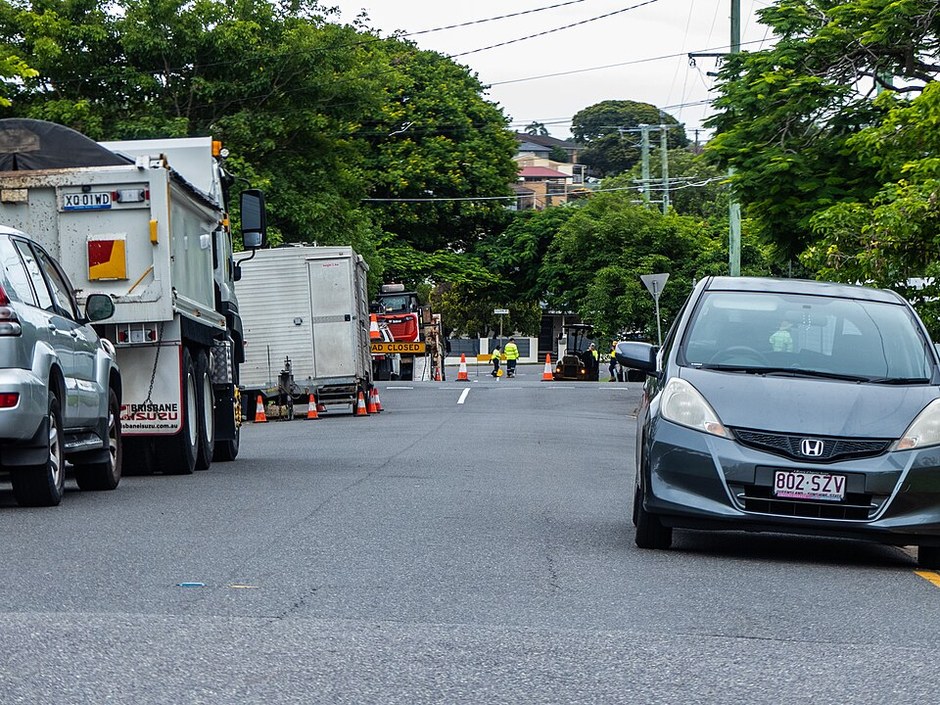
    Roadworks cover road construction and maintenance, road cleaning, installing traffic signals or signs, and road surface surveys. Obey roadworks speed limit signs and directions from traffic controllers. Road workers can be exempt from some road rules where it is impractical to follow them and warning has been given, so expect vehicles and people in unusual positions. Motorcycle edge filtering is banned through roadworks.

    Stopped emergency and breakdown vehicles

    When you approach a parked emergency response vehicle showing flashing lights on a multi-lane road, leave a clear lane between you and it if it is safe and practical to change lanes. You do not have to move over where there are roadworks, when following a police or enforcement officer’s direction, or when turning left or right. If you cannot move over, keep as far from the vehicle as you can within your lane and slow to a safe speed. On a single-lane road, pass at a safe distance and a speed that does not put people at risk. See emergency vehicles and slow down rules.

    Default speed limits

    Where no sign applies, the limit is 50 km/h in a built-up area and 100 km/h outside one.

    Common questions

    What are Queensland school zone times?

    Most run 7am to 9am and 2pm to 4pm on school days, but the times on the sign are the ones that apply.

    Can I cross a level crossing if the lights are flashing but I see no train?

    No. You must not enter while warning lights operate or bells ring.

    What if traffic stops while I am on a level crossing?

    Do not enter unless you can get all the way across. If you are already on it, leave as soon as it is safe.

    Can I overtake at a pedestrian crossing?

    Not past a vehicle that is stopping or has stopped for someone crossing.

    Related: Your keys to driving in Queensland study guide, PrepL and learning to drive in Queensland.

    Sources

    • Queensland Government, “Transport Operations (Road Use Management: Road Rules) Regulation 2009”, current as at 31 August 2026 (legislation.qld.gov.au)
    • Queensland Government, “Transport Operations (Road Use Management: Driver Licensing) Regulation 2021”, schedule 5 (legislation.qld.gov.au)
    • Department of Transport and Main Roads, “School zones” (tmr.qld.gov.au)
    • Department of Transport and Main Roads, “Your keys to driving in Queensland”, Road rules section (publications.qld.gov.au)
    • Queensland Government, “Parked emergency response vehicles with flashing lights” (qld.gov.au)
  • Driving in Brisbane Tunnels and on Queensland Motorways

    Driving in Brisbane Tunnels and on Queensland Motorways

    Photo: Kgbo, CC BY-SA 4.0, via Wikimedia Commons

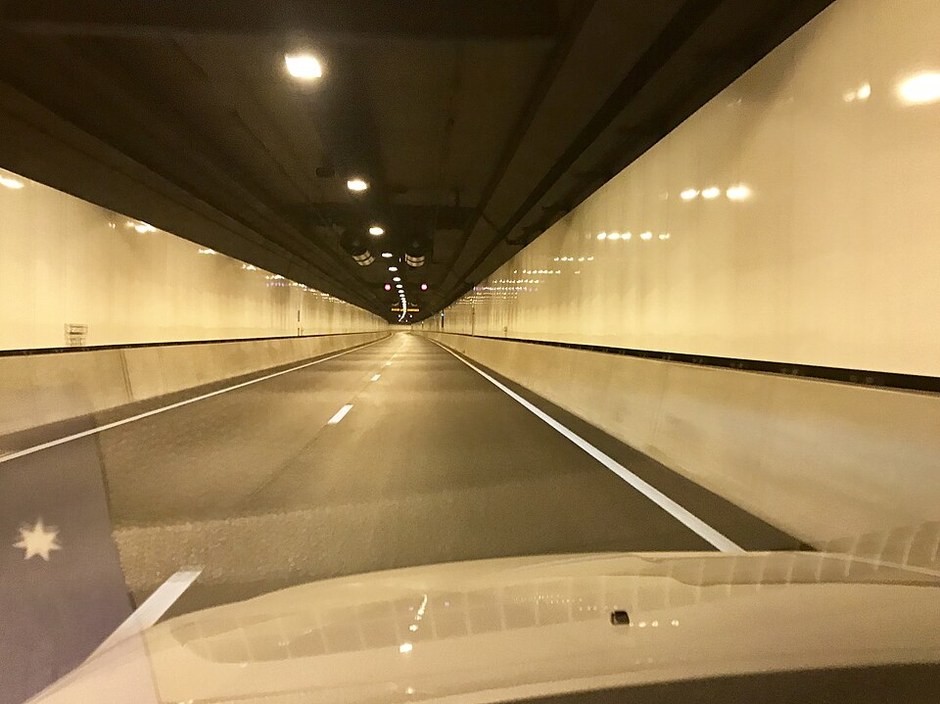
    Brisbane’s motorway tunnels, including CLEM7, AirportlinkM7 and Legacy Way, are open to learner and P plate drivers, but a breakdown or crash underground needs a different response from one on an open road. This guide covers the Queensland rules that apply in tunnels, what TMR says to do if you break down or there is a fire, and how to handle motorways as a new driver.

    Key facts

    • Stopping: you must not stop in a tunnel or underpass unless the road is as wide as on the approaches, or you are in a signed parking or stopping area.
    • Breakdown: drive out if you can. If not, stop in a breakdown bay or at the side of the lane, turn on hazard lights and wait for the incident response team.
    • Emergency phones: connect you to the tunnel control room.
    • Your car catches fire: pull over to the left, stop, turn off the engine and get everyone out, watching for traffic. Do not open the bonnet of an engine fire. Call 000 from an emergency phone or your mobile.
    • Traffic help line: 13 19 40 for incidents and breakdowns on major Queensland roads, 24/7. Call 000 in an emergency.

    Before you enter a tunnel

    • Check your fuel or charge before you go. Breaking down underground blocks a lane.
    • Know your exit. Lane changes inside are harder, so pick your lane on the approach.
    • Read the overhead signs at the entry. Overhead lane control signals can close lanes; ignoring them carries demerit points.
    • Take off sunglasses (unless they are prescription lenses) and turn your headlights on so other drivers can see you.
    • Turn your radio on. Tunnels rebroadcast safety and traffic messages over the radio as well as the public address system.

    Reading overhead lane control signals

    • Red cross over your lane: do not drive in that lane or past the sign.
    • Flashing red cross: the lane is closing or closed ahead. Check mirrors, signal and move out as soon as it is safe, rather than swerving into a vehicle beside you.
    • Speed sign or white, green or yellow arrow over the lane: you may use the lane, at the speed shown.

    A car ahead carrying on under a red cross does not make the lane open. Keep reading the signs, because they can change during an incident.

    Driving through the tunnel

    1. Keep to the speed limit shown on the signs, which can change for incidents.
    2. Keep a safe following distance. Queensland law requires enough distance to stop safely; the Q-Safe test checks for at least 2 seconds.
    3. Stay in your lane. Do not cross continuous lane lines. See road markings and lane lines.
    4. No stopping except in an emergency, in a signed bay or when the tunnel controller directs you. Never reverse in a tunnel.
    5. Avoid changing lanes and overtaking. If you must pass a broken-down vehicle, check it is clear and signal first.

    Motorcyclists cannot ride on the road shoulder (edge filter) in a tunnel, but an open-licence rider may still lane filter between slow or stopped vehicles at 30 km/h or less, so check your mirrors before moving within your lane in queued traffic. See motorcyclists and lane filtering.

    If you break down or crash in a Brisbane tunnel

    1. If the car can move, drive out of the tunnel.
    2. If not, pull into a breakdown bay or as far to the side of the lane as you can.
    3. Turn on your hazard lights.
    4. Stay in the car, or wait safely in front of it, unless there is a fire or you are told to evacuate.
    5. Use the nearest emergency phone to reach the tunnel control room. Watch for traffic when you get out.
    6. Wait for the incident response unit.

    Learner? Your supervisor should take the lead, but practise the steps together so you both know them. After any crash, follow what to do after a crash in Australia.

    If you are stuck in tunnel traffic

    • Follow overhead signs and radio traffic updates.
    • Keep windows closed and set the air conditioning to recirculate.
    • Use an emergency phone if you need urgent help.

    If there is a fire

    • Do not enter a tunnel if you see smoke ahead or have been warned of a fire inside.
    • If you are in the tunnel and see smoke or fire ahead, pull over, turn off the engine and wait for instructions by radio, public address or the incident response team.
    • If your own car catches fire, pull over to the left, stop, turn off the engine and get out, watching for passing traffic. Do not open the bonnet of an engine fire, as the extra air feeds it. Do not stay in a burning car waiting for an announcement.
    • If you cannot put the fire out, leave the keys in the ignition and call 000 from an emergency phone or mobile. Follow any instructions you are given.
    • If you are told to evacuate, leave your keys in the ignition in the off position and follow the running man symbols and flashing lights to the nearest safe exit, on foot.

    Queensland motorways on L and P plates

    • Learners may drive on motorways with their supervisor; Queensland sets no separate learner speed limit, so the posted limit applies.
    • Merge by matching the speed of traffic and finding a gap; give way to traffic already in the lane you are joining.
    • Obey any “keep left unless overtaking” signs.
    • If you break down on a motorway, use your hazard lights, get as far left as possible (onto the shoulder or an exit) and call 13 19 40, or 000 if anyone is in danger.
    • When passing a stopped emergency or breakdown vehicle with flashing lights on a multi-lane road, leave a clear lane between you and it if it is safe and practical. If you cannot change lanes, keep as far away as you can within your lane and slow to a safe speed. See emergency vehicles and slow down rules.

    More: learners on motorways and freeways and overtaking, merging and changing lanes.

    Common questions

    Can learners drive through Brisbane tunnels?

    Queensland’s rules do not ban learners from tunnels. Build up to it on motorways first with your supervisor.

    Can I stop in a tunnel if I miss my exit?

    No. Keep going and take the next exit.

    Should I get out of my car if it breaks down in a tunnel?

    Stay in the car or wait safely in front of it, unless there is a fire or you are told to evacuate. Watch for traffic if you go to an emergency phone.

    What number do I call for a breakdown on a Queensland motorway?

    13 19 40 for minor incidents and breakdowns on major roads, or 000 in an emergency.

    Are tunnels part of the Q-Safe test?

    The test route is chosen by the examiner. Practise tunnel and motorway driving anyway so you are ready to drive them alone on Ps.

    Related: Your keys to driving in Queensland study guide, Queensland learner rules and learning to drive in Queensland.

    Sources

    • Department of Transport and Main Roads, “Tunnel safety” (tmr.qld.gov.au)
    • Queensland Government, “Breakdown safety on motorways and freeways” (qld.gov.au)
    • Department of Transport and Main Roads, “QLDTraffic: Contact us” (qldtraffic.qld.gov.au)
    • Queensland Government, “Transport Operations (Road Use Management: Road Rules) Regulation 2009”, current as at 31 August 2026 (legislation.qld.gov.au)
    • Queensland Government, “Transport Operations (Road Use Management: Driver Licensing) Regulation 2021”, schedule 5 (legislation.qld.gov.au)
    • Department of Transport and Main Roads, “Your keys to driving in Queensland”, No. 19, November 2022, complete PDF, Safe road use: Driving safely in tunnels (p. 146) and Safe following distance (p. 147) (publications.qld.gov.au)
    • Queensland Government, “Traffic lights, U-turns and overhead lane controls” (qld.gov.au)
    • Queensland Government, “Parked emergency response vehicles with flashing lights” (qld.gov.au)
  • UK Speed Limits: National Speed Limit for Every Vehicle and Road

    UK Speed Limits: National Speed Limit for Every Vehicle and Road

    Photo: Michał Robak / Pexels. Illustrative photograph.

    For cars in Great Britain, the national speed limits are 60 mph on single carriageways and 70 mph on dual carriageways and motorways. In built-up areas with street lights, the limit is generally 30 mph in England and Scotland, and 20 mph in Wales since 17 September 2023. This explainer is for learner and new drivers. It sets out the full Rule 124 table, what the national speed limit sign means on each road type, the lower limits for towing, and why the limit is a maximum, not a target.

    UK speed limits by vehicle and road

    These are the national speed limits from Highway Code Rule 124 for England, Scotland and Wales, in mph. They apply unless signs show a different limit. You MUST NOT go faster than the limit for the road or the limit for your vehicle, whichever is lower.

    Vehicle Built-up areas (England, Scotland) Built-up areas (Wales) Single carriageway Dual carriageway Motorway
    Cars and motorcycles (and car-derived vans up to 2 tonnes laden) 30 20 60 70 70
    Cars, car-derived vans and motorcycles towing caravans or trailers 30 20 50 60 60
    Motorhomes up to 3.05 tonnes unladen 30 20 60 70 70
    Motorhomes over 3.05 tonnes unladen 30 20 50 60 70
    Buses, coaches and minibuses 30 20 50 60 70 (60 if over 12 metres long)
    Goods vehicles up to 7.5 tonnes laden 30 20 50 60 70 (60 if articulated or towing)
    Goods vehicles over 7.5 tonnes (England and Wales) 30 20 50 60 60
    Goods vehicles over 7.5 tonnes (Scotland) 30 20 40 50 60

    “Built-up area” here means a road with street lights, where the default is 30 mph in England and Scotland and 20 mph in Wales, unless signs say otherwise. Learner drivers follow the same limits as everyone else.

    Key facts: UK speed limits for cars

    • Built-up areas: 30 mph (48 km/h) in England and Scotland, 20 mph (32 km/h) in Wales, on roads with street lights unless signs show otherwise. GOV.UK gives 30 mph for Northern Ireland too.
    • Single carriageway: 60 mph (96 km/h).
    • Dual carriageway: 70 mph (112 km/h).
    • Motorway: 70 mph (112 km/h).
    • Towing a caravan or trailer: 50 mph on single carriageways, 60 mph on dual carriageways and motorways.
    • Learners in Great Britain follow the same limits as full licence holders.

    Most vans are not car-derived and follow the goods vehicle limits for their weight, which is why a van can have a lower limit than a car on the same road. Our guide to speed limits for vans explains how to tell.

    What does the national speed limit sign mean?

    The national speed limit sign (captioned “National speed limit applies” in the Highway Code) does not mean one fixed number. It means the limit from the table above for that road and your vehicle. In a car:

    Four panels for cars: built-up areas with street lights at 30 mph in England and Scotland or 20 mph in Wales, and the national speed limit sign meaning 60 mph on a single carriageway and 70 mph on dual carriageways and motorways, with lower towing limits of 50 and 60 mph.
    Car speed limits by road type, with towing limits. Simplified illustration, not the official sign design.
    • on a single carriageway, it means 60 mph
    • on a dual carriageway, it means 70 mph
    • on a motorway, it means 70 mph

    Towing a trailer changes the number: 50 mph on a single carriageway and 60 mph on a dual carriageway. Speed limit signs in a red circle give a maximum speed. Blue circular signs give a minimum speed. Our guides to regulatory signs and speed limit and less common signs show them.

    Built-up areas and street lights

    Rule 124 says the 30 mph limit (20 mph in Wales) usually applies to all roads with street lighting, except motorways, unless signs show otherwise. Councils can set different local limits, which must be clearly signed. Rule 124 gives examples: 20 mph in some built-up areas of England and Scotland, 30 mph on some roads in Welsh built-up areas, and 50 mph on single carriageways with known hazards. GOV.UK also mentions 20 mph zones near schools.

    Wales’ 20 mph default limit

    The Restricted Roads (20 mph Speed Limit) (Wales) Order 2022 cut the default limit on restricted roads in Wales from 30 mph to 20 mph from 17 September 2023. The Highway Code was updated the same day. The Welsh Government describes restricted roads as usually residential and built-up streets, often with street lights no more than 200 yards apart.

    Welsh highway authorities can return particular roads to 30 mph using a traffic regulation order, following guidance issued in July 2024. So on a Welsh street with street lights, expect 20 mph unless signs show 30 mph.

    Variable and temporary limits

    Some motorways and dual carriageways have variable speed limit signs that change the maximum. Road works often have temporary limits. See smart motorways and red X signals and road works and temporary speed limits.

    The limit is a maximum, not a target (Rule 125)

    Rule 125 says the speed limit is the absolute maximum and does not mean it is safe to drive at that speed in all conditions. It tells you to slow down for:

    • bends and other hazards in the road layout or surface
    • vulnerable road users, such as children, older or disabled people, cyclists, horse riders, horse-drawn vehicles and motorcyclists
    • bad weather
    • night driving, when other road users are harder to see

    Rule 152 adds that some residential areas have a 20 mph limit and asks you to drive slowly where pedestrians, cyclists and parked cars are likely. Rule 154 asks you to slow down where country roads enter villages. Annex 8, the safety code for new drivers, says to keep your speed down because many serious collisions happen when drivers lose control, particularly on bends. Learn how speed affects stopping in stopping distances and the two second rule.

    Speed limits for learners and in Northern Ireland

    GOV.UK confirms that learners in England, Scotland and Wales have the same speed limits as full licence holders. In Northern Ireland, older rules set a 45 mph limit for L-plated cars, and drivers who pass under the pre-GDL system before 1 April 2027 keep a 45 mph limit for a year. Under Graduated Driver Licensing, nidirect says the 45 mph restriction is removed. Read Learning to Drive in Northern Ireland for details.

    Scenario: leaving a town

    You drive out of a town on a lit 30 mph road. The street lights stop and you pass a national speed limit sign. The road is a single carriageway with one lane each way.

    A car leaves a lit 30 mph town road and passes a national speed limit sign onto a single carriageway with a bend ahead. The limit becomes 60 mph, or 50 mph when towing, but the driver should slow for the bend.
    Passing a national speed limit sign raises the maximum, not the safe speed. Simplified illustration, not the official sign design.
    • The national limit for your car is now 60 mph.
    • That does not mean you should drive at 60 mph. With a bend ahead and a farm entrance, Rule 125 says choose a speed that fits the conditions.
    • If you are towing a small trailer, your limit is 50 mph.

    Common questions

    What is the national speed limit for a car on a single carriageway?

    60 mph (96 km/h). On dual carriageways and motorways it is 70 mph (112 km/h).

    Is the speed limit 30 mph wherever there are street lights?

    Generally yes in England and Scotland, and 20 mph in Wales, unless signs show a different limit. Motorways are the exception.

    When did Wales change to 20 mph?

    On 17 September 2023, for restricted roads (usually residential streets with street lights). Some roads have since been returned to 30 mph, so follow the signs.

    Can learner drivers drive at 70 mph?

    In Great Britain, yes, where the limit allows and conditions are suitable. Learners have the same limits as other drivers. Learners can only drive on motorways with an approved driving instructor in a dual-controlled car. See learners and motorways.

    What is the speed limit when towing a trailer?

    50 mph on single carriageways and 60 mph on dual carriageways and motorways, plus the normal built-up area limits. See towing a trailer on a car licence.

    What happens if I speed as a new driver?

    Speeding can lead to penalty points. If you reach 6 points within 2 years of passing, your licence is cancelled. See the New Drivers Act.

    Back to the main guide: Learning to Drive in Great Britain.

    Practice questions

    These practice questions are written for this site to help you revise. They are not official DVSA questions.

    Q1. You are driving a car on a single carriageway road and pass a national speed limit sign. What is the maximum speed?

    A) 50 mph
    B) 60 mph
    C) 70 mph
    D) 40 mph
    Answer: B. For cars, the national speed limit on a single carriageway is 60 mph. It is 70 mph on dual carriageways and motorways. (Highway Code Rule 124)

    Q2. You are towing a caravan on a motorway. Unless signs show a lower limit, what is your maximum speed?

    A) 50 mph
    B) 70 mph
    C) 60 mph
    D) 40 mph
    Answer: C. Cars towing caravans or trailers are limited to 60 mph on dual carriageways and motorways, and 50 mph on single carriageways. (Highway Code Rule 124)

    To practise choosing a safe speed below the limit, work through the syllabus topic speed and speed limits, and see our free study guides for more revision.

    Sources

    • Department for Transport, “The Highway Code: General rules, techniques and advice for all drivers and riders (103 to 158)” (gov.uk)
    • Department for Transport, “The Highway Code: Traffic signs” (gov.uk)
    • Department for Transport, “The Highway Code: Updates” (gov.uk)
    • Department for Transport, “The Highway Code: Annex 8. Safety code for new drivers” (gov.uk)
    • Department for Transport, “Know your traffic signs” (gov.uk)
    • GOV.UK, “Speed limits” (gov.uk)
    • GOV.UK, “Driving lessons and learning to drive” (gov.uk)
    • Welsh Government, “Introducing default 20mph speed limits” (gov.wales)
    • Welsh Government, “The Restricted Roads (20 mph Speed Limit) (Wales) Order 2022” (legislation.gov.uk)
    • nidirect, “What Graduated Driver Licensing means for learner drivers” (nidirect.gov.uk)
  • Red X on the Motorway: Smart Motorways and Emergency Areas (GB)

    Red X on the Motorway: Smart Motorways and Emergency Areas (GB)

    Photo: Mike Bird / Pexels. Illustrative photograph.

    A red X above a motorway lane in Great Britain means that lane is closed and you must not drive in it. Ignoring one can bring a fixed penalty of up to £100 and three points, and cameras can detect it. This guide covers red X signals, variable speed limits, the hard shoulder used as a lane, and what to do if you have to stop on a motorway with no hard shoulder.

    Key facts

    • Red X (with flashing red lights): lane closed. You MUST NOT drive in it (Highway Code Rule 258).
    • Penalty: fixed penalty of up to £100 and three points, or court in some cases (National Highways).
    • Cameras: since a law change in June 2019, cameras can automatically detect drivers ignoring a red X so police can act.
    • Speed limit in a red circle: mandatory (Rule 261). Without a red circle, it is advisory.
    • Emergency areas: blue signs with an orange SOS phone symbol, often orange surfacing. For emergencies only (Rule 270).

    What does a red X on the motorway mean?

    A red X with red lights flashing in pairs means “do not proceed in the lane directly below”. It is used when there are people, stopped vehicles or other hazards in the lane, and to keep it clear for emergency services.

    Top view of a three-lane motorway with four overhead gantries over the left lane: an arrow, a red X with flashing red lights, a blank sign and an END sign, with a car moving out of the closed lane early.
    A red X closes the lane until a speed limit, national speed limit sign or END is shown; a blank sign does not reopen it. Simplified illustration, not the official sign design.
    1. Follow the earlier signs, such as an arrow, to move into an open lane in good time.
    2. Do not drive in the closed lane, even after you pass the obvious hazard. There may be more danger further on.
    3. If the lane next to you is about to close, leave gaps so others can merge.
    4. The lane is open again only when a sign shows a speed limit, the national speed limit sign or “END”. A blank sign does not cancel a red X.

    If red lights and closures are shown for every lane, the road is closed. You MUST NOT go past the sign in any lane or use the hard shoulder to get round it unless a police or traffic officer tells you to.

    Variable speed limits

    What you see Meaning
    Speed in a red circle, over a lane or at the side Mandatory limit. Enforcement cameras may be in use.
    Speed with no red circle Maximum speed advised for the conditions
    Amber lights flashing with a message (fog, queue) Warning of a hazard ahead
    National speed limit sign or “END” End of the temporary restriction

    A message may appear with no obvious cause. There may be an incident ahead you cannot see yet, so obey it. More signals: motorway signs and signals. See all motorway gantry signs.

    Types of smart motorway

    Type Hard shoulder
    Controlled motorway Permanent hard shoulder, with variable speed limits
    Dynamic hard shoulder Opened as a lane at busy times. It is open only when the sign above it shows a speed limit (60 mph or lower).
    All lane running No hard shoulder. The old hard shoulder is a permanent lane, with emergency areas at intervals.

    When can you drive on the hard shoulder? (Rule 269)

    • Only in an emergency, when police or traffic officers direct you, or when a sign shows a speed limit above it.
    • A red X or a blank sign above the hard shoulder means do not use it except in an emergency.
    • Misusing it can lead to a warning letter, or a fine and points.

    Emergency areas: what they are and how to use them

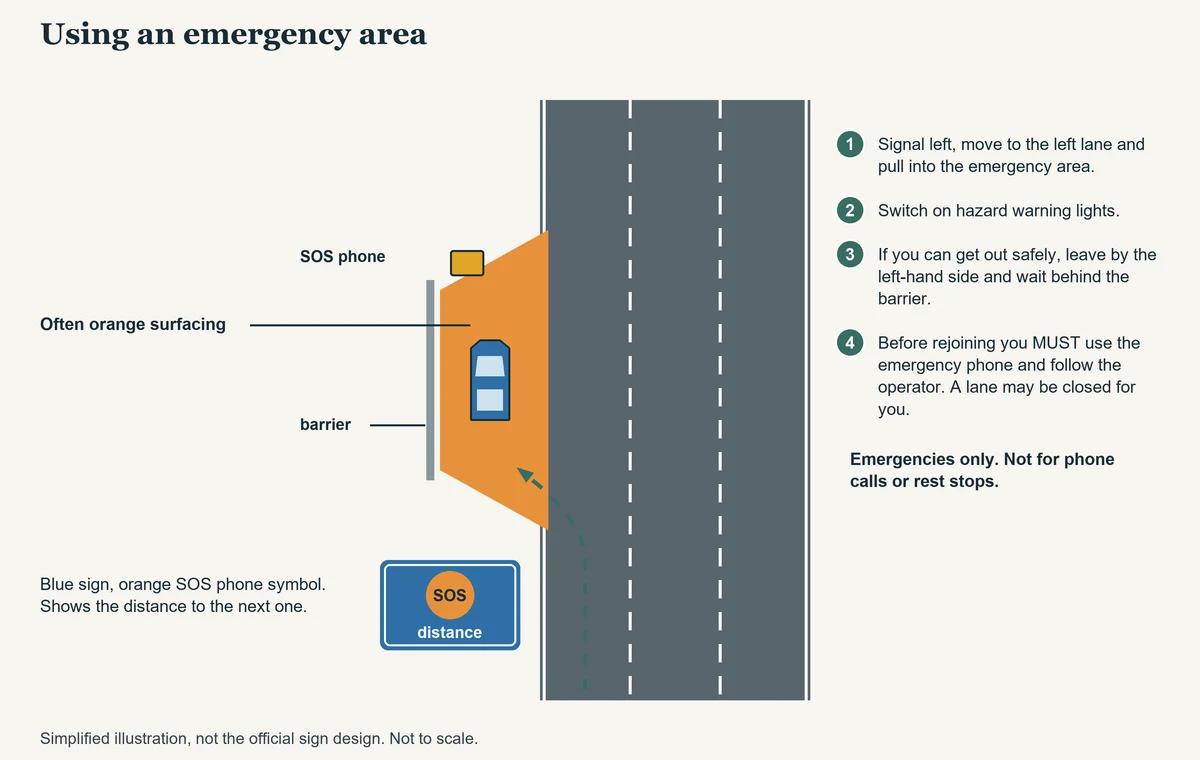
    Emergency areas sit beside motorways with no hard shoulder, or where the hard shoulder is used as a lane. They are set back from the carriageway and have an emergency telephone linked to a National Highways control centre.

    Top view of a motorway with no hard shoulder and an orange-surfaced emergency area set back on the left, with a barrier, an SOS phone, a car stopped inside, and a blue SOS sign before it.
    How to pull into and leave an emergency area. Simplified illustration, not the official sign design.
    • How to spot one: blue sign with an orange SOS telephone symbol, giving the distance to the next one, and often orange surfacing.
    • Use: emergencies only (Rule 270). Not for phone calls, rest stops or checking a route.
    • Leaving: you MUST use the emergency telephone and follow the operator’s advice. A lane may be closed for you to rejoin safely (Rule 278).

    Breaking down on a motorway with no hard shoulder

    1. Leave at the next exit or service area if you can.
    2. If not, signal left, move into the left lane and pull into an emergency area, or onto a hard shoulder if there is one.
    3. Switch on hazard warning lights (and sidelights in the dark or poor visibility).
    4. If you can get out safely, leave by the left-hand side, keep passengers with you and wait behind the barrier if there is one.
    5. If you stop in a live lane and cannot get out safely, stay in the car with seat belts on and hazards on, and call 999 (or press the SOS button if fitted).
    6. Do not put out a warning triangle on the motorway.
    7. Once you are out and behind the barrier, do not go back to the car, even if it is raining or cold. Do not try repairs.
    8. If a disability means you cannot follow these steps, stay in the car with your seat belt on and hazards on, and call 999 or press SOS (Rule 279).

    Rejoining the motorway (Rule 278)

    • From an emergency area: you MUST use the emergency telephone first and follow the operator’s advice, even if the engine has restarted. The operator may close a lane so you can pull out safely. A restart also does not prove the fault is fixed.
    • From a hard shoulder: build up speed on the hard shoulder, signal, and wait for a safe gap. Watch for stopped vehicles and debris ahead of you. Your indicator does not give you priority.

    When you call, have ready the motorway, direction of travel, the number on the nearest marker post or driver location sign, whether you are in a lane, an emergency area or on the hard shoulder, and who is with you. Read it from a safe place, not by walking along the road.

    Full checklists, including how to tell services where you are: what to do if your car breaks down.

    Common questions

    How many points for driving under a red X?

    Three points and a fixed penalty of up to £100. Some cases go to court, where higher penalties are possible.

    Can a camera catch me in a red X lane?

    Yes. Since June 2019, cameras can automatically detect vehicles that ignore a red X, and the police then take enforcement action.

    Are smart motorway speed limits enforced?

    Yes, when the limit is shown in a red circle. Limits without a red circle are advice.

    Can I stop in an emergency area to take a phone call?

    No. Emergency areas are for emergencies only, and Rule 271 says do not stop on a motorway to make or take calls.

    Can learners drive on smart motorways?

    Learners in Great Britain can drive on motorways only with an approved driving instructor in a dual-controlled car. See learners and motorways.

    Related: your first motorway drive, Highway Code light signals and road works and contraflows. Back to the main guide: Learning to Drive in Great Britain.

    Sources

    • Department for Transport, “The Highway Code: Motorways (253 to 274)” (gov.uk)
    • Department for Transport, “The Highway Code: Breakdowns and incidents (275 to 287)” (gov.uk)
    • Department for Transport, “Know your traffic signs” (gov.uk), section: Motorway signs, signals and road markings
    • National Highways, “Red X” (nationalhighways.co.uk)
    • National Highways, “The hard shoulder” (nationalhighways.co.uk)
    • National Highways, “Ambulance crews urge drivers to respect the Red X” (gov.uk)
  • Police, Traffic Officer and School Crossing Patrol Signals (GB)

    Police, Traffic Officer and School Crossing Patrol Signals (GB)

    Photo: Tony Zohari / Pexels. Illustrative photograph.

    In Great Britain you MUST obey signals from police officers, traffic officers, DVSA officers, traffic wardens and school crossing patrols (Highway Code Rule 105). This explainer covers who can stop you, how each one signals, what you must do, and the school crossing patrol “Stop for children” sign under Rule 210.

    Who can stop or direct you?

    Who How they signal What you must do Where
    Police From behind: flashing blue lights, headlights, siren or horn, or by pointing and/or using the left indicator. On foot: arm signals to stop or beckon you on Pull over and stop as soon as it is safe, then switch off your engine (Rule 106) Anywhere
    DVSA officers Flashing amber lights, from the front (follow them) or from behind (pull over) Obey their signals. Not complying is an offence (Rule 107) Any road vehicle, anywhere
    Traffic officers (uniformed) Flashing amber lights, usually from behind, then pointing and/or the left indicator to direct you to the side of the road Pull over and stop when safe, switch off your engine. Not complying is an offence (Rule 108) Most motorways and some A roads in England and Wales
    Traffic wardens Directions and signs Obey them (Rule 105) Anywhere they are directing traffic
    School crossing patrols “Stop for children” sign Stop (Rule 210) Near schools
    Four cards comparing police, DVSA officers, traffic officers and school crossing patrols: the lights or sign each uses, what you must do, and where they operate.
    Who can stop you, how they signal, and what you must do. Simplified illustration, not the official sign design.

    Traffic officers usually stop vehicles for safety reasons, for example an insecure load (Rule 108).

    Police signals on foot

    The Highway Code shows police officers signalling three ways to stop traffic: traffic approaching from the front, from both front and behind, and from behind. There is also a signal to beckon traffic on from the side, front or behind. In Wales, bilingual markings appear on emergency service vehicles and clothing.

    If an officer is controlling a junction, follow their signal even if the traffic light says otherwise. Watch their hands, and if you are unsure, wait.

    Arm signals you give to the person controlling traffic

    The Highway Code also shows arm signals a driver can give to a police officer or other person controlling traffic, to show you intend to:

    • go straight ahead
    • turn left (either hand)
    • turn right

    These are separate from the arm signals you give to other road users. See signalling with indicators, arm signals and headlights.

    School crossing patrols: the four signals

    1. Not ready: the patrol is not yet ready for pedestrians to cross.
    2. Barrier: the sign is held out to stop pedestrians crossing.
    3. Ready to cross: pedestrians are ready, so vehicles must be prepared to stop.
    4. All vehicles stop: you must stop.
    Four numbered cards for the school crossing patrol signals: not ready, barrier, ready to cross and all vehicles stop, each with what the driver should do.
    The four school crossing patrol signals in order. Simplified illustration, not the official sign design.

    Rule 210 makes stopping a legal MUST when the patrol shows the “Stop for children” sign. Rule 208 adds: near schools, drive slowly, and where a flashing amber signal sits under a “School” warning sign, children may be crossing ahead.

    Scenario: blue lights behind you on a dual carriageway

    A police car behind you flashes its headlights and points to the left. Signal left, find a safe place (a lay-by or hard verge, not a bend or a junction), stop, and switch off the engine. If the police car simply wants to get past, see letting emergency vehicles pass.

    Common questions

    Can a traffic officer pull me over?

    Yes, on most motorways and some A roads in England and Wales. You must stop when safe. Not complying is an offence (Rule 108).

    How do I know it is a DVSA officer?

    DVSA officers use flashing amber lights. They may drive in front and ask you to follow, or signal from behind to pull over (Rule 107).

    Do I have to stop for a lollipop person?

    Yes. When a school crossing patrol shows the “Stop for children” sign, you MUST stop (Rule 210).

    What if a police officer waves me through a red light?

    Follow the officer. Rule 105 requires you to obey police signals, and they override the lights.

    Should I switch my engine off when stopped by police?

    Yes. Rules 106 and 108 both say stop as soon as it is safe and then switch off your engine.

    Related: road users requiring extra care, regulatory signs and Highway Code light signals. Back to the main guide: Learning to Drive in Great Britain.

    Sources

    • Department for Transport, “The Highway Code: Signals by authorised persons” (gov.uk)
    • Department for Transport, “The Highway Code: General rules, techniques and advice for all drivers and riders (103 to 158)” (gov.uk)
    • Department for Transport, “The Highway Code: Road users requiring extra care (204 to 225)” (gov.uk)