Author: Get Driving Test Ready

  • Roadworks Signs and Traffic Calming in Ireland

    Roadworks Signs and Traffic Calming in Ireland

    Photo: Jan van der Wolf / Pexels. Illustrative photograph.

    Roadworks signs in Ireland are orange, not yellow: diamond or rectangular, with a black border and black symbols or words. When you see them, slow down, obey any Stop/Go board and keep to the roadworks speed limit. This guide explains the roadworks signs, temporary speed limits and the traffic calming features you meet in Irish towns and estates, with fixed charges as of November 2026.

    Key facts

    • Roadworks signs: orange with a black border. Ordinary warning signs are yellow.
    • At a Stop board you must stop. Go only when the board shows “Go” or “Téigh”. Ignoring it is an offence.
    • Councils can set a roadworks speed limit as low as 20 km/h for the duration of the works, for up to 12 months per order.
    • Don’t park at roadworks.
    • Traffic calming: islands, gateways, mini-roundabouts, build-outs, chicanes, pinch points, ramps, speed cushions and speed tables.
    • Breaking the mini-roundabout rules: €60 fixed charge and 1 penalty point.

    What do roadworks signs look like in Ireland?

    They use the same shapes as warning signs, but in orange. That colour tells you the hazard is temporary and that a temporary layout or speed limit may apply. For the other sign families, see Irish road signs explained.

    Common roadworks signs

    Sign What to do
    Roadworks ahead Slow down and look for workers, vehicles and a changed layout
    Temporary traffic signals ahead Be ready to stop at portable lights
    Flagman ahead Someone will control traffic by hand. Follow their signs
    Queues likely Expect stopped traffic; leave room to stop
    Lane closed (nearside, offside, or two lanes of three or four) Move into the open lane early and merge in turn
    One-lane or two-lane crossover (out and back) Traffic is being moved to the other carriageway and back again
    Move to left / move to right Follow the lane shift
    Loose chippings, slippery road, uneven surface Slow down and keep your distance; chippings can be thrown up
    Hump or ramp Temporary ramp across the road
    Site access on left or right Works vehicles may pull out
    Overhead electric cables Take care with high loads
    Pedestrians cross to left or right The footpath is diverted across the road

    Information plates at roadworks

    Plates under or beside the main signs show detours (ahead, left, right, end of detour), road closed, hard shoulder closed, use hard shoulder, unfinished road surface, concealed entrance, the type of works, a cautionary speed, and the distance or length the works cover. Barrier boards and chevron boards mark the edge of the works.

    Stop/Go boards at roadworks

    1. When the Stop board faces you, stop. You may only go when the Go (or Téigh) side is shown.
    2. Where plant or machinery is crossing the road, you must stop at a Stop sign whichever direction you come from.
    3. The boards can be held by a person or operated mechanically. Both carry the same legal force.
    A yellow warning diamond beside an orange roadworks diamond, and a two sided Stop and Go board, with Go only when Go or Teigh shows.
    Orange roadworks signs and the Stop/Go board. Simplified illustration, not the official sign design.

    Speed limits at roadworks

    Under section 10 of the Road Traffic Act 2004, a council chief executive can apply a special speed limit to a road where works are being carried out. It must be at least 20 km/h, it lasts for the duration of the works, and a single order can last no more than 12 months. Section 10A gives a similar power on national managed roads. The limit is shown on regulatory speed signs (red ring, white background). Breaking it carries the speeding fixed charge: €160 and 3 penalty points. Motorways can also have lower signed limits at roadworks. See speed limits in Ireland.

    Driving through roadworks: checklist

    • Slow down as soon as you see the first orange sign.
    • Get in lane early when a lane is closed.
    • Leave a bigger gap; queues form suddenly.
    • Watch for workers on foot and vehicles leaving site entrances.
    • Read the electronic variable message signs. They give live information about roadworks and changed layouts.
    • Don’t park at roadworks.

    Traffic calming in Irish towns and villages

    Traffic calming slows traffic and manages its flow at junctions. Entering a calmed town or village, you will see an information sign, often with the place name and a speed limit sign. Expect:
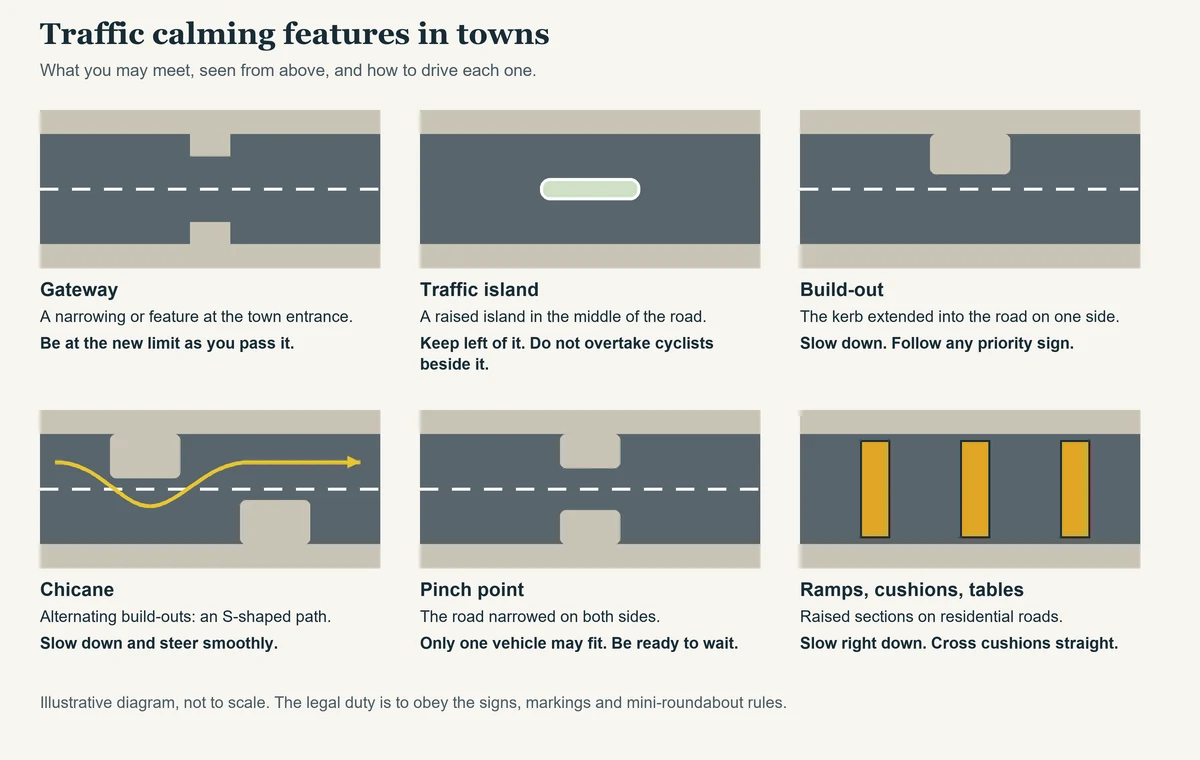
    Six road views from above showing a gateway, traffic island, build-out, chicane, pinch point and ramps, with how to drive each one.
    Traffic calming features and how to drive them. Illustrative diagram, not to scale.
    Feature What it is How to drive it
    Gateway A narrowing or feature at the town entrance Be at the new limit by the time you pass it
    Traffic island A raised island in the middle of the road Keep left of it; don’t overtake cyclists alongside it
    Build-out The kerb extended into the road on one side Slow down; follow any priority sign telling you to give way to oncoming traffic
    Chicane Alternating build-outs forcing an S-shaped path Slow down and steer smoothly
    Pinch point The road narrowed on both sides Only one vehicle may fit. Be ready to wait
    Mini-roundabout A small painted or slightly raised roundabout Follow the mini-roundabout rules; drive around the central marking
    Ramps, speed cushions, speed tables Raised sections, signed on residential roads Slow right down; cross cushions straight

    The “how to drive it” column is practical guidance; the legal duties are to obey the signs, road markings and the mini-roundabout rules. For mini-roundabouts in detail, see roundabouts in Ireland.

    Slow zones in housing estates

    A Slow Zone sign marks a 30 km/h area, usually a self-contained estate of local roads. Expect speed bumps and the unexpected: children, parked cars and people stepping out.

    Penalties

    Offence Fixed charge Points on payment Points on conviction
    Speeding, including through a roadworks limit €160 3 5
    Breaking the mini-roundabout rules €60 1 3
    Not complying with mandatory traffic signs €60 2 4
    Not complying with prohibitory traffic signs €60 1 3

    As of November 2026. See penalty points in Ireland for the full table.

    Common questions

    What colour are roadworks signs in Ireland?

    Orange, with a black border and black symbols or words. Permanent warning signs are yellow.

    Is the speed limit at roadworks legally binding?

    Yes, when it is shown on a regulatory speed limit sign. Councils set them by order under the Road Traffic Act 2004. A “cautionary speed” plate is advice; still follow it.

    What happens if I drive past a Stop board?

    It is an offence. You must wait until the board shows Go or Téigh.

    Do I have to stop at roadworks lights when nobody is coming?

    Yes. Temporary signals are traffic lights. Red means stop.

    What is the speed limit in a Slow Zone?

    30 km/h.

    Will roadworks come up in the theory test?

    Sign recognition is part of the theory test and the driving test questions. See Irish theory test topics.

    Back to learning to drive in Ireland.

    Sources

    • Road Safety Authority, “Rules of the Road”, Section 6 and Section 23 Warning signs for roadworks (Revision 5, hosted on garda.ie)
    • Law Reform Commission, “Road Traffic Act 2004, Revised”, sections 2, 10 and 10A (revisedacts.lawreform.ie)
    • Irish Statute Book, “S.I. No. 227/2024, Road Traffic Act 2010 (Part 3) (Fixed Charge Offences) Regulations 2024”, Schedules 2 and 6 (irishstatutebook.ie)
    • Law Reform Commission, “Road Traffic Act 2002, Revised”, First Schedule (revisedacts.lawreform.ie)
  • Road Works and Contraflow Systems: Temporary Limits and Lane Rules (GB)

    Road Works and Contraflow Systems: Temporary Limits and Lane Rules (GB)

    Photo: Thomas Fuhrmann / Pexels. Illustrative photograph.

    Driving through road works in Great Britain comes down to Highway Code Rules 288 to 290: obey the temporary speed limit, which is mandatory, get into the right lane early, merge in turn where lanes close, and never drive into a coned-off area. This guide explains what a contraflow system is, what each road works sign means, convoys, temporary traffic lights and what to do if you break down inside the works.

    What is a contraflow system?

    A contraflow system is a temporary layout, usually at road works on a motorway or dual carriageway, where traffic going one way is moved across to share the other carriageway with traffic coming towards it. Rule 290 of the Highway Code warns that you may be in a narrower lane than normal, with no permanent barrier between you and oncoming traffic, often only a line of cones or cylinders.

    What to do as you approach a contraflow

    1. Read the signs early. After the “Road Works Ahead” sign, look for the more detailed signs that follow (Rule 288). Lane diagram signs show which lanes cross over to the other carriageway, and some lanes are marked for narrower vehicles only.
    2. Choose your lane in good time. Use your mirrors and move into the lane the signs show for your route well before the crossover. Where lanes close, merge in turn (Rules 134 and 288).
    3. Keep to the temporary speed limit. A limit in a red circle at road works is the law: you MUST NOT exceed it (Rule 288).
    4. Keep your distance. Keep a safe gap from the vehicle in front (Rule 288), and slow down and increase that gap at the start and end of the contraflow, where changes in the camber of the road can affect your car’s stability (Rule 290).
    5. Stay in your lane. Once inside, the lanes are narrow and oncoming traffic is close, so hold a steady position. Do not switch lanes to overtake queuing traffic (Rule 288).

    Key facts

    • You MUST NOT exceed a temporary maximum speed limit (Rule 288).
    • Average speed cameras are often used in road works. A sign shows the length of road where two cameras measure your average speed.
    • Where lanes close, merge in turn. Do not switch lanes to overtake queuing traffic.
    • You MUST pass a works vehicle on the side its “Keep Left” or “Keep Right” sign shows (Rule 289).
    • You MUST NOT pass a vehicle showing “CONVOY VEHICLE NO OVERTAKING” (Rule 289).

    The road works rules (Rule 288)

    • When you see the “Road Works Ahead” sign, take extra care and look for signs with more detailed instructions.
    • Keep to the temporary limit and keep a safe distance from the vehicle in front.
    • Use your mirrors and get into the correct lane in good time, as the signs direct.
    • Do not drive through an area marked off by cones.
    • Watch for works vehicles entering or leaving the site, especially those showing amber lights, and leave extra space.
    • Give cyclists and motorcyclists room: grit, mud or debris can make them skid.
    • Concentrate on the road ahead, not the works. Traffic may be stopped round the next bend.

    Temporary speed limits: are they enforceable?

    Yes. A limit in a red circle at road works is mandatory, and the “end of road works” sign ends it, along with all other temporary restrictions. If the permanent limit after the works is different from the one before, a speed limit sign is always added. A speed on a rectangular sign (“max speed advised”) is advice, not a legal limit.

    A road with a sequence of simplified signs: road works ahead, a limit in a red circle, a rectangular max speed advised sign, a lane closing with cones, and an end of road works sign, each labelled as law or advice.
    Which road works signs are mandatory and which are advice. Simplified illustration, not the official sign design.

    Know Your Traffic Signs also shows signs for areas where speed cameras are in use, and for a length of road where two cameras measure your average speed between two points. Braking hard at one camera does not help: it is your average over the whole stretch that counts.

    Driving through a contraflow system (Rule 290)

    Inside the contraflow you share the other carriageway, often with only traffic cylinders between you and oncoming vehicles. These points apply all the way through:

    Top view of a dual carriageway where the northbound side is coned off for works and northbound traffic crosses into a narrow lane on the southbound side, separated from oncoming traffic by a line of traffic cylinders.
    In a contraflow you share the other carriageway, often with only cylinders between you and oncoming traffic. Illustrative diagram, not to scale.
    1. Slow down and increase your following distance at the start and end of the contraflow. Changes in road camber here can affect your car’s stability.
    2. Keep well inside your lane, where you can clearly see its edges (studs or temporary markings).
    3. Watch the lane signs. A lane with a car symbol and a width figure is restricted to narrower vehicles.
    4. If the hard shoulder is in use as a lane, look out for signs telling you it is ending and traffic is moving back onto the main carriageway.

    Road works on motorways and dual carriageways (Rule 289)

    • Lanes may be closed and a lower speed limit may apply.
    • A flashing light arrow or a red X may give early warning of a closed lane.
    • Mobile works (line painting, minor repairs) are protected by vehicles with flashing amber lights and a large arrow. Pass on the side shown and do not return to the closed lane until it is safe.
    • Rolling road blocks: convoy vehicles with a large red cross and red lights flashing in vertical pairs hold all traffic back while works are done ahead. Do not overtake them.

    Convoys, stop/go boards and temporary lights

    Situation What to do
    Convoy working (not motorways) Wait where shown for the convoy vehicle, which takes traffic through at around 10 mph. On a single carriageway you must not overtake it. On a dual carriageway you may pass it only after the works, once signs show a higher limit, and if safe.
    STOP/GO boards Used for short shuttle-working sites where only one direction can pass at a time. Obey the board held by the operative.
    Temporary traffic lights Same meaning as normal signals. There is usually no stop line, so a sign shows where to stop. The red may last longer than normal.
    Temporary lights at a junction (“3-way” or “4-way”) Each arm goes through separately, so expect a long red.

    If you break down in road works

    Follow the normal breakdown rules (Rules 275, 277 and 278). Where available, move to a signed road works refuge. Some sites have signs telling you to wait for a free recovery service. Steps in full: what to do if your car breaks down.

    On the driving test

    If your test route meets road works, the examiner wants to see you obey the temporary limit, read the signs early, plan your lane, merge in turn safely and respond correctly to temporary lights and stop/go boards. Treat them as you would any other signs and signals: see how faults are marked.

    Common questions

    What is a contraflow system?

    A temporary layout at road works where traffic in one direction is moved onto the other carriageway, sharing it with oncoming traffic, usually in narrower lanes with no permanent barrier (Rule 290).

    Is a temporary limit in motorway road works the law?

    If it is in a red circle, yes. Temporary limits are mandatory and often enforced by average speed cameras.

    When does the temporary limit end?

    At the “end of road works” sign, which also ends all other temporary restrictions. A speed limit sign may follow it to show the permanent limit.

    Should I merge early or late when a lane closes?

    The Highway Code says merge in turn where lanes are restricted, and do not switch lanes to overtake queuing traffic. Rule 134 recommends merging in turn at very low speeds, such as when approaching road works.

    Can I overtake a convoy vehicle?

    Not on a single carriageway, and never one showing “CONVOY VEHICLE NO OVERTAKING”. On a dual carriageway you may pass after the works, once the speed limit has gone up, if it is safe.

    Can I drive through a coned-off lane if no one is working?

    No. Do not drive through an area marked off by cones, whatever you see inside it.

    Related: red X signals and smart motorways, UK speed limits, lane discipline and less common UK road signs. Back to the main guide: Learning to Drive in Great Britain.

    Sources

    • Department for Transport, “The Highway Code: Road works, level crossings and tramways (288 to 307)” (gov.uk)
    • Department for Transport, “The Highway Code: Breakdowns and incidents (275 to 287)” (gov.uk)
    • Department for Transport, “Know your traffic signs” (gov.uk), sections: Speed limit signs; Signs for road works and temporary situations
  • Level Crossings, Low Bridges and Road Tunnels in Ireland

    Level Crossings, Low Bridges and Road Tunnels in Ireland

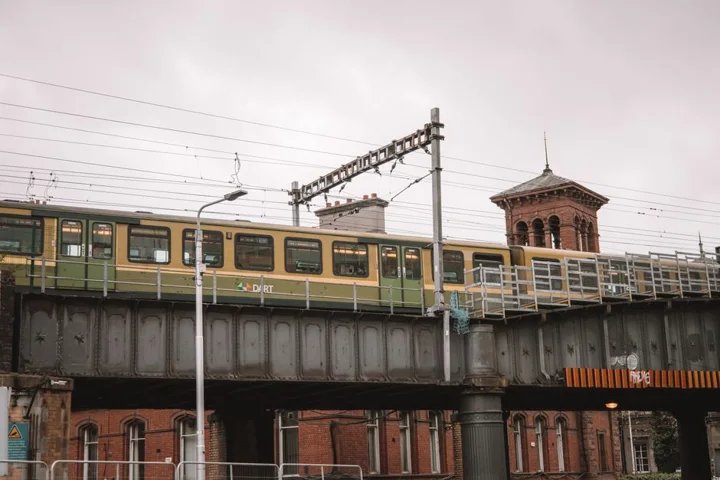
    Photo: Joaquin Carfagna / Pexels. Illustrative photograph.

    At a railway level crossing in Ireland you must obey the signs and lights, slow down, be ready to stop and never stop on the tracks. At an unattended crossing you stop at least 2 metres from the line, look and listen, then cross quickly. This guide covers the four types of Irish level crossing, what to do if you stall, low railway bridges and road tunnel lane signs, all from the Rules of the Road and current fixed charges.

    Key facts

    • Never stop on the railway tracks. Don’t enter a yellow box at a level crossing unless you can clear it without stopping.
    • Flashing red lights at a level crossing mean stop, exactly like a red traffic light.
    • At an unattended crossing, stop at least 2 metres before the railway line, look, listen, then cross quickly.
    • You must shut and fasten iron gates after you, even if they were open when you arrived.
    • Ignoring the lights or signs at a level crossing: €80 fixed charge and 2 penalty points (5 on conviction).
    • If your vehicle hits a railway bridge, you must report it straight away, even if there is no visible damage.

    The Rail Cross Code

    The Rules of the Road gives one routine to use every time you cross at an unattended crossing:

    A car stopped at least 2 metres before a railway line at an unattended crossing, with the four steps of the Rail Cross Code.
    The Rail Cross Code at an unattended level crossing. Illustrative diagram, not to scale.
    1. Always expect a train.
    2. Stop, look and listen. Stop at least 2 metres before the railway line. Look right and left for train lights. Listen for a horn or whistle.
    3. Give way to trains. Let any train pass, then look right and left again.
    4. Cross quickly once the railway is clear.

    The four types of level crossing in Ireland

    Type What protects it What you must do
    Unattended, with iron gates Gates only, which users open and shut themselves. Found on minor roads. Stop clear of the gates, open both gates, drive forward and stop 2 metres from the line, handbrake on, look and listen, cross, stop well clear on the far side, then shut and fasten both gates.
    Attended, with gates or barriers worked by railway staff Railway staff Slow down and be ready to stop. The crossing is open only when the gates are fully open to the road.
    Automated, traffic lights only Road traffic lights, no barriers Obey the lights. If you are already on the crossing when they change, keep going and clear it quickly.
    Automated, barriers and flashing red lights Barriers that lower when a train approaches, plus amber and flashing red lights (sometimes an alarm) Amber means stop if you safely can. Flashing red means stop. Wait until all lights are out and the barriers are up. Never zigzag round the barriers.
    Three stages at an automated crossing: amber means stop if you safely can, flashing red with the barrier down means stop, and you go only when all lights are out and the barriers are up.
    What the lights mean at an automated level crossing. Simplified illustration, not the official sign design.

    Extra steps at an unattended gated crossing

    The RSA describes these crossings as potentially dangerous and says to use a bridge or a staffed or automated crossing if one is available. Before crossing:

    • switch off your phone and music
    • open the driver and passenger windows so you can hear
    • read the instructions at the crossing
    • get a helper to work the gates if you can

    Failing to shut and fasten the gates is an offence.

    What to do if you stall on a level crossing

    If your vehicle stalls or an animal strays onto the line:

    1. Get everyone well clear of the railway.
    2. Leave the vehicle or animal where it is.
    3. Phone the railway controller on the number displayed at the crossing.
    4. Give the “crossing number” shown on the plate at the crossing. Each crossing has its own number.

    When to phone the railway before crossing

    At crossings with iron gates or automatic half barriers, or on minor roads protected only by lights, you should phone for permission first if you are taking across:

    • a long, low, wide, heavy or slow vehicle
    • dangerous goods or an exceptional load
    • a crowd of people or a herd of animals

    On electrified lines such as the DART, the safe headroom under the overhead wires is 5 metres (16 ft 4 in).

    Railway bridges and low bridges

    Railway bridges carry an identification plate with a bridge number and Iarnród Éireann’s emergency phone number.

    • If you hit a bridge: report it immediately, damage or not. Phone the number on the plate, say what happened and give the bridge number. If you can’t get through, tell a Garda immediately. Failing to report is an offence.
    • Height restriction sign: you must not pass unless your vehicle, including any load, is lower than the height shown. The law says a vehicle must not pass the sign if its height equals or exceeds the figure.
    • Restricted headroom warning sign: gives advance notice of the height limit, in feet and inches first, then metres.
    • Arch bridges: the signed height is only available across part of the arch. “Goalpost” markings show that width.
    • Bridges over the railway may have weight, axle, width or axle-count limits. Gross weight, axle weight and width signs mean you cannot go past if your vehicle exceeds the figure.

    Most of this matters more for vans, campervans and towing, but learners are tested on the signs. RSA advice: know your height, know your route.

    Road tunnel lane signs

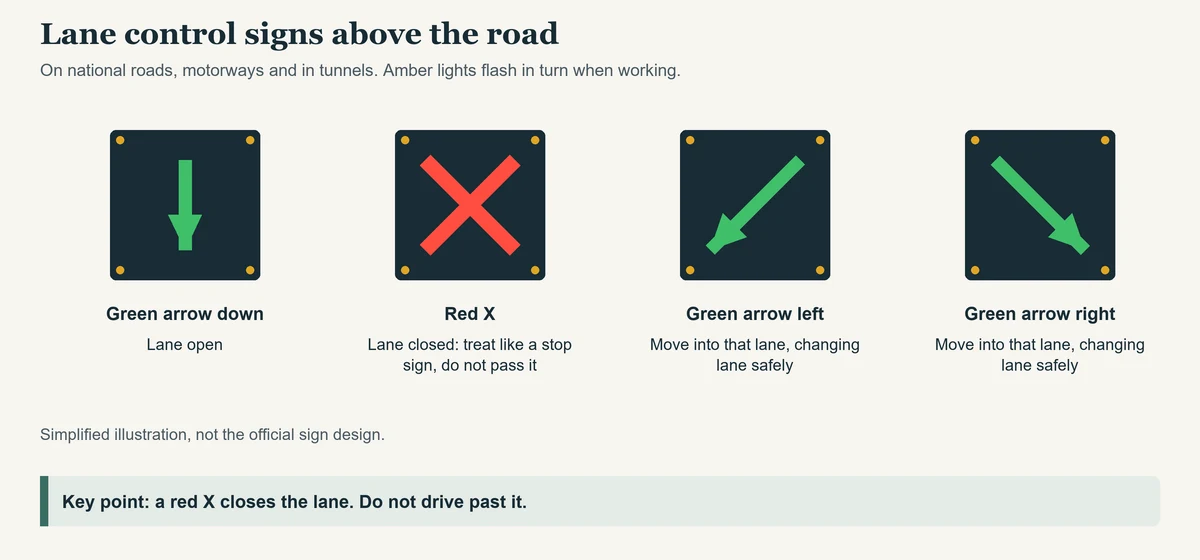
    Lane control signs hang above each lane at and inside road tunnels. When they are working, amber lights at the top and bottom flash in turn.

    Sign Meaning
    Green arrow pointing down Lane open. You may use it.
    Red X Lane closed. Stop. It has the same effect as a stop sign.
    Green arrow pointing left Move into the left-hand lane, following the normal rules for changing lanes.
    Green arrow pointing right Move into the right-hand lane, following the normal rules for changing lanes.
    Goods vehicle with axle number Goods vehicles and large non-passenger vehicles with that number of axles or more must stay in the left-hand lane. This does not apply if the left lane shows a red X, the right lane shows a green arrow, or the left lane is blocked.

    Tunnel speed limits are either a standard sign or a variable message sign: a black square with a red circle and white or yellow numbers. Both are maximums, not targets. Ignoring a lane control sign carries a €60 fixed charge.

    For driving through a tunnel (the 50 metre gap, what to do in a breakdown or fire), see motorways and tunnels in Ireland. Each tunnel operator signs its own restrictions on the approach, so read them.

    Common questions

    Can I stop on a level crossing if traffic ahead is queuing?

    No. You must never stop on the tracks. Wait before the crossing until there is room on the far side for your whole vehicle.

    What does a flashing amber light at a level crossing mean?

    The Rules of the Road says the amber light works like an amber traffic light: stop if you safely can. Flashing red then means stop.

    The barriers went up but a light is still flashing. Can I go?

    No. Wait until all the lights have gone out and the barriers are fully raised. Another train may be coming.

    The gates at an unattended crossing were already open. Do I still close them?

    Yes. You must shut and fasten them after you, whatever state you found them in.

    How many points for going through a level crossing on red?

    Failing to obey traffic lights or signs at a railway level crossing carries a €80 fixed charge and 2 penalty points, or 5 points on conviction in court. See penalty points in Ireland.

    Where do I learn the other signs?

    See Irish road signs explained, Irish road markings and bus lanes, Luas and light rail.

    Back to learning to drive in Ireland.

    Sources

    • Road Safety Authority, “Rules of the Road”, Section 6 Railway level crossings, Railway bridges and overhead structures, Road tunnel signs (Revision 5, hosted on garda.ie)
    • Irish Statute Book, “S.I. No. 182/1997, Road Traffic (Traffic and Parking) Regulations 1997”, articles 31 and 34 (irishstatutebook.ie)
    • Irish Statute Book, “S.I. No. 227/2024, Road Traffic Act 2010 (Part 3) (Fixed Charge Offences) Regulations 2024” (irishstatutebook.ie)
    • Law Reform Commission, “Road Traffic Act 2002”, First Schedule, revised (revisedacts.lawreform.ie)
  • Types of Pedestrian Crossing UK: Zebra, Pelican, Puffin, Toucan

    Types of Pedestrian Crossing UK: Zebra, Pelican, Puffin, Toucan

    Photo: Airam Dato-on / Pexels. Illustrative photograph.

    Great Britain has six main types of pedestrian crossing: zebra, parallel, pelican, puffin, toucan and equestrian. The one difference drivers most often get wrong is that only pelican crossings have a flashing amber light, which means give way to anyone on the crossing and go only if it is clear. At every crossing you MUST NOT park on the crossing or its zig-zag lines, and you MUST NOT overtake the vehicle nearest the crossing. This guide covers Highway Code Rules 191 to 199 for drivers in England, Scotland and Wales, plus what the pedestrian rules (18 to 30) mean for you behind the wheel.

    The six crossings compared

    Crossing Who uses it How you spot it Lights for drivers What you must do
    Zebra Pedestrians Black and white stripes, flashing beacons None MUST give way once a pedestrian has moved onto the crossing; should give way to people waiting
    Parallel Pedestrians and cyclists Zebra stripes with a cycle route alongside None MUST give way once a pedestrian or cyclist has moved onto the crossing
    Pelican Pedestrians Push button operated by pedestrians Red, then flashing amber, then green MUST stop on red; on flashing amber MUST give way to anyone on the crossing
    Puffin Pedestrians Red and green figures above the control box on the pedestrian’s side Same sequence as traffic lights, no flashing amber Treat as traffic lights
    Toucan Pedestrians and cyclists together Push button; pedestrians and cyclists get the green signal together Same as traffic lights, no flashing amber Treat as traffic lights; cyclists may ride across
    Equestrian Horse riders Pavement barriers, wider space, horse and rider figures, a higher control panel Same as traffic lights, no flashing amber Treat as traffic lights

    A handy way to remember: toucans are for two (people and bikes), puffins have the signals on the pedestrian’s side, and pelicans are the only crossing with a flashing amber light.

    Rules for every crossing

    • Zig-zag lines (Rule 191): you MUST NOT park on a crossing or in the area covered by the zig-zag lines. Rule 240 repeats this ban on stopping or parking.
    • No overtaking (Rule 191): you MUST NOT overtake the moving vehicle nearest the crossing, or the vehicle nearest the crossing that has stopped to let pedestrians cross. A stopped vehicle can hide the very person stepping out in front of it, even if the lane beside it looks empty.
    • Keep it clear (Rule 192): in queuing traffic, do not move onto a crossing unless you can clear it completely, and do not block advanced stop lines for cycles.
    • Blocked views (Rule 193): take extra care when queuing traffic or badly parked vehicles hide the crossing. People may be crossing between stopped vehicles.
    • No pressure (Rule 194): give people plenty of time and do not rev your engine or edge forward.
    • After the lights change (Rule 198): give way to anyone still crossing after your signal turns green. This applies at all crossings.
    Top-down zebra crossing with zig-zag lines on both approaches. A car has stopped for a pedestrian, a car overtaking it is marked with a red cross, and a car parked on the zig-zags is marked with a red cross. Four cards list keep it clear, blocked views, no pressure and give way after green.
    The rules that apply at every pedestrian crossing. Illustrative diagram, not to scale.

    Zebra crossings (Rule 195)

    Zebra crossings have black and white stripes and flashing beacons. As you approach:

    1. Look out for people waiting to cross, and be ready to slow down or stop.
    2. You should give way to pedestrians waiting to cross.
    3. You MUST give way when a pedestrian has moved onto the crossing.
    4. Allow more stopping time on wet or icy roads.
    5. Do not wave, flash your lights or sound your horn to invite people across. Another vehicle may be coming.
    6. Watch for people approaching from the side of the crossing.

    A zebra crossing with a central island counts as two separate crossings. Once a pedestrian has reached the island, the half on your side may be clear for you to go, but watch for them stepping onto your half.

    Parallel crossings

    Parallel crossings look like a zebra with a cycle route running beside the stripes. The same rules apply, but for cyclists as well as pedestrians: you should give way to anyone waiting, and you MUST give way once a pedestrian or cyclist has moved onto the crossing. Expect cyclists to arrive faster than walkers.

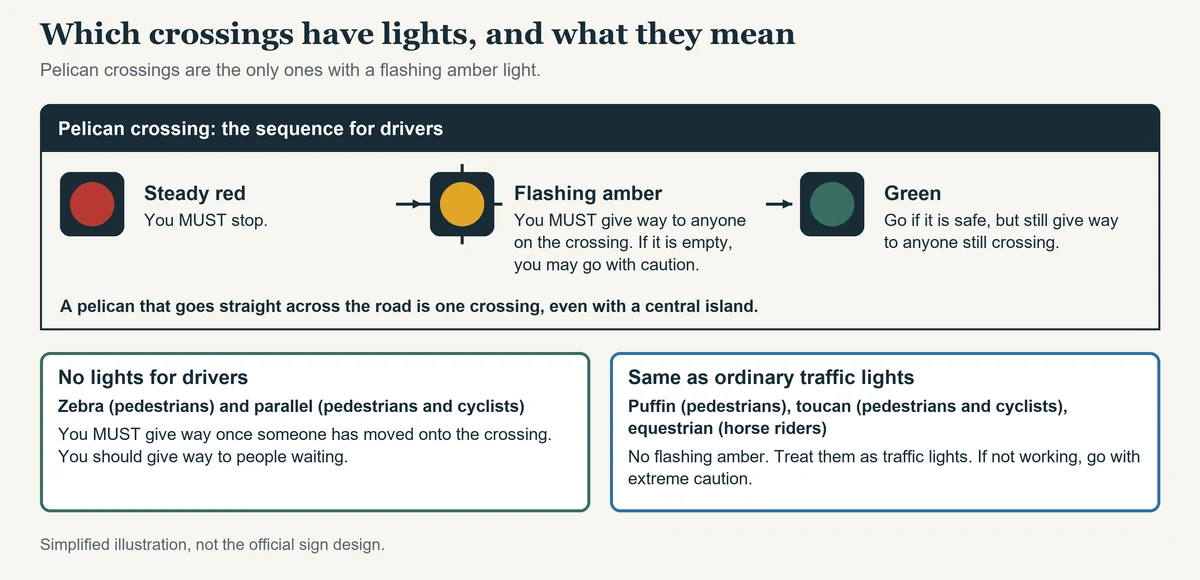
    Pelican crossings and the flashing amber (Rules 196 and 197)

    Pelican crossings are signal-controlled crossings where a flashing amber light follows the red “Stop” light.

    The pelican crossing sequence for drivers: steady red means stop, flashing amber means give way to anyone on the crossing, green means go if safe. Below, zebra and parallel crossings have no lights for drivers, and puffin, toucan and equestrian crossings work like traffic lights with no flashing amber.
    Crossing lights for drivers, with the pelican flashing amber. Simplified illustration, not the official sign design.
    Light What it means for you
    Steady red You MUST stop
    Flashing amber You MUST give way to any pedestrians on the crossing. If nobody is on it, you may go with caution
    Green Go if it is safe, but still give way to anyone still crossing (Rule 198)

    A pelican crossing that goes straight across the road is one crossing, even if it has a central island. You MUST wait for pedestrians crossing from the other side of the island. A pedestrian on the far half still has priority over you.

    From the pedestrian side, Rule 22 says that when the green figure starts flashing, people should not start to cross, but anyone already crossing should have time to finish.

    More detail: pelican crossing guide.

    Puffin, toucan and equestrian crossings (Rule 199)

    These work like pelican crossings but have no flashing amber phase. The light sequence for drivers is the same as at ordinary traffic lights. If the crossing is not working, go with extreme caution. Do not enter the crossing unless you can clear it completely, so you do not block pedestrians, cyclists or horse riders.

    • Puffin (Rule 23): the red and green figures are above the control box on the pedestrian’s side, and there is no flashing green figure.
    • Toucan (Rules 25 and 82): pedestrians and cyclists see the green signal together, and cyclists are allowed to ride across. Rule 81 tells cyclists to dismount at zebra, pelican and puffin crossings instead. See our toucan crossing guide.
    • Equestrian (Rule 27): for horse riders, with pavement barriers, wider crossing spaces, horse and rider figures, and either two sets of controls (one higher) or just one higher control panel.

    Puffin crossing lights

    A puffin crossing looks like a pelican, but the lights work differently:

    • The figures are on the near side. The red and green figures are above the control box on the pedestrian’s side of the road, not across the road, and there is no flashing green figure (Rule 23).
    • Sensors control the timing. Detectors watch the crossing and can keep the red light showing to traffic for longer while someone is still crossing. Kerbside detectors can also cancel the request if the person who pressed the button walks away.
    • No flashing amber for drivers. The sequence is the same as ordinary traffic lights (Rule 199): green, steady amber, red, red and amber, then green.
    Drivers see What you do
    Green Go if the way is clear, but give way to anyone still crossing (Rule 198)
    Steady amber Stop at the stop line, unless you have already crossed it or are so close that stopping might cause a collision (Rule 175)
    Red You MUST stop behind the stop line
    Red and amber Still stop. Do not move off until green shows

    The difference from a pelican matters most when the lights are about to change: at a puffin you wait for green, while at a pelican crossing a flashing amber lets you go on if the crossing is clear.

    Staggered crossings

    Rule 28 explains that where the two halves of a pelican or puffin crossing are not in line across a central refuge, they are two separate crossings. Pedestrians press the button again on the island. As a driver, your lights only control your half.

    What pedestrians are told, and why it matters to you

    Knowing the pedestrian rules helps you predict what people will do:

    • Rule 19 tells pedestrians that traffic does not have to stop until someone has moved onto a zebra crossing, and to keep looking in case a driver overtakes a stopped vehicle. That is exactly why overtaking near a crossing is banned.
    • Rule 18 tells pedestrians to check that traffic has stopped before they step out, to cross between the studs or over the stripes rather than at the side or on the zig-zag lines, and says they MUST NOT loiter on any crossing. Some still cross at the edges, so watch them.
    • Rule 26 says some crossings bleep or speak, and may have a tactile signal, for blind, partially sighted and deafblind people. Someone using these may need more time.
    • Rule 29 says pedestrians should only cross where a police officer, traffic warden or school crossing patrol signals them to. See signals by police and crossing patrols.

    For more on pedestrians, read Highway Code rules for pedestrians and the hierarchy of road users.

    Penalties for crossing offences

    Parking on zig-zags, overtaking at a crossing or failing to give way are breaches of the pedestrian crossing regulations. GOV.UK lists three endorsement codes, each carrying 3 penalty points:

    Code Offence Points
    PC10 Undefined contravention of pedestrian crossing regulations 3
    PC20 Contravention of pedestrian crossing regulations with a moving vehicle 3
    PC30 Contravention of pedestrian crossing regulations with a stationary vehicle 3

    For a new driver, two crossing offences reach 6 points, which means losing your licence within 2 years of passing. See the New Drivers Act.

    Common questions

    Do I have to stop for someone waiting at a zebra crossing?

    Rule 195 says you should give way to pedestrians waiting to cross, and you MUST give way once they have moved onto the crossing.

    What does flashing amber mean at a pelican crossing?

    You MUST give way to anyone on the crossing. If it is empty, you may go with caution.

    Which crossings have no flashing amber?

    Puffin, toucan and equestrian crossings. Their lights follow the normal traffic light sequence.

    Can I park on zig-zag lines to drop someone off?

    No. Rules 191 and 240 say you MUST NOT stop or park on a crossing or in the area marked by the zig-zag lines.

    Should I wave pedestrians across?

    No. Rule 195 says do not wave, flash your lights or sound your horn to invite people across, because another vehicle may be approaching.

    Is a crossing with a central island one crossing or two?

    A zebra with an island is two crossings. A pelican that goes straight across is one crossing, even with an island. Staggered pelican or puffin crossings are two.

    Related: traffic lights and signals; pedestrian crossings syllabus topic. Back to the main guide: Learning to Drive in Great Britain.

    Sources

    • Department for Transport, “The Highway Code: Using the road (159 to 203)” (gov.uk)
    • Department for Transport, “The Highway Code: Rules for pedestrians (1 to 35)” (gov.uk)
    • Department for Transport, “The Highway Code: Waiting and parking (238 to 252)” (gov.uk)
    • GOV.UK, “Penalty points (endorsements): Endorsement codes and penalty points” (gov.uk)
  • NI R Plates: What Your Test Date Means for Your Plates and First Two Years

    NI R Plates: What Your Test Date Means for Your Plates and First Two Years

    Photo: Jonathan Borba / Pexels. Illustrative photograph.

    In Northern Ireland, the R plate you drive home with after your test depends on two dates: when you started learning and when you pass. Under Graduated Driver Licensing (GDL), new drivers show a blue R on a white background for 6 months, then a white R on a blue background for 18 months: 2 years in all. Learners on the old system who pass before 1 April 2027 show the amber R plate for 1 year, with a 45 mph limit. This guide explains what the new rules mean for your test date and your first two years on the road: which plate you will display, how to show it, and the penalty for getting it wrong.

    The three NI R plates at a glance

    Plate Who displays it For how long Speed limit
    Blue R on white GDL drivers, first stage First 6 months after passing None set by GDL (normal limits apply)
    White R on blue GDL drivers, second stage Next 18 months None set by GDL
    Amber R Drivers who passed under the old rules, including pre-GDL learners who pass before 1 April 2027 1 year after passing 45 mph
    Three R plates on a timeline from passing: under GDL a blue R on white for the first 6 months then a white R on blue for the next 18 months with no GDL speed limit, and under the old rules an amber R plate for 1 year with a 45 mph limit.
    How long each Northern Ireland R plate is shown. Simplified illustration, not the official sign design.

    Your start date and test date decide your plate

    1. Provisional entitlement started on or after 1 October 2026: you are on GDL. Blue on white for 6 months, then white on blue for 18 months.
    2. Provisional started before 1 October 2026 and you pass before 1 April 2027: amber R plate and 45 mph for 1 year. DVA’s reason: your training and test didn’t include driving above 45 mph.
    3. Provisional started before 1 October 2026 and you pass on or after 1 April 2027: you come under GDL, so the blue then white plates apply.
    4. You passed before 1 October 2026: keep the amber R plate and the old restrictions until your restricted period ends.
    A decision chart: provisional entitlement from 1 October 2026 leads to GDL plates. If it started earlier, passing before 1 April 2027 means the amber R plate with 45 mph for a year, and passing on or after 1 April 2027 means GDL plates.
    How your start date and pass date decide which R plate you display. Illustrative diagram, not to scale.

    If you started before 1 October 2026, your test date is the deciding factor. Passing before 1 April 2027 means the amber plate and 45 mph for 1 year; a pass on or after that date (including after a fail and retest) brings you under GDL instead. Book with that in mind, and be ready before the date you book. The transition is explained in full in the NI transition rules.

    Your first two years: why GDL has two plates

    The first-stage blue on white plate marks the 6 months when the night-time passenger rule applies to drivers under 24. It lets police and other enforcement agencies see who is in that period. The second plate covers the rest of the 2 years and warns other road users that you are still inexperienced.

    The 2 years match the probation period under the Road Traffic (New Drivers) (NI) Order 1998. Get 6 or more penalty points in that time and your licence can be revoked.

    Displaying R plates from the day you pass

    • Show the plate on the front and back of the car, clearly visible to others.
    • Plates must meet the legal specification, so buy proper plates rather than making your own.
    • Remove or cover them when someone who is not a newly qualified driver is driving.
    • Have your plates ready before test day so you can display them on the drive home.
    • Switch from blue on white to white on blue on the 6 month point. Keep a note of your test pass date.

    Penalty for not showing R plates

    The Department for Infrastructure says not displaying your R plates can bring a fine of up to £1,000 and 3 penalty points. Under GDL, 3 points takes you halfway to the 6 that can revoke your licence.

    The 45 mph limit: amber plates only

    Only to the amber R plate. GDL removed the 45 mph limit for learners and newly qualified drivers on the scheme. The older Highway Code for Northern Ireland (2020 impression) says the 45 mph limit applies to a car displaying R plates whether or not a restricted driver is driving. So if a parent drives an amber-plated car, take the plates off.

    Scenario: how one test date changes everything

    Ciara got her provisional licence in June 2026 and passes on 10 February 2027. She started before 1 October 2026 and passed before 1 April 2027, so she shows the amber R plate and keeps to 45 mph until February 2028. If she had failed and passed on 15 April 2027, GDL would apply: blue on white for 6 months, then white on blue, with no 45 mph limit.

    Common questions

    Do R plates apply to motorcyclists?

    Yes. DfI says GDL R plates apply to new car drivers and new motorcyclists on categories A1, A2 and A. The night-time passenger rule does not apply to motorcyclists.

    Can I drive on the motorway with R plates after my test?

    GDL sets no speed or motorway restriction after you pass. On the amber plate, the 45 mph limit still applies wherever you drive. After you pass you can still do the optional GDL Module 15 (motorway driving) with an ADI or supervising driver; see GDL Module 15.

    Do I need R plates when I drive in Great Britain or the Republic of Ireland?

    Check before you travel. R plates are a Northern Ireland requirement, and the rules where you are driving apply. See driving across the border.

    Does time disqualified count towards my R plate period?

    The 2020 Highway Code for Northern Ireland says the amber R plate period does not count periods of disqualification or revocation. For GDL, check the current rule with DVA.

    Looking for lessons or an instructor? Our sister site Compare Driving Instructors covers lesson prices and choosing an instructor.

    More on GDL: what changed on 1 October 2026. Main guide: Learning to drive in Northern Ireland.

    Sources

    • DVA, “Graduated Driver Licensing for newly qualified drivers” (nidirect.gov.uk)
    • Department for Infrastructure, “Graduated Driver Licensing FAQs” (infrastructure-ni.gov.uk)
    • DVA, “What Graduated Driver Licensing means for learner drivers” (nidirect.gov.uk)
    • DVA, “Motor vehicle documentation, learner and newly qualified driver requirements” (nidirect.gov.uk)
    • Department for Infrastructure, “The Official Highway Code for Northern Ireland”, twentieth impression 2020 (nidirect.gov.uk)
    • Department for Infrastructure, “The Highway Code for Northern Ireland”, current online edition updated for GDL, September and October 2026 (nidirect.gov.uk)
  • Level Crossing Rules UK: Barriers, Lights and User-Operated Gates

    Level Crossing Rules UK: Barriers, Lights and User-Operated Gates

    Photo: Jan Wright / Pexels. Illustrative photograph.

    A level crossing is where a road crosses a railway or tramway line. In Great Britain, the rule at every type of crossing is the same: never drive on until the road is clear on the other side, never stop on it, and always stop when red lights flash. This guide explains each type of crossing you will meet as a learner or new driver: full barrier, half barrier, open, and user-operated gates. It also covers the signs on the approach and what to do if you break down on the tracks. It is based on Highway Code Rules 291 to 299 and the Department for Transport’s Know Your Traffic Signs.

    Key rules at any level crossing

    • Never drive onto a crossing until the road is clear on the other side, and don’t get too close to the car in front (Rule 291).
    • Never stop or park on, or near, a crossing.
    • You MUST obey flashing red stop lights and stop behind the white line (Rule 293).
    • Never reverse onto or over a controlled crossing.
    • If a train passes and the red lights keep flashing, wait. Another train is coming.
    • Do not enter a yellow box at a crossing if traffic ahead could leave you stopped with any part of your car inside it.

    Types of level crossing in Great Britain

    Type What you see What you do
    Full barrier (controlled) Steady amber, then twin flashing red lights, alarm, barriers across the whole road Stop at the white line. Cross only when the lights go off and the barriers are fully up.
    Automatic half barrier Amber lights and alarm, then flashing red lights, then half barriers lower You MUST stop. Never zig-zag around the barriers: they lower automatically because a train is approaching.
    Automatic open (no barriers) Flashing red lights and alarm, St Andrew’s cross sign A train is approaching whenever the lights show. Stop and wait until they go off.
    Gates or barriers without traffic lights Gates or barriers, sometimes worked by an attendant Stop and wait when the barrier or gate begins to close. Don’t cross until it opens (Rule 295).
    User-operated, with miniature lights ‘Stop’ sign, small red and green lights, gates you open yourself You MUST NOT cross on red. Cross only on green (Rule 296).
    User-operated, no lights Gates or barriers, often a railway telephone Stop, look both ways and listen. If there’s a phone, always ring the signal operator first and again when clear (Rule 297).
    Open crossing No gates, barriers, attendant or lights. A ‘Give Way’ sign over a train symbol Look both ways, listen and make sure no train is coming before you cross (Rule 298).

    How do the lights at a level crossing work?

    1. Steady amber: means stop, as at normal traffic lights, unless it is unsafe to do so. If you have already crossed the white line when the amber comes on, keep going.
    2. Twin flashing red: means STOP. This applies to pedestrians too.
    3. Lights still flashing after a train passes: another train is coming. At automatic half-barrier crossings the barriers stay down and the alarm sound may change.
    4. Barriers rising: don’t move until the lights go out.
    Four panels showing level crossing lights in order: steady amber means stop unless unsafe, twin flashing red means you must stop, lights still flashing after a train means another train is coming, and lights out with the road clear means you may go.
    The level crossing light sequence and what each stage means. Simplified illustration, not the official sign design.

    Know Your Traffic Signs says to phone the signal operator if the red lights flash for more than three minutes without a train arriving (except at full-barrier crossings), or if a barrier lowers without the lights flashing.

    More on signals: Highway Code light signals.

    How to use a user-operated gated crossing

    These crossings have gates or barriers but no attendant. With miniature red and green lights, which are worked by an approaching train:

    1. Stop. You must stop even if the gates have been left open.
    2. Check the light. Red means a train is coming: don’t cross.
    3. On green, open the gates or barriers on both sides.
    4. Check the green light is still on, then cross quickly.
    5. Close the gates or barriers once you are clear.

    If there are no lights, follow the same steps, but stop, look both ways and listen before crossing. If there is a railway telephone, use it before you cross and again when you are clear.

    Signs on the approach to a level crossing

    • Warning triangle (gate or barrier): level crossing with a gate or barrier ahead.
    • Warning triangle (no gate or barrier): level crossing without a gate or barrier ahead.
    • Plate showing lights: advance warning of light signals at the crossing.
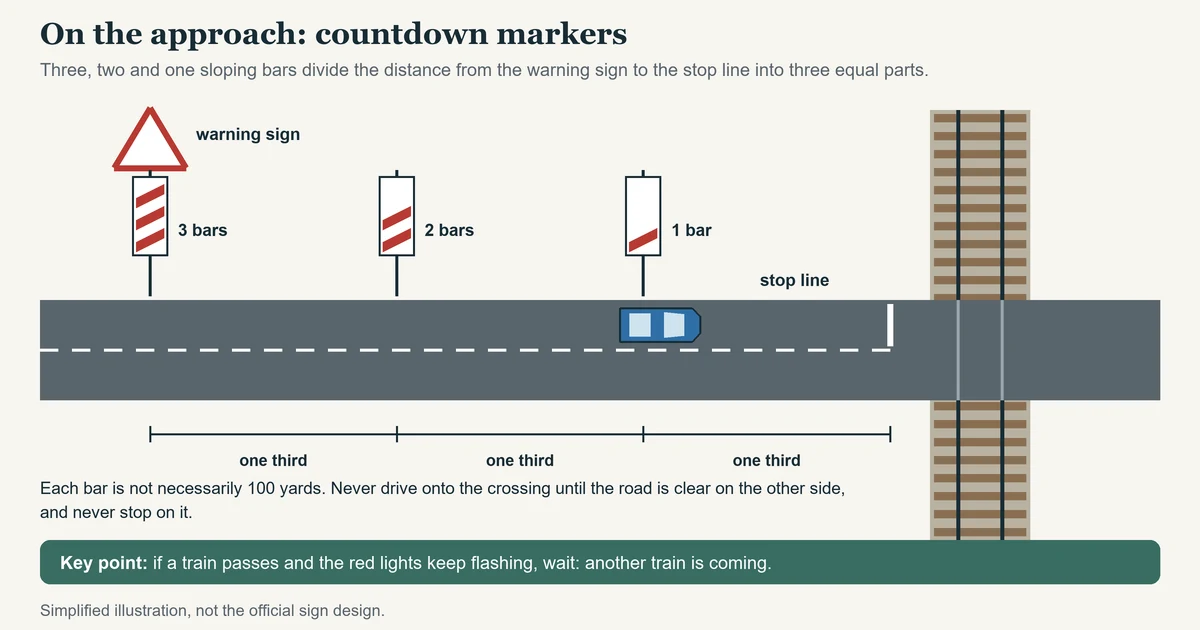
    • Countdown markers: three, two and one sloping bars on the approach. They divide the distance from the warning sign to the stop line into three equal parts. Each bar is not necessarily 100 yards.
    • St Andrew’s cross: used at crossings with no gates or barriers.
    • Overhead cable sign with a safe height: electrified lines ahead. Bells may hang over the road to warn vehicles that are too tall.
    • Yellow box markings: part of the road that must be kept clear.
    • Name and phone number board: for contacting the railway operator at crossings without a dedicated phone.
    Top-down road approaching a railway, with a warning sign then countdown markers with three, two and one sloping bars dividing the distance to the stop line into three equal parts.
    Countdown markers on the approach to a level crossing. Simplified illustration, not the official sign design.

    See UK warning signs for the sign shapes.

    Overhead electric lines and railway telephones

    • It is dangerous to touch overhead electric lines. You MUST obey safe-height signs. Don’t go on if your vehicle touches a height barrier or bells. The usual clearance is 5 metres (16 feet 6 inches), but it may be lower (Rule 292).
    • Drivers of large or slow vehicles, long low vehicles that could ground, or anyone herding animals MUST obey signs telling them to phone for permission before crossing. They must phone again when clear if asked to (Rule 294).

    What to do if you break down on a level crossing

    Rule 299:

    1. Get everyone out of the car and clear of the crossing immediately.
    2. Use the railway telephone, if there is one, to tell the signal operator. Follow their instructions.
    3. Move the car clear only if there is time before a train arrives.
    4. If the alarm sounds or the amber light comes on, leave the car and get clear at once.

    Full breakdown routine: what to do if your car breaks down.

    Level crossings with trams

    Where a tramway crosses the road with no barriers, gates or traffic lights, drivers must give way to trams. Sometimes only a ‘Give Way’ sign and a tram plate are used. See driving alongside trams.

    Common questions

    Can I go if the barriers are up but the lights are still flashing?

    No. Wait until the lights go out, even after the barriers rise. Lights that keep flashing after a train has passed mean another train is coming.

    Is it ever OK to drive around half barriers?

    Never. They come down automatically because a train is approaching.

    What if the amber light comes on as I reach the crossing?

    Stop at the white line unless stopping would be unsafe. If you have already crossed the white line, keep going.

    Traffic is queuing over the crossing. Should I follow?

    No. Only drive on when the road is clear on the other side, and keep out of the yellow box if you could end up stopped in it.

    Do learners get level crossings on the driving test?

    Test routes are not published. If your route has a crossing, the examiner will expect you to follow these rules. Level crossings also come up in the theory test under rules of the road.

    What does an open crossing look like?

    It has no gates, barriers, attendant or lights, just a ‘Give Way’ sign. You must look both ways and listen for trains yourself.

    Related: road works and contraflows (Rules 288 to 290) and learning to drive on rural roads. Back to the main guide: Learning to Drive in Great Britain.

    Sources

    • Department for Transport, “The Highway Code: Road works, level crossings and tramways (288 to 307)” (gov.uk)
    • Department for Transport, “Know Your Traffic Signs: Level crossing signs and signals” (gov.uk)
    • Department for Transport, “Know Your Traffic Signs: Tram signs, signals and road markings” (gov.uk)
  • Less Common UK Road Signs: Speed Limits, Low Bridges, Weights

    Less Common UK Road Signs: Speed Limits, Low Bridges, Weights

    Photo: Mike Bird / Pexels. Illustrative photograph.

    Some UK road signs turn up rarely but still appear in the theory test and on real roads: speed limit repeaters, low bridge height signs, weight and width limits, pedestrian zones, tidal flow lanes and clean air zones. This guide explains what each one means for a car driver in Great Britain, using the Department for Transport’s Know Your Traffic Signs.

    Speed limit signs you might misread

    Sign Meaning
    White circle with a black diagonal stripe National speed limit for the type of road and vehicle applies. See UK speed limits.
    Small speed limit repeater Reminder of the limit you are in
    Speed in a red circle at a town or village name sign Start of the limit at the boundary
    Speed in a blue circle Minimum speed. A red diagonal line through it marks the end.
    Speed on a rectangular plate under a bend warning Advised maximum speed for the bend, not a legal limit
    Speed limit sign with a camera symbol Start of a variable speed limit with enforcement cameras
    Camera symbol on its own Speed cameras in use in the area
    Camera sign with “average speed” Two cameras measure your average speed between two points
    20 mph zone entry sign Entrance to a 20 mph zone, where you may meet traffic-calming measures
    Five simplified speed signs: a speed in a red circle, the white national speed limit sign with a black diagonal stripe, a minimum speed in a blue circle, the end of minimum speed with a red diagonal line, and a speed plate under a bend warning triangle.
    Which speed signs are legal limits and which are advice or minimums. Simplified illustration, not the official sign design.

    Repeater rules: why you will not see 30 mph repeaters under street lights

    • On a road with street lights (other than a motorway), the limit is 30 mph unless signs say otherwise. In Wales it is 20 mph.
    • So 30 mph repeater signs are used only on roads without street lighting.
    • National speed limit repeaters are used only on roads with street lighting (other than motorways).
    • A camera sign on a lit road with no repeaters tells you the limit is 30 mph. On an unlit road with no repeaters, the national limit applies.

    Low bridge signs

    Bridges with a clearance under 16 feet 6 inches (about 5 metres) are normally signed. These matter if you drive a van, tow a caravan or carry a roof box.

    Four simplified low bridge signs: a red circle with a height, a red triangle with a height, a triangle for an arch bridge with two heights, and a panel of four amber lights.
    The low bridge signs and signals and what each one tells you. Simplified illustration, not the official sign design.
    Sign Type Meaning
    Red circle with a height in metric and imperial Mandatory No vehicle over that height may pass. It is unlawful for an overheight vehicle to go past it.
    Red triangle with a height Warning Maximum headroom under the bridge or structure ahead. A plate may give the distance.
    Arch bridge with two heights Warning Headroom differs across the arch. Road markings guide tall vehicles through the highest point.
    Four amber lights flashing in pairs Warning A high vehicle has triggered a sensor on the approach to a bridge at risk of strikes

    At an arch bridge, give way to an oncoming tall vehicle using the middle of the road. Cars may keep left and cross the markings if that lets everyone pass safely.

    Weight, width and length limits

    Sign Meaning Does it affect a car?
    Red circle with a weight in tonnes (for example 7.5T) No vehicles over that maximum gross weight Rarely. Most cars are well under. Check if you tow.
    Red circle with a lorry and a weight No goods vehicles over that weight No
    Red circle with a width (metric and imperial) No vehicles over that width Possibly, for wide vans or with towing mirrors
    Red circle with a length No vehicles or combinations over that length Possibly, if towing
    “Except for access” plate Exempts vehicles going to premises on that road with no other route Read it with the sign above

    For towing weights and sizes, see towing on a car licence.

    Pedestrian zone signs

    • A zone entry sign with a red-ringed prohibition roundel marks the start of a pedestrian zone. It may show hours (for a part-time zone) and exemptions in a lower panel.
    • Yellow panels on the sign mean there are waiting restrictions inside the zone.
    • The zone may have no kerbs or yellow lines, so the sign is all you get. Check the times before you enter.
    • A variable message sign may change the exemptions through the day.
    • A “zone ends” sign has a grey version of the roundel.

    Some zones use rising bollards. A red signal means the bollard is up and you must not go on. Do not follow an authorised vehicle through.

    Tidal flow lanes

    On some busy roads, overhead lane signals change how many lanes run each way.

    Signal above the lane Meaning
    Green arrow Lane open to you
    White diagonal arrow Lane closes ahead. Move to the next lane on the left.
    Red cross Lane closed to traffic facing the signal

    Direction signs for cyclists and pedestrians

    • Blue with a white cycle: cycle route direction. A red patch with a number is a National Cycle Network route; a blue patch is a regional route.
    • Blue with a walking figure: pedestrian direction sign.
    • Green: public footpath. A yellow waymarker is also a footpath; a blue arrow is a bridleway.

    Expect cyclists and walkers crossing or joining the road near these signs.

    Miscellaneous signs worth knowing

    Sign Meaning for drivers
    “2+” or “3+” car symbol HOV lane. Only vehicles with that many occupants (and others shown) during its hours.
    White “C” on red Road charging, congestion charge or toll
    White cloud on green with a letter A to D Clean air zone. Class D can include cars; non-compliant vehicles may have to pay.
    London ULEZ entry sign Cars not meeting the emission standard pay a daily charge
    “LEZ” road marking or sign in Scotland Low emission zone. Non-compliant vehicles must not be driven in it unless exempt.
    Driver location sign (motorways and some other roads) Exact location reference to give in an emergency

    Common questions

    Why are there no 30 mph repeater signs?

    Because street lights already tell you the limit is 30 mph (20 mph in Wales) unless signs say otherwise. Repeaters for 30 mph are only used on unlit roads.

    Is the speed on a bend warning plate a legal limit?

    No. A speed on a rectangular plate is the advised maximum. Only a speed in a red circle is a legal limit.

    Does a 7.5 tonne weight limit apply to my car?

    The sign applies to vehicles over the maximum gross weight shown. Ordinary cars are far lighter, but check the plate: some signs apply only to goods vehicles or exempt access.

    What does a blue circle with a number mean?

    A minimum speed. You must not go slower unless it is impracticable or unsafe.

    Are UK low bridge signs in feet or metres?

    Newer signs show both. Some older height restriction signs show imperial only and are replaced when they reach the end of their life.

    Related sign guides: regulatory signs, warning signs, direction and information signs, traffic calming and road works signs. Back to the main guide: Learning to Drive in Great Britain.

    Sources

    • Department for Transport, “Know your traffic signs” (gov.uk), sections: Regulatory signs; Speed limit signs; Low bridge signs; Pedestrian zone signs; Direction signs for cyclists and pedestrians; Tidal flow lane control signs and signals; Miscellaneous signs
  • Irish Road Signs Explained: Regulatory, Warning and Information

    Irish Road Signs Explained: Regulatory, Warning and Information

    Photo: Dahlia E. Akhaine / Pexels. Illustrative photograph.

    Irish road signs fall into three groups: regulatory signs you must obey, warning signs for hazards ahead, and information signs for directions. Colour and shape tell you which group a sign belongs to before you can read it. Warning signs are yellow diamonds, roadworks signs are orange, and regulatory signs are mostly round with a red border. This guide decodes each group as set out in the RSA’s Rules of the Road. It is what you need for the theory test and for the sign questions on the driving test.

    Key facts

    • Regulatory signs: usually circular, with a red border and black symbols on white. Mandatory direction signs are blue and white.
    • Stop is the only octagonal (eight-sided) sign.
    • Warning signs: diamond or rectangular, yellow with a black border and black symbol.
    • Roadworks signs: the same shapes, but orange.
    • Information signs: blue on motorways, green on national roads, and white with black text on regional and local roads.
    • Speed limits are shown in km/h.

    Shapes and colours at a glance

    Look Type What to do
    Red octagon Stop Stop completely at the line, however quiet the road looks
    Yield sign reading “Yield” or “Géill Slí” Yield Give way to traffic on the major road
    Circle with red border, white background Prohibition or limit Must obey (no entry, no right turn, speed limit, parking prohibited)
    Blue circle, white symbol Mandatory instruction Must do (turn left, keep left, straight ahead)
    Yellow diamond, black border Warning Slow down and expect the hazard shown
    Orange diamond or rectangle Roadworks Take extra care and reduce speed
    Blue rectangle Motorway information Motorway rules apply
    Green rectangle National road information Directions and distances
    White rectangle, black text Regional and local road information Directions and distances
    Generic shapes for each Irish sign family: red octagon for Stop, red bordered circle for bans and limits, blue circle for mandatory instructions, yellow and orange diamonds for warnings and roadworks, and blue, green and white information rectangles.
    Irish sign families by shape and colour. Simplified illustration, not the official sign design.

    Regulatory signs: what you must obey

    Regulatory signs show what the law requires. They include upright signs, road markings and traffic lights. The common upright signs are:

    Four overhead lane control signs: green arrow down for lane open, red X for lane closed, and green diagonal arrows telling you to move into that lane.
    Lane control signs on national roads, motorways and in tunnels. Simplified illustration, not the official sign design.
    • Speed limit signs: a red circle with the limit in km/h, for example 50, 60, 80, 100 and 120. The rural speed limit sign, a white circle with black diagonal stripes, can be used on rural local roads instead of a 60 km/h number sign. Since 7 February 2025 it means a maximum of 60 km/h, not 80 km/h. It is not a national speed limit sign like the one used in the UK, and on a narrow lane you may need to drive well below 60 km/h. See speed limits in Ireland 2026.
    • No entry, no right turn, no left turn, no U-turn and no overtaking.
    • Parking signs: parking prohibited, parking permitted, disc parking and clearway. See parking rules in Ireland.
    • Size and weight limits: maximum width, height, length, gross weight and axle weight.
    • Lane signs: with-flow bus lane, contra-flow bus lane, tram lanes and the start and end of cycle tracks. See bus lanes, Luas trams and light rail.
    • School warden stop sign: you must stop.

    Stop and Yield

    At a Stop sign you must stop completely before entering the major road. At a Yield sign you must give way to traffic on the major road and wait until it is safe. Yield signs can read “Yield”, “Yield Right of Way” or “Géill Slí”. Both carry 3 penalty points on payment of the fixed charge, or 5 on conviction, if ignored. See junctions in Ireland.

    Traffic lane control signs

    These are found on national roads, motorways and in tunnels. When they are working, amber lights flash in turn at the top and bottom.

    • Green arrow pointing down: the lane is open.
    • Red X: the lane is closed. Treat it like a stop sign and do not pass it.
    • Green arrow pointing left or right: move into that lane, following the normal rules for changing lane safely.

    One-way streets

    At the entrance you see a blue “straight ahead” sign. At the wrong end you see No Entry road markings, and sometimes an upright No Entry sign. Do not pass them.

    Warning signs: hazards ahead

    Warning signs are yellow diamonds or rectangles with a black border and a black symbol. The Rules of the Road groups them as:

    • Junctions: crossroads, T-junction, Y-junction, side road, staggered crossroads, and junctions with a dual carriageway. A thicker arm shows the more important road.
    • Bends and corners: dangerous bend, series of bends, dangerous corner, and chevron boards for a sharp change of direction.
    • Road layout: roundabout, mini-roundabout, road narrows, dual carriageway ends, merging traffic, two-way traffic, lane loss, and the start of a climbing or passing lane.
    • Road surface and gradient: slippery road, steep ascent or descent, sharp dip, hump-back bridge, and a series of bumps.
    • Users and animals: school ahead, children crossing, pedestrian crossing, cyclists, cattle, sheep, deer, and accompanied horses.
    • Rail and trams: level crossings with or without gates, barriers or lights, and tram lane crossings. See level crossings, low bridges and tunnels.
    • Other hazards: traffic signals ahead, low bridge with height shown, overhead cables, tunnel, crosswinds, falling rocks, and unprotected quay or river.

    Roadworks signs and Stop/Go boards

    Roadworks signs use the same shapes as warning signs but are orange. At manual traffic control you must stop at the Stop board. Go only when it shows “Go” or “Téigh”. Ignoring them is an offence. More in roadworks signs and traffic calming.

    Information and motorway signs

    • Advance direction signs are colour coded by road type: blue for motorway, green for national and white for regional or local.
    • Motorway countdown signs mark 300 m, 200 m and 100 m to the next exit.
    • Motorway ends 500 m ahead, end of motorway, and lane gain, where an extra lane joins.
    • Variable message signs show changing electronic information about speed limits, roadworks, new layouts and safety.

    See motorways and tunnels in Ireland.

    Emergency diversion symbols

    When a motorway is closed, traffic can be sent along a signed diversion marked with a symbol: a square, triangle, circle or diamond, either filled in or outlined. Note the symbol at the start of the diversion and follow that same symbol at each junction until the diversion ends. Do not switch to a different symbol because it looks quicker.

    Variable speed signs

    Electronic signs can show two kinds of speed. A regulatory variable speed limit is a legal limit, and you must keep to it. A cautionary speed is a warning: slow down to a safe speed for the hazard ahead. Read any message shown with it, such as a queue or lane closure warning. A blank sign does not change the normal speed limit for the road.

    Traffic calming and slow zones

    Town entry signs may come with a speed limit and traffic calming features such as islands, chicanes, build-outs, pinch points and mini-roundabouts. Signs on residential roads warn of ramps, speed cushions or speed tables. A Slow Zone sign marks a 30 km/h area, usually in housing estates.

    Common questions

    What colour are warning signs in Ireland?

    Yellow with a black border and symbol, usually diamond shaped. Roadworks warnings are orange.

    Why are Irish speed signs in km/h?

    All speed limits in the Republic of Ireland are set in kilometres per hour. Your speedometer’s km/h scale is the one to follow.

    What is the difference between a blue and a red circle sign?

    A red-bordered circle tells you what you must not do, or sets a limit. A blue circle tells you what you must do.

    Are road markings signs too?

    Yes. Road markings have the same legal status as upright signs. See Irish road markings.

    How many signs come up on the driving test?

    Under the RSA’s 2025 procedures, the oral part includes 6 road sign questions. See pre-test checks.

    Does the theory test include signs?

    Yes. Road signs are part of the Driver Theory Test question bank. See Irish theory test topics.

    Back to learning to drive in Ireland.

    Sources

    • Road Safety Authority, “Rules of the Road”, Section 6 Traffic signs and road markings and Sections 21 to 25 sign catalogues (Revision 5, hosted on garda.ie)
    • Road Safety Authority, “Standard procedures and requirements for conducting driving tests 2025” (rsa.ie)
    • Law Reform Commission, Road Traffic Act 2002, First Schedule, revised (revisedacts.lawreform.ie)
    • Road Safety Authority, “Rules of the Road”, current edition reflecting the law at 1 March 2025, printed pages 118 to 119 (rural speed limit sign), 159 (diversion symbols) and 166 to 167 (variable speed signs) (rsa.ie)
    • Road Safety Authority, “Rural speed limit” campaign page (rsa.ie)
  • Bus Lane Rules and Cycle Lanes: Signs, Times and Fines (GB)

    Bus Lane Rules and Cycle Lanes: Signs, Times and Fines (GB)

    Photo: Max W / Pexels. Illustrative photograph.

    In Great Britain you must not drive in a bus lane during its hours of operation unless the sign allows your vehicle. If the sign shows no times, the lane operates 24 hours a day. Bus lanes are usually enforced by camera, and fines are set by the local authority: £160 in London (£80 if paid early) and often £70 elsewhere in England, with no penalty points. This guide explains bus lane and cycle lane signs, when you can enter, and what the penalties are.

    Key facts

    • No times on the blue sign: the bus lane operates at all times.
    • Bank holidays: restrictions apply as normal on days they are in force.
    • You may enter a bus lane to stop, load or unload where this is not prohibited (Rule 141).
    • Solid white line cycle lane: you MUST NOT drive or park in it during its hours (Rule 140).
    • Advance stop line (bike box): when the light is red, you must wait behind the first stop line.

    How to read a bus lane sign

    The blue sign shows who may use the lane and when. Anyone not shown must keep out during the times on the sign.

    Three simplified blue bus lane signs: one with times shown, one with no times, and one adding a cycle symbol and the word taxi, each with what it means for drivers.
    How to read the times and symbols on a bus lane sign. Simplified illustration, not the official sign design.
    Sign shows Who may use the lane
    Bus symbol only Local buses and any vehicle designed to carry 10 or more people including the driver
    Bus symbol marked “local” Only buses running a local service
    Cycle symbol Pedal cycles as well
    Motorcycle symbol Solo motorcycles as well
    “Taxi” Taxis as well (check local rules on private hire cars)
    Times shown Restriction applies only at those times. Outside them, anyone may drive in it.
    No times shown Lane operates at all times

    Bus lane road markings on the carriageway show where the lane starts. A Blue Badge does not let you drive in a bus lane.

    Other bus signs and markings

    • Break in the bus lane at a junction: other traffic may use the left-hand lane there to turn left only.
    • Contraflow bus lane: buses travel against the flow in a one-way street. Never enter it.
    • Bus gate: a short length of bus-only street, often camera-enforced.
    • Bus stop with a broad yellow line: other vehicles must not stop there.
    • Turning left across a bus lane: give way to vehicles using it, from either direction (Rule 183).

    Cycle lanes: solid line or broken line?

    Lane Marking Rule for drivers
    Mandatory cycle lane Solid white line, with a blue sign that may show hours You MUST NOT drive or park in it during its hours of operation.
    Advisory cycle lane Broken white line Do not drive or park in it unless it is unavoidable.
    Any cycle lane Either You MUST NOT park in it while waiting restrictions apply. Give way to cyclists in it, including those coming up behind you.
    Contraflow cycling in a one-way street Sign showing cycles allowed both ways, with or without a line Expect cyclists coming towards you.
    Three road views from above: a car turning left through a break in a bus lane, a cycle lane with a solid white line, and a cycle lane with a broken white line, each with the rule for drivers.
    Where you may cross a bus lane, and the difference between solid and broken cycle lane lines. Illustrative diagram, not to scale.

    Cyclists do not have to use cycle lanes or tracks, so expect them on the main road too.

    Advance stop lines (bike boxes)

    At some traffic lights there is a second stop line with a cycle symbol between the two. When the lights are red, drivers must wait behind the first line. Allow cyclists time and space to move off when the lights go green.

    HOV lanes

    High occupancy vehicle lanes work like bus lanes but also admit cars with enough people inside. A “2+” sign means the driver plus at least one passenger; “3+” means at least two passengers. You MUST NOT use one during its hours unless your vehicle qualifies (Rule 142).

    Rule 142 also says designated lanes may or may not admit cycles, buses, taxis, licensed private hire vehicles, motorcycles or HGVs, so a vehicle allowed in one lane may be barred from the next. Following a taxi into a lane tells you nothing about whether your car is allowed. If you cannot read the sign in time, stay in the ordinary lane rather than swerving, and remember that qualifying for the lane does not remove the need for a safe gap to move into it.

    Bus lane fines: how much?

    Councils (and Transport for London on its own roads) enforce bus lanes, mainly with cameras, and send a penalty charge notice (PCN) to the registered keeper. Councils such as Newcastle and Birmingham state that a bus lane PCN carries no penalty points.

    Area Penalty (as of November 2026) If paid early
    London (TfL roads and boroughs) £160 £80 within the discount period on the notice
    Many English councils outside London (for example Lancashire, Manchester, Nottinghamshire) £70 £35, usually within 14 or 21 days

    Amounts and deadlines vary by council, and in Scotland and Wales. Check the notice and the council’s website. You can challenge a PCN with the council, then appeal to the independent tribunal named on the notice.

    Common questions

    Can I drive in a bus lane on a Sunday?

    Only if the sign’s times exclude Sunday. If the sign shows no days, the times apply every day. If it shows no times at all, the lane is in force 24 hours.

    Can I use a bus lane to turn left?

    Where the bus lane has a break at a junction, you may use the left-hand lane there to turn left. Otherwise, stay out during its hours.

    Can I pull into a bus lane to let an emergency vehicle pass?

    Not during its hours. The Highway Code says let emergency vehicles pass while still complying with traffic signs, so do not drive into a bus lane just to get out of the way. See emergency vehicles behind you.

    Do I get points for driving in a bus lane?

    Councils that issue bus lane PCNs, such as Newcastle and Birmingham, say they carry no points. You pay the penalty charge only.

    Can I park in a cycle lane?

    Not in a mandatory (solid line) cycle lane during its hours, and not in any cycle lane while waiting restrictions apply.

    Can taxis use bus lanes?

    Only where the sign includes “taxi”.

    Related: lane discipline, Highway Code rules for cyclists, yellow lines and red routes and driving alongside trams. Back to the main guide: Learning to Drive in Great Britain.

    Sources

    • Department for Transport, “Know your traffic signs” (gov.uk), sections: Bus and cycle signs and road markings; Miscellaneous signs
    • Department for Transport, “The Highway Code: General rules, techniques and advice for all drivers and riders (103 to 158)” (gov.uk)
    • Transport for London, “Pay a Penalty Charge Notice” and bus lane FOI response (tfl.gov.uk)
    • London Councils, “London boroughs raise parking and traffic PCN levels for first time since 2011” (londoncouncils.gov.uk)
    • Lancashire County Council, “Bus lane enforcement” (lancashire.gov.uk)
    • Manchester City Council, “Bus lane rules: penalty charge notice” (manchester.gov.uk)
    • Nottinghamshire County Council, “Bus lane fines” (nottinghamshire.gov.uk)
    • Birmingham City Council, “Bus Lane Guidance and Information” (birmingham.gov.uk)
    • Newcastle City Council, “Bus Lane Enforcement” (newcastle.gov.uk)
    • Department for Transport, “The Highway Code: Road users requiring extra care (204 to 225)” (gov.uk)
  • Bioptic Driving Laws by State: All 50 States and DC (2026)

    Bioptic Driving Laws by State: All 50 States and DC (2026)

    Photo: Fernando Capetillo, Pexels

    Most US states allow some people with low vision to drive using a bioptic telescope, a small telescope mounted on the top of a pair of glasses. The rules differ a lot from state to state. A typical pattern: you meet a minimum acuity through your ordinary lenses (the “carrier”), reach a higher acuity through the telescope, complete specialist training, pass a road test while wearing the bioptic, and start with a daylight-only license. Many states do not let you use the telescope to pass the DMV vision screening. The table below separates rules from official state sources from details that come only from secondary or manufacturer summaries.

    How to read the table

    • Official means the rule comes from the state’s own DMV page, form, regulation or statute (November 2026). Confirm the full rule with the state before you apply.
    • Legal reprint (Cornell/Justia) means the regulation or statute text comes from a legal reprint site such as Cornell LII, Justia or FindLaw, not the state’s own site. Check it is still current.
    • Check with the state DMV means the details come from a manufacturer’s summary or other secondary source. Treat them as a starting point only and ask the state’s DMV or medical review unit for the current rule.
    • Carrier acuity is your best vision through the glasses, without the telescope. Telescope acuity is your vision looking through the telescope.

    Bioptic driving rules in all 50 states and DC

    Source key: Official, Legal reprint (Cornell/Justia) or Check with the state DMV, as explained above.

    State Bioptic driving? Key figures Training, test and restrictions Source
    Alabama Not to meet the standard Standard: 20/60 or better in at least one eye; the rule says no one may use a bioptic telescopic or similar lens to meet the acuity standard Daylight-only and other restrictions possible for low acuity (not bioptic-specific) Legal reprint (Cornell/Justia)
    Alaska Reported yes Reported: case by case on an eye specialist’s report Check with the state Check with the state DMV
    Arizona Yes Bioptic may be used in the vision screening; 20/40 in at least one eye; binocular 20/50 or 20/60 means daylight only; field 70 degrees temporal and 35 nasal in at least one eye; 4x maximum Eye exam form from a physician or optometrist at application and every year after Legal reprint (Cornell/Justia)
    Arkansas Conflicting reports Secondary sources disagree on whether bioptics are allowed Check with the state Check with the state DMV
    California Yes Better than 20/200 best-corrected in at least one eye without the telescope; the telescope can’t be used to pass the screening DL 62 from your eye doctor, then a driving test (SDPE) wearing the bioptic; license restricted to wearing it; daylight-only if you passed in daylight Official
    Colorado Yes If carrier acuity is worse than 20/100, the telescope must correct vision to at least 20/40 Eye report on form DR 2402; check other conditions with the DMV Official
    Connecticut Yes, since 1 October 2022 DMV must license bioptic wearers who otherwise meet its vision standards and license requirements (Public Act 22-44) Check figures, training and restrictions with the DMV Official
    Delaware Reported yes Check with the state Check with the state Check with the state DMV
    District of Columbia Reported yes Reported: on a doctor’s recommendation Reported: restriction on the license Check with the DC DMV
    Florida Not to meet the standard Standard: 20/70 in either eye or both eyes, field 130 degrees; telescopic lenses may not be used to meet it FLHSMV says drivers wearing telescopic lenses get a field revocation for inadequate vision Legal reprint (Cornell/Justia); FLHSMV field rule: official
    Georgia Yes Carrier worse than 20/60 but better than 20/200; telescope 20/60; prescribed by an optometrist or ophthalmologist Training certified by the prescribing doctor; standard driver education course wearing the bioptic; road test; restrictions may include daylight only, outside mirrors, area, time, no interstate and yearly eye exams; reviewed after 1 year; renew every 2 years Legal reprint (Cornell/Justia)
    Hawaii Reported yes Reported: you must meet the standard without the telescope Check with the state Check with the state DMV
    Idaho Reported yes Reported: not to pass the vision test Check with the state Check with the state DMV
    Illinois Yes Carrier 20/100 or better; telescope 20/40 or better; field 140 degrees (or 70 temporal and 35 nasal with one eye); maximum 3.0x wide angle or 2.2x standard Lenses owned 60 days before applying; Class D only, daylight only; night privileges considered after 12 months of daylight driving and a night road test; annual vision specialist report Official
    Indiana Yes Carrier no worse than 20/200; telescope 20/40 or better; 4x maximum; 120 degrees horizontal field Certificate of Vision for Bioptic Drivers; BMV-approved bioptic driver rehabilitation program; no motorcycle endorsement Official
    Iowa No Iowa will not issue a license to anyone who must wear bioptic telescopic lenses to meet the acuity standard Not applicable Official
    Kansas Reported yes Reported: case review by the state Check with the state Check with the state DMV
    Kentucky Yes Carrier 20/200 in the better eye; telescope 20/60; field 120 degrees horizontal and 80 vertical Road test over a bioptic route, by day and by night; daytime restriction if recommended or after failing the night exam; left and right outside mirrors Official (Kentucky Driver Manual, updated July 2026)
    Louisiana Yes Carrier 20/200, 110 degrees horizontal (one eye: 40 temporal, 30 nasal); telescope 20/60 without field expanders 30 hours behind-the-wheel with an approved bioptic instructor; skills test by a certified third-party tester; Class E only, no motorcycles; daylight only, no adverse weather; night after 1 year at 20/40 and a night test Official
    Maine Not to meet the standard BMV vision forms say telescopic or bioptic lenses may not be used for the acuity test Check with the state Official
    Maryland Yes Carrier 20/100 in one or both eyes; field 150 degrees (100 with one eye); telescope 20/70 without field expanders Bioptic owned 60 days; instruction; skills test wearing it; Class C up to 10,000 lb; Medical Advisory Board if the condition is medical or unstable. The 1997 statute adds daylight only and night after 1 year at 20/40 Legal reprint (Cornell/Justia)
    Massachusetts Yes Telescope 20/40; carrier 20/100; field 120 degrees; 3x maximum, fixed focus, one eye only See the Massachusetts guide Official
    Michigan Yes BTL restricted license: at least 20/50 in one eye (rule amended 12 May 2025); check any carrier figure with SOS Behind-the-wheel BTL training with a qualified professional, then a road test; check any daylight or no-freeway limits with SOS Legal reprint (Cornell/Justia)
    Minnesota Reported case by case Reported: the eye doctor notes bioptic use on the vision form Check with the state Check with the state DVS
    Mississippi Yes Must meet the Department of Public Safety vision guidelines (check the figures with DPS) Low vision specialist evaluation and lens training; driving permit; instruction by a Driver Services Bureau-approved provider; road test at the Jackson headquarters; limited license valid 1 year; restrictions possible Legal reprint (Cornell/Justia); figures: check with the state
    Missouri Driving aid only You must pass the vision test up to 20/160 without the telescope; the telescope may only supplement your vision 20/41 to 20/59: daylight only; 20/60 to 20/74: daylight only and 45 mph; 20/75 to 20/160: referred for a driving examination and a conditional license Legal reprint (Cornell/Justia)
    Montana Reported yes Reported: may be used to meet the standard Check with the state Check with the state MVD
    Nebraska Yes Acuity through the telescope must meet the state acuity standard (a 20/80 reading means denial); field through the carrier lens at least 100 degrees License expires every year; annual driving demonstration before an examiner to renew Legal reprint (Cornell/Justia)
    Nevada Yes Telescope 20/40; carrier 20/120; field 130 degrees; stable condition Comprehensive road test; corrective lens, telescope and outside mirror restrictions; daylight only; 45 mph maximum; yearly vision exam and yearly driving test Legal reprint (Cornell/Justia)
    New Hampshire Reported yes Reported: bioptic lens exam Check with the state Check with the state DMV
    New Jersey Reported yes Reported: 20/50 through the telescope Check with the state Check with the MVC
    New Mexico Reported yes Reported: not to pass the test Check with the state Check with the state MVD
    New York Yes Check acuity figures with the DMV MV-80L eye report to the Medical Review Unit; lenses used 60 days first; no clip-on or hand-held telescopes; Class D or DJ only; “TELESCOPIC LENS” restriction; road test may be required Official
    North Carolina Yes Carrier 20/200 with 70 degrees horizontal field (one eye: 40 temporal, 30 nasal); telescope 20/70 without field expanders Eye report on a DMV form; behind-the-wheel training and assessment; road test; daylight only; night needs 20/40 through the telescope Official
    North Dakota Yes Carrier 20/130 in each eye; bioptic 20/40; full peripheral field in both eyes Road test if acuity is below 20/60; acuity-based restrictions include daylight only, vision rechecks, a field report (105 degrees) and an outside mirror Official
    Ohio Yes Acuity through the device and field with the device must meet Ohio’s standard rule No commercial, motorcycle or moped license; driving exam by at least two BMV examiners; daytime restriction until a night exam and night training Official
    Oklahoma Yes Carrier 20/60 (20/50 with one eye) and field 70 degrees (75 with one eye); or carrier no worse than 20/100 with 20/60 through a device of 4x or less Vision report; extra testing and training may be required; new drivers: daylight only, no interstates, 45 mph; may ask to lift restrictions after 36 months with no crashes; no CDL Legal reprint (Cornell/Justia)
    Oregon Yes Best-corrected acuity in the better eye from 20/80 to 20/200; field 120 degrees horizontal, 80 vertical Report of Limited Vision Examination; DMV-certified Rehabilitation Training Specialist; limited vision learner’s permit; drive test; daylight only unless night training is certified; recertify every 2 years Official
    Pennsylvania Yes Field 120 degrees; telescope acuity sets restrictions (below 20/50 daylight only); the telescope can’t be used to meet the acuity standard 10 hours passenger training, then a bioptic permit and 65 hours of driving (20 with a specialist); no freeways; up to 10,000 lb; night after 1 year if better than 20/40 Official
    Rhode Island Yes Carrier 20/100; telescope 20/40; 3x maximum; one eye only; field 120 degrees; no clip-on or hand-held telescopes Daylight-only restriction; night driving needs a night driving test Legal reprint (Cornell/Justia)
    South Carolina Yes (statute) Bioptic law S.C. Code 56-1-222 (2016); bill text: carrier 20/120, telescope 20/40 Bill text: bioptic training course, road test with the bioptic, daytime restriction possible, no motorcycle or commercial license. SCDMV manual (2026): annual Low Vision Acuity Screening (Form 412-LV) to SCDMV Driver Improvement Official
    South Dakota Reported yes Reported: may be used during the vision test Check with the state Check with the state DPS
    Tennessee Yes Carrier 20/200 with a full field (central loss up to 5 degrees); telescope 20/60; 4x maximum; field 150 degrees without field expanders Training with a certified instructor before applying; eye report after 60 days of use, renewed yearly; restrictions may include daylight only, 50 mph, outside mirrors, area or time limits and no interstate Legal reprint (Cornell/Justia)
    Texas Reported yes Check the vision guidelines with DPS Check with the state Check with Texas DPS
    Utah No Utah DLD guidance says telescopic lenses are not allowed for driving Not applicable Official
    Vermont Reported yes Check with the state Check with the state Check with the state DMV
    Virginia Yes Carrier 20/200 with 70 degrees horizontal (one eye: 40 temporal, 30 nasal); telescope 20/70 without field expanders Eye report for Medical Advisory Board review; half an hour after sunrise to half an hour before sunset; night after 1 year at 20/40 and a night skills test Official
    Washington Yes, with re-examination Anyone using bioptic or telescopic lenses to meet the standard is referred for re-examination Check with the state Official; details: check with the state DOL
    West Virginia Yes Must meet the commissioner’s acuity and field standards with the bioptic, without field expanders (figures not in the statute) Class G permit and license; approved program with at least 30 hours behind the wheel; road skills exam; daytime only, liftable after 36 months with no at-fault crash plus night training and a night exam; yearly eye report Official; figures: check with the state
    Wisconsin Not to meet the standard Bioptics are not “corrective lenses” under the rule and may not be used to meet acuity if they cut the field below standard; WisDOT says they may not be used to meet standards. Standard: 20/100 in one eye, 20 degrees temporal field Vision specialist referral and driving evaluation below 20/40 Legal reprint (Cornell/Justia); WisDOT page: official
    Wyoming Yes Denied only if carrier is worse than 20/100 and the telescope does not correct to at least 20/40; field 120 degrees Check with the state Legal reprint (Cornell/Justia)

    Which states don’t allow bioptic driving?

    Two states shut the door on official sources. Utah’s Driver License Division says telescopic lenses are not allowed for driving. Iowa will not license anyone who must wear bioptic telescopic lenses to meet its acuity standard. Florida, Alabama, Maine, Missouri and Wisconsin do not let the telescope count toward the vision standard, so you must meet it with ordinary lenses.

    Some secondary lists are wrong. Nebraska and Wyoming rules both provide for bioptic drivers, and Connecticut has had a bioptic law since 1 October 2022. For Arkansas, its vision statute does not mention bioptics, so ask the Office of Driver Services in writing.

    Can you use the bioptic to pass the DMV vision test?

    Usually not. California says you may not wear the lens to pass the vision test. Pennsylvania’s regulation says telescopic correction is not acceptable for meeting the acuity requirements, even though the state runs a bioptic program. Missouri says you must pass up to 20/160 without the telescope. In these states the telescope is a driving aid on top of a minimum carrier acuity. Ohio, Arizona and Nebraska are different: acuity is measured through the device.

    Common restrictions on a bioptic license

    Restriction Examples (official)
    Daylight only Virginia, Louisiana, North Carolina: half an hour after sunrise to half an hour before sunset. Pennsylvania permit: 30 minutes after sunrise to 30 minutes before sunset
    Night driving later Virginia, Louisiana, Maryland statute: 20/40 through the telescope, 1 year licensed and a night test. Illinois: 12 months of daylight driving plus a night road test
    Road type Pennsylvania: no freeways; may be limited to a radius around home. Oklahoma (new drivers): no interstates. Georgia and Tennessee: no interstate driving possible
    Speed Nevada and Oklahoma: 45 mph maximum. Tennessee: 50 mph maximum possible
    Vehicle type Louisiana: Class E only, no motorcycles. New York: Class D or DJ. Ohio and Indiana: no motorcycle
    Weather Louisiana: no driving in adverse weather
    Equipment Kentucky and Nevada: outside mirrors. Rhode Island: no clip-on or hand-held telescopes

    Learner permits and training

    1. See a low vision specialist (optometrist or ophthalmologist) who prescribes and fits the bioptic. Several states want you to own it first: 60 days in Illinois, New York, Maryland and Tennessee, three months in Pennsylvania.
    2. Get the state eye report. Examples: California DL 62, New York MV-80L, Pennsylvania DL-102BD, Oregon Report of Limited Vision Examination.
    3. Train with a specialist. This is often a Certified Driver Rehabilitation Specialist (CDRS) or a state-approved instructor. Pennsylvania requires 65 hours in total; Louisiana and West Virginia require at least 30 hours behind the wheel.
    4. Take the road test wearing the bioptic.
    5. Expect renewals with eye reports. Illinois wants a report every year, and Oregon recertifies every 2 years.

    For evaluations and adapted equipment in general, see learning to drive with a disability in the US. Ordinary acuity and field standards are in the vision test by state guide and the regional guides for the Northeast, South, Midwest and West.

    State bioptic guides

    Back to the US guide to driving with a medical condition or disability.

    Want to practise the eyesight check? Our sister site Driving Eyesight Test has a free US letter chart on drivingeyesighttest.com. It is a practice screen, not an eye test, and it does not test bioptic use.

    Sources

    • California DMV, “Vision Conditions” and “Report of Vision Examination (DL 62), rev. 8/2024” (dmv.ca.gov)
    • Illinois Secretary of State, “Medical and Vision Conditions” (ilsos.gov), and Illinois Administrative Code Title 92 Part 1030 (ilga.gov)
    • Indiana BMV, “Driver Ability Program” (in.gov) and “Certificate of Vision for Bioptic Drivers” (forms.in.gov)
    • Kentucky General Assembly, 2022 Acts Chapter 116 and KRS 186.579 (apps.legislature.ky.gov), and Kentucky State Police, “Kentucky Driver Manual” (updated July 2026)
    • South Carolina DMV, “Driver’s License Manual” (2026), section 3 (scdmvonline.com)
    • Louisiana Office of Motor Vehicles, “Policy 9.01 Bioptic Telescopic Lenses”, revised 25 November 2025 (powerdms.com/ladpsc), under R.S. 32:403.5
    • Maryland General Assembly, “Transportation Article section 16-110.2” (mgaleg.maryland.gov)
    • Massachusetts RMV, medical standards for drivers: vision (mass.gov)
    • New York DMV, “Eye Test Report for Medical Review Unit (MV-80L)” and “Driver License Restrictions for Medical Conditions” (dmv.ny.gov)
    • North Carolina General Assembly, “G.S. 20-7” (ncleg.gov), and NCDMV, “Certificate of Behind the Wheel Bioptic Driver Training (DL-77BT)” (ncdot.gov)
    • Ohio Administrative Code, “Rule 4501:1-1-33” (codes.ohio.gov)
    • Oregon DMV, “Limited Vision” driving privileges page (oregon.gov)
    • Pennsylvania DMV, “Driving with Bioptics” (pa.gov), and Pennsylvania Code Title 67 section 83.3 (pacodeandbulletin.gov)
    • Virginia General Assembly, “Code of Virginia section 46.2-312” (law.lis.virginia.gov)
    • Washington State Legislature, “WAC 308-104-010” (app.leg.wa.gov)
    • Alabama Administrative Code r. 760-X-20-.14; Arizona Administrative Code R17-4-503; Georgia Comp. R. & Regs. 375-3-5-.08; Oklahoma Administrative Code 260:135-5-52; Tennessee Comp. R. & Regs. 1340-01-13-.10; Florida Administrative Code 15A-5.011; Missouri 12 CSR 10-24.090; Nevada Administrative Code 483.410 and 483.415; Wisconsin Administrative Code Trans 112.02 and 112.14; Wyoming Code R. 045-1, Chapter 1, section 16; Nebraska Administrative Code Title 247, Chapter 7, section 002; Rhode Island 280-RICR-30-05-4.3; Code of Maryland Regulations 11.17.05 (text via law.cornell.edu)
    • Iowa Administrative Code 761-605.3 (legis.iowa.gov); North Dakota Administrative Code 37-08-01 (ndlegis.gov); West Virginia Code chapter 17B, article 2B, as enacted by 2008 Enrolled Committee Substitute for H.B. 4139 (code.wvlegislature.gov)
    • Mississippi Code 63-1-34.1 (codes.findlaw.com) and 32 Miss. Code R. 22-3.21.2 (law.cornell.edu)
    • Official sources consulted: Utah DLD “Category I Visual Disorder” (rev. 2024, dld.utah.gov); Connecticut General Statutes 14-45a and Public Act 22-44 (cga.ct.gov); Colorado form DR 2402 (rev. 08/15/25, dmv.colorado.gov); Maine BMV form MVE-103 (rev. 5-23); Michigan Administrative Code R 257.3; South Carolina S.21 of 2015-2016, Act 196 (scstatehouse.gov); Kentucky Office of Vocational Rehabilitation Bioptic Driving Program (kcc.ky.gov); FLHSMV “Medical Review” (flhsmv.gov)
    • Rows marked “check with the state DMV”: manufacturer and secondary summaries used as a starting point only, not official sources